The Adventures of the Pilot from Tsingtau -Pages 143 - 148


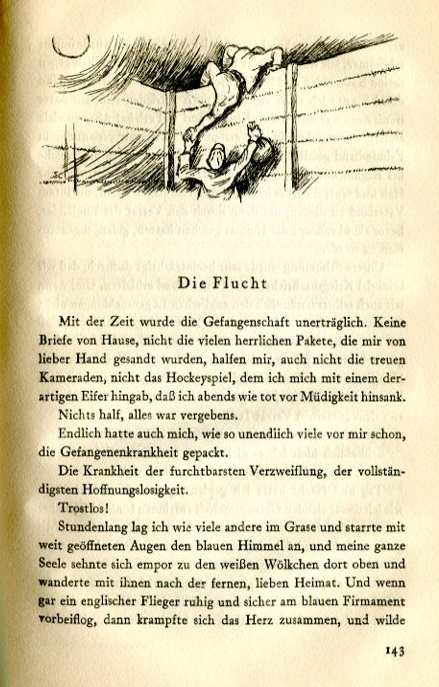
Escape

In time imprisonment became unbearable. No letters from home, no marvelous packages sent to me by loving hands arrived to help me. Even loyal comrades and hockey games which used to impart enthusiasm and leave me dead tired in the evening didn't help.

Nothing helped. Everything was useless.

In the end I was gripped by prison fever like so many people before me.

Symptoms of the illness included dreadful despondency and a total feeling of helplessness.

So forlorn!

Like many I laid in the grass for hours, staring wide-eyes at the blue sky, my soul reaching up to the white clouds where I travelled with them to my far-away, beloved homeland. Whenever an English plane quietly soared above my heart clenched and


raw, grieving longing shook me. Circumstances progressively got worse. I became aggitated and nervous and unfriendly towards my conrades. My soul and my body sank low. I could have found consolation in the fact that I had done things and had experienced so much! So many others had been wounded and had fallen into enemy hands in the first days of battle. The unluckiest were those who left America at the beginning of the war, had left all their possessions and livelihoods in order to serve the fatherland, and then had been treacherously imprisoned by the English before they got to see the homeland.

Our moods were compromised because we received few reports about the war from Germany. Even though we put no faith in the deceiving English reports they still had an affect on us since week in and week out all we read about were the losses, the revolts, and the famine occuring in Germany. The uncertainty was the worst part and this was especially true from the Italian reports.

The victories in the English newspapers!

I couldn't hold out any longer! Something had to be done if I didn't want to become totally despondent.

Day and night I planned, I weighed, I considered how to escape from this miserable prison. I devised, then rejected, plan afer plan. Something had to be committed to quietly and strategically if success was to occur.

For hours I strode past the various sides of the barrier and inconspicuously examined each section of wire and posts. Feigning sleep, I laid in the grass for hours near


various positions I thought might be favorable. I paid close attention to each individual object and the habits of the individual guards.

I determined where I wanted to go over the barbed wire. Now I had to figure out how to proceed in order to overcome the barrier. We did not have any maps of England, compasses, timetables or even tools. Plus the location of Donington Hall was completely unknown to us. I knew the way from Donington Castle since I paid attention on the march over. From an officer who travelled from Donington Castle to Derby I learned Derby was approximately twenty-five to thirty kilometers north and before entering the village the car had to cross over a bridge. I befriended a stuffy, old English soldier. Occasionally I gave him some cigarettes and I invited him to a glass of beer at the cantine. After sitting together several times I told him it must be very boring constantly sitting in Donington when he had no diversions. Oh yes, he intimated. He bicycled back and forth and sometimes he took the bike to the cinema in Derby.

"What, Derby?" I asked. "That's much too far away for you, and you're far too old!"

"Me too old? No, Sir! You don't know Englishmen well at all. When I sit on a bicycle I feel like a youngster again. I can cover the stretch to Derby in three to four hours."

On this day I had learned enough. Over the next week I met my old friend once more. We greeted each other, and I pressed a couple cigarettes in his hand. Despite the fact that I don't smoke I carried them with me.


"Hey, tell me, Tommy," I suddenly began, "Yesterday I made a bet with a comrade. I said Derby is north of us and my comrade maintains that it lies to the south. If I win, you get a full crock of beer."

My friend's whiskey eyes glistened with happiness and he assured me with his solemn word that I was right and that Derby was indeed north of Donngton Hall.

Now everything was clear to me.

I decided to share the plan with one of my Marine comrades, Junior Lieutenant Trefftz, who spoke excellent English and knew England well.

Our flight was schedule for July fourth, nineteen hundred fifteen. Everything was practiced and worked out and all preparations were made.

Early on the fourth of July Trefftz and I reported ourselves sick.

During early inspection at ten o'clock when our names were called "sick" was the response. After inspection the watch sergeant came to our quarters and found us sick in our beds.

Everything was beautifully in order.

The afternoon and the moment of decision quickly followed.

At four o'clock I got dressed, packed everything I thought was necessary for my escape, ate a couple slices of bread and butter, then said goodbye to my roommates and particularly my true friend Siebel who couldn't come along because he wasn't a navy man and he spoke no English.

Outside there was a powerful storm and rain burst forth from the clouds. The guards were drenched and shivering in their little guardhouse. Nothing was going on except for two officers who desired a stroll in the park despite the rain.


There was a grotto surrounded by bushes in the park from which one could see the entire park and the barbed wire fence but from which one could not be seen.

Trefftz and I crawled into it.

Another brief goodbye to S. who covered us with garden benches, then we were all alone.

Now only Providence and good luck could save us.

We waited in breathless anticipation. Minutes lasted an eternity. Slowly and surely one hour sounded after the other. When the tower clock loudly chimed six o'clock our hearts beat strongly. As the bell for inspection sounded we heard the command "Attention," then the loud clanging as the wire fence closed off the perimeter. We anxiously awaited each quarter hour. We scarcely dared to breathe. We expected our names to be called at any moment. Six-thirty and nothing happened. A knot the size of the an Alp dislodged from our hearts. Thank God, the first part of the plan was successful! Upon inspection "sick" was announced when our names were called, then the officers were allowed to disperse. One comrade for me and another for Trefftz ran back to the barracks and laid in our beds. When the field sergeant arrived he could safely attest to the fact that both sick men were present. Everything was in order so like every other evening the night fences were closed, the guards left the day barriers, and we were left to ourselves. The heavy rain served us well since English soldiers usually strolled in our park at night. Otherwise it would have been easy to discover us.


Hour followed hour. We laid there quietly, merely turning to each other occasionally and noding with joy that everything so far had gone as planned.

Around ten thirty our excitement reached it peak. Two tests must be passed. We clearly heard the signal for bedtime and from the open window of my former quarters loudly echoed "The Watch on the Rhine." That was the sign to us that everyone would be at their posts.

The Watch officer with a sergeant came into the quarters and convinced themselves that no one was missing. Through weeklong observations I established that the watch officers always chose the same path in order to get to their own quarters in the shortest distance possible. And so it was tonight. Rounds started in the room where Trefftz was missing. Naturally someone else was laying in that bed.

"All present?"

"Yes, Sir!"

"All right, good night, gentlemen!"

And so the rounds continued. They were scarecly around the corner when the two other comrades went in separate directions and ran to my room so, of course, everyone was "present" there too.

One can scarcely imaging the excitement and tense anticipation we experienced during this time. Our minds considered all possibilities and as time stood still we began to fear that all was lost. We laid there with ice-cold hands, bated breath, and hearing stretched to the limits.

Finally at eleven that night a loud cheer rang out. This was our signal that everything went well.


Go to pages 149 - 180

Return to Index


Imaging and translation by Susan Kriegbaum-Hanks