The Adventures of the Pilot from Tsingtau -Pages 20- 26


Magnificent Days in Tsingtau

Many days on the railroad line through the Russian Steppes and deserts and onto the final destination, the Far East.

Finally Mukden!

Peking was quickly passed by...Tsinanfou!

The first German sounds chimed, then came the final ten hours of railroad travel through wonderfully thriving farmland full of gardens, fields and flowers, and finally the train pulled into the main railway station at Tsingtau.

I only saw Tsingtau again six years later!

Once again I was on German soil in a German city in the far east.

My comrades collected me. The fast clip-clopping of small Mongolian Steppe horses carried me to my new homeland.

First we went to Iltisplatz, which was to be our racetrack and at the same time my air field. The district was festively decorated and all of Tsingtau was assembled here.
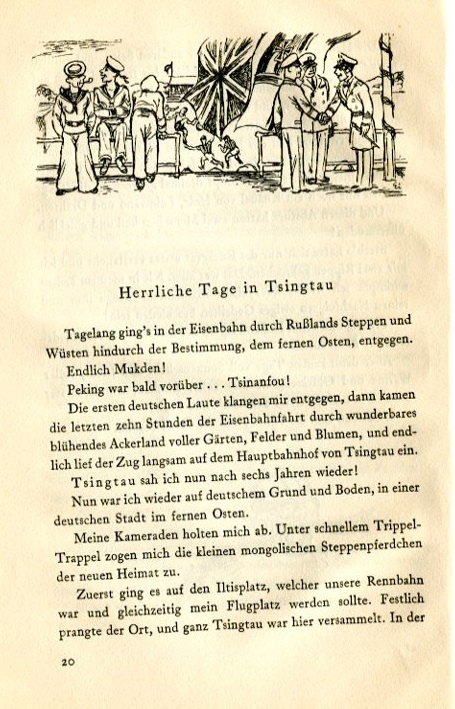
In the middle of wide grassy space there was an incredible number of onlookers at the football field. Today was a holiday and a large football tournament was held between the German sailors and their English comrades from the English flagship "Good Hope."

"Good Hope" was visiting Tsingtau. It was a magnificent game ending in a 1-1 tie.

Who would have thought it at the time! Almost six months later these opponents again faced each other but this time it was a serious and frightful game in which there was only victory or death. It was at the sea battle of Coronel in which the German blue jackets sent the English flagship "Good Hope" to the dreadful depths of the Pacific Ocean in 27 minutes.

But today no one knew about future events and people moved about happily in comradery uniting German sailors with their English guests. Two days later the English squadron sailed away and shortly thereafter our Kreuzer squadron under the direction of Admiral Graf von Spee departed.

Lustfully flags fluttered in the wind delivering the signal in semaphor between the two squadron chiefs: "Live well. Hope to see you again!"

Who could have guessed it would happen in Coronel.

Shortly after my arrival and after reporting for duty I looked for my airplane and hoped that in the following days I would see the wonders of Tsingtau in my giant bird. But now mealtime! I would quietly wait for a few weeks because my airplane was sailing brightly around the Indian Ocean and the steamship wasn't due until July.

Then without you, dear old girl, I said. Now I had plenty of time to look around Tsingtau and find housing.


A charming little villa near my airfield was free and I quickly rented it. I moved into my lovely new home with my new comrade, Patzig.

Everything I needed to feel content was at hand. My beautiful new command, the country command for the Marines. I was in Tsingtau, a paradise on earth, and my military duties were the best I could have wished for. Plus this beautiful villa, situated high on a hill, with a wonderful view of Iltisplatz and the wide, deep, blue sea. Besides which I belonged to a mounted troop and three wonderful years stretched out before me. Who could be happier or more content that I?

Now to the interior decor of the residence. I had a full complement of pictures on home decorating from Kunst Magazine. With these I went to our capable Chinese cabinet maker and ordered furnishings. It's almost astonishing the degree of skill the Chinese possess to make anything and they do so in an incredibily short time and quite cheaply. Four weeks later everything arrived. The furniture was placed in just the right spots and from top to bottom the house sparkled and shined. Then we moved into our new home and felt pride and joy as new villa owners. Nothing was missing, especially with the ample number servants available. This is how the European gains respect from the Chinese; he surrounds himself with lots of Chinese servants and it is practically the moral duty of Europeans to do so.

Moritz, the cook, in his blue silk Ischang; Fritz, the Mafu (stableboy), always smirking but very careful with the welfare of the horses; Max, the gardener, lazy to a faulty; and finally August, the sassy little errand boy, comprise the army of our service staff.


In addition, "Mr." Dorsch and "Mr. Simon arrived.

These two "Misters" were our orderlies, Europeans who by custom in the Far East may not perform physical tasks in the presence of the Chinese.

A large garden surrounded our house. In it the horse barn with a carriage house, a car garage and the Chinese quarters were located. But the most important thing was my chicken coop. Two days after my arrival I purchased a brooding hen, placed a dozen eggs beneath her and when I moved into the house I already had seven newly hatched chicks.

Poultry is cheap in China. The hen cost ten Pfennig. A duck or goose costs a Mark. I soon had a poultry farm of fifteen birds.

Yes, correct. I had indeed become a horseman! So I bought a horse! One of my comrades had a cute little chestnut. We made an agreement and soon after "Fips" stood in my barn. "Fips" was a charming creature, a good service horse, perfectly suited for the hunt or polo. But he still got the military jacket when I saw him again. On the day before the lockdown during the siege the buggers had me in a bind as I rode on the border. Some schrapnel exploded near the horse. He broke loose and ran over towards the enemy.

Life in East Asia is very monotonous for Europeans. Little social life, even less theater, no music, and none of the things one so sorely misses. The only benefit and consolation is that one can live somewhat better when it comes to householding and equestrian sports. The later flourishes quite well in Tsingtau.

I dedicated myself enthusiastically to polo


and after I had gotten somewhat used to the unusual gait and stepping pattern things went well.

By the middle of July my yearning was stilled. The steamship arrived and it had transported the planes. The giant containers barely made it to the dock when my crew and I arrived. The poor birds, born to soar through the air in the sunshine, were freed from the dark prison in which they had spent months. Since the containers were too heavy, the planes had to be unpacked right here and now. Hei! meaning hello among the Chinese gawkers. When everything was unpacked the parade of triumph was arranged. First came the two airplanes, then three wagons with wings and two wagons filled with accessories and parts. The horses pulled and we proudly crossed Tsingtau, moving in triumph to the hangar at Iltisplatz.

No rest from that day on. Day and night we worked on assembly and bracing. Two days later, quite early in the morning, as no one still could have anticipated, my airplane stood ready for takeoff . As the sun rose I gave it full gas and shot up into the wonderful pure sea air.

I will never forget the first flight in Tsingtau. The airfield was extraordinarily small, only six hundred meters long and two hundred meters side, full of obstacles and surrounded by hills and rocks. Just how small the field was and how incredibly difficult it was to takeoff and land I soon learned. My friend Clobuczar, a former Austrian flight officer who was now on the "Kaiserin Elisabeth" said to me once, "This is an airfield? At most it's a children's playground! In my entire life I've never seen how a man could fly in such a place." I felt a similar sentiment. And in Germany


I would only search out such a place for an emergency landing.

But there was nothing to be done about it. It was the only flat area in the entire reserve. Everywhere else there were jagged mountain peaks run through with deep ravines. But on this wonderfully sunny morning I didn't worry about it and moved by happiness I circled Tsingtau while the roar of my engine shocked the citizens of Tsingtau out of their slumber. As I started to land I felt rather giddy! By thunder, the place was small! Involuntarily I turned in ever wider circles and delayed the critical moment for landing.

But I couldn't stay up there forever. Eventually I gathered my courage, reduced the gas and a moment later set down on the field in a flawless landing. Now I was sure of myself. I scarcely left my plane the entire morning.

But now it was back to work. The second airplane, also a Rumpler Taube, which supposedly had been flown by my comrade from Sea Batallion, Lieutenant Müllerkowski, had to be assembled and braced. After two days, on the afternoon of the thirty-first of July, nineteen hundred fourteen, the plane was finished.

Müllerskowski got into his plane and after I had given him some observations about this airfield he gave it full gas and soared off.

But luck did not remain true to my comrade.

His airplane was in the air for only a few seconds when it found itself in dire straits about fifty meters off the ground. He was at the point where airfield and landfall ended and steep cliffs fell down to the sea when the plane suddenly canted to one side


and in horror we could see it sweep down nose first into the rocks.

We rushed as quickly as we could to the accident sight. It looked bad. The plane was completely shattered and Müllerskowski laid amid the wreckage. Severely injured, we brought him to the hospital where he remained until shortly before the end of the siege. The plane was destroyed.

In the interim a lot of events unfolded in Tsingtau. July entered the land with all its beauty and splendor, with marvelous sunshine and deep blue skies. It is Tsingtau's most beautiful month.

Swimming season was in full bloom. There was an exceptional number of fine foreigners, predominantly female, who came in from the European and American settlements in China and Japan in order to bask in Tsingtau's beauty and enjoy the bathing in the "East End of the Far East."

The mood was splendid. Auto and horse-riding parties, polo games and tennis filled service-free hours. Especially fine were the evening gatherings where Terpsichore received full honors.

As in earlier years English ladies were most frequent among the guests and delightful conversation soon developed.

In the beginning of August a polo match was supposed to take place and we were invited to play against the English polo club in Shanghai.

However, on the thirtieth of July like a bolt of lightning from a heated sky came the command to "secure quarters" in Tsingtau.


Go to pages 27 - 44

Return to Index


Imaging and translation by Susan Kriegbaum-Hanks