The Adventures of the Pilot from Tsingtau -Pages 83 - 102


Mr. McGarvin's Fish Poisoning

I went to the Mandarin that evening. As I came through the door the entire courtyard glistened with torches and innumerable large lamps. The watchmen entered and presented arms. The drums thumped and the musicians played tingling music only acceptable to the Chinese ear. Yes, the Mandarin even sent me his own palanquin.

I will never forget this evening.

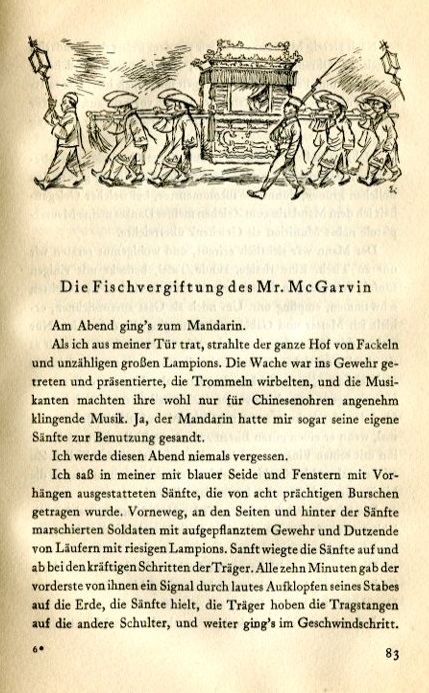
I sat in my portable chair covered in blue silk with curtained windows, which was carried by eight splendidly dressed young men. Before, to the sides and behind marched soldiers with rifles and dozens of runners carried giant lanterns. The palanquin gently swayed back and forth in time to the strong steps of the bearers. Every ten minutes the foremost soldier gave a signal by hitting his staff on the ground. The palanquin stopped, the bearers raised the carrying poles onto the other shoulder and they went on farther at a swift pace.
After forty minutes we reached the Mandarin's palace. Ear shattering music, command shouts and bright lamp and torch lights also greeted me here. The middle doors of the giant gates flew open before me and the Manadarin himself came to me in front of the last gate.

Many high-placed personages and a few generals were already assembled and after the ceremonial greeting there was the usual green, weak welcome tea, at which time I gave the Mandarin my Mauser pistol along with some ammunition as a sign of my gratitude.

The man was visibly pleased and we sat amicably down to dinner. It was a giant, round table covered with about fifty bowls in which large, Chinese tasty tidbits swam. To distinguish myself as a guest I took out a knife and fork and went to work. I only counted the first thirty-six courses. And what were all these? The tenderest swallow's nest to the finest shark fin, sugarcane salad to the most delicious chicken ragout would never be forgotten. I had to taste each one. And the Mandarin never tired of handing them to me. Sometimes when he had a fine morsel on his plate he took it in his fingers and laid it on my plate. There were glasses of beer to drink, which had somehow made their way to this region, and rice schnapps.

Once again Mr. Morgan did the hardest work interpreting the lively and often comic conversation.

The battle for Tsingtau, the damage done by the Japanese and English, and aviation interested the Chinese the most. There was no end to the questions.

With heartfelt sincerity and gratitude I took leave of the


Mandarin. The next day I had to say goodbye to my good host.

When I had landed all I had was some toothpaste, a piece of soap and my flight uniform, a smoking jacket with sash and slacks. I also had a civilian suit in my plane. I now put on this suit. The five-year-old daughter of the missionary sent me her old, shabby felt hat as a replacement for my sports cap which had been stolen by a Chinaman while I disassembled my plane. Towards evening I was again escorted with ceremony to the junk the Mandarin had placed at my disposal.

My escort and honor guard for the coming journey consisted of the Chinese General Liu, who had made a name for himself as a pirate fighter, two officers and twenty-five men plus the boat personnel. Drop-dead tired after all the activity I went to my small, wooden chamber, where to my surprise and joy I found a magnificent sleeping bag with blanket and mattress rather than a wooden plank bed. It had been brought on board for me by the caring wife of the missionary. Without these articles things would have gone badly for me in my thin sports suit. It was fiercely cold and the wind whistled through the big gaps and holes. I could see the starry sky through the roof.

My thoughts were far to the north with my brave comrades in Tsingtau and I dwelled upon Tsingtau's fate. I also thought with gratitude about the better fate I had been dealt. I had survived unharmed through all the heavy fighting and danger in order to fulfill my mission right through to these last few days. Eventually sleep came and embraced me in its secure arms.


The journey proceeded slowly. The junk was pulled upstream from the harbor by two coolies with a line which was secured above on the mast. The first stretch to Bampu, which I could have reached by plane in twenty minutes, took a day and a half! Later things went better especially once the winds turned favorable and we could set sail. The trip lasted five full days to get from Hai-Dschou to Nanking.

The journey was extremely interesting for me. It went through a network of rivers to the old and famous Emperor Canal [Beijing–Hangzhou Grand Canal] and from here on the Yangtze to Nanking. We crossed into a region notorious for pirating and passed cities on which no European foot had even touched. On days when the junk had to be hauled I went with my general and half of the watch onto the river bank and saw some very interesting cities in which the bustling Chinese crowd had felt no touch of European culture. Chinese men, women and children ran out of their houses and crowded together in bright mobs to look at me in amazement. Most of the time I went about without a hat. Often individuals touched me as if to convince themselves that I really was a man.

My bright blond hair and blue eyes seemed to be a great mystery to them.

My strolls and my stay on the junk transpired mostly in silence. My dear general was dressed like a proper European but around the ankles of his trousers he tied the traditional Chinese ribbons and he sported a magnificently long braid down his back which was placed behind the belt of his jacket. Except for Chinese the good man didn't understand a word in any other language just as I understood no Chinese.


During our meals, which were opulant but tasting too strongly of onions and garlic, the two of us sat opposite each other in a small chamber of the junk. We smiled and everything was amicable but that was the extent of the social exchange.

Finally on the eleventh of November we reached Jang-Dschou-Fou. One can well image the eagerness with which I opened the first newspaper.

Full of excitement I finally found something about the fate of Tsingtau as I flew through the pages of the Shanghai Times There, on the second page, the name Tsingtau! But no, that was not possible but there was no other place in the world by that name!

Full of disgust and horror I read:

Tsingtau's Cowardly Surrender

The Stronghold Taken without a Sword being drawn.
The Entire Garrison drunken and plundering.

Then came so much scurrilous trash, so many lies that I threw away the newspaper in distain. How dare the English say such things about our brave defenders?

I no longer knew the English newspapers! Later in Shanghai and then in America when reading the American newspapers I had to learn to keep quiet about England.

At least I knew with some certainty about Tsingtau's unavoidable fate. I had not left the stronghold a moment too soon because a short time later they surrendered to superior forces.

On the afternoon of this, the eleventh of November, nineteen hundred fourteen we happily entered Nanking.

At the railroad station I received warm greetings from Lieutenant-Captain Brunner, the commander of Torpedo Boat S 90 and his officers.


We drove in a wagon to the building in which the officers and crew of S 90 were housed. To my great surprise a bunk was prepared for me. Curiously I asked my comrades many questions. They told me I'd be taken into custody but they'd all be happy because they'd have a fourth man for Scat. First thing I said out loud that I wouldn't be playing cards and then I thought about the question of internment and what it meant for me.

So I went to the palace of the governor of Nanking with my general. Unfortunately, or perhaps more fortunately for me, the governnor was not available. An old Chinese doctor received me amicably, wished me farewell and hoped I would be happy in Nanking.

I thanked him for his well wishes but I had my own thoughts about future happiness!

Then I took leave of General Liu, who seemed happy to have fulfilled his mission. As I climbed into my wagon a Chinese soldier in full uniform sat next to me.

Questioning what all this meant, he told me in passable German that he was my honor guard assigned to my protection and from now on he would accompany me everywhere.

Well that was a bit too much! It was against the agreement!

In Hai-Dschou I was expressly told that the journey to Nanking was just a formality and I would be completely at liberty afterwards.

So here they intended to take me prisoner?

I had to take care of this quickly before one of the Chinese said anything about internment and I was robbed of my freedom.


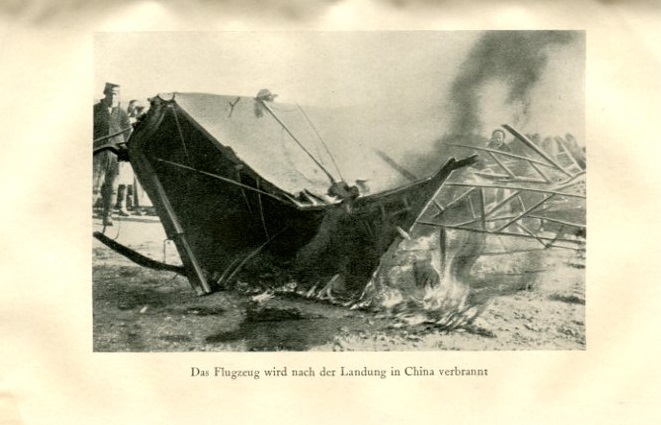
Caption under photograph reads: The airplane was set on fire after landing in China.


The nastiest part of this business was the "honor guard" but I had to find a way and means.

In the evening all the officers were invited to the home of a German acquaintance. My plan was set. After a few pleasant hours during which I would again have to talk about the last days of Tsingtau, around ten o'clock all the officers, except yours truly, would get up and leave to go home accompanied by their guards. Half an hour later would be the best time for me to disappear if I still wanted to escape.

As my host exited through the door who was standing right in front of him? My yellow watchman!

Now Holland was in trouble. I quickly decided to send our boy to the guard and have him ask what he was supposed to do here. The men were long gone. He should run and bring them back, otherwise he might be punished for his inattentiveness.

While the poor kid ran after the others with his tongue hanging out, a covered wagon drove by. I took a seat inside and with all haste it drove to the railway station where the newly opened express train stood ready. I just managed to grab the last free bed. The sleeper compartment was already locked and after vigorously knocking on the door a tall Englishman opened it. Because of the disturbance he wore an angry look. Naturally I ignored him and one, two, three, I was in the upper bunk. I turned off the light and acted as though I were taking off my clothes. In reality I buried myself deep under the covers and avowed firmly that if anyone wanted anything from me I simply wouldn't wake up. During that eight hour journey I didn't sleep a wink.

Whenever the D-Train stopped a chill ran up my spine and I thought: Now they're going to get you! And when there were loud voices outside


I was convinced that this would be my last D-Train ride in this war.

But nothing happened. Thank God the Chinese didn't yet know how to use the telegraph to issue a warrant and so, according to plan, the train rolled into Shanghai at seven o'clock. Now came the dangerous coastline cliffs but we got past them.

Then came a fast ride in a rickshah through the Chinese portion of the city in which the Chinese authorities still had power over me. Eventually my little two wheeler made it to the European side of the city.

Hurray, I was free!

What more could I want?

With elation I drove to a German acquaintance who hospitably took me in.

I stayed in the city three full weeks before with great effort I was able to continue my journey.

It was three full weeks full of adventure and full of risks of being recaptured and full of games of hide and seek.

What was more natural than the fact that Commander P. was not known and that Mr. Meyer, who had lived there for a while, had moved on? That a Mr. Scott had visited a good friend for a few days. This was of concern to no one. But I had to be careful, especially since I knew an extrordinarily large number of people in Shanghai, even some Englishmen, etc. who shortly before the war had been with me in Tsingtau.

I alternated between four or five names and alternated lodgings among my friends.

The Chinese could keep searching!

The most difficult thing was, how to get to America? I tried everything with no success. Once I almost set off in an English ship.


That was a funny situation. One of my friends knew the shipping company owner, an English Jew named Mr. Penny, quite well. I went with my friend one day to visit Mr. Penny and seek out my good fortune. I wore a plain suit and looked rather seedy, thus making a pathetic and downtrodden appearance. My friend had us announced and after a little while we appeared before the stern, fat, frog face of Mr. Penny. The two men seemed to know each other well and their greetings bore this out.

I humbly remained standing at the door, ashamedly looking at my tattered shoes and turning my hat around in my hands. Naturally I didn't understand a word of the conversation, which took place in English.

My friend began:
"Mr. Penny. I come here to ask a great favor of you. I have a rascal here with me whose father I know well and who has been a good business associate in the past. This lad, who is just seventeen years old, left his father because of a girl and signed on as a ship's hand. He arrived here penniless and has been stranded here with me because of his foolishness. I would like to send the boy, who by the way is Swiss and doesn't speak a word of English, back to Europe so I wanted to ask you if you would have a place on your steamer for a kitchen boy. Maybe then once and for all he'd give up his fancy ideas if he had to do hard work for an uncouth ship's captain."

Mr. Penny barely glanced my way the whole time except for an occasional scornful look at which time I made myself appear contrite. "Yes," he said, "I have just the man. This afternoon the steamship "Goliath" sails directly from here to San Francisco" (at which I pricked up my ears!)


"Now and again he'll deliver a sound thrashing but he won't injure him. I'll telephone him and let him know when the steamer sails. Six weeks of peeling potatoes will do the youngster good."

We were dismissed.

When we got outside I grabbed my friend's arm so hard he cried out in pain. As we finally got to the street I let go and burst out laughing so hard that people walking past me couldn't help but laugh along. It was a miracle that I could remain quiet during the entire scene. Unfortunately that afternoon I found out that the steamer had left two hours earlier due to the tide. It was all for nothing and I had to begin again. There were plenty of steamers leaving but the unfortunate thing was that they were all sailing to Japan first and staying there for several days.

I'd only dare to do that if it was absolutely necessary.

However luck did not leave me hanging. One day I ran into a friend with whom I had spent many amusing nights years ago traipsing around the far east. He was willing to help. A few days later he got me the necessary papers and explained various regulations. The former Mr. Scott, Mr. Brown, and Mr. Meyer suddenly became the wealthy, distinguished Englishman with the fine name of McGarvin. The man was a representative for Singer Sewing Machines traveling from Shanghai to his factory in California.

And it was only natural that Mr. McGarvin would take the next big American postal steamer.

On board this ship there were only two splendid luxury cabins. An American multi-millionaire resided in one; in the other resided Marine First Lieutenant Plüschow -- Oh, excuse me,


I meant to say Singer Sewing Machine factory representative McGarvin.

I had to overcome one more obstacle -- escaping Shanghai undetected.

Again my acquaintance helped me. Three days before the steamer departed I received offical permission to leave whereby I added that I no longer felt safe in Shanghai and would travel to Peking in order to gain employment with the German legation. In reality I rode in my wagon at eleven in the morning to the train station. How could I have known that the coachman would turn a few streets too soon and drive off at a fast trot to the south out of the city? How was I supposed to know anything about Shanghai?

After about two hours, during which time the wagon drove along the Wusung River, we stopped. Two man armed with revolvers approached the wagon. There was a brief conversation and a shaking of hands then I respectfully and gratefully kissed the thin white hands of two woman, who pulled me from the wagon and rushed us along our way. My two friends took me into their midst and I pulled out my revolver as we silently climbed aboard a junk anchored at the shore.

The night was pitch black, the wind howled and the dark, dirty water gurgled in a strange way as the tide pushed us along.

Four dark Chinese figures used all their strength to move the oars and after about an hour and four kilometers of rowing with the stream we reached our destination in the harbor.

Quietly we disembarked, quietly the junk disappeared, and just as quietly we walked towards a dark building which was in the middle of a small garden near a giant factory.


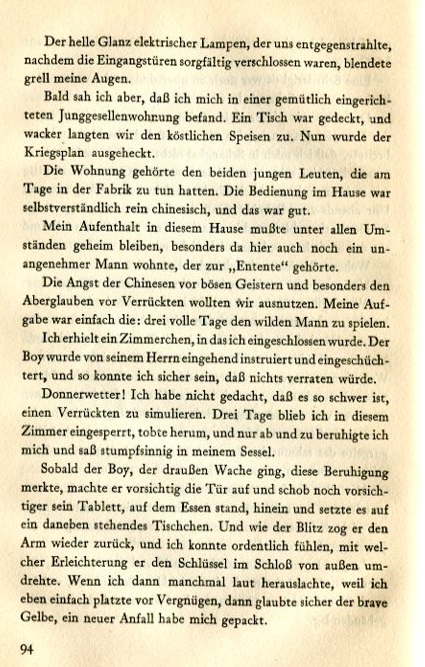
Once the entry door was carefully closed the bright glare of electic lamps blinded my vision but soon I recovered and I found myself in pleasantly furnished bachelor's quarters. The table was set and we eagerly helped ourselves to a delicious meal. Then we constructed our wartime plan.

The quarters belonged to the two young men who worked in the factory by day. Naturally the household servants were Chinese and that was a good thing.

Under all circumstances my stay in this house had to remain a secret especially since an unpleasant man also live here whose sympathies were for the other side.

We wanted to use the Chinese people's fear of evil spirits and especially their superstitions concerning madness. My assignment was simple: I was to play a wild man for three full days.

I stayed in a room that was locked. The master of the house continually instructed and intimidated his houseboy so I would be assured that nothing was revealed.

Wow, I never would have thought that it's so difficult to act like a crazy person. I stayed in this room for three days, blustered about and only quieted down every once in a while and sat mindlessly in my armchair.

As soon as the houseboy, who stood watch outside, noticed it was quiet he'd carefully open the door and reach in with a tray full of food and gingerly place it on a nearby table. Then just like lightning he'd jerk his arm back. I could feel his relief as he turned the key in the lock from the outside. If I then laughed out loud as though reanimated in satisfaction the brave yellow boy must have believed that I was in the throes of another fit.


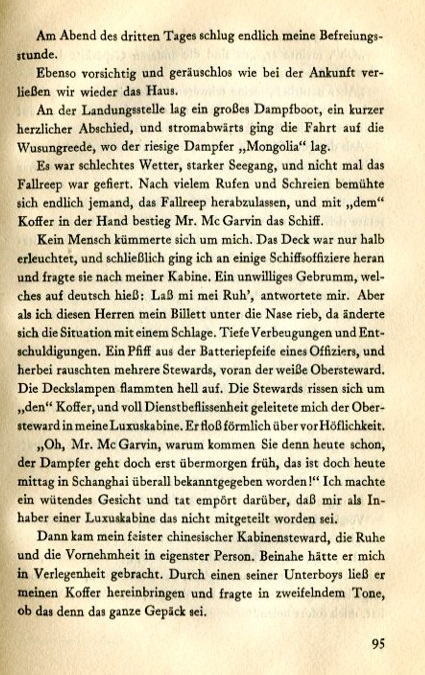
The hour of my liberation finally came on the evening of the third day.

We left the house as carefully and quietly as we had upon our arrival.

A large steamboat sat at the landing. After brief and heartfelt farewells I sailed with the tide on the Wusung Reed where we met the giant steamer, the "Mongolia."

The weather was bad, the seas were rough, and the accommodation ladder wasn't yet hoisted. After many cries and shouts someone finally took the trouble to set it down so that with suitcase in hand Mr. McGarvin boarded the ship.

No one bothered to help me. The deck was only half lit and finally I found one of the ship's officers and asked him where my cabin was. A reluctant hum answered me, which means in German, "Leave me alone." However once I waved my ticket under the man's nose the situation abruptly changed. Deep bows and apologies. A blow on an officer's whistle and out rushed several stewards, at the head of which was the white head steward. The deck lights were turned up. The stewards rushed to grab the one suitcase I had. The head steward in full first-class service mode led me to my luxury cabin. He flowed over with hospitality.

"Oh, Mr. McGarvin, why did you come so soon? The steamer doesn't depart until early the day after tomorrow. That was known all over Shanghai today!" I drew an angry grimace and asserted that as the guest in a luxury cabin this information was not passed on to me.

Then my plump Chinese cabin steward arrived, peace and nobility personified. He practically made me feel uncomfortable. He had my suitcase brought up by one of the cabin boys and then asked in a quizzical tone if that was all my luggage.


"Yes," I said.

"Oh," he replied. Are all your other pieces of luggage already in the cargo hold?"

"But of course. My heavy bags were loaded yesterday, and I certainly hope that the cargo master pays attention to my valuable trunk."

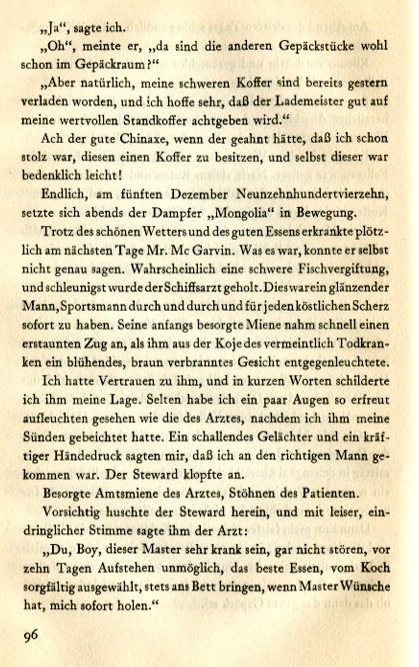
Oh, that good little Chinaman. If only he had known how proud I was to have this one suitcase even though it was quite light!

Finally, on the fifth of December nineteen fourteen, the steamship "Mongolia" set off in the evening.

Despite the beautiful weather and the good food Mr. McGarvin suddenly became ill the next day. He couldn't say for sure what caused it. Probably a serious case of fish poisoning. The ship's doctor was called at once. He was a splendid chap, a sportsman through and through and immediately ready for any fine source of amusement. His initial, worried expression quickly turned to astonishment as a flushed, sunburnt face beamed out at him from the bunk of the supposedly close-to-death patient.

I trusted him and in a few words I explained my situation to him. I've seldom seen a pair of eyes light up with such mirth as this doctor's as soon as I confessed my sins. Echoing laughter and a solid handshake told me that I had come upon an honest man. The steward knocked.

Concerned look on the doctor's face and moaning from the patient.

The steward quietly entered. In a soft but firm voice the doctor advised him:
"You, boy. His Master is very sick and must not be disturbed. It's possible he could be up in ten days. Bring him the best food carefully chosen by the cook. Bring it right to his bedside. And whenever he wishes, call me immediately."


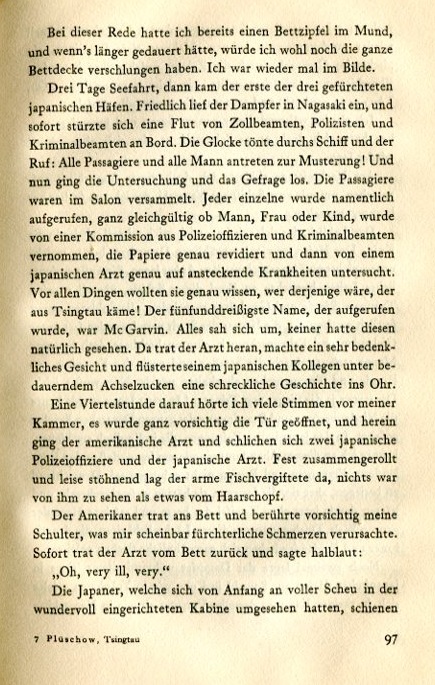
During these instructions I kept the corner of the blanket in my mouth. If it had taken much longer I would have devoured the entire thing. Once again I was on my way.

A three day sea journey, then the first of three feared Japanese ports. The steamer peacefully sailed into Nagasaki and there was an immediate flood of tariff agents, police and detectives on board. The loud speaker issued the call throughout the ship: All passengers and crew report for inspection! Questions and inspections ensued. Passengers were assembled in the salon. Each passenger was called by name, whether man, woman or child by a commissioner from either the police or detective ranks. Papers were scrutinized and a Japanese physician tested for contagious diseases.

Most importantly they wanted to know if anyone came from Tsingtau! The thirty-fifth name to be called was Mr. McGarvin's. Everyone looked around but naturally no one was found. The doctor came in wearing a concerned expression and whispered something dreadful into his Japanese colleague's ear.

A quarter of an hour later I heard several voices outside my cabin. The door gently opened and the American doctor entered along with two Japanese police officers and the Japanese doctor. The poor fish poisoned victim moaned as he laid all wrapped up so that only his hair showed.

The American approached the bed and carefully touched my shoulder, which I pretended caused me terrible pain. The doctor immediately stepped away from the bed and said half out loud:
"Oh, very ill, very."

The Japanese, who from the start of entering the well-furnished cabin, were full of dread and seemed happy to leave this unusual environment as quickly as they could.


Lots of deep bows, hissing noises through the teeth, which are supposed to signify deference, and a softly murmured "Oh, I beg your pardon!" then out went the entire yellow peril.

I believe that during this entire scene and especially the time beforehand I experienced chills up my spine, which quickly subsided.

In the afternoon I dared to get up for a moment in order to look out from the ship to the Nagasaki I had once known.

The view which greeted me forced me quickly back to my bunk. The harbor was packed with countless steamers which laid at anchor below richly decorated flags. An extreme level of activity prevailed onboard this ship. Troops, horses and weaponry were being loaded all over. All the soldiers were festively attired. The houses in the city practically disappeared under the garland and banners. Streams of people moved through the streets and along the parade and troop routes. Now I knew for sure. These were the victors over Tsingtau! Today throughout Japan they celebrated the surrender and defeat of the German Empire. This evening in the Japanese newspapers which were also published in English I could read, among other things, that the English, French and Russians had not succeeded in winning over Germany but they, the Japanese, could have brought the war to an end and without a doubt they had the best and strongest army in the world. Enough of this nonsense, the Americans and English have accomplished much the same.

Twice during this day the steamer entered Japanese ports. The same scene as I witnessed in Nagasaki played out in Kobe and Yokohama.


Mr. McGarvin remained sick and unmolested. We spent five whole days in Japan. Finally, after I had spent eight days in bed during which time I lacked for nothing but the supposed illness, we departed the dangerous waters. As the Japanese coastline disappeared into the horizon a young man sprung up onto the deck of the steamer. He was insanely joyful as we waved his little hat, which at one time had belonged to a five-year-old girl in far off China. He turned in the direction of Japan, smiled and called out, "Good bye, Japs, good bye, Japs!"

With all the forms of entertainment that are conducted on such large steamers the days flew by. There were many German men onboard whom the war had driven from their most recent homeland. One of these was a comrade who until now still had business in Shanghai. The other was a war acquaintance, the American reporter Mr. Brace, who was the only foreigner to stay during the siege of Tsingtau.

Neptune brought change. Shortly before reaching Honolulu we sailed right into a typhoon, which last two days and put the steamer in serious danger.

As we reached Honolulu in sparkling sunshine, I could scarcely believe my eyes. Straight ahead a German war flag waved. There was no doubt about it!

Then we weighed anchor next to it. What looked like a little nut shell was the cruiser "Geier," which we later discovered had sailed the South Seas for many months until it was hauled here and impounded. What a strange coincidence! Beloved comrades, from whom I hadn't heard in a long time, were right here with me in the middle of the war, far from home and filled with great adventures. We had a question and answer session for which no end was in sight.


At the outbreak of the war the Geier was far away in the South Pacific among the coral islands. The crew learned about the mobilization in Russia but then the radio telegraph system broke in two. The Geier sailed around the Pacific Ocean without receiving any reports. It was fourteen days later that the Geier learned of the war with the English and still later before it found out about Japan. That meant they had to be careful. Despite being surrounded and pursued by the enemy the cruiser managed to sail for a week before being towed by a small steamer the thousands of nautical miles to Honolulu. When the crew of a large Japanese cruiser sailing from Honolulu was rubbing the sleep out of its eyes and lurking about, the little nutshell of a ship was well secured in the harbor with its flag proudly waving from the mast. The yellow men had to run for home with their tails between their legs.

After the departure from Honolulu I had a serious axe to grind with my war correspondent. Beaming with joy he brought me the Honolulu Times and proudly showed me the first page. In giant letters stood my name, my rank, and my background information. Underneath was a column-length article telling about all my outrageous actions before and after the siege of Tsingtau.

How typically American: after what was stated in the paper I would be prejudged.

This was especially painful for me because I had every reason to fear that the American authorities would arrest me in San Francisco. All the Americans on board reassured me that I would remain completely unmolested because what I had done would be considered "good sport" in the American sense of the word. In contrast, the average American would be extremely pleased if


I were to be sensible, forget my foolish German officer sentiments, and thus earn a proper salary in America. If I were to go to the right newspaper and have them advertise for me, then I could travel from city to city, hold lectures, perhaps even with musical accompaniment, and take home plenty of dollars. Ah, such as spiritual people, the Americans! One of these gentlemen, who was famous and amicable and had a charming daughter on board with him, came over one day and pulled me over to the side and spoke with full earnestness:

"You see, Mr. Garvin. I like you and have your best interests at heart. How do you want to start? You probably don't have any money and you don't know anyone in America and a good job is hard to come by!"

"I just want to return to Germany and fight for my fatherland. I'm still an officer!"

A pitying smile crossed his face.

Then he said, "Leaving America is out of the question as are your faith and dedication in honor. But believe me, I have good connections. In a few months Germany will be no more. Then there'll be no work and no place for you to go. England will not permit any German officers after the war. They'll all be expelled, the German empire will be broken up and the German Kaiser will be ousted by his own people. So be reasonable and seek out a new homeland. Stay in America. I will gladly help you."

It was too much for me. I gave the gentleman an answer and some instruction on who a German officer is and how things really are in Germany.


With that the good man himself praised Germany. From then on he was much friendlier towards me and afterwards I was often his guest in San Francisco and New York.

On the thirtieth of December we arrived in San Francisco.

It was a typical American affair.

Dozens of newpaper reporters and photographers ran around the deck, came into the salons, and wouldn't even leave people alone in their cabins. These fellows even got wind of me. They buzzed around on all sides, sniffing around every corner. It was just ridiculous. Finally I did the only thing that would help. I rudely shouted "I have absolutely nothing to say and if you bother me again I'll call the police!" My war correspondent from Tsingtau had instructed me to deal with his colleagues this way.

Only one slippery yellow Japanese man snuck up on me like a cat, bowed deeply, hissed through his teeth, and said with a fake smile that he came from the Japanese Consulate (that's all I needed!) to say hello and congratulate me for getting out of Tsingtau. I might have nothing to fear because I was on American soil but he would be frightfully happy to send a small notice to his newspaper in Japan, which would make his Japanese brethren happy.

I had the Chinese steward escort the yellow Jap off the boat.


Go to pages 103 - 112

Return to Index


Imaging and translation by Susan Kriegbaum-Hanks