History of the German Associations - March 1932
|
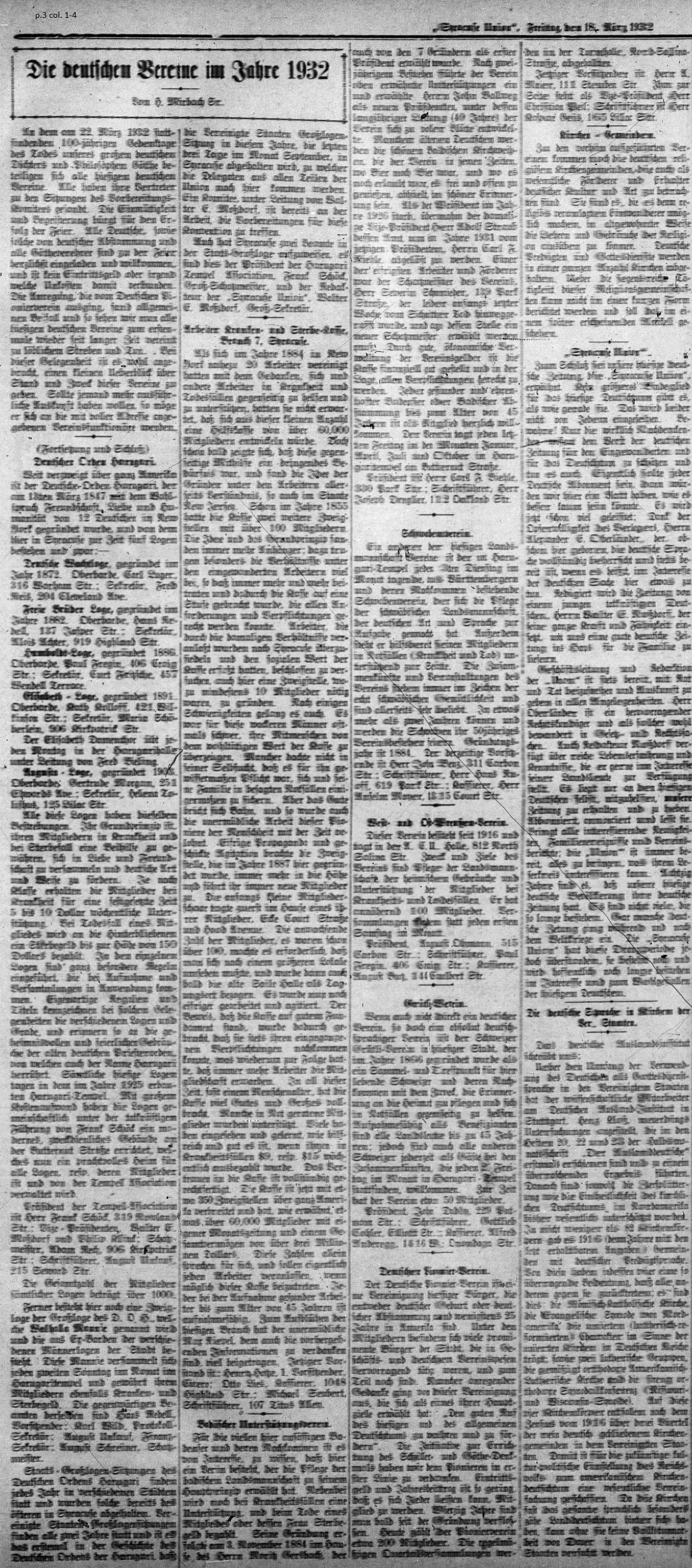
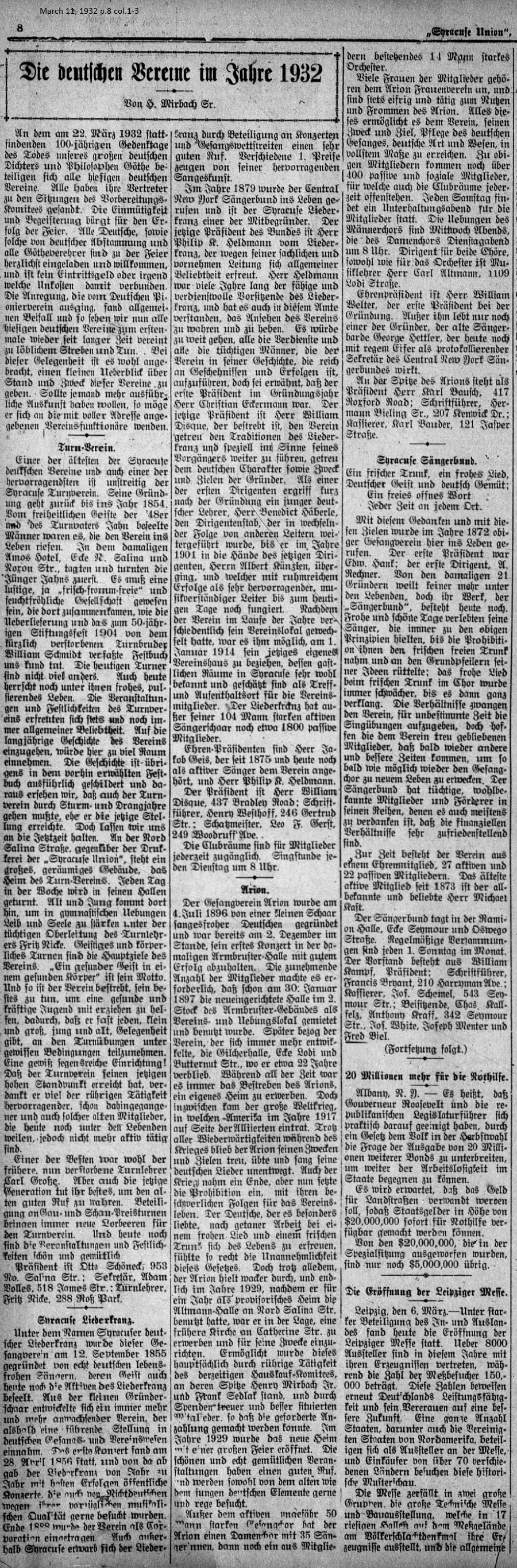
March 11, 1932 page 8 _____ By H. Mirbach Sr. On the 22nd of March 1932 all the local German associations commemorated the 100th Anniversary of the death of our great German poet and philosopher Goethe. Everyone sent representatives to the meeting of the Preparations Committee. Unity and enthusiasm guaranteed successful outcome for the celebration. All those of German abstraction and all devotees of Goethe were cordially invited and welcomed to the event, for which there were no entry fees or hidden costs. The German Pioneer Society provided the initial impetus for the event and the idea received public approval, and thus we saw for the first time in a very long while all the local German organizations united in praiseworthy effort and action. This provided an opportunity to take a small look at the structure and goals of these organizations. Should anyone wish more detailed information he should request it from the organization's officers at the addresses listed at the end of each section. The Turn Verein (Gymnastics Association) The Syracuse Turnverein is one of the oldest and undoubtedly one of the finest Gernan associations. Its establishment goes back to the year 1854. Men inspired by the free spirits of 1848 and the father of gymnastics, Friedrich Ludwig Jahn, brought the association to life. Disciples of Jahn met and exercised at the Amos Hotel on the corner of N. Salina and Noxon St. It must have been a happy, lively, devoted, free and sweat-loving group who came together there, as we are informed by recently deceased Turnbrother William Schmidt, who wrote about it in the 50th Anniversary Commemorative Book in 1904. Todays Turners are no different. They still live a happy, pulsating life. The meetings and events of the Gymnastics Association are always popular and delightful. It would take too much room here to give a yearly history of the organization. That history is already completely laid out in the festival book, and we see that the Turners went through years of storm and stress before achieving its current status. So let's take a look at it now. The large, spacious building which is the home of the Turn Verein, is located on North Salina St. opposite the printing office of the Syracuse Union. Gymnastics are performed every day in its halls. Old and young go there to receive gymnastics instruction in order to strengthen body and mind under the capable supervision of gymnastics instructor Fritz Nicke. Spiritual and physical gymnastics are the association's main goal. "A healthy mind and a healthy body" is its motto. And so the association does its best to help nurture healthy and strong youngsters and give just about everyone — small and large, young and old — the opportunity to participate in gymnastic exercises under specific circumstances. It's certainly an enriching institution! Now that the Turn Verein has achieved its current status, it wishes to thank the past efforts of many excellent old members, who are still among the living yet not longer active. One of the best was former gymnastics teacher, now deceased, Carl Grosse. And the current generation does its best to preserve the organization's reputation. Participation in regional gymnastics contests and exhibitions always brings new laurel wreaths to the Turn Verein. And today the meetings and festivities are still beautiful and pleasant. The President is Otto Schönecke, 953 No. Salina St,; Secretary, Adam Bolles, 518 James St.; Gymnastics Instructor, Fritz Nicke, 288 Ross Park. The Syracuse Liederkranz Among the names of Syracuse's singing societies the Syracuse Liederkranz (Circle of Songs) was established on September 12, 1855 by merry German singers whose spirit still infuses the activities of the society today. From a tiny group of members it grew larger and larger to become an organization which soon took a leading position among German singing societies. The first concert was held on April 28, 1856 and from there on the Liederkranz successfully performed yearly concerts, which were also attended by non-Germans due to their excellent musical quality. At the end of 1888 the association incorporated. Even outside of Syracuse the Liederkranz had a fine reputation due to its participation at concerts and singing contests. In 1879 the Central New York Sängerbund (Singing Federation) was called to life and the Syracuse Liederkranz was one of the cofounders. The current president of the federation is Philip K. Heldmann of the Liederkranz, who enjoys overall popularity due to his objective and effective leadership. For many years Mr. Heldmann was the capable and commendable chairman of the Liederkranz and even in this office he understood how to preserve and raise the society's prestige. It would be too lengthy to list all the capable men who contributed to its rich history of events and victories, but let us mention that the first president in the year of its establishment was Mr. Christian Eckermann. The current president it Mr. William Disque, who strives to maintain the society's traditions as set by his predecessors along with its true German character and the original intent of its founders. Shortly after its founding a young German teacher, Mr. Benedict Häberle, took the conductor's baton, which then went to others until the year 1901 when its current conductor, Mr. Albert Künzlen, successfully took over as a very musically talented leader. After changing locations several times over the course of the years, on January 1, 1914 it acquired its own home known in Syracuse for its hospitable rooms and treasured as a meeting and layover point for society members. Along with its 104 vigorously active men there are around 1800 inactive members. Honorary presidents are Mr. Jakob Geis, who since 1875 and still today belongs to the society as an active singer, and Mr. Philip Heldmann. The President is Mr. William Disque, 437 Bradley Rd.; Secretary, Henry Westhoff, 246 Gertrud St.; Treasurer, Leo F. Gerst, 249 Woodruff Ave. Club rooms are available to members anytime. Singing lessons every Tuesday at 8 o'clock. Arion The Arion Singing Society was established on July 4, 1896 by a small group of happy singers and by December 2nd it was in a position to successfully perform its first concert in the Armbruster Hall. The increase in the number of members made it necessary to construct a new hall on the second floor of the Armbruster Building to be rented out and used as an association and exercise locale. Later on the ever-changing society moved to Gilcher Hall at the corner of Lodi and Butternut St., where it stayed for about 22 years. During that time all of the Arion's efforts were focused on getting a home of its own. In the interim the great World War came, during which America in 1917 was on the side of the allies. Despite all the obstacles during the War the Arion remained true to its principles and goals and staunchly performed its German songs. The War came to an end but Prohibition took its place with its difficult restrictions on societal life. After the work of singing a merry song, Germans are particularly fond of a cold drink to refresh the soul, so they felt these laws were downright unwelcome. However despite it all, the Arion valiently endured. Eventually in 1929 after using the Altmann Hall on North Salina St. as its provisional home, it was in the position to acquire the former church on Catherine St. and furnish it to fullfil the society's needs. This was made possible primariliy through the energetic activities of the House Purchasing Committee headed by Henry Mirbach Jr. and Frank Sedlak plus donations supplied by better-situated members, so the purchase price was covered. There was a large celebration for the opening of the new home in 1929. The beautiful and truly hospitable events have been well-received and both young and old members of the German community gladly and regularly attend. Besides the approximately 50 active male singers in the men's choir, the Arion has a ladies choir with 35 singers and an orchestra made up of 14 men from the membership. Many of the members' wives belong to the Arion's Ladies Association and they are actively and cheerfully useful to the Society. All those involved within the Society make it possilbe for the Arion to achieve its objectives — the proliferation of German songs and culture to their fullest extent. There are over 400 passive and social members for whom the club rooms are always open. Each Saturday evening there are discussions and entertainment for the members. Rehearsals for the men's choir take place every Wednesday evening; the women's choir rehearses Tuesday evenings at 8 PM. Music teacher Carl Altmann, who lives at 1109 Lodi St., conducts both choirs and the orchestra. Mr. William Welter, the first president at the Society's founding, is the honorary president. Beside him only one of the original founders, the old singer bard George Hettler, is still alive. Today he still works diligently as the protocol secretary for thr Central New York Sängerbund. Syracuse Sängerbund A crisp drink, a happy song
With these sentiments and objectives the Syracuse Sängerbund was called to life in 1872. The first presidemt was Edw. Hank; the first conductor, A. Rechner. None of the 21 founders is still alive but their work still exists today. These singers led happy and beautiful lives, ever upholding the above principles until Prohibition took away the cold drink and uprooted the cornerstone of their ideals. The choir's happy songs accompanied by the crisp drink grew ever weaker until it completely faded away. Conditions forced the association to give up song rehearsals for an undetermined length of time in hopes that the association members would remain loyal until better times came and it was possible for the choir to reawaken. The Sängerbund had capable, well-known members and advocates among its ranks to whom gratitude is due for its very favorable financial situation. To date the association stands at one honorary member, 27 active and 22 passive members. The oldest active member, who has been there since 1873, is the widely known and loved Michael Kast. The Sängerbund meets in Ramion Hall at the corner of Seymour and Oswego St. Regular meetings are the first Sunday of each month. The Board consists of William Kampf, President; Secretary, Francis Byrant, 210 Harryman Ave.; Treasurer, Jos. Schemel, 543 Seymour Ave.; Committee members Chas. Kallfelz, Anthony Kraff, 342 Seymour St.; Jos. White, Joseph Menter and Fred Biel. _____ German Order of the Harugari With many branches trhoughout America, the German Order of the Harugari was founded on March 13, 1847 with the motto "Friendship, Love and Humanity" by 12 Germans in New York. To date in Syracuse there are five lodges: The German Watch Lodge, established in 1872 with Senior Bard Carl Lager, 316 Worham St.; Secretary, Fred Reis, 204 Cleveland Ave. The Free Brother Lodge, established in 1882. Senior Bard, Hans Redell, 137 Jasper St.; Secretary, Alois Achter, 919 Highland St. The Humboldt Lodge, established 1886. Senior Bard, Paul Fregin, 406 Craig St.; Secretary, Curt Fritzsche, 457 Wendell St. The Elisabeth Lodge, established 1891. Senior Bard, Ruth Kolloff, 421 Wilkinson St.; Secretary, Maria Schöberlein, 906 Kilpatrick St.
The August Lodge, established 1903. Senior Bard, Gertrude Morgan, 251 Edwards Ave.; Secretary, Helena Tolishus, 125 Lilac St. All these lodges have the same goals. Their grounding principles are to provide assistance to their members in sickness and in death, to gather together in love and friendship, and to promote German customs and manners. The members keep a cash fund and provide financial assistance for a set length of time of five to ten dollars weekly in the event of a fellow member's illness. In the event of a member's death those left behind are paid a benefit of up to 150 dollars. Individual lodges adopt specific regulations with regard to admission fees and meeting frequency. Special rituals and titles are applied at various times by each lodge and grade and are reminiscent of the secret and celebratory practices of the old German priestly orders, from which the name Harugari is derived. The local lodges have communal meetings in the Harugari Temple, which was built in 1925. At great expense the lodges, under the capable leadership of Frank Scöck, built a modern, multipurpose building on Butternut St., which is the magnificent home for all the lodges and which is governed by the Temple Association. President of the Temple Association is Mr. Frank Schöck, 319 Rowland St.; Vice-Presidents, Walter E. Mossdorf and Philip Klinck; Treasurer, Adam Rech, 906 Kirkpatrick St.; Secretary, August Un****, 215 Seward St. There are over 1000 members in all the lodges. Another branch of the Grand Lodge of the D.O.H. (German Order of the Harugari) was called the Valhalla Mannie Lodge. It was founded by the former Bards of the various men's lodges of the city. It meets each second Sunday of the month in the Harugari Temple and it administers the funds for sick or dead members. The current officers are Hans Redell, Chairman; Karl Wild, Protocol Secretary; August Un****, Finance Secretary; August Schreiner, Treasurer. Statewide Grand Lodge meetings of the German Order of the Harugari take place once a year in various cities and have been held often in Syracuse. United States Grand Lodge meetings happen every two years and it is the first time in the history of the Order that it will be held in Syracuse this year on the last three days of September. Delegates from all over the Union will gather here. A committee under the direction of Walter E. Mossdorf is already at work preparing for this convention. Syracuse also has two officers in the State Grand Lodge. They are the President of the Harugari Temple Association, Frank Schöck as Grand Treasurer and editor of the Syracuse Union, Walter E. Mossdorf as Grand Secretary. Workers Sick and Death Fund, Branch 7, Syracuse In 1884 around 20 workers in New York united with the intention of helping and supporting themselves and other workers in the event of sickness or death. They never expected this tiny number would increase to over 60,000 members and it soon became apparent that such mutual assistance was an urgent need. The founders' idea appealed to workers everywhere, including the State of New Jersey. Already by 1855 [sic] the fund gained two branches with over 100 members. The concept and the founding principle found ever more advocates, especially among immigrant workers. Participation increased and the fund grew to the point where it could cover all demands and obligations. Favorable conditions prompted workers to settle in Syracuse and the social value of the fund was embraced. It was decided to create a branch here, provided there were at least 10 members, the minimum number needed to establish a branch. After a few obstacles there was success. These brave men often found it difficult to convince their fellow workers of the beneficial value of the fund. Some did not think that it was their duty to protect themselves and their families against emergencies. However cool sense prevailed and the untiring work of these pioneers rewarded mankind. Vigorous propaganda and skillful agitation allowed a branch to be established here in 1887, ever collecting new members. At first the small membership met in a house at the corner of Court St. and Hood Ave. When there were over 100 members, they had to find a larger location and they moved their meetings to old Saile Hall. They began to work more stenuously to influence others to join. They provided proof that the fund stood on firm ground and could meet their obligations. As a result more and more workers became members. In all this time, practically the span of a human life, the fund has achieved many grand and good things. Many members in need received support. Many have winessed and learned how helpful and beneficial it was when they were paid $9 to $15 weekly in cases of illness. Trust in the fund is completely justified. The fund currently has 350 branches spread across America, and as mentioned, over 60,000 members. There's a monthly newspaper plus the total fund amounts to over three million dollars. This amount speaks for itself and it should prompt every worker to participate in the fund if possible. Healthy workers up to age 45 can be accepted. Max Riepel has contributed ceaselessly towards the growth of the local branch and we have him to thank for the information given here. The current board has: Henry Hatze, Chairman, Cicero; Otto Lars, Treasurer, 1048 Highland St.; Michael Seubert, Secretary, 107 Titus Alley. For the many settlers from the Baden region and their descendents it is of interest to learn that there is an association here, which has chosen as its guiding principle the support of people from Baden. Along with financial support in times of illness there's a death benefit fund for members or their wives. The founding came about on November 3, 1884 in the home of Mr. Moritz Gersbach, who was elected the Society's first presdient by the other 7 founding members. After two years of effort the Society began rendering support and it elected Mr. John Ballweg as its new president, who led the society to a flourishing state for 49 years. Many of the older Germans, who are in the Society, still remember the beautiful Baden Church Fairs back in the days when beer was beer and it was permitted to enjoy it freely and openly. When the President died in 1926, Vice-President Adolf Straub took over. In 1931 he was succeeded by the current president, Mr. Carl F. Biehle. One of the most zealous workers and advocates was the Treasurer of the Society, Mr. Severin Schneider, 139 Park St., who unfortunately was taken away by the Grim Reaper at the beginning of last week. A new treasurer will have to be elected to take his place. Sound economic administration of the Society's money has placed the fund on firm financial footing and it is in a position to fulfill all obligations. Every healthy and honorable Badenser or descendent of Baden heritage is heartily welcome to become a member up to age 45. The Society meets the last Friday in the months of January, April, July and October at the Harugari Temple on Butternut St. The President is Mr. Carl F. Biehle, 300 Park St.; Secretary, Mr. Joseph Dengler, 112 Oakland St. The Swabian Society The Swabian Society is another local association made up of people from Wurttemberg and the region of Swabia and their descendents. The Society meets in the Harugari Temple every 3rd Tuesday of the month. Its missions are the support of the local Swabian population and the proliferation of the German language and culture. It is ready to provide its members financial assistance in times of need (sickness and death.) The meetings and events alway display signs of true Swabian hospitality and they are well-loved by all. In a little over two years the Swabians will be able to celebrate the 50th anniversary of the Society's founding in 1884. The current chairman is Mr. John Benz, 311 Carbon St.; Secretary, Mr. Hans Ruoff, 619 Park St.; Treasurer, Mr. Anselm Moyer, 1315 Court St. The West and East Prussian Society This association was founded in 1916 and it meets in the A.C.U. Hall, 812 North Salina St. The objectives and goals of the Society are the usage of Prussian customs and support of the membership in times of sickness and death. There are almost 100 members. Meeting take place the first Saturday of each month. President, August Ohmann, 515 Carbon St.; Secretary, Paul Fregin, 405 Craig St.; Treasurer, August Bartz, 144 Culbert St. Though not directly a German association, the Swiss G****** Society is absolutely a German speaking association in this city, which was founded in 1866 as a meeting and assembly point for Swiss people living here and their descendents with the objective of remembering the old homeland and providing mutual support in times of need. All countrymen up to age 45 are eligible for benefits. All other Swiss countrymen are also welcome as guests at their meetings on the 2nd Friday of the month at the Harugari Temple. To date the Society has around 50 members. President, John Dudln, 229 Putnam St.; Secretary, Gottlieb Eohler, Ellicott St.; Treasurer, Alfred Anderegg, 1416 W. Onondaga St. The German Pioneer Society The German Pioneer Society is an association of local citizens, who are either of German birth or German heritage and have lived in America for at least 25 years. Among its members are many prominent citizens of this city who were active in business and organizational life. This Society came up with many excellent ideas. One of their main goals was "To preserve and advance the good reputation of the German community here and everywhere." We mainly have the Pioneers to thank for the initiative to erect a Schiller and Goethe Memorial. Admission fees and yearly dues are so small that anyone can afford to join. Nearly forty years have flown by since the Society's founding. Today the Pioneer Society has around 200 members. Regular quarterly meetings are held in the Turn Hall, North Salina St. The current President is Mr. A. Maier, 111 Steuben St. Right at his side is Vice-President Christian Peil; the Secretary is Mr. Kaspar Geis, 165 Lilac St. Church Congregations Along with the mentioned associations there are German religious church congregations who essentually promote and maintain German culture and manners. It is they who make it possible for immigrants to practice the old teachings and rituals of their religion. German preaching and church services are held in a large number of churches. We cannot report in this short section everything about the benevolent activities of these religious communities. This shall appear later in another article. The Syracuse Union In closing let us mention our local German newspaper, the Syracuse Union. There's no greater binding agent for the local German community than this periodical, yet it isn't seen by everyone. Beware! Only real thinkers know the value of the German newspaper for immigrants and for the German community. Every German should have a subscription; this way we can have a newspaper better than any other. It has already achieved much. Our thanks to the publisher, Mr. Alexander E. Oberländer, for his willingness to sacrifice. Although he was born here, he has total command of the German language and is ready, when called upon, to work on behalf of German interests. The newspaper is edited by a young, energetic German, Mr. Walter E. Mossdorf, who applies all his strength and ability to deliver a fine German newspaper to the family home. Management and editorial staff of the Union are always available with advice, action, and information on all occasions. Mr. Oberländer is an excellent and trained legal advisor well-versed in the law and jurisprudence. Editor Mossdorf also lends a wealth of life experience and knowledge and he is glad to place them at the disposal of his countrymen. It is up to the local German to assist in maintaining our newspaper — help to increase the number of subscribers; promote the newspaper, and read it. Bring in news items, family events, and organizational reports. The Union is always ready to publish items of interest to its readership. For eighty years our local German community has had a German newspaper. There aren't many German newspapers that have lasted this long. So many disappeared during and after the World War. The Syracuse Union survived this stressful period. It still exists and hopefully will continue to exist for a long time to serve the interests and well being of the local German population.
|
|
|