|
Newspaper Articles from the Vossische Zeitung of Berlin Germany, the Syracuse Union from Syracuse, N.Y. and the Daily Buffalo Democrat and World Citizen of Buffalo, N.Y. in celebration of the Summer Solstice. |
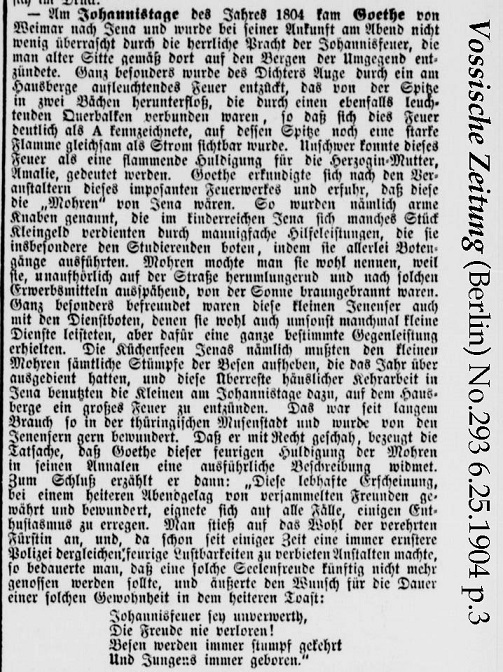 |
Vossische Zeitung (Berlin), no. 293, June 25, 1904, p. 3
Available through the Digitized Newspaper Collection of the Staatsbibliothek zu Berlin. On the feast day of St. John the Baptist in 1804 Goethe went from Weimar to Jena. Upon his arrival he was surprised by the marvelous display for the celebration of St. John the Baptist's birthday as it was celebrated in ancient custom by a bonfire in the mountains of that region. The poet's eyes beheld the lighting of a bonfire on a mountain, which loomed between two rivers. The pyre was supported by a crossbeam which looked like a letter "A". Atop the beam a fire as strong as a river current burned. The flame might easily have been a gesture in hommage to Duchess-Mother Amalie. Goethe inquired about the organizers of this impressive bonfire. He found out that the organizers were called "the Moors of Jena." They were poor boys who performed many and varied services for small sums of money in Jena, which was a city with many children at that time. They usually ran errands for the university students. They were called Moors because they persistently hung around the streets seeking employment and were usually sunburnt. These small denizens of Jena befriended the house servants of the city and performed tasks for them at a predetermined rate of compensation. Each year the "kitchen fairies" [cooks] of Jena surrendered their brooms to the young Moors, who then used these implements of domestic maintenance to build a bonfire on St. John's Day. This was a long-establish custom in the model Thuringian city and it was much admired by the residents of Jena. Proof that it actually occurred come from Goethe's description of the Moors' fiery ceremony in his writings. He wrote: "This lively ceremony, preserved and perpetuated at a happy soiree attended by an assembly of friends, incites an enthusiastic response at every turn. People stand to give their well-wishes to the revered princess yet in the past few years the ever serious police have forbidden this fiery merrymaking. It's regrettable that such heartwarming joy may no longer be enjoyed. In hopes of reestablishing this custom I offer this toast: "May St. John's Bonfire no longer be banned,
|
|
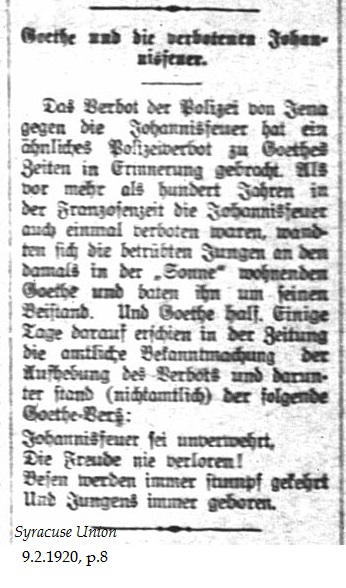
Syracuse Union, September 2, 1920, p.8
The ban against the St. John's Eve Bonfire by the Jena Police Department brings to mind a similar ban instituted during Goethe's time. More than a hundred years ago during the time of the French occupation, the bonfire was also banned. A group of disappointed youths went to Goethe, highly favored by the regime at the time, and asked for his assistance. And Goethe helped. A few days later an official decree appeared in the newspaper announcing the lifting of the ban. Underneath the announcement (and not official) stood the following verse by Goethe: May St. John's Bonfire no longer be banned,
|

Imaging and translation by Susan Kriegbaum-Hanks