|
Iwan, Volume II, pages 145 - 159
Quite incredible events were sustained in one of Grabau's daughter congregations in Eden, near Buffalo.(51. 18) (It has been well reported by the congregation that it was not part of the immigrant Prussian population, however Grabau administered to it.) For the maintenance of the church and school there was introduced what some considered a kind of church tax, because of this Grabau was grossly suspected of wanting to set up a bank and build a cleric's regiment. This led to the establishment of an opposition party under a man by the name of Schweickhart. This party seceded from Grabau on July 30, 1848 and he placed them under the ban. The excommunicants called upon Pastor Bürger, who had in the meantime been recalled by Missouri in 1847. At first in August and September Bürger had presided over church services for them in an English schoolhouse. On October 18th, the 16th Sunday after Trinity at 7:30, a hour and a half before the main church service,the excommunicants broke into the church by pounding on the window and then unbolting the locked door. Bürger then held a church service there. It wasn't until December 4, 1848 that they came into legal possession of St. Peter's church and that came as the result of a vote. When the banned ones tallied up the votes with the help of the justice of the peace they had called, the portion of the congregation remaining with Grabau handed over St. Peter's Church and built a new church in 1849, which they called St. Jacob's Church. They called upon the candidate Lange, son-in-law to Krause, to become pastor. At the time of the flight from St. Peter's Church Grabau's adherents took along all movable church goods such as the altarpiece and cloths, the baptismal font and the books and they brought them to Teacher Hoge for safe keeping. For this they were charged with theft. On May 8, 1849 in the evening three of the men, who were banned, forced their way into Hoge's residence with a constable, opened up the chests, siezed items to recoup their costs and carried away the books and the other goods. Hoge was taken as prisoner before the justice of the peace. Those who had taken him into custody were much more frightening than the Prussian gendarmes in the time of persecution. So it was reported by the adherents to Grabau. When they speak of it, they say that at that time the gang-church in Eden had been christened with a stolen key because this key was a present from Ph. Müller of Erfurt to the church congregation and it had belonged to him. This notation is important because from it one may concluded that Prussian Lutherans belonged to the congregation in Eden. When we go to the disputes in the State of Michigan we are not only dealing with a single area of settlemtn or Prussian Lutheran but about remote-lying outposts. Until that time the congregations of Detroit, Macomg and Hamtrank belonged to the Buffalo Synod and were administered by a pastor with ties to Buffalo. These settlements were the result of immigration from Grabau's congregation in and around Buffalo. The State of Michigan was not unknown in old Lutheran circles. From a parish archives of the Lutheran congregations in Bernstadt (238) we have letters of a man by the name of Berger from Peilau in which the conditions in Michigan are described by someone who settled there. The letter of 1833 was known in old Lutheran circles and certainly contributed in giving the entire group of old Lutheran immigrant its primary directions. In Detroit in 1845 a congregation established itself under the name of the Evangelical-Lutheran St. Matthew's Congregation. (18) This originated from members with a united tendency, the greater portion of whom came from Grabau's congregations, especially Bergholz. This congregation chose Professor Winkler as their pastor. Winkler had separated from Ohio in 1845 along with other Franconians clerics sent by von Löhe but unlike the other Franconians Winkler had not allied himself with the Missouri Synod but rather remained without synodal attachment. He entered his posting in Detroit in early 1845. Although he had heard some things about Buffalo he urged the portion of his congregation, which had come from Buffalo, to ask Grabau to take up a collection in the Buffalo Synod for planned construction of the church. With the help of the considerable sum acquired through this collection the church building could be finished. Grabau was invited to the church dedication on August 2, 1846. When Winkler met him for the first time the prejudices he had against him quickly vanished but he delayed in connecting with Buffalo until the year 1850. In the year 1848 a portion of his congregation was displeased with Winkler's confessional and repentance practices it asked for the revocation of all excommunications, which had been enacted in the past year. Some of those who had come from Buffalo participated in this feeling of discontent. The congregation orders provided under such a circumstance that it was the duty of each party to elect a man they trusted to act as arbitrator in the dispute or that to call a synod. They chose the first course. One group proposed Grabau, the other Walther from Missouri, who for his part appointed Pastor Crämer from Monroe to be mediator. However Grabau refused to sit at an arbitration panel with someone from Missouri and this proposed that the congregation should affiliate with Buffalo, then the Buffalo Synod could act as church court. Winkler set this proposal before his congregation. The daughter group in Macomb was unanimous in its decision and Detroit decided by majority vote to affiliate with Buffalo. This affiliated with Buffalo was accomplished on June 6, 1850. Because of it the congregation in Detroit stood under the church court in Buffalo and Winkler wrote Crämer that by this method they could save themselves an arbitration through committee, therefore he need not come to Detroit. However the opposition party still called Crämer on June 12th and Crämer arrived from Monrie on June 13th. Naturally he visited Winkler and explained to him that he would have nothing further to do with the negotiations. Crämer wove his way into the ranks of the faithful in Detroit. On June19, 1850 17 members seceded from Winkler and Buffalo with the words, "We publically withdraw from Winkler and his papist tyranny. We cannot acknowledge him as an ordained Lutheran minister, rather we are compelled by conscience to shun the openly transformed horrible wolf. (19) This letter of renunciation was sent to Winkler, however he burned it. Those opposed to the withdrawal publicized the letter on billboards on the street corners and through notices in the newspapers. When the Buffalo church court under Grabau, v. Rohr and Kindermann convened on the 23rd and 24th of July, 1850, they declared each and every excommunication, which Winkler had rendered during the negotiations with the plaintiffs, was justified and in accordance with the customary measures taken with regard to church discipline and thus they placed the excommunicants under the ban in August and September. According to a report in Buffalo's Informatorium the people who had been banned attempted to take possession of the church's property and the members of the congregation had to stand vigil over the property as if against a band of robbers. The banned ones were next served by the Missouri pastor Hattstädt from Monroe and in November 1850 they received their own minister, Pastor Schaller, from Pastor Walther in Missouri. They published an article in the Lutheraner on how according to them they had been robbed of their church building and they asked for donations for the building of a church. They were sent considerable support from the groups from the Missouri Synod. With this, as written by Buffalo in the Third Synodal Letter (19), the gang erected their temple behind the St. Matthew's Church and afterwards they held church service in their mutineer-infested no-good house. The daughter congregations in Macomb and Hamtrank were also dragging into this dispute in Detroit. In Macomb (later Roseville) a rebel faction siezed St. Peter's Church from the true adherents to Pastor Winkler and then refused Pastor Winkler entrance. What was especially tragic in this church siezure was that it was accomplished under the leadership of the famous Pastor Krause, who in the interim was excommunicated by Buffalo, appointed minister by the rebels from Macomb and conductin church services in the residence of a certain man by the name of Hoffmeyer. He was installed into his office by Pastor Schaller of Detroit. The already rich in alternations life of Krause entered upon a new episode when five months later it was eclipsed. (See Krause's biography.) Concerning St. Peter's Church the Informatorium says that after the schism of the mutineering souls it became ever more defiant. The seized church was informed by the governing body of the gang what happened in the Buffalo Synod, accusing and discussing the faulty justifications of the leadership and how necessary it was that prayers be said for them. (14)
The craziest thing to happen occurred in the other daughter congregation in Hamtrank. Here it developed by 1846 into a regular battle between the Lutherans and other denominations (United). Afterwards the congregation was also a mixed one. First they tried to prevent the Lutherans from entering the church with cudgels and when that didn't work, a fist fight broke out in the church whereby the opposition pastor, it wasn't told who he was, supposedly incited his congregation to fight while on the pulpit until the Lutherans were driven out of the church. The disturbers of the peace were, of course, punished by the court and the church was turned over to the Lutherans during the trial. (51) There is an interesting epilogue to this invasion of the Missourians into Detroit and its daughter congregations. The constant infiltration of Missouri clergy attracted much attention and offended the Buffalo congregations, and as we shall see, the people of Buffalo. It was for this reason that the Missouri congregation planned to issue a letter of statement to justify its actions and commissioned all opposition preachers to assemble all documentation concerning the excommunicated people. Two Missouri clerics from the neighborhood of Detroit looked into the matter, handled it in an unbiased way and studied the declarations of the opposite side.(15) On June 15, 1851 they went to Winkler and examined the acta for almost a week. Winkler states that while there they had admitted that for years no it had been a settled matter within their synod that the Buffalo Synod must be driven to the ground. Indeed people believed that they would be doing God a special service. These two clerics, Bayerlein and Clöter, sent a letter to their synod saying that Winkler and his congregation created a heaven-shaking injustice and Crämer for his part had not gone to Detroit as a fact-seeker but as an advocate. They protested again such fickle dealings. The Informatorium added that the men. who filed the complaints, would be forced into silence. In connection to the previously described schisms we wish to briefly allude to later episodes, although you have already encountered these in earlier sections of this book. In St. Johnsburg, a daughter congregation to Bergholz, the Missouri Synod had been holding church services since 1855. A dispute had originated over a percentage levy by Buffalo and Buffalo took church disciplinary measures. Missouri not only took a large portion of the congregation but also was awarded the church in a trial held here in 1859. In Wolcottville in 1859 Missouri founded a counter congregation from those discontented with Buffalo and from new immigrants. Likewise it happened again in 1859 in Wollcottsburg over the percentage levy. (51) To the last three congregations one may compare it to the colony of 1843. In Newark (14), eight miles from New York, Pastor Marschop and his St. John's congregation affiliated itself with Buffalo in 1852. In 1855 a godless gang of rebels gained the ownership of the church property through cunning and force. In Grafton near Cedarburg an opposition preacher was also installed by Missouri in 1853. Thus we see in these takeovers how Missouti remained on the march, and the two Missouri clerics from Michigan may indeed have been right when they related to Winkler that it was a conscience act on the part of the Missouri Synod to drive Buffalo into the ground. Thus now these last differences of opinions could not be resolved in the second synodal letter adny more than those of Eden or Detroit or and daughter congregations. The sharp ton of the synodal letter of 1850 seems to be clear. It was to be expected that Missouri would not keep quiet about this letter. In October 1850 the second meeting of the Missouri Synod took place in St. Louis. Professor Walther laid the groundwork a response in defense for the meeting. (66) At the next meeting of the Missouri Synod in Fort Wayne this response, "The Voice of the Church," was submitted and the following decisions were reached: "Since it is important to know whether God wishes people to be united in teaching with the Buffalo Synod and first of all with Pastor Grabau, a published copy of "The Voice of the Church," complied by Professor Walter as commissioned by the Synod, will be sent to him by Secretary Habel with the request that he read this book through as unbiasedly as possible...If he is not convinced by it the synod is willing to publically or privately discuss it with him orally through delegates, who will leave the time and place to him. The synod also volunteers to write nothing to him during that time in the event that he abstains from writing. If Grabau agrees to this he will be asked to offer a declaration of his compliance to the president of the synod as soon as possible." Despite the spitefulness apparent on all sides Missouri did not wish to come to a full break. One must acknowledge that it took a certain amount of self-control to ivite Grabau one more time after he had declined for the first time in 1847. If one does not want to take a look at the intentional trickery and evil behind any proposal coming from an opponent, this proposal signified a definite attempt at reestablishing communication on the part of Missouri. Grabau did not take it that way rather he declared it preverse to bring forth a book in which people do not recognize their own confusion since it would be filled with the old false teaching concerning church and office, freedom and the priesthood in general. At Buffalo's fourth synodal meeting in 1853 the Missouri proposal was turned down. In counterpoint this synod drafted a plan in order to seek a proper reconciliation with the worthy synod of Missouri. Within it a condition for reconciliation was placed in which Missouri was to acknowledge the past injustice of having taken in those who had been properly banned. Word for word the plan stated: "Is this not a terrible sin against a Lutheran sister congregation that an altar has been build against an altar in a Lutheran church congregation through the help of another synod. How many souls have been led into temptation in the nine years of our community, each attempting to extricate himself from the application of church discipline and to flee to a mutinous counter altar! How many have escaped from church discipling because of greed or lechery or irreconcilable differences or other vices and have been taken in by gang preachers? By this unlutheran, unchristian, sinful dilution of church discipline many souls have gone missing from other evangelical Lutheran synods! The synod (Missouri) must desist from this dreadfully unhappy course by repentantly recognizing and apologizing for this committed wrong. In response our pastors will gladly acknowledge where they have failed amid the heat of dispute, using words contrary to love and gentility; "with regard to this point both sides have blundered and we are ready to make apologies and offer reconciliation." This plan was set up at the close of the synod and sent on May 27th to Cleveland where Missouri was also holding a synodal meeting. It was requested that a response be sent within eight days so that the congregational deputies would receive the answer before the Buffalo Synod adjourned. It was no wonder that a response was not received. Missouri energetically refused to make any admission with regard to public transgression and challenged Grabau to name names otherwise he'd be considered a willful liar. Word for word it states (66): "It is indeed a crime against heaven to come before the entire church and describe our synod as a refuge of the horrible and blatant sort for the damned sinners of the Buffalo congregations!" It is apparent that neither side assumed the proper spirit. In spite of this Missouri wrote in the same letter of June 4th that it would renew its earlier offer and ask the Buffalo Synod for the love of Christ not to lash out at them. Despite everything one notices how both synods, feeling themselves related through the old Lutheran movement in America, went about trying to avoid the final schism because their long-standing hostility might significantly affect the attitudes of newly immigrating Lutherans with regard to them. Missouri persisted in suggesting a meeting, Buffalo rejected this until such time as the injustice of sending gang preachers was rectified. In Grabau's letter of June 21, 1853 (16), which was written in onjunction with the church ministry, the first series of battles concluded. The oppositing sides tried to prepare for one another. However the way to direct treatment of the issue was not forthcoming, so Buffalo took an indirect approach through the letter named above, calling upon the all Lutheran churches at the same time with its final proposition based on Matthew 18: "Tell It to the Church!" With this we enter the second round of fighting between Missouri and Buffalo with the battlefield moving to Europe, especially Germany. It remains remarkable that Buffalo, which happily designated itself the immigrant Lutheran church from Prussia, which had given up all ties to the old Lutheran church community in Breslau, should now take its dispute with Missouri back to Europe, indeed to Prussia and Breslau. At the second meeting of the Buffalo Synod in 1848 plans had been discussed for the sending of delegates to Europe; at the fourth meeting in 1853 the decision to send them was made (16, 20). Grabau was elected delegate on June 4th with 21 votes and von Rohr was elected with 19 of 22 votes; arrangements were made and 700 - 800 dollars were set aside for the purpose. The delgates had a threefold mission:
of the High Church College;
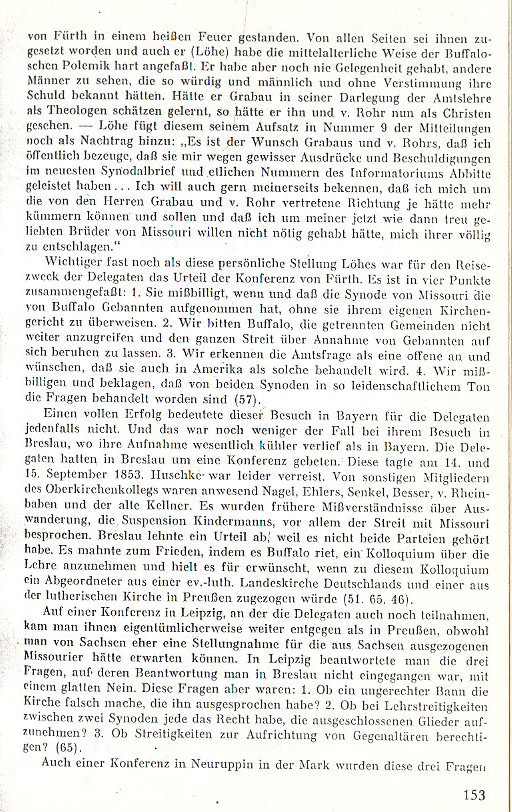
The reality of things did not seem to have been reported and disclosed. So it also stands in the fourth synodal letter of 1853 (20), although Löhe had been been sending his disciples to America for years. It is true that Löhe had discussed doctrinal differences when pastors Walter and Wynecken visited him in 1852 and this was published with large and sticking print in a special issue of his "Communictions concerning America" (Number 10 in 1852). When these Missourians had spoken with Löhe they discussed this: "We have spoken to them. We shall deliver our disciples to them joyously and into no other hands." We may thus observe that Walter and Wynecken spent the greater portion of their time in Germany in Erlangen so that they could use the library there to conplete Walter's book "The Voice of the Church" (29). In the same issue of his "Communications" Löhe saiys this about Buffalo: "One thing we deeply regret, with regard to the richly gifted and learned Pastor Grabau of Buffalo, is the ways and means in which he has handled the Missouri Synod through his recent pastoral letter and here and there in his newspaper, Informatorium where little effort has been expended in becoming united with the brethren. Truly the points leading to union between the two of them are not few. The use of the ban, the sharpness of criticism impede each approach. Our brothers from Missouri have not petitioned us but we hold it necessary that we be prepared and willing to understand Grabau with respect for the gifts and knowledge, that we relate that we stand more and more on the side of our brothers in Missouri though here and there in Saxony there may be so-called gang preachers at fault." After this there didn't seem to be much good in store for the pair of delegates from 1853 Buffalo. As a matter of fact the manner of greeting the pair received is noted in the Communications" for it says that Löhe greeted them with a certain amount of reserve. They received no specially printed issue in greeting. To make things happier for Buffalo, things would have to be more painful for Missouri; this was the sentiment circulated when getting to know eachother better on the visit to Löhe and we could scarcely hear more perceptive words about Grabau from a more respected and judicious man than Löhe. Löhe writes in Number 9 of his "Communications" of 1853 (57), concluding that Walter and Grabau belonged together, adding that he had not given up the hope of uniting the two: There was no relationship between us and Grabau. We did not seek the tie. Our hearts were alienated from the Grabau faction because of the truth they held against the other sect, the severity of Grabau's authorship and Buffalo's use of the ban. Now the brothers come to us. If they had gone everywhere except to us we would not have wondered since they had nothing favorable to say about the undersigned (Löhe) the last time around. The Informatorium has shown us several examples of their inclinations." But now they were there and the exposition of their doctine concerning office was found to be neither scripturally nor symbolically adverse. The question remained open. Even at the pastoral conference in Furth in September 1853 hearts opened to Grabau and von Rohr. However Grabau's teaching on office may have already made an impression as most certainly the manner, in which they bore the censure, won the hearts of many more. They had stood in a very hot fire because of the harshness and courseness of their polemic against the brothers from Missouri. They were overwhelmed on all sides and even he (Löhe) was deeply touched. He might never have had the opportunity to see other men who acknowledged their faults so honorably and gentlemanly and without equivocation. He might have learned to regard Grabau in his exposition of the doctrine concerning ministerial office as a theologian but he only saw Grabau and v. Rohr as Christians. — Löhe added this to his article in Number 9 of the "Communications" as a supplement: It is Grabau's and von Rohr's wish that I publically certify that they have begged my forgiveness for certain phrases and accusations in the most recent synodal letter and several issues of the Informatorium...For my part I gladly wish to acknowledge that I could and should be more worried about the course indicated by Messers Grabau and von Rohr and that, for the sake of the brothers from Missouri, whom I truly love now as much as I did before, I would not have found it necessary to conpletely divest myself from them." Still more important to the goals of the travelling delegate than this personal position of Löhe's was the decision of the conference in Fürth. Four points were compiled:
The visit to Bavaria did not signify full success for the delegates either. And that was no less the case with their visist to Breslau, where there reception was essentially cooler than it was in Bavaria. The Delegates had asked for a conference in Breslau. This was held on the 14th and 15th of September, 1853. Huschke was unfortunately travelling at the time. Of the members of the Upper Church College, Nagel, Ehlers, Senkel, Besser, von Rheinbaben and the elder Kellner were present. Earlier misunderstandings concerning immigration, the suspension of Kindermann, and above all else the dispute with Missouri were discussed. Breslau declined to issue a decision because it had not heard from both parties. It warned for the sake of peace, advising Buffalo to attend a colloquium concerning doctrine and Breslau considered it desirable for one ordained representative from each of the established Evangelical-Lutheran Churches and one from the Lutheran Churchs in Prussia be invited. (51, 65, 46) At a conference in Leipzig, at which the delegates also took part, people were more willing to meet them on their own terms than in Prussia, although it was to be expected that men from Saxony would voice the opinion of the Missouri Synod, which had come from Saxony. In Leipzig they answered the three questions which the men in Breslau were not inclined to respond to, with a simple "No." These questions were:
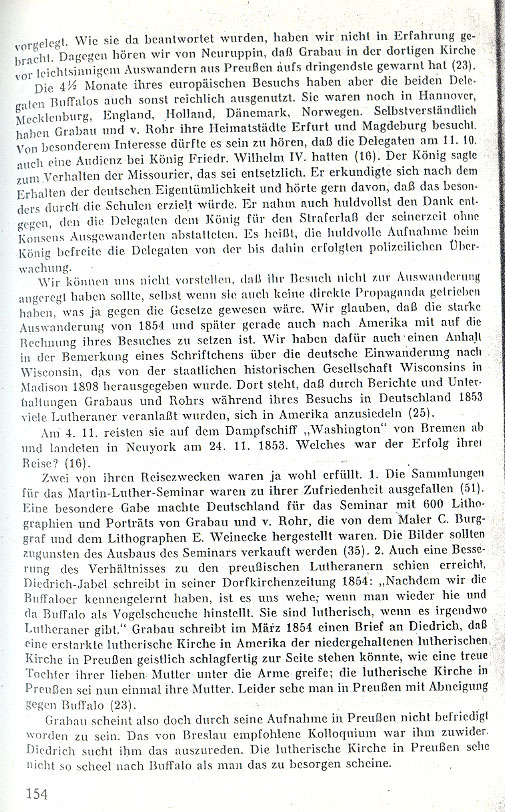
These three questions were also addressed at a conference in Neurippen in the Mark. How these were answered ther we have not been able to discover. Concerning it we hear from Neurippen, that in the church there Grabau had warned in the most stingent of terms about frivolous emigration out of Prussia (23). The two delegates from Buffalo made the most of their 4 ½ month tour. They went to Hannover, Mecklenburg, England, Holland, Denmard and Norway. Understandibly Grabau and von Rohr visited their hometowns of Erfurt and Magdeburg. It is of particular interest to hear that the delegates also had an audience before King Friedrich Wilhelm IV on October 11th (16). Concerning the relationship with Missouri the King said that it was horrible. He inquired about the retaining of German values and characteristics and was happy to hear that these were taught trhough the schools. He also graciously accepted the thanks, which the delegates rendered to the King for giving amnesty to the immigrants who left during his time without being given permission. This means the gracious reception with the King freed the delegates from the police surveillance they had experienced earlier. We could not imagine that their visit would not stimulate emigration, even when they did not carry our direct propaganda, which would have been against the law. We believe that the strong immigration of 1854 and later to America is to be attributed to their visit. In support of this we have in hand a document concerning the German emigration to Wisconsin published by the State Historical Society of Wisconsin in Madison in 1898. There it states that due to reports and conversations with Grabau and von Rohr during their visit to Germany in 1853 many Lutherans were motivated to settle in America (25). On November 4th they departed on the steamship Washington from Bremen and landed in New York on November 24, 1853. What were the results of their trip? (16) Two of the reasons for traveling were accomplished.
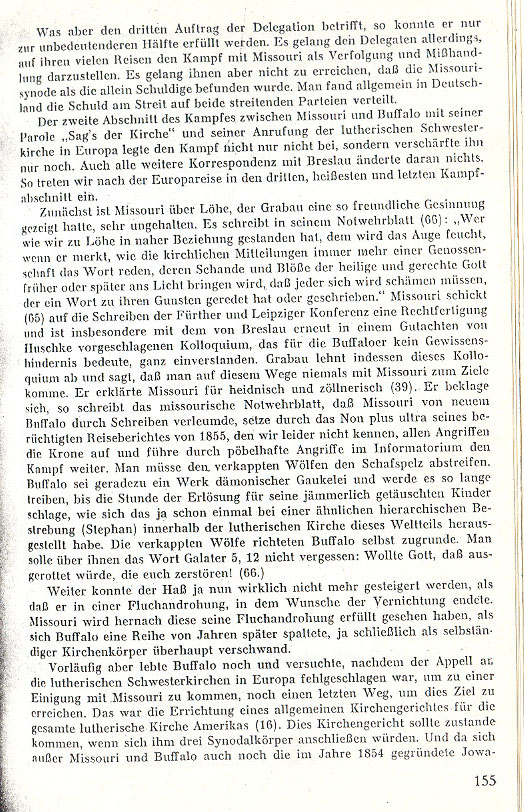
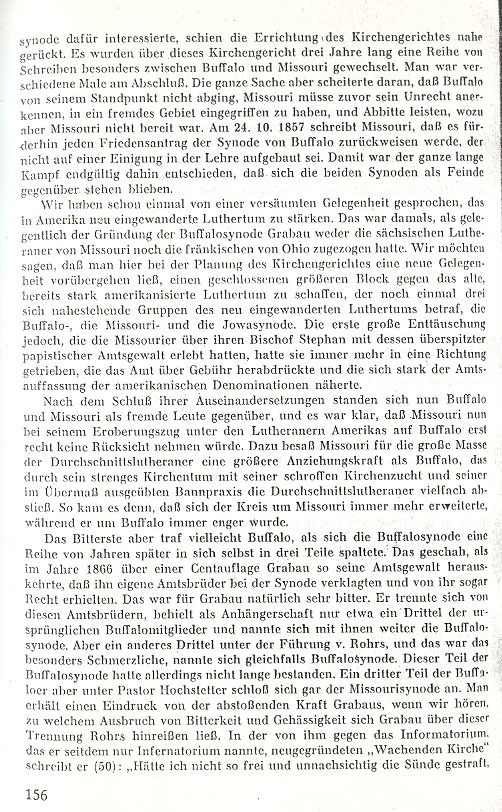
Thus Grabau seems not to have been satisfied with his reception in Prussia. The colloquium in Breslau went against him. Diedrich tried to dissuade him from this. The Lutheran church in Prussia was not as concerned with Buffalo as it seemed to be. With regard to the third mission of the delegation only a a less than meaningful half could be fulfilled. During their many travels the delegates successfully managed among other things, to expose the battle with Missouri as persecution and maltreatment. However they wer unsuccessful in seeing to it that the Missouri Synod be found responsible for all the blame. In Germany they found that the blame for the dispute could be divided between both sides. The second round of battles between Missouri and Buffalo, carried out through his parole, "Tell It to the Church!" and laid out in his calling to Lutheran sister churchs in Europe not only did not settle the conflict but actually heightened it. All further correspondence with Breslau altered nothing. Thus after the European trour we come to the third, most heated and last round of battles. Missouri becomes very angry about Löhe, who now showed friendly inclinations towards Grabau. In the Notwehrblatt (Letters in Self Defense)(66) it is written: "Who stood in closer relationship to LÖhe than us? The eye mists up when one notices that the ecclesiastic communications discuss ever increasing words of fondness for the person who m the holy and righteous God will sooner or later expose in his shame and nakedness, as anyone would feel shame for having said or written a word for his own advantage." Missouri sends an justification to the writers at the Fürth and Leipzig conferences and renews its contact especially with Breslau concerning advice given by Huschke's proposal for a colloquium, which indicated no impediments to conscience for the Buffalo Synod. In the mean time Grabau rejects attendance to this colloquium and says that one would never achieve his end with Missouri in this way. He declared that Missouri was pagan and materialistic (39). He complains, so writes the Missouri Notwehrblatt, that Missouri is renewing its slander against Buffalo through its writings and ultimately puts on the crown of victory in his notorius travel report of 1855, which unfortunately we do not know and he further carries on these vulgar attacks in the Informatorium. One must strip the sheepskin from this disguised wolf. Buffalo operates a devilish fraud and it continue to do so until the hour of redemption sounds for his grieving, deceived children as was once before exposed in a similar hierarchical striving (Stephan) within the Lutheran church in this part of the world. The disguised wolf is driving Buffalo into the ground. Concerning them one should not forget the words of Galatians 5, 12: May God wish that those, who would destroy us, will be destroyed! (66) In reality the hatred couldn't have escalated more than when it ended in a threat of damnation, in a wish for annihilation. Missouri would have seen its threat of damnation fulfilled years later when Buffalo split into factions, in the end substantially having disappeared as a self-standing church body. For the time being however Buffalo still existed and attempted, after the call to the Lutheran sister churches in Europe had failed to make its point, to come to an understanding with Missouri and yet in the long run achieve its goals. This was the establishment of a general church court for the assembled Lutheran churches in America (16). The Church court was established to incorporate the three synods. Besides Missouri and Buffalo the Iowa Synod, established in 1854 was interested in the erection of a church court. concerning this church court there was over a three year period a series of letters exchanged especially between Missouri and Buffalo. Many times they were deadlocked. The entire matter however floundered upon the point that Buffalo would not relent in its opinion that Missouri must acknowledge its injustice of having encroached into territory outside their sphere of influence beforehand, and beg foregiveness, but Missouri was not ready to do this. On October 24, 1857 Missouri wrote that Buffalo had rejected every effort at peace offered by the Synod and no consensus concerning teaching could be reached. Throughout the long hard battle is was decided that the two synods would remain enemies. We have already spoken once of the neglected opportunity to bolster the new immigrating Lutherdom in America. At the time of the establishment of the Buffalo Grabau connected with neither the Saxon Lutherans in Missouri or the Frankish Lutherans in Ohio. We might say that in the planning of the church they passed over another opportunity to create a decisively large bloc with the old, already strong Americanized Lutherdom but instead the newly immigrating Lutherans found three distinct groups, the Buffalo, Missouri and Iowa synods. The first great disappointment, in which the Missourians experienced the hypercritical, papist authority of Bishop Stephan, forever after shaped their direction whereby ministerial office was unduly suppressed and strongly approached the concept of ministerial office prevalent in American denominations. Perhaps Buffalo suffered the most bitter disappointment when years later it divided into three parts. This happened in the year 1866 concerning the penny levy whereby Grabau flaunted his ministerial authority to such an extent that this own brothers in office indicted him at the synod and obtained a certain amount of justice. This was, of course, very bitter for Grabau. He separated from these brothers in office, retaining about one third of the original members of the Buffalo Synod and continuing to call themselves the Buffalo Synod. Another third under the leadership of von Rohr, and this was particularly painful, also called itself the Buffalo Synod. This portion of the Buffalo Synod did not last long. The third portion of Buffalo under Pastor Hochstetter joined with Missouri. One gets an impression of the repulsive power of Grabau when we hear about the outbreak of bitterness and spite Grabau allowed himself concerning the schism by von Rohr. In his newly established Wachende Kirche (Vigilant Church) meant to oppose the Informatorium, which from that time one he called the Infernatorium he wrote (50): "If I hadn't punished sins so freely and so unrelentingly showed myself to be so earnestly and rightly opposed to the pulpit babbler then I still would have had my seniority for a much longer time that the 21 year old gracious young men had to them. They are popular since they wouldn't hurt even a member of the perfumes, young beer, wine, theatre and game playing crowd, they flatter the foolishness of the elders at picnic gorgings and drinking binges. Rohr brings the devil his ultimate tribute...Whenever this poor man has drunk from the intoxicating cup of his soldier's hatred he commits the most grievous of private and public sins...The animal in Rohr came after me and the gang of oxen ran among the calves (Psalms 68, 31." This however does attest to the power of faith, which Grabau still exerted, not only in bringing the Buffalo Synod through the worst crisis but also in that he still wanted it to be strong so it might withstand these latest times. He held onto his old immigrating traveller with the words, "We emigrated for the sake of our faith, would you rather acknowledge that faith has emigrated from us?" In a statistics reoprt concerning the Lutheran churches in America in 1896Fritsche (29) exceeded the Buffalo Synod with 23 pastors, 34 congregations and 4180 communicants. — In these later times it came to pass that Buffalo disappeared as a self-standing church body. In the year 1930 (91) it united with the synods from Iowa and Ohio into the American Lutheran Church. Thereby Missouri may see its prophecy fulfilled, that Buffalo would drive itself into the ground, however Buffalo assured that by becoming part of a larger church body it not only assured its continued existence but increased its influence among realted church bodies. Also a word of Löhe's came to fruition when he was speaking about something else: "What cannot united itself, divides itself and the exalted form of the holy church comes forth in its full beauty when it also has specific borders." (57) We do not want to neglect to bring forth another unfortunate result of this malicious dispute. Aside from the old sad weakness of the German immigrant to prefer and pay attention to all things foreign was the motive for many crossing over to one of the many English denominations. We find a few falling off to the Catholic church, as with a certain Justiniani or a Örtel, about whom we have spoken. However if we might lend creedance to the words of one Mathilde Schley this falling away to the several denominations of English confession do not become insignificant. In an article in the Milwaukee Sunday Post of 1921 titled "Old Lutheran Migrations" she writes (61): "One might not wish to believe that the descendants of the old Lutherans can only be found in the Lutheran churchs of america. As a matter of record the churches of the English sects often consists totally of German or half-German members." Hengstenberg writes (47): The Methodists have worked with great success among the German immigrants, especially among the smaller groups. Their message was already familiar to them on board their ships and they often attempted to make the adherents of the German ministers convert by using unworthy tactics. After the Methodists the Baptists drew a smaller portion of the Germans. The most educated or semi-educated went to the Episcopal churches, which were called the fashionable churches. The refined Germans were ashamed of the German communities in the Lutheran churches...Even the Catholic Church, which is rich, launched large propaganda campaigns among the immigrant Germans." It would be a very difficult undertaking to establish how many of our Prussian Lutherans switched to other, non-Lutheran church conmunities. We must allow a tragic chapter with distressful scenes to pass us by. One might think that this would only be the beginning of an all out deterioration. If this was not the case but rather both sides of the battle-initiating church bodies retained and gre in good and strong Lutheran direction then it is a proof of the power of the faith in Lutherdom. And if we might establish that it has been just these church bodies of good Lutheran character, which have preserved at the same time the best of the language and the folk culture, then we must recognize and acknowledge both the religious and the cultural significance of the new immigrating Lutherans. That the German culture has maintained itself for so long is to a large extent thanks to the pure retention of Lutherdom. Those turning foremostto the old Lutheran congregations of America or some switching to the English denominations were of not only religious but also cultural temperament. Indeed the purer and more genuine the Lutherdom the tighter the hold on the folk culture. |