|
Outline:
- Reasons for Emigration
- Tales of the Journey
- Settling in Buffalo
- Schism I: The Silesians
- Schism II: The Mini-Secessions
- Schism III: Grabau's Congregation in 1865
- It gets personal!
- The "Little Buffalo Synod"
- Limited Resolution in the 20th Century
A. Reasons for Emigration
- The Agenda:
Chapter 1 (p.9) of Die Altlutherische Auswanderung um die Mitte des 19. Jahrhunderts by Wilhelm Iwan mentions that Kaiser Friedrich Wilhelm III wanted to celebrate the eucharist with his wife.
- Laws concerning marriage and inheritance from Iwan, Vol. II
- Christian Bierosch's letter - Trinity footnote 3 - chairman of the Silesian Congregation
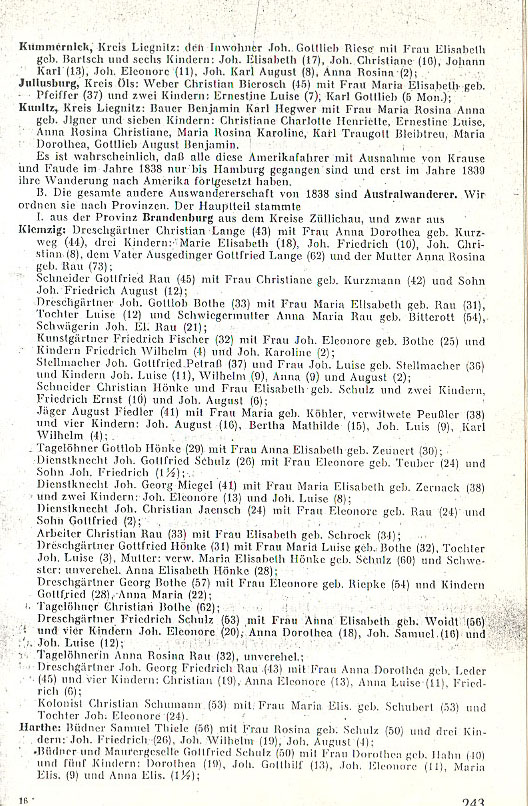
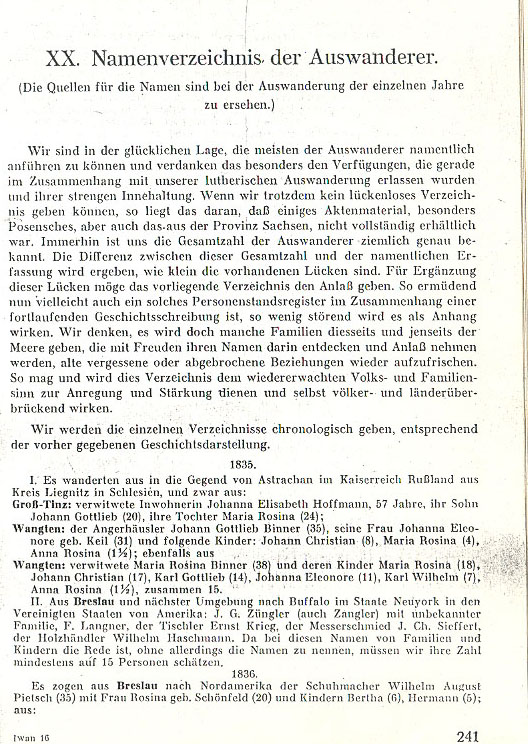
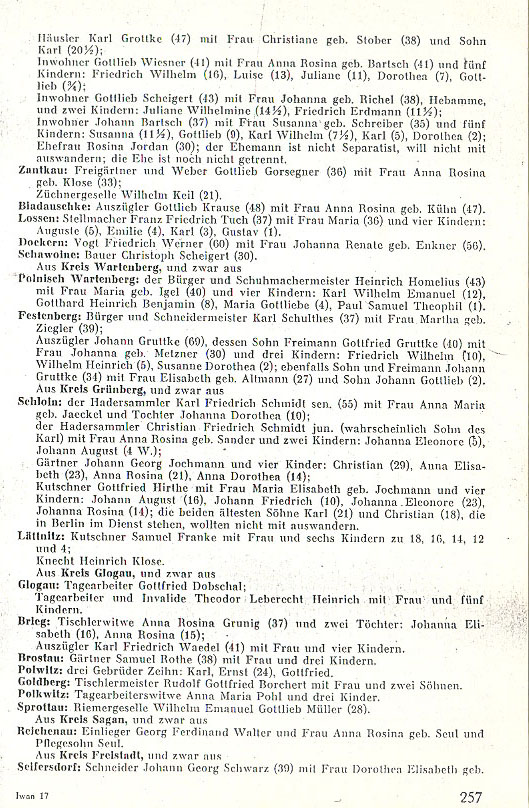
Weaver Christian Bierosch, 45 years of age, supposed to immigrate with the Silesians in 1838 - see Iwan, Volume II, page 243
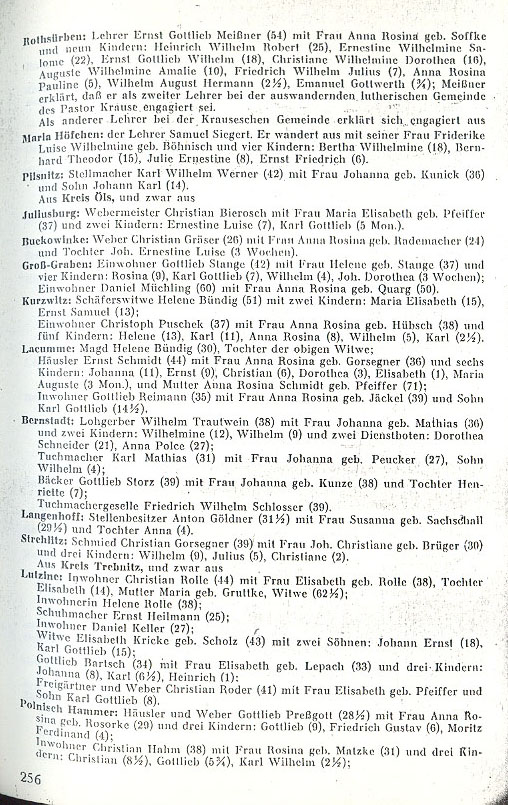
Actual emigration: Master Weaver Christian Bierosch immigrated with Silesian contingent in 1839 - see Iwan, Volume II, page 256
- Grabau's dispute over the Union Agenda
- "As late as the early nineteenth century Frederick William III imposed the following oath on the Prussian clergy: "With life and blood, with doctrine and example, with words and deed, I will defend the royal power and dignity as it is established...I will make it known in good time if I discover anything aiming at its alteration...and will admonish my parishioners." (page 222) - "Church and State in Protestant Germany before 1918, with Special Reference to Prussia" by Andrew Landale Drummond, Church History, September 1944, Vol. 13, No. 3, pp.210 - 229.
- Heinrich von Rohr, 3/28/1797 to 1874
- from Philip von Rohr Sauer's "Heinrich von Rohr and the Lutheran Immigration to New York and Wisconsin":
- Prussian Military Family - father privy councillor to the court in Berlin
- served as a page in the court of Friedrich Wilhelm III of Prussia
- second lieutenant in the grenadier regiment "Kaiser Alexander"
- Eugene Camann's works.
B. Tales of the Journey
- Tell It, page 4
"In the year 1838 our pastors, A. Grabau and F. Krause and the deputies of the 1000 souls in the emigrating congregation of Pastor Grabau, and the then Captain Heinrich von Rohr sought to unite with the emigrating Saxon pastors Löber, Walther, Bürger Sr., Bürger Jr., and Keyl, who were under the auspices of Stephan. However, having received a sincere warning and recognizing during their visit the confusion among the Stephists, they gave up on this decision."
- 1838 - von Rohr, Martin Stephan and the Saxons
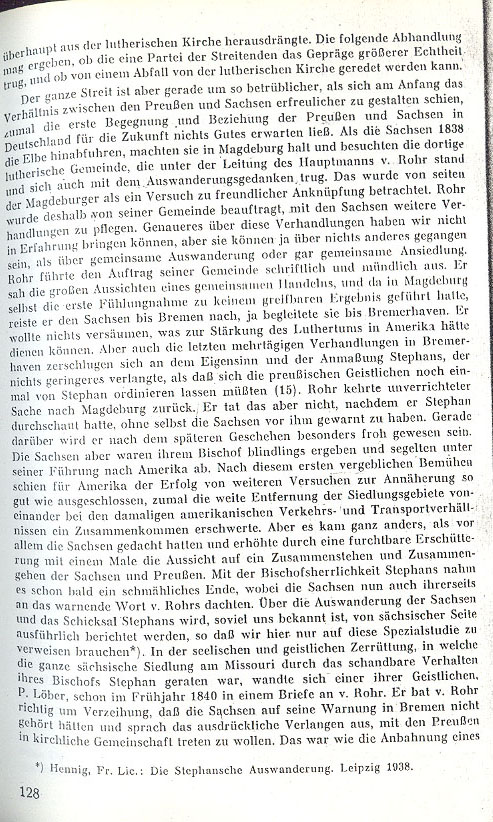
Also see Iwan II, page 128 where von Rohr warns the Saxons about Stephan:
"When the Saxons reached the Elbe in 1838 they stopped in Magdeburg and visited the Lutheran congregations there, which stood under the leadership of Captain von Rohr and which also contemplated emigration. The people of Magdeburg considered this an opportunity to establish ties. For this reason Rohr was commissioned by the congregation to hold further negotiations with the Saxons. We do not have sufficient information concerning these negotiations to know what they were about but they probably had to do with nothing other than communal emigration or perhaps communal settlement. Rohr executed the commission from his congregations both orally and in writing. He saw the great potential of a communal effort and since the initial contact yielded no discernible results, he travelled with the Saxons as far as Bremen, indeed he accompanied them as far as the Bremen harbor. He did not want to neglect anything, which might serve to fortify Lutheranism in America. However the last, many-day long negotiations in Bremenhaven were dashed to pieces by the obstinancy and arrogance of Stephan, who in no modest terms demanded that the Prussian clerics would have to allow Stephan to reordain them. Rohr unsuccessfully returned to Magdeburg. But he didn't do this until after he had seen through Stephan and then warned the Saxons about him."
- Stephan declares himself bishop while travelling to Missouri. Once settled there, his extravagances become evident to his clergy. He is deposed by his congregation.
- Confusion among the Silesians; Grabau's Ban in Hamburg - see Trinity footnote 20; 72 Silesians came to Buffalo from Hamburg, arriving a month before Grabau's congregation - see Trinity footnote 22
- Trinity footnote 30 - Krause appoints Bierosch to give the sacraments of baptism and communion in his absence.
November 23, 1839: "Until such time as the Lord wills it otherwise the Lutheran brother Bierosch, who is a true teacher of children, may give you the sacraments of baptism and communion. Let him do this for you, they were instructed as it has been permitted since 1836 in the case of need as established by the committee members of our church."
- Grabau's tale - P. 42 "Soon after the wealthy members travelled on to America and left their poorer brethren with Pastor Grabau's congregation."
C. Settling in Buffalo
D. Schism I:
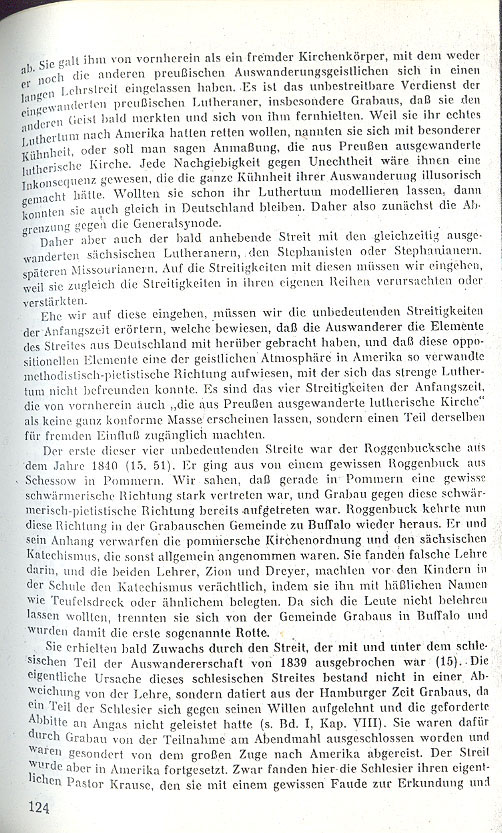
- Trinity, page 12 - The Roggenbuck Dispute whereby the Pommeranians ally themselves with the Silesians
- Roggenbuck (1839 immigrant from Schwessow, Pommerania - Iwan II, p.249)and Amereyn discussed in Grabau's First Pastoral Letter
Further clarification in Iwan II, page 124
- Fall 1840 -Grabau calls von Rohr back to Buffalo to help Grabau with the church and school (is there a connection between this and the pastoral letter; von Rohr was left pretty much on his own in Wisconsin). Krause goes to Wisconsin and makes things worse.
- Summer 1841: the Silesians meet with Grabau and Krause (Bierosch in Wisconsin) - see Trinity page 13
- September 12, 1841: members of the Silesian committee excommunicated - see Trinity page 16
Those excommunicated were:
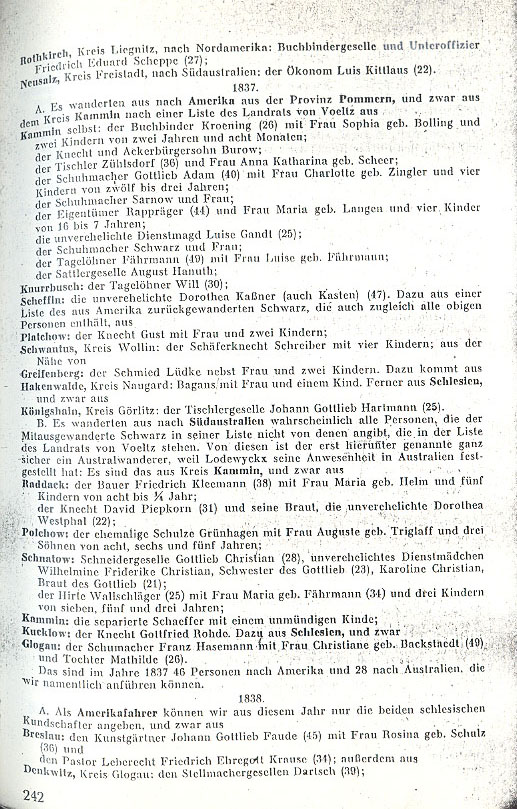
1835 Immigrants (from Breslau and neighboring area) F. Langner, cabinet maker Ernst Krieg, cutlery maker J. Ch. Sieffert (his daughter? Mrs. Maria Grässer, nee Sieffert, provided testimony for the Trinity book) - see Iwan, Vol. II, page 241
1838 Immigrant from Breslau, nursery gardener Johann Gottlieb Faude, 45 years old (who came with Pastor Krause) - see Iwan, Vol. II, page 242 or 1839 Breslau immigrant nursery gardener Ernst Faude (35 in 1839)
1839 Breslau immigrants: master shoemaker Josef Hantschke (45), 48 year old shoemaker Ignaz Pelzel (r?) - see Iwan, Vol. II, page 255
1839 Buckowinke immigrant 26 year old weaver Christian Gräser - see Iwan, Vol. II, page 256
1839 Kurzwitz , 51 year old shepherd's widow Helene Bündig (Bindig), who came with her 2 children, Maria Elizabeth (15) and Ernst Samuel (13) - he provided testimony for the 50th anniversary Trinity book - see Iwan, Vol. II, page 256
1839 Polnisch Hammer immigrant: cottager (Häusler) Karl Grottke (47) - see Iwan, Vol. II, page 257
Unable to identify Mayer and Toy, the other 2 excommunicants
- September 15, 1841: The burning of the order of excommunication in front of the church during a service - Trinity, page 17 bottom
- October 1841: E. M. Bürger comes to Buffalo and becomes pastor to the Silesian congregation = the first incursion by the Missouri Synod - See Trinity footnotes 42 and 43
- In Tell It, page 5 top it is stated that E. M. Bürger left Missouri for doctrinal differences - "he had separated himself from the Saxon pastors and from his own congregations because the congregation still held to the Stephanist abomination and because they still considered the symbolic books a mere appendix to the holy scriptures."
Grabau accuses Bürger of siding with Roggenbuck
- The dispute continues through June 17, 1845; Bierosch faces Grabau; Grabau's demands - see Trinity footnote 37
E. Schism II: The Mini-Secessions
- Tell It to the Church, page 3 - Pastor Grabau and von Rohr charge the Missouri Synod with taking in the Buffalo Synod's excommunicated members and agitating other congregations to secede.
Missouri's guiding principle: "A Lutheran Church group may take in the banned members of another group when there is a dispute over doctrine within the church until such time as the dispute is settled." See the supplement to our church's Informatorium, Volume 2, No. 16 of July 1, 1853 (from page 4)
- Grabau calls the response he received to his first pastoral letter "a spiteful critique" ("eine gehässige Kritik") - see Tell It, page 5
- The response to the pastoral letter accuses Grabau of causing the problem: "It seems as though you have placed the administration of the sacraments as the main function of the spiritual office over the function of teaching. If these statements haven't caused the separatists to attempt the separation of the administration of the holy sacraments from the public office of teaching and if you haven't primarily with this lesson concerning ministerial office discussed the administration of the sacraments as a separate function, then we must have had something else in mind in thinking that the proper main function of priestly office is related more to the preaching of the gospel, for holy baptism (which in case of necessity may also be administered by a layman) and the holy eucharist are only extraneous symbols. " - Pastoral Letter, page 22
- Pastoral Letter, page 28 - Missouri's response to Grabau's statement that the congregation owes its pastor unconditional obedience:
"The congregation owes us obedience only and in so far as we preach to them God's word. However if we desire to make obedience an unconditional thing, such as when we wanted to build a church or a school, this is certainly not in and of itself contrary to God's word, but we would undeniably be laying claim to something to which we are not entitled."
- Pastoral Letter, page 36 - an invitation to Krause within the response, which probably burned Grabau
- Point of doctrine: the role of the minister in Grabau's retort to the critique of the pastoral letter Pastoral Letter, page 47
- Pastoral Letter, p.76 - In Missouri's response to Grabau's anticritique, the explanation about Fürbringer:
"Regarding our brother in office, Pastor Fürbringer, it was very painful for us that he carried on the office unordained for a long time and gave offense to you and others. However if you would have known the contingencies of the matter perhaps your judgment would have been somewhat milder. In no way did he have lax principles concerning ordination; rather he esteemed it so highly that scruples kept him from believing he could receive it from his brothers in office. He wanted to go to Germany to seek the verdict of the superintendent, Dr. Rudelbach. Due to the many pressing circumstances within the congregation, which had called him, (such as unbaptised children, for example) he believed it to be a "casu necessitatis," and because of this many theologians, such as Baldwin and others, declare it permissible to execute the office for a limited time because there was proper vocation although no ordination. For the sake of his conscience we have been as lenient as possible but we are pleased that he has long since allowed himself to be ordained by our brother in office, Walther, in St. Louis. "
- Pastoral Letter, p.82 - In Missouri's response to Grabau's anticritique, Missouri claims it was necessary to drop some of the Lutheran church orders:
"Finally with § 15 you have failed in directing us to anything, for which we are guilty. — If anyone reads unbiasedly what we have said about the representative constitution of the Lutheran church, he will easily understand our meaning, that we consider it impossible to install the entire constitution under the currect American conditions; we could not conceive, for example, how the episcopacy of the princes and the entire consistorial and diocesan sense of controlling territory could be united with it. Concerning it we intended that , as the Lutherans must have let go of much of the apostles' church order, so too in this country did we have to let go of much of the Lutheran representative constitution. Here you twist our words as through we had let these fall, as though we had spoken of "debemus" [we were obliged to], when we had maintained that it was of necessity; you make the effort to prove the opposite, namely that the constitution was completely justified according to God's word even here in America, that it was to be obtained and maintained in opposition to independent liberty. "
Takeover of Kindermann's fallen congregation in Watertown, Wisconsin
1846: The Missouri Synod unites with the Chicago Synod; Grabau accuses them of stealing the fallen congregations in Milwaukee, Kirchhayn and Freistadt, which belonged to Pastor Krause - Tell It, page 6
1848: Grabau's daughter church in Eden secedes and appoints E. M. Bürger its pastor; "forcably seizing the church of the Lutheran congregation there by means of climbing through windows and breaking doors" - See Tell It, page 6, bottom
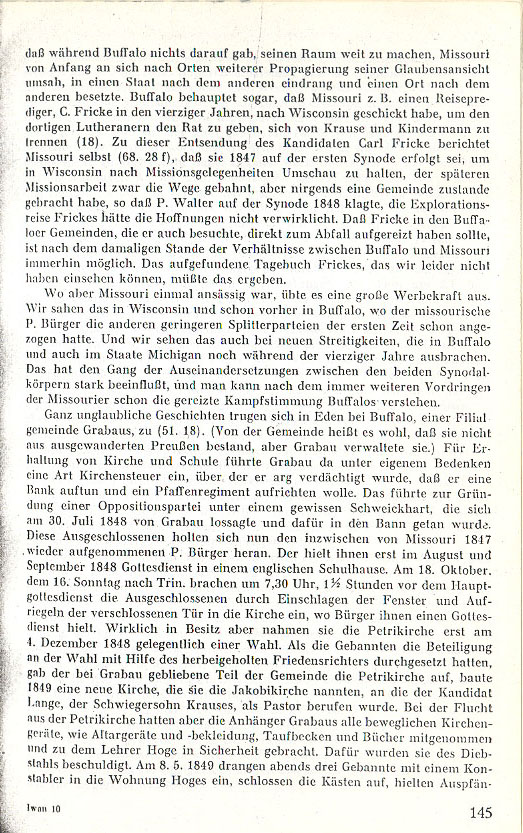
Also see Iwan II, page 145 and Iwan II, page 146 for Grabau's church tax and the legal battle in Eden:
"Quite incredible events were sustained in one of Grabau's daughter congregations in Eden, near Buffalo. (It has been well reported by the congregation that it was not part of the immigrant Prussian population, however Grabau administered to it.) For the maintenance of the church and school there was introduced what some considered a kind of church tax, because of this Grabau was grossly suspected of wanting to set up a bank and build a cleric's regiment. This led to the establishment of an opposition party under a man by the name of Schweickhart. This party seceded from Grabau on July 30, 1848 and he placed them under the ban. The excommunicants called upon Pastor Bürger, who had in the meantime been recalled by Missouri in 1847. At first in August and September Bürger had presided over church services for them in an English schoolhouse. On October 18th, the 16th Sunday after Trinity at 7:30, a hour and a half before the main church service,the excommunicants broke into the church by pounding on the window and then unbolting the locked door. Bürger then held a church service there. It wasn't until December 4, 1848 that they came into legal possession of St. Peter's church and that came as the result of a vote. When the banned ones tallied up the votes with the help of the justice of the peace they had called, the portion of the congregation remaining with Grabau handed over St. Peter's Church and built a new church in 1849, which they called St. Jacob's Church. They called upon the candidate Lange, son-in-law to Krause, to become pastor. At the time of the flight from St. Peter's Church Grabau's adherents took along all movable church goods such as the altarpiece and cloths, the baptismal font and the books and they brought them to Teacher Hoge for safe keeping. For this they were charged with theft. On May 8, 1849 in the evening three of the men, who were banned, forced their way into Hoge's residence with a constable, opened up the chests, siezed items to recoup their costs and carried away the books and the other goods. Hoge was taken as prisoner before the justice of the peace. Those who had taken him into custody were much more frightening than the Prussian gendarmes in the time of persecution. So it was reported by the adherents to Grabau. When they speak of it, they say that at that time the gang-church in Eden had been christened with a stolen key because this key was a present from Ph. Müller of Erfurt to the church congregation and it had belonged to him. This notation is important because from it one may concluded that Prussian Lutherans belonged to the congregation in Eden."
1848: Secession of the New Bergholz congregation to join the Missouri Synod - Tell it, page 7
Also see Iwan II, page 148
1850: Takover of portions of a congregation from Detroit - Tell it, page 7
1850, Macomb County - Missouri Synod installed Krause, by then excommunicated by Grabau into Pastor Winkler's congregation - Tell it, page 7
See Iwan II, page 146 and Iwan II, page 147 for details on Winkler being from neither synod
Courting Löhe in Breslau in 1853 - see Iwan, page 152
The strange case of Karl August Göhle - Buffalo and its German Community, page 89 - Grabau took one of 3 missionaries sent by von Löhe - these missionaries were associated with neither synod
1859, St. Johnsburg, from Clarifications, page 36: "We have, for example, the case of the Johannisburg Trustees of 1859 where they acknowledged no duty towards their pastor or towards their denomination but rather drove their denominational pastor out and took in a minister from the Missouri mutineers, thus creating a new and different church."
F. Schism III: Grabau's Congregation in 1865/66
- August 1857 - Hochstetter appointed deacon of Grabau's church
- January 1865 - Grabau accuses Hochstetter of "unbearable babble from the pulpit, his dark and false teachings". Hochstetter prepared to resign quietly but von Rohr advises him to protest the the church ministry - see Clarifications, preface; also see Hochstetter's Pulpit Oratory
- "Deacon Chr. Hochstetter (at the time appointed to the German-Lutheran Trinity Church of Buffalo) had accused the pastor of the congregation, J. An. A. Grabau of false doctrine in February 1866 because of the sermon he delivered on the feast of St. Paul's conversion (January 25th)." - Clarifications, page 3
- March 22, 1866 - Clarifications, page 17 ff: The Letter Grabau claims poisoned the Synod against him.
- March 8, 1866 - Church ministry agrees with Hochstetter
- March 28, 1866 - Grabau caught in a hierarchy of his own making?:
Clarifications, page 4:
"On March 23rd I wrote Pastor Wollaeger and what happened! I received a reply in a most arrogant and cold official tone dated March 27th. For example: I shall not declare the verdict of the Church Ministry an erroneous one! He would not grant this to me! No one besides the pope in Rome denies permission! It was so Roman! We had been sold under an orally binding clause of obedience to the Church Ministry. We thought: How could this be!"
- April 1866 - Bergholz congregation (von Rohr) accuse Grabau of heresy - Clarifications, page 3
- April 14 - Hochstetter leaves the church
- April 21, 1866: Grabau suspended for not showing up for a summons issued by the church committee. He doesn't consider himself suspended. While waiting for the Synod to convene Hochstetter and supporters (Henning Sect) take over the Martin Luther College and set up church services with Hochstetter as pastor. Church committee advises Hochstetter to stop but he continues. - Clarifications, page 4
- April 28 - Clarifications, page 13: Attempt at a mediated truce through Professor Winkler and Pastor Wolläger of Milwaukee. Hochstetter and Wolläger would not agree to it.
- April 29th -Grabau delivers the sermon, breaking the treaty. Clarifiactions, page 13:
"On April 30th I answered Pastor Wolläger that in accordance with his understanding of the agreement since he alone would be present I would not have to refrain from giving the sermon out of love for peace. The fact that he made such a big deal out of a mere sermon proved that he really may have been in agreement with the suspension and that he may be very angry about the failure of this artfully deployed agreement. — He shouldn't be so arrogant as to expect that I would allow myself to be silenced by his gang related activities or that I wouldn't lift a finger against him; he should have considered that in his recklessness, whereby he participated in such senior ministerial fanatacism, he might not find pleasure at the hands of the living God."
- May - Inflammatory letters sent by the Hochstetter contingent to the congregation
- May 7 - Clarifications, page 16: Pamphlet published by the Trustees of Grabau's church and distributed to the congregation
- Clarifications, page 17: Grabau accuses the Hochstetter contingent of turning the 7th Synodal Letter inside out -
"In this 7th letter teaching concerning blind (peaceful) obedience by all Christians to the church ministry was turned inside out!"
- May 28 - The Synod begins - who may judge doctrine; which comes first, the doctrine or the offenses?
- June 1 - Peace Commission, Clarifications, page 27
- June 7 - testimony read before the General Assembly of the Synod expressing the layman's point of view, Clarifications, page 21 ff; the trustees, administrators and congregation are put in the middle
- June 7, 1866: Grabau resigns from the Synod, Clarifications, page 29
- June 8 - Grabau and his ministers and trustees decide to keep the name, Buffalo Synod, and regard the other synod a false one.
- Grabau's bitterness towards Heinrich von Rohr - Clarifications, page 21; Letter from A. St.: Rohr as a Fool!
- Clarifications, page 39 - Grabau accuses the synod of trying to steal the church property:
"It is clear that the corrupted synod in service to the gang is not just ruling over faith or questioning faith, it wishes to bring the ownership of church property under its jurisdiction."
- Hochstetter and parts of the Buffalo Synod unite with the Missouri Synod in the Summer of 1866 - see Trinity page 22 and Trinity footnote 51
- The one dissenter of the group was Heinrich von Rohr - see Trinity page 23.
Uprooted, p. 80: "In 1866 Pastor Grabau actually withdrew from the Buffalo Synod he established. Later that year a series of doctrinal debates between the Buffalo and the Missouri synods resulted in twelve pastors and their congregations leaving the Buffalo Synod to join Missouri. The only debater who still could not accept Missouri's position was Pastor von Rohr. When in 1867 two-thirds of his Holy Ghost Congregation in Bergholz, N.Y. also voted to join the Missouri Synod, von Rohr and the minority group resentfully left Holy Ghost. They immediately established Trinity Congregation as the second Lutheran church in Bergholz...The venerable Pastor von Rohr's three decadesof invaluable service to Wheatfield ended with his death in 1874. The following year, 1875, a split occurred also in his Trinity Congregation. The major portion of its members left and formed the third Lutheran church in Bergholz which joined the revived Grabau Buffalo Synod."
- The Six Point Accord - see Trinity footnote 53
- February 1867 - Hochstetter and the Missouri Synod meet at the Martin Luther College - See Trinity page 24
- 1867 G. Henning becomes a Trustee of First Trinity Evangelical Lutheran Church - Trinity, page 27
What Grabau teaches and professes by G. Henning - its not clear exactly when this was published, however the book cites Aufklärungen, therefore it came afterwards (page 9); reflects how the non-clerics were affected by the disputes. Henning was a trustee of the Martin Luther College. He claims the Synod gave the groug permission to hold services in the college after they were ejected from Grabau's church.
Page 3 - why the sect separated from Grabau
page 4 - "Grabau however made the realization of the Word dependent upon the skill of a minister, as he thus professed: when a truly-called pastor knows how to deliver the Word, then it is real; here he takes the place of the Holy Spirit. He preached on the second Sunday after Easter (Misericordia Domini)..."
page 5 - "Unfortunately it was not Grabau alone but the earlier Synod of Buffalo with him that had made the force and realization of God's Word through the sacrament of the Eucharist dependent upon the just vocation of the minister."
page 6 - "Grabau played with the ban in a fickle and shameful manner; he wielded it powerfully to announce: In the name of the most reverend ministries I deliver N.N. [the name of a person] to Satan, close him off from heaven and lay before him his path to hell, etc."
page 6 - "Whenever two people quarreled, one would say: I'm telling the Pastor, or he needed only to write a few lines to Pastor Grabau and send it without signing it, - then the accused would be called forth by Grabau and this would be "the first stage of the warning." If the accused pleaded that he was not guilty, he would be tried by two committee members, and that was "the second stage." If the accused still maintained that he was not guilty, he was brought before the entire church, and that was "the third stage." Thus all three stages of warning had been gone through but the ban would not be completed until the Ministry issued the decree. During such inquisitions it often passed that the accused let slip an indiscreet word, - or he would not or could not go to Communion during the investigation - for this he would be placed under the ban due to disobedience to the Pastor and contempt for the Sacrament. Thus is often happened that people were excommunicated under paltry circumstances; in the beginning the indiscretion was small but through the process of inquisition larger sins were exposed a little at a time. It was not rare for people to be banned without any prior warning."
page 7 - "Grabau's Bible is also false - when the Lord spoke in Matthew 18, 17 He said "Tell it to the congregation," but Grabau said: Don't do that. Tell the ministry, for the priests alone must decide everything and deliver judgment. With this the ministry became the high tribunal authority, which robbed the congregation of its rights to Christian justice."
Page 9: the "Historical Facts" told to Grabau by a "Christian Man"
page 12 - "In 1866 Grabau drew aside 4 trustees from his congregation and advised them to firmly and quickly form a faction. While the dispute between him and Deacon Hochstetter was in deliberation by the ministry and the decision, which the Synod should make concerning church authority, was close at hand, he managed to convince the 4 trustees to act in the manner described in the dreadful argument cited above - to chase the deacon from the pulpit, claim ownership of the church holdings and property, and bring their own church to ruination!"
In 1849 Grabau wrote a pamphlet titled "Einblick in dem öffentlichen Prozeß" condemning the trustee laws; in 1866 he used those laws to gain the church property
Page 18 - Grabau says he'll turn over the deed to the college only if he is paid for the 19 years he taught there
Page 19 - The Lawsuit
Page 26:
"It seems clear that Pastor Grabau was convinced in 1854 that the college was incorporated and that it was on this basis that he signed Pastor Dietrich's letter of appointment as President of the Directory of the M.L. College. This raises the question - did Grabau lie to the Directory and the church comittee in 1854 or did Grabau perjure himself in 1866? Pastor von Rohr assured me that Grabau had openly said to the Synod in 1856 that they held a certificate of incorporation from Albany. "
Grabau wins the first lawsuit. Then he files suit claiming $1500 in damages from Zeumer and Leemhuis.
- Grabau's vindication in Clarifications, page 41
"Again and yet another time I deny the ponderous accusation, that the power of God's Word is conditional, that pure doctrine is proven through passages in Holy Scripture! Rather it is the reverse. The power and sanctifying nature of the sermon depends upon whether the Word of God is properly or improperly used in the sermon or whether it is not used at all, as was stated above." (bottom p. 48)
G: It gets personal! - less than kind remarks recorded from the original sources:
- Clarifications, Preface -
"The time of Rohr's instigation ('65 and '66) was the same as the period in which he thought I had insulted him about his son's appointment to Winona; but he said nothing to me. It was also the time in which he believed that, among other things, I had insulted his daughter in a warning I had issued."
- Clarifications, page 30 - Grabau speaking of his own son:
"Pastor Grabau complained about this rough treatment. Rohr warned Döhler to take back this insult. Döhler maintained it in protest! Pastor Johannes Grabau took exception to the treatment of his father using the same words Rohr had used against Döhler, as though he still supported his father, but reluctantly."
- What Grabau profess, Page 34:
"During the Marilla trail it was demonstrated how well Wilhelm Grabau had learned to testify under oath from his father. He had sworn that since his ordination he had been assigned to work with his father and that he had been a member of the Synod, of which his father was Senior Minister. It is well known and can be attested to by hundreds of individuals that at the time of the dispute he stood against his father, that he had come before a meeting of the Synod with tears, that he wished to distance himself from his own misdeeds. He resigned from his appointment as minister and took up the carpentry trade. Then he moved to Detroit and earned his bread as a painter. Yet despite all this he could come into court and testify to the above under oath. One can see the truth in the words of Psalm 12,9: There will be Godless people everywhere, who rule among men."
The Life of the Reverend J. An. A. Grabau by John A. Grabau - presented separately because it seems more an attempt by a son to redeem himself in his father's eyes.
- Educated in the Union Church Agenda
- His father dies when J.A.A. is 18 years old, mother unable to finance his stay in Magdeburg. He walks back and forth each day. Teacher feels sorry for him. 6 weeks later he gets a stipend. Works as a tutor. Wins a 35 Reichs Dollar prize for a theological essay.
- The subject of money comes up several times throughout the biography:
Page 7 - "The undersigned heartily hopes that Mr. Grabau will obtain a better outside position with suitable compensation; with sadness he sees him depart the school and he regrets that the patron of the school has not recognized his worth adequately to retain him at the school."
- Grabau's first sermon as permanent minister of the Andreas Kirche is totally different from the stance he later took (page 8)
Page 51: "In 1853 Pastor Grabau was elected Director of the college and he remained in this office until his death. He delivered his many true and diligence courses of instruction for 37 years without financial compensation for the sake of God's Church.
Page 57: "Right up to the eleventh day of the Synod Pastor Grabau endured the most acrid and hateful derision and scorn even from former students, whom he had educated and otherwise provided for without financial remuneration."
Page 68: "When in 1866 Pastor Grabau's persecutors approached him, saying that he should draw up another deed, he was prepared to do so but in return he desired from them a valid Revers in which they would pay him for his 19 years of instruction in the college, as was proper before God and man that a worker receive compensation for his labor."
- Declares his opposition to the Union agenda in August 30, 1835 (page 11)
- October 1836 - Grabau dismissed from his ministerial post. Continues to hold services until stopped by the Union police.
- March 1, 1837 - deported from Erfurt. March 2 - arrived at the prison in Heiligenstadt; 6 months later the Upper Court of Hallerstadt signs his release but the court in Erfurt rejects the order; Grabau decides to take his leave rather than wait to be exiled to Münster.
- At first Grabau was opposed to emigration. In 1838 another order for his arrest was issued. September 21, 1838 - Grabau arrested again. spends 17 weeks in prison.
- On October 5, 1838 Pastor Grabau sent a petition to the Royal Government in Erfurt: "Since it becomes ever more apparent that the King no longer wishes to tolerate the Lutheran Church and its teachings in this country, he most humbly asks for a letter of permission so that he, his wife and child may emigrate."
- Erfurt wanted to deport him privately but Grabau would not agree to this. Only if he was allowed to accompany his congregation would he emigrate. Released from prison March 12, 1839
- Grabau left on the last of the 5 ships leaving Hamburg - July 27, 1839 Left Liverpoole August 14th. arrived October 5th in Buffalo
- Pages 44 & 45 - Grabau's interpretation of the dispute with the Missouri Synod
- The biography states the purpose of the 1853 visit to Germany:
"In order to create this position, take on the building of a college and assemble a sufficient teaching force, in 1853 the Synod appointed Pastor Grabau and Pastor von Rohr their delegates to travel back to Germany and seek the assistance of the brothers in faith and the Christian authorities there. This journey was not just undertaken for the sake of the college but for the sake of the benefit and blessing of the entire synod."
Pastor Winkler was appointed to teach there in 1856; remained there for 22 years until his death.
- page 52: "Thus the years passed amid exigency, distress and heated conflict especially against the Missouri Synod and against the false spirit of Iowa Synod established by fervent missionaries. In the beginning this synod seemed to be true to the symbols of the Lutheran Church and it was assumed in communion with the Buffalo Synod in heartfelt love and friendship. Soon after it revealed itself as a Chilistic synod, which merely accepted a "historical positing of the symbols of the church" and merely wished "to acknowledge duty within the limits of such positing and interpretation of these church symbols." As such the synod identified itself as one of those "establishments within the Lutheran Church, which strives towards the further development of church teachings."
H. The "Little Buffalo Synod"
- Uprooted, p. 80: "In 1866 Pastor Grabau actually withdrew from the Buffalo Synod he established. Later that year a series of doctrinal debates between the Buffalo and the Missouri synods resulted in twelve pastors and their congregations leaving the Buffalo Synod to join Missouri. The only debater who still could not accept Missouri's position was Pastor von Rohr. When in 1867 two-thirds of his Holy Ghost Congregation in Bergholz, N.Y. also voted to join the Missouri Synod, von Rohr and the minority group resentfully left Holy Ghost. They immediately established Trinity Congregation as the second Lutheran church in Bergholz...The venerable Pastor von Rohr's three decadesof invaluable service to Wheatfield ended with his death in 1874. The following year, 1875, a split occurred also in his Trinity Congregation. The major portion of its members left and formed the third Lutheran church in Bergholz which joined the revived Grabau Buffalo Synod."
Uprooted, p. 81 - The Trinity congregation of Bergholz disbanded in 1889 and joined St. James Lutheran (Grabau Buffalo Synod)
I. Limited Resolution in the 20th Century
- Uprooted, p. 81 - Camann attributes increased industrialization of the area with young German men going to work outside the community, German girls getting jobs as maids in English-speaking households, and the negative effects of 2 wars with Germany for the reduction in tensions between the distinct Lutheran groups.
- More Prussians, p.82 - Martin Luther Seminary ceased operations before 1930
- Obituary of Rev. Dr. John N. Grabau (J.A.A.'s grandson, John A.'s son) from the New York Times, December 3, 1940, p. 36:
"Dr. Grabau was president of the Buffalo Synod for three terms before it merged with the American Lutheran Church in 1930. He was elected vice president of the eastern district of the American Lutheran Church in 1935."
|