The Adventures of the Pilot from Tsingtau -Pages 113 - 142
![]() |
The English officer calmed me down. "Be assured," he said. "Later today you can speak with the Swiss Consulate. If your passport is in order you'll be free today." Soon afterwards I found out what that meant. The steam launch chugged towards port and landed on the inner side of the wartime harbor. Ten soldiers with fixed bayonets stood ready at the landing site. After a few brief instructions, we put the few items we had brought with us onto our backs. We formed two rows. The ten soldiers surrounded us. With the command "Quick March" our sad entourage was set in motion. Everything within me and around me seemed like a dream. I felt so dejected I could barely form a cohesive thought. Captured! |
![]() |
Was it really true? Did it really happen? It was horrible, incomprehensible! We were brought here as criminals. The people who looked at us as we passed must have throught we were criminals. The soldiers hurriedly drove us along. I was so weak I was about to fall over. I had not yet quite recovered from the fever, and after three days without quinine I still couldn't keep anything in my stomach. The sun beat down on the rock walls and my soul felt the hopelessness! There was no consolation! We climbed through the small, sunburnt alleys. The houses soon disappeared behind us. After an hour we reached the highest point of the Gibralter cliffs. Commands echoed. Wire enclosures and iron gates were opened then locked again with chains and bars. Captured! First we were taken to the police station and interrogated. I vehemently protested and demanded to be taken to my consulate as the English officer had assured me. A deploring laugh was the response. We weren't the first to be sent here and to have made the same suggestion. Countless others had already stood here and had their hopes dashed! Now the body search began. "Does any one of the prisoners have money on him?" Naturally no one answered. We had to undress and every piece of clothing was searched for money, binoculars, cameras and especially documents. I was the third in line. I was able to keep my shirt on. |
![]() |
"Do you have money?" "No!" The sergeant frisked me and suddenly something jangled in the left breast pocket of my shirt. "What is that?" "I don't know!" He stuck his hand in my pocket and what did he pull out? A beautiful twenty-dollar piece of the finest American gold and a small mother-of-pearl button which gave me away during the course of the search. Yes, that's what I get due to my sense of order! If I had thrown that button out two days ago instead of carefully saving it, this wouldn't have happened. The English soldier seemed well pleased with his little stunt. Now he searched me more thoroughly. To my distress he pulled other beautiful gold coins from my other shirt pocket and both pants pockets. He also retirieved my little Browning pistol which had accompanied me all these months. Once I was completely searched I was allowed to dress. I then rejoined the other unfortunates in the prison courtyard. From there we went to our prospective quarters. About fifty civilian German prisoners greeted us with a loud hello. They had sat there since the beginning of the war and had apparently regained their sense of humor. Our new comrades invited us to dine. Like wild men we attacked the bread pudding the prison inmates had made themselves. Then we went to work. First we had to haul coal and water. We were divided up by physical size and by accident I was paired with |
![]() |
the greasy Swiss man who disgusted me on the steamship. It turned out that he was a locksmith, the same occupation I had chosen. Later when we were together for some time we somewhat altered our occupations. We were no longer locksmiths; we were castle keepers. That way we didn't best anyone but at the same time the simple change in pronunciation had a certain economy to it. For the time being we still carried coal but we made sure that the baskets we carried on our backs weren't completely full. We were both so weak! After we carried enough coal and water we received our three-piece soldier mattresses, which were hard as stone but had two woolen blankets. Then we could rest for the night but first we had to wash. I can still see the episode in my mind. My filthy colleague of the same occupation placed his wash basin near mine and quietly took off his shirt. Wow, I hadn't expected that level of cleanliness. I examined him carefully. His body was flawlessly clean! But his head, neck and hands, terrible! I suddenly stopped in mid-wash. My face grew longer with my astonishment. My colleague's wash water was as black as broth. And what about him? He was a totally different person from the one who was standing near me a moment ago. The dark and greasy hair glistened bright blond. The face was fresh and white and it displayed fine features. The hands were thin and well built. How was it possible? Dueling scars spread from his cheeks to his temple. There were genuine, German student dueling scars. A hello, some questions and an explanation followed. My colleague had been |
![]() |
an actual German student who recently had been in America establishing an automobile factory. He left everything to become a reserve officer in his fatherland. We quickly grew close and remained loyal and inseparable friends through the many weeks of imprisonment until fate unfortunately drew us apart. We two castle keepers were soon discovered. Curfew was sounded evenings around ten with all lights out. I had my sleeping gear up at the window, which extended high off the floor. Lying at the base of it I could easily look out the window. The day had brought so many new things that it took a while to settle down and observe. The barracks we inhabited were high above the highest point of Gibraltar with south-facing cliffs which fell straight down to the sea. Through the window I saw the marvelous blue waters of the Strait of Gibraltar. Far off on the horizon was the clear and bright coast of Africa. Freedom was over there. Ships sailed to and from it. People lived there free and unfettered. They could go where they wanted, not knowing how marvelous and dear freedom was! It was enough to lose your mind! One thought followed the other and the events of the day went through my mind. When I thought that perhaps I could have swum under the steamship to escape it made me want to scream in frustration. Especially today, the eighth of February. It was my birthday and I never imagined I'd spend it like this! |
![]() |
I tossed and turned on my bed like a crazy person. When I thought of how things could have been, of all the things I had hoped for today, of how I had envisioned the future, I was gripped by utter despair. Tears poured from my eyes uncontrollably. Longing, such frightful longing! On this night I wasn't the only one experiencing these feelings. Pale faces peered out of four other beds. Wide-open eyes stared at the ceiling and sobs were suppressed by blankets. All of us were abruptly awakened the next morning around four o'clock. English sergeants came into the room. Orders were bellowed that all German prisoners should prepare to march in twenty minutes and board a waiting steamship headed for England. To England! That wasn't possible. We were Swiss and supposed to speak with our Consulate today! All our pleas just bounced off the stoic, unshakable composure of the Englishmen. Everything was quickly gathered and half an hour later fifty-six civilians marched on, surrounded by a hundred heavily armed English soldiers, into the growing light of morning and away from the cliffs of Gibraltar. But our pride was not broken and we wanted the English to know this. Loud and clear and strengthened by rage we shouted up to heaven "The Watchtower on the Rhine" and "Oh Germany in High Esteem." A giant transport steamer waited below filled to the brim with English troops. A small pathway was created between those saying farewell and those receiving the sentiment. We marched through the gauntlet in goosestep. |
![]() |
But I must say, no one harassed us. Not even one individual yelled at us. Silently they moved out of the way for us. Silently they let us pass. Every once in a while a look of regret and sympathy was cast upon our sad parade. In the first section of the loading deck a shelter was constructed. There were benches, tables, and hammocks. It had everything on board that any troop transport ship would have had. Inside the shelter there were two guards carrying sidearms with bayonets. Above the hatch there were two more guards. The hatch itself locked from the outside. We sat below the hatch. The porthole of our space was locked tight with iron blinds so none of us could look out or send out light signals. After a short time the ship lightly shook, the machinery set into action and our swimming prison began to rise and fall gently. We were in open waters. So the days continued. We sat under heavy guard, locked up in our room. Once a day we were let out and allowed to take in fresh air for an hour. A very primitive outhouse made out of a couple boards was thrown together on the foredeck. Anyone who wanted to use this needed to tell the guard. The two bayonet-armed guards accompanied him and watched him the whole time. More than one at a time wasn't allowed on deck. The food was good, proper ship's fare. The buttered bread with rich, excellent jam was particularly good. We passed the time as best we could with reading or telling stories. More than anything else the question of our future loomed before us. What awaited us in England was vigorously discussed. |
![]() |
The two guards, who stood below with us, soon became friendly with us. We greatly frightened the poor Tommies with stories like what it looked like on the battlefront in France. We experienced very bad weather on the Bay of Biscay. Here was the situation. Fifty-six people crammed in a small room with no light or air. The majority were seasick. The English guards and the soldiers who brought us our food were the most sick. They formed a portrait of misery. As we approached the English Channel a general feeling of edginess and disquiet prevailed over the English occupants. There were daily checks of life saver vests. Our hour of recreation was cancelled and the English soldiers never stopped asking us about our U-boats. We made life hot as hell for them! Finally after ten days the steamship arrived in Plymouth. As the anchor chain rattled and we were now safe from U-boats in secure harbor we saw the English soldiers sink to their kness and we heard them singing songs of gratitude and praise because they had been delivered safely from German submarines. As soon as we arrived a ferry pulled up alongside. We prisoners boarded along with a doubled number of guards and we went ashore. They didn't seem prepared for the arrival of so many prisoners. The English were bewildered. No one knew what would happen to us. There was no one to give an explanation. Finally we were boarded onto a train. I was taken to a separate compartment. To the right, left, and ahead of me were sergeants with bayonets |
![]() |
who had strict orders to carefully watch over me. The reason for this particular honor was as follows: When I realized that it was impossible to regain my freedom or be recognized as a Swiss citizen like the others on the steamship I went to the lead officer, who asked for my rank so I would be handled accordingly. The English officer immediately had me taken to first class. I could stay there if I gave my word never to attempt to escape and to no longer fight in this war. Naturally I indignantly refused so I was sent back down to the loading deck. The only victory was the heavy guard. We arrived in Portsmouth that evening in the dark of night. Onto a train and no one knew what would become of us. There was utter confusion even here since there was an unusually large number of prisoners (we numbered fifty-six.) Eventually were were taken to the prison (a slightly better prison.) Here again there was great astonishment and confusion. The prison was there mostly to take in drunken soldiers and sailors, who had collected at nighttime on the streets and various localities, to house them so they could sleep off their intoxication, and then to charge, issue corporal punishment, and be release to their command units. An old, nasty prison guard and two just as old but more pleasant soldiers kept watch. We were dispersed into three rooms, which were completely empty and lit by one paltry gaslight each. Large portions of the windows were shattered. It was ghastly cold and of course there were no fires in the hearths. |
![]() |
We received nothing to eat the entire day and being hungry as wolves we looked forward to dinner. An evening meal? None was given! We went to the two old soldiers and quickly made friends with them. A little money for drinks worked wonders. The old geezers sprang up quickly for us. We gave them money and after half an hour they returned heavily laden with bread, butter and cold cuts. Two giant pots of tea with milk and sugar were presented. We collected charcoal ourselves and soon enough all three fireplaces had marvelous fires. The food was excellent and so plentiful that even we famished wolves had leftovers. Our good mood reached its highpoint when the soldiers handed us a few English newspapers. Intellectural hunger was even greater than the physical variety. It had been weeks since we knew anything going on in the world. Even if they only reported English, French and Russian victories at least we knew where we had lost. Alcohol was strictly prohibited to us. Even here in England a prohibition was something to be broken. One of our guards was a member of the Free Masons, with lodges scattered far and wide across England and America. Coincidentally my friend, the other locksmith, was a Master Mason. When the soldier recognized my friend's masonic insignia in his buttonhole the friendship was sealed. There was a small cantina in the cellar of our prison and one of us after the other would be led down to it by the lodge brother, allowed to refresh ourselves and bring back a bottle of beer in our pockets. The best part was that our guard would stand watch at the door with his bayonet, let us go our way, |
![]() |
even asking us to bring him back a couple bottles. By nine in the evening our guards were so far gone that we practiced weapon moves with them. By eleven one of the guards dropped his weapon tripped over the coal bucket and landed on its rim. If I had previously incorporated any of the experiences which I had accumulated in the past five months of imprisonment I would have been drummed out of military service. In this prison as in all the others in which we came in contact with the English tommies, their first request after we had gotten to know each other was to have a list of our addresses and if possible the addresses of our acquaintances in Germany plus testimony that English soldier So-And-So had handled us fairly. They treated these lists like sacred objects so they could exhibit them if they were sent to the front and ended up in German prisons. We received puny straw sacks to sleep on which were so short that the calves of our legs stuck out. They were so small that only a circus performer could have maintained balance and kept his back on one of them. We received two woolen blankets. We slept like bears and by next morning we all laid next to our mattresses. The next day, a Sunday, a higher ranking army officer appeared in order to inspect us. He asked what each of us wanted. Once again I told him I was an officer and as such I wished to be treated as a prisoner of war. The man was quite friendly and promised me everything once we had reached our final destination the next day, but I got nothing. Finally, on Monday, we were escorted from our prison. |
![]() |
As always, we were surrounded by guards. We marched to the harbor, seated on a small steamship where we weighed anchor. After an hour we were loaded onto a gigantic steamer which served as a prison ship. After lengthy negotiation we had to get off since the boat's captain said he knew nothing about us and did not have enough room. The next steamship was the Cunard liner "Andania." The same scene played out. Not sure if the English major who led us was better at blustering than the prison camp commandant, but whatever the case in half an hour we were onboard. A fat, bloated English Army lieutenant, who functioned as the camp commandant and interpreter on this ship, took us into custody. As I was next to be examined I presented my case in a courteous tone and energetically requested that I be taken to an officer's camp as befitted my rank. This gentleman's response was infuriating and demonstrated accurately his character. "I'm going to treat you very badly. I have heard about you. You're the one who sneaked out of Tsingtau and broke your word several times. If you use that tone again I'll lock you up and let you go hungry until you can't talk anymore. English officers are handled so poorly in Germany that you're going to pay for it." This wasn't a happy prospect. What else could I have done? There were over a thousand prisoners on the steamship. The accommodations were the worst I'd ever seen. People sat crammed together below deck with no light and no air. |
![]() |
The only possible physical movement came with the swaying back and forth on the small fore and aftdecks. As we were being led to our appointed quarters I was seized by true horror. I thought I would go mad if I had to stay there an extended period of time. Our English sergeant seemed a reasonable man. I hit upon some luck because of him and along with my locksmith comrade we secured a small side cabin which even had a porthole. Life on board was highly monotonous. We awoke at six in the morning and lights out was at ten at night. In the morning and the afternoon we had to stand on the upper deck every two hours. Roll call was each noontime. We took our meals in the gigantic dining halls of the steamship. We sat twelve to a table and like all the others I performed table service by carrying out the food from the galley kitchen for the entire table. I also had to wash dishes. Incidentally, our commandant's name was Maxstedt. As a civilian he was a whiskey salesman thereby earning a lot of money and able to buy his officer's commission. One thing in particular bothered him. Upon our arrival we were asked if we were willing to pay two Marks and fifty Pfennig a day. Whoever could would get a room to himself and better food plus he wouldn't have to wash dishes. None of us fell for this trick, which made him very angry. On the second day I finished my English report to the English government and went up with it to Mr. Maxstedt. He wore a scornful grin. "You know I'll pass your request along but you can just think about what I'm going to add to it. In Germany English generals pull the plows just like horses and you'll pay for that." |
![]() |
It was useless trying to dissuade him of this ridiculous notion. Each night after bed checks he'd make an extra trip to my room, turn on the light and say, "Still here?"—How childish! One day fifty of us civilian prisoners were ordered by Mr. Maxstedt to scrub the first class decks and scour the portholes. Understandibly we went out on strike. Since we stood by our refusal to work we were punished with two days without lunch and nine o'clock bedtimes. During this time Maxstedt was such a coward that he didn't dare confront us at roll call, thus we grumbled about the punishment alone. He stayed at a respectable distance and merely sent his subordinant as messenger. Maxstedt fumed. "Of course," he declared, "it's that flying man again who incited the mutiny. But I'll silence him and bring him up before the war tribunal." The matter was all too confusing for me. I was totally innocent and wrote Maxstedt a vehement letter in which, among other things, I stated he was not only a temporary lieutenant but also a temporary gentleman. It helped! Maxstedt stated he wanted nothing more to do with this flying man. As soon as a steamship pulled up alongside the next day I was escorted along with a few other comrades in sorrow from the Andania to my new prison warden. How depressed I was! We went by train westwards for hours. Naturally I was alone in my cabin, this time guarded by three sergeants and one officer. In the evening we reached Dorchester. |
![]() |
A different wind blew here and one noticed it right away. An English captain by the name of Mitchell came out of the prison camp and courteously asked me if I was an officer. "Yes!" "Then I wonder why they brought you to a enlisted man's camp. Please, excuse me for not having a officer to escort you but I'll give you my senior sergeant. That way you can go in behind the other prisoners." I was speechless. As we marched through the charming, clean little village suddenly behind us echoed the crisp, bright, clear and enthusiastic song "The Watch on the Rhine," then some beloved soldier songs and "O Germany, Highly Esteemed." We thought we were dreaming. Amazed, we looked around us. Behind us a troop of about fifty German soldiers marched. They had been commanded to bring up our luggage from the railroad station. Oh, how the heart swelled! In the middle of an enemy land, beaming enthusiasm instead of pain and imprisonment. Such blazing song! I had to give credit to the English; they were extremely tolerant. And the native populace behaved impeccably. They stood packed together on either side of the street, little blond heads poking out of all the windows. Not one insulting word. In part they seemed awed by the old German melodies. We civil detainees reached the camp where thirty small wooden barracks contained our sleeping, living and dining quarters. Meager straw sacks lying directly on the floor and two woolen blankdet comprised our sleeping quarters. My captain begged me to make do with this because unfortunately he had no extra room because of the lack of space. |
![]() |
The camp in Dorchester housed between two and three thousand prisoners and consisted in part of old stables and wooden barracks. Hundreds of years ago German Husars had housed field marshals visiting from England as guests in the same type of stables! The prisoners felt safe here. The food was good and plentiful. They were benevolently treated and they were well supplied for sporting activities. In particular Captain Mitchell and Major Owen saw to the well-being of their people. Both were capable old soldiers from head to toe; they had taken part in several wars and battles and they knew how to handle soldiers. These two men and the English physician even sent our men a musical band, a gymnasium and sporting equipment. They did the best they could for us. The oldest German prisoner, Sergeant Major X from Munich, performed an exceptional service for the men. As a civilian he was a merchant and he spoke fluent English. He was an excellent man! He was the soul of the group, the true mother of the camp. It didn't make the slightest difference that he was not assigned to the activity. He became the right hand of the English camp commandant. Without him I believe things would have been completely the opposite since the English did not possess the slightest talent for organization. It was amazing how well the Sergeant Major understood how to care for the well-being of our people and how to mediate between us and the English. The English officers also knew full well what a support he was for them. On the day after my arrival in Dorchester I once again placed my request to be |
![]() |
transferred to a camp for officers because I had seen that the first request placed with Mr. Maxstedt had gone nowhere. Fourteen days later a request for information came from the War Ministry whether there was anyone in England who knew me. I decided to take the difficult step and write my English acquaintance. Three days later a response came from him stating he knew me and would testify on my behalf. The response went back to the War Office and I patiently awaited my transfer. If only things worked according to the old saying, slow and steady wins the race, I would have been able to shoot down millions of my fellow aviators. But I was still in Dorchester. Fourteen days after my arrival the rest of the civilian prisoners had been transported elsewhere yet I managed to stay in the soldier's camp in Dorchester. But I moved out of the barracks and settled into a small room in the stable where I was cordially received by field sergeant N. Life in this stable was unique and infused with the best of comradery. Aside for my field sergeant my comrades consisted of a giant Bavarian infantryman from an instructions regiment with the nickname of Schorsch. He was also our cook. There was an agile Husar private, who was a native of Lotharingia and a constable in civilian life, and finally two splendid guardsmen, gigantic, blond Friesians. After eight days a seventh guest was added, Naval Petty Officer H., who as an aerial observer was fished out of the North Sea by the English along with his pilot. They had been in their wrecked airplane for over forty hours. |
![]() |
Relations in the stables were simply ideal. All the enlisted men were captured during the great retreat after the Battle of the Marne. As would be expected all these magnificent men had been severely wounded and thus had fallen into enemy hands. These people exhibited such noble spirits, enthusiasm, and burning love for their fatherland that my heart swelled with pride. Evenings were especially fine. If only someone had observed how much delight and childlike joy was exhibited as we played chess on our self-made boards with our cork-constructed game pieces for hours each night. And then once the stories began! Everything was new to me and I was happy. I experienced what was finest in our battles and our victories from the best possible sources. Every afternoon three to four hundred prisoners were taken for a walk, naturally surrounded by English soldiers. I often went with them. They went through the charming little town, then in a big circle through the beautiful countryside. They sang soldier songs the whole time, singing with particular enthusiasm and emphasis "The Watch on the Rhine" and "O Germany in High Esteem" while going back and forth through the town. One might imagine three or four hundred of our best fellows under the leadership of our victor, General Kluck! The English populace came outside, stood in thick columns on either side of the street, never uttering an insult or a threat. The Field Sergeant told me about a nice episode. When Major Owen and Captain Mitchell first came to command the camp their wives begged them not to go out among the German barbarians without guards and heavy weaponry. The two old soldiers would not be pursuaded. |
![]() |
They came without weapons and they were not eaten alive. After a while they said to their wives, they should come along to the camp sometime and see that German soldiers are not what the newspapers have made them out to be. They're quite normal people. Naturally the women nearly fainted, but after several discussions and reassurances that they would be surrounded by armed guards they dared to enter their husbands waiting rooms and observe the operations of the German Soldateska from above. The men found out about the visit. Under the guidance of a young, talented musician the men's choir quietly went beneath the window and began to sing their most beautiful songs. Choked with emotions, the ladies went to the window and cried in deep sorrow. After that they came often and in return they performed many good deeds for our people. Another incident was similar. A new first lieutenant came into the camp. On his first appearance he was armed to the teeth and he planted himself behind a soldier with a bayonet. When he saw the major and the captain come in without weapons and unescorted he reproached them for their carelessness. But he soon learned better. One day the two gentlemen allowed this new officer to accompany them. The officer said to them in horror: "Please remember that yesterday some new prosoners came in and they had lice! Such a disgusting state could only befall the Germans." The Captain quietly turned towards the major and said to him, "Say, Owen, do you still remember how the two of us
|
![]() |
"were so full of lice during the last campaign that we couldn't move?" The first lieutenant was speechless. In any case I must add that the first lieutenant was just a first lieutenant who had never been involved in any military operations his entire life. Only in England can that happen! At the end of March I finally received my first news from home. In July nineteen hundred fourteen, shortly before the outbreak of the war, I had received my last letter, which had been sent out in June. Now, after nearly four months the first lines arrived. One can imagine how happy I was to hold this letter in my hand. At first I hesitated to open it. All my brothers and relatives were officers. They had been in the field since the beginning of the war. What did the first words of the letter tell me? In brief, the happy news that despite battles and danger my brothers were still alive. But the sad news, which hit me hard, was that my beloved littled sister, my truest friend and confidante, had died as a result of battle. The fates of war! On the last day of March orders came recognizing that I was an officer and I would be transferred to an officers' camp. My bags and my hockey stick were soon packed up. After a heartfelt goodbye from the brave comrades I marched in my best suit together with Major Owen out the gate and to the railway station. I especially appreciated the old warhorse's sense of tact. After traveling for several hours we finally reached Maidenhead, near London, where I was handed into the custody of another English officer. And here, o wonder, I met a dear old acquaintance. |
![]() |
Five pure gold, round coins which had previously been taken from locksmith apprentice, now castle keeper Ernst Suse, were handed over to my new custodian, who since I was an officer again, were immediately handed back over to me. Oh, the joy of reunion! We went by auto to the officer's camp at Holyport. The guards presented arms, the barbed wire gate was opened, and I was soon surrounded by a joyous host of comrades. Who would have thought? People I had met nearly three-quarters of a year before in Tsingtau, the victors of Coronel, the few brave souls who survived In the Falkland Islands, I now encountered. You can imagine the joy. The questions and the stories. I never wanted them to end. And then a miracle occurred. I was led to a room where there were six to eight real beds, beautiful and proper beds, clean and white sheeted beds. I had been a prisoner for nearly eight weeks and this was the first bed I encountered. Can you understand how timidly and devoutly I laid myself upon it that first evening? On these first days it was like paradise, especially because I was being treated as a human being again. I was again among comrades and I found beloved friends and intellectual stimulation. Treatment in the camp was good. The English commandant was a reasonable man who tried to ease our circumstances. The building itself was an old cadet house. In total there were a hundred captured officer in the camp and we were housed eight to ten officers to a room. The rooms were both our sleeping and personal living quarters. There was also a long row of parlours, reading and dining rooms which we inhaibted most of the time when we weren't outdoors. |
![]() |
The food was true English fare, less than acceptable to most Germans but it was good and plentiful. Things were better at first when we chose our own menus but unfortunately later the English War Office did away with that. It seemed we were left undisturbed the entire day. We were free to move about the building and the relatively large garden which surrounded it. Morning inspection was held at 10 o'clock and Lights Out and Rounds were at 10 PM. Naturally we were not allowed to approach the barbed wire fence which surrounded the perimeter, and it goes without saying that we could not cross the barrier. It was closely watched both day and night and the area was well lit. The barrier was opened for us in the mornings and afternoons, the path limited by two rows of English soldiers on either side, so we could walk to the sporting grounds about two hundred meters away. We were amply provided with equipment for our sports. Two great areas for football and, of all things, a hockey rink stood exclusively at our disposal. We played there and even made the Englishmen's eyes pop. Needless to say the sporting grounds were surrounded by guards and barbed wire. Twice a week an excellent tailor and wash delivery service came to the camp. This was a welcome event because it allowed us to be properly dressed. Monthly we received one hundred and twenty Marks in salary, of which sixty was kept for our upkeep. We could keep the other sixty for ourselves or have money sent home. The mail system functioned flawlessly. Letters from Germany came regularly, usually within six to eight days. Packages took the same amount of time. |
![]() |
Our own letters were sharply limited. Weekly we were permitted only two small sheets of paper. How happy we would have been to write for hours to our loved ones! The mail service, it was everything to us. We measured the entire day according to when mail was distributed. The status of our psyche depended on the letters. The mood of the entire camp hinged on the mail. Each morning the same drama played out. When the interpreting officer arrived with the mail everything was left behind and everything was forgotten. The English officer was surrounded by a silent crowd. Each held the warmest wish in his heart that he would receive greetings from home, a few lines written by a loving hand. Joy followed if a letter arrived; those with empty hands experienced sadness and depression. In the latter case we always said, "Another day lost!" When about two months later I was back in Germany and I fielded questions from all sides about how one could make a prisoner of war happy, I always said, "Write, write as much as you can; letters are the things that the prisoners want the most." Our communal existence was one of utter comradery. The evenings were particularly fine when we sat as a group around the beuatiful, large fireplace. Huge logs burned, stories of battles and victories, need and death, wild adventures surfaced. There were many good books, a string quartet and a singing society which we had established ourselves, which contributed to our entertainment. Even a few pranks were pulled, and when we finally stopped shaking with laughter, |
![]() |
a deep breath provided relief and for a brief time the terrible oppression of imprisonment receded.
Our communal existence in comradery was suddenly shattered at the end of April. One evening an order came that fifty of the hundred officers would be transferred to the officers' camp at Donington Hall. We all were greatly agitated. No one wanted to leave. No pleas and no reluctance helped. It was that simple: pack your bags and march. The only naval officer who went with them unfortunately was me. This came by specific order of the English camp commandant who seemed to thing the proximity to London was too dangerous for me. Since I was leaving, the second pilot from the Army, my true friend Siebel, decided to leave too. At least we two pilots stayed together. On the first of May we departed. We were driven by auto, five to a car, to the train station at Maidenhead, where two extra train cars had been prepared for us. One section was reserved for us alone. The cars themselves were carefully guarded by soldiers. We rolled for hours through the regions to the north. The crowds at the train stations looked curiously into our cabin windows but they remained completely silent. Only once in a while would an old lady, perhaps a suffragette in civil service, stick her beautiful tongue out at us. We finally reached the station for Donington Castle, which is near Derby, in the afternoon. We climbed down from the train. We had to form columns then leave the station. Surrounded by about seventy soldiers, we marched to the command of "Quick march." A raucous crowd greeted us outside the station. There were mostly women, adolescent boys and children, only a few men. |
![]() |
Most of us had become acquainted with such poor behavior in France, but this was something new for England. The women and young girls, belonging to the lower classes, behaved like wildlings. They screamed and hissed near us and behind us. Some threw stones and mud into our ranks. Most of the demonstrators simply guffawed as though they were half-dead. They seemed richly amused by their jeering. At the first bend in the road an automobile drove up behind us. At the steering wheel sat our fat and arrogant English interpreter and officer, Mr. Meyer, whom we more than adequately got to know later on. Mr. Meyer wanted to show off for us and in doing so he ran over one of his own people, who was escortng us. Overall screaming and blustering. Not a man to take responsibility for anything. Finally two of us "barbarians" jumped in and pulled the unfortunate Tommy from under the auto. The rage of the wives was directed against Mr. Meyer and if he hadn't sped away they might have thrashed him. They complained that they hadn't. The incident was soon forgotten and the crowd began to jeer again. It became more heated and threw more mud on us, then suddenly—peace and quiet. Four or five cud-chewing cows with heads downcast came up on either side of us. They wanted to get by. What followed was so comical that that we all, including our English Tommies, just stood there and laughed. Once the raging women saw the cows they began to shriek in terror, turn, and run in wild flight from them. Wantonly the weaker were knocked over by the stronger and soon a wild tangle of terror-stricken women littered both sides of the street in the ditches. |
![]() |
From then on it was quiet. Unmolested, we continued at a seeming swift pace on our way. During the march I paid close attention to the path, especially the road markers. One never knew when that might be of value. The sun burned down from the sky, and sweat-drenched, we reached our new home at Donington Hall after an hour and a half. Discipline prevailed here. The gate and the barbed wire fence was open, the entire guard unit stood with arms presented. The watch commandant and two lieutenants stood to the right with hands at their hats in salute. After being received by the English camp commandant we were delivered to our barracks. I was fortunate to be housed with four other comrades and of course my friend Siebel. It was a very nice little set of quarters. Here again I encountered a large number of old acquaintances. Present were the survivers from "Blücher," from torpedo boats and small cruisers plus many army and marine pilots. Donington Hall had been represented as the model prisoner of war camp in England. After all we had read about it for weeks in the English newspapers it seemed a paradise. One daily found column-length articles in the newspapers assailing the government for treating the German prisoners so extravagantly. As always, the women protested the most vehemently and they had turned the enforcement of housing regulations at Donington Hall into a women's issue. Even Parliament returned to this topic repeatedly. Supposedly there were dining halls and many billiard tables. The building was furnished like a castle. A special wildlife park was reserved for the officers. |
![]() |
Fox hunts were held for the German prisoners. None of this was true. Yes, Donington Hall was a big old castle built in the seventeenth century and it was surrounded by a magnificent park, but the rooms were freezing cold and the furnishing were more primitive and in more deplorable state than anyone could have imagined. There were no signs of billiard tables, dining halls, or fox hunts. However everything was spotlessly clean and well supervised by the English commandant. Upon our arrival there were in total around one hundred and twenty officers crammed together. The camp was designated with a capacity for four to five hundred officers. If that had been the case then there wouldn't have been sufficient room for dining halls and cooking facilities, bathing and sufficient furnishings. The beautiful park was especially welcoming to us. Our living spaces were divided into two zones, the so-called day and nighttime spaces. The area was bordered by heavy wire fences, a portion of which was electrified. Powerful arc lamps were lit at night. Both day and night guards kept a sharp watch. The wire fencing of the nighttime area circled the house and the front tennis and sporting areas. Daytime borders stretched up to the park. Inspections took place evenings at six o'clock. After all were verified present and accounted for the daytime border was closed then reopened the next morning at 8 AM. Life at Donington Hall was basically the same as in Holyport, but we had far more freedom of movement in the park, more sports to play, and whenever it was possible three very good tennis courts. The fare here was typically English, not very flavorful but good and plentiful. The English colonel was quite reasonable. |
![]() |
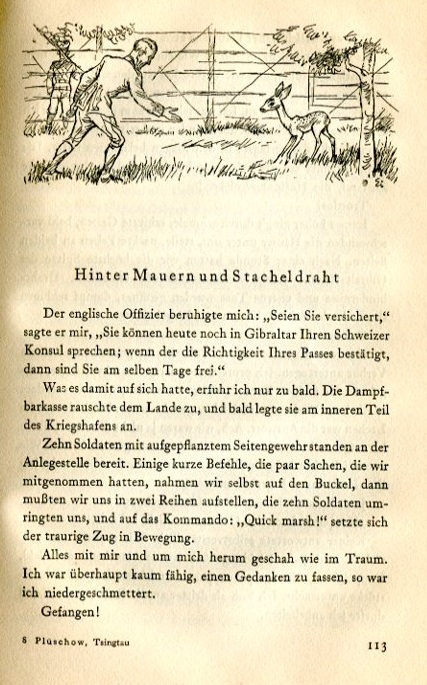
Sure, he would oft growl and become rather exacting, but he was an excellent, reasonable man and an impeccable soldier from head to foot. That was the main thing. He had done everything possible to lighten our heavy load and he had a special interest in game play. That was good. The English interpreter was an unpleasant character. This was Lieutenant Meyer (the insolent car driver), a worthy compliment to my friend Maxsted from the "Andania." He wasn't just a temporary lieutenant, he was also an temporary gentleman. He was born in Frankfurt an Main. Before the war he was a motor lubricant manager and he did nothing to hide his lowly character. I believe the English colonel generally despised him. The English sergeant, with whom we occasionally spoke at the cantine, told us he hoped we didn't believe all English officers were like this Mr. Meyer. One evening at the end of June we witnessed a splendid event. Beyond the barbed wire there were many fallow deer, often in groups up to a hundred, which gently pranced around like goats. A darling little fawn, which had lost its mother, went beyond the barbed wire. It had been enticed and called by us and it got past the barrier and came into the camp. Our joy was great. It was quite a sensation for us. We surrounded, petted, and stroked the fawn (the hunters grumbled.) Eventuallly it was triumphantly carried in the arms of a lieutenant into the junior officer quarters where one of the hunters decided it should be raised to maturity. I don't know how Meyer got wind of this but he quickly summoned the German camp adjutant. With a voice trembling with consternation Meyer asked: |
![]() |
"Lieutenant S., is it true? Is there an animal in the camp?" "Yes, one animal!" "And it got through the barbed wire fence?" "Yes, it just crawled through it." "Oh, this is dreadful!" Mr. Meyer said. His voice seemed to quiet down. "I must see where the hole is which allowed a large animal to crawl through. The German officers must have cut a hole in the barbed wire so they could escape. The animal must be removed immediately!" And so it happened. No joke. Twenty men from the watch with drawn side arms were called up. The German soldier with the innocent little fawn was surrounded by them, and at a quick march the entire entourage was sent to the inner gate of the barrier. The gate was opened, the twenty men plus one German soldier and one fawn entered the in-between space, the so-called sliuce gate. The inner gate was carefully closed, then the outer gate was opened. The German soldier had to set the fawn free, then the entire procession returned. Oh, Mr. Meyer, what a fool you made of yourself! The entire barrier was inspected but not even the smallest hole was discovered through which a man might crawl. Even so, Meyer was not pacified. Besides the arrival of the mail the daily reception of the newspapers was the high point of the day. The Times and Morning Post kept us going and even though they only reported allied victories we got good enough at reading between the lines to give us a sufficient picture of the situation, such as when the newspapers reported |
![]() |
the rage over the sinking of the Lusitania and the anger when the Russians retreated for strategic reasons! We had attached many large maps and smaller though sufficient maps of the theaters of war. Each morning around eleven AM our "General Staff" went to work and repositioned the flags. Often the English colonel stood before the maps and shook his head. |
Imaging and translation by Susan Kriegbaum-Hanks