The Adventures of the Pilot from Tsingtau -Pages 52 - 58


My War Plan

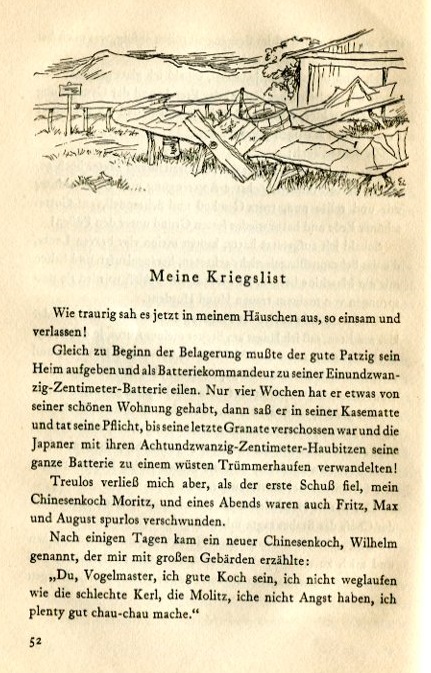
How sad my little house looked, so lonely and abandonned!

Likewise since the beginning of the siege good Patzig also had to give up his home and as Battery Commander rush to his twenty-one centimeter battery. He only had his home for four weeks, then he had to sit in his casemate and perform his duty until he shot off his last shell and the Japanese turned its twenty-eight centimeter howitzer towards the battery and turned it into a pile of rubble!

As the first shots fell my Chinese cook, Moritz, disloyally abandonned me and one night Fritz, Max, and August also disappeared without a trace.

A few days later a new cook, named Wilhelm, arrived. Using big gestures he told me:

"You, Bird Master, I be good cook. I not run away like bad guy, Molitz. I not afraid. I make plenty good chow-chow."
I believed it and promised him five dollars more. And things went well until one day the first enemy grenades exploded in the vicinity of my house and Mr. Wilhelm scrammed like his predecessor.

Now I sat alone with my loyal orderly Dorsch in the ruined house.

The two of us were the only residents in the entire villa compound of Iltis Bay.

Staying there wasn't pleasant or secure because the villas were built on the hill which also held our main batteries and the enemy shelling which went past them ended up into our midst. We were very careful and moved out of the upper floor and set up on the ground floor. To make things worst we had to place our beds in a corner so we weren't lying down near a window. That way we were safe enough. It was a good thing there weren't any big suitcases around.

I didn't stay alone in the air for long.

On the morning of September fifth in inclement weather thick with clouds I suddenly heard the droning of an engine. I ran out of the house to see what it was. Close to our heads a giant biplane shot out from the clouds. I was speechless. And I was spellbound by this spectre. The first explosions barely cracked as I noticed the big red balls under the plane's wings.

It was a Japanese plane!

I must say I was especially moved as I saw the giant enemy colleague soaring so close to my head. In the future that could become an amusing story!

For Tsingtau the appearance of an enemy aircraft was a highly unwelcome surprise.


We hadn't expected that the Japanese would have also brought airplanes.

During the course of the siege the Japanese used a total of eight airplanes, among them four superb and large doubled-winged seaplanes. I truly envied the Japanese for that.

Over the next weeks I often looked up in wonder at the beautiful, new, large, double-decker seaplanes as they cricled the village. With longing I looked up and wished I had such a plane.

The Japanese flew very well and with extraordinary ability. You had to give them that.

It was a blessing that their bomb throwing wasn't as good otherwise it would have gone badly for us.

The Japanese bombers were of strong, recent construction with significant explosive power.

The seaplanes had a mighty advantage. They could go farther out, totally undisturbed by the wind direction, take off easily with endless runway ahead of them. Wind direction made no difference and when they reached their three thousand meter altitude with greater certainty they'd come down on us and whisk by our shelling and machine gun fire.

One of the main targets of the enemy bombers was my airplane shed.

Conditions for my plane soon became so unfavorable that I went out one day and decided to mislead my enemy colleagues.

My designated shed was on the north end of the airfield, easy to spot from above and naturally the Japanese recognized it. Now I quietly built a new shed at the other end of the airfield.


I built it directly in contact with the mountain overhang and covered it with dirt and grass so that it couldn't be seen from above. Then with a lot of finessing using boards, canvas and tin we built a fake plane which looked similar to my Dove from above. Now if an enemy plane came by in the future the drama would be set in motion.

One day the doors of my old shed were open and on the beautiful green grass my replica was displayed for all to see. On another day the doors were closed and nothing could be seen. On yet another day the replica sat on a difference section of the green grass where it could easily take off immediately. Now the enemy planes came and dropped bombs, taking great pains to hit my innocent bird. Meanwhile we sat quietly with the real plane well protected by the overhang at the other end of the air field. We held our stomachs in laughter as we watched how the bombs sought out our guiltless sacrifice.

One day as more than the usual number of bombs fell I took a fragment from one of them, attached my visiting card and wrote: "Greetings to my enemy colleagues! Why are you dropping such hard objects? They could easily land in someone's eye! One shouldn't do that!"

I took this message on my next flight and dropped it in front of the Japanese seaplane station.

But that was just the announcement of my visit.

At the artillery depot one of the men prepared a bomb for me. A truly grand-looking thing! A big two-kilogram tin canister on which was written: "Sietas, Plambeck & Co., the Best Java Coffee." It was filled with dynamite, horseshoe nails and iron fragments.


Beneath it was a spattering devise and above there was a fuse. The spraying iron pellets worked like a primer cap which hits the enemy munitions and creates a massive explosion. The thing seemed quite sinister to me. I'd grab it like a raw egg and I was alway happy when I'd gotten rid of it. It didn't create much damage. Once I hit a torpedo boat and the thing didn't go off. A few times I nearly hit a transport steamer and one time according to a Japanese report I threw a bomb into the middle of a Japanese column and sent thirty yellow fellows to Hades.

On one occasion I was particularly vexed. Early one morning I spotted the camp of our beloved cousins and wanted to add some of my genuine Java coffee to their morning coffee. According to the English report the bomb fell onto their kitchen tent but since the tent was so tauntly mounted the bomb just bounced off and unfortunately didn't detonate.

Soon after the pleasure in tossing bombs eluded me. As I've already said, I was always alone and had plenty to do. The assignment just didn't permit wasting time by throwing bombs.

More often I was meeting my enemy aviation colleagues in the air. I didn't go looking for these encounters. Alone in my slow-climbing, cumbersome Dove I couldn't accomplish anything against the massive double-winged planes which had three men on board. Above all else it was my damned duty to elude them and bring "the" plane of Tsingtau back home in one piece.

One time I was completely engrossed in my observations when my plane began to roll and pitch violently. I thought it was just turbulence caused by steep and jagged cliffs.


Indeed the entire flight in this region had been extrordinarily complicated. Without looking up I continued my observations and only grabbed the control stick in order to steady the plane.

Upon my return I learned to my astonishment that one of the enemy planes might have been flying close above me. Everyone thought I would have been shot down.

The next time I paid closer attention. When I saw my enemy collegue close beneath me I pursued and shot him down with thirty shots from my Luger.

A short time later the same thing nearly happened to me. I was only seventeen thousand meters up and despite great effort was unable to climb higher. I was just above the enemy seaplane base and one of the larger double-deckers took off. I continued my assignment and thought: he'll scramble a long time before he's as high as you!

But after only fourteen minutes as I looked to the left over the wing the enemy soared only a few thousand meters away at the same altitude as me. Nuts! Now it's time to pay close attention and climb higher. But as though hexed, my bird sputtered. I didn't even gain a meter and fifteen minutes later the other plane was a far piece higher than me. He came up along sideways and I discerned his intention to cut off my path back to Tsingtau.

Now it became a contest to see who would get to Tsingtau first.

I won the race.

When I was over my runway I dived steeply and just as I touched down


the first enemy bombs landed right behind me.

Sometimes it's a miracle the way bombs hit!

In Tsingtau there were strict orders that as soon as enemy planes approached everyone was supposed to run for cover so it was possible to avoid injuries. A non-commissioned officer was injured only one time as was one Chinese individual. That was miracle enough! In my area approximately one hundred Chinamen worked and the approach of an enemy plane brought rapid response to find a safe place.

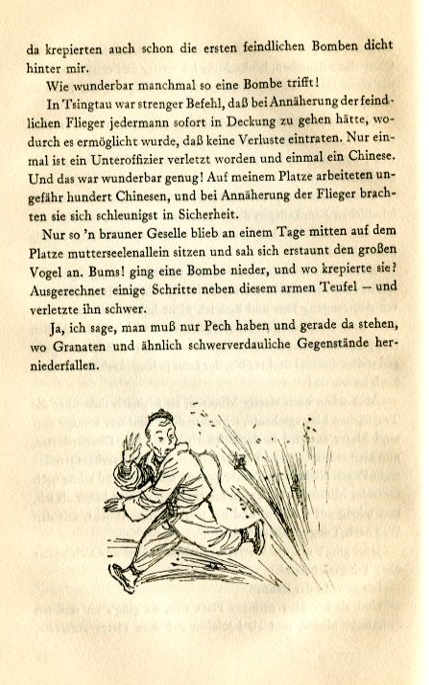
Only one one occasion did a brown assistant sit all by himself on the runway and look in amazement at the big bird. A thud as a bomb descended and where did it explode? A few paces from the poor devil—and severly injured him.

Yes, I say, one need only have bad luck and just stand there for a shell or some similar convoluted device to fall down on him.


Go to pages 59 - 65

Return to Index


Imaging and translation by Susan Kriegbaum-Hanks