The Adventures of the Pilot from Tsingtau -Pages 59 - 65
![]() |
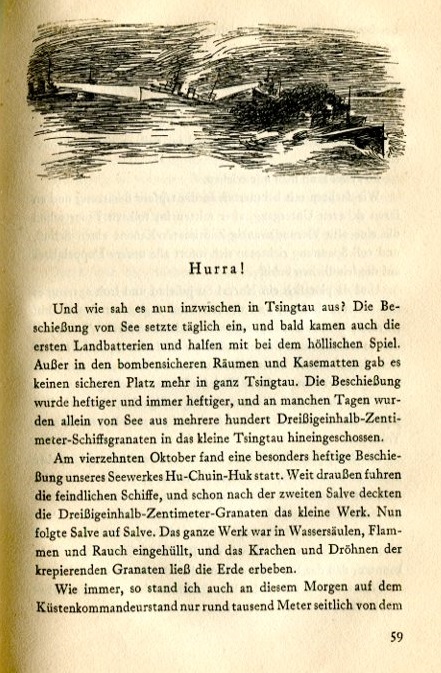
And during the interim how did thing look in Tsingtau? Shelling from the sea commenced daily and soon after the first land batteries arrived to help with the hellish drama. Except for the places and casemate outside the bombing range there was no safe place left in Tsingtau. The shelling got heavier and heavier. On some days from the sea alone came several hundred thirty-and-a-half centimeter shells. On the fourteenth of October there was especially heavy shelling of our seaside facility at Hu-Chuin-Huk. Far out there enemy ships sailed and after the second salvo thirty-and-a-half centimeter shells covered the facility. Now salvo followed salvo. The entire facility was concealed by columns of water, flames and smoke. The explosions of shells shook the earth. As always, I stood on that morning at the coastal commandant station only about a thousand meters |
![]() |
away from the targeted fort and experienced the gruesome drama at close proximity. Often the over meter long dispersion path of the shells whistled uncomfortably close to our heads as we noticed how the fort changed appearance as it sustained hits.The sight was so compelling it defied description. Some things one can only experience. We painfully thought about the brave crew inside and their certain death as amid the dreadful firing the one old twenty-four meter canon issued a single shot. Suspensefully all our binoculars were directed towards the enemy vessels. And then a sudden "hurray!" Our throats tingled with jubilation. Our shell hit the middle of the deck of the English liner "Triumph," which then immediately turned and ran off at its fullest speed. A short time later our second shell fired but it only reached as far as fifty meters behind its stern and landed in the water. The "Triumph" sailed off for repairs in Yokohama after sending a signal to the Japanese Flagship. The three Japanese ships continued their shelling but now from a more respectful distance so it was beyond the range of our old canons. Afternoons around twelve noon the shelling finally ended so that the enemy as well as we could definitively ascertain that the fort had been destroyed and all the occupants had died. The staff of the coastal command immediately rushed to Fort Hu-Chuin-Huk and I followed in my automobile. |
![]() |
Prepared for a dreadful sight, we were greatly astonished to find upon our arrival the entire crew happily collecting exploded shards. We were amazed to see the giant crater left by the enemy shells. The sight was pure joy! Not one individual was injured. No weapons were destroyed and no room constructed to be bomb-secure was hit! The result of the heavy shelling: a cookie tin was blown up and a crewman's shirt, which had been left hanging to dry, was torn apart. And all this amid fifty-one to thirty-one and a half centimeter shelling. A heavy shell hit the thin turret of one of the tanks but since it was a dud it just landed on the iron platform next to the cannon. Now the mystery of our own shots was cleared up. Our shells had only managed a range between one hundred and one hundred, sixty meters. However that was due to the way the guns were employed. After much effort reangling the guns sixteen degrees higher increased the shooting range by between two and three hundred meters. The gun barrel had been secured at the highest point and the brave crew and its valiant battery leader, lieutenant junior grade Hasshagen, persevered despite heavy shelling until they managed to get the ship within range. And the first shot, it made it! Too bad that the Triumph ran off so quickly before the second shot, otherwise it would have sealed the ship's fate that day. |
![]() |
But the ship didn't escape its fate! What we couldn't accomplish our Hersing did a few months later. In early nineteen fifteen Hersing took revenge for us residents of Tsingtau. His U-boat sent the "Triumph" to the bottom of the sea near the Dardenelles. We residents of Tsingtau offer him our thanks! I experienced a particular bond with the officers and crew of Fort Hu-Chuin-Huk. By rights I belonged to them first of all because my runway bordered the fort and secondly they were instrumental in each takeoff but above all else due to my efforts to keep clear of their cannons. And on more than one occasion the fort's people stood ready to jump in the water and save me if they believed I was going to crash. Often I was the guest of the excellent fort commandant, Lieutenant Kopp. We painted in the most colorful tones our eventual arrival in German after the war ended and naturally I assumed that I would march alongside the crew from Fort Hu-Chuin-Huk. Late in the evening of October seventeenth a group of officers stood in breathless anticipation at the coastal command station. Only a few of us knew what was happening. The old torpedo boat S 90 with Lieutenant Commander Brunner was supposed to sail off. Two evenings previously the boat had gone off on a brave night mission in order to distribute mines in locations where Japanese ships had fired upon us. Today he was supposed to fulfill his most difficult and final mission: Break through the line of enemy torpedo boat destroyers and attack one of the enemy ships. |
![]() |
It was a bright night and the moon descended around ten o'clock. The boat was supposed to sail off now. Ten o'clock, ten thirty. The tension was unbearable. No sight of the S 90. Then around eleven o'clock we noticed a long, gray shadow which carefully made its way upon the water beneath the pearly mountains. Soon after sharp seaman's eyes recognized the form of the torpedo boat. "Good sailing, you brave men!" We sent forth our fondest wishes to them. The boat disappeared from sight and then came the dangerous moment when it would break through the enemy line of destroyers. Transfixed our eyes looked out on the open sea, anticipating that at any moment the searchlights might flare on and the enemy guns might fire. All remained quiet. It was twelve o'clock and then twelve thirty. The dread drained from us all. The enemy destroyers hadn't noticed anything. By now the boat must be in enemy territory! Minutes became hours for us. No one dared speak. Then suddenly around one o'clock, far off to the south on the open seas, there was a giant column of fire and searchlights blaring from all sides. After a while a dull rumbling and quaking came to us. Hurray! That was S 90's work! Around one thirty we had the following radio communiqué in hand: "Have attacked enemy cruiser with three torpedos. All torpedos hit. The cruiser immediately flew into the air. |
![]() |
"I'm being hunted down by an enemy flotilla of destroyers. Cut off from return to Tsingtau. Will try to escape to the south and if necessary, will blow the ship up. Signed, Brunner." This telegram alone would speak well for the commander, his officers and crew. A few weeks later, never having expected it, I encountered the crew of S 90 in Nanking. But that's a later story. |
Imaging and translation by Susan Kriegbaum-Hanks