The Adventures of the Pilot from Tsingtau -Pages 65 - 73


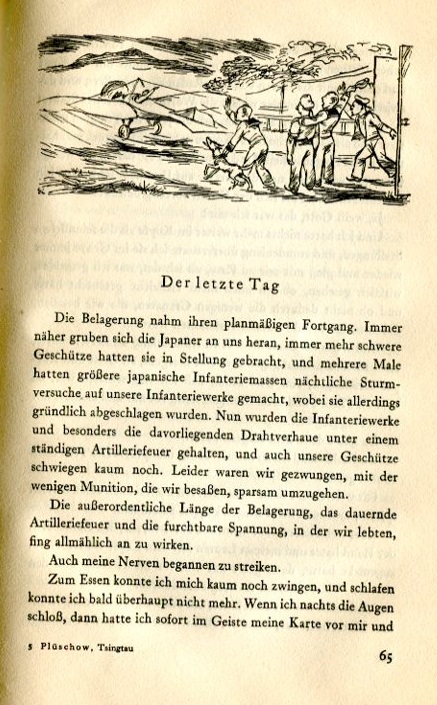
The Last Day

The siege took its planned course. The Japanese continually dug in closer to us and they always brought heavier guns into position. Large masses of Japanese infantry made several nighttime attacks on our infantry weapons and basically wiped everything out. Now the infantry stations and especially the tangled wire lying before it were under constant artillery fire and our own guns were scarcely quiet. Unfortunately due to our limited ammunition we were forced to use it sparingly.

The extraordinary duration of the siege, the persistant artillery fire and the dreadful tension under which we lived began to have its effect.

Even my nerves were on edge.

I could scarcely force myself to eat and I barely got any sleep. When I closed my eyes at night I immediately saw my map in front of me,
and the reserve's border below me torn up by enemy trenches and installations. My head pounded and I heard the drone of the propeller in my ears interspersed by the words from the Chief of Staff:

"Plüschow, consider this. You're more important to Tsingtau right now than our daily bread! Come back to me and bring the plane back in good condition! I also want you to think about how few shells we have and how much we're relying on your observations. Be aware of your responsibilities!"

Indeed, God knows I was aware!

Then my head was filled with the enemy's positions and and I went back and forth for hours checking to see if what I reported was what I actually saw, whether I had perhaps been deceived and whether it was my fault that the few shells we had left were shot off to no avail.

Once I had tortured my brain for a few hours I'd sometimes sleep until around three in the morning, feeling drained mentally and physically. I had barely dozed off when duty called, my mechanic stood before me and told me the plane was ready for takeoff.

No time to dawdle. I was soon at my Dove checking all systems one more time.

Often my nerves would kick up and my stomach would clench. But once I was in the pilot's seat with hand on the throttle I'd nod farewell to my crew and all I'd feel was the peaceful sense and the iron will to complete my mission.

Once the takeoff was behind me and I had happily reached an altitude of a few hundred meters everything was back in order.


One thing would occur to me which especially depressed me. This was the terrible loneliness, the infinite feeling of being alone in my plane. If I had a comrade with me to whom I could have nodded every once in a while it truly would have lifted my spirits.

If I couldn't fly for several days due to bad weather or faulty propeller and couldn't soar over the enemy lines things would have been dreadfully different.

Utter dispair often attacked me in the air. How should I begin to mark down the new positions which were below me? How can I make sense of the tangle of trenches, the zigzagging paths and the enemy installations? Dispirited, I'd let the map slip down.

But that was but for a few seconds.

I'd pull myself together, take my pencil, and look below. Soon after I wouldn't hear or notice anything around me. I would only see the enemy on my charts.

The twenty-seventh of October was a celebration day for us. The following telegram came from His Majesty, the Kaiser:

"Along with me the entire German race looks with pride upon the heroes of Tsingtau, who have held true to the word of their governor and fulfilled their duty. All of you, please know I am grateful!"

There was no one in Tsingtau whose heart did not beat faster. Our supreme war commander had not forgotten his loyal, tiny army here in the far east.

Each man vowed within his heart to fight and to perform his duty unto his last breath so that the Kaiser would be pleased with him.

Soon after October thirty-first, the birthday of the Mikado, was upon us. Through scouts we learned that the


Japanese would definitely take Tsingtau on this day. It's impossible to describe that day.

Up until that night the Japanese had built up their collective land batteries. Around six in the morning of the thirty-first of October, nineteen hundred fourteen all the weapons of the enemy from both land and sea thundered down their terrible iron hail upon us.

First the Japs blew up the petroleum tanks. With no wind giant, thick columns of smoke ominously stood up in the beautiful blue sky. On land from the front line the Japanese fired heavy-gauge, up to twenty-eight centimeter howitzers. The heaviest ships weapons fired from the sea. The hissing and spitting of the howitzer shells, the fizzing of the flat-trajectory guns, the impact of shells and grenades and the detonation of explosives, then the bellowing of expanding schrapnel and the droning of our heavy weapons—these were the sounds let loose by hell itself.

And how did all this activity affect the nearby landscape? Entire hill tops were removed and deep craters were stamped into the ground.

Evening eventually came and the intensity of enemy fire diminished. We as well as the enemy certainly believed that our entire operation had been crushed since it was nothing but a pile of rubble. However as our brave boys in blue hurried to their cannons, which at least in part had to be dug out from under the dirt and boulders, they found that all the weapons were still intact or only slightly damaged.

Then suddenly, in the middle of the night, as we heard and saw how the enemy attack column assembled we began to fire all our iron guns and pelt the


enemy batteries. The enemy retreated with its own annihilating firepower. The results of our firing must have been disasterous for the Japanese.

The intended attack did not occur and the next day the enemy artillery weakly recommenced right around midday. However it was powerful enough that tiny Fort Hu-Chuin-Huk sustained fifty hits from the heavest howitzers.

On this night the Japanese taught us a lesson. And more followed for the next eight dreadful days and nights. The enemy artillery never stopped for more than a minute.

By human reckoning not one of us should have survived this horrid shelling, but surprisingly our casualties were few. The Japanese artillerymen shot well, no surprise there since a portion of their artillery officers had studied shooting with us in Jüterbog. However their ammunition was awful which was fortunate for us.

Despite the heavy shelling and high angle weapons they never succeeded in hitting one of the bomb-secure rooms or an infantry installation. The small number of casualties was due to the enormous number of duds. Grousers in Germany, whom I have unfortunately met, contend that the small number of casualties is due to counting errors in Tsingtau. I wish to present one fact before them:

We only had one line of defense with five small infantry installations, one temporary fortification, and one puny wire barrier.

This line was six thousand meters long and was held by three thousand men. There wasn't a second position any more with men to secure it


because we only numbered a little over four thousand men!

Plus after eight days of heavy artillery shelling the wire barrier was blown away and the temporary fortification was destroyed. There were thirty thousand Japanese whom we had withstood for eight days before they had broken through and forced us to surrender Tsingtau.

In the first days of November we prepared for the final battle.

On the night of November first our loyal ally, the Austrian cruiser "Empress Elizabeth" had fired its last shell and its brave crew blew it up and watched it sink.

A few days later our last ship, the valient little cannon boat, Jaguar, followed.

Thereafter followed our dock and our giant crane. Soon after the boatyard became rubble.

Our guns had shot their last rounds. Some were destroyed by enemy artillery fire. Most of them we blew up ourselves after they had fulfilled their purpose.

On November fifth, nineteen hundred fourteen I too had to take part in the destruction, and this time it involved my double winger. With much effort and the help of former Austrian flight lieutenant Clobuczar and the boatyard crew I had built a wonderful, large, double-winged seaplane. It was now finished and I wanted to fly it and continue my reconnaissance reports with it but I could no longer use the air field, which was only four to five thousand meters away from the enemy and under constant artillery fire.

My double winger was of no use to me.

Unfortunately all our work and effort was for nothing.


In the afternoon I stood before my governor and he said to me:

"We expect the main attack from the Japanese within a few hours! See to it that you succeed in leaving the stronghold with your airplane early in the morning. Above all else I fear the Japanese won't leave you any more time than that.

"May God permit you to get through this. And I thank you for the work you have done for Tsingtau!"

And with that he shook my hand.

"I obediently announced my departure from the stronghold!"

And with this I left.

A brief farewell to my subordinants and comrades followed and a large bunch of personal letters were given to me.

I went to my villa for the last time and took leave of my rooms, of many beloved objects, opened the stall door and let out my little horse and my chickens, and then I went down to my airplane in order to clear it for its last flight.

I sat hunched over my map, memorized it and made calculations.

I went up at night for the last time to the highest knoll where my good friend, Lieutenant Junior Grade Aye's small battery of men had withstood the heaviest artillery fire for weeks and where one had a magnificent view of Tsingtau and the entire reserve. Overcome by the vista if offered I remained sitting at the highest peak for a long time as though held captive. Below me the lightning flashed like tongues of flame and the enemy guns thundered in rage. The artillery and machine gun fire danced in golds bands from sea to sea and fell down on our people in the valleys.


Above my head sounded the snorts, whizzes and hissing of thousands of guns, which had to zoom over this high knoll in order to reach their targets. Our own howitzers droned their final greetings behind me and far beyond the southernmost corner of Tsingtau the twenty-one centimeter cannons of Fort Hsiauniwa bellowed their swan songs.

Distraught to the core of my being I returned to Aye and after a comrade's farewell he wished me good flying. We vigorously shook hands and parted.

I was the last officer in Tsingtau to shake his hand. A few hours later he fell along with his little band of men in heroic battle against the threefold superior forces when they refused to surrender their weapons.

A stunning example of noble heroism.

With the time I still had remaining I stayed with my four brave crewmen with my plane keeping watch lest the Japanese attack and push through, so I could carry out my assignment.

Early in the morning of November sixteenth, nineteen hundred fourteen as the moon shone brightly my plane stood ready for takeoff and the propeller satisfactorily murmurred its morning song.

No more time to lose. The field was in hellishly bad condition due to the Japanese shells and schrapnel. I checked my plane over one more time, vigorously shook the hands of my brave crew in farewell, petted the head of my loyal dog, and gave the plane full gas. The Dove shot off into the night like an arrow.

Then suddenly when I was thirty meters off the ground and over the middle of the field my plane sustained a dreadful jolt


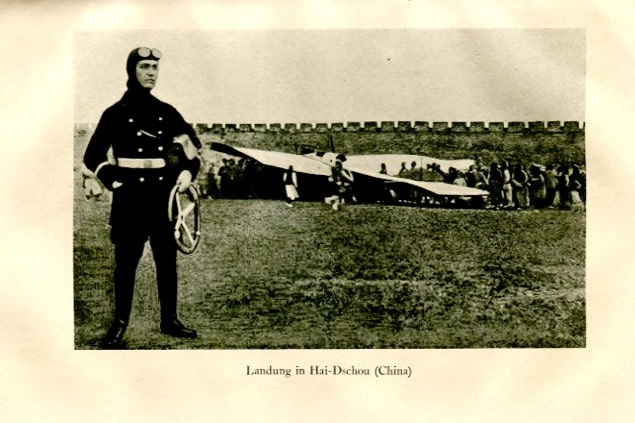
Caption under photograph reads: Landing in Hai-Dschou (China)


and it was only by using iron force that I could correct the machine and prevent a crash. An enemy shell had just exploded underneath me and the force of detonation could have hurled me to the ground.

But praise God! Except for a fist-sized hole which the shell splinter had torn through my left wind there was no other damage.

Now all that came towards me was the usual schrapnel. This was the final farewell by the Japanese and their English brethren to me.

As I climbed high enough I looked back one more time.

There laid beloved, little Tsingtau which had gone through so much yet still survived. Here was our dear second home, a paradise on earth!

Until I reached my final, lonely altitude I heard the drone of guns, the bang of shells and the clatter of cannons and machine guns.

An endless sea of flickering lightning allowed one to see both lines of battle. Everywhere there were signs of the continuing attacks and the desparate counter offensives.

Would we be able to withstand this third attack?

I waved my hand. Farewell Tsingtau! Live well, you loyal comrades who fight down below!

This farewell was infinitely difficult for me. It choked me. Quickly I altered course and headed for Cape Jäschke.

As the sun rose in all its glory I soared high up in the blue ether above the wild southern ridges.

I had succeeded in a modern break from the blockade!


Go to pages 74 - 82

Return to Index


Imaging and translation by Susan Kriegbaum-Hanks