The Adventures of the Pilot from Tsingtau -Pages 74 - 82


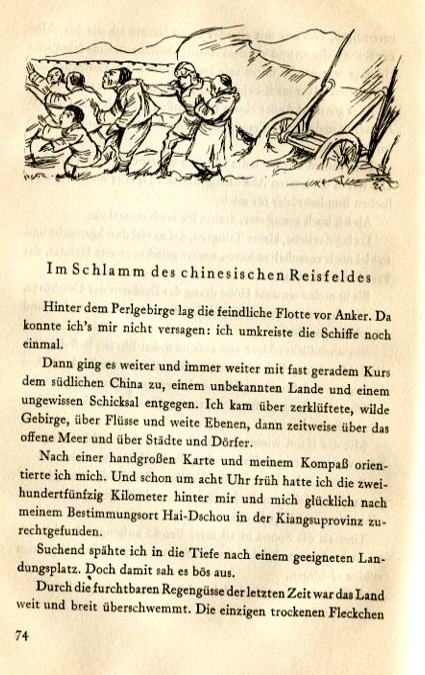
In the Muck of a Chinese Rice Paddy

The flotilla stood at anchor behind the Pearl Mountain. I couldn't help myself. I circled the ships one more.

Then I flew farther and farther away towards southern China, to unknown lands and an uncertain fate. I went over wild, jagged cliffs, over rivers and broad expanses of land then after a time out over the open sea and over towns and villages.

I oriented myself with a large hand-held map and my compass. By eight in the morning I had put two hundred and fifty kilometers behind me and good fortune guided me to my destination of Hai-Dschou in the Kiangsu Province.

I searched below for a designated landing field but it didn't seem in good condition.

In previous days the countryside had been flooded by torrential downpours. The only dry spots

were covered in houses or Chinese burial mounds. Finally I discovered a tiny, perhaps two hundred meter long and twenty meter wide field closed in on two sides by deep ruts and high walls with the front and back bordered by rivers.

The landing was damned difficult, but I couldn't stay up in the air forever.

Aside from the fact that I was in the middle of China and not in Germany, I was happy to have found this place in which to land.

I descended in a big spiral and after a time of gliding during which my plane sank fast due to the heat, I stood in a marshy rice field at eight forty-five in the morning.

The soil was so wet and sticky that my landing gear sank and glued my wheels to the ground. With a mighty jerk my plane fell on its nose and almost flipped over.

The propeller flew off in pieces but thank God, my landing gear did not break off.

The sudden silence all around me seemed quite strange. After so many weeks there finally was no droning of guns, crashing of exploding shells, no hissing and booming of splintering schrapnel.

With its tail in the air and its beak deep in the mud my little Dove stood peacefully in the sunshine.

In the distance stood a crowd of Chinese. Men, women, and many, many children stood in fearful astonishment.

They, like all other Chinese whose lands I had flown over, could scarcely grasp the wonder of it. I was


the first pilot here and all thought that an evil spirit had come in the form of a human to wreak havoc.

As I climbed out of my machine and tried to gesture to a few people, there was not stopping them. They all ran away screaming and howling, the men at the front, and the fallen children who, to the men's way of thinking had been abandoned as sacrifices to the devil. In reality my appearance could not have elicited such great terror in darkest Africa.

Determined, I ran behind the crowd and grabbed three or four Chinese by their braids and dragged the screamers back to my plane in order to show them that the big bird wouldn't hurt them.

After a few minutes this helped and as soon as I gave them a few coins they thought that a good spirit had soared down. Willingly they helped me to bring the plane back into a horizontal position. When the others saw this they came back in such masses that I was amazed that the plane wasn't crushed.

The astonishment of the Chinese. Touching and feeling! Snorting and laughing! Only someone who knows how childlike the Chinese are can imagine what a delightful situation I found myself in.

Surrounded by a horde of nature's children, I sat tentatively in my cockpit on my tin chest with the secret documents inside, my Mauser pistol next to me for security, and awaited for what would come to pass.

Each attempt to communicate with the Chinese was useless. The guys just happily grinned or simply laughed at me.

After some time in this silly situation I was startled by a hefty, "Good morning, Sir!" Next to me stood a man


who introduced himself as Dr. Morgan from the American Mission. After a warm greeting and a firm handshake I quickly told Dr. Morgan about my situation and asked him for help, especially since he spoke fluent Chinese.

I soon noticed that I found myself in a secure position.

My giant Chinese passport, which I had brought with me from Tsingtau, was immediately taken to the Mandarin. After an hour a troop of forty soldiers came out of the local barracks, which were only ten minutes away, and my plane was placed under guard.

Then I gladly accepted a breakfast invitation from Dr. Morgan, and went with him to the mission with all my things which weren't nailed down. I received the warmest of welcomes and met Mrs. Morgan, plus Mrs. Rice, wife of the American missionary, and a Mr. G., who most hospitably went to great efforts on my account.

Just as I sat down to breakfast a Chinese officer was brought to me who told me that an honor guard from the company would be placed in front of the house and that he had received instructions from the Mandarin to see to my every wish and well-being. The Mandarin himself would personally visit me in half an hour.

I was pleased to receive so much attention.

Ten minutes later there was another visitor, this time the leader of Hai-Dschou, who wanted to deliver his own greeting.

The situation was unique. I sat among these old and venerable Chinese gentlemen after endless deep bows and mumbled greetings were exchanged.


The conversation soon becane quite lively as Mr. Morgan worked as interpreter.

Now came the questions. Where did I come from? What did Tsingtau look like? Was it really true that I came from the air? How long did it take and what kind of magic was at work for me to fly? The questions could hardly be answered even though the interpreter exerted great effort. There were so many things these good sons of the Middle Kingdom could not understand.

A small incident also occurred.

As we sat and conversed the lady of the house came for a visit. Along with her were ten or twelve lovely, little Chinese women clothed in magnificent, colorful silk pants and robes who scurried and dashed about. Two or three of these tiny creatures stood before the open door in curiosity and terror. With open mouths and large, astonished eyes they stared at me. A curt shout from Mrs. Morgan shocked them into leaving. I later found out the reason for this strange behavior. For a proper Chinese lady it is a great faux pas to offend a male guest by staring at him!

The three little sinners received a stern lecture. I must say I wasn't pleased with this custom. I would have been happy to have these lovely, polished little damsels look upon me.

My hostess also told me she was also assailed with questions by the Chinese women. Above all else they wanted to know the nature of the evil spirit which so threatened their city this morning with its screeching and booming. They were told that a man sat in the device which had come from Tsingtau.


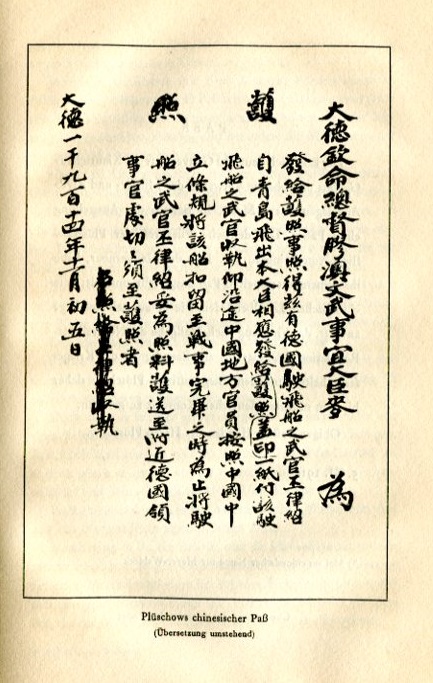
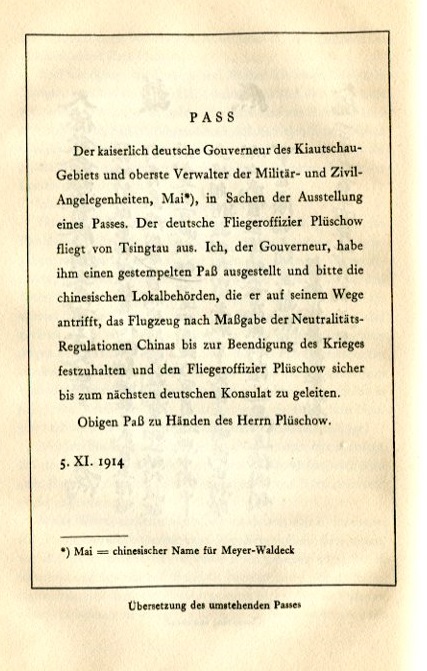
Caption under photo reads: Plüchow's Chinese Passport (Translation follows)


Passport

The Imperial German Governor of Kiautschau District and Chief Administrator of the Military and Civilian Affairs, Meyer-Waldeck, issues a passport. The German Flight Officer Plüschow flies from Tsingtau. I, the governor, have issued him this stamped passport and ask the local Chinese authorities he may meet along the way to secure his plane in accordance with China's Neutrality Regulations until the end of the war and grant Flight Officer Plüschow safe passage to the nearest German Consulate.

This passport is issued into the Hands of Mr. Plüschow.

November 5, 1914


At this they simply smiled and said, even if we were as stupid as the white men think, we wouldn't be stupid enough to believe such nonsense!

In any event Mrs. Morgan assured me that over the next two years the superstitious Chinese would blame all miscarriages, bad harvests, and misfortunes on the appearance of the airplane. The medicine men would especially make use of the event.

Around eleven in the morning the Lord Mandarin appeared in person amid much ceremony, drum rolling and horn tooting. Extraordinarily well-fed with head immaculately shaved and clothed in magnificent attire he entered with great dignity. The greeting was exceptionally solemn. There was no end to the deep, almost to the ground bowing.

After the Mandarin asked about my well-being and requests he assured me in the warmest manner of his full support. Then he left.

His departure for home met with the same fanfare.

As soon as I had made my own official visits and had dinner with the Mandarin I started to disassemble my plane.

This was easier said than done. All I had brought along was a wrench so now I had to search for tools. Here I was in China in a part of the country which looked like it had a thousand years ago. Wrenches and screwdrivers were unknown entities.

Eventually I found in the American Mission an ax and a puny saw-like item.

And so the work commenced. Since I wanted to save my hundred horsepower Mercedes engine from destruction I hoisted and sawed from tail to nose. This showed just how good German work is. It took me four hours to take apart the motor. That's how tightly everything was put together.


In accordance with the laws of neutrality I surrendered the motor to the Mandarin for safekeeping.

Then came the saddest part.

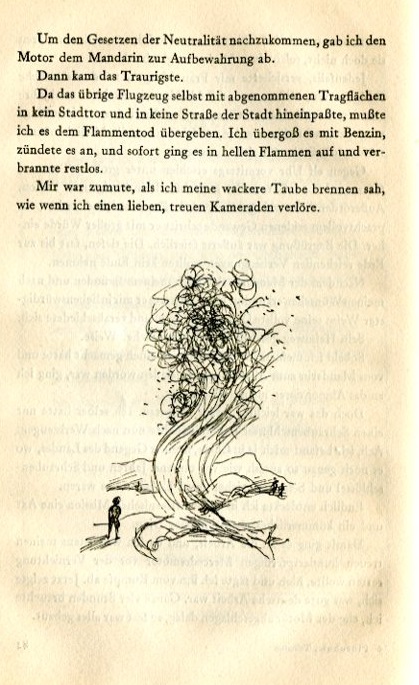
Since the rest of the airplane with its wings taken off still couldn't get through the small city gate or the tiny city streets I had to surrender it to a fiery death. I poured gas all over it and lit it. Immediately bright flames soared up and burned it to bits.

As I watched my brave Dove burn I felt as though I had lost a beloved and loyal comrade.


Go to pages 83 - 102

Return to Index


Imaging and translation by Susan Kriegbaum-Hanks