Supplement to The Adventures of the Pilot from Tsingtau - Newspaper articles from various databases


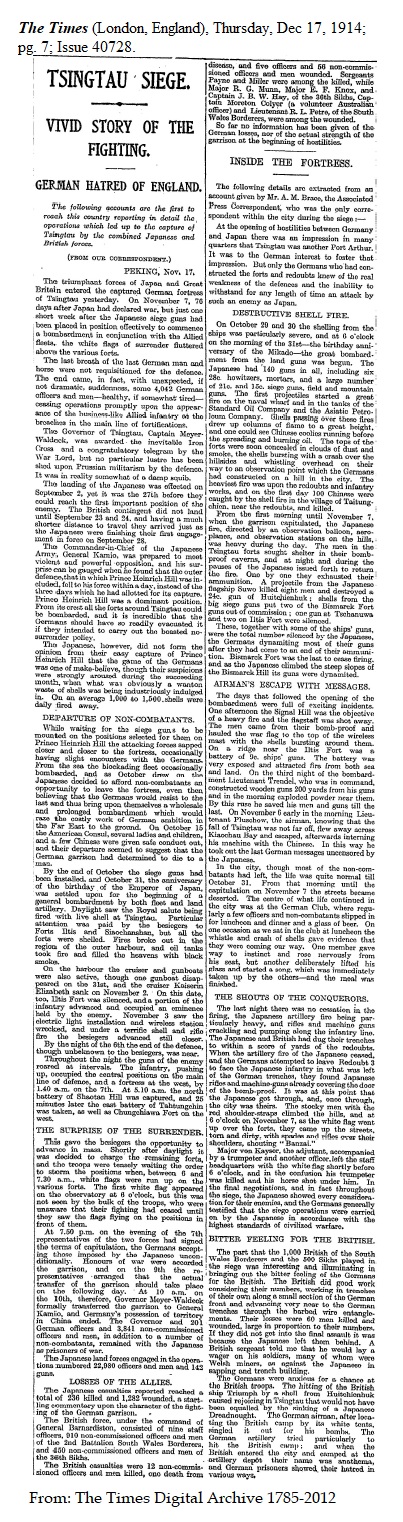
The Times (London, England), Thursday, December 17, 1914, p. 7

TSINGTAU SIEGE

_____

VIVID STORY OF THE FIGHTING.

_____

GERMAN HATRED OF ENGLAND

The following accounts are the first to reach this country reporting in detail the operations which led up to the capture of Tsingtau by the combined Japanese and British forces.
               (From our Correspondent.)

                                             Peking, Nov. 17.

The triumphant forces of Japan and Great Britain entered the captured German fortress of Tsingtau yesterday. On November 7, 76 days after Japan had declared war, but just one short week after the Japanese siege guns had been placed in position effectively to commence a bombardment in conjunction with the Allied fleets, the white flags of surrender fluttered above the various forts.

The last breath of the last German man and horse were not requisitioned for the defence. The end came, in fact, with unexpected, if not dramatic, suddenness, some 4042 German officers and men—healthy, if somewhat tired—ceasing operations promptly upon the appearance of the business-like Allied infantry at the breaches in the main line of fortifications.

The Governor of Tsingtau, Captain Meyer-Waldeck, was awarded the inevitable Iron Cross amd a congratulatory telegram by the War Lord, but no particular lustre has been shed upon Prussian militarism by the defence. It was in reality somewhat of a damp squib.

The landing of the Japanese was effected on September 2, yet it was the 27th before they could reach the first important position of the enemy. The British contingent did not land until September 23 and 24, and having a much shorter distance to travel they arrived just as the Japanese were finishing their first engagement in force on September 28.

The Commander-in-Chief of the Japanese Army, General Kamio, was prepared to meet violent and powerful opposition, and his surprise can be gauged when he found that the outer defence, that in which Prince Heinrich Hill was included, fell to his force within a day, instead of the three days which he had allotted for its capture. Prince Heinrich Hill was a dominant position. From its crest all the forts around Tsingtau could be bombarded, and it is incredible that the Germans should have so readily evacuated it if they intended to carry our the boasted no-surrender policy.

The Japanese, however, did not form the opinion from their easy capture of Prince Heinrich Hill that the game of the Germans was one of make-believe, though their suspicions were strongly aroused during the succeeding month, when what was obvously a wanton waste of shells was being industriously indulged in. On an average 1,000 to 1,500 shells were daily fired away.

DEPARTURE OF NON-COMBATANTS.

While waiting for the siege guns to be mounted on the positions selected for them on Prince Heinrich Hill the attacking forces sapped closer and closer to the fortress, occasionally having slight encounters with the Germans. From the sea the blockading fleet occasionally bombarded, and as October drew on the Japanese decided to afford non-combatants an opportunity to leave the fortress, even then believing that the Germans would resist to the last and thus bring upon themselves a wholesale and prolonged bombardment which would raze the costly work of German ambition in the Far East to the ground. On October 15 the American Consul, several ladies and children, and a few Chinese were given safe conduct out, and their departure seemed to suggest that the German garrison had determined to die to a man.

By the end of October the siege guns had been installed, and October 31, the anniversary of the birthday of the Emperor of Japan, was settled upon for the beginning of a general bombardment by both fleet and land artillery. Daylight saw the Royal salute being fired with live shell at Tsingtau. Particular attention was paid by the besiegers to Forts Iltis and Siaochanshan, but all the forts were shelled. Fires broke out in the region of the outer harbour, and oil tanks took fire and filled the heavens with black smoke.

On the harbour the cruiser and gunboats were also active, though one gunboat disappeared on the 31st, and the cruiser Kaiserin Elizabeth sank on November 2. On this date, too, Iltis Fort was silenced and a portion of the infantry advanced and occupied an eminence held by the enemy. November 3 saw the electric light installation and wireless station wrecked, and under a terrific shell and rifle fire the besiegers advanced still closer.

By the night of the 6th the end of the defence, though unbeknownst to the besiegers, was near.

Throughout the night the guns of the enemy roared at intervals. The infantry, pushing up, occupied the central positions on the main line of defence, and a fortress at the west, by 1:40 a.m. on the 7th. At 5:10 a.m. the north battery of Shaotan Hill was captured and 25 minutes later the east battery of Tahtungehin was taken, as well as Chungchiawa Fort on the west.

THE SURPRISE OF THE SURRENDER.

This gave the besiegers the opportunity to advance in mass. Shortly after daylight it was decided to charge the remaining forts, and the troops were tensely waiting the order to storm the positions when, between 6 and 7:30 a.m., white flags were run up on the various forts. The first white flag appeared on the observatory at 6 o'clock, but this was not seen by the bulk of the troops, who were unaware that their flighting had ceased until they saw the flags on the positions in front of them.

At 7:50 p.m. on the evening of the 7th representatives of the two forces had signed the terms of capitulation, the Germans accepting those imposed by the Japanese unconditionally. Honours of war were accorded the garrison, and on the 9th the representatives arranged that the actual transfer of the garrison should take place on the following day. At 10 a.m. on the 10th, therefore, Governor Meyer-Waldeck formally transferred the garrison to General Kamio and Germany's possession of territory in China ended. The Govenor and 201 German officers and 3,841 non-commissioned officers and men, in addition to a number of non-combatants, remained with the Japanese as prisoners of war.

The Japanese land forces engaged in the operations numbered 22,980 officers and men and 142 guns.

LOSSES OF THE ALLIES.

The Japanese casualties reported reached a total of 236 killed and 1,282 wounded, a startling commentary upon the character of the fighting of the German garrison.

The British force, under the command of General Barnardiston, consisted of nine staff officers, 910 non-commissioned officers and men of the 2nd Battalion South Wales Borderers, and 450 non-commissioned officers and men of the 36th Sikhs.

The British casualties were 12 non-commissioned officers and men killed, one death from disease, and five officers and 56 non-commissioned officers and men wounded. Sergeants Payne and Miller were among the killed, while Major R.G. Munn, Major E.F. Knox, and Captain J.B.W. Hay of the 36th Sikhs, Captain Moreton Colyer (a volunteer Australian officer) and Lieutenant R.P. Petre, of the South Wales Borderers, were among the wounded.

So far no information has been given of the German losses, nor of the actual strength of the garrison at the beginning of the hostilities.

_____

INSIDE THE FORTRESS.

_____

The following details are extracted from an account given by Mr. A.M. Brace, the Associated Press Correspondent, who was the only correspondent within the city during the siege:
   At the opening of hostilities between Germany and Japan there was an impression in many quarters that Tsingtau was another Port Arthur. It was to the German interest to foster that impression. But only the Germans who had constructed the forts and redoubts knew of the real weakness of the defences and the inability to withstand for any length of time an attack by such an enemy as Japan.

DESTRUCTIVE SHELL FIRE

On October 29 and 30 the shelling from the ships was particularly severe, and at 6 o'clock on the morning of the 31st—the birthday anniversary of the Mikado—the great bombardment from the land guns was begun. The Japanese had 140 guns in all, including six 28c. howitzers, mortars, and a large number of 21c. and 15c. siege guns, field and mountain guns. The projectiles started a great fire on the naval wharf and in the tanks of the Standard Oil Company and the Asiatic Petroleum Company. Shells passing over these fires drew up columns of flame to a great height, and one could see Chinese coolies running before the spreading and burning oil. The tops of the forts were soon concealed in clouds of dust and smoke, the shells bursting with a crash over the hillsides and whistling overhead on their way to an observation point which the Germans had constructed on a hill in the city. The heaviest fire was upon the redoubts and infantry works, and on the first day 100 Chinese were caught by the shell fire in the village of Taitungchien, near the redoubts, and killed.

From the first morning until November 7, when the garrison capitulated, the Japanese fire, directed by an observation balloon, aeroplanes, and observation stations on the hills, was heavy during the day. The men in the Tsingtau forts sought shelter in the bombproof caverns, and at night and during the pauses of the Japanese issued forth to return the fire. One by one they exhausted their ammunition. A projectile from the Japanese flagship Suwo killed eight men and destroyed a 24c. gun of Huitchienhuk: shells from the big siege guns put two of the Bismarck Fort guns out of commission; one gun at Tschanuwa and two on Iltis Fort were silenced.

These, together with some of the ships' guns, were the total number silenced by the Japanese, the Germans dynamiting most of their guns after they had come to an end of their ammunition. Bismarck Fort was the last to cease firing, and as the Japanese climbed the steep slopes of the Bismarck Hill its guns were dynamited.

AIRMAN'S ESCAPE WITH MESSAGES.

The days that followed the opening of the bombardment were full of exciting incidents. One afternoon the signal hill was the objective of a heavy fire and the flagstaff was shot away. The men came from their bomb-proof and hauled the war flag to the top of the wireless mast with the shells bursting around them. On a ridge near the Iltis Fort was a battery of 9c. ships' guns. The battery was very exposed and attracted fire from both sea and land. On the third night of the bombardment Lieutenant Trendel, who was in command, constructed wooden guns 200 yards from his guns and in the morning exploded powder near them. By this ruse he saved his men and guns till the last. On November 6 early in the morning Lieutenant Pluschow, the airman, knowing that the fall of Tsingtau was not far off, flew away across Kiaochau Bay and escaped, afterwards interning his machine with the Chinese. In this way he took out the last German messages uncensored by the Japanese.

In the city, though most of the non-combatants had left, the life was quite normal till October 31. From that morning until the capitulation on November 7 the streets became deserted. The centre of what life continued in the city was at the German Club, where regularly few officers and non-combatants slipped in for luncehon and dinner and a glass of beer. On one occasion as we sat in the club at luncheon the whistle and crash of shells gave evidence that they were coming our way. One member gave way to instinct and rose nervously from his seat, but another deliberately lifted his glass and started a song, which was immedately taken up by the others—and the meal was finished.

THE SHOUTS OF THE CONQUERORS.

The last night there was no cessation in the firing, the Japanese artillery fire being particularly heavy, and rifles and machine guns crackling and pumping along the infantry line. The Japanese and British had dug their trenches to withing a score of yards from the redoubts. When the artillery fire of the Japanes ceased, and the Germans attempted to leave Redoubt 3 to face the Japanese infantry in what was left of the German trenches, they found Japanes rifles and machine guns already covering the door of the bomb-proof. It was at this point that the Japanese got through, and, once through, the city was theirs. The stocky men with the red shoulder straps climbed the hills, and at 6 o'clock on November 7, as the white flag went up over the forts, they came up the street, torn and dirty, with spades and rifles over their shoulders, shouting "Banzai."

Major von Kayser, the adjutant, accompanied by a trumpeter and another officer, left the staff headquarters with the white flag shortly before 6 o'clock and in the confusion his trumpeter was killed and his horse was shot under him. In the final negotiations, and in fact throughout the siege operations were carried on by the Japanese in accordance with the highest standards of civilized warfare.

BITTER FEELING FOR THE BRITISH.

The part that the 1,000 British of the South Wales Borderers and the 500 Sikhs played in the siege was interesting and illuminating in bringing out the bitter feeling of the Germans for the British. The British did good work considering their numbers, working in trenches of their own along a small section of the German front and advancing very near to the German trenches through the barbed wire entanglements. Their losses were 60 men killed and wounded, large in proportion to their numbers. If they did not get into the final assault it was because the Japanese left them behind. A British sergeant told me that he would lay a wager on his soldiers, many of whom were Welsh miners, as against the Japanese in sapping and trench building.

The Germans were anxious for a chance at British troops. The hitting of the British ship Triumph by a shell from Huitchienhuk caused rejoicing in Tsingtau that would not have been equalled by the sinking of a Japanese Dreadnought. The German airman, after locating the British camp by its white tents, singled it out for his bombs. The German artillery tried particularly to hit the British camp; and when the British entered the city and camped at the artillery depôt their name was anathema, and German prisoners showed their hatred in various ways.
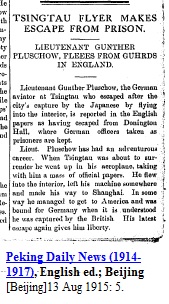
TSINGTAU FLYER MAKES
ESCAPE FROM PRISON

_____

Lieutenant Gunther
Pluschow flees from Guards
in England

_____

Lieutenant Gunther Pluschow, the German aviator at Tsingtau who escaped after the city's capture by the Japanese by flying into the interior, is reported in the English papers as having escaped from Donington Hall, where German officers taken as prisoners are kept.

Lieut. Pluschow has had an adventurous career. When Tsingtau was about to surrender he went up in his aeroplane, taking with him a mass of official papers. He flew into the interior, left his machine somewhere and made his way to Shanghai. In some way he managed to get to America and was bound for Germany when it is understood he was captured by the British. His latest escape again gives him liberty.


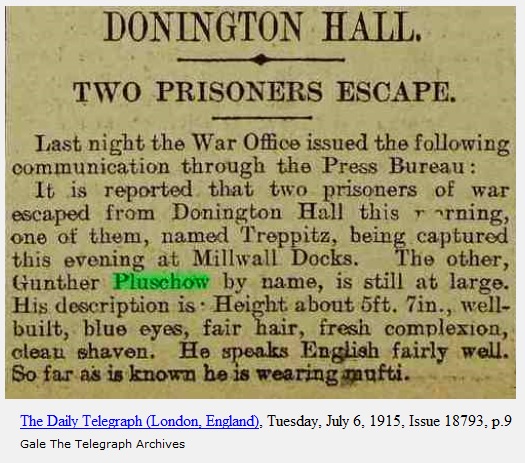
The Daily Telegraph (London, England), Tuesday, July 6, 1915 p. 9

DONINGTON HALL.

_____

TWO PRISONERS ESCAPE

_____

Last night the War Office issued the following communication through the Press Bureau:
It is reported that two prisoers of war escaped from Donington Hall this morning, one of them, named Treppitz, being captured this evening at Millwall Docks. The other, Gunther Pluschow by name, is still at large. His description is: Height about 5 ft. 7 in., well built, blue eyes, fair hair, fresh complexion, clean shaven. He speaks English fairly well. So far as is known he is wearing mufti.


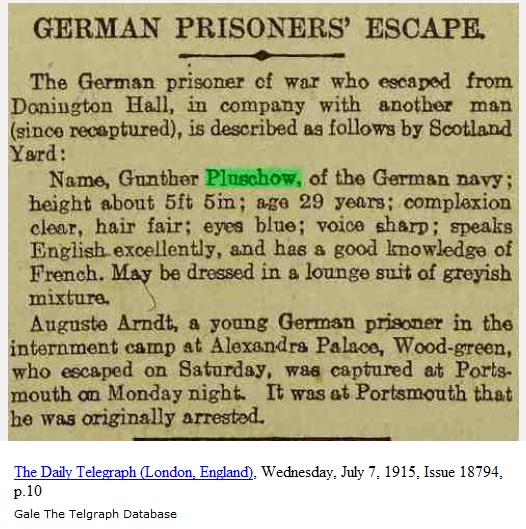
The Daily Telegraph (London, England), Wednesday, July 7, 1915 p. 10

GERMAN PRISONERS' ESCAPE.

_____

The German prisoner of war who escaped from Donington Hall, in company with another man (since recaptured), is described as follows by Scotland Yard:

Name, Gunther Pluschow, of the German navy; height about 5ft 5in; age 29 years; complexion clear, hair fair, eyes blue; voice sharp; speaks English excellently, and has a good knowledge of French. May be dressed in a lounge suit of greyish mixture.

August Arndt, a young German prisoner in the internment camp at Alexandra Palace, Wood-green, who escaped on Saturday, was captured at Portsmouth on Monday night. It was at Portsmouth that he was originally arrested.


The Naples News (Naples, New York), September 29, 1915, p. 2

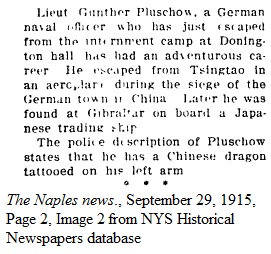
Lieut. Gunther Pluschow, a German naval officer who has just escaped from the internment camp at Donington hall, has had an adventurous career. He escaped from Tsingtao in an aeroplane during the siege of the German town in China. Later he was found at Gibraltar on board a Japanese trading ship.

The police description of Pluschow states that he has a Chinese dragon tattooed on his left arm.


The Daily Telegraph (London, England), Monday, February 2, 1931, p.8

NOTED AIRMAN
KILLED

_____

A DONINGTON HALL
ESCAPE RECALLED

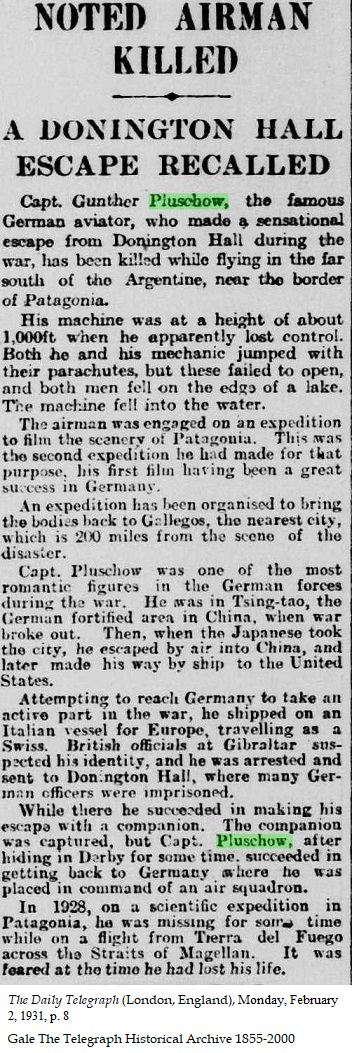
Capt. Gunther Pluschow, the famous German aviator, who made a sensational escape from Donington Hall during the war, has been killed while flying in the far south of the Argentine, near the border of Patagonia.

His machine was at a height of about 1000 ft when he apparently lost control. Both he and his mechanic jumped with their parachutes, but these failed to open, and both men fell on the edge of a lake. The machine fell into the water.

The airman was engaged on an expedition to film the scenery of Patagonia. This was the second expedition he had made for that purpose, his first film having been a great success in Germany.

An expedition has been organized to bring the bodies back to Gallegos, the nearest city, which is 200 miles from the scene of the disaster.

Capt. Pluschow was one of the most romantic figures in the German forces during the war. He was in Tsing-tao, the German fortified area in China, when war broke out. Then, when the Japanese took the city, he escaped by air into China, and later made his way by ship to the United States.

Attempting to reach Germany to take an active part in the war, he shipped on an Italian vessel for Europe, travelling as a Swiss. British officials at Gibraltar suspected his identity, and he was arrested and sent to Dontington Hall, where many German officers were imprisoned.

While there he succeeded in making his escape with a companion. The companion was captured, but Capt. Pluschow, after hiding in Derby for some time, succeeded in getting back to Germany where he was placed in command of an air squadron.

In 1928, on a scientific expedition in Patagonia, he was missing for some time while on a flight from Tierra del Fugo across the Straits of Magellan. It was feared at the time he had lost his life.


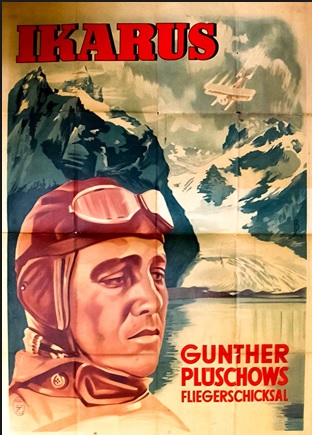
1932 movie post for Ikarus: Gunther Plüschow's Fate as a Pilot


The North-China Herald and Supreme Court & Consular Gazette (1870-1941), February 24, 1931, p.257

ACE OF TSINGTAO
MOURNED

Local Residents Generous
Tributes

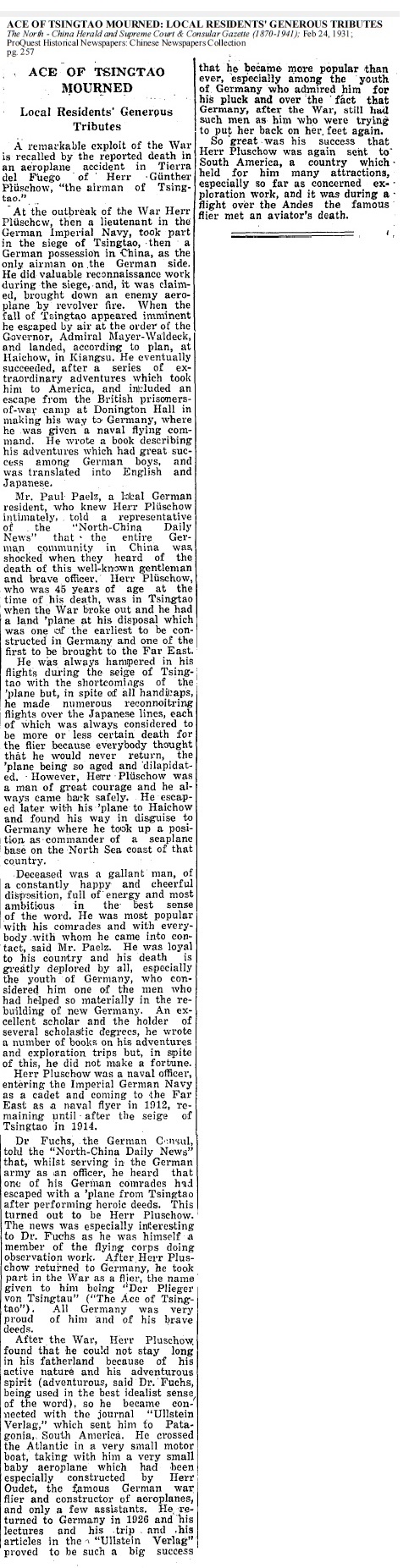
A remarkable exploit of the War is recalled by the reported death in an aeroplane accident inTierra del Fuego of Herr Günther Plüschow, "the airman of Tsingtao."

At the outbreak of the War Herr Plüschow, then a lieutenant in the German Imperial Navy, took part in the siege of Tsingtao, then a German possession in China, as the only airman on the German side. He did valuable reconnaissance work during the siege and, it was claimed, brought down an enemy aeroplane by revolver fire. When the fall of Tsingtao appeared imminent he escaped by air at the order of the Governor, Admiral Mayer-Waldeck, and landed, according to plan, at Haichow, in Kiangsu. He eventaully succeeded, after a series of extraordinary adventures which took him to America, and included an escape from the British prisoners-of-war camp at Donington Hall in making his way to Germany, where he was given a naval flying command. He wrote a book describing his adventures which had great success among German boys, and was translated into English and Japanese.

Mr. Paul Paelz, a local German resident, who knew Herr Plüschow intimately, told a representative of the "North-China Daily News" that the entire German community in China was shocked when they heard of the death of this well-known gentleman and brave officer. Herr Plüschow, who was 45 years old at the time of his death, was in Tsingtao when the War broke out and he had a land 'plane at his disposal which was one of the earliest to be constructed in Germany and one of the first to be brought to the Far East.

He was always hampered in his flights during the siege of Tsingtao with the shortcomings of the 'plane but, in spite of all handicaps, he made numerous reconnoitring flights over the Japanese lines, each of which was always considered to be more or less certain death for the flier because everybody thought that he would never return, the 'plane being so aged and dilapidated. However, Herr Plüschow was a man of great courage and he always came back safely. He escaped later with his 'plane to Haichow and found his way in disguise to Germany where he took up a position as commander of a seaplane base on the North Sea coast of that country.

Deceased was a gallant man, of a constantly happy and cheerful disposition, full of energy and most ambitious in the best sense of the word. He was most popular with his comrades and with everybody with whom he came into contact, said Mr. Paelz. He was loyal to his country and his death is greatly deplored by all, especially the youth of Germany, who considered him one of the men who had helped so materially in the rebuilding of new Germany. An excellent scholar and the holder of several scholastic degrees, he wrote a number of books on his adventures and exploration trips but, in spite of this, he did not make a fortune.

Herr Plüschow was a naval officer, entering the Imperial German Navy as a cadet and coming to the Far East as a naval flyer in 1912, remaining until after the seige [sic] of Tsingtao in 1914.

Dr. Fuchs, the German consul, told the "North-China Daily News" that, whilst serving in the German army as an officer, he heard that one of his German comrades had escaped with a 'plane from Tsingtao after performing heroic deeds. This turned out to be Herr Plüschow. The news was especially interesting to Dr. Fuchs as he was himself a member of the flying corps doing observation work. After Herr Plüschow returned to Germany, he took part in the War as a flier, the name given to him being "Der Plieger [sic] von Tsingtau" ("The Ace of Tsingtau"). All Germany was very proud of him and of his brave deeds.

After the War, Herr Plüschow found that he could not stay long in his fatherland because of his active nature and his adventurous spirit (adventurous, said Dr. Fuchs, being used in the best idealist sense of the word), so he became connected with the journal "Ullstein Verlag," which sent him to Patagonia, South America. He crossed the Atlantic in a very small baby aeroplane which had been especially constructed by Herr Oudet [Ernst Udet], the famous German war flier and constructor of aeroplanes, and only a few assistants. He returned to Germany in 1926 and his lectures and his trip amd his articles in the "Ullstein Verlag" proved to be such a big success that he became more popular than ever, especially among the youth of Germany who admired him for his pluck and over the fact that Germany, after the War, still had such men as him who were trying to put her back on her feet again.

So great was his success that Herr Plüschow was again sent to South America, a country which held for him many attractions, especially so far as concerned exploration work, and it was during a flight over the Andes the famous flyer met an aviator's death.


Der Oberleutnant feuerte auf Ärzte und Schwestern

Am 27. Juni 1918 torpedierte das deutsche „U 86“ ein britisches Lazarettschiff. Das war schon gegen alle Regeln. Doch was dann folgte, war eine Steilvorlage für die Propaganda der Alliierten.

Veröffentlicht am 26.06.2018 | Lesedauer: 6 Minuten

Von Sven Felix Kellerhoff Leitender Redakteur Geschichte

Einen Fehler kann man nicht durch einen zweiten, noch größeren Fehler ungeschehen machen. Genau das aber versuchte der Oberleutnant zur See der Kaiserlichen Marine Helmut Patzig am 27. Juni 1918.

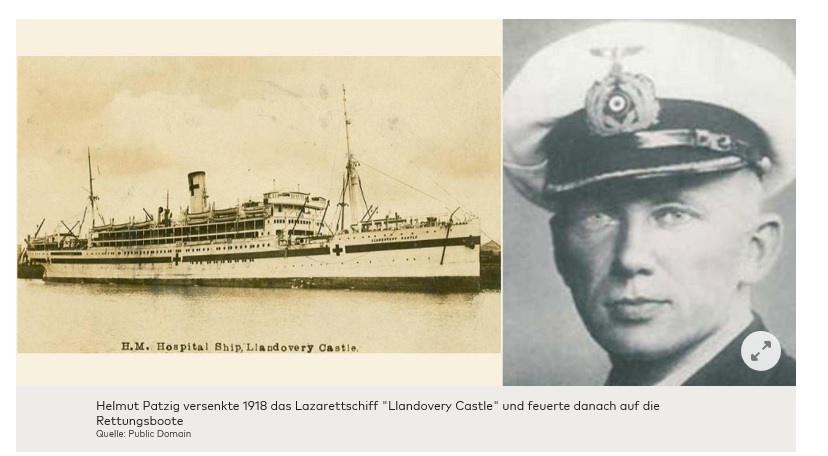
Mit seinem U-Boot "SM U-86" patrouillierte er rund 120 Seemeilen südwestlich von Irland, als ihm am Abend ein beleuchtetes und direkten Kurs haltendes Schiff auffiel. Patzig, ein schneidiger 27-jähriger Offizier, brachte sein Boot in Schussposition. Spätestens beim Anpeilen musste ihm auffallen, dass der rund 12.000 Tonnen verdrängende Dampfer mit einem Schornstein mittschiffs keinen Tarnanstrich hatte, sondern weiß war, einen roten Streifen über die gesamte Rumpflänge trug und mittschiffs sowie am Schornstein große rote Kreuze. Ein Lazarettschiff, eindeutig.

Nun galten seit der Ausrufung des unbeschränkten U-Boot-Krieges durch Deutschland 1917 die hergebrachten Regeln des Kreuzerkrieges nicht mehr. Doch gekennzeichnete Lazarettschiffe waren dennoch tabu. Patzig aber kümmerte das nicht. Er gab später an, „militärisches Material“ auf dem Schiff vermutet zu haben, und ließ einen Torpedo abfeuern. Der schlug im Maschinenraum achtern ein.

Die Folgen waren katastrophal: Sofort fiel die gesamte Beleuchtung an Bord des 1913 als Passagier- und Postschiff für die Ostafrikaroute gebauten Dampfers mit dem walisischen Namen „Llandovery Castle“ aus. Da auch der Funkraum zerstört worden war, konnte kein Notruf abgesetzt werden.

Schlimmer noch: Die gesamte Besatzung im Maschinenraum war tot, doch die Kessel ließen die Doppelschrauben des Schiffs weiter rotieren. Dadurch wurde das Sinken beschleunigt und Rettungsmaßnahmen erschwert.

An Bord waren insgesamt 258 Menschen gewesen, darunter als einzige Passagiere 97 britische und kanadische Ärzte sowie Schwestern. Da das Lazarettschiff auf dem Rückweg von Kanada nach Europa war, transportierte es auch keine verletzten Soldaten.

Nach Aussagen der Überlebenden konnten von den 19 Rettungsbooten, je sechs auf jeder Seite und sieben weitere am Heck, nur drei erfolgreich ausgebracht werden; mindestens zwei weitere stürzten von den Davits ab. Dann, nur zehn Minuten nach dem Torpedotreffer, verschwand die „Llandovery Castle“ in den Tiefen des Meeres.

Zwischen den drei schon voll besetzten Rettungsbooten schwammen weitere Schiffbrüchige. Auch Ende Juni war der Nordatlantik eiskalt; die einzige Chance der Schwimmenden war, schnell von einem der Boote aufgenommen zu werden.

Bis hierhin war Patzigs Verhalten ein schwerer Fehler und streng rechtlich betrachtet natürlich ein Kriegsverbrechen. Doch was der U-Boot-Kommandant nun tat, machte alles noch schlimmer: Er steuerte inmitten der Rettungsboote und zwang mit Revolverschüssen eines von ihnen, an „U 86“ anzulegen (und dazu die Rettung schwimmender Menschen zu unterbrechen).

Dann vernahm er den ranghöchsten Mann an Bord des Bootes, warf ihm vor, Amerikaner zu sein und Kriegsmaterial auf dem Schiff transportiert zu haben. Der Mann, Major Thomas Lyon, ein Arzt des kanadischen Sanitätskorps, verneinte entschieden. Offenbar erkannte Patzig nun, dass er gegen die Grundregel verstoßen hatte, Sanitätspersonal zu schützen. Er drehte zunächst ab und überließ die Menschen ihrem Schicksal. Die nächste Stufe seines Fehlverhaltens.

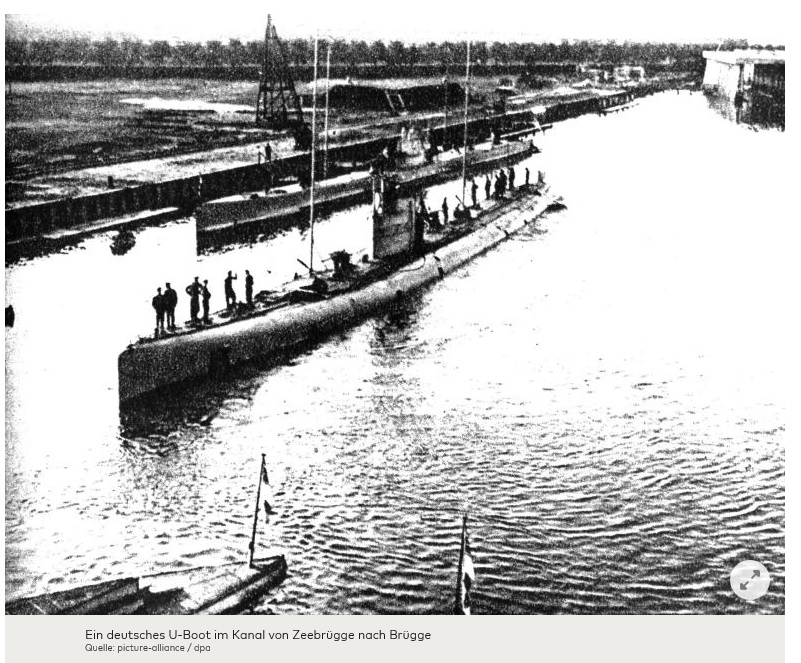
Doch dann trieb er es noch weiter: Nach kurzer Zeit drehte „U 86“ und fuhr zurück. Nun waren nur noch vier Mann an Bord des aufgetauchten U-Bootes – die beiden Wachoffiziere Ludwig Dithmar und Johann (manchmal auch John geschrieben) Boldt sowie der Oberbootsmannsmaat namens Meißner und natürlich Patzig auf der Turmbrücke selbst.

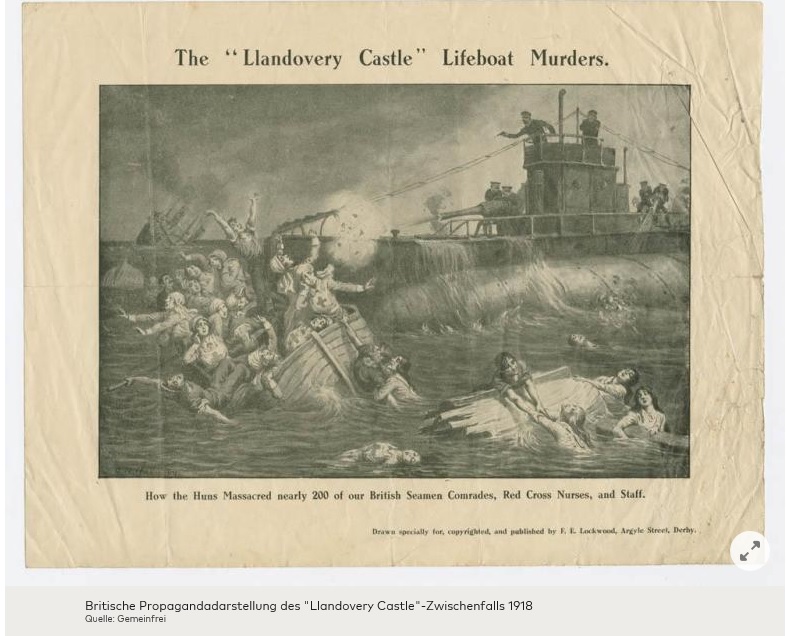
Während der Kommandant dort blieb, feuerten die anderen Männer auf seinen Befehl mit der Kanone des U-Bootes etwa ein bis zwei Dutzend Granaten auf die drei Rettungsboote. Ob auch mit einem Maschinengewehr auf die Schwimmenden geschossen wurde, ist unklar.

Zwei mit Menschen vollgestopfte Boote wurden getroffen und sanken; eines konnte in der Dunkelheit verschwinden, obwohl mindestens eine Granate ganz in der Nähe einschlug. Die 24 Menschen in diesem Boot waren die einzigen Überlebenden der „Llandovery Castle“. Sie ruderten zwei Tage lang auf die irische Küste zu, bis ein britischer Zerstörer sie aufnahm.

Patzig versuchte nun, den Vorfall zu vertuschen: Er fälschte, für einen Seeoffizier ein schweres Vergehen, seine eigenen Logbuch-Einträge, um zum Zeitpunkt der Versenkung eine andere Position vorzuspiegeln.

Doch im einzigen Rettungsboot, das dem Granatbeschuss entkommen war, saß ausgerechnet Thomas Lyon, der sich die Kennung des Bootes gemerkt hatte: Schon am 2. Juli 1918 berichteten Zeitungen in Großbritannien und den USA, die „New York Times“ sogar auf der Titelseite, über die „Tragödie auf See“. Die Ausreden der deutschen Seite verfingen nicht.

[Translator's Note: is this the same Patzig who is mentioned as Pluschow's comrade on page 22?]

From Welt, a newspaper published in Berlin, Germany. Article available at https://www.welt.de/geschichte/article178209706/U-Boot-Krieg-1918-Der-Oberleutnant-feuerte-auf-Aerzte-und-Schwestern.html

The First Lieutenant fired on Doctors and Nurses

On June 27, 1918 the German submarine "U86" torpedoed a British hospital ship. That was against all the rules of war. What followed was a forward pass for the allies.

Published June 26, 2018

by Sven Felix Kellerhoff, lead editor, History Department


Caption under photograph reads: In 1918 Helmut Patzif sunk the hospital ship "Llandovery Castle" and later fired on the rescue boats.


One mistake cann not be erased by a second, even greater mistake, but Lieutenant, Junior Grade of the Kaiser's Marines, Helmut Patzig, tried to do just that on June 27, 1918.

With his submarine "SM U-86" he patrolled around 120 nautical miles southwest of Ireland when he came upon a lighted ship sailing a direct course. Patzig, a spirited 27 year old officer, brought his boat into firing range. Surely by then, if not before, he should have noticed that the approximately 12 thousand ton steamship with a smokestack in the center had no camouflaging. Instead it was white with read stripes at its stern and large red crosses on its smokestack and at midship. This meant only one thing, a hospital ship.


Caption under illustration reads: British propaganda concerning the Llandovery Castle incident of 1918.


With the declaration of unlimited submarine warfare by Germany in 1917 the previously established rules of marine warfare no longer applied. Until then designated hospital ships were considered taboo. However this didn't bother Patzig. He later indicated he thought the ship carried "military material" so he let loose a torpedo, which hit the aft machine room.

The results were catastrophic. Immediately all lights went out aboard the steamer which had been built in 1913 to carry passengers and mail on the East Africa route under the Welsh name "Llandovery Castle." The radio room was also destroyed so no distress call could be sent out.

Still worse: The entire crew of the machine room was dead but the boiler kept the double propellers rotating. Because of this the ship sank quickly and disrupted rescue operations.


Caption under photograph reads: A German U-Boat in the Zeebrugge Canal going towards Bruges.


There were 258 people on board including 97 British and Canadian doctors and nurses. The hospital ship was on its way back from Canada to Europe and not carrying any injured soldiers.

According to testimony by the survivors there were 19 lifeboats, six on each side and seven others astern but only three boats could be successfully launched. At least two others dropped from their cranes. The Llandovery Castle disappeared beneath the sea only ten minutes after the torpedo hit.

More shipwrecked people swam amid the three lifeboats, which were already full. Even though it was the end of June the waters of the north Atlantic were ice cold. The only chance a swimmer had was if he could be quickly tanken on board one of the lifeboats.

Until this point Patzig's behavior was a dreadful mistake and of course it would be considered a war crime, but what the U-boat commander did now made everything much worse. He steered into the middle of the lifeboats and by means of shots from a revolver pushed one of them close to U-86 (thus disrupting rescue efforts directed towards the swimmers.


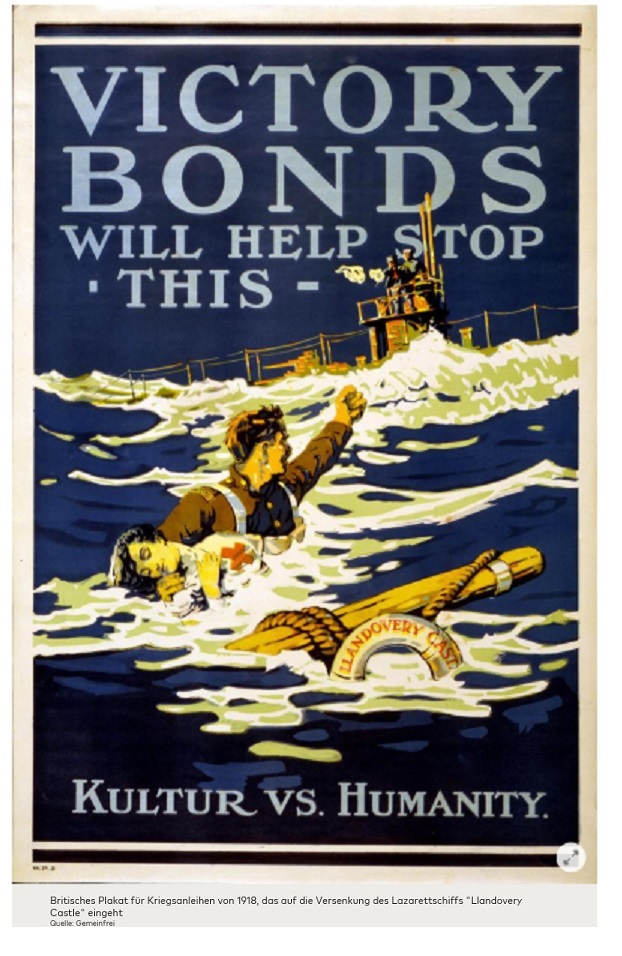
Caption under poster reads: 1918 British poster to sell war bonds which pertains to the sinking of the hospital ship Llandovery Castle.


He then took the highest ranking man onboard the boat, accused him of being American and transporting war materials on the ship. The man, Major Thomas Lyon, a physician in the Canadian Medical Corps, denied the charge. Now Patzig ostensibly realized that he had broken a fundamental rule by not protecting medical personnel. He turned around and left the people to their fate. This was his next act of misconduct.

Then he went even farther by turning U-86 around and coming back a short time later. There were now only four men on deck of the surfaced U-boat—the two watch officers, Ludwig Dithmar and Johann (sometimes also spelled John) Boldt, senior boatswain mate Meissner, and of course Patzig on the turret bridge.

The commander remained and ordered the other men to fire the U-boat's cannons. One or two dozen shells were fired at the three lifeboats. Whether machine guns were also fired at the swimmers is unclear.

Two fully occupied boats were hit and sunk. One boat disappeared into the dark but at least one shell was a near miss. The 24 people in this boat were the only survivors of the Llandovery Castle. They rowed for two days to get to the Irish coast then a British destroyer took them onboard.

Patzig tried to hush up the incident. He falsified his logbook entries in order to alter the timing of the sinking. This was serious misconduct for a naval officer.

In the only lifeboat to elude cannon fire Thomas Lyon sat. He notated the boat's identification number. By July 2, 1918 the newspapers of Great Britain and the New York Times reported on the front page the tragedy at sea. Excuses on the German side accomplished nothing.


Return to Index


Imaging and translation by Susan Kriegbaum-Hanks