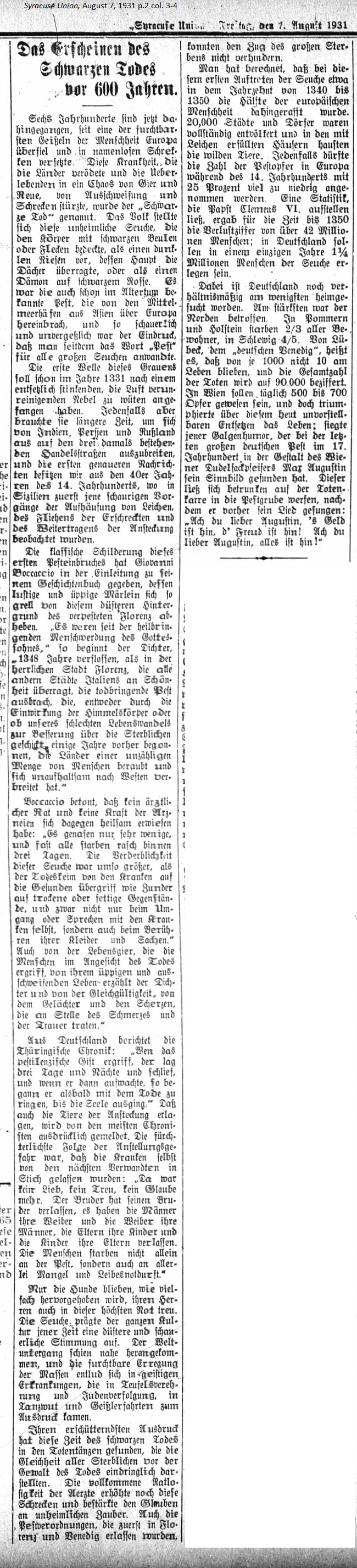
The Appearance of the Black Death 600 Years Ago
|
August 7, 1931 page 2 _____ The first wave of this horror began to rage in the year 1331 after the arrival of a horrible, stinking, contaminated fog. However it took a long time for it to spread from the three trade routes of India, Persia and Russia. We have the first more precise reports out of the 40th year of the 14th century where ghoulish scenes were observed in Sicily, such as the piling up of corpses, fleeing by the terrified and the spread of contagion. A classical description of the first pest outbreak was made by Giovanni Boccaccio in the introduction to his book of stories in which the amusing and opulent fairy tale contrasts with the glaring background of pest-ridden Florence. "Since the redeeming incarnation of God's Son," so the poet begins, "1348 years had flown by when in the magnificent city of Florence, which surpassed all other Italian cities in beauty, the death-delivering Pest broke out. Either by the working of heavenly bodies or for the improvement of our poor lifestyles, this lesson to mortals began a few years ago, robbing countries of countless members of humanity and spreading unstoppably to the West."* Boccaccio stressed that no medical advice and no medicinal powers proved restorative: "Very few recovered, and almost all died rapidly within three days. The perniciousness of this plague became even greater as the deadly germ passed from the sick to the healthy like tinder on dry or greasy objects and this is not just with being near to or speaking with the sick but by touching their clothing and other possessions." The writer also speaks about the lust for life, which seized people in the face of death, about their luxurious and dissolute lives, and the apathy, the laughter and the frolicking which take the place of pain and sorrow." In Germany the Thüringische Chronik reports: "Whoever was taken by the pestilence-ridden poison slept for three days and nights and when he woke he began to wrestle with death until the soul went out of him." Most chroniclers specifically mentioned that even animals succumbed to the contagion. The most dreadful result of the dangerous situation was that the sick were abandoned by their closest relatives. "There was no love, no trust, no more faith. A brother abandoned his brother; husbands abandoned their wives and wives their husbands; parents abandoned their children and children their parents. People didn't just die alone from the plague but also from privation and a lack of life's necessities." It was often mentioned that only the dogs remained true to their masters in their greatest time of need. The contagion imprinted a dark shadow on the entire culture of an era. It seemed the end of the world was near and the terrible agitation of the masses led to spiritual disease and the outbreak of devil worshipping and Jewish persecution, to dance mania and flagellation. The most terrifying expression in the time of the Black Death was the Dance of the Dead, which emphasized the equality of all mortals before the power of death. The utter cluelessness of the medical profession intensified this fear and reinforced the belief in arcane magic. Even the Pest Ordinances, first enacted in Florence and Venice, could not hinder the advance of massive death tolls. It's been calculated that from the first outbreaks of contagion in the decade before 1340 until 1350 half of the European population had been carried off. 20,000 cities and towns were completely depopulated and wild animals lived in the houses filled with corpses. The number of European pest victims in the 14th century was grossly underestimated at 25 percent. One statistic, which Pope Clemens VI had commissioned, had calculated the death toll at over 42 million people by 1350. In a single year in Germany 1 ¼ million people succumbed to the plague. According to this, Germany was not as greatly infected. The north was hardest hit. In Pomerania and Holstein ⅔ of all residents died; in Schlewig ⅘ died. From Lübeck, the Venice of the North, for every 1000 residents only 10 survived. The total number of deaths was calculated at 90,000. In Vienna the daily number of victims was 500 to 700 and yet life triumphs from this unimaginable figure. Gallow humor prevailed when in the last great outbreak of plague in Germany during the 17th century the Vienese bagpiper Max [Marx] Augustin lived. After singing a song he drunkenly threw himself into the death cart and was tossed into the pit dug for pest victims. The lyrics to the song were,"Ach du lieber Augustin, 's Geld ist hin, d' Freud ist hin! Ach du lieber Augustin, alles ist hin!" (Oh, beloved Augustin, the money's all gone, happiness is long gone. Oh, my dear Augustin, everything is gone!) ______ *The Decameron : Day the First, twelfth paragraph: To leave the country and return to the city, what more can be said save that such and so great was the cruelty of heaven (and in part, peradventure, that of men) that, between March and the following July, what with the virulence of that pestiferous sickness and the number of sick folk ill tended or forsaken in their need, through the fearfulness of those who were whole, it is believed for certain that upward of an hundred thousand human beings perished within the walls of the city of Florence, which, peradventure, before the advent of that death-dealing calamity, had not been accounted to hold so many? Alas, how many great palaces, how many goodly houses, how many noble mansions, once full of families, of lords and of ladies, abode empty even to the meanest servant! How many memorable families, how many ample heritages, how many famous fortunes were seen to remain without lawful heir! How many valiant men, how many fair ladies, how many sprightly youths, whom, not others only, but Galen, Hippocrates or Æsculapius themselves would have judged most hale, breakfasted in the morning with their kinsfolk, comrades and friends and that same night supped with their ancestors in the other world! |