by Hilde Reimesch - Dominik
Illustrations by Ragimund Reimesch
_____
|
January 9, 1931 page 2 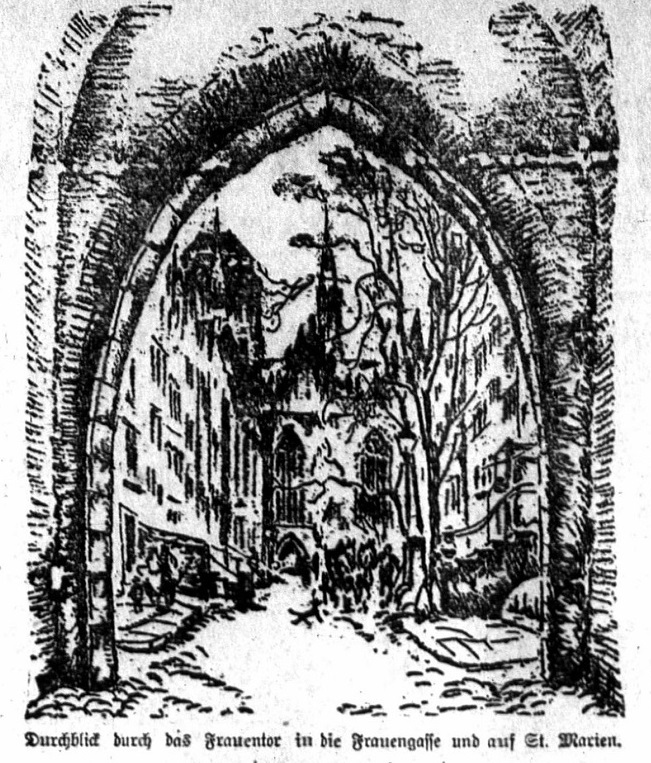
Caption under Illustration reads: Vista through Our Lady's Gate into the Alley and St. Mary's They took away the Vistula region, they forbade a people's right to vote — and just as they did in East Prussia — they would have delivered a vast and harrowing blow to the German Reich. However bare-face cynicism was was the solution for Danzig and the backcountry, a region which never had a Polish population and even today still has none. Pure German farmland, the pinnacle of German enterprise delivered into Poland's hands. 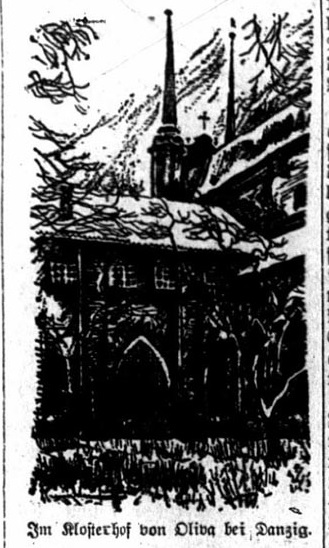
Caption under Illustration reads: The Monastery Courtyard of Oliwa near Danzig [Today Gdansk] 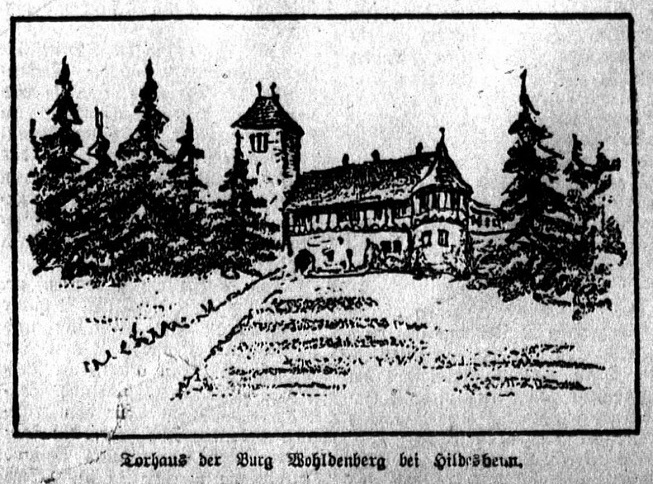
Caption under Illustration reads: Gatehouse of Castle Wohldenberg near Hildesheim The only actively pursued political desire of the Danzig residents — Reunification with the motherland. I've known of no other city like Danzig in which the centuries play so well against each other and create a fabric of supreme harmony. A modern port-city of the 20th century — the magnificent city of the noble merchants on the 15th and 16th centuries — the seriously fortified Teutonic Knights city of the 13th and 14th centuries. Truly an outrageous combination! And the environs! Mountains, forests, lakes, lowlands, the mighty Vistula, the blue sea. The harbor. A trip through it is confusing to the senses. There's rattling, stomping and hammering in a scurrying of human labor; ships' sirens boom, locomotives issue long, drawn-out toots. Wooden palates, massive petroleum tanks, giant grain silos, huge floating docks, industrial equipment, and manufacturers throughout. Countless cranes creak as they swivel their loads. The one in the shipyard, which can hoist a unbelievable load weighing 250 tons, stretches its arm over the harbor. We leave behind the harbor of Nowy Port and the mouth of the Vistula and approach the notorious Westerplatte, once a park and favorite getaway spot for Danzigers — today behind the garish red wall it hides Poland's munitions storage facility — we climb up the tower of the main lighthouse and look right into the deathly still munitions harbor of Poland, which the Danzigers called the Church Courtyard, then look left over the teeming activities in the basin free zone. English, Norwegian, Latvian, and Italian ships lie beneath the claws of the cranes. A jetty with a light tower at the top peers deep into the bay. On this side the ships glide into the harbor, beyond roars the Baltic Sea. From the harbor canal over the "Dead Vistula" or the "Kaiser Canal" one reaches Motlawa and the urban region of Danzig. On the "Long Bridge," as the residents of Motlawa call it, stand the old gates, one more beautiful than the other; the best-known called the Krantor (Crane Gate.) And here the 20th century no longer reigns supreme. Of course the busy lives of the people on the "Long Bridge" travel endlessly back and forth, however on the other side of the gate one enters the streets of the past centuries. Breadbank Alley, Beer Alley, Our Lady's Alley, Holy Ghost Alley, the First through Fourth Dams, St. John's Alley. One goes around and spins around. The smell of summer or vapor hang in the blue sky in the depths of the quiet streets. Then there's St. Mary's Choir and the side aisles rising unspeakably high, dark windows of this majestic house of God at the end of Our Lady's Alley and over the First Dam a supernatural dream. Quite narrow, quite tall houses line up next to each other, crowned by delightful Renaissance and Barock gables, which draw capricious lines in the heavens. Scattered, old linden trees spread their branches across the alleys. The gloom of the past; small, preassembled and raised verandas enclosed with stone or wrought-iron railings and beautiful plaster castings. Wrought-iron stairways leading up to the deck ending in stone globes or posts. Plaster and curbstone line up under the stairs and whimsical waterspouts, mostly monsters of the sea, hold their mouths open over the pavement. Where are they, these beautiful, pleasant alleyways that were built, inhabited and loved? The twenty-eight glorious pillars of St. Mary's Church is where they rest their bones. St. Mary's and the delightful, metallic flickering church rooms of St. John were constructed by the Teutonic Knights. Today the old alleyways are the quarters of the poor. — "Home of the Danziger Patricians" one of them wrote above his modest tavern. How melancholy is that! Things still aren't quiet in the medieval boulevards, the Long Lane and Long Market. Around the indescribably delightful townhall and aristocratic Artushof (King Arthur's Court), around the cut stone, gilded, painted sculpture-enhanced private houses city life surges as in the old days. 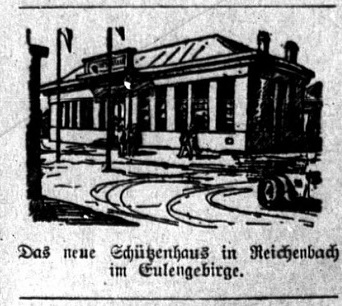
Caption under Illustration reads: The New Marksman Club House in Reichenbach in the Owl Mountains Extravagant wealth and cultivated taste are conducive to art. Massive brick buildings in the North German Gothic style like those the Teutonic Knights built solemnly, nobly, simply and expansively because they were typically German and knew nothing of the Dutch and Venetian pomp and luxury. The oldest structure of the Teutonic Knight era located near Danzig is the Monastery Church in neighboring Oliwa. The Cistercian Order erected it around 1170. The interior has been overrun with barock decor in the harsh style. Behind the walls sleeps an enduringly atmosphereic and isolated monastery courtyard. There's also the Oliwa chapel, which for a long time concealed an olive tree from the Holy Land. A few entwined and secret paths lead to the Karlsberg Mountain. Up above one can enjoy a magnificent view of the sea and its green shore near beautiful Danzig Bay. 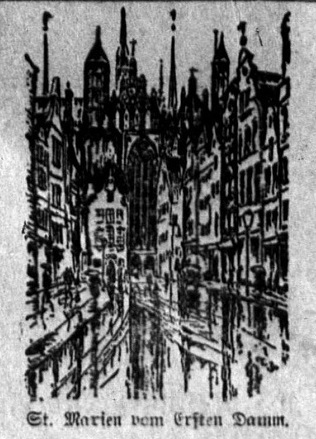
Caption under Illustration reads: St. Mary's of the First Dam South of Danzig lies the Danzig Highlands, which for Germans of the south and west of Empire are a surprise since the terrain rises near Lake Mary up 800 feet. The graceful hills have the most beautiful old-wood forests — Conifer trees thrive here, however one also finds many old beeches. Eichendorff developed his ballads sung by the German people not just in his Upper Silesian homeland but also in these woods and the beloved valleys around Oliwa. Lake Mary is just one of several large, still lakes at the foot of the forested hills. Let's turn now to the lowlands and the Grosser Werder (Large Island), which are east of Danzig. The Vistula majestically flows over this land, moving farther into it. The poor, and the vassals too, carry the messages of its majesty across the countryside — farther, farther — commanding the earth, the animals, the people to service. Tremendous amounts of water moving without end. Clouds wandering along, gathering into mighty mounds, forming wavy layers into the distance until human eyes can no longer see them. Shorelines erode, spread, snake along, wishing to pause. Forests sway and whisper. Alders and willows vacillate and reflect graceful forms in the flowing waters. Barques and sailing ships and heavy boats carrying fruit and treasures of the land benignly float up the river. Birds glide over the streams and below the clouds. If you wish to feel eternity and see infinity — Then, tiny human, travel along the shore of the Vistula! The Germanic people traveled to and resided in the Highlands. Centuries later the Germans, led by knights and monks, struggled against the Vistula's majesty and built canals and dams. Again and again the scornful current broke out, corrupting and destroying the work of men. It was stubborn and harsh, raw and consistent, but men did not let up until they finally reached an agreement with the Vistula. And the current gave them lush meadows and fertile fields. Here the Lower Saxons and the Franks harvested their crops and built their houses with steep pitched roofs and timber frames. Upper deck porches projected from the upper floors, which were firmly rooted in the earth below and offered a wide covered space at the ground level broad enough for a harvest wagon to drive in. Above the wagen storage space could be opened up and grain could be unloaded into it. About a hundred years ago the German Mennonites emigrated from here, moving eastward and establishing villages in Russia. Under Russian rule they were brought to their knees. Hungry and destitute, today they've returned to the old homeland. In the lowlands to the east you can see their settlements built around village greens. Danzig — City and Country — its churches, palaces and farmhouses display German character from every era and generation. 
Caption under Illustration reads: Hoffmann tells a story. Pen and ink drawing by Hans Hartmann.
|
|