|
February 6, 1931 page 2 by Dr. Friedrich Apitzsch _____
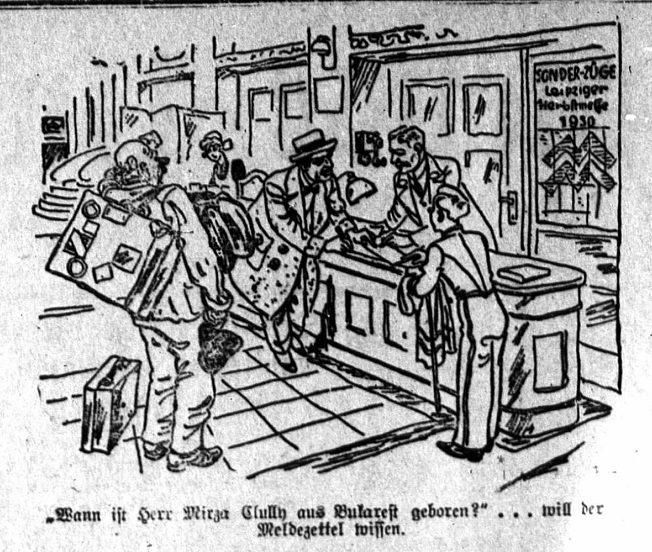
Caption under Illustration reads: "When was Mr. Clully from Bucharest born?...The Registration Form wants to know." _____ Excessive Red Tape There are still some regulatory relics of the pre-war era, but in general it is believed and assumed that the majority of them have been abolished. However this does not apply to red tape from the post-war era since it seems to have originated from every facit of bureacracy and have a lasting resiliency concocted to be as time-consuming and pointless as possible. There are cases of excessive red tape which grew and thrived with horrendous speed and lack of restraint as only the unnatural environment of a hot house could produce. In one particular case the authorities must have watched as inflated demands reached their peak in the attempt to monitor foreign tourism which produced the monster known as the Police Registry. All pleasure and business travelers had to record in detail their personal background and that of their wives. Never before and never afterwards was such a form concocted. Even in more reasonable times the register was never altered. It remained longer than was necessary, born out of mistrust and a love for red tape. 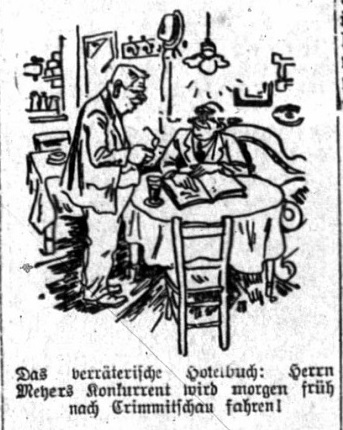
Caption under Illustration reads: The ever-revealing hotel book. Remembrances of Düsseldorf Even in the year 1928 in Düsseldorf each hotel guest is presented with a beautiful specimen of a registration form. You can get upset over it; everyone gets irritated by it — hotel personnel, the guests, and we assume, the public servants, though the form works to their advantage. However the form must be filled out. What's entered into the register stands as a chapter in the life of the guest. For example, female hotel guests surrender to the police the most intimate of details. The following seven questions must, according to the instructions, be answered personally, in detail, completely, and legibly"
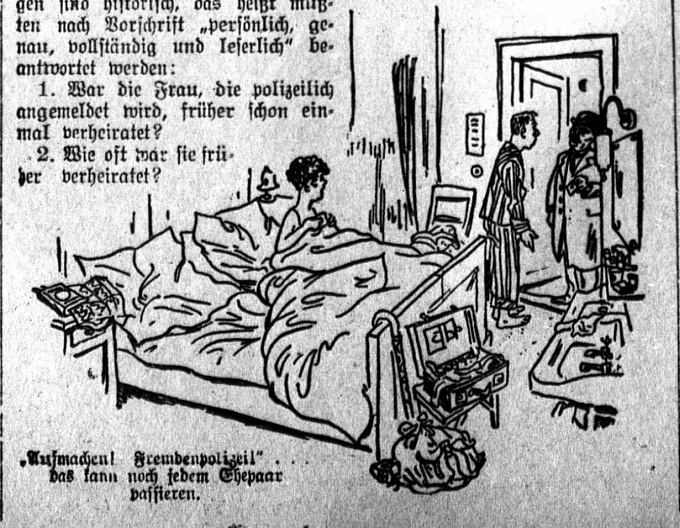
Caption under Illustration reads: "Open up! Tourism Police!..."
It reads like a comic strip but it's a police mandate. The only questions missing are: If widowed, happy or sad; and how many times; if married, why not yet divorced; and if divorced, why not better a widow? Other superfluous information might include: If widowed, were you separated from your husband? On the other hand they forgot to ask about other moral issues, such as, if the dear female hotel guest were widowed, divorced, or married, what occupation would she pick for her future husband and what forenames would he have on the day of their wedding? Today this resource, coming from everyone who filled out the registration form, could create a comprehensive profile of a female lodger. Luckily the form has already been altered and simplified. It's quite understandable that answering the questionnaire could test the patience of the hotel guests. People knew little about the severity with which the authorities of small town A. treated disrespectful travelers who, after a labor-intensive day or an unproductive business trip landed at the hotel, when presented with the need to put his personal information down on paper, answered the next questions in a fit of gallows humor: Travel Destination: Locarno!
This bit of humor didn't bode well for the traveler. The police force couldn't reconcile itself with the specific nature of his signs of exhaustion. But if he had enough humor left to make up for this small faux pas, perhaps the official might have let it pass. Instead the traveler received a fine of 5 Marks. After the traveler left the town he turned to his organization, the League of Traveling Salesmen in Germany, which appealed the case to the Police Administration of the town. The League made it clear that in handling this case they were representing all merchant travelers. They gave the Police a free lesson on the sense and purpose, or rather the senselessness and lack of purpose of this issue. They were successful. The reduction of the fine from five to three Marks was a symbolic gesture. However the irritated police communicated that in the future any similar treatment of the registration procedure would be deemed thoroughly improper and subject to police punishment. In the vestibules of the hotels outdated regulations, were a constant topic of discussion, which waivered between the comic and the tragicomic. Every porter had to count these occasions as a continuing but unavoidable darkside of their occupation. "What would happen if upon entry to the hotel guests were given the opportunity to complain?" one porter of the largest hotel in Leipzig asked. "Many foreigners, who come here for the fur trade and the exhibitionsshould be treated courteously. Many of them don't understand the regulations. One of us must always be present to explain what they mean." To Leipzig's credit it can be said that things did not go as far as earlier in Düsseldorf or the aforementioned Town of A. They did not ask the wives of travelers about deceased or future husbands, however they were asked the dates of their birth, which practically was official encouragement to falsify information. Who happily tells the truth about his or her birthday? What difference does it make to the Reception Desk or the Foreigner Police how old Mr. Y or his wife are? Experience showed that the men were just as troubled by the question as the women. Every hotel porter can confirm what the police apparently overlooked, that the birthdays of some travelers were simply falsified and other guests just preferred not to fill out this information. Then the Reception Desk had no other choice than to omit taxing the guest according to his age. The fact that this option was "forbidden" did not weaken the guests' resolve. One hotel owner found the precise expression for this problem: He closed the discussion with "Everyone lies about his birthday. Besides which, some foreigners don't know when they were born." This touches on another critical point. Abroad it's simply not usual to turn a birthday into a more or less large family celebration. The English and the Americans do not know the birthdays of their relatives. This seems surprising but it's been substantiated through experience. As a result, the guest might know the year of his birth but not the month or day. Upon his first stay in Germany he becomes acquainted with the "Police State." The Hotel Boy in Leipzig often had to deal with a long debate before the fully completed registration form was run over to the Police not fewer than three times a day — at 1 in the afternoon, at night at 11, and mornings at 5 AM! Nobody believes that only the irritated and especially contentious hotel guests are swept up in the problem. Anyone can get hung up by the questions on the registration form. Even people taking short trips can experience problems. For example, one married couple took a short trip from Leipzig to Chemnitz, and figured that since Chemnitz wasn't that far from Leipzig and neither of them was a foreigner or from another German state, they left their passports at home. Plus to their misfortune, as a rule they did not wear wedding rings. This put them in the ranks of the "highly suspicious." Since they brought luggage with them, they were accepted at the hotel. However, the hotel owner told them upon their entrance that they eventually might have difficulties. The difficulty was a prompt visit that night from a detective. The police entered and pulled the couple out of bed. There was a hearing that night with the officers fully clothed escorting the couple, now fully awake but in their sleeping attire. The officers eventually had to excuse themselves since they were looking for a crook with a similar name. Since these people had a similar name, they had to investigate them because their registration form was not quite in order. Despite the policeman's opposition, the married man convinced the prosecutor that he had been married for 20 years and it was not improper to be in the same bedroom with his wife. Unfortunately the husband could not be let off because he didn't have his passport. He would gladly have carried this affair to its conclusion in order to cast a harsh light the insanity of these petty regulations. The travelers and the police aren't at fault; it's the registration form that's guilty. It's outdated and the product of bureaucracy. It originated as a necessity in its day, which was never improved over time, and it contains questions which have become superfluous and not worth the effort. However the statistics on a region's foreign trade are thoroughly warranted. But it's unnecessary to have official declarations of birthdays and birth places. Furthermore, awkwardly detailed interrogation on one's present and past life should be dispensed with, as should the name and list of surnames of the wives of hotel guests, and questions on one's religious affiliation and reason for the trip. That leaves four questions for the registration form, which can be used for statistics and the needs of police authorities:
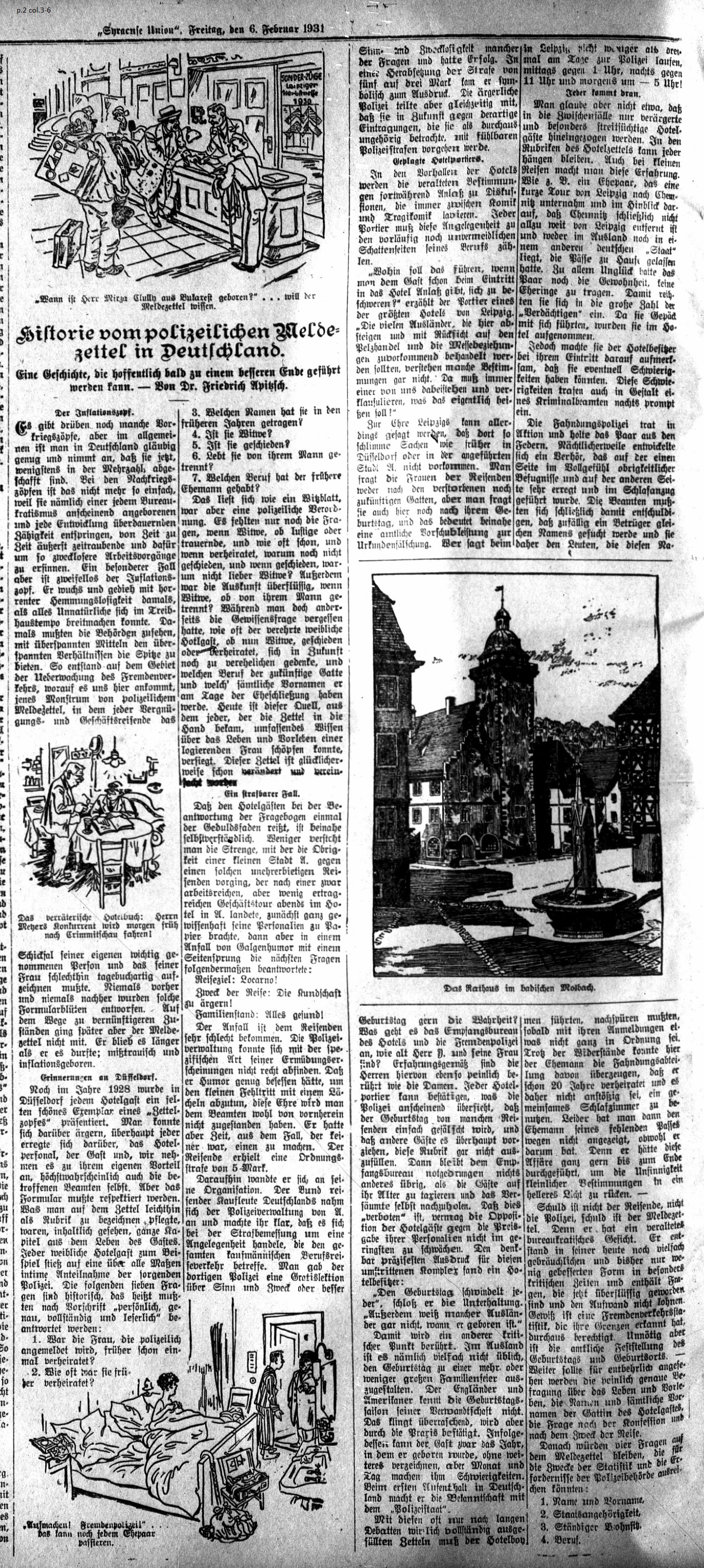
Caption under Illustration in center of columns 3 & 4 reads: The Courthouse in Mosbach, Baden. |
|