January - June 1932
|
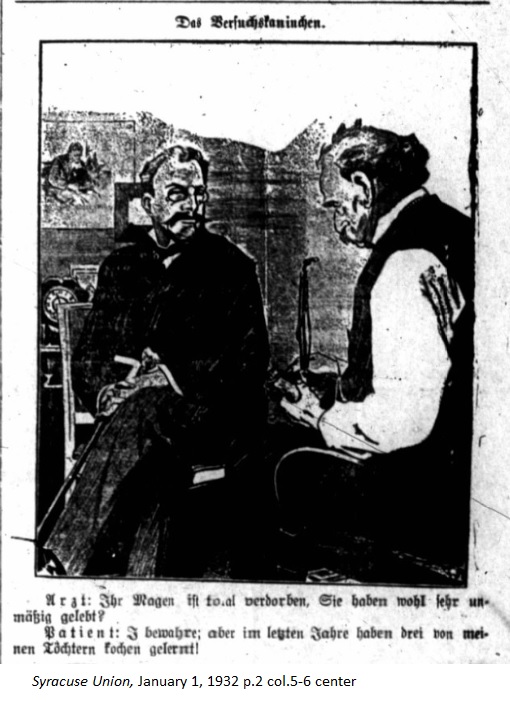
January 1, 1932 page 2 Physician: Your stomach is all messed up. Have you been living immoderately?
|
|
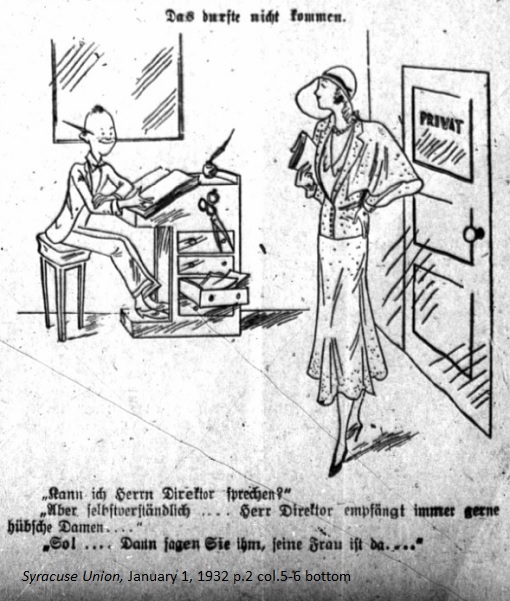
January 1, 1932 page 2 "May I speak with the director?"
|
|
January 1, 1932 page 4 _____ We wish our beloved readers a Happy New Year. May it fill you with inner peace, and bring you good health and prosperity. We stand at the brink of a significant year. Many expect that the bad economy of the past year will persist into this year. Broader and perhaps even harsher need stands before us. So say the experts. Then again they may be in error just as they were in predicting eternal prosperity. No one knows if unexpected events will reverse their calculations. In the coming year we elect a president. We should prepare now in public and private ways to insure that the votes of the German community are being sought after by both sides. Once again they will slap us on the back and call us the most pleasant names. Let's not be misled by it. The coming year will have decisive meaning for the old fatherland. Dark storm clouds cover the sky and obscure the sun. Will threatening weather strike, and what will the results be? The current government is taking all possible measures to prevent catastrophe. But success relies to a great extent upon the actions of others. Let us hope that good sense and reason will prevail over hatred and apathy. The Spoils of His Enemies _____ One must constantly tell the Germans that throughout world history a people divided among itself appears outward weak and incapable of self-determination. Such a people is not the subject of its politics but its object, and in the worst case the spoils of his enemies. One must assure these people that the security of internal peace leads to the preservation of the state and that we must defend and maintain the freedom and independence of our German people. This serious warning to the German people was deliverd by the Reich's Finance Minister and Vice-Chancellor Dr. Dietrich during a radio address. |
|
January 1, 1932 page 4 _____ The famous French physiologist Chalres Richet, who received the Nobel Prize in 1913, made a suggestion in the Parisian newspaper Le Matin which reveals the unworldliness of the old researcher. He earnestly claims that women should be forbidden from working outside the home. In his opinion it's the best way to successfully fight against unemployment. He bases this on the estimate that in France women hold around 30 percent of all paid positions and he believes that if all these posts were vacant, all men would be employed. This contention may also arise in large measure in other countries experiencing the same problem. |
|
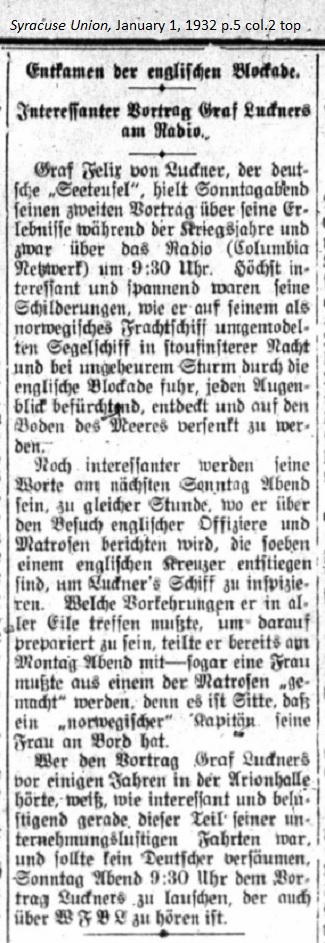
January 1, 1932 page 5 _____ On Sunday evening Count Felix von Luckner, the German "Sea Devil," delivered his second lecture on his experiences during the war years on the Columbia Radio Network at 9:30 PM. His description of how he sailed through the English Blockade in his ship, which was camouflaged to look like a Norwegian freighter, in the dead of night and during a huge storm was highly interesting and exciting. He feared that at any moment he might be discovered and sunk to the bottom of the sea. Still more interesting will be his program next Sunday evening at the same time, when he will report on the visit of English officers and sailors, who alighted from an English cruiser in order to inspect Luckner's ship. On Monday evening he described what precautions he had to take in great haste in order to prepare for the boarding. One sailor had to be disguised as a woman because it was the custom of "Norwegian"captains to have their wives onboard. Anyone who heard Count Luckner's lecture a few years ago in Arion Hall knows how interesting and amusing this part of his adventurous voyage was, and no German should miss Luckner's lecture Sunday evening at 9:30 P.M., which can be heard on Station W.F.B.L. |
|
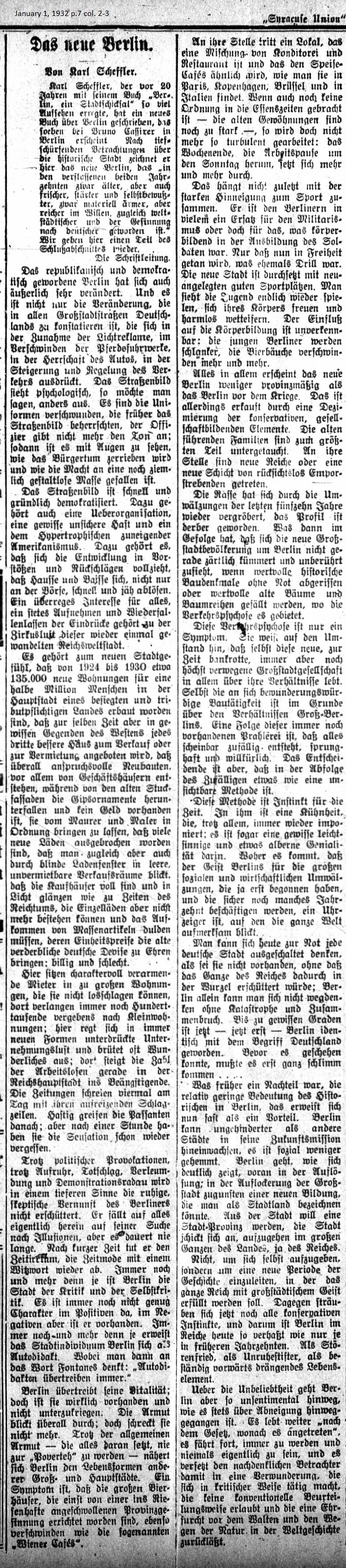
January 1, 1932 page 7 By Karl Scheffler. The Editorial Staff. Republican and Democratic Berlin has also changed outwardly. And it's not just the transformation all large city streets in Germany have encountered — the increase in neon signs, the disappearance of horse-drawn vehicles, the dominance of automobiles and the increase and regulation of traffic. Psychologically the streets' appearance, one might say, is different. Uniforms have disappeared, officers no longer set the tone, and one can see how the middle class is being crushed while the power of the seemingly faceless masses has fallen away. The streets' appearance is rapidly and fundamentally being democratized. Now there's a super-organization, an uncertain haste and a hypertrophic inclination towards Americanism. There's a rapid and sudden movement of advancement and setback, boom and bust, and it's not just in the stock market. There's an overexcited interest for all things, a constant digesting and expelling of sensations in a circus-like atmosphere in this transformed imperial world city. Between 1924 and 1930 the capital city in this vanquished and tribute-paying country has developed a new feel with an increase of 135,000 residences for half a million people while at the same time in certain sections of West Berlin every third "better" house has gone on sale or has been rented out. Overall there's sophisticated new construction built by housing companies while old stucco-facade houses have let their plaster ornamentation decay and fall. There's no money on hand to have walls and paint repaired. Many new shops have opened while at the same time display windows lie bare in empty, unrentable showrooms. Department stores are full of merchandise as lights gleam as if they were still in the time of superabundance while smaller shops can no longer subsist with the arrival of mass-produced goods, the unit pricing of which taint the old German motto of honor through quality workmanship; instead it's cheap and of poor quality. Here sit atypical and impoverished renters in large residences which they cannot sell off; over there sit hundreds of thousands hoping in vain for a small home. Here in ever new forms the repressed spirit of enterprise reigns and often produces surprising results. There the number of unemployed climbs at an alarming rate in the Empire's capital city. Four times a day the newspapers scream with their maddening headlines. Passersby hastily grab them, but after an hour they have already forgotten the sensationalism. Despite political provocations, despite upheaval, homicide, slander and the noise of demonstrations, in the deeper sense the quiet, sceptical reason of the Berliner remains unruffled. He looks at everything in his search for illusions, but it doesn't last long. After a short time he discounts the contemporary confusion with a joke. More than ever Berlin has become the city of criticism and self-critique. There's never enough of the positive but of the negative there's always enough at hand. More than ever the Berlin individual is an autodidact. One thinks on Fontane's words: "Autodidacts always go to excess." Berlin exaggerates its vitality, but it is there and it won't be subdued. Poverty is everywhere but it no longer frightens. Regarding the overall poverty — everyone does his utmost to prevent ever becoming impoverished — Berlin is approaching the level of poverty in other large and capital cities. One symptom is the disappearance of large beer halls, which once were built in gigantic, provincial fashion. The so-called "Vienna-style cafés" also have disappeared. In their place there's a local spot, a combination pastry shop and restaurant, similar to the cafés in Paris, Copenhagen, Brussels, and Italy. There are no set meal times — the old customs are far too rigid — the work pace is no longer as turbulent. More and more service occurs on weekends and during the day off on Sunday. Basically that coincides with the strong inclination towards sports activities. For many a Berliner it's a substitute for militarism or for physical training similar to that of the soldier. What once was compulsory drilling is now done voluntarily. The new city is well furnished with good sports facilities. One sees youth at play again, enjoying their bodies and engaging in harmless contests. The influence of physical training is obvious. Young Berliners are thinner; more and more the beer bellies are disappearing. All in all, the new Berlin seems less provincial than pre-war Berlin. That was achieved through the decimation of the conservative, social element. To a large extent the old leading families have disappeared and as a result the new, big-city population around Berlin didn't seem bothered or uncomfortable tearing down valuable historic memorials for no reason or felling priceless old trees and rows of trees whereever they cause traffic psychosis. Traffic psychosis is only one of the symptoms. It points to the fact that even this new, at time bankrupt, but always upwardly mobile big-city population lives beyond its means. Even the wonderous building activities essentially go beyond the means of Berlin at large. The result of this ostentatiousness is that everything appears to originate randomly, erratically, and haphazardly. However, the deciding factor is that in the array of random elements there is an invisible method. The method is instinct for the times. There's a boldness to it which, despite everything, always impresses. There's a certain frivolous yet silly ingenuity. Where does it come from, this Berlin mindset for great social and economic revolution, which once begun will take decades? It's the hands of a clock attentively looking at the entire world. If necessary, today one can consider every German city disconnected as though it were not there without the entire empire being shaken to its roots. Only in Berlin one cannot disgard the other cities without catastrophe and collapse. To a certain degree, until now. Berlin has become identical with the concept of Germany. Before this could happen, things had to become absolutely dire... The relatively minor significance of Berlin in history was considered a drawback in earlier times. Now it's proven to be an advantage. Berlin can develop its future mission in a more unhindered manner than any other city because it is less socially confined. It clearly shows us it will move towards its own solution — the loosening up of a large city as it forms its new culture, which one could designate a city-state. The city will become a city-province creating itself and absorbing the entire country and even the whole empire. Not to relinquish itself, but to lead into a new era in history in which the entire empire shall be filled with grand-city spirit. This bristles against all conservative instincts and for this reason Berlin is hated so much more today in the empire than it was in previous decades. Berlin is a troublemaker, a disturber of the peace, and a lifeforce consistently urging progress. Berlin unsentimentally brushes aside the unpopularity just as it has always shunned reluctance. It lives on "according to the law as written." It continues to become and never to just be; it turns the pensive observer into someone who is amazed, made an active critic who entertains no conventional assessments and who leaves behind fear for the workings and ways of nature in world history. |
|
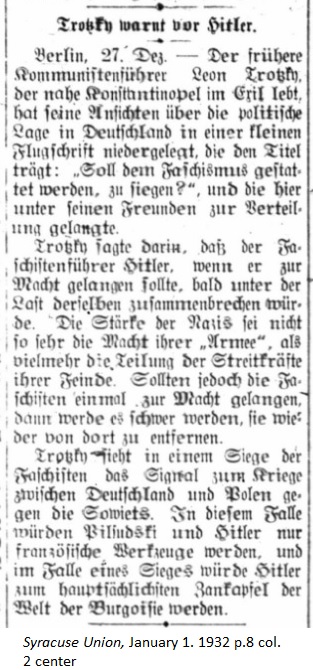
January 1, 1932 page 8 Berlin, December 27th. — The former Commmunist leader, Leon Trotsky, who lives in exile near Constantinople, has written down his opinions on Germany's political situation in a small flyer with the title "Should the Fascists be allowed to win?" and asked his friends to distribute it. Trotsky states within that the Fascist leader Hitler, if he comes to power, would soon collapse under the burden. The strength of the Nazis is not so much in the strength of its army but its troops' ability to divide its enemies. If the Fascists come to power, it would become difficult to remove them. Trotsky sees a victory by the Fascists as a signal to warfare between German and Poland against the Soviets. In this case Pilsudski and Hitler would become tools of the French. In the event of victory, Hitler would become the principle bone of contention for the world of the bourgeoisie. |
|
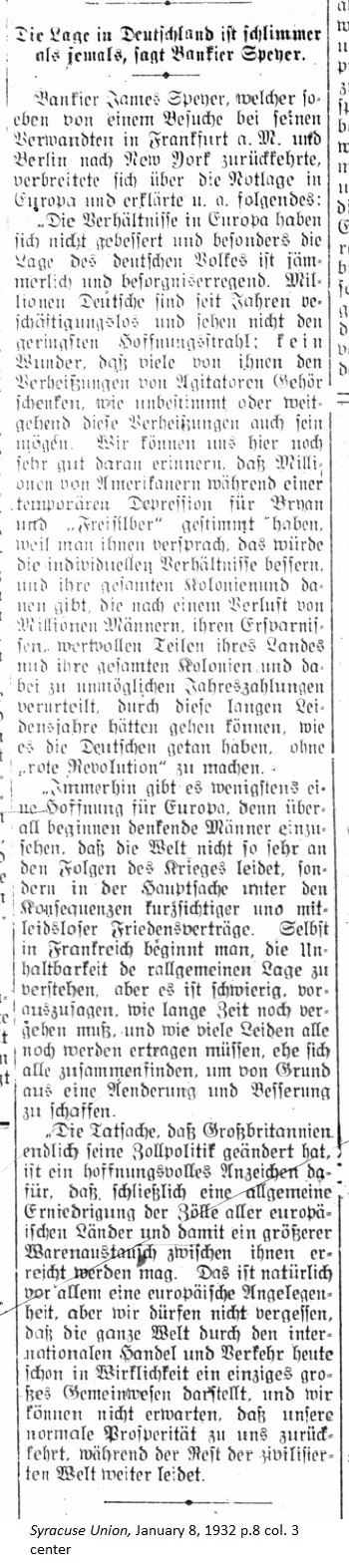
January 8, 1932 page 8 _____ Banker James Speyer, who just returned to New York from a visit to his relatives in Frankfurt a.M. and Berlin, spoke about the dire situation in Europe as follows: Economic conditions in Europe have not improved. The situation for the German people is particularly wretched and alarming. Millions of Germans have been unemployed for years and do not see any glimmer of hope on the horizon. It's no wonder that many of them have listened to the promises of agitators, no matter how uncertain and far flung these promises may be. We can well remember here that millions of Americans voted for Bryan and his "Free Silver" movement during the short-lived depression because they promised that individual economic conditions would improve, as would the financial situations of their colonies. Otherwise, with the loss of millions of men those left would be held responsible for impossible amounts of taxation on their savings and properties, leading to long, hard years of suffering. This is similar to what the Germans have gone through but without creating a 'red revolution.' "There's always at least one hope for Europe if thinkig men begin to see that the world doesn't suffer as a result of war but as a consequence of shortsighted and unmerciful peace treaties. Even in France they're beginning to understand the untenability of the situation, however it's difficult to predict how much time must pass and how much suffering must be endured until everyone comes together to create change from the ground up in order to improve things. "The fact that Great Britain has finally altered its taxation and customs policies is a hopeful sign for an eventual lowering of taxes in all European countries and an increase in the exchange of goods. Naturally this it a European issue, but we must not forget that in reality it outlines a strategy for a unique commonwealth of international business and trade for the entire world. We can hardly wait for our prosperity to return to us while the rest of the civilized world continues to suffer." |
|
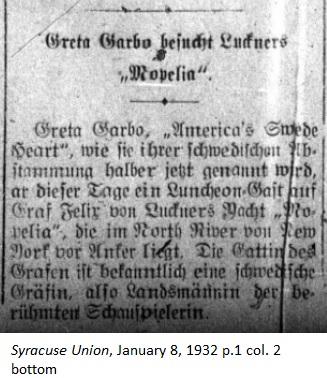
January 8, 1932 page 1 _____ Greta Garbo, "America's Swedish Heart" as she is called due to her Swedish heritage, was a luncheon guest today on Count Felix von Luckner's yacht "Mopelia", which lies at anchor on the North River in New York. The Count's wife is a Swedush countess and thus a compatriot of the famous actress. |
|
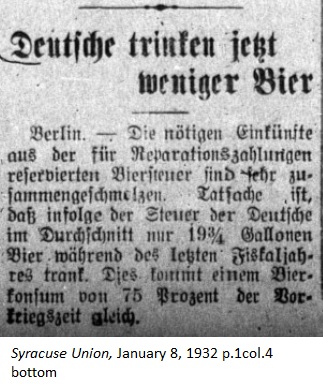
January 8, 1932 _____ Berlin. — The revenue from the Beer Tax required to offset a portion of reparation payments has greatly diminished. The fact is, due to the tax Germans only drank an average of 19 ¾ gallons during the fiscal year. This is only 75% of the beer consumed in the prewar years. |
|
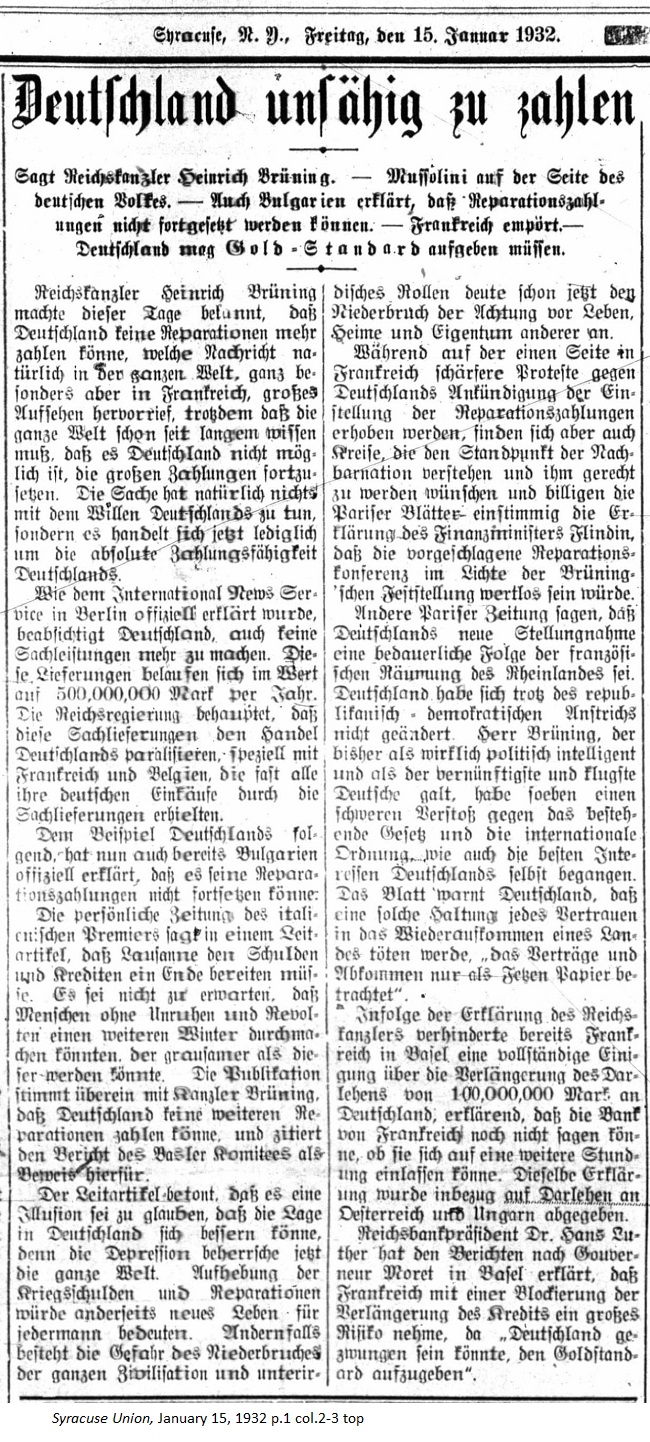
January 15, 1932 page 1 _____ Says Reichs Chancellor Heinrich Brüning — Mussolini on the Side of the German People — Bulgaria also declares that Reparation Payments cannot continue — France appalled — Germany might have to give up the Gold Standard. _____ Reichs Chancellor Heinrich Brüning announced today that Germany can no longer pay war reparations. This is naturally unprecedented throughout the world but in France it's created quite a furof even though the whole world has known for a long time that it's impossible for Germany to continue making these huge payments. Naturally it has nothing to do with Germany's willingness; rather it deals with Germany's absolute inability. As officially announced by the International News Service in Berlin, Germany no longer intends to make non-cash payments, which amounted to 500,000,000 Marks per year. The Reichs government contends that these non-cash payments have paralized Germany's trade, especially with France and Belgium, which obtain all of their German good through non-cash transactions. Following Germany's example, Bulgaria is ready to officially declare that it cannot continue making reparation payments. The personal newspaper of Italy's Premier states in a lead article that Lausanne must prepare to end the debits and credits. It's anticipated that people will not last through another winter without rioting and revolting, which would make matters worse. The publication agrees overall with Chancellor Brüning's statement that Germany cannot continue to make reparation payments and cites the report of the Basel Committee as proof. The lead article states it is dillusional to believe that Germany's situation will improve when the Depression reigns throughout the world. Cancelling war debts and reparations would mean a new life for everyone. Otherwise there's the danger of collapse of civilization as a whole and underground tremors signalling the breakdown of regard for life, home, and property. While some of the French have launched vehement protest against Germany's announcement on reparation payments, there are other factions which understand their neighboring nation's position and want to be fair. The Parisian newspapers unanimously support Finance Minster Flindin's statement that the proposed reparations conference is made moot in light of Brüning's declaration. Another Parisian newspaper states that Germany's new stance is the regretable result of French occupation of the Rhineland. Despite the democratic and republican veneer Germany has not changed. Mr. Brüning, who until now was deemed a true political intellect and a reasonable and sage German, has committed a serious infraction of existent laws and the international order even if it's in the best interests of Germany. The newspaper cautions Germany that such conduct would kill any confidence in the reemergence of a nation, "which considers treaties and conventions so much scrap paper." As a result of the Reichs Chancellor's declaration, in Basel France has already prevented an extention on the loan of 100,000,000 Marks to Germany, stating that the Bank of France still could not say if it would agree to a further moratorium. The same statement was given regarding the loans to Austria and Hungary. Reichs Bank President Dr. Hans Luther responded to Govenor Moret in Basel that in France's blocking of the credit extention it risked "Germany's being forced to abandon the Gold Standard." |
|
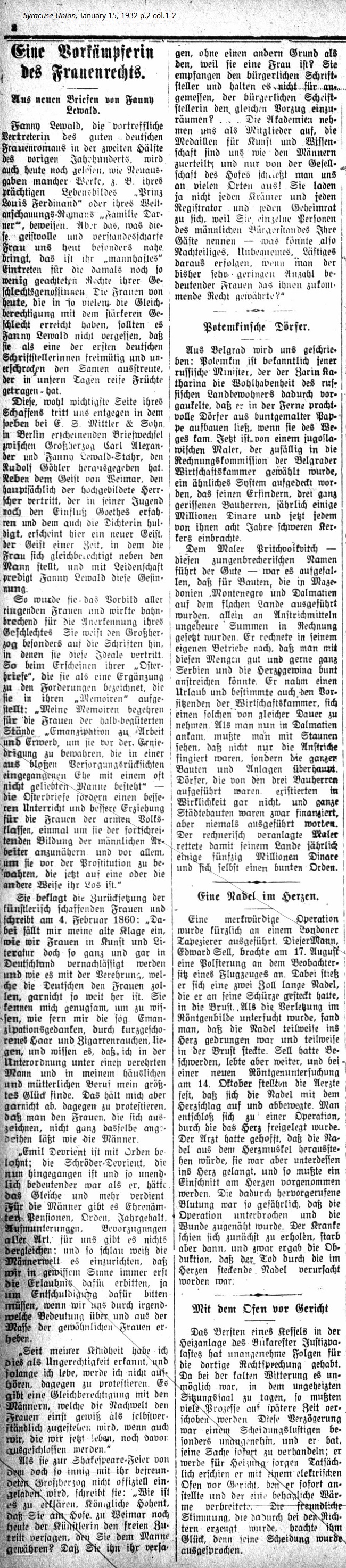
January 15, 1932 page 2 _____ From New Letters by Fanny Lewald Fanny Lewald, the splendid representative of the good German women's novel in the second half of the previous century, is still read today, as indicated by new editions of several works, such as the superb life story of Prince Louis Ferdinand or her novel, which takes a look at the world through the eyes of the Darner Family. But what draws us closer to this intelligent and insightful woman today is her "manly" approach to the seldom recognized rights of her female contemporaries. Women of today, who have gained so many equal rights as their stronger counterpart, should not forget Fanny Lewald. She was one of the first German woman authors to straightforwardly and dauntlessly sow the seeds which have yielded ripe fruit in our lifetime. What might be the most important of her creations we now have in a set of correspondence between Grand Duke Carl Alexander and Fanny Lewald-Stahr published in Berlin by E.S. Mittler & Sohn and compiled by Rudolf Göhler. Along with the spirit of Weimar, as represented primarily by the highly educated sovereign who also experienced the influence of Goethe and to which Lewald paid tribute, we have here a new spirit, a spirit of the age in which women placed themselves on equal footing with men. Fanny Lewald passionately preached this sentiment. Thus she became the model for all struggling women and she became a pioneer for the recognition of her sex. She pointed out to the Grand Duke those writings in which she advocated these ideals. With the publication of her "Easter Letter," which she called a supplement to the claims she had set down in her memoires: "My memoires seek the semi-affluent status of women; 'the emancipation to work and earn in order to save herself from humiliation which exists in a marriage often entered into with a man one doesn't love because of the need for financial support.' The Easter Letter demands better training and better education for women of the lower classes so they may approach the educational level of male workers, and prevent prostitution, which sooner or later leads to their undoing." She laments the neglect of artistic women and writes on February 4, 1860: "I'm recalling my old complaint, how we women in the arts and literature are so completely dismissed in Germany and how it reflects the German's veneration of women, as far as it goes. You understand me well enough to know how little I entertain emancipation thoughts regarding short haircuts and cigarette smoking. I find my greatest happiness as a subordinate to a respected husband and in my domestic and motherly vocation. But I do protest that women, who have distinguished themselves, are not granted the same respect as men. "Emil Devrient was awarded a medal; Wilhelmine Schröder-Devrient, who is now departed and yet so much more important as he, deserved a similar award and so much more. For men there are honorary offices, pensions, awards, yearly salaries, encouragements and privileges of all kinds. For us there's nothing similar. The world of men has been arranged so smartly that we women must always ask for permission, and indeed we must ask for pardon whenever we excel over and above the masses of average women. "Since childhood I have seen this as an injustice and as long as I live I will not cease to protest against it. There is equality with men which in the next world will certainly be seen as self-evident, even if we, who are alive now, are being excluded from it." When she wasn't officially invited to the Shakespeare Festival by her close friend, the Grand Duke, she wrote: "How can it be explained, Your Royal Highness, that today you deny a female artist entrance to the Court in Weimar, which you grant to men? You deny it for no other reason than because she is a woman. You receive middle-class male writers but consider it inappropriate to extend the same privilege to a middle-class female author?...The academies accept us as members; medals for the arts and sciences are given to us as well as men. Only the society of the Court excludes us in many areas! You invite every huckster and every file clerk because you call any person of the male pursuasion your guest — what could result in disadvantage, discomfort, or unpleasantness if one were to extend to a small number of important women the same courtesy?" Potemkin Villages _____ From Belgrade we receive this message: Potemkin is known as the Russian Minister, who fooled Tsarina Catherine into believing in the prosperity of rural Russian residents by having brightly painted cardboard villages constructed in the remote areas she was visiting. Now a Yugoslav painter, who incidentally happens to have been elected Accounts Commissioner of the Belgrade Chamber of Finance, has discovered a similar system whereby its inventors, three cunning building contractors, raked in several millions of Dinars annually and are now sentenced to eight years in prison. The painter, named Pritchvoikvitch — a tongue-twister of a name— noticed that buildings being constructed on flat land in Macedonia, Montenegro and Dalmatia accumulated incredibly high sums for paint and coating materials. Based on this own occupation he figured with this amount of materials one could colorfully paint all of Serbia and Herzegovina. He went on leave and had the presiding Chamber of Finance take one of similar duration. As they arrived in Dalmatia they looked in astonishment because not only was the paint lacking, the buildings and equipment were also absent. The villages supposedly built by the three contractors did not exist in reality. The civil construction project had been financed but never executed. Thus the account-savvy painter saved his country some fifty million dinars annually and netted himself a colorful medal. A Needle in the Heart _____ A remarkable operation was recently performed on a London paperhanger. The man, Edward Sell, installed upholstery to an aircraft observation seat on August 17th, at which time he stuck himself with a two-inch long needle which he had pinned at his chest onto his work apron. When the injury was x-rayed they found that the needle had plunged halfway into his heart while to other half was lodged in his chest. Sell had difficulties but lived on and when a new x-ray was taken on October 14th the doctors established that the needle had moved bck and forth with his heartbeat. They decided to operate and expose the heart. The doctors had hoped that the needle would be extracted from the heart muscle but they had to cut into the heart. The amount of bleeding was so dangerous that they had to discontinue the operation and sew up the wound. The sick man seemed to recover but then died. During the autopsy it was determined that death was caused by a needle thrust into the heart. Before the Court with a Heater _____ |
|
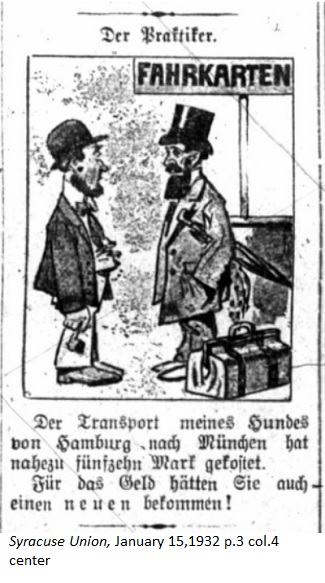
Jamuary 15, 1932 page 3 "For that price you could have bought a new dog!" |
|
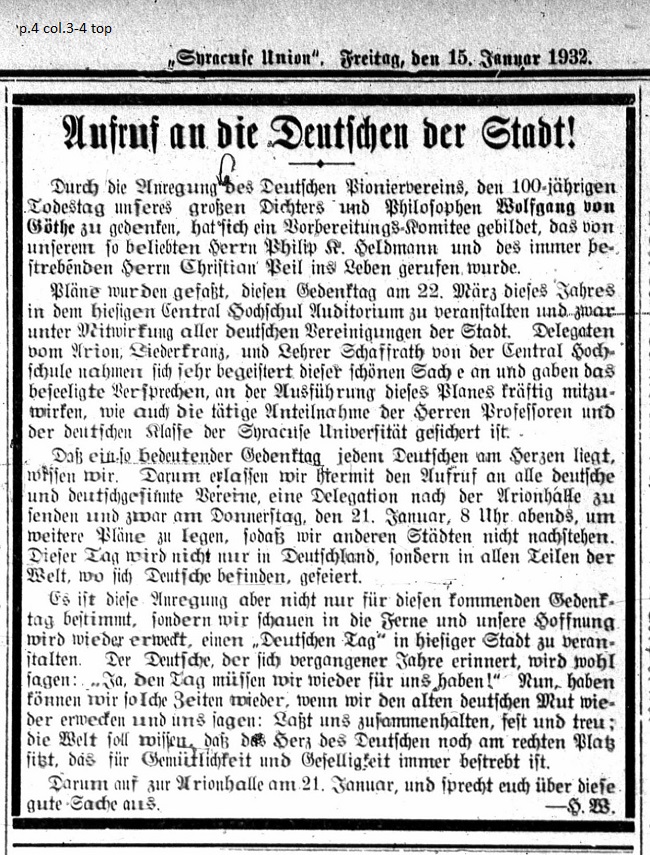
January 15, 1932 page 4 _____ At the suggestion of the German Pioneer Society a planning committee has been formed to commemorate the 100 year death date of our great poet and philosopher Wolfgang von Goethe. Our beloved Mr. Philip K. Heldmann and the ever-striving Mr. Christian Peil initiated the call for a committee. Plans have been made to hold this commemorative celebration on March 22nd of this year in the Central High School Auditorium. All the German organizations in the city will be participating. Delegates from Arion, Liederkranz, and Teacher Schaffrath of the Central High School have taken up this beautiful task with great enthusiasm and have given their solemn promises to vigorously work on an execution of the plan. Active participation by the professors and German classes of Syracuse University has been assured. We know that such a significant day of remembrance lies at in the heart of every German. For this reason we hereby issue a call to all German and German-minded societies to send a delegation to Arion Hall on Thursday, January 21st at 8 PM to set forth further plans so we do not lag behind any other cities. This day will not just be celebrated in Germany but in all parts of the world where you find Germans. The suggestion is not limited to the upcoming commemoration day but awakens a hope for the future that we might reinstitute a German Day celebration in our city. Germans who remember years gone by will certainly exclaim, "Yes, we must once again have a German Day celebration!" We can regain those good old days if we reawaken the old German courage and say, Let's get together, strong and true; the world should know that the heart of the German people is in its right place, forever striving for congeniality and sociability. Come to Arion Hall on January 21st and let's discuss this fine idea.
|
|
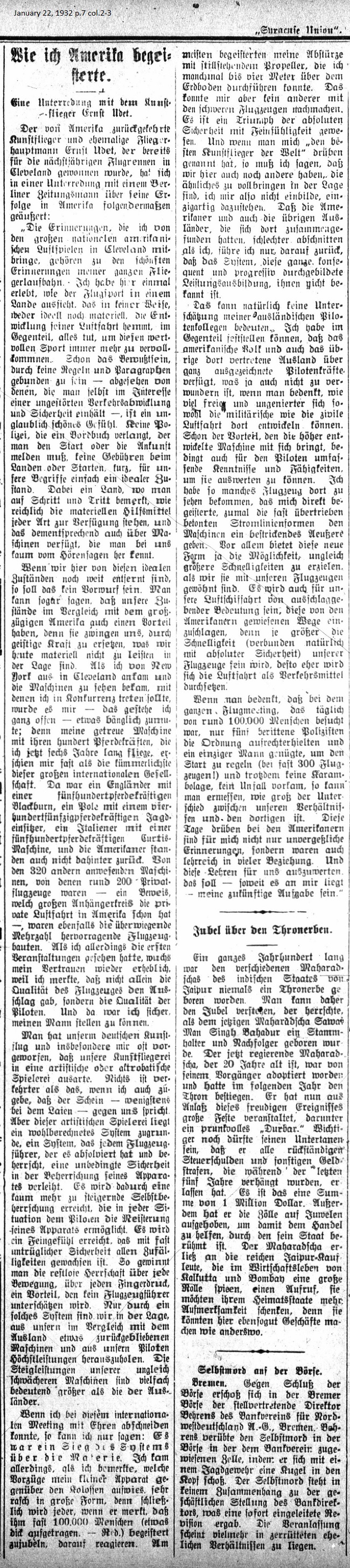
January 22, 1932 page 7 _____ An Interview with Stunt Pilot Ernst Udet "The memories which I bring back from the grand national American airshow in Cleveland belong to the most beautiful moments in my flying career. I experienced how aerial sports looks in a country that in no way is either imaginary or tangible. The evolution of aviation encompasses everything in order to constantly improve it as a worthy sport. Already the awareness, not bound by any rules or stipulations except for those which one observes in the interest of undisturbed traffic control and safety, is an incredibly fine feeling. No police asking for a log book, which one must produce at the start of a flight or at the point of arrival, no fees for takeoff or landing; in brief, to my mind, the ideal situation. Add to this in a country where one notices at every turn how ample material resources of all kinds are available along with the corresponding machinery to an extent one never hears spoken about in our country. If we here are so far away from this ideal situation, it's not a reproach. One can say that our circumstances in comparison with those of lavish America also present an advantage because it forces us to compensate with the power of intellect when we're not in position to acquire the necessary materials. When I arrived in Cleveland from New York and acquired the materials with which I could enter the competition, it was somewhat daunting — I often feel that way — my trusty machine with its hundred horsepower engine, which I had been flying for six years, seemed almost puny compared to this grand international entourage. There was an Englishman with a five hundred horsepower Blackburn, a Pole with a four hundred, fifty horsepower Jagd one-seater, an Italian with a five hundred horsepower Curtis engine, and the Americans didn't lag behind. Of the 320 other machines present, around 200 were privately owned aircraft — proof of the large number of devotees of private aviation in America, the overwhelming majority of which exhibired excellent aircraft construction. When I watched the first meets my confidence grew substantially because I noticed that not only did the quality of the aircraft tip the scales but also the quality of the pilots. And then I was certain I could enter my old man. People have often suggested our German stunt flying, and mine in particular, of being artistic or acrobatic shenanigans. There's nothing more incorrect, though I do admit, to the layman it must so appear. But behind this artistic gimmickry lies a well thought-out system which every fully-schooled aviator has mastered with an unconditional confidence in the control of his apparatus. It's achieved through an ever rising level of self control which allows the pilot complete mastery of his machine under every circumstance. A level of sensitivity has been achieved which evolved with almost infallible confidence in all eventualities. One gains utter dominence over every move, over every press of the finger; an advantage no aviator will underestimate. Only through such a system are we in the position to extract maximum performance from our somewhat antiquated machinery, when compared to the rest of the world, and our pilots. The ability to climb higher in our disparately weaker machines is significantly greater than that of the foreigners. If I could depart from this international meeting with honors, I can only say, it was a victory of the system over the equipment. I noticed what advantages my little plane had over the colossal ones, the rapid speed and the great form, then noticed that everyone watching, close to 100,000 people (Laying it on a bit thick — The Editor) rapt and cheering, I reacted. Most of all they were enthralled by my landing with a feathered propeller, which I accomplished some four meters above the ground. No one else was able to do that with their heavy aircraft. It has been a triumph of absolute confidence with delicacy. When they called me "the best stunt pilot in the world" I must respond that we have a lot more of them here who are in a position to execute similar maneuvers. I don't consider myself unique. That the Americans and the other foreigners who had gathered there together received poorer instruction leads me back to the point that it's due to the system, this complete, consistent and progressive competency training of which they are unaware. That doesn't mean I underestimate my foreign aviation colleagues. To the contrary, I can declare that the American people and those represented by other countries have command of excellent piloting skills even when you consider how very freely and unabashedly military and civilian aviation has developed. Even the advantages, which these highly developed machines offer, become a valuable part of the pilots' comprehensive knowledge and ability. I have been able to see so many airplanes there which have enchanted me, especially the exaggerated streamlined forms which give the machine a charming exterior. Above all else this new form offers the possibility of acccomplishing unparallelled speed, much greater than anything to which we are accustomed. This is also of huge significance for our airline flights because the greater the speed (naturally within limits of absolute safety) of our aircraft, the more we are able to establish air travel as a means of transportation. When one considers that the daily attendance at the flight meet was around 100,000 people with only five policemen mounted on horseback and only one man was needed to arrange takeoffs (with almost 300 aircraft!) and not even a single collision or injuries occurred, one can gage how large the difference is between our circumstances and theirs. These days over with the Americans are not only unforgettable memories but packed with lessons on many levels. And it will be my future task to assess just how valuable these lessons are — to whatever extent I am able. Jubilation for the Heir to the Throne _____ For an entire century an heir to the throne was never born to the various maharajas of the Indian State of Jaipur. For this reason one can understand the jubilation which prevailed as the current Maharaja, Sawai Man Singh Bahadar, became the father of a son and heir to the throne. The current reigning maharaja, who is 20 years old, was adopted by his predecessor and a year later ascended to the throne. To celebrate the happy event he is hosting a giant festival and court gathering. What may be more important to his subjects is that he is cancelling all outstanding debts and taxes which have accumulated over the past five years, a sum totalling one million dollars. Besides this he has eliminated the tariffs on jewels, thus helping the jewelry trade for which his state is known. The Maharaja issued a decree to the rich Jaipur merchants, who play a large role in the economic life of Calcutta and Bombay, stating they may wish to pay closer attention to their home state since they could conduct a business just as well here as anywhere else. Suicide at the Stock Exchange Bremen. At the close of the Bremen Stock Exchange Deputy Director Behrens of the Bank Association for Northwest Germany, A.G. Bremen, shot himself. Behrens committed suicide in the Bank Association's assigned booth. He used a hunting rifle to put a bullet into his head. The suicide had nothing to do with the financial situation of the Bank Director, as indicated by an immediate audit. The reason appears to have been a shattered marriage. |

|
January 29, 1932 page 2 _____ Just as Klopstock often sang that buried in eternal darkness is the name of the great inventor and how seven cities argued over Homer's birth, so we have various versions concerning the creation of one of the great feats of cookery, namely the invention of mayonnaise sauce. Opinions among the learned researchers of gastronomy range widely and the problem is once again taken up by a French historian of culinary science. According to the opinions of some experts this great tasting mixture goes back to the year 1589 on the day of the Battle of Arques. To celebrate the victory the cook of the Duke of Mayenne prepared a feast at which this sauce supposedly was offered for the first time. Thus its original designation "Mayonnaise." Others contend that the sauce originated as a happy accident by the head chef of the Duke of Richelieu during the seige of Port Mahon in 1756. It must have been called Mahonnaise because it exalted the feats of French weaponry. However this interpretation stands in doubt because the scholar Marin two years later in his "The Gifts of Comus" gave the most complete and comprehensive compilation of famous recipes. No name was mentioned for this innovation and no culinary writer of the 18th century showed any knowledge of the word mayonnaise. For the first time at the beginning of the 19th century the name "mayonnaise" appeared in culinary literature when it was mentioned by Viard, who in 1806 published the recipe in his Kaiserlichen Koch (Imperial Cook.) Not long afterwards the published Würterbuch der Küche (Vocabuary of the Kitchen) reported that it is grateful for this sauce created by an unknown cook, who was humble enough to call his ingenious descovery after his home village of Magnon. This statement was later discounted because there is no region called Magnon in France. Ongoing research, which is currently being conducted, seems to have brought a resolution to the disputed issue. There is a Magnon, but it's not a village and not even a small plot of land but a house located in the region of Fauillet in the Department Lot-et-Garonne. In this manor, so important to the history of the culinary arts, five people reside, who certainly have no inkling that the name of their house is famous throughout the entire world. The generally recognized term "mayonnaise," which may have originated as Magnonnaise, seems to have been published for the first time in 1856 in the Klassischen Küche (Classic Cuisine) of Vernard and Urbain Dubois. |
|
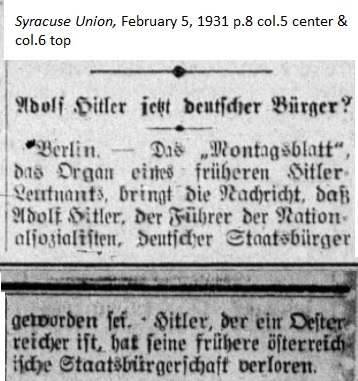
February 5, 1932 page 8 _____ Berlin. — The Montagblatt, the organ of a previous Hitler lieutenant, brings th report that Adolf Hitler, the leader of the National Socialists, has become a German citizen. Hitler, who is an Austrian, lost his previous Austrian citizenship. [June 1925] |
|
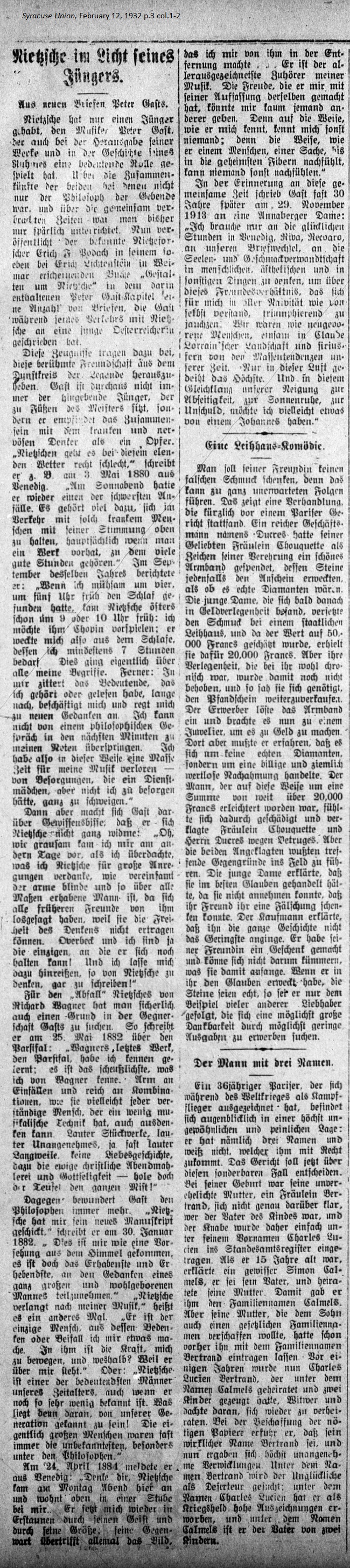
February 12, 1932 page 3 From Recent Letters by Peter Gast Nietzsche only had one disciple, the musician Peter Gast, who played an important role in the publication of his work and the history of his renown. One receives little insight from the meetings at which the philosopher was not just the host or about the times they spent together. The well-known Nietzsche researcher Erich F. Podach, in his book published by Erich Lichtenstein in Weimar titled Gestalten um Nietzsche, contains a chapter on Peter Gast and a number of letters which Gast wrote to a young Austrian woman during Gast's time together with Nietzsche. These testimonials contribute to lifting this famous friendship out of the realm of legend. Gast is definitely not always the devoted disciple sitting at the feet of the master, rather he feels his time together with the sick and nervous thinker is a sacrifice. "In this miserable weather things are not going well for Nietzsche," he wrote on May 3rd, 1880 from Venice. "On Saturday night he again had one of the most diffuclt attacks. It takes a lot to keep one's spirits up when dealing with such a sick man especially when one is planning a work which requires many good hours." In September of the same year he reported: "Whenever I had trouble getting to sleep around four or five AM, Nietzsche often came around 9 or 10 AM. I liked playing Chopin to him. He'd wake me up when I needed at least 7 hours sleep. It goes beyond my comprehension. Important things that I have heard or read vibrate through me; they occupy me and produce new thoughts in me. I can't jump from a philosophical discussion and in the next minute take up my music. In this way I have lost a massive amount of time for my music — by keeping quiet about an errand to which a maid, not I, should have to attend." However Gast then felt pangs of remorse for not devoting himself to Nietzsche: "Oh, how cruel I felt the other day when I thought about how indebted I was to Nietzsche for his many suggestions. How alone the poor blind man, who is elevated above the masses, feels when he rids himself of his former friends because they could not bear such freedom of thought. Overbeck and I are the only ones to whom he can relate! And I let myself get carried away thinking about Nietzsche that way, let alone writing it down!" Concerning the breech between Nietzsche and Richard Wagner one certainly had justification in researching Gast's antagonism. On May 25, 1882 he wrote concerning "Parsifal": "I've become acquainted with Wagner's latest work, Parsifal. It's the most atrocious thing I've heard from Wagner — poor in concepts and rich in combinations as they are perhaps concocted by reasonable men with little musical technique. Pure piecework, purely unpleasant, and rather boring; no romance or tale of the Last Supper and godliness. Send the whole mess off to the devil!" Then again Gast had ever greater admiration for the philsopher. "Nietzsche has sent me a new manuscript," he wrote on January 30, 1882. "For me it's an act of Providence coming down from heaven. It is the most sublime and uplifting of thought from one of the greatest and most well-form of men." "Nietzsche yearns for my music," he said another time. "He is the only person whose opinion or approval means something to me. He has the power to move me, but why? Because he stands above me." Or, "Nietzsche is one of the most significant man of our age, even if he is not so well known. What does it mean to be known by our generation? The truly great men were almost always unknown, especially among the philosophers." On April 24, 1884 he reported from Venice: "Consider this. Nietzscne arrived here on Monday evening and he lives in a room above me...He astonished me once again with his intellect and his greatness; his presence always exceeds the images I have of him from afar...He is the most distinguished audience for my music. His opinion of my music makes me happier than scarcely anyone else's ever could. He knows me like no other; the way with which he empathizes with a man or an issue, down to deepest fiber of his being, can never be equaled by anyone else." In his memoires concerning the same period Gast wrote almost 30 years later on November 29, 1913 to a lady from Annaberg: "I need only think back on the happy hours in Venice, Riva, and Recoaro in our exchange of letters to recall the spiritual and aesthetic kinship of this friendship, which I understood in all its simplicity and which caused me to cheer triumpantly. We were like newly-born men, alone in a Claude Lorraine landscape and a constellation away from the mass tendencies of our time. Only in these heavens were we granted the utmost. And in this harmony of our inclinations towards remoteness, towards sun filled peace, towards innocence, I might have had something of a St. John the Disciple moment." A Pawnshop Comedy _____ One should never give his girlfriend fake jewelry because it can have unexpected consequences. This is demonstrated in a recent case before the Parisian Court. A rich man named Dueres gave his beloved Miss Chouquette a beautiful bracelet as a sign of his affection. The bracelet's gemstones sparkled like real diamonds. The young woman, who found herself pressed for money, took the bracelet to a state pawnshop, where the value was set at 50,000 Francs. She received 20,000 Francs. But her financial difficulites were not resolved so she had to sell the pawn ticket. The buyer retrieved the bracelet and took it to a jeweler to sell it and recover his expenses. But he found out that the diamonds weren't real so he had a cheap and worthless replica. The man, who now had been relieved of well over 20,000 Francs, felt cheated and accused Miss Chouquette and Mr. Dueres of fraud. However the two accused filed excellent counterarguments. The young lady declared that she had acted in good faith since she assumed that her friend would not give her a fake. The merchant declared that he had nothing to do with the entire episode. He had given his girlfriend a gift and didn't care what she did with it. If he had left her to believe that the jewels were real, then he had just followed the example of so many other lovers who sought to acquire the greatest possible amount of gratitude for the least possible amount of money. The Man with Three Names _____ A 36 year old man, who identified himself as a combat pilot during the World War, finds himself in a highly unusual and embarassing situation: he has three names and does not know which one is correct. The Court will now preside over the unique case. At the time of his birth his unmarried mother, a Miss Bertrand, never made it clear who was the child's father. The boy was simply listed at the registration office by his first and middle names, Charles Lucien. When he was 15 years a certain Simon Calmels said he was his father. He married his mother and thus he gave the son the family name Calmels. But his mother, who wanted her son to have a legal family name, had already listed him under the name Bertrand. A few years ago he had married under the name Charles Lucien Calmels and had two children. He was now a widower and was considering remarriage. While obtaining the necessary documents he discovered that his actual last name was Bertrand and this created highly unpleasant complications. Under the name Bertrand the unfortunate man was being sought as a deserter. Under the name Charles Lucien he was decorated as a war hero, and under the name Calmels he is the father of two children. |

|
February 12, 1932 page 4 _____ Since It's Been in the Hands of the Oberländer Press for 20 Years _____ 20 years ago today the Syracuse Union became the property of Mr. Alexander E. Oberländer. It had been in existence for 60 years and today also marks its 80th year. On August 23, 1852 George Saul published a prospectus in which the publication of a German newspaper for Syracuse was announced. The first issue was published on September 4th under name Onondaga Demokrat. Since then the newspaper has appeared regularly every week with only one issue missing. In 1863 the name was changed to Wöchentlicher Syracuser Demokrat (Weekly Syracuse Democrat) and on January 6, 1866 the newspaper appeared for the first time under the name Syracuse Union. George Saul was the first publisher from 1852 to January 1863 when it passed into the hands of John L. Röhner, who sold the newspaper on August 10, 1870 to Johann Ziegler. Four months later at the begining of December it was taken over by Alexander von Landberg, who managed it with much skill, knowing how to win significant political influence. In July 1895 he sold the paper to J. Peter Pinzer, who carried it further until June 1911, when the Federal Court placed it in the hands of bankruptcy administrators, the late Gustav F.E. Meistering and Mr. Wilhelm Dopffel. They managed the paper until February 12th, when by court order tbe newspaper was put up for sale to the highest bidder. No one was willing to buy the newspaper when Mr. Oberländer came on the scene. No one wanted the Germans to lose their local newspaper. It was due to urging and love for the German element that he, along with his brothers Fridolin F. and Walter B. Oberländer, made an offer much higher than the price it had cost Mr. Pinzer for the newspaper and the print equipment. The offer was quickly accepted by the Court and the newspaper and printshop was turned over to its new owners. It was a risky enterprise — for many years expenses outnumbered income. To put the business on secure footing Mr. Alex E. Oberländer gave up his large attorney practice and dedicated all his time to the new enterprise. The war years, especially after America entered the World War, were a dubious time — the Union sunk to its lowest point. American business people and many so-called German-Americans, who openly wished to display their great loyalty to America, refused to advertise their wares in the German newspaper, because it was viewed as unpopular. Complaint after complaint was filed at the newspaper office that letter carriers often overlooked the delivery of the newspaper and occasionally tossed it who-knows-where. In other places where duty-conscious letter carriers correctly delivered the newspapers, they were stolen by unknown parties. This created many complaints to the postal authorities, from whom little sympathy was received. In addition the Union, like so many other German newspapers in this country, were placed under the supervision of the Censureship Office. English translations had to be supplied with the German text of all articles, be it news or lead article, having the slightest to do with the War. Hundreds of German newspapers throughout the country had to adjust to these complex stipulations, including The Brooklyn Freie Presse, New Yorker Journal, Buffalo Freie Presse, Cincinnati Freie Presse, and the Illinois Staatszeitung — all large and significant daily newspapers. [Scroll down for column 2 of this article] |
|
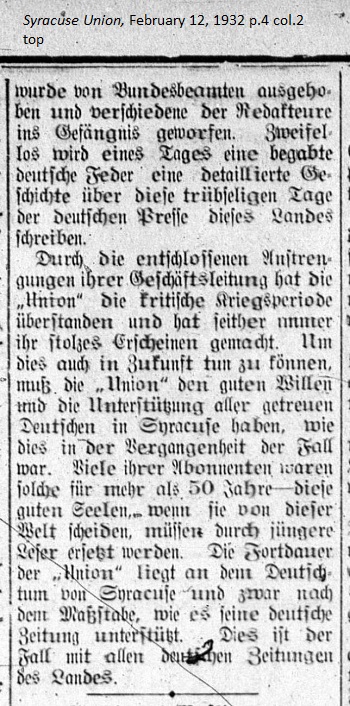
February 12, 1932 page 4 column 2 Others such as Philadelphia Tageblatt and Der Wächter und Anzeiger in Cleveland were confiscated by Federal officials and various editors were thrown in prison. Undoubtedly some day a gifted German feather will write a detailed history concerning these dismal days of the German press in this country. Through the determined efforts of the business management the Union survived the critical war years and continued to publish its proud issues. In order to continue to publish in the future, the Union must have the good will and the support of all loyal Germans in Syracuse, as was the case in the past. Many of its subscribers were loyal for more than 50 years — these good souls, when they departed this world, had to be replaced by younger readers. The continuation of the Union relies on the Germans of Syracuse to support its newspaper in full measure. This is the case for all German newspapers in this country. |
|
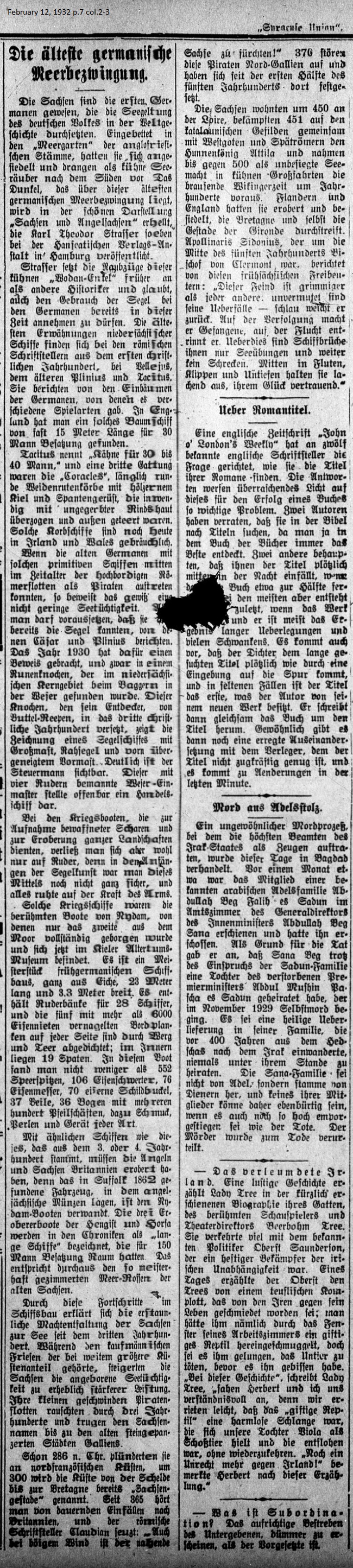
February 12, 1932 page 7 _____ The Saxons were the first seaworthy group among Germans in world history. Nestled among the people of the Anglo Frisian tribes, they established themselves as bold pirates in the south before the dark ages. The oldest German sea conquest is highlighted in the beautiful account titled Sachsen und Angelsachsen (Saxon and Anglo-Saxon) by Karl Theodor Strasser published by Hanseatische Verlags-Anstalt in Hamburg. Strasser places the piracy of these bold "Grandchildren of Odin" in an earlier era than other historians and believes that the Germans were already using sails at this time. The earliest mentions of Lower-Saxon ships are found among the Roman writers of the first century A.D., Velleius, Pliny the Elder and Tacitus. They described various kinds of dug-out canoes used by the Germans. In England such a wooden ship was found, almost 15 meters in length and able to transport 30 men. Tacitus spoke of "boats for 30 to 40 men" and a third type called coracles, oblong willow-branch baskets with wooden keel and framework and an interior covered in untanned cowhide and a tarred exterior. Such basket boats are still used today in Ireland and Wales. When the old Germans with their primitive ships entered Roman-controlled waters as pirates during the age of high-sided Roman flotillas they demonstrated a great deal of seaworthiness. One may suppose that they already knew about sails, as reported by Caesar and Pliny. Proof was found in 1930 from runes on bones which were found in the Lower Saxon central region during excavation of the Weser River. These bones, dated as belonging to the third century by their discoverer, Buttel-Reepen, show markings of a sailing ship with a large mast, square sail, and bent foremast. The navigator is clearly marked. This four-oar propelled, Weser, single masted boat apparently represents a trade vessel. The warships, which served to transport men with weapons to conquer entire regions, were powered by oars alone because in the beginning sails were not yet a completely reliable means of propulsion. Everything depended on the strength of human arms. Such war vessels were the famous boats of Nydam Mose, of which only the second was completely salvaged during the excavation of the bog, and is currently located at the Kiel Antiquities Museum. It is a masterpiece of early Germanic ship building, made entirely of oak, 23 meters long and 3.3 meters wide. It contains 28 stations for oarsmen and 5 wall planks per side nailed together with more than 6000 iron rivots and sealed with oakum and tar. The interior has 19 spars. No fewer than 552 spearheads, 106 iron swords, 76 iron knives, 70 shield bosses, 37 axes, 36 bows and many hundreds of arrows, plus jewels, pearls, and equipment of all kinds were found. Ships similar to the Nydam boats, which originated in the 3 or 4th century, must have invaded the Angles and the Saxons of Britain because a vessel was found in Suffolk in 1862 which contained Anglo-Saxon coins. The three conquest boats of Hengist and Horsa were described in the chronicles as "long ships," which had room for 150 men. This conforms to the masterfully carpentered "Seahorses" of the old Saxons. This progress in shipbuilding accounts for the astonishing display of seapower by the Saxons since the third century. While the merchantile Frisians belonged to the larger coastal areas, the Saxons increased their inborn sea prowess to much greater and stronger achievment. Their small, swift, pirate flotillas swept through the third century and carried the Saxon name all the way to the old, stone-fortified cities of Gaul. By 286 A.D. they plundered the coast of northern France. Around 300 the coastline from the Scheldt River to Brittany was called the "Saxon Shores." From 365 on one heard of recurring incursions into Britain and the Roman writer Claudian lamented: "And wherever the gusty wind blows, the approaching Saxon is to be feared." By 370 A.D. these pirates assailed northern Gaul and since the first half of the fifth century they have settled there. Around 450 the Saxons lived in the Loire region. In 451 they fought in the Catalonian fields along with the Visigoths and Late Romans against Attila, King of the Huns. Until around the end of 500 A.D. they were the undefeated seapower during the era of bold voyages by the Vikings. They invaded and settled in Flanders and England. They even wandered down to Brittany and the Gironde region. Apollinaris Sidonius, who around the middle of the fifth century was the bishop of Clermont, wrote about these early Saxon buccaneers, "This enemy is more fierce than any other. The raids are unexpected — prudently he retreats. During the foray he takes prisoners; when in flight, he escapes. Moreoever, shipwrecks are merely maritime exercises, nothing to fear. In the midst of floodwaters, cliffsides and shallows they smile, relying upon their luck." Novel Titles _____ An English periodical titled John o' London's Weekly asked twelve well-known English writers how they decided on the titles of their novels. The answers shed a surprising light on this important issue with regard to the success of their books. Two authors admitted that they looked for titles in the Bible since one always found the best titles there. Another two writers maintained that the titles occurred to them in the middle of the night when the books were about half way finished. However for most the title originated as the result of lengthy deliberation and much wavering back and forth once the work was complete. It also was revealed that the poet suddenly discovered the title like an inspiration out of the blue. In a few cases the title was the first thing that came to the author's mind for a new work. He writes the book after the title. Usually there's a heated discussion with the publisher that the title isn't sufficiently appealing and it's changed at the last minute. Death and the Pride of Nobility _____ An unusual murder trial took place in Baghdad recently in which the highest official of the Iraqi State was called as a witness. About a month ago a member of a well-known Arab noble family, Abdullah Beg Falih es Sadun, appeared before the office of the General Director of the Interior, Abdullan Beg Sana, and shot him. He admitted the reason for the deed was that Sana Beg married the daughter of the late Prime Minister, Abdul Mushin Pascha es Sadan despite the objection by the Sadan family. In 1929 the late Prime Minister had committed suicide. It was a sacred tradition within his family, who had emigrated 400 years ago from Hejaz to Iraq. The Sana family was not a noble family but descendents of servants, thus no member of the family was a social equal no matter how high they had risen, such as the dead Prime Minister. The murderer was condemned to death. — Villified Ireland. Lady Tree told a funny story in the recently published biography of her husband, the famous actor and theater director Beerbohm Tree. She frequently socialized with the well-known politician Colonel Saunderson, who was an ardent opponent to Irish independence. One day the Colonel told the Trees about a fiendish plot conspired by the Irish against his life. Someone had smuggled a poisonous repile through the window of his study, but he managed to kill the little monster before it bit him. "In this tale," Lady Tree writes, "Herbert and I agreed that the 'poisonous repile' was a harmless snake our daughter Viola kept as a housepet, which had escaped and not returned. Just another injustice levelled against Ireland, Herbert remarked after this story." |

|
February 26, 1932 page 5 _____ From the German newspaper in Schenectady, N.Y., Schenectady Herold-Journal, publisher and editorial manager Mr. Oswald E. Heck, et.al.: "The German newspaper of Salt City, the Syracuse Union, has reached the last issue of its 80th volume, the last 20 years of which have been under the management of its owner, Mr. Alexander Oberländer. 80 years is a long time for a German newspaper in America, which had to maintain its existence under unfavorable circumstances. Only a small portion of the residents of this country can make this claim especially with regard to the difficult battle it had to wage against the apathy of its fellow Germans. The 80 year survival of a German paper speaks more clearly than all else for the idealism of the publisher, who might have postponed publication until times were more advantageous. With regard for "our esteemed sister newspaper in Syracuse" the current publisher expressed his optimism when he took the German newspaper out of the hands of the bankruptcy administrators and saved it for the portion of the German community, which needed a publication in its own native language. Mr. Oberländer gave up his law practice and dedicated himself to the new enterprise until it was on more secure footing, even though it did not yield him riches. "The Germans of Syracuse — and this can be said by the Germans of all cities and towns — should actively support their German newspaper. The duration of the existence of German newspapers in America may be counted as a beacon making the obscure discernible. The German Press is for the German immigrant, and since a new large wave of immigration is not expected, let's not avoid the issue of decline. However existence can still be assured for a considerable number of years if every German musters national pride and a few dollars to declare themselves a unique entity and not dissolve into the American melting pot until absolutely necessary. "On its 80th birthday the Schenectady Herold-Journal extends to its sister newspaper, the Syracuse Union, its publisher, Alexander E. Oberländer, and its managing editor, Walter E. Mossdorf, our heartfelt congratulations." To the Publisher of the Syracuse Union, Mr. Alexander Oberländer Dear Mr. Oberländer. Here are heartfelt congratulations on the successful battle you have waged to keep a German newspaper in Syracuse. You not only kept the newspaper but much improved it, as any old reader can attest. We wonder if the new generation of immigrant Germans will support the newspaper as much as their predecessors did? Should this be the case, then the Union will be alive for a long time. We hope it will, with all our hearts. With most respectful greetings, Your Old Readers,
|
|
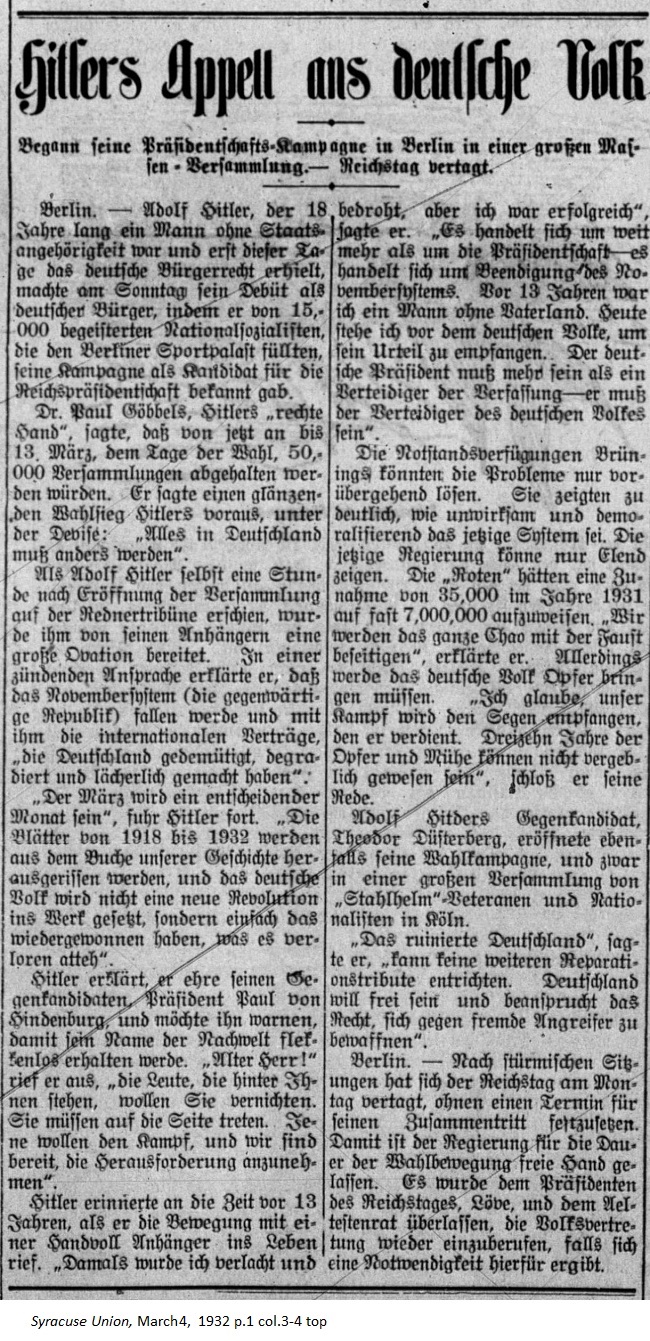
March 4, 1932 page 1 _____ His Presidential Campaign in Berlin began with a Huge Mass Assembly — Reichstag in Session _____ Berlin. — Adolf Hitler, who was a man without citizenship for 18 years and just a few days ago received his German citizenship, made his debut on Sunday as a German citizen, filling the Berlin Sports Arena with 15,000 enthusiastic National Socialists and announcing his campaign as a candidate for the Reichs presidency. Dr. Paul Göbbels, Hitler's "right hand" said that from now until March 13th, the day of the election, 50,000 assemblies will be held. He forecast a stunning election victory for Hitler under the slogan, "Everything in German must be changed." When Adolf Hitler himself appeared on the platform an hour after the assembly opened, he received a resounding ovation from his followers. In a rousing speech he declared that the November System (the current Republic) will fall and with it the international treaties "which have humiliated and degradated Germany and turned it into a laughing stock." "March will be a decisive month," Hitler continued. "The pages of our history book from 1918 to 1932 will be torn out and the German people will not only set a new revolution in motion but win back everything that was lost." Hitler stated he respects his opposition candidate, President Paul von Hindenburg, and wishes to advise him to keep his reputation spotless for posterity. "Elder Gentleman!" he shouted, "the people who stand behind you, want to ruin you. You must step aside. Everyone wants a fight, and we are ready to accept the challenge." Hitler thought back to the time 13 years ago when he called the movement into life with a handful of followers. "Back then I was laughed at and threatened, but I was successful," he said. "It concerned much more than the presidency — it dealt with the conclusion of the Novembe System. Thirteen years ago I was a man without a fatherland. Today I stand before the German people to receive their verdict. The German president must be more than the defender of the constitution — he must be the defender of the German people." Brüning's contingency regulations cane solve the problems only temporarily. They clearly show how ineffective and demoralizing the current System is. The current goverment can only display misery. The "Reds" exhibited an increase from 35,000 in 1931 to almost 7,000,000. "We will obliterate the chaos with our fists," he declared. Certainly the German people must bring sacrifices. "I believe, our fight will be blessed. It deserves that. Thirteen years of sacrifice and effort cannot be for nothing." With this he closed his speech. Hitler's opposition candidate, Theodor Düsterberg began his campaign at the same time in Cologne with a mass assembly of "Steel Helmet" veterans and Nationalists. "Germany is in ruins," he stated, "and can no longer pay reparation tributes. German wants to be free and demands the right to arm itself against aggressors." Berlin. — After stormy sessions the Reichstag adjourned on Monday without setting any date to reconvene. Thus the government is allowed a free hand for the duration of the election process. It was left to the President of the Reichstag, Löve, and the Elder Council to call back the people's representatives in the event there is a need. |
|
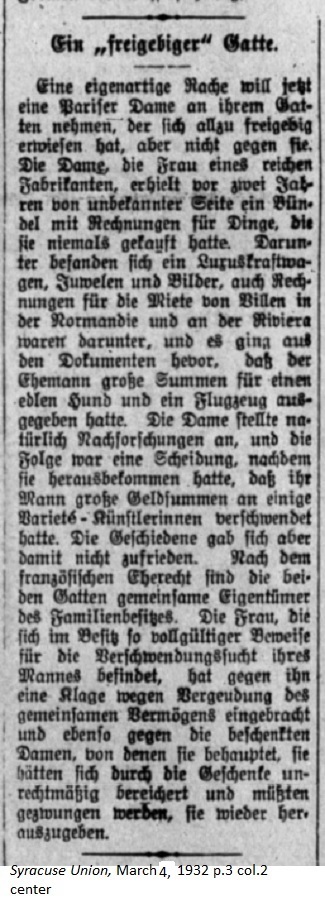
March 4, 1932 page 3 _____ |

|
March 11, 1932 page 4 _____ Rotfront (the Red Front,) the Communist Party wants to deliver Germany to the Bolsheviks. The Harzburg Front, in which National Socialism is predominant, presents the program of the Third Reich: Nationalism on socialistic principle or the reverse. The Iron Front represents the antagonist to National Socialism; it encompasses the Socialism of the Second Internationals along with its middle class followers. All three movements are unavoidably or programmatically for economic independence. Each wants to destroy the other system and national collectivism and no longer permit the justification of existence as a liberal, middle class model. Their political slogans are incredibly similar, so similar that only the enemies of their leaders seem to stand between the groups. Ferdinand Fried, who's made an effort to intellectually refine National Socialism, speaks about the end of Capitalism. However his theses are none other than nationalized Marxism. They differ from the teachings of Marx and Lenin only by the narrowness of their range. Cross connections whereever one looks. Hitler's National Socialism currently holds a wide berth from the three socialist movements. But thanks to economic need this movement is still growing. It has the core of the middle class, and when it came to the election it significantly weakened the right wing and pushed their waves against the Central Tower [Supporters of the Weimr Republic], the last stronghold of the middle class still boldly facing the political crisis. Hitler's position in Germany is similar in many important respects to the position of French General Boulanger during the height of his power, when the era of Boulanger's socialist impact failed. Both leaders undoubtedly exhibit a common trait: the ability to fanaticize their followers to the point of belief in miracles. National Socialism learned much organizationally from the failure of 1923. In the near future it may decide its political limitations. If it chooses the right course it may change in a positive direction and embrace continuing development towards measures sufficiently tolerable for its followers to endorse. Give the upper hand to the lower eschalon leaders Göbbels and Strasser, and the radical surge will soon tumble. |
|
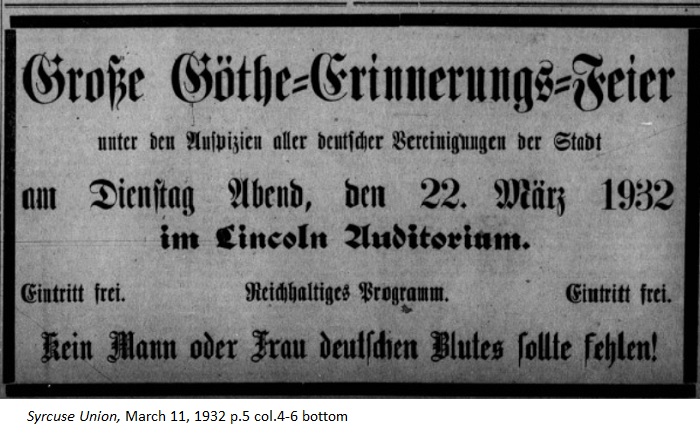
March 11, 1932 page 5 under the auspices of all the German Associations of the City Thursday Evening, March 22, 1932
Free Admission Extensive Program Free Admission No Man or Woman of German Blood should miss this! |
|
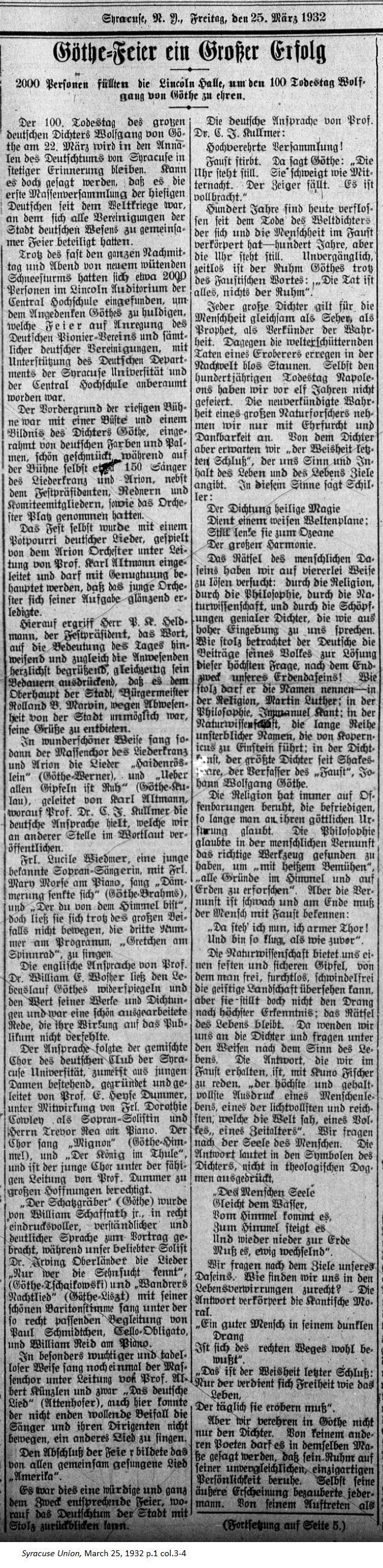
March 25, 1932 page 1 _____ 2000 People filled Lincoln Hall to Commemorate the 100th Death Date of Wolfgang von Goethe _____ Despite the recent snowstorm, which practically lasted all afternoon and evening, around 2000 people gathered in the Lincoln Auditorium of the Central High School to pay tribute to Goethe's memory. It was a celebration suggested by the German Pioneer Association and the all the city's German organizations, supported by the German Department of Syracuse University, and held at the Central High School. The foreground of the giant stage was beautifully decorated with a bust and portrait of the poet Goethe framed in German paints and palms. On the stage itself were 150 singers from the Liederkranz and Arion singing societies along with the festival president, speakers, and committee members plus the orchestra. The festivities included a potpourri of German songs, accompanied by the Arion Orchestra under the direction of Prof. Karl Altmann. Let it happily be noted that the young orchestra executed its assignment brilliantly. Afterwards Festival President P.K. Heldmann delivered a few words on the meaning of the day and heartily greeted all those present while also expressing his regrets that the mayor of the city, Rolland B. Marvin, was absent from the city and unable to offer his greetings. Then the group choir of the Liederkranz and Arion beautifully performed the songs "Haidenröslein (Goethe-Werner) and "Ueber allen Gipfeln ist Ruh" (Goethe-Kulau) conducted by Karl Altmann. Thereafter Prof. C.J. Kullmer gave a German language speech, the text of which we publish in a separate section. Miss Lucile Wiedmer, a young, well-known soprano, with Miss Mary Morse at the piano, sang "Dämmerung senkte sich" (Goethe-Brahms), and "Der du von dem Himmel bist". Despite the thundering applause she did not move until she performed the last song, "Gretchen an Spinnrad." The English language speech by Prof. Dr. William E. Wosher focused on Goethe's life and the value of his prose and poetry. It was a beautifully prepared address which did not fail to impress the audience. After the speech the mixed choir of the German Club of Syracuse University performed. The choir was comprised mostly by young women. It was established and conducted by Prof. W. Heyse Dummer with the participation of Miss Dorothie Cowley as soprano soloist and Mr. Trevor Rea at the piano. The choir sang from the opera "Mignon" (from the poem by Goethe, music by Himmel) and "Der König im Thule." Under the capable baton of Prof. Dummer the young choir exhibits great promise. "Der Schatzgräber" (Goethe) was recited by William Schaffrath Jr. in the German language in an expressive and clear manner then our beloved soloist, Dr. Irving Oberländer, sang the songs "Nur wer die Sehnsucht kennt" (Goethe-Tchaikowsky) and "Wanderers Nachtlied" (Goethe-Liszt) in his fine baritone voice accompanied by Paul Schmidtchen on the cello-obligato and William Reid at the piano. In an especially stunning and flawless rendition the group choir sang again under the direction of Prof. Albert Künzlen "Das deutsche Lied" (Attenhofer). Once again the unending applause prompted the singers and their conductor to sing another song. The conclusion of the celebration led to the song "America" sung by all. It was a a worthy and appropriate celebration upon which the German community of this city can look back with pride. The German address by Prof. Dr. C.J. Kullmer: Honored Assembly! Faust dies. Then Goethe says: "Time stands still. It's as silent as midnight. The clock stops. It is completed." A hundred years have flown by since the death of the world-poet, who epitomized himself and humanity in Faust — a hundred years, but time stands still. Goethe's fame is everlasting, timeless despite the Faustian words, "The deed is everything; fame is nothing." Every great poet works for humanity in a manner similar to the seer, the prophet, the herald of truth. Earth-shattering deeds of the conquerer merely elicit amazement in the next world. We didn't even celebrate the hundredth year anniversary death date of Napoleon eleven years ago. We accept the newly pronounced truth of a great researcher of nature with respect and gratitude. However from the poet we await "the ultimate conclusion of wisdom," which delivers us the sense and substance of life and its goal. In this vein Schiller speaks: The sacred magic of poetry
We have attempted to solve the mystery of human existence in many different ways: through religion, through philosophy, through the natural sciences, and through the creations of ingenious poets, who seem to speak to us from a higher level of intuition. How proudly the German considers his people's contribution towards the solution of this lofty problem, right to the end of their existence on earth! How proudly he names names — in religion, Martin Luther; in philosophy, Immanuel Kant; in natural science, a long list of iimmortal names from Copernicus to Einstein; in poetry, the greatest poet since Shakespeare, the author of "Faust", Johann Wolfgang Goethe. Religion has always relied on revelations, which satisfy so long as one believes in a divine origin. Philosophy believed it had found human reason to be the correct tool "to investigate all the reasons on heaven and earth" "with heated endeavor." However reason is weak and in the end man must recognize with Faust: "And here I stand with all my lore,
The natural sciences offer us a firm and secure perch from which one can survey the landscape freely, fearlessly and without feeling dizzy. However it still doesn't quiet the urge for higher learning. Life remains a mystery. So we turn to the poet and ask, how to make sense of life. The answer, which we find in "Faust" according to Kuno Fischer: Faust "is the highest and most substantial expression of a human life, he is the most enlightened and richest the world, a people, an era has ever seen." We ask about the human soul. The answer resounds in the symbols of the poet, not theological dogma. The soul of man
[From Gesang der Geister über den Wassern by Goethe.] We ask about the purpose of existence. How do we discover ourselves amid life's confusion? The answer epitomizes the Kantian moral "A good man in his dark urges
"Here is wisdom's final conclusion
However we don't just honor the poet in Goethe. So much more can be said of him than any other poet. His fame rests on his unique personality. Even his outward appearance charmed everyone. (Continued below on page 5) |

|
March 25, 1932 page 5 From his first entry as a youth at the Weimar Court to his last days when he was characterized by his olympic dignity and his sublime composure, he was considered a godlike entity transformed on earth. From no other poet were the journals, the speeches and letters so elaborately cited as a source of truth. If we turn to one timeless poetic creation, our attention is drawn to the fact that each work, including his immortal main opus, is one of overpowering experience. "I have always employed the ongoing harvest of experience in my existence," he once said. The harvest of the Sesenheimer era produced his first significant poetry. In the Sorrows of Young Werther, his first purely aesthetic work, he overcame the intoxicant of youth, the Storm and Stress Movement. From there he entered the path of his true destiny. The cultural world of western Europe had strayed into the pseudoclassical erroneous path and couldn't extract itself. A melding of the classical form with modern content originated out of the fire of the revolutionary period. But how peacefully, how solemnly he let the fateful days of the revolution pass over him. The fruit of these earthshaking events were perfectly illustrated in the classical idyll, "Hermann und Dorothea." In these days of reassessment of all values, where everything fluctuated, we should take a look at Goethe's attitude. When we contemplate the timeless significance of Goethe in his era we must not forget the influence of Schiller's friendship and the lasting mutual impact upon both of these unique geniuses. We must be astonished by the phenomenal extent of his creative intellect. His interests extended into all fields of study and investigation. However the subject above all others, whose range closely paralleled the national character of the German people, never left him in peace. It is the theme of the fall and reformation of humanity epitomized in the conjuror of the folk saga, Doctor Faustus. In the compendium of German literature there is no work which expresses so deeply the uniqueness of the German people. The conjuror, who through a pact with the devil acquires the pleasures of life, became a symbol for humanity, whose fate is decided through the investigation of life. In this questioning lies the grandiose character of Faust. Saying that the German exists among "the ranks of the poets and thinkers" is an honorable designation, however this honor was first bestowed upon him by the magnificent thinkers and poets of the 18th century. Of all the great ones who consistently enriched our intellectual treasury and who lent brilliance and prestige to the term German, the name Goethe stands in first place. For that reason on the hundredth anniversary of his death we bring the laurel wreath to commemorate his immortal ballads and pay tribute to his superior intellect. Indeed, what we say here is all too inadequate. Throughout the world one hears on this day of honor what was spoken by a choir: Traces of my days on this earth
|

|
April 1, 1932 page 1 _____ Confiscated Documents supposed to justify planned use of force, Results doubtful, the Courts will have the Last Word. Truce decreed by Request of the Clergy The branches of Adolf Hitler's National Socialist Party throughout Prussia were raided and searched according to orders from Berlin. Clarification was rendered by the Prussian Interior Minister, who said it dealt with thwarting a plot aimed at nothing less than initiating a civil war in order to allow the National Socialists to seize power by armed force. Not only the branch offices were raided, police officers paid personal visits to numerous National Socialist leaders in their homes and conducted thorough searches. Letters and documents in great numbers were confiscated. It was stated in the Brown House in Munich that the National Socialists intended to challenge the incursions of the Prussian Party in Federal Court. All legal measures were brought to bear in order to "fight against this unheard of incursion, which was counted upon to create public panic." The local headquarters of the National Socialists has registered energetic protest against the Police raid with Reichs Minister Wilhelm Gröner along with Police President Albert Grzesinski. By decree of President von Hindenburg, for the Easter holiday a truce had been declared for all of Germany lasting from March 20th to April 3rd. During this time period political assemblies and announcement were banned, as were distribution of flyers. The decree, as announced, resulted from a request by the Protestant and Catholic clergies. "The sale of my theater in Berlin is nothing other than a business transaction for the sale of the property," he stated. "Meanwhile I am searching for competent people who will take over the management of my theaters in Berlin and Vienna." Reports from Berlin indicate that Reinhardt wants to give up the theater business because of the Depression. He recently sold the Comedy House and the theater on Kurfürstendamm. It now appears he also wants to sell the German Theater. |
|
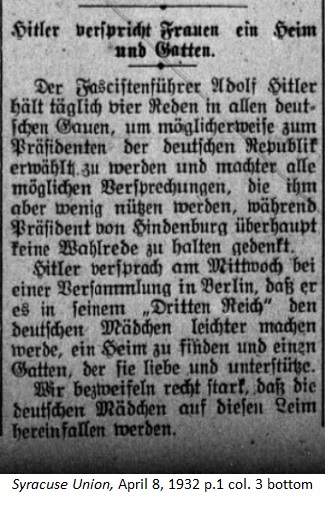
April 8, 1932 page 1 _____ The Fascist leader, Adolf Hitler, conducts four speeches daily in all German regions in order to enhance his chances to become President of the German Republic. He also makes all possible kinds of promises, which are of little use to him, while President von Hindenburg doesn't hold any election speeches. On Wednesday Hitler promised at an assembly in Berlin that he will make life easier for German girls in his "Third Reich" to find a home and a husband whom she will love and support. We strongly doubt that the German girls will fall for this line. |
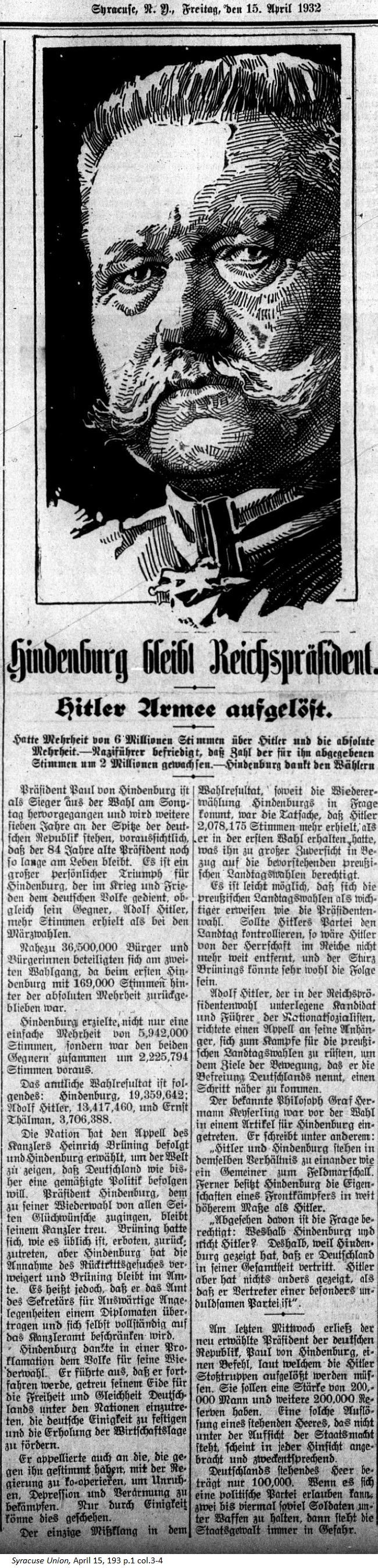
|
April 15, 1932 page 1 _____ Hitler Army Disbanded _____ A Majority of 6 Million Votes over Hitler and the Absolute Majority — Nazi Leader pleased that the Number of Votes increased by about 2 Million — Hindenburg thanks the Voters _____ President Paul von Hindenburg is the victor of the Sunday election and will stand as head of the German Republic for another 7 years, provided the 84 year old President remains alive that long. It is a great personal triumph for Hindenburg, who served the German people in war and peace, although his opponent, Adolf Hitler, received more votes than during the March election. Nearly 36,500,000 male and female German citizens participated in the second election. In the first election Hindenburg was 169,000 votes shy of an absolute majority. Hindenburg received not just a simple majority of 5,942,000 votes, but he was ahead of his two opponents combined by around 2,225,794 votes. The official election results are as follows: Hindenburg, 19,359,642; Adolf Hitler, 13,417,460; Ernst Thälman, 3,706,460. The Nation followed the appeal of Chancellor Heinrich Brüning and elected Hindenburg in order to show the world that Germany will continue in the moderate Party line. President von Hindenburg, who received congratulations from all sides, remains loyal to his Chancellor. As usual, Brüning offered to resign but Hindenburg refused the resignation attempt and Brüning remains in office. This means that he will transfer the office of Secretary for Foreign Affairs to a diplomat and limit himself to the position of Chancellor. In a proclamation to the people Hindenburg thanked them for his reelection. He explained that he will continue to be true to his oath and advocate for the freedom and equality of Germany among nations, secure German unity, and work towards economic recovery. He also issued an appeal to those who had voted against him to cooperate with the government in order to fight against unrest, depression and poverty. Only through unity can these things improve. A few notes of discord in the election results which call Hindenburg's relection into question involve the fact that Hitler received 2,078,175 more votes than he got in the first election, which entitles him to feel more confident with regard to forthcoming Prussian regional elections. It's easily possible that the Prussian parlimentary elections may prove more important than the presidential election. Should Hitler's Party control the parliament, then Hitler would not be far away from dominance in the Reich and the fall of Brüning could be in question. Adolf Hitler, the defeated presidential candidate and leader of the National Socialists, directed an appeal to his adherents to prepare themselves for the upcoming battle in the Prussian parliamentary election, which would take them a step closer to the Movement's ultimate goal, which he called the liberation of Germany. The famous philosopher, Count Hermann Keyserling, submitted a pro-Hindenburg article before the election. Among other things he wrote: "Hitler and Hindenburg stand in the same relationship to each other as a private stands to a field marshal. Furthermore, Hindenburg possesses the character of a front line fighter to a much higher degree than Hitler." "Apart from this, the question becomes: Why Hindenburg and not Hitler? Because Hindenburg has demonstrated that he represents Germany in its entirety. Hitler has demonstrated that he is the representative of a particularly intolerant Party." Germany's standing army only has 100,000 men. When a political party is allowed to have two to four times as many weaponed soldiers, then the the authority of the State is in jeopardy. |

|
April 29, 1932 page 8 _____ Last Friday a large audience listened with rapt attention to an interesting debate on the theme, "The Relations between France and Germany" between Prof. Herbert Kraus and M. Raymond Lange. The debate took place in the auditorium of the Utica Country Day School and was arranged by the Foreign Policy Association in Utica. Mr. Lange, a well-known French journalist, represented his nation in true French fashion. A small, dark-haired man with quick, almost nervous movements, skillfully laid out France's position. He emphasized France's need for security and peace, which was guaranteed by the Versailles Treaty. France is, he stated, not imperialistic and its people hate war. However it cannot forget that the country was invaded twice in recent memory, France still can't put its trust in German, and above all else it fears Hitler and his aspirations. Mr. Lange admitted that the Versailles Treaty is not perfect on all points and that in the course of time, but he didn't say when, those points would be altered. In a straightforward manner he conceded that the Polish Corridor is an absurdity, which cannot survive over the the course of the years. In general one could scarcely ignore the impression that the French representative was on the defensive. At the direct accusation by the German representative that France was working towards continental European dominance, Lange had no answer except that the Versailles Treaty existed and that "France had won the war." As representatives for their people the speakers could not have been better chosen. Compared to the typical French appearance of Monsieur Lange, Prof. Krause is truly germanic in appearance. Large, not too slim, somewhat angularly built, blond with distinctive and healthy face coloration, he exemplified the properties of the German teacher with the fine intellectual acuity of a good diplomat. He did not spend much time on the courteous points raised by the French representative, but instead went quickly to the heart of the matter. He made his audience aware of the German issues and emphasized that Germany had finally discontinued reparation payments not because it did not want to pay them but because it could not pay them. "The pot is empty," he said, "and nowhere else in world history has a defeated people been as patient as the Germans." Concerning the Hitler Movement Prof. Kraus said that it arises from young Germany's exasperation and dissatisfaction that war forces generations to suffer for events for which they were not responsible. Young Germany wants something other than conferences, discussions and lectures which produce no results. It wants to live in peace and to have work. Hitler, he said, is not anti-French, he's more anti-Slavic. Prof. Krause described French politics as the development of a fear complex and posed the question, when the often mentioned "security" of France will be attained, then answered his own question with "once hegenomy over Central Europe is achieved." He warned this could drive Germany into the arms of the Communists. A Communist Germany would lead to a Communist France in a few months, and then probably spread to Spain. "The consequences of such an event would not remain without interest for the United States," he stated. Two dark clouds are always present on the political horizon, the referendum on the Saar region in 1935 and the Danube Federation suggested by France. Even if the Saar Referendum goes in favor of Germany, as expected, then according to the Versailles Treaty Germany must buy back the coal mines in gold. Germany doesn't have any gold. The Danube Federation would rob Gemany of an important export zone and take away Germany's possibility of exporting goods. In that case Germany would be finished. Lively applause thanked both speakers at the conclusion of their debate. People left the hall with the conviction that the German's position had been well served. Prof. Kraus studied in Heidelberg and Leipzig, and later in America at Columbia and Harvard. Since 1930 he has been director of a seminar for international law and diplomacy. M. Raymond studied jurisprudence and political science in France, served in the French Army, later became editor of a newspaper and since 1923 has been Secretary of a large Polish evening newspaper in Paris, L'Intransigeant. |
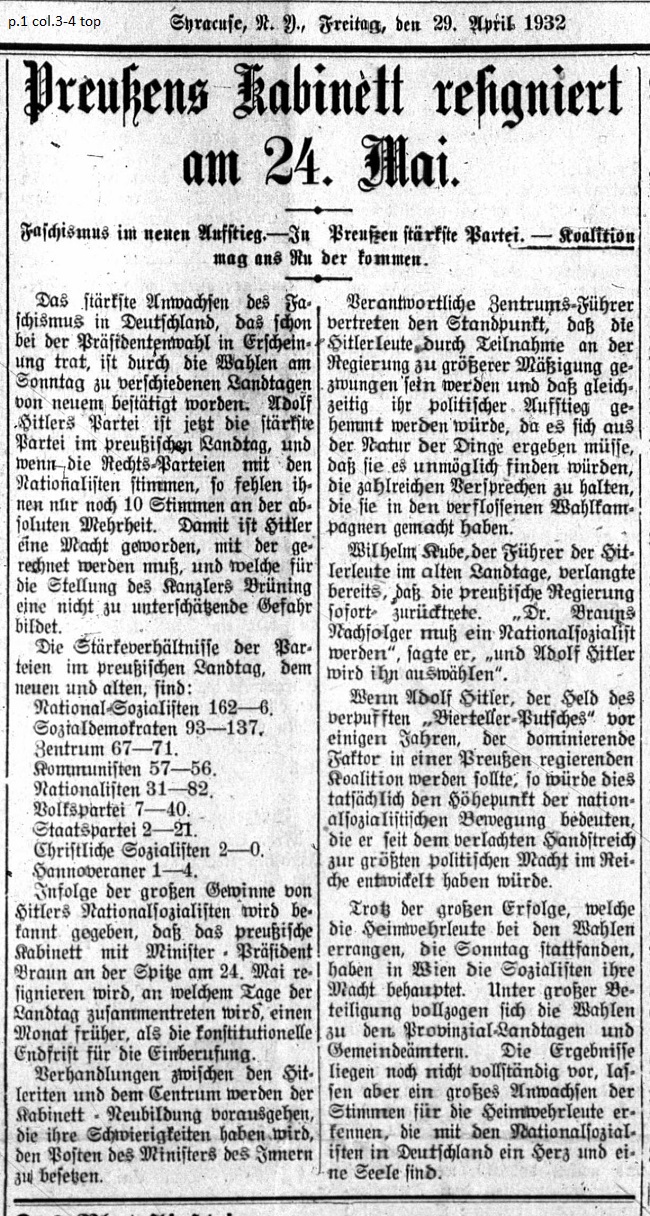
|
April 29, 1932 page 1 _____ Fascism Recently on the Increase — Strongest Party in Prussia — Coalition Might Lose Control _____ The sharp growth of Fascism in Germany, already apparent during the presidential election, has now been confirmed by the result of election held on Sunday in various regional parliaments. Adolf Hitler's Party is now the strongest party in the Prussian Parliament and if the right-wing parties side with the Nationalists they still lack 10 votes for an absolute majority. Thus Hitler has become a force to be reckoned with. The danger to Chencellor Brüning's office should not be underestimated. The relative strength of the parties in the Prussian Parliament has changed as indicated by the new number of seats held vs. the old number of seats: National Socialists: 162 — 6
As a result of the landslide of Hitler's National Socialists, it has been announced that the Prussian Cabinet with Minister-President Braun at the helm will resign on May 24th, on which day the parliament will assemble a month sooner than constitutionally proscribed to reconvene. Negotiations between the Hitlerites and the Central Party will lead to cabinet realignment. There will be difficulties with filling the position of Minister of the Interior. Amenable leaders of the Central Party are of the opinion that the Hitler people will be forced to become much more moderate as they participate in governing and that at the same time their political ascent will be slowed down. Inherently they will find it impossible to keep the numerous promises they made during the course of the election campaign. Wilhelm Kube, leader of the Hitler people in the old Parliament, already wants the Prussian government to reconvene. "Dr.Braun's successor must be a National Socialist," he said, "and Adolf Hitler will choose him." If Adolf Hitler, the hero of the fizzled-out Beer Hall Putsch a few years ago, becomes a dominant factor in a Prussian coalition government, it would be a highpoint for the National Socialist Movement. It would instantly change him from a laughing stock to a great political power in the Reich. Despite the great success which the Home Guard achieved in the election held last Sunday, in Vienna the Socialists retained their power. A large turnout won the elections for the Provincial Parliament and town officials. The results are still not fully tallied and there may be a large increase in the number of votes for the Home Guard people, who are one in heart and mind with the National Socialists in Germany. |
|
May 6, 1932 page 8 _____ German Mother Who had to Send Two of Her Sons to the War
_____ Mrs. Julia Wickert, born in Germany and living here for the past 45 years, was called away from the living Monday night in her home on 529 Carbon St. Two of her three sons, Joseph and Benjamin Wickert, died during the World War. Joseph died of influenza in 1918 as he was waiting to go to France and fight against Germany. Benjamin was killed in the Battle of the Argonne. In 1924 Mrs. Wickert made a trip to Europe to visit the grave of her sons and her old homeland. The departed was a beloved wife and member of the German branch of the 3rd Franciscan Order. She leaves behind her husband, Bernhardt J. Wickert; one son, William H. Wickert; five daughters, Mrs. Orris Green, Mrs. Theodore Wischerath, Mrs. Ernst Mahar, Miss Julia and Miss Martha Wickert; one sister, Mrs. Caspar Markert; two brothers in Germany and five grandchildren. Today, Friday morning at 8:30 a memorial service is being held in the home and half an hour later a funeral service at the Church of the Assumption with burial at the Assumption Cemetery. |
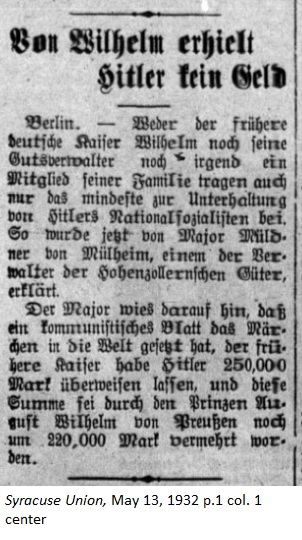
|
May 13, 1932 page 1 _____ Berlin. — Neither the former German Kaiser nor his estate manager nor any member of his family have contributed in the least to the support of Hitler's National Socialists. This was recently announced by Major Müldner von Müheim, one of the administrators of the Hohenzollern Estates. The Major indicated that a Communist newspaper had issued this fairytale to the world in a report stating that the former Kaiser may have transferred 250,000 Marks to Hitler and that this sum may have been increased by another 220,000 Marks by Prince August Wilhelm of Prussia. |

|
May 27, 1932 page 7 _____ We can't easily enough picture such an old germanic garden. The only fruit trees known back then were wild apple trees, which were planted in the fertile soil near the house in order to obtain better fruit. For vegetables beans, lentils, peas and carrots were planted. There were no flowers. More refined gardening techniques were first brought to the old Germans by the monks, who carried a sickle and knife along with their crucifixes in their belts as a sign that they were supposed to care for not only the heart of humanity but also the fields. Thus the missionaries became the first teachers of gardening to the Germans. They also brought an abundance of new plants with them which originated in the old cultures of the Mediterranean. In the time of Charlemagne there were already 73 varieties of vegetables, kitchen herbs, spices and healing plants recommended for stocking a garden along with some flowers like roses, white lilies, irises and poppies, at the time not used for decoration or special occasions but cultivated as healing aids. By the beginning of the 9th century the garden became a mainstay in German life and we learn from a Latin poem by the Abbot of Reichenau, Walafried Strabo, how he tended his own garden. The cleric had prepared a small plot of land in front of the door to his cell on the east side of the house. An awning protected against rain and wind. Just about all the plants came from the south and it required extra care to adjust the tender strangers to German soil. Walafried discusses in detail his efforts, which made his hands brown and calloused: how at the beginning of spring the garden was covered in stinging nettles; how he dug them out; how he destroyed the moles and dispatched every earthworm; how he chopped up the soil with a rake and hoe; how he got baskets of manure to loosen the hard clumps; and how he watered the seedlings from his cupped hand so as not to injure them. Sometime later the garden was separated from the old germanic farmstead and carefully cultivated in its own domain. Distinctive in this era was the garden patch, Beet in German, about which something new was always being discussed. It's certain that concepts were vivid — plants should rest in a soft, warm place like a bed. In fact, only when New High German [circa 1650] developed did the words Beet and Bett, meaning bed, become distinctive from each other. The art of plant care resided in the monastery in the hands of a particularly esteemed monk called the Pater Gärtner (Father Gardener,) who along with his assistants worked with the various fruit, herb, and vegetable gardens. The monastery gardener had the added duty, as was frequently reported, of wandering through the entire region around the monastery throughout the year and training the farmers in fruit cultivation and gardening. For a long time garden care rested primarily in pious hands and one finds exact instructions in many church works such as those of Hildegard von Bingen and the great master, Albertus Magnus. Hildegard, Germany's first female physician and natural scientist, gave full instructions for the layout of a garden and like the most experienced planter, Albert described how to graft fruit trees and grape vines and plant grass. In order to get short, tender grass which is most pleasing to the eye, one must, according to his instructions, completely remove all the roots and seeds of other plants by drenching the area in boiling hot water. Then the main and middle sections are covered in square pieces of turf. The grass is stamped into the ground with the foot until it's not longer visible. This causes the individual blades to burst forth and cover the surface like a green cloth. In the following centuries there arose a lay garden guild, whose patron saint was St. Gertrude. However the guild was comprised only of kitchen gardnerers, who dealt in the fruit, herb, and flower trade. Artistic and decorative gardeners first arrived during the Renaissance. Gardeners were highly respected people and when the journeymen made their masterwork they received difficult assignments. According to a "regulation" they had to be capable of planting a root garden and creating a labyrinth. Beyond this they were examined on flower propagation, grafting, stonefruit and other subjects. |
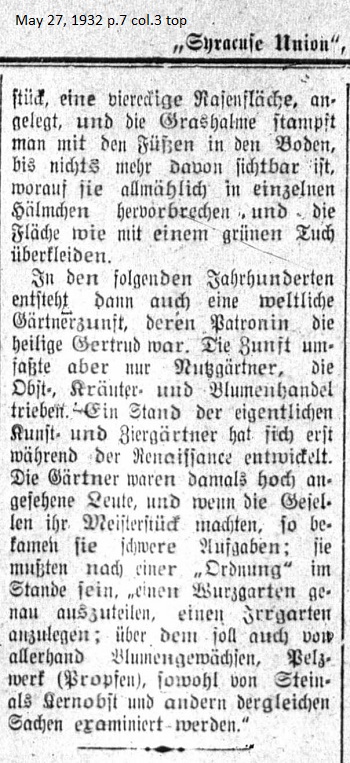
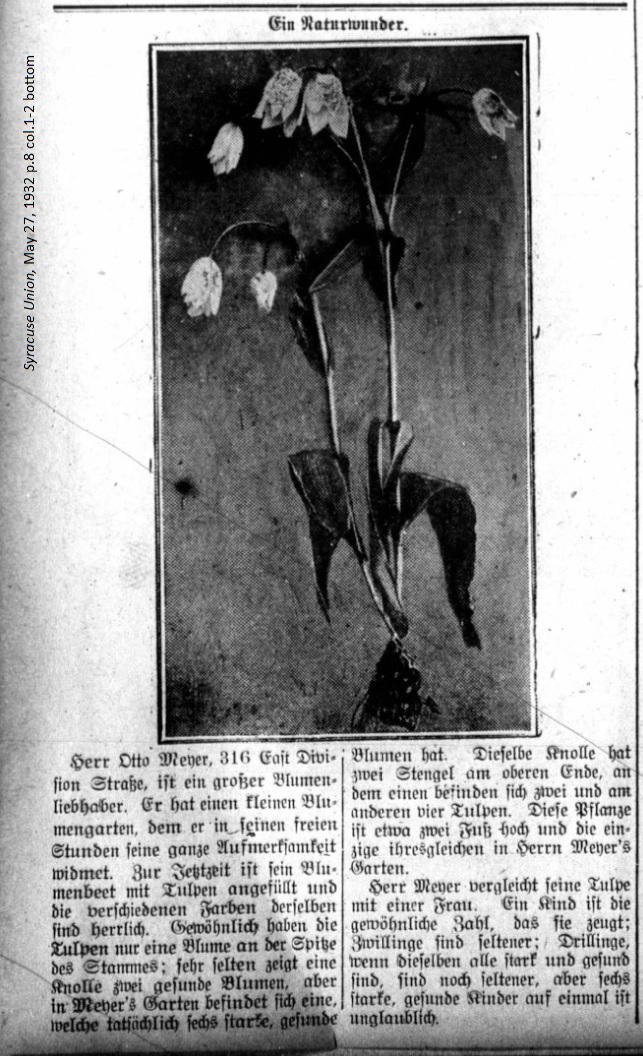
|
May 27, 1932 page 8 Mr. Meyer compares his tulip to a woman. One child is the usual number that she produces; twins are less frequent; triplets, when they're all strong and healthy, even rarer; but having six strong, healthy children at a time is unbelievable. |
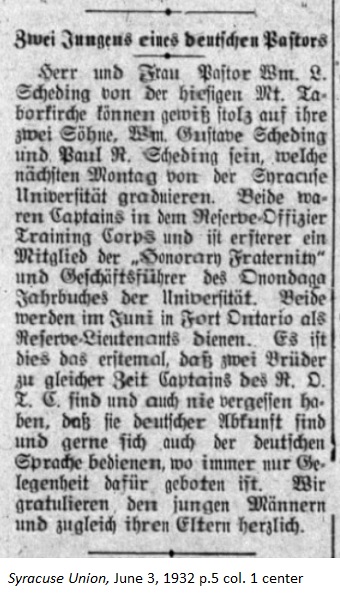
|
June 3, 1932 page 5 _____ |
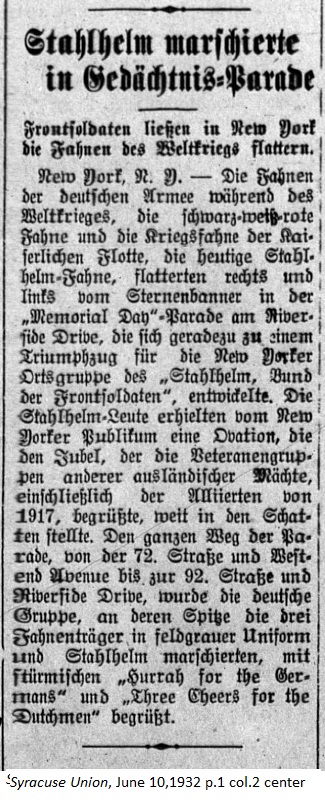
|
June 10, 1932 page 1 _____ Frontline Soldiers Wave World War Flags in New York |
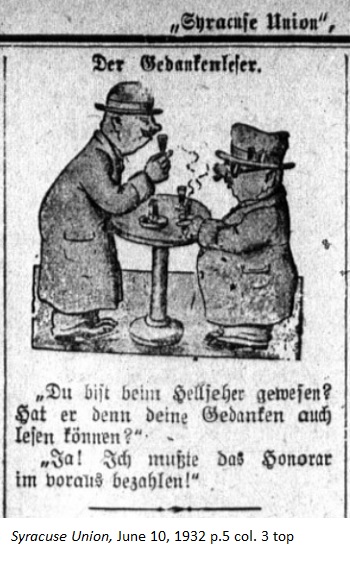
|
June 10, 1932 page 5 "Yes! He made me pay for the reading in advance!" |
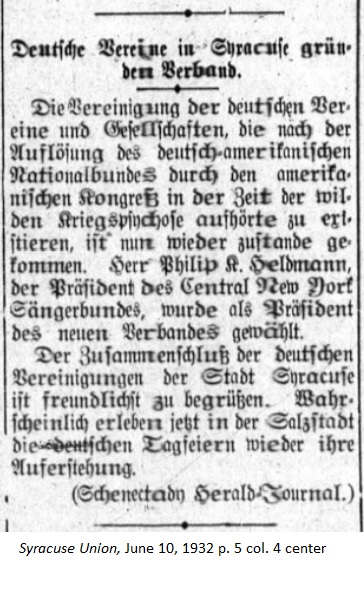
|
June 10, 1932 page 5 _____ (Schenectady Herald Journal) |
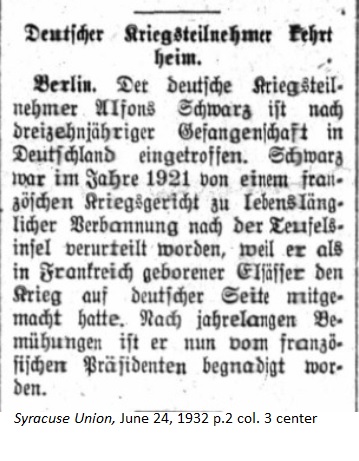
|
June 24, 1932 page 2 |