German Day, August 12, 1933
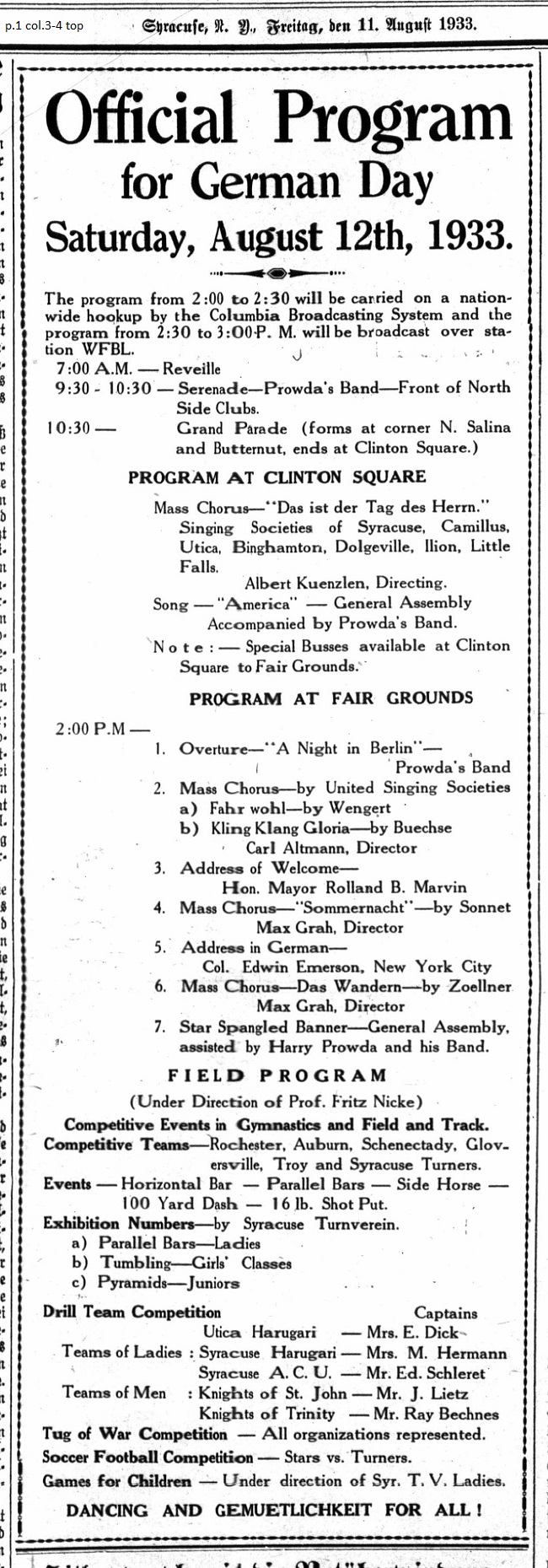
|
Friday, August 11, 1933 page 1 |
|
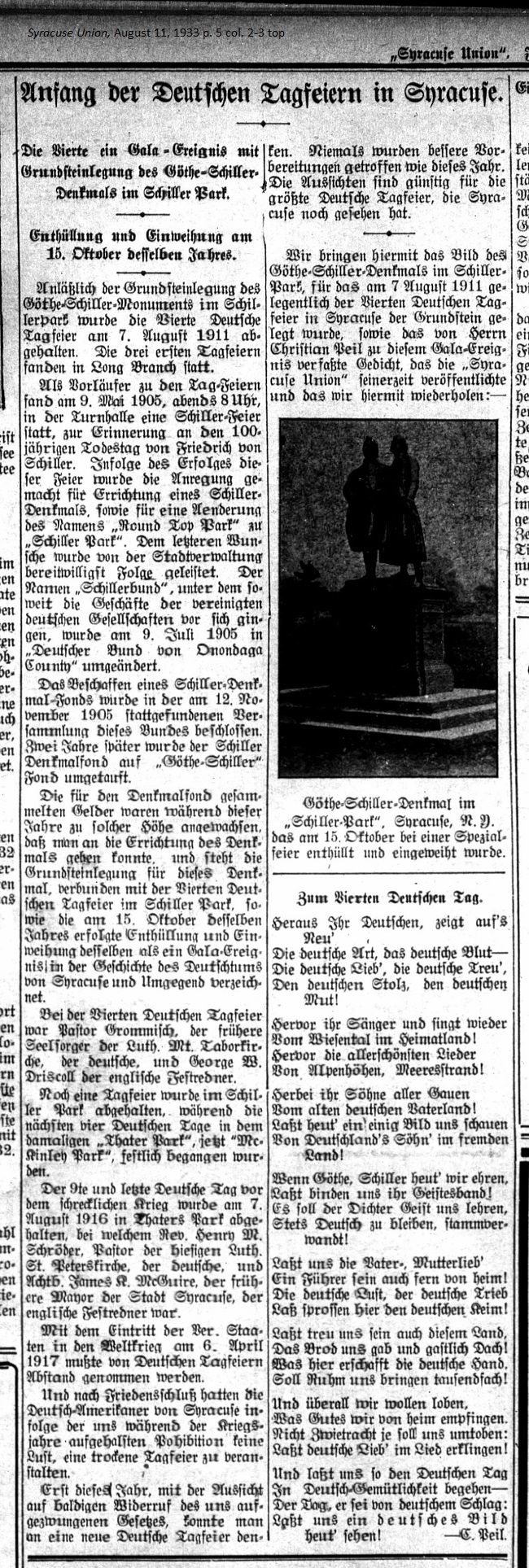
August 11, 1933 page 5 _____ The Fourth Gala was held to celebrate the Laying of the _____ Unveiling and Dedication held on October 15th of the Same Year. _____ The fourth German Day celebration took place on August 7, 1911 with the laying of the groundstone for the Goethe-Schiller Monument at Schiller Park. The first three celebrations took place at Long Branch. As a precursor to the German Day festivities on May 9 1905 at 8 in the evening, there was a Schiller Celebration held in the Gymnastics Hall in commemoration of the 100th anniversary of the death date of Friedrich von Schiller. As a result of this celebration great enthusiasm developed for the construction of a Schiller Monument plus a changing of the name "Round Top Park" to Schiller Park. The City Authorities readily granted this last request. The name "Schillerbund" (Schiller Federation,) under which the business of the United German Associations was conducted, was changed to the "German Bund of Onondaga County" on July 9, 1905. The Bund created a Schiller Monument Fund at its November 12, 1905 meeting. Two years later the Schiller Monument Fund was rededicated as the "Goethe-Schiller Fund." The money collected for the Monument Fund grew that year to such a sum that the Bund could go ahead and construct the monument. The groundstone was laid during the Fourth German Day celebration at Schiller Park and on the 15th of October the unveiling and dedication ceremony followed as a gala event in the history of the German community of Syracuse and the surrounding area. At the Fourth German Day celebration Pastor Grommisch, former spiritual caregiver of the Lutheran Mt. Tabor Church, was the German festival speaker and George W. Driscoll delivered the English speech. One more German Day celebration was held at Schiller Park and the next four celebrations were held at the former "Thater Park," now known as McKinley Park. The ninth and last German Day before the dreadful war was held on August 7, 1916 in Thater's Park, at which Rev. Henry M. Schröder, Pastor of the local Lutheran St. Peter's Church, gave the German address and the Honorable James R. McGuire, former mayor of Syracuse, delivered the English speech. With the United States' entry into the World War on April 6, 1917 the German Day celebrations had to be abandonned. After the signing of the peace treaty, due to the the establishment of Prohibition during the war years, the German-Americans of Syracuse had no desire to hold a dry German Day celebration. For the first time this year, with the prospect of the repeal of the law forced on us, one could start thinking about a new German Day celebration. There have never been better preparations than this year's. Prospects are favorable for the greatest German Day celebration which Syracuse has ever seen. We present here a picture of the Goethe-Schiller Monument in Schiller Park, the cornerstone laying of which happened on August 7, 1911 at the Fourth German Day celebration plus a poet penned by Christian Peil for the unveiling and dedication ceremoney, which the syracuse Union, published at the time and which we republish here: Look here, Germans, see what's new
Come forth voices and sing anew
Come here you sons from far and near
Goethe and Schiller, our poets
_____ Translator's Note: This poem goes on for 4 more stanzas, which I find too tedious to translate! |

|
August 11, 1933 page 4 _____ For the first time in a long while German Day will be celebrated on August 12th in Syracuse. Who would and should participate? First and foremost, all Americans of German heritage. Beside these people, who else should come along? Every unbiased American, who must openly and honestly recognize that German immigration has been of great use in the building of this country. In whatever region there may be, Germans or people of German extraction are prevalent. We do not celebrate the day to show ourselves off as Germans but as American citizens and residents of German extraction who are pround of their heritage. Orderliness and loyalty are two character traits especially recognizable in Germans and they are readily exercised here. The German who becomes an American citizen and takes the oath considers it to be sacred and attempts to fulfill his duties as an American citizen to the best of his ability. But he is also keenly aware that he need not be ashamed of his "Germanness", his attributes and nature. He also knows that all influential social groups and all rational Americans recognize his qualities. Only ignorant fanatics still believe in the lies, which distributed hateful propaganda about the German community. The German himself knows that, like all nationalities, he has his faults but these are far outweighed by his good qualities. Thus qualitatively he stands in the first ranks of the racial profile within the American population. This year it will be 250 years since the first documented and verified settlement of Germans under Pastorius. The first group of immigrants were comprised of workers, scholars, and soldiers, who engaged in the same occupations here and also represented the entire wave of later immigrations. German diligence, German knowledge and German courage have accomplished much towards the development of this country. Names such as Steuben, Schurz, Siegl, Herchheimer, Steinmetz, and others attest to this. The American Nation owes much thanks to German culture and science as well as German toil. We can and want to be proud of our German heritage without arrogance and also without false modesty. Our forefathers worked loyally for the country in the past and we will attempt to do the same. We will gladly apply all our efforts to the benefit and well-being of this country, which gave us homeland rights. The child of German parents, who is born here, is no German and neither is the German who becomes an American citizen. They are Americans and in them we will place our pride. German-Americans, that is, Americans of German extraction, we love and treasure the land of our origin, Germany. But above all else it comes down to, do we work for the land of our birth or the land of our choosing? With inherited German loyalty we shall make the decision: "America First." Then on this German Day let us celebrate with pride and courage for all of German blood! H. Mirbach. German Day Celebrations in Rochester and Newark a Huge Success _____ German Day was celebrated last Sunday in Rochester and Newark and it was reported from both cities that the success was overwhelming. In Rochester the German festival speaker was Dr. Otto C. Kiep, German Consular General of New York City while the English address was given by Theodore H. Hoffman, National Chairman of the Steuben Society. |
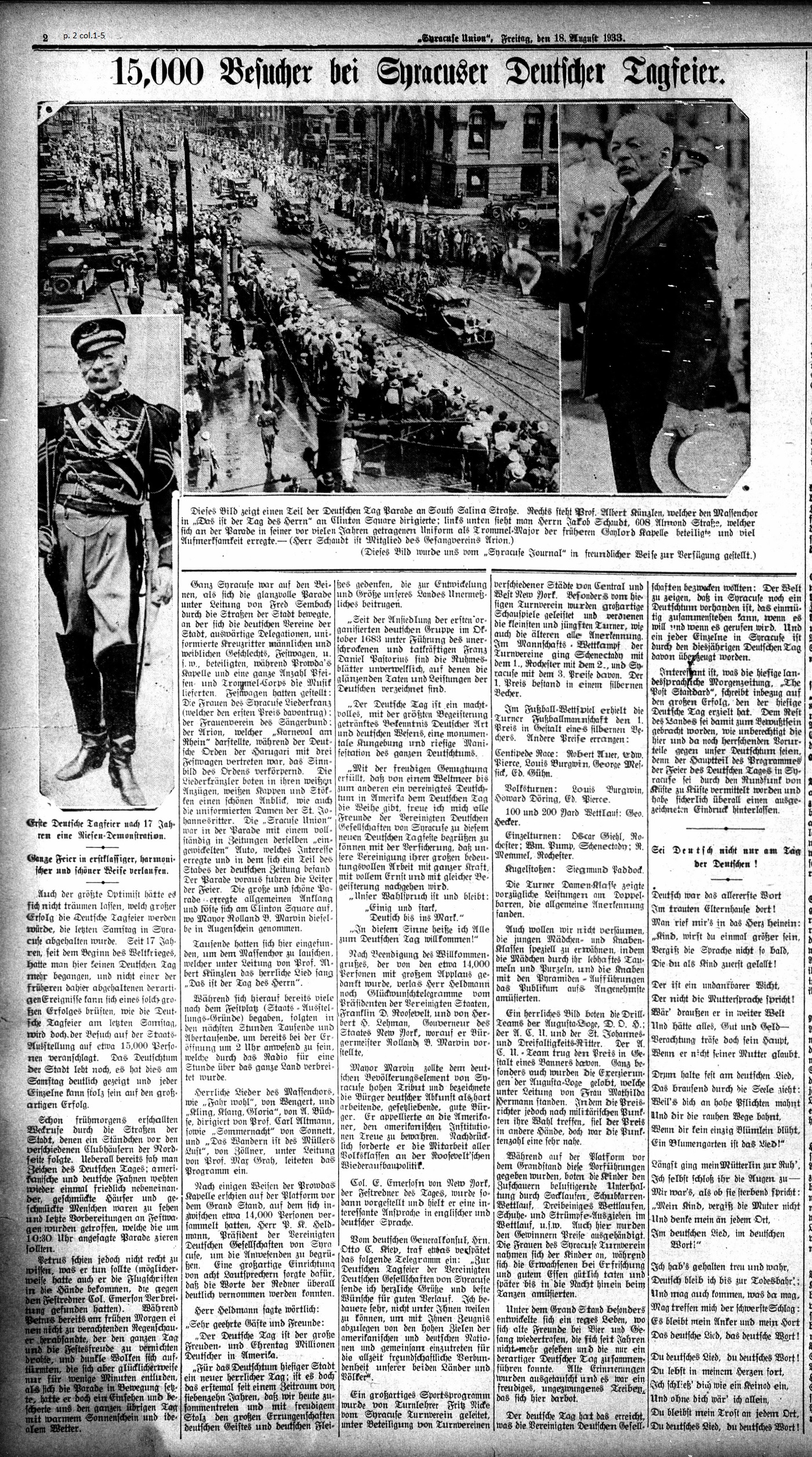
August 18, 1933 page 2 _____ This picture shows a portion of the German Day Parade down South Salina Street. To the right Prof. Albert Künzlen, who conducted the mass choir in "Das ist der Tag des Herrn" (This is the day of the Lord,) stands at Clinton Square. To the lower left one sees Mr. Jakob Schaudt of 608 Almond St., who participated in the parade wearing the uniform he wore for many years as Drum Major of the old Gaylord Band. He drew much attention. — (Mr. Schaudt is a member of the Arion Singing Society.)
_____ The Entire Celebration Conducted in a First-Class, Harmonious, and Beautiful Manner _____ Even the greatest optimist could not have dreamt what a grand success the German Day Celebration held last Saturday in Syracuse turned out to be. For 17 years, since the beginning of the World War, there was no German Day Celebration, and no previous festival can boast of such great success as the celebration last Saturday with attendance at the State Fair Grounds estimated at around 15,000 people. The German community of Syracuse is still alive, as Saturday proved and every individual can be proud of its great success. Early in the morning the wake-up call sounded through the streets of the city from a stand in front of the various clubhouses on the Northside. There were signs of the German Day Celebration everywhere. American and German flags fluttered peacefully alongside each other. Decorated houses and decorated people could be seen and final details were made on the festival wagons which would accompany the parade at 10:30. The weather didn't quite seem to know what it was supposed to do (possibly it too had the pamphlets in hand which had been distributed against festival speaker Colonel Emerson.) There had already been a not too torrential rainshower early that morning and dark clouds threatened all day to cancel the festivities but luckily they dispersed for a few minutes as the parade got underway and then granted us the rest of the day with warm sunshine and ideal weather. All of Syracuse was on its feet as the magnificent parade, under the direction of Fred Sembach, marched through the streets of the city in which the German associations of the city, foreign delegations, uniformed knights of the male and female gender, festival wagons, etc. took part while Prowda's Band and a full number of fife and drum corps delivered the music along with the ladies of the Syracuse Liederkranz (who won the first prize,) the Ladies Association of the Sängerbund, and the Arion Society, which represented "Carnival on the Rhine." The German Order of the Harugari had three wagons carrying displays of the Order. The members of the Liederkranz with their white suits, white hats and canes were a pleasant sight as were the uniformed ladies of the Knights of St. John. The Syracuse Union was in the parade in a auto completely wrapped in newspapers, which aroused interest and in which a portion of the staff was present. The leaders of the celebration preceded the parade, which was large and beautiful and noisy. It stopped at Clinton Square, where Myor Rolland B. Marvin made an appearance. Thousands came here to hear the mass choir, which was under the direction of Prof. Albert Künzlen. The choir sang the wonderful song "Das ist der Tag des Herrn," (This is the day of the Lord.) Many were already at the festival place (the State Fair Grounds,) followed thousands upon thousands over the next few hours to be at the opening ceremony starting at 2 PM, which was broadcast by radio for an hour throughout thr area. Magnificent songs by the mass choir, such as "Fahr wohl" (Farewell) by Wengert and "Kling, Klang, Gloria" by A. Büchse were directed by Prof. Carl Altmann and "Sommernacht" (Summer Night) by Sonnett and "Das Wandern ist des Müllers Lust" (To Wander is the Miller's Delight) by Zöllner were directed by Prof. Max Grah. After a few tunes by the Prowda Band, around 14,000 people appeared on the platform before the grandstand to hear Mr. P.R. Heldmann, President of th United German Associations of Syracuse, greet the audience. The installation of eight loud speakers made sure that the speaker's every word could be clearly heard. Word for word, Mr. Heldmann said the following: "Honored Guests and Friends, "German Day is the day of great joy and honor for millions of Germans in America. "For the German community of this city it is a new and magnificent day. It is the first time in a span of seventeen years that we have come together and with joyous pride celebrate the achievements of the German intellect and remember the German industriousness which vastly contributed to the development and greatness of our country. "Since the settlement of the first organized German group in October 1683 under the leadership of fearless and resourceful Franz Daniel Pastorius, chapters of fame and glory have pointed to the deeds and achievements of the German people. "German Day is a powerful and enthusiastic acknowledgement of German methods and character, a monumental manifestation of the entire German community. "Filled with gratification that from one ocean to the other a united German community exists in America dedicated to a German Day celebration, I happily greet all friend of the United German Associations of Syracuse to this new, German Day festival and give the assurance that our association will pursue our great and significant work with all our strength, with full seriousness of purpose, and with equal enthusiasm. Our motto is and remains:
With this I welcome you all to German Day!" At the end of the welcome greeting, which received loud applause from around 14,000 people, Mr. Heldmann read aloud telegrams of best wishes from the President of the United States, Franklin D. Roosevelt, and from Herbert H. Lehman, Governor of the State of New York. He then introduced Mayor Rolland B. Marvin. Mayor Marvin paid high tribute to the German population in Syracuse and noted that the citizens of German heritage were hard-working, law-loving, good citizens. He called on Americans to be loyal to American institutions. He emphatically asked for cooperation among all classes of people in working together on Roosevelt's reconstruction politics. Col. E. Emerson of New York, the festival speaker of the day, was then introduced. He gave an interesting speech in English and German. The following telegram arrive somewhat belatedly from the German Consul General, Mr. Otto Kiep: "I send cordial greetings and best wishes for a good turnout at the German Day Celebration of the German Associations of Syracuse. I sincerely regret that I cannot spend time among you and bear witness to the lofty goals of the American and German nations and unite both our countries and people in friendship." A marvelous sports program was held under the direction of gymnastics instructor Fritz Nicke of the Syracuse Gymnastics Society with the particiption of gynmastics associations of various cities of Central and Western New York. The local gymnastics society in particular performed a magnificent spectacle, which earned recognition for the smallest and youngest gymnasts as well as their elders. In the men's gymnastics competition Schenectady took first prize, Rochester second and Syracuse third. The prize for first place was a silver cup. In the football match the Turners (gymnastics football mens team) took the first prize silver cup. Other prize winners included: Centipede Race: Robert Auer, Edw. Pierce, Louis Burgwin, George Messick, Ed. Gühn. Team Gymnastics: Louis Burgwin, Howard Döring, Ed. Pierce. 100 and 200 Yard Dash: Geo. Hecker. Individual Gymnastics: Oscar Giehl, Rochester; Wm. Pump. Schnectady; R. Memmel. Rochester. Shot Put: Siegmund Paddock. Ladies Class Gymnastics demonstrated excellent achievment on the double bars, which garnered overall approval. We also do not wish to neglect to especially mention the young girls and boys classes. The girls with their tumbling and the boys with their pyramid display greatly entertained the public. The Drill Teams of the Augusta Lodge, German Order of the Harugari; the A.C.U. and the Knights of St. John and Trinity presented magnificent sights. The A.C.U. team won a prize banner. The exercise drills of the Augusta Lodge under the direction of Mrs. Mathilda Hermann were especially lauded. Since the prize judges made their choice according to military standards, the prize went to other hands, but the score was quite close. During the performances on the platform before the grandstand the children amused the audience with sack races, wheelbarrow contests, three-legged races, contests to see who could take off their shoes and socks the fastest, etc. Prizes were also handed out here to the winners. The ladies of the Syracuse Gmynastics Association cared for the children while the adults partook of refreshments and good food and later enjoyed a dance which lasted into the night. Lively activity developed under the grandstand where old friends gathered together with beer and song in a sight that hadn't been viewed in years, which could only have been brought about by a German Day celebration. Old memories resurfaced which led to joyful, easy conviviality. The German Day had achieved the goal which the United German Associations had intended: To show the world that there is still a German community in Syracuse which can stand together in unity if it wants to and is called upon to do so. And every individual in Syracuse has been convinced of this by this year's German Day. It's interesting what the local English language morning newspaper, The Post Standard writes about the great result the local German Day had achieved. Through it the rest of the country has been made aware how unjust the prevalent bias again the German community has been because the main portion of the German Day Celebration program was broadcast from coast to coast via radio, which certainly left a favorable impression. |

|
August 18, 1933 page 5 _____ (Sent in) The German Day Celebration of 1933 is over. It was a success in ways we could not have expected. Participation was far greater than expected; many thousands of people of German heritage and their friend were found there and communally enjoyed happy hours in true German fashion. It was pleasant, joyful, delightful, and best of all, peaceful. There wasn't the slightest sign of dispute or discord to spoil the event. Everyone was of one heart and one soul. It was genuinely German. Young and old were there. Young Germany was there with kith and kin. One saw older men and women, who were prominent in earlier days but due to their ages were now retired from public life and seldom seen any more at social events. But for German Day, they just had to be there! Thank you, dear good old friends! And still one missed many fine acquaintences, but most assuredly they'll be there next year because now they know that the old German spirit still lives and that a fine German community still exists in our city, which is respected and appreciated. This appreciation was apparent in the excellent speech by our honored Mayor, Rolland B. Marvin. The words from the Chairman of the United German Associations of Syracuse, Mr. P.R. Heldmann, were full of praise and reassurance as was the speech by Col. Emerson, the festival speaker who received enthusiastic applause. He extolled the German way of life and character and expressed the hope for a better future for Germany. Singers, gymnasts and other association members successfully and zealously competed in contests to entertain the public. Excitement prevailed throughout the crowd. Old acquaintanceships were renewed and new ones were established. Everyone was happy and satisfied. The entire program proceeded harmoniously. There was great appreciation for the festival committee and the various subcommittees and their workers. One can scarcely imagine how much preparation and planning it took to put the celebration on the right track and carry it out successfully. All the workers and the backers deserve heartfelt thanks. It would be too extensive to name them all. May our acknowledgement to all, who contributed to the success, demonstrate our gratitude. It would be wrong not to mention the man who acted as leader of the event, who worked tirelessly for the celebration and who was inspired by the greatest optimism. He is Mr. Frank Sedlak. We owe him particular thanks along with Mr. Otto Tremmel, the eager secretary who worked his way through a huge task. Heartfelt thanks to all who attended the celebration. We hope we see you all again and many others at the next German Day in 1934. This year's celebration was without a doubt a grand moral success which will yield great results and bestow honor on the local German community. — Henry Mirbach Sr. |

|
August 18, 1933 page 5 _____ (Sent In) First an answer to the question, who is Colonel Edwin Emerson, who delivered a festival speech on German Day? Colonel Emerson was born in Dresden, Germany as the son of an American diplomat. He spent his childhood years in Germany, where his father filled many diplomatic posts for the United States. Colonel Emerson studied at Cornell and Princeton University, where his father was a Professor of English Literature before he was called by President Adams to diplomatic service. After his studies in America Emerson was a student in Munich for a few years and then became secretary for the American Ambassador in Berlin. When the Spanish-American War broke out we find Emerson as an officer under Theodore Roosevelt's Rough Riders, where he advanced to become adjutant of Division Generals. Emerson also served under General Smedley Butler with the Marine Corps in Nicaragua. Soon after he became a war correspondent in South America and later in Germany, where spent years with the German Army and the Germany Army in Turkey. In Bersheba the English flight bombers got too close and pushed the Army with Emerson back to Beirut. We all know that Colonel Emerson spent a period of time as a commandant of a prisoner of war camp on the State Exhibition Grounds. Emerson wrote an entire series of books, among them Vier Jahre mit der Deutschen Armee (Four Years with the German Army,) which was suppressed by Wilson. In every library in the country we find Emerson's books, such as the History of the 19th Century in 3 volumes. His son, Sidney Brooks Emerson, who worked with Father Ed. Walsh from Georgeton University and those of us in Russia in Famine Relief, has written his first book, which paved the way for better understanding after the War. The book is titled America and Germany. [Translator's Note: An online selection of Emerson's writings can be found at http://onlinebooks.library.upenn.edu/webbin/book/lookupname?key=Emerson%2C%20Edwin%2C%201869%2D1959.
We German Day people in Syracuse should be thankful to have had a festival speaker who is an American of Irish blood, and who is famous here and over there not just for his diplomatic service but also his military service. Colonel Emerson is President of the Association of Friends of Germany, whose goal is to create better understanding between the old fatherland and America in the way in which Colonel Emerson has become a friend of the German people. Years of youth spent in Germany are never swept away, so this association sends its American children to Germany for a short period of time to give them a lifelong impression of German nature and character. Colonel Emerson has nothing to do with the "Verein des Neuen Deutschlands" (Association of New Germany) and good people should make sure that before they jump into the water they check to see if it is water or thick ink. In this instance those who ask the question "Who is Colonel Emerson" are basically thrown into the thick ink.* [* Not sure if Pastor Scheding was referring to rumors of Emerson's political agenda, but four months later an article was published concerning it. See The Jewish Telegraphic Agency article of December 3, 1933 for "Colonel Edwin Emerson Denies He is Official Spokesman for the Nazi Party in America."] — W.L. Scheding. |