.
.
German Protestants in America
_____
(by Pastor W.L. Scheding)
August 11, 1933 page 2
The first German Protestants were isolated individuals, who came from this or that region and came together in settlements or on ships. With regard to the number of people, the total number cannot be established.
We know that at the time of the Pilgrim fathers, small German settlements existed in Georgia. One reads much about German Protestants as if they were all Quakers and Mennonites who came first to this country. Thanks to Pietism under Spener in Germany there were many Rhinelanders among the Quakers and Mennonites. However Spener was Lutheran. When Wiliam Penn was in Germany in 1671 and 1677 promoting settlement in Pennsylvania, and in 1681 issuing a proclamation there inviting settlers, many were movd to accept the invitation.
In 1682 a society was established in Frankfurt, which purchased 25,000 acres from Penn and a year later a young lawyer arrived in Pennsylvania as an agent for the corporation. His name was Pastorius and he was a follower of Spener. He brought his family and a number of friends along to, as he put it, "lead a peaceful Christian life." That was the beginning of Germantown in Philadelphia, Pa. in 1685. Incorporation of Germantown followed in 1689. With its first 50 houses Germantown became the center of all possible religious persuasions, not just Quakers and Mennonites.
Already by 1700 we find many more German immigrants along the Wissahocken River, among whom Kelpius was the most well known. A few years before in 1694, Daniel Falkner came with other "Hermites" and Lutherans to Germantown, became a land agent of the Frankfurt Society and took over the Lutheran congregation as pastor in Falkner's Swamp (New Hanover) in New Jersey around 1703. Mühlenberg, the Patriarch of the Lutheran Church in America, mentions a few Lowland Germans who came here from Cleve in 1680 and 1708.
A proper German immigration occurred in 1708. Dispute and discontent in Germany and the oppressions of many kinds brought an entire society from Halberstadt and Wolfenbüttel, a fine Lutheran neighborhood, to New York in 1707. In the same year Lutheran Pastor Kocherthal came from Landau with 61 people to America. They arrived via Jamaica to New York through the kindness of English Queen Anne. The Governor of New York, Lord Lovelace, graciously received the group and assigned them 2100 acres of land north of West Point. The settlers called the new district "Neuburg" or Newburg on the Hudson.
Soon after, large flocks of settlers followed. Queen Anne had enough to do fulfilling all the requests for transport to America. Nearly 20,000 Lutherans from the Palatinate arrived here a year via England. In Greenwich they had to erect camps to accommodate everyone.
From the area surrounding Heidelberg alone 6000 people came to America in a year, to the point where the Prince Elector imposed a death sentence on anyone who left the country without special permission. Wanderlust seemed to have gripped many. 3800 emigrated to Munster in Ireland and 700 made the trip to America and settled in New Berne, North Carolina.
Pastor Kocherthal, who was again in Germany in 1710, brought 3000 people on 10 ships to America. Around 800 died during the trip. The survivors at first settled on Governor Island. In fall of the same year they left their homes on the Hudson and relocated near the Catskill Mountains into the western and later the eastern camp. The Palatines' wishes were fulfilled, for they had a peaceful place which suited their tastes and replaced the vinyard covered mountains of their old homeland. However, misery soon arrived.
A few years later many hundreds of families moved to Schoharie because they were tired of the forced making of tar and their exploitation, contrary to the wishes of the authorities.* They obtained land from the Indians. 1712 progressed differently and despite a great number of difficulties and thanks to the amity of the Indians, who helped them out with food, they made it through the harsh winter. In 1718 the Schoharie group sent a representative to London to have the title to the land verified. Conrad Weiser, the father of the later famous Indian agent and father-in-law of Pastor Heinrich Melchoir Mühlenberg, was that emissary.
Meanwhile many other immigrants came into the colony of Pastor Kocherthal and settled along the Hudson in Rheinbeck, Esopus, Kingston, Paltz, Middleburg (Wieserdorf), and up to the Palatine Bridge over the Mohawk River and Cobbleskill.
Then in 1712 immigration veered towards Pennsylvania. By 1723 many of the people from Schoharie settled along the Susquehanna River and moved as far as to Tulpehocken.
There are two items of interest at this time. The first was the Church Register of Pastor Kocherthal which began with the words, "Church Register of the Germans who accept the Augsburg Confession."
The Baptism Registry is transcribed:
"List of children, who were baptized by me, Joshua Kocherthal, the first pastor of Germans in New York."
The other interesting item is a gravestone on the grave of Joshua Kocherthal in West Camp, N.Y. under the shadow of Overlook Mountain, the inscription of which could still be read:
Know this, Wayfarer,
Under this stone lies
next to his Sibylla Charlotte
A true wanderer
The Highland German in America
Behold Joshua,
The same on the East and West Side
Of the Hudson River,
A simple Lutheran pastor
His first encounter with
Lord Lovelace took place
January 1st, 1707 - 8.
His second with Colonel Hunt,
June 14th, 1710.
His trip to England was interrupted
By his heavenly journey
on St. John's Day 1719
If you wish to know more
Undertake the search in Melanchton's
Fatherland
Who was Kocherthal
Who was Harschia
Who was Winchenbach
_____
B. Berkenmayer, S. Heutrien,
L. Bervort
1742
_____
(This is as close a transcription as one can find on such a gravestone with remarkable spelling and syntax.)
We already find a Lutheran congregation in Albany by 1644, which still exists today. The parish actually consisted of New York and Albany. Pastors such as Pastor Justus Falkner administered to New York in the summer and Albany in the winter. The son-in-law of Pastor Kocherthal, Pastor Berkemeyer, preached in an assembly of German pastors and congregations in 1735. There was no synod, rather a conference. There were three pastors in this conference, Pastors Berkemeyer, Knoll, and Wolff, and lay delegates from 9 congregations: from New York, Chas. Beekman and Jac. Bos; from Hackensack, Abr. Boskerk and Jac Norden; from Uylekill, Pet. Frederick; from Rockaway, Balth. Pichel and Lorenz Rulossen; from Raritan, Dan. Schumacher and Henry Schmid.
Already back then the question of which language to use caused problems since there were Dutch and Germans in many congregations, some of which preferred to learn English rather than Dutch.
It's interesting to know that one family, Kochertal [sic] and his son-in-law Berkemeyer, and Berkemeyer's son-in-law Sommer served the State of New York, among which were the congregations along the Mohawk such as Stone Arabia, which still exist today.
Immigration continued into Pennsylvania despite the lack of spiritual care. Spener, who was in Halle and who inspired Count Zinsendorf with his pietistic teachings, soon also exerted influence on Aug. Herman Franke, founder of the Halle Orphanage and the schools. Franke was the spiritual advisor of many in far-off America. Prof. Franke sent his pupils to London as Court Preachers and Pastors Boltzius and Gronau to the immigrants from Salzburg who had been settled for some time in Georgia. He also sent Mühlenberg to Philadelphia.
In London the pastors from Halle, Böhme, Ruperti, and Ziegenhaben, Pastor Urlsperger of Augsburg's pastors, and some others all emigrated to America to give support.
Each group in London had a benefactor and they all had benefactors in Halle. While Urlsperger's pastors took on most of the Salzburg immigrants, the others tended to the immigrants in Pennsylvania and New York.
Prof. Franke in Halle and Pastor Urlsperger were fortunate in their choice of young pastors they sent to America. The members of the congregations here were true German people. Their first and last and greatest concerns were the churches and the schools. Their Sundays and weekdays were service to God in the literal sense. They were the preservers of German culture and existence, the preservation of which was grounded in religion. Conducting house devotions every morning and evening with all members of the household was the first duty of the housefather.
The immigration continued in regular cycles. Not just Quakers, German Baptists, and Mennonites but also Lutherans came in ever greater droves from Württemberg, Hessen and Alsace, and later from northern Germany.
Those who came over were normally concerned for their spiritual care. If pastors weren't in the region, laymen undertook caring for the people with prayer devotions. Their Bibles, songbooks, and cathechisms were ever and always primary and most important with these new immigrants.
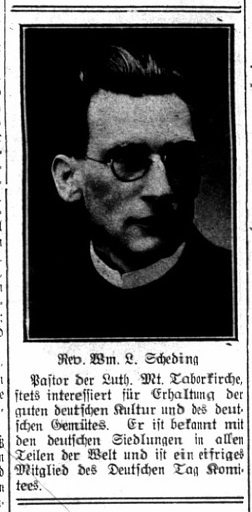 | Pastor of the Lutheran Mt. Tabor Church, interested in the preservation of good German culture and German nature. He is acquainted with the German settlements in all parts of the world and is an avid member of the German Day Committee. |
Mühlenberg came to Philadelphia in 1742 at the suggestion of Prof. Franke and began a consolidation of all the congregations, thus becoming the father of the organized German community in America. It would be going too far to describe how influential and significant Pastor Mühlenberg was in the years in which the United States achieved its freedom. It's sufficient to mention thst one of his sons assembled one of the first regiments from the pulpit and dramatically shed his cassock in order to appear in a full colonel's uniform; that he was one of Washington's closest associates; and that another son of Pastor Mühlenberg was elected first Speaker of Congress [House of Representatives].
The name Mühlenberg, like the names Weiser, Falkner, UnionPastorius, Berkemeyer, Kocherthal, Sommer and others stand tall in the history of the first German immigration to this country. They were men of true German character, to whom the words of the German freedom poet Arndt might apply: "Who is a man? One who can pray!"
Supplement by the Editorial Staff of the Union
Roman Catholics were the first denomination on the North American continent, or the current United States. After the discovery of the West Indian Islands by Columbus the religion was planted on the mainland by the Spanish in 1565 in St. Augustine.
(Continuation on Page 7)
_____
*Translator's Note: The National Park Service has an article on its website at https://www.nps.gov/articles/000/the-palatine-germans.htm on the Palatine Germans.
August 11, 1933 page 7
(Continuation from Page 2)
_____
With the settlement of the northern portion of the country by the English, who arrived in Jamestown, Virginia in 1607, the Anglican church was the first Protestant church established in this country. There were many Germans among these first settlers in Jamestown, and among the English and the Huguenots who settled in Port Royal, South Carolina in 1562.
The Puritans, different in doctrine from the Anglican Church, were the next to enter Plymouth, Mass. in 1620. After them came the Dutch, who settled in New Amsterdam, now New York City, in 1623 and established the first Reformed Dutch Church in 1628 with Rev. Jonas Megapolensis as its first pastor. This is the first Reformed Dutch Church in America. It still exists and is currently known as the Collegiate Church of New York. It has one of the richest congregations in America. Its current pastor is Rev. Norman V. Peale, who resigned last year as pastor of the University Ave. M.E. Church in Syracuse, N.Y. in order to take over the pastorate of the Collegiate Church in New York.
The first Lutheran Church in America was established by the Swedes around 1639 on the lower Delaware River, near what is currently called Wilmington in the State of Delaware. Rev. Reorus Torkillus was the first active Lutheran pastor in America. He died on September 7, 1643 after a summer of great sickness with many casualties among the settlement. He's buried at the south end of the Old Swedish Church in Wilmington. The first Lutheran Church building was made of wood and dedicated on September 4, 1646. The cornerstone of the still-standing stone building of the "Old Swedes' Church" in Wilmington, Delaware was laid on May 28, 1698. The dedication ceremony for the church was held July 2, 1700. It is the oldest church building in the United States. The first Lutheran pastor, ordained in America on November 7, 1739, was William Malander. He was ordained by Rev. Dylander and Rev. Trauberg, who were authorized to perform the service by the Archbishop of Sweden. The first German Lutheran pastor ordained in America on November 24, 1703 was Justus Falkner, born on November 22, 1672 in Zwickau, Saxony. Justus Falkner was the composer of the best known church hymn, "Auf ihr Christen, Christi Glieder," which was translated into many languages and as "Rise, Ye Children of Salvation" in English. Justus Falkner's first ministry was in New York, which he commenced on the third Sunday in Advent, 1703.
The first Lutheran Church was built in Philadelphia in 1669. It was a blockhouse. Johnn Ernst Gutwasser was the first German Lutheran minister in the colony of New York, then called New Amsterdam. He arrived in 1657 but he was forbidden to perform public church services. Instead he held private services, which were also banned. The Lutherans appealed to the State Council to permit their services and began their petition as follows: "We, the adherents to the Augsburg Confession, petition" etc. etc. They received the following reply: "In as much as we do not recognize the Augsburg Confession and are not adherents to it," etc. Gutwasser was subsequently ordered to leave the country. However he hid among the German farmers of Long Island, where he later preached. He was discovered, arrested, and deported in 1559 [sic] [1659.]
The Lutherans made no further attempt to hold church services in New Amsterdam until the English took over the government in 1666. The first German Lutheran minister, Fabricius, came and took over the position, which at the time consisted of the congregation in Fort Orange (Albany.) Religious freedom was granted to the Lutherans in 1673 and Rev. Arensius was called in 1674 to the church. The First Lutheran Church in Albany still exists today and is located near the State Buildings. It has one of the richest congregations in Albany. Pastor Charles W. Leitzell, for many years President of the New York Synod of the Lutheran Church and currently President of Hartwick College in Oneonta, was the pastor of the Albany Church for many years. Rev. Chalmers E. Frontz is the current pastor. It's unnecsessary to say that no German church service has been held in this church for many years. The synodal congregation reports indicate that this Albany congregation was organized in 1644.
In closing: The oldest church on this mainland, the Roman Catholic Church, was banned in the Dutch and English colonies. Many Catholic missionaries attempted to convert the Indians and other groups, and many of these missionaries suffered a martyr's death. Lord Baltimore (Sir George Calvert,) who received Maryland from Charles I of England, took responsibility for reserving the colony as a refugee place for the Catholics sent from England. The Province of Maryland (now the State of Maryland) was established as a Diocese on April 6, 1789 and an Archbishop Diocese on April 8, 1908 [sic] [1808] with the Most Rev. John Carroll as its first Bishop. He was anointed Bishop on August 15, 1790 and as Archbishop in 1808. The Baltimore Archbishop Diocese produced the first Cardinal of the Roman Catholic Church of America, the much loved Cardinal James Gibbons, who was installed as Cardinal on June 7, 1886. He died in 1921.
Currently we have four Cardinals in America: O'Connell in Boston; Hayes in New York; Dougherty in Phildelphia; and Mundelein in Chicago (the last one is of German heritage.)
Something from the Cuckoo Oracle
_____
Mr. John Müller of Cool Ave., who recently returned from a lengthy stay in his old home in Kohlweiler in the Rhine Palatinate, knows something interesting about a saga which attributes much to the local cuckoos.
No other of the countless residents of the avian world is as richly embellished with superstitious sagas, fantastic folklore, and eerie imaginings as the cuckoo. The first call of the cuckoo supposedly has a unique magical property because it calls to life the renewed power of nature. Whosoever, at the first call of the cuckoo, is carrying money or bread will never suffer from privation for an entire year. However anyone, who's surprised by the call and has empty pockets, must endure privation for the coming year. If one hears the call with an full stomach, he'll find success in business and prosperity. If one hears the call while hungry, nothing will go right for him the entire year. No less common is the belief that with his call the cuckoo portends the number of years a man will live, provided the man asks the question. It's better if you hear the cuckoos call coming from the east or to your right than if its cry comes from the north or to your left. Whoever hears the cuckoo first in spring may hope for a long life. But if he doesn't hear the call, he is doomed to an early death. The bird can predict when a girl desiring to marry will have to wait until her nuptials. The cuckoo is also highly regarded as a weather prophet. If the bird arrives too early, one fears for bad weather that year. If many cuckoos cry in the spring, one can expect a lot of rain; if the cuckoo calls frequently at midday, he's predicting a warm spring. Even when the bird disappears for a time, people draw conclusions, and if things are quiet around St. John's Day [June 24th,] people fear for a bad harvest. The closer it cries near houses, the snowier the fall and the earlier winter's arrival. Mainly people fear the bird's unusual visits in the houses because it means bad weather or at least sudden changes in weather.