April - June 1933
|
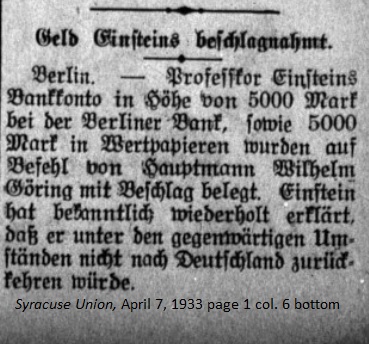
April 7, 1933 page 1 _____ Berlin. Professor Einstein's bank account at the Berlin Bank amounting to 5000 Marks along with 5000 Marks in negotiable bonds were seized by order of Captain Wilhelm Göring. Einstein has repeatedly stated in public that he will not return to Germany under the present state of affairs. |
|
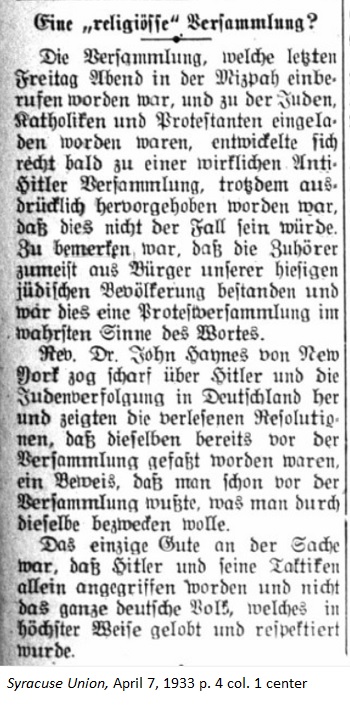
April 7, 1933 page 4 _____ The meeting call last Friday evening in the Mizpah, to which Jews, Catholics and Protestants were invited, rapidly developed into a true Anti-Hitler rally despite express emphasis that this would not be the case. It was noticed that the audience was composed mostly of citizens in our local Jewish community and this was a protest rally in the truest sense of the word. Rev. Dr. John Hayes of New York spoke sharply about Hitler and the persecution of Jews in Germany and pointed out the resolutions which had already been composed before the meeting, thus proving that people knew beforehand the true intention behind the assembly. The only good thing about this was that Hitler and his tactics alone were attacked and not the entire German population, which was highly praised and respected. |
|
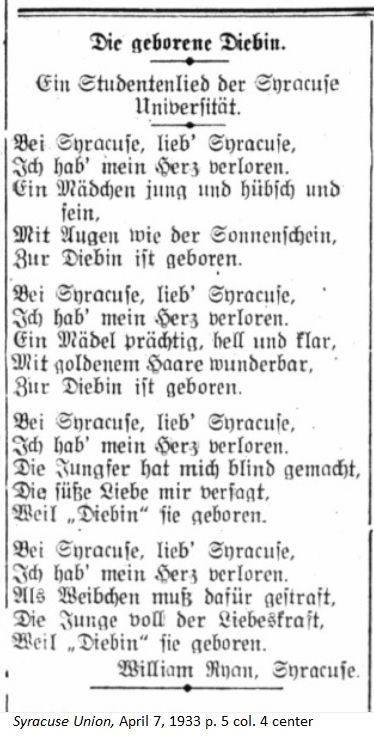
April 7, 1933 page _____ A Student Song at Syracuse University _____ In Syracuse, dear Syracuse,
In Syracuse, dear Syracuse,
In Syracuse, dear Syracuse,
In Syracuse, dear Syracuse,
William Ryan, Syracuse. |
|
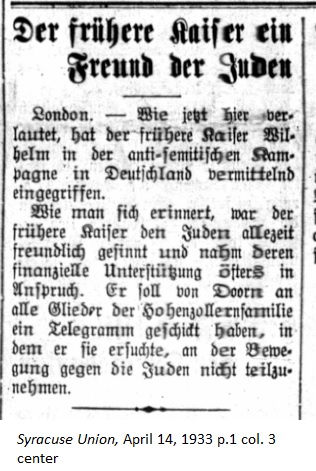
April 14, 1933 page 1 _____ London. — As announced here, former Kaiser Wilhelm has intervene in the anti-semitic campaign in Germany. As some may remember, the former Kaiser was always amicably disposed towards the Jews and often made use of their financial support. He has sent telegrams from Doorn to all members of the Hohenzollern family, in which he asks them not to participate in the movement against the Jews. |
|
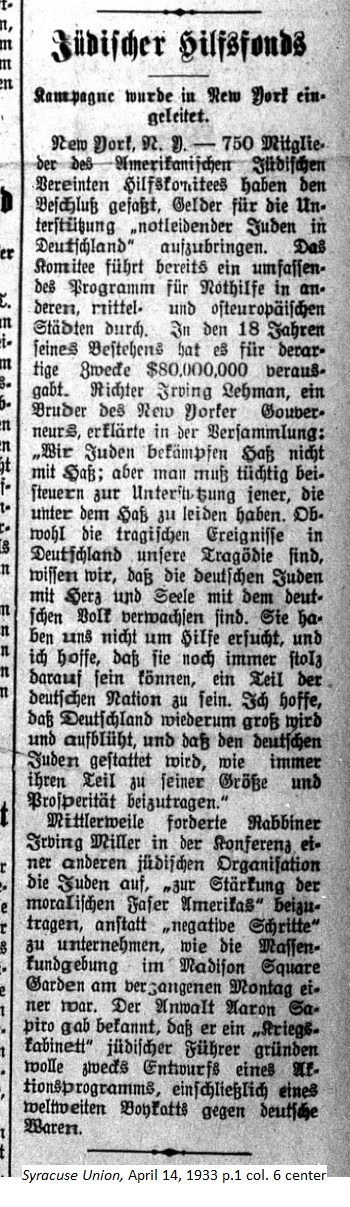
April 14, 1933 page 1 _____ Campaign introduced in New York New York, N.Y. — 750 members of the American-Jewish United Assistance Committee have passed a resolution to raise money for the support of "destitute Jews in Germany." The Committee already conducts an extensive program for assistance in other middle and eastern European cities. In the 18 years of its existence it has distributed $80,000,000 for this purpose. Judge Irving Lehman, a brother of the New York Governor, declared in the meeting, "We Jews do not combat hate with hate; however one must dilgently distribute support to those who have suffered under hatred. Although the tragic events in Germany are our tragedy, we know that the German Jews are intimately connected in heart and soul with the German people.They have not asked for our help and I hope that they can always be proud to be part of the German nation. I hope that Germany will once again be great and flourish and that the German Jews will always do their part to contribute to its greatness and prosperity." In the meantime at the conference of another Jewish organization Rabbi Irving Miller requested they "contribute to the strengthening of the moral fiber in America instead of undertaking 'negative steps' such as the mass demonstration in Madison Square Garden that past Monday. Attorney Aaron Sapiro announced that he wanted to establish a "War Cabinet" for the purpose of drafting programs of action, including a worldwide boycott of German goods. |
|
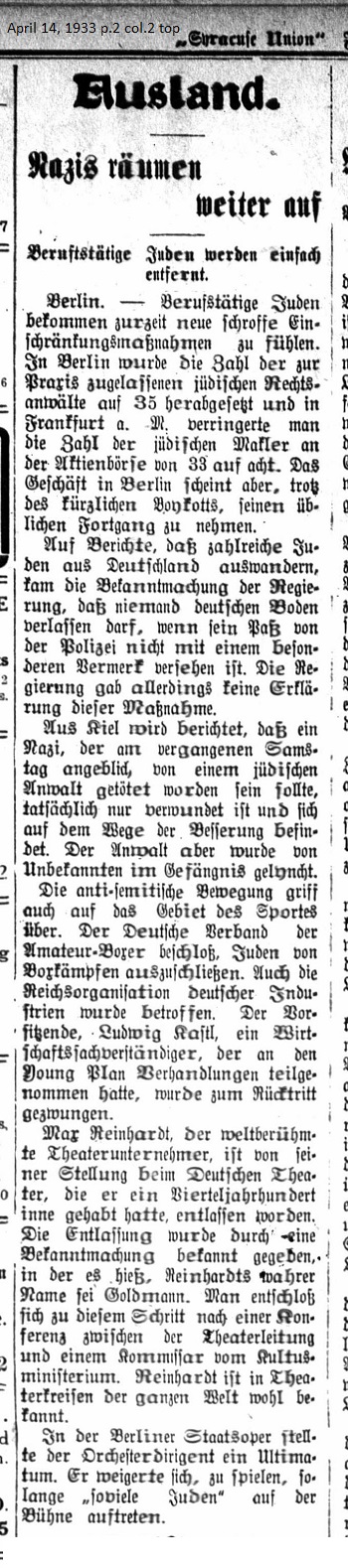
April 14, 1933 page 2 _____ Nazis continue cleaning House _____ Jews in Professions simply removed. Berlin. — Jews in professions are currently experiencing new and harsh limitations. In Berlin the number of practicing Jewish attorneys was reduced to 35 and in Frankfurt a.M. the number of Jewish brokers on the Stock Exchange was reduced from 33 to 8. Despite the recent boycott business in Berlin appears to be making steady progress. Concerning reports that many Jews are emigrating out of Germany, an announcement came from the government that no one can leave German soil unless his passport has a special notation on it from the police. The government gave no explanation for this measure. It was reported in Kiel that a Nazi, who was supposedly killed last Saturday by a Jewish attorney, was only wounded and is on the path to recovery. The attorney was lynched by unknown individuals in prison. The antisemitic movement also drifted into the field of sports. The German Association of Amatuer Boxers decided to exclude Jews from boxing competition. Even the Reich Organization of German Industry was affected. The chairman, Ludwig Kastl, an economy expert who participated in the negotiations for the Young Plan, was forced to retire. Max Reinhardt, the world famous theatrical producer, was fired from his position by the German Theater. It was a position he had occupied for a quater century. The dismissal was followed by an official statement that Reinhardt's true name was Goldmann. This step was taken after a conference between the theater management and a commissioner of the Ministry of Culture. In theater circles Reinhardt's reputation is known worldwide. In the Berlin State Opera the orchestra conductor issued an ultimatum. He refused to conduct as long as "so many Jews" perform on the stage. |
|
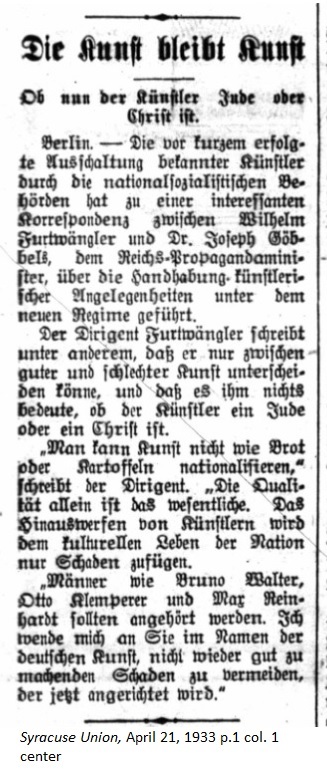
April 21, 1933 page 1 _____ No Matter whether the Artist is Jewish or Christian Berlin. — The recent elimination of well-known artists by the National Socialist authorities has led to an interesting correspondence between Wilhelm Furtwängler and Dr. Joseph Göbbels, the Reich's Propaganda Minister, concerning the handling of artistic events under the new regime. Conductor Furtwängler writes, among other things, that he only knows the difference between good and bad art and it means nothing to him if the artist is a Jew or a Christian. "One cannot nationalize art like bread or potatoes," the conductor writes. "Quality alone is essential. Casting out artists will only damage the cultural life of the nation." "Men like Bruno Walter, Otto Klemperer, and Max Reinhardt belong. I turn to you in the name of German art, don't let something that is good be damaged." |
|
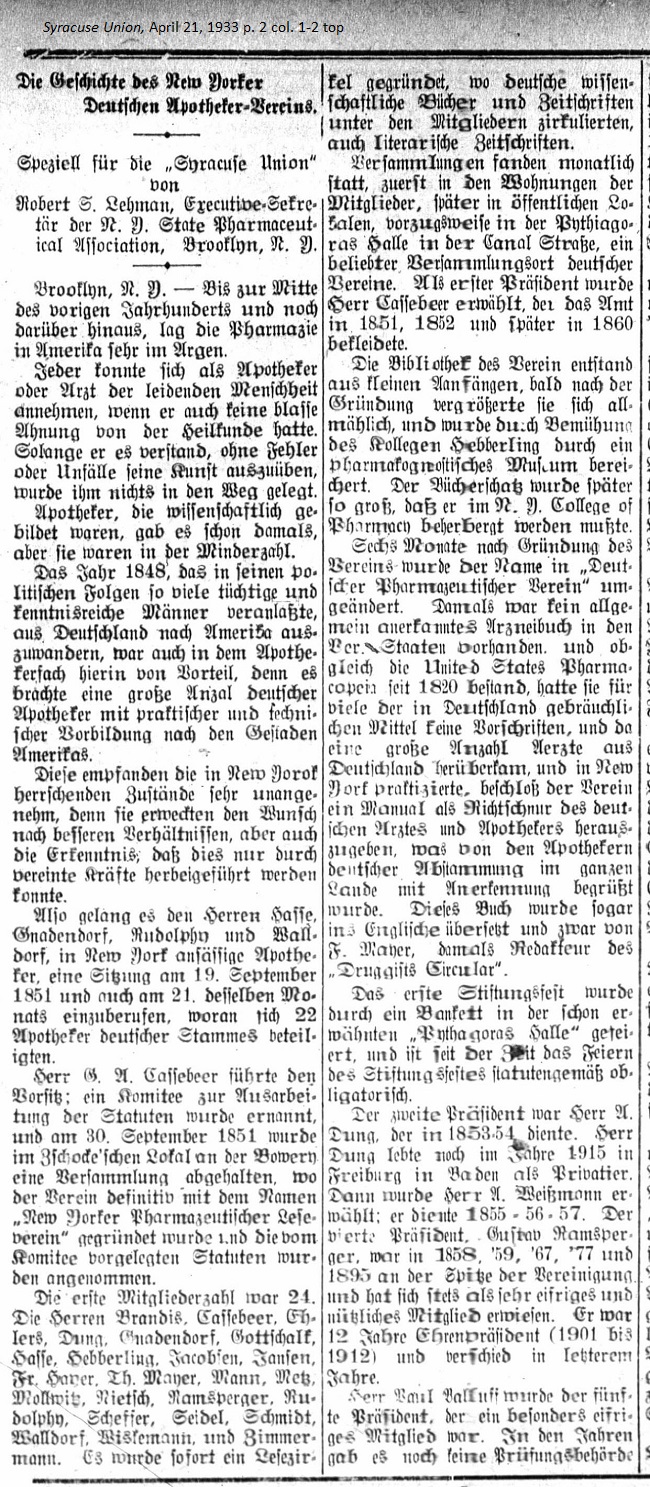
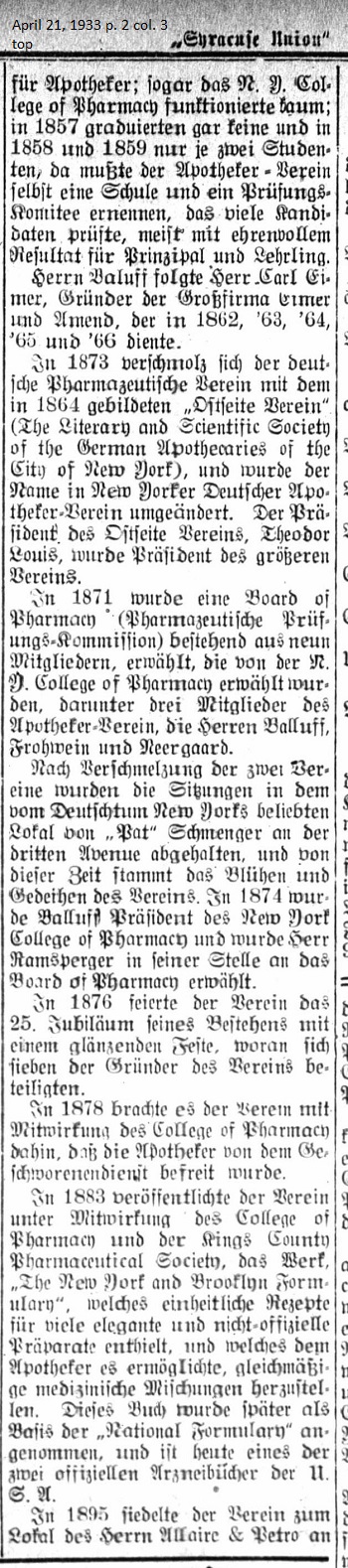
April 21, 1933 page 2 _____ Special for the Syracuse Union by Robert S. Lehman, Executive Secretary of the N.Y. State Pharmaceutical Association, Brooklyn, N.Y. _____ Brooklyn, N.Y. — Until the middle of the last century and even beyond, the field of pharmaceutics in America was in a sad state. Anyone could act as a pharmacist or physician to suffering humanity even if he had not the slightest notion of the healing arts. As long as he understood how to practice his craft without errors or accidents nothing stood in his way. There may have been some pharmacists, who were scientifically trained, but they were in the minority. The year 1848, which prompted so many diligent and knowledgeable men to leave Germany for America due to the political climate, thus became a beneficial time for pharmacuetical study since it brought a large number of German pharmacists with practical and technical education to the cities of America. Pharmaceutics in New York was very poor and it awakened the pharmacists' desire to improve the applications and the knowledge base itself. This could only be accomplished with unified effort. Messrs Hasse, Gnadendorf, Rudolophy, and Walldorf succeeded in calling together pharmacists living in New York for a meeting on September 19, 1851 and another meeting on September 21st, at which 22 pharmacists of German heritage took part. Mr. G.A. Cassebeer acted as chairman. A committee was appointed to work out the by-laws, and on September 30, 1851 a meeting was held at the Zschocke Bar in the Bowery where the association named the "New Yorker Pharmazeutischer Leseverein" (New York Pharmaceutical Literary Society) was founded and the by-laws drafted by the committee were adopted. There were 24 original members: Messrs Brandis, Cassebeer, Ehlers, Dung, Gnadendorf, Gottschalk, Hasse, Hebberling, Jacobsen, Jansen, Fr. Mayer, Th. Mayer, Mann, Metz, Mollwitz, Nietsch, Ramsperger, Rudolphy, Scheffer, Seidel, Schmidt, Walldorf, Wiskemann, and Zimmermann. A reading group was immediately established, where German scientific books and journals were circulated among the members. There were also literary journals. Meetings were held monthly, at first in the residences of the members and later in public locales, chiefly Pythiagoras Hall on Canal St., a favorite meeting place for German associations. The first president elected was Mr. Cassebeer, who held the office in 1851, 1852 and later in 1860. The Society's library originated from small beginnings but soon after its founding it grew little by little. Through the efforts of Colleague Hebberling the collection was expanded by a pharmaceutical museum. Later the collection became so large that its was housed in the N.Y. College of Pharmacy. Six months after its founding the society's name was changed to "Deutscher Pharmazeutischer Verein" (German Pharmaceutical Association.) At that time there were no generally recognized books on medicine available in the United States, and although the United States Pharamcopeia had existed since 1820, there were no entries for many of the medicines used in Germany. Since a large number of physicians came over from Germany and practiced in New York, the association decided to publish a manual as a guide for German doctors and pharmacists. The pharmacists of German heritage throughout the country greeted the manual with appreciation. This book was translated into English and published by F. Mayer, editor at that time of the Druggists Circular. The Association's first anniversary was celebrated at the aforementioned Pythagoras Hall and since that time the celebration of the anniversary is obligatory under the Association's by-laws. The second president was Mr. A. Dung, who served in 1853-54. Mr. Dung was still alive in 1915 and was living in Baden as a gentleman of independent means. Then Mr. A. Weissmann was elected. He served in 1855, 1856, and 1857. The fourth president, Gustav Ramsperger headed the association in 1858, '59, '67, '77, and 1895 and has proven himself a very keen and useful member. He was honorary president for 12 years (1902-12) and left in the last year. Mr. Paul Balluff, the fifth president, was an especially diligent member. For years there had been no certification board for pharmacists. Even the N.Y. College of Pharmacy rarely functioned in that capacity. No one graduated from there in 1857 and in 1858 and 1859 only 2 students. The Pharmacy Association itself had to designate a school and a certification board to examine the many candidates, mostly with good outcomes for bosses and trainees. Mr. Carl Eimer, founder of the large firm of Elmer and Amend, followed Mr. Baluff and served in 1862, '63, '64, '65, and '66. In 1873 the German Pharmaceutic Association merged with the Eastside Association (The Literary and Scientific Society of the German Apothecaries of the City of New York,) which was formed in 1864. The name was changed to the New York German Apothecary Association. The president of the Eastside Association, Theodor Louis, became president of the larger organization. In 1871 a Board of Pharmacy was formed with nine members elected by the N.Y. College of Pharmacy. Three members of the Apothecary Association were among those elected: Messrs. Balluff [sic], Frohwein, and Neergaard. After the two associations merged meetings were held at "Pat" Schmenger's Pub on Third Avenue, a favorite spot for New York's German community. At this time the association flourished and prospered. In 1874 Balluff became president of the New York College of Pharmacy and Mr. Ramsperger was elected to fill his seat on the Board of Pharmacy. In 1876 the association celebrated the 25th anniversary of its founding with an elegant feast, at which seven of the founders of the association attended. In 1878 with the assistance of the College of Pharmacy the Association succeeded in releasing pharmacists from jury duty. In 1883 with help from the College of Pharmacy and the Kings County Pharmaceutical Society the Association published the work The New York and Brooklyn Formulary, which contained standardized recipes for many elegant and non-official preparations and which enabled pharmacists to manufacture consistent medicinal mixtures. This book was later accepted as the basis for the National Formulary and today it is one of the two official books of medicine in the U.S.A. In 1895 the Association migrated over to the pub of Messrs. Allaire & Petro on 3rd Avenue. The space was much larger and offered room for the library, which was moved from the College of Pharmacy. On October 1st the Apothecary Association celebrated its 50th anniversary with an elegant banquet in Terrace Garden. Carl F. Schleussner was president and the Association had 300 members at the time. The Association took an active role in the founding of the National Association of Retail Druggists; the Corresponding Secretary of the Association became the Secretary of the N.Y. City Board of Pharmacy. Members of the Association were also on the list of trustees of two Colleges of Pharmacy, the New York and the later founded Brooklyn College. After this period there were many changes and improvement in the State's Pharmacy Regulations. The Association took an active role in this legislative movement in order to improve and clarify the laws governing pharmacy practices. In 1909 membership rose to 350. In 1911 the 60th anniversary was celebrated and on this occasion Dr. Abraham Jacobi, Dr. Joseph P. Remington, and Prof. John Uri Lloyd were named honorary members. In 1914 the Association undertook a communal trip to Germany while under the leadership of Dr. William C. Alpers and Robert S. Lehman. One hundred and twenty-five people took part in the journey. Unfortunately the trip was abruptly cut short due to the World War once they had visited the societies in various cities of Germany, Austria and Switzerland, where they were treated hospitably and cordially by local pharmacists. During and after the War the Association did much for the benefit of Germany. In 1921 the Association moved to the gymnstics hall of the N.Y. Turnverein on 65th St. and Lexington Ave., where it remains to this day. In 1926 the 75th anniversary of the Association's founding was celebrated with a banquet at the Roosevelt Hotel. It was a beautiful feast at which around 900 people attended. The current president is Mr. Karl Benkendörfer, who was elected this year as successor to Dr. Otto P.M. Canis. The New York German Pharmacists Association is the oldest pharmaceutic association in America; the next oldest is the American Pharmaceutic Association, founded in 1852. Members of the Pharmacists Association have held other distinguished posts in other associations such as presidents of national and state associations, presidents and trustees of colleges of pharmacy. Our members are also represented in faculties of pharmaceutical schools such as Fordham, Columbia, Rutgers, Philadelphia, and Toronto. Furthermore three members of the N.Y. State Board of Pharmacy are active members of the German Pharmacists Association. Respectfully,
(Mr. P.R. Heldman of Syracuse, owner of Powers Drug Co., 116 East Fayette St. and president of the Central N.Y. Sängerbund and the United German Business Association of Syracuse is also a member of the Association.) |

|
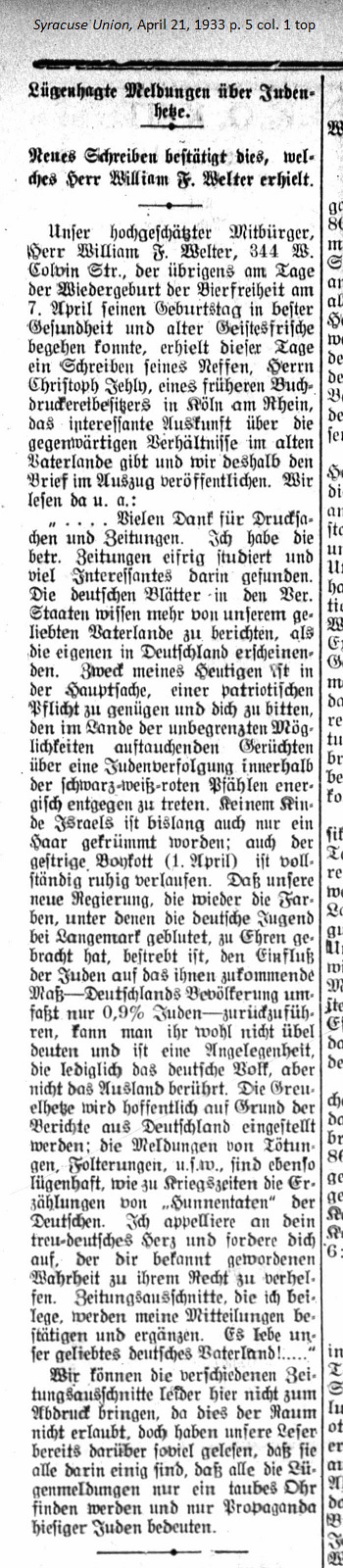
April 21, 1933 page 5 _____ New Letter received by Mr. William F. Welter Attests to This. _____ Our esteemed fellow citizen, Mr. William F. Welter of 344 W. Colvin St., who incidentally on April 7th, the day of the resurrection of beer freedom, could celebrate his birthday in the best of health with oldtime spiritual refreshment, received a letter that day from his nephew, Mr. Christopher Jehly, a former owner of a book printing business in Cologne on the Rhine, relating some interesting information about the current state of the old fatherland. We have published some excerpts as follows: "...Many thanks for the printed matter and the newspapers. I've carefully studied the newspapers and have found some interesting items in them. German newspapers in the United States report more about our beloved fatherland than our own newspapers in Germany seem to know. My current purpose is to fulfill my patriotic duty and ask you to energetically oppose the emerging rumors in the land of endless opportunities concerning Jewish persecution within the black, white, and red borders. So far not one hair on a Jewish child's head has been ruffled. Even yesterday's boycott (April 1st) proceeded peacefully. Our new government, which again has brought glory to the flag under which the youth of Germany bled in Langemarck, is striving to lead us back from the influence of the Jews to a proportionate level — Germany's population is only .9% Jewish — One can't consider this wrong. It's an issue which only impacts the German people, not the countries abroad. Cries of abomination will hopefully cease with the reports coming out of Germany. Reports of homicides, torture, etc. are just as fraudulent as the tales of "Hun deeds" by Germans during the World War. I appeal to your true blue German heart and ask that for the sake of justice you make the truth known. Long live our beloved German fatherland....." Unfortunately we could not print the various newspaper excerpts since there wasn't sufficient room, but our readers have already read so much about this matter that all the fraudulent reports will fall on deaf ears and only point back to the propaganda of local Jews. |
|
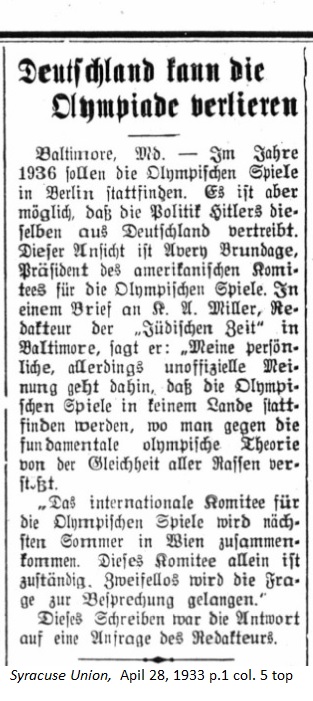
April 28, 1933 page 1 _____ Baltimore, Md. — In 1936 the Olympic Games are supposed to take place in Berlin. However it is possible that Hitler's politics will drive it out of Berlin. This is the opinion of Avery Brundage, president of the American Committee for the Olympic Games. In a letter to R.A. Miller, editor of the Jüdische Zeit [Baltimore Jewish Times?] in Baltimore, he says, "My personal opinion, completely unofficial, is that the Olympic Games cannot take place in a country where people violate the fundamental olympic theory of the equality of all races. "The International Committee for the Olympic Games will convene next summer in Vienna. This Committee alone is in charge. Undoubtedly the issue will be discussed." This letter was in response to an inquery by the editor. |
|
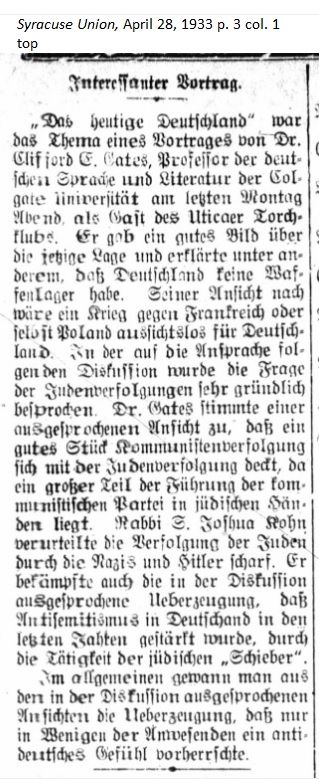
April 28, 1933 page 3 _____ "Germany Today" was the theme of a lecture given by Dr. Cliffort E. Gates, Professor of German Language and Literature at Colgate University last Monday evening as a guest of the Utica Torch Club. He gave a good picture of the current sitation and declared, among other things, that Germany may have no weapons stockpile. In his opinion a war against France or even Poland would be futile. In a discussion following the lecture the question of Jewish persecution was thoroughly examined. Dr. Gates agreed with an expressed opinion that a good portion of Communist persecution was concealed along with the Jewish persecution since a large part of the leadership of the Communist Party rested in Jewish hands. Rabbi S. Joshua Kohn condemned the persecution of Jews by the Nazis and Hitler. During the discussion he also expressed opposition to the conviction that antisemitism in Germany intensified in the last few years due to the activity of Jewish "black marketeers." In general, people came away from the discussion with the idea that only a few of those present harbored anti-German sentiments. |
|
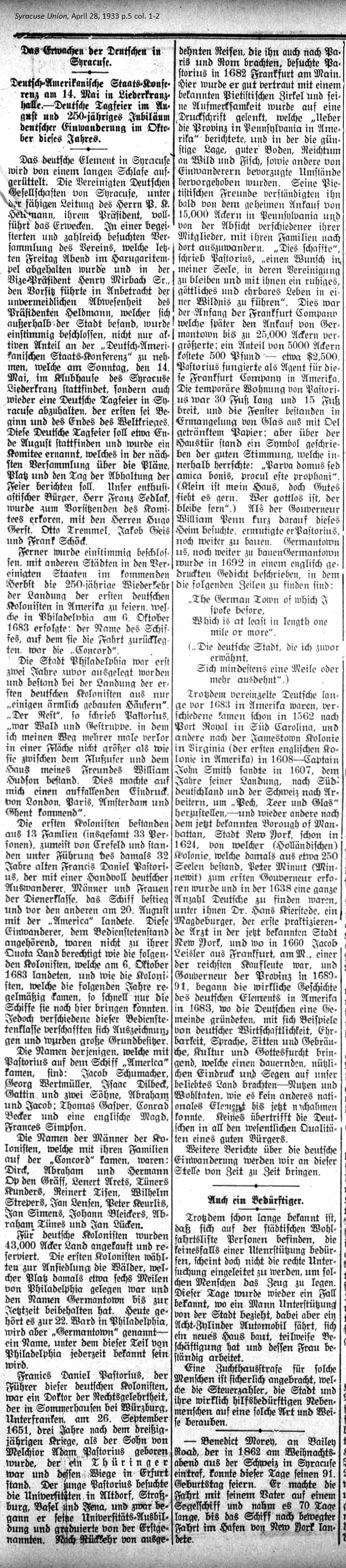
April 28, 1933 page 5 _____ German-American State Conference on May 14th in the Liederkranz Hall — German Day Celebration in August and 250th Anniversary of German Immigration in October of this Year _____ The German element in Syracuse is about to be jolted out of its long nap. The United German Societies of Syracuse, under the capable leadership of Mr. P.R. Heldmann, its president, will execute the awakening. In an enthusiastic and well-attended meeting of the United Societies, held last Friday evening in the Harugari Temple, Vice President Henry Mirbach Sr. acted as chair in the unavoidable absence of President Heldmann, who was out of town. By unanimous decision the group decided not just to take an active role in the German-American State Conference, which will be held on May 14th in the Club House of the Syracuse Liederkranz, but also to reinstitute a German Day Celebration in Syracuse, the first since the World War. This German Day will be held sometime towards the end of August. A committee was appointed, which at the next meeting will report on the plans, the location and the date on which the celebration will be held. Our enthusiatic citizen, Mr. Franz Sedlak will chair the committee, made up of Messrs. Hugo Gerst, Otto Tremmel, Jakob Geis, and Frank Schöck. Furthermore it was unanimously decided to celebrate with other cities in the United States this coming Fall the 250th anniversary of the first German colonists landing in America, which occurred in Philadelphia on October 6, 1683. The name of the ship on which they made the voyage was the "Concord." The city of Philadelphia was just laid out two years before and near the landing it consisted only of "a few poorly built houses." "The rest," so wrote Pastorius, "was woodlands and brush, in which I lost my way many more times in an area no larger than the distance between the riverbank and the house of my friend William Hudson. This made a striking impression on me after coming from London, Paris, Amsterdam, and Ghent." The first colonists consisted of 13 families (a total of 33 people) mostly from Crefeld. They stood under the guidance of the then 32 year old Francis Daniel Pastorius, who preceded the families and boarded the ship with a handful German immigrants, men and women of the servant class. He landed on the ship "America" on August 20th. These immigrants, being servants, were not entitled to a piece of land like the colonists who arrived on October 6th or like the colonists who regularly arrived the following year as quickly as a ship could bring them. However many of the servants received rewards and became large estate owners. The names of those who came on the ship "America" with Pastorius are: Jacob Schumacher; Georg Wertmüller; Isaac Dilbeck, wife and two sons, Abraham and Jacob; Thomas Gasper; Conrad Becker and an English girl, Frances Simpson. The names of the male colonists, who arrived with their families on the "Concord" were: Dirck, Abraham and Hermann Op den Gräff; Lenert Arets; Tüners Kunders; Reinert Tisen; Wilhelm Strepers; Jan Lensen; Peter Keurlis; Jan Simens; Johann Bleickers; Abraham Tünes; and Jan Lücken. For German colonists 43,000 acres of land were purchased and reserved. The first colonists chose the woodlands for settlement. This location was about six miles from Philadelphia and chose the name Germantown, which it has retained to this day even though it is now the 22nd Ward of Philadelphia. Francis Daniel Pastorius, the leader of these German colonists, was a doctor of jurisprudence, who was born in Sommerhausen near Würzburg, Lower Franconia on September 26, 1651, three years after the Thirty Years War. He was the son of Melchior Adam Pastorius, a Thuringian whose birthplace was Erfurt. Young Pastorius attended the universities in Altdorf, Strassburg, Basel and Jena, however he began his university education and graduated from the first named school. After his return from extensive travel, which even took him to Paris and Rome, he visited Frankfurt am Main in 1682. Here he became acquainted with a well-known Pietist circle. His attention was drawn to a printed brochure which reported "about the province of Pennsylvania in America," in which there were favorable conditions, good soil, a wealth of wild game and fish plus other advantages for immigrants. His Pietist friends soon informed him about the secret purchase of 15,000 acres in Pennsylvania and the intention of many of their membership to emigrate there with their families. Pastorius wrote, "This created a desire in my soul to remain with their society and lead a peaceful, godly, and honorable life with them in the wildernis." This was the beginning of the Frankfurt Company, which later increased its purchase to 25,000 acres of land. A portion of 5000 acres cost 500 Pounds — around $2500. Pastorius functioned as an agent for the Frankfurt Company in America. His temporary residence was 30 feet long and 15 feet wide and the windows were made of oil-soaked paper due to the lack of glass. However over the threshold stood a saying indicating the good spirit which prevailed within: "Parva domus sed amica bonis, procul este prophani" (a little house, but a friend to the good, keep at a distance ye profane.) Shortly after Governor William Penn visited this house, he encouraged Pastorius to continue building. In 1692 Germantown was described in an English poem in which the following lines are found: "The German Town of which I spoke before,
There were individual Germans in America long before 1683. Various people had already come in 1562 to Port Royal in South Carolina, and others came to the Jamestown Colony in Virginia (the first English colony in America) in 1608. In 1607, a year after his landing, Captain John Smith sent for workers in southern Germany and Switzerland to produce "pitch, tar and glass." He sent more requests in 1624 to the well-known Borough of Manhattan in New York City. This Dutch colony had around 250 souls. Peter Minuit (Minnewit) was its first governor and in 1638 a large number of Germans could be found there. Among them was Dr. Hans Kierstede of Magdeburg, the first practicing physician in what is now known as New York City, and where in 1660 Jacob Leisner of Frankfurt a.M., one of the richest merchants and governor of the province in 1689-91, began the actual history of the German element in America in 1683 where the Germans founded a community with examples of German economic vitality, honesty, language, customs and practices, culture and reverence, which brought a lasting, useful impression and blessing to our beloved country — usefulness and good deeds as no other national element could imitate until now. No one outdoes the Germans in all the essential qualities of a good citizen. We will bring further reports on German immigration in this spot from time to time. Even a Beggar _____ It's been known for a long time that there are people on the welfare list, who in no way need support, yet the proper investigations seem not to have been introduced to track such people down. Recently one case was found where a man obtained support from the state but drove an eight cylinder car, built a new house, was employed and his wife had steady work. A prison sentence for such a man is indeed appropriate for someone who uses such ways and means to rob the tax payer, the city and our neighbors truly in need. — Benedict Morey of Bailey Rd., who on Christmas Eve 1862 arrived in Syracuse from Switzerland, was able to celebrate his 91st birthday today. He made the trip with his father on a sailship which took 70 days until it landed in New York Harbor. |
|
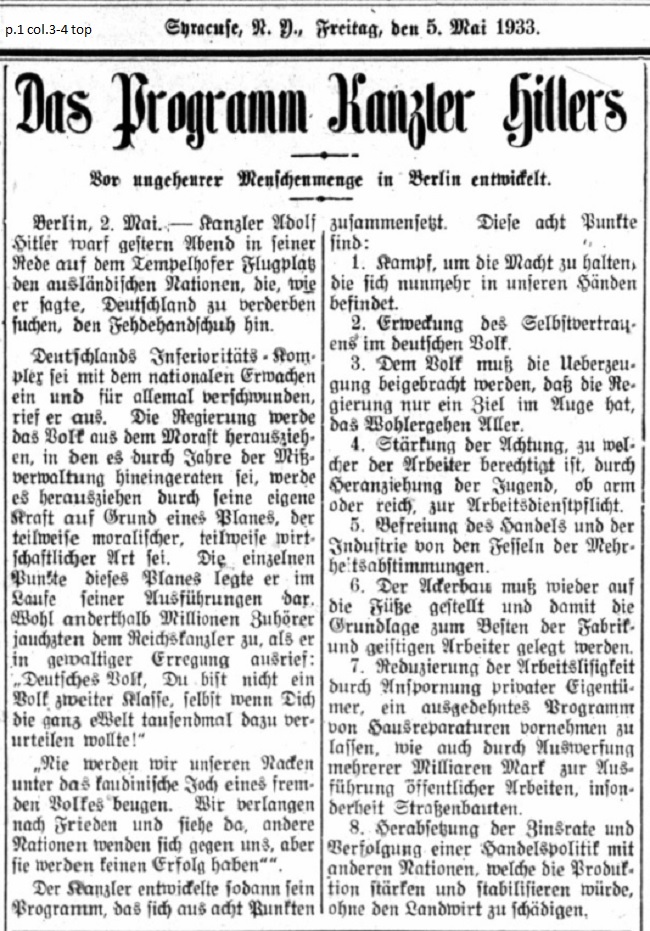
May 5, 1933 page 1 _____ Revealed before a huge Crowd in Berlin _____ Berlin, May 2nd. — Yesterday in a speech give at Tempelhof Airport, Chancellor Adof Hitler threw down the gauntlet to nations abroad, which, as he put it, attempted to corrupt Germany. With Germany's awakening its nationwide inferiority complex has vanished once and for all, he shouted. The government will pull the people from the morass into which it was dragged by years of bad government. It will extract itself under its own power by establishment of a plan, which is partly moral and partly economic. He laid out the individual points to the plan during the course of his remarks. One and a half million listeners cheered for the Chancellor as he proclaimed in powerful excitement, "German people, you are not a people of the second class, even if the entire world wanted to comdemn you to it a thousand times!" "Never again will we bend our necks under the caudine yoke of a foreign people. We demand freedom and behold, other nations turn aganst us, but they will achieve nothing." The Chancellor then unfolded his plan, which was comprised of eight points:
|
|
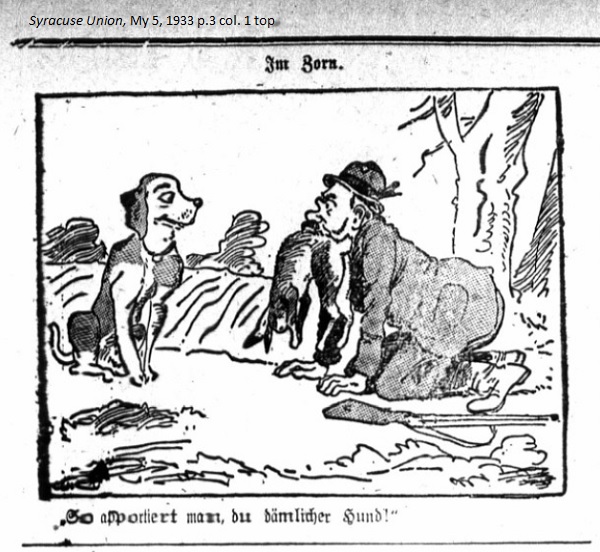
May 5, 1933 page 3 _____ "This is how you fetch, you stupid mutt! |
|
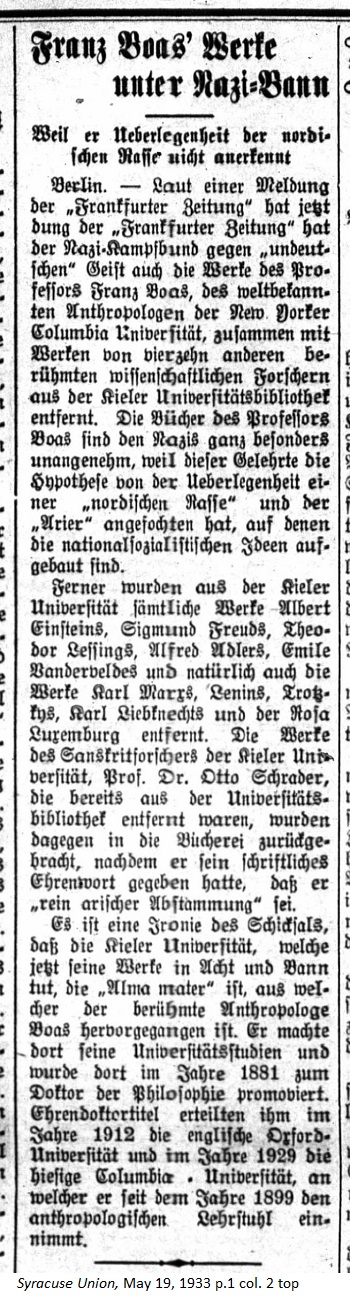
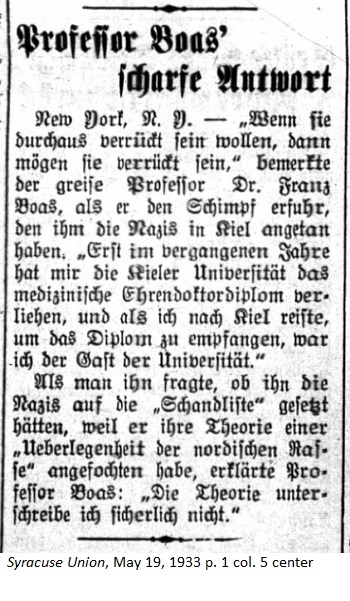
May 19, 1933 page 1 _____ Because He did not acknowledge the Superiority of the Nordic Race Berlin. — According to an announcement in the Frankfurter Zeitung the Nazi Battle League against "Ungermanic" Ideology is removing the work of Professor Franz Boas, the well-known anthropologist at New York's Columbia University, along with the works of fourteen other famous scientific reseachers from the Kiel University Library. Professor Boas' books are particularly unwelcome to the Nazis because this scholar has refuted the hypothesis of the superiority of the "Nordic Race" and the "Aryan People", upon which the National Socialist ideology is based. Furthermore the collected works of Albert Einstein, Sigmund Freud, Theodor Lessing, Alfred Adler, Emile Vandervelde and naturally the works of Karl Marx, Lenin, Trotzky, Karl Liebknecht, and Rosa Luxemburg are being removed. The works of Kiel University Sanskrit researcher Dr. Otto Schrader, which were already removed from the library, were returned to the book shelves after he had given his written pledge that he was "of pure Aryan descent." It's an ironic twist of fate that the Kiel University, which currently holds his work in contempt and under the ban, is the "Alma Mater" of the famous anthropologist. He performed his academic studies there and graduated as a Doctor of Philosophy in 1881. He received honorary doctirates in 1912 from Oxford University and in 1929 from Columbia University, where he has held the chair in anthropology since 1899. |
|
May 19, 1933 page 1 When asked whether the Nazis had placed him on the "Disgrace List" because his theory refuted the "superiority of the nordic race" Professor Boas replied, "I certainly do not subscribe to that theory." |
|
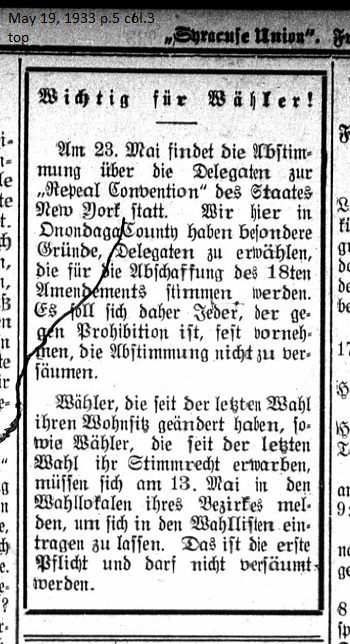
May 19. 1933 page 5 _____ On May 23rd the vote for delegates to the "Repeal Convention" takes place in New York. We here in Onondaga County have particularly good reason for electing delegates who will vote for the repeal of the 18th Amendment. Everyone who is against Prohibition should make every effort not to miss the election. Voters, who have changed residences sine the last election, and voters, who since the last election have acquired the right to vote, must report on May 13th to the voting location in their precinct in order to place their name on the voting roster. This is a prime duty and should not be neglected. |
|
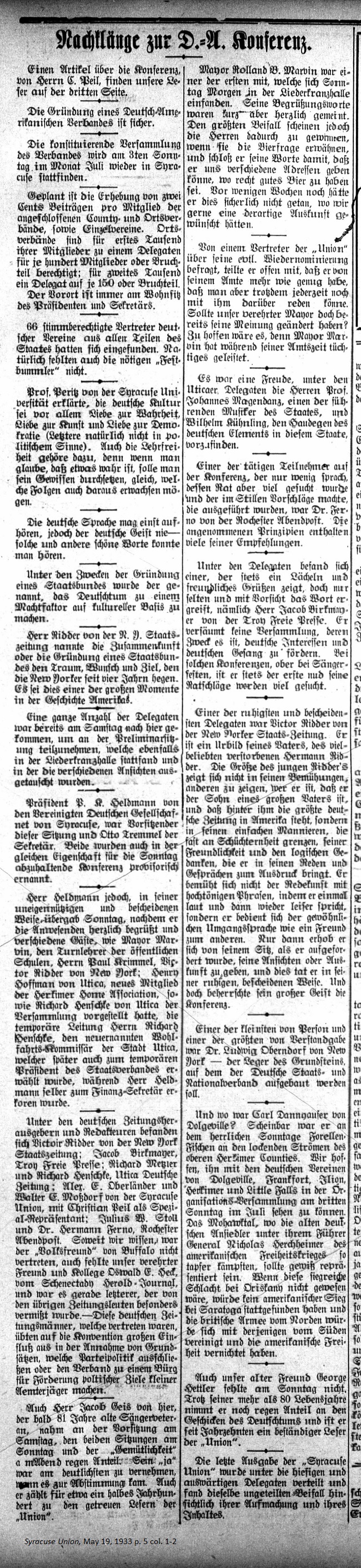
May 19, 1933 page 5 _____ Our readers will find an article on the Conference written by Mr. C. Peil on page 3 (next translation down) The establishment of a German-American Association is assured. A meeting to create the Association's constitution will take place on the third Sunday in July in Syracuse. Planned is the raising of a two-cent contribution per member of the affiliated county and district associations and individual groups. The first thousand members of each district association qualify for one delegate per hundred members or fraction thereof; the second thousand qualify for one delegate per 150 members or fraction thereof. The location is always the address of the residence of the president or secretary. 66 voting representatives of German associations from all parts of the state have been located. Naturally there's always the necessary last minute party crashers. Prof. Peritz of Syracuse University stated that German culture has above all a love for truth, a love for art, and a love for democracy (the last element naturally meant only in a non-political sense). Academic freedom also belongs to this group because when one believes that something is true one should follow one's conscience, which in turn may evolve. The German language may leave off occasionally, but never the German spirit — one may hear other beautiful words. Among the goals in the establishment of a statewide association let it be mentioned that the German community will be made a powerful factor in the cultural basis. A large number of delegates were ready to come here on Saturday to take part in a preliminary meeting, which took place in the Liederkranz Hall and in which various opinions were exchanged. President P.R. Heldmann of the United German Businesses of Syracuse was chairman of the meeting and Otto Tremmel was secretary. Both have been provisionally appointed to perform the same functions in the Sunday conference. Mr. Heldmann, in his selfless and humble fashion, presided on Sunday after he cordially greeted all those present including various guests such as Mayor Marvin; the gymnastics teacher of the public school, Mr. Paul Krimmel; Victor Ridder of New York; Henry Hoffman of Utica, new member of the Herkimer Home Association and Richard Henschke, newly appointed Welfare Commissioner of the City of Utica were introduced. Richard Henschke was elected temporary president of the State Association while Mr. Heldmann became Finance Secretary. Among the German newspaper publishers and editors were Victor Ridder of the New Yorker Staatszeitung; Jacob Birkmayer, Troy Freie Presse; Richard Metzler and Richard Henschke, Utica Deutsche Zeitung; Alex E. Oberländer and Walter E. Mossdorf of the Syracuse Union; with Christian Peil as a special representative; Julius W. Stoll and Dr. Hermann Ferno, Rochester Abendpost. As far as we know, the Buffalo Volksfreund was not represented. Also absent was our esteemed friend and colleague Oswald E. Heck of the Schenectady Herold Journal, who was particularly missed. — The German newspaper men who were present exercised great influence over the convention with the acceptance of the policies excluding party politics or making the association into a platform for the furthering of the political agenda of any political office seeker. Even Mr. Jacob Geis of Syracuse, the almost 81 year old singing society veteran, participated at the Saturday meeting, both sessions on Sunday, and the social that evening. His "yes votes" were extremely loud and clear. He's also been a loyal reader of the Union for around half a century. Mayor Rolland B. Marvin was one of the first to arrive at the Liederkranz Hall on Sunday morning. His words of greeting were brief but heartfelt. The men seemed to give the greatest amount of applause when the Beer Question was mentioned. The mayor closed his speech saying he could give us various addresses where truly good beer could be had. A few weeks ago he certainly wouldn't have done that if we had wanted such information. When asked by a representative of the Union about his eventual renomination, he openly admitted that he had more than enough to do in his office but he was williing to discuss it with anyone. Could our honored Mayor have already altered his opinion? We hope so because Mayor Marvin has capably served during his time in office. It was a pleasure to see among the Utica delegates Professor Johannes Magendanz, one of the leading musicians in the state, and Wilhelm Kühnling, the tough old soldier of the German community in this state. One of the active participants in the conference, who seldom spoke but whose advice was often sought, and who quietly made suggestions which were then carried out, was Dr. Ferno of the Rochester Abendpost. The adopted principles contained many of his recommendations. Among the delegates there was one who seldom showed a smile or extended a friendly greeting and carefully chose his words, namely Mr. Jacob Birkmayer of the Troy Freie Presse. He didn't miss a meeting and it was his goal to promote German interests and German song. He's the first to attend conferences and song festivals and his advice is often sought out. One of the quietest and most unassuming delegates was Victor Ridder of the New Yorker Staatszeitung. He is the spitting image of his father, the much loved, now deceased Hermann Ridder. The greatness in young Ridder does not show in his endeavors to show others who he is, that he is the son of a great father and that behind him stands the greatest German newspaper in America but in his easy manner, almost bordering on timidness, his friendliness and his logical thinking, which is exhibited in his speeches and conversations. He does not bother with rhetoric filled with high-flung words spoken loudly at first then repeated softly. Rather he uses everyday language as a friend to all. He only got out of his seat when he was asked to give his opinion or information and he did this in his peaceful, humble manner. And thus his great intellect prevailed at the conference. And where was Carl Dannhauser of Dolgeville? Apparently he was spending a beautiful Sunday trout fishing in the enticing streams of upper Herkimer County. We hope to see him with the German associations of Dolgeville, Frankfort, Ilion, Herkimer and Little Falls at the organizational meeting on the third Sunday in July. The Mohawk Valley, where the old German settlers so bravely fought under their leader, General Nicholas Herchheimer during the American Revolution should definitely be represented. If this victorious battle near Oriskany had not been fought, then the American victory at Saratoga would not have occurred, and the British Army of the North would have united with the Army of the South and annihilated the American freedom fighters. Even our old friend George Hettler did not fail to attend. Despite his more than 80 years of life he regularly takes part in the affairs of the German community and he has been a constant reader of the Union for decades. The last edition of the Syracuse Union was distributed to the local and visiting delegates and it found unanimous approval by all for its layout and content. |
|
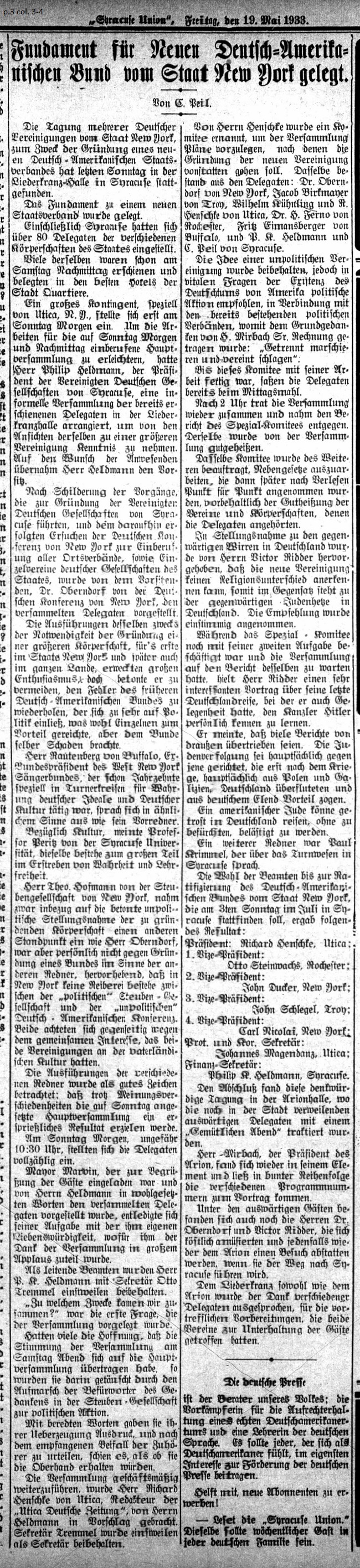
May 19, 1933 page 3 _____ by C. Peil _____ The conference of many German organizations of the State of New York in order to set the foundation for a new German-American State Association took place last Sunday in the Liederkranz Hall in Syracuse. The fundamentals for a new statewide association were laid out. Including Syracuse there were over 80 delegates from various organizations in the state. Many of those delegates were already present on Saturday afternoon and they stayed in the best hotels in the city. A large contingent from Utica, N.Y. came in on Sunday morning. To lighten the workload for the Sunday morning and afternoon sessions, Mr. Philip Heldmann, President of the United German Societies of Syracuse, had arranged for an informal meeting of the delegates already present in the Liederkranz Hall in order to gather opinions towards a greater organizational wareness. At the wish of those present Mr. Heldmann took the committee chair. After a description of the processes leading to the foundation of the United German Societies of Syracuse and the resulting request by the German Conference of New York to issue a call to all district associations and individual German societies of the state, the committee introduced Dr. Oberndorf of the German Conference of New York to the assembled delegates. Oberndorf's explanations for the necessity of establishing a larger corporate body, first in New York State and later the entire country, elicited great enthusiasm but he emphasized the need to avoid the mistake of previous German-American associations, which focused too strongly on politics to the advantage of certain individuals and to the detriment of the association. Mr. Rautenberg of Buffalo, former president of thr Western New York Sängerbund, who was active for decades in gymnastic circles promoting the preservation of German ideals and German culture, expressed himself in a manner similar to that of the previous speaker. Professor Peritz of Syracuse University indicated that to a great extent culture consisted of aspirations towards truth and scholastic freedom. Mr. Theo. Hoffmann of the Steuben Society of New York took issue with the emphasis on Mr. Oberdorf's nonpolitical stance in the establishment of a corporate body. He wasn't personally opposed to the other speaker's opinion but raised the point that in New York no friction existed between the "political" Steuben Society and the "nonpolitical" German-American Conference. Both sides respected each other due to their common interests based on the culture of the fatherland. Statements by various speakers were deemed a good omen. Notwithstanding the differences of opinion, the main meeting on Sunday would produce fine results. On Sunday morning at around 10:30 the delegates were all in seated in place. With some well-chosen words, Mr. Heldmann introduced Mayor Marvin to the delegates. The Mayor had been invited to greet the guests and he carried out his task graciously. The assembly expressed their thanks with a round of applause. Mr. P.R. Heldmann and Secretary Otto Tremmel were retained as interim official leaders. "For what purpose have we come here together," was the first question put before the assembly. If many had hoped that the assembly's mood on Saturday evening would be carried over to the main meeting, they were disappointed by the support for political action advocated by the Steuben Society. With eloquent words they gave expression to their conviction and after cheering by the audience it seemed as though they would hold the upper hand. The meeting continued in a businesslike fashion. Mr. Heldmann nominated Mr. Richard Henschke of Utica, editor of the Utica Deutsche Zeitung . Secretary Tremmel retained his interim post. Mr. Henschke appointed a committee to submit the plans from the meeting, after which the establishing of the new association would take place. The committee was comprised of the following delegates: Dr. Oberndorf of New York; Jacob Birkmayer of Troy; Wilhelm Kühnling and R. Henschke of Utica; Dr. H. Ferno of Rochester; Fritz Eimansberger of Buffalo; and P.R. Heldmann and C. Peil of Syracuse. The idea of a nonpolitical association was retained but in vital issues dealing with the existence of the German community in America, political action was recommended in conjunction with other political organizations already in existence, as suggested by Henry Mirbach Sr. with the basic principle, "March separately and strike as one." Once the committee finished its task, the delegates sat down together for lunch. After 2 PM the meeting recommenced and received the report of the Special Committee. It was passed by the assembly. The same committee was further commissioned to work out the bylaws, which upon being read aloud were approved point by point pending approval by the associations and corporate bodies to which the delegates belonged. In a statement regarding the current turmoil in Germany, Mr. Victor Ridder raised the point that the new association can acknowledge no religious distinctions, and therefore takes no stand on the current Jewish persecution in Germany. The recommendations was unanimously approved. While the committee worked on its second task, the assembly had to wait for the report. Mr. Ridder delivered an interesting lecture on his last trip to Germany, during which he had the opportunity to personally meet Chancellor Hitler. He intimated that many reports from abroad might have been exaggerations. The persecution of Jews was mainly directed against those who flooded into Germany after the war from Poland and Galicia [Southeast Poland and West Ukraine] and took advantage of Germany's misery. An American Jew could travel confidently in Germany without fear of harm. Another speaker was Paul Krimmel, who spoke about gymnastics in Syracuse. The election of officers pending ratification of the German-American Bund of the State of New York, which will take place on the 3rd Sunday in July in Syracuse, produced the following results. President: Richard Henschke, Utica;
The conclusion of this memorable conference took place in the Arion Hall where the delegates, who were still in the city, were treated to a "pleasant evening." Mr. Mirbach, the President of the Arion, again found himself in his element and arranged the performance of various programs in a colorful series. Among the guests present were Dr. Oberndorf and Mr. Victor Ridder, who were cheerfully entertained. They will pay a visit to the Arion whenever their path leads to Syracuse. Many delegates expressed their gratitude to the Liederkranz and the Arion for the excellent preparations both associations had undertaken to entertain their guests. The German Press is the mentor to our people; the champion for the preservation of a genuine German-American community and a teacher of the German language. Everyone, who feel themselves to be German-American, should contribute their utmost to the promotion of the German Press. Help to bring in new subscriptions. — Read the Syracuse Union. It should be a weekly guest in every German family's home. |
|
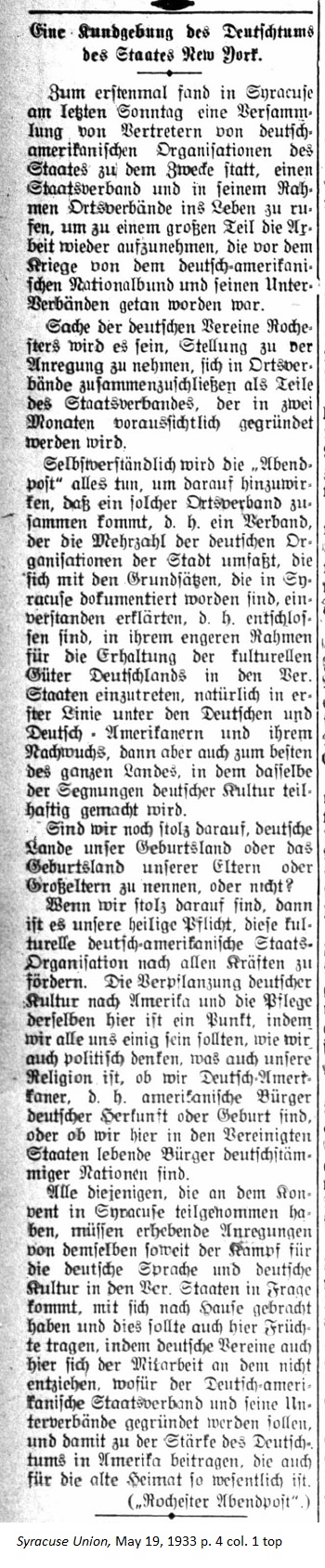
May 19, 1933 page 4 _____ For the first time there was a meeting in Syracuse last Sunday held by representatives of German-American organizations in New York for the purpose of calling to life a statewide association uniting various district organizations so they could once again participate in the work which was accomplished before the War by the German-American Bund and its subordinate associations. The German associations in Rochester will take on the role of bringing together the regional organizations to become part of the State Association, which is projected to be established in two months. Understandably the Abendpost (Evening Post) will do everything to work towards bringing the district associations together in forming an association which encompasses the majority of the German organizations of this city. It will clarify the principles documented in Syracuse geared towards the preservation of Germany's cultural wealth in the United States for Germans, German-Americans, and their descendants and also for the benefit of the entire country for which German culture is a blessing. Are we still proud to call Germany the land of our birth, or that of our parents or grandparents, or not? If we are proud, then it is our sacred duty to dedicate all our resources to this cultural, German-American State Organization. The transplanting of German culture in America and the practice of the same here is a point on which we must all be unified. It also encompasses how we think politically, what our religion is, whether we are German-American, that is, American citizens of German background or birth, whether we are here in the United States as active citizens originating from German nations. All those, who have taken part at the conference in Syracuse, must have come across questions regarding the fight for the German language and German culture in the United States which they have brought back home with them. These questions should bear fruit and German associations here will not be able to shirk from lending a hand towards the establishing of a German-American State Association and its subordinate organizations and thus contribute to the strength of the German community in America, which is also so essential to the old homeland. (Rochester Abendpost) |
|
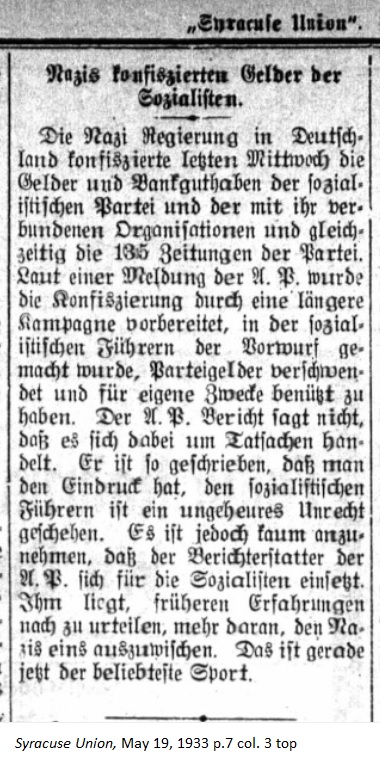
May 19, 1933 page 7 _____ Last Wednesday the Nazi govenment in Germany confiscated the money and bank accounts of the Socialist Party and those of their allied organiztions along with the 135 newspapers of the Party. According to a report by A.P., the confiscations were arranged in a lengthy campaign in which Socialist leaders were accused of wasting party funds and using them for personal reasons. The A.P. report did not say that the accusations dealt with individual facts. It was written in such a way that one got the impression that the Socialist leaders had suffered a huge injustice, however it should not be assumed that the reporter for A.P. was working for the Socialists. Based on previous experience, it's more the Nazis just swiping a blow. Currently it's their favorite sport. |
|
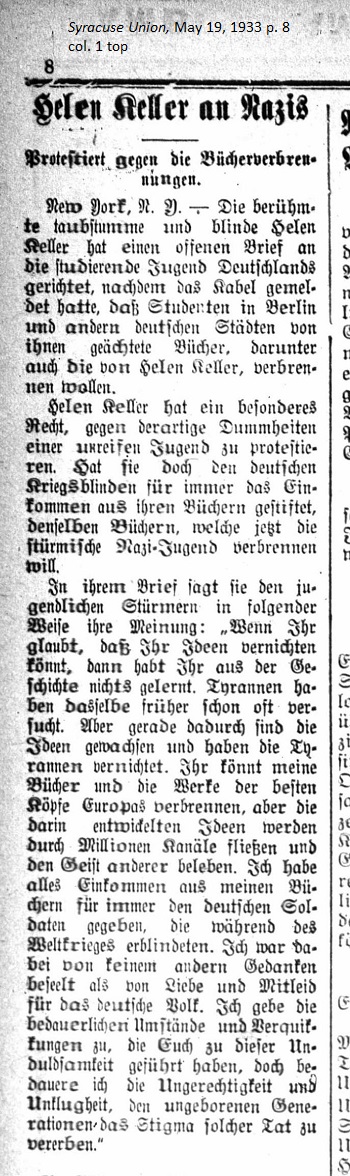
May 19, 1933 page 8 _____ Protesting against the Book Burnings New York, N.Y. — The famous deaf-mute and blind Helen Keller has sent a public letter to the student youth in Germany after a cable had announced that students in Berlin and other German cities wanted to burn books they disliked, including Helen Keller's book. Helen Keller has a particular right to protest against the stupidity of immature students. For imperpetuity she has endowed the income from her books to those Germans blinded during the War and now storming Nazi youth want to burn those same books. In the letter she states her opinion concerning youthful stormers as follows: "If you believe that you can negate ideas, then you haven't learned from history. Tyrants have tried the same thing before. However ideas grew and tyrants died. You could burn my books and the works of the best minds in Europe, but the ideas contained within them will flow through a thousand channels and inspire the spirits of others. I have given all the income from my books to German soldiers who were blinded during the War. I was motivated by no other thought than love and sympathy for the German people. I recognize the regrettable circumstances and connections which have led you to this intolerance and I regret the injustice and imprudence of bequeathing the stigma of such deeds upon unborn generations." |
|
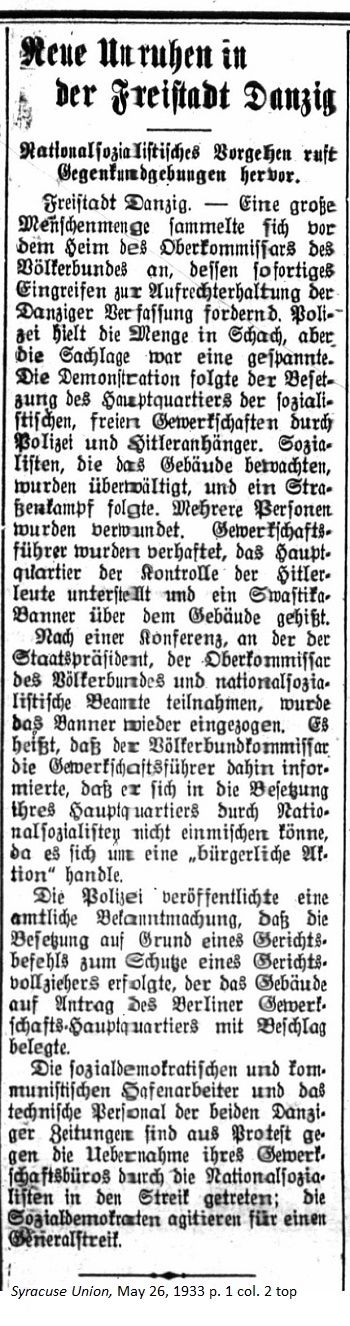
May 26, 1933 page 1 _____ National Socialist Proceedings elicit Counter-Protest Free City of Danzig. — A large crowd of people assembled in front of the home of the Senior Commissioner of the League of Nations demanding immediate intervention in preserving the Danzig Constitution. Police held the group in check but the situation was tense. The demonstation followed the occupation of the headquarters of the Socialist Free Trade Union by police and supporters of Hitler. Socialists watching the building were overpowered and a streetfight broke out. Many people were wounded. Trade Union leaders were arrested, the headquarters placed under the control of the Hitler people, and a swastika banner was hoisted over the building. After a conference in which the State President, the Senior Commissioner, and National Socialist officials participated, the banner was removed. The League Commissioner reportedly informed the Trade Union leaders that he could not interfere in the occupation of their headquarters by the National Socialists since this may deal with a "civilian action." The police issued an official notice that the occupation resulted from a court-mandated order of protection. The building was confiscated and handed over to a court-appointed administrator. The Social Democrat and Communist dockworkers amd the technical personnel of both Danzig newspapers are calling for a strike in protest against the takeover of their headquarter offices by the National Socialists. The Social Democrats are campaigning for a general strike. |
|
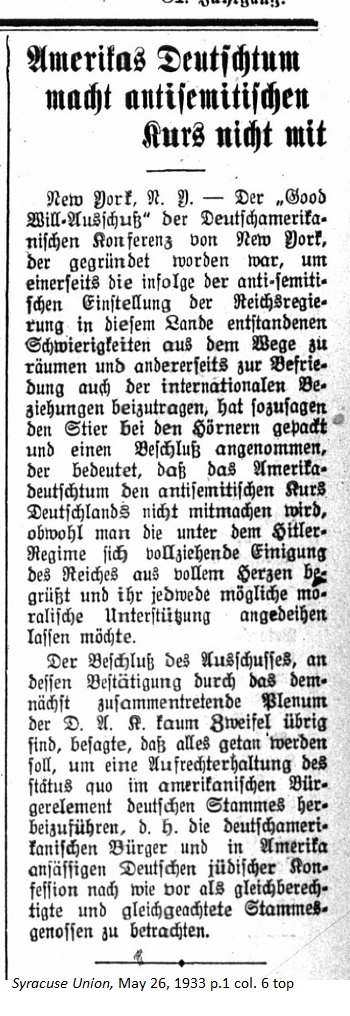
May 26, 1933 page 1 _____ New York, N.Y. — The "Good Will Panel" of the German-American Conference of New York, which was established to distance itself from the antisemitic mindset of the German government in this country and to contribute to the pacification of international relationships has, so to speak, taken the bull by the horns and passed a resolution which signifies that America's German Community will not participate in Germany's antisemitic policy, although one may full-heartedly approve the executive unification of the Reich under Hitler's regime and allow oneself to render moral support. The Panel Committee's resolution, with which there's scarcely any doubt that it will be passed at the next full session of the D.A.K. (German-American Conference,) will have done everything it can to uphold the status of American citizens of German ancestry, that is, it will maintain the equality and dignity of German-American citizens and those Germans of Jewish faith who settled in America. |
|
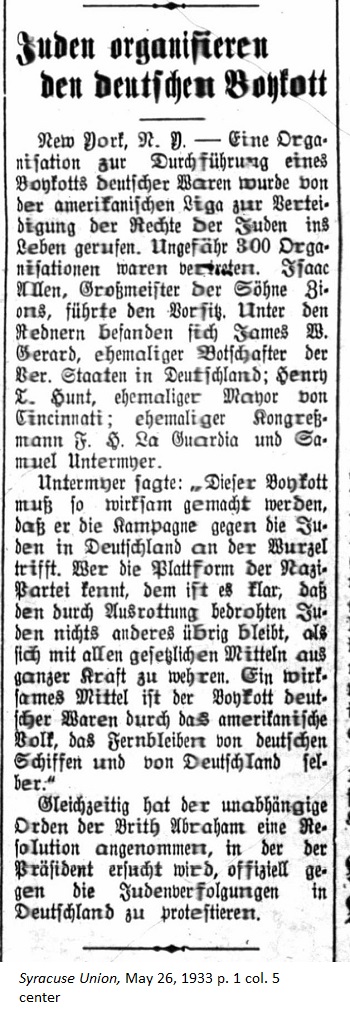
May 26, 1933 page 1 _____ New York, N.Y. — An organization for the execution of a boycott of German goods was called to life by the American League for the Defense of the Rights of Jews. Around 300 organizations were represented. Isaac Allen, Grandmaster of the Sons of Zion, led the committee. Among the speakers were James W. Gerard, former ambassador of the United States to Germany; Henry T. Hunt, former mayor of Cincinnati; former Congressman F.H. La Guardia and Samuel Untermyer. Untermyer stated, "This boycott must be made so effect that it will strike at the heart of the compaign against Jews in Germany. It's clear to anyone who knows the platform of the Nazi Party that Jews threatened to the point of extinction have no other choice but to defend themselves by all legal means. An effective agent is a boycott of German goods by the American people along with refusal to board German ships and even refrain from going to Germany." At the same time the Independent Order of Brith Abraham passed a resolution requesting that the President issue an official protest against Jewish persecution in Germany. |

|
May 26, 1933 page 2 _____ In his sarcastic manner Frederick the Great had so frequently jeered at goldmaking swindels that his relationship to goldmakers seemed quite peculiar. In the Deutsche Medizinische Wochenschrift (German Medical Weekly) Prof. Lockemann points to a remark by the great king to the famous physician von Zimmermann, which sheds light on Old Fritz's position on the subject. In the presence of Minister von Horst the king stated the following according to Zimmermann. "Goldmaking is a form of sickness; it often seems healed for a time by reason, but then it comes back unsuspectedly and become truly epidemical. In Potsdam alchemists reported to Fredersdorff. He believed strongly in alchemy and had dealings with them. Soon the rumor of this enterprise spread throughout the garrison and there wasn't an officer candidate in Potsdam who didn't hope to repay his debts by means of alchemy. Shady and deceptive characters snuck out of every corner and came to Potsdam under all sorts of disguises. A Mrs. von Pfuel came from Saxony with two very lovely daughters. They artfully performed their handiwork and young people saw them as great prophets. I wanted to forcibly rid myself of the problem but I didn't succeed. "People offered their services in my presence to make all conceiveable kinds of tests in order to convince me. I considered it the best remedy to cover up the foolishness, so I allowed the lady alchemist to work under appropriate supervision. Throwing gold into the kettle and other grand deceptions could not succeed, but nonetheless Mrs. von Pfeul made the matter seem so real that I had to permit all attempts; and that cost over ten thousand Talers that I had to appropriate. — It remains pure folly, believing you can change metals. But this much is certain, metals come in completely different forms. One should not search among them. One can make little red granules out of gold that look like rubies and don't seem to have any metal-like quality. Whoever gives me back my money, I'll teach him that trick. — I must just stand by the premise that one does not get any richer by it, because in order to change fifty Ducats into red granules, one loses around six Ducats." Zimmerman reached the conclusion from these remarks by the king that Frederich had given out significant sums for alchemical research but that he himself did not believe in goldmaking. |
|
May 26, 1933 page 4 — Last Thursday was Ascension Day, which is usually celebrated in the church. However none of the local German pastors found it worth the effort to say anything about it, not even a syllable, in the Church Reports section, which is at their disposal free of charge. — Remarkable, if it deals with an amusement such as a card game, a dance party, a supper, etc., the dear pastors usually don't forget to put a notice in the paper. |
|
May 26, 1933 page 4 _____ American Capitalists, who have invested their money in foreign bonds, own approximately 50 percent of German private debt. For this reason the German Reichs Bank has called for a conference with the bond holders, which will begin today, Friday, in Berlin. |
|
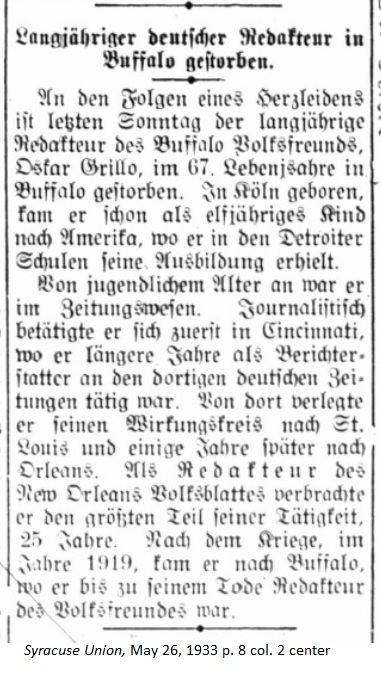
May 26, 1933 page 8 _____ Last Sunday the many-year editor of the Buffalo Volksfreund, Oskar Grillo died in Buffalo as the result of a heart condition. He was 67 years old. Born in Cologne, he came to America at the age of 11, where he received his education in the Detroit schools. At a young age he was already involved with the newspaper business. He was first journalistically employed in Cincinnati, where for many years he was worked as a reporter for the German newspapers. From there he worked in St. Louis and later in New Orleans. He spent a large portion of his working life, 25 years, as the editor for the New Orleans Volksblatt. After the War he came to Buffalo, where he was editor of the Volksfreund until death. |
|
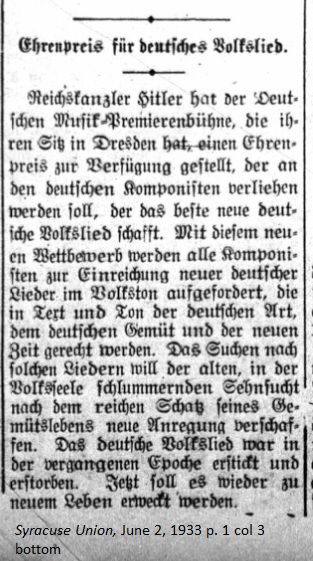
June 2, 1933 page 1 _____ Reich Chancellor Hitler has commissioned the German Music Premier Theater located in Dresden to set up a special prize to be offered to the German composer, who creates the best new German folksong. With this new contest all composers are invited to enrich the treasury of German songs with content and language in the German folk style doing justice to German temperament and the new times. The search for such songs will reawaken the slumbering desire for the richness of German emotional existence. The German folksong had sufficated and died out in the past epoch. Now it will be revived to new life. |
|
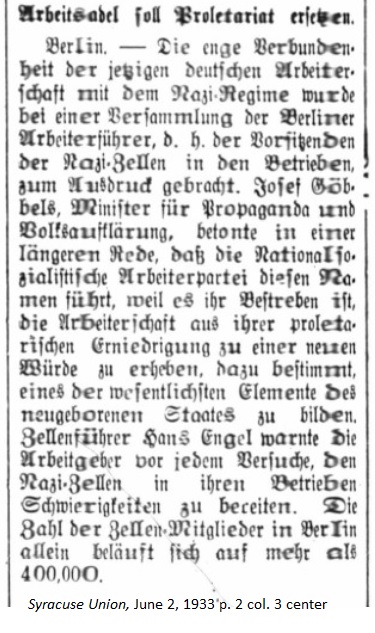
June 2, 1933 page 2 Berlin. — The close connection between the current German workforce and the Nazi Regime was discussed at a meeting of the Berlin labor leaders in the Nazi Cell. Josef Göbbels, Minister for Propaganda and Public Enlightenment emphasized in a long speech that the National Socialist Workers Party proposed this name because it is their endeavor to raise the labor force out of its proletariat humiliation to a new status designed to build one of the most essential elements of the newly-born state. Cell leader Hans Engel warned employers of any attempt to hinder the Nazi Cell in its operations. The number of Cell members in Berlin alone runs to more than 400,000. |
|
June 2, 1933 page 4
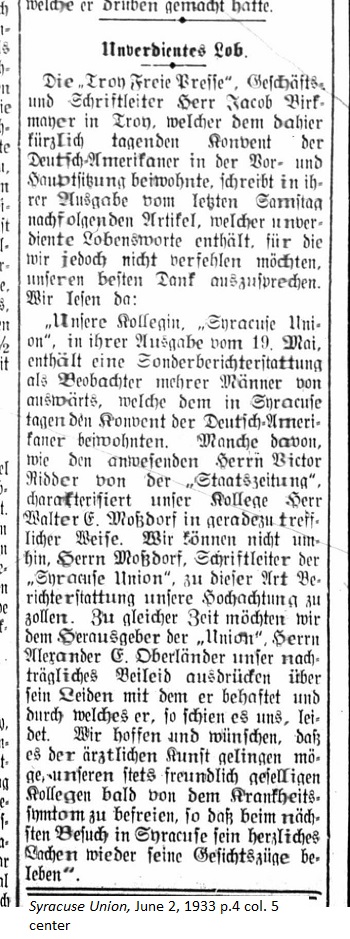
_____ The Troy Freie Presse business manager and chief editor, Mr. Jacob Birkmayer of Troy, who recently served as committee member and chairman at the German-American Convention, wrote the following article last Saturday in his paper, which contained undeserved words of praise for which we could not fail to express our thanks. The article read: "Our colleague, the Syracuse Union, in its edition of May 19th issued a special report as outside observer of the many men who attended the convention of German-Americans in Syracuse. Many of them, like Mr. Victor Ridder of the Staatszeitung were characterized by our colleague, Mr. Walter E. Mossdorf, in glowing terms. We could not help but bestow our high regard for Mr. Mossdorf's brand of journalism. At the same time we wish to express to Union publisher, Mr. Alexander W. Oberländer our sympathy for the illness with which he was afflicted and by which, it seemed to us, he suffered. We hope and wish that the medical arts may soon free our friend and colleague from his symptoms so that on our next visit to Syracuse the warming smile will once again live on his face. |
|
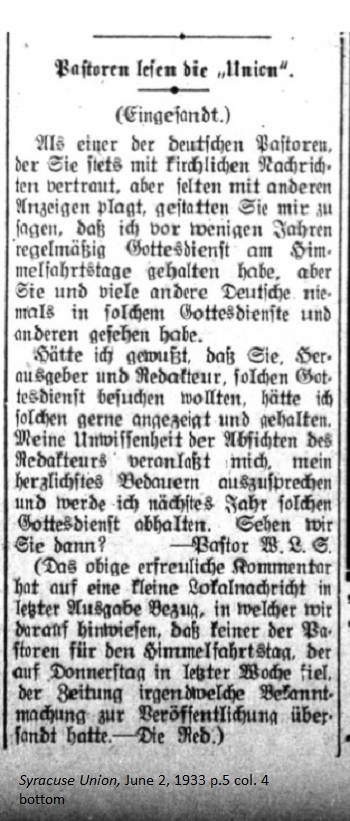
June 2, 1933 page 5 _____ (Sent In) As one of the German pastors, who entrust you with church reports, yet seldom with other advertisements, allow me to say that a few years ago I regularly performed church service on Ascension Day but never saw you or many other Germans at such service. If I had known that you, the publisher and editor, wanted to attend this church service, I would have gladly shown up and performed it. My ignorance of the intentions of editors cause me to express my heartfelt regret and next year I will perform this church service. Will I see you then? — Pastor W.L.S. (The above pleasant commentary relates to a small local report in the last issue in which we indicated that none of the pastors had sent in any information to publish regarding Ascension Day on Thursday of last week. — The Editor) [see above at May 26, page 4] |
|
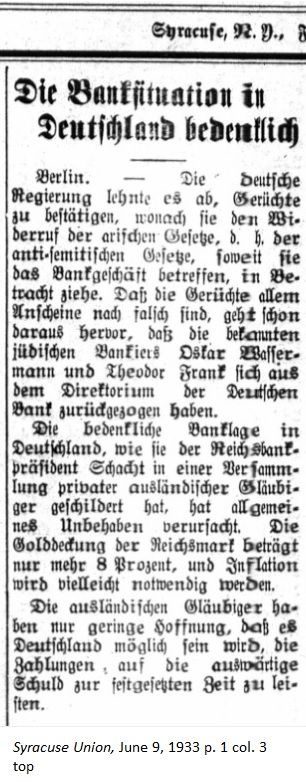
June 9, 1933 page 1 _____ Berlin. — The German government declined to confirm rumors whereby it would repeal the Aryan Laws, that is, the antisemitic laws regarding the banking business. Since the rumors are, to all appearances, false it follows that the well-known Jewish bankers Oskar Wassermann and Theodor Frank have resigned from the Board of Directors of the Deutsche Bank. The dubious bank situation in Germany, as Reichsbank President Schacht described in a meeting of private foreign bond holders, has caused general discontent. The gold backing for the Reichs Mark amounts to no more than 8 percent and inflation may become necessary. The foreign bond holders have only a slight chance that it will be possible for Germany to make payments on the current debt on a firmly set time schedule. |
|
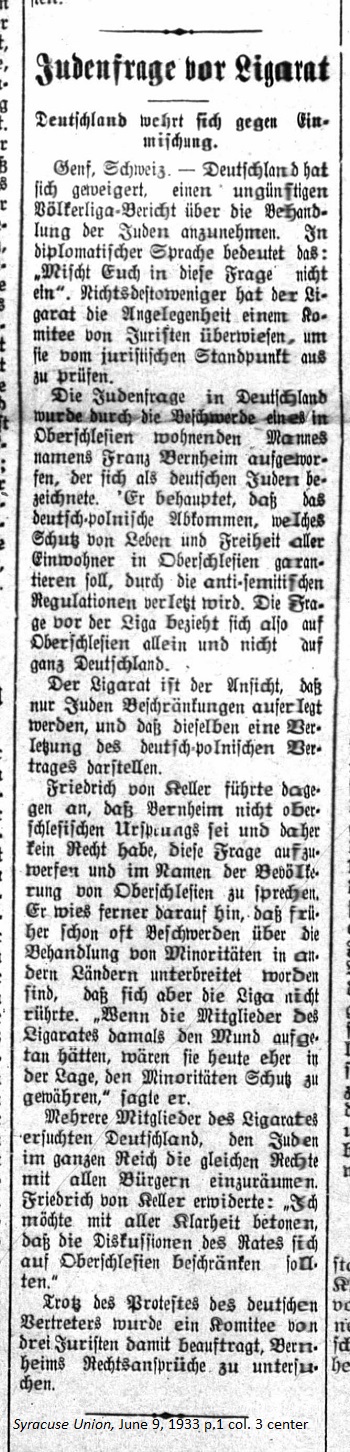
June 9, 1933 page 1 _____ Germany Defends Itself against Intervention The Jewish question in Germany was raised by a complaint from a man living in Upper Silesia named Franz Bernheim, who identified himself as a German Jew. He maintains that the German-Polish Accord, which guarantees life and liberty to all residents of Upper Silesia, will be violated by the antisemitic regulations. The question before the League pertains to Upper Silesia alone and not the whole of Germany. The League Council is of the opinion that only Jewish restrictions were imposed and that this represents a violation of the German-Polish Accord. Friedrich von Keller countered that Bernheim was not of Upper Silesian origin and thus has no right to raise this issue and speak in the name of the people of Upper Silesia. He further continued that previously complaints were often submitted concerning treatment of minorities in other countries but the League had not bothered with them. "If the members of the League Council had opened its mouth then perhaps they'd be in a situation today to grant minority protection," he stated. Many members of the League Council petitioned Germany to give the Jews throughout the country equal rights with all other citizens. Friedrich von Keller responded, "I would like to stress with clarity that the Council's discussion should limit itself to Upper Silesia." Despite the protest of the German representative, a committee was formed to investigate Bernheim's civil rights complaint. |
|
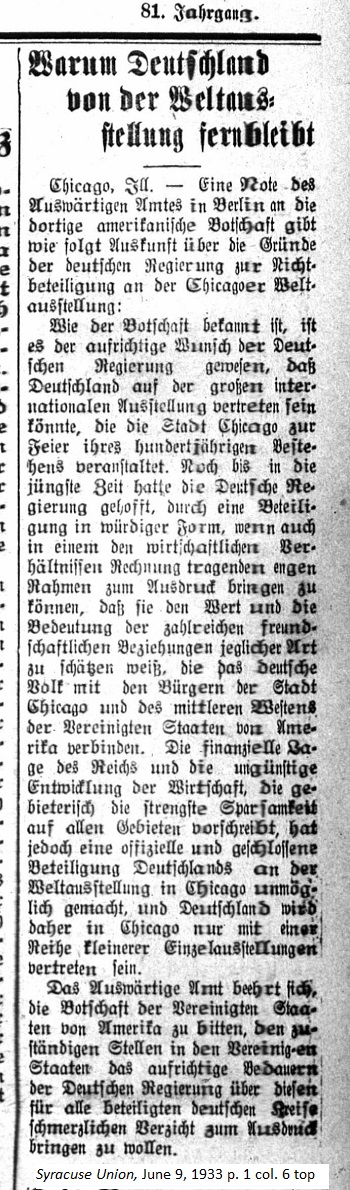
June 9, 1933 page 1 _____ Chicago, Ill. — A note from the Berlin Foreign Office to the American Embassy there gave the following information concerning the reason the German government has decided not to participate at the Chicago World's Fair: As the Embassy knows, it was the German government's fondest wish to participate in the great international fair taking place in the city of Chicago to celebrate the hundredth anniversary of its existence. Until recently the German government hoped to participate in a worthwhile form, even if only to accomplish bringing relationships closer together since the government knows the value and meaning of countless amicable connections. This would bind the German people together in friendship with the citizens of the city of Chicago and the midwestern states of the United States. The financial situation in the Reich and the unfavorable turn in the economy, which demand the strictest money-saving measures in all areas, have made official and complete participation in the Chicago World's Fair impossible. Germany will only be represented by a series of smaller and individual exhibits. The Foreign Office requests the privilige of asking the Embassy of the United States to pass on the German government's sincere regrets. On our behalf please explain the painful sacrifices being made in all German circles. |
|
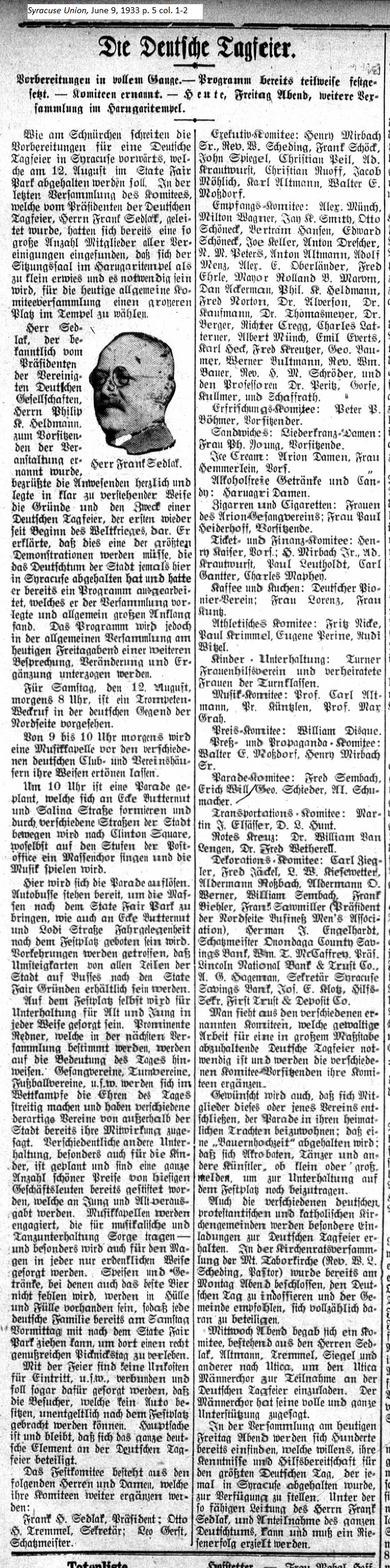
June 9, 1933 page 2 _____ Preparations in Full Swing — Program partially set — Committee appointed — Today, Friday Evening, another Meeting in the Harugari Temple. _____ Like clockwork, preparations for a German Day celebration move forward in Syracuse. It will be held on August 12th in State Fair Park. At the last meeting of the committee, led by Mr. Frank Sedlak, president for the German Day, a large number of members of various associations attended. The sitting room in the Harugari Temple proved too small and it will necessary to choose a larger place in the Temple for tonight's general committee meeting. Mr. Sedlak, who was appointed chairman of the event by the well-known president of the United German Associations, Philip Heldmann, cordially greeted those present and clearly laid out the reasons for and goal of the German Day Celebration, the first one since the beginning of the World War. He stated that this must be one of the greatest demonstrations which the German community of this city holds in Syracuse. He had already worked out a program, which he presented to the committee and which received general approval. The program will undergo further discussion, changes, and supplementing at the general meeting tonight. On Saturday, August 12th at 8 AM a trumpet wake-up call is scheduled in the German section of the northside of the city. From 9 to 10 AM a band will play tunes for the various German clubs and associations. At 10 AM a parade is planned, which will gather at the corner of Butternut and Salina St. and move through various streets of the city to Clinton Square, where on the stoop of the Post Office a choir will sing and music will be played. Here the parade will disperse. Buses will be ready to bring the masses to the State Fair Park, while at the corner of Butternut and Lodi St. transport opportunities will be offered to the festival location. Provisions will be made so that boarding passes will be available from all parts of the city for buses to the State Fair Grounds. At the festival location there will be amusements of all kinds for the young and old. Prominent speakers, which will be chosen at the next meeting, will tell about the importance of the day. Singing societies, gymnastic clubs, football groups, etc. will compete in contests in honor of the day. Various similar groups from outside the city have already assured their participation. Various other amusements, especially for children, have also been planned and a large number of fine prizes have already been donated by local business people, which will be distributed to young and old. Bands have been engaged to provide for musical and dance entertainment — and the needs of the stomach have been particularly cared for. Food and drink will be amply on hand, and the best beer shall not be missing, so that every German family can come to the State Fair Park on Saturday and experience a pleasant picnic. There is no entry fee for the festival, etc. Visitors, who don't have a car, can be brought to the festival location at no cost. What is most important is for the entire German community to participate at the German Day celebration. The Festival Committee consists of the following men and women, who will then form their own committees: Frank H. Sedlak, President; Otto H. Tremmel, Secretary; Leo Gerst, Treasurer. Executive Committee: Henry Mirbach, Sr.; Rev. W. Scheding; Frank Schöck; John Spiegel; Christian Peil; Ad. Krautwurst; Chrisitan Ruoff; Jacob Möhlich; Karl Altmann; Walter E. Mossdorf. Reception Committee: Alex Münch; Milton Wagner; Jay R. Smith; Otto Schönecke; Bertran Hansen; Edward Schönecke; Joe Keller; Anton Drescher; N.M. Peters; Anton Altmann; Adolf Menz; Alex E. Oberländer; Fred Ehrle; Mayor Rolland B. Marvin; Dan Ackerman; Phil R. Heldmann; Fred Norton; Dr. Alverson; Dr. Kaufmann; Dr. Thomasmeyer; Dr. Berger; Richter (Judge) Cregg; Charles Latterner; Albert Münch; Emil Everts; Karl Heck; Fred Kreutzer; Geo. Baumer; Werner Bultmann; Rev. Wm. Bauer; Rev. H.M. Schröder; and Professors Dr. Peritz, Gorse, Kullmer, and Schaffrath. Refreshment Committee: Peter P. Böhmer, Chairman. Sandwiches: Liederkranz Ladies, Mrs. Ph. Young, Chairwoman. Alcohol-Free Drinks and Candy: Harugari Ladies. Cigars and Cigarettes: Ladies of the Arion Singing Society, Mrs. Paul Heiderhoff, Chairwoman. Ticket and Finance Committee: Henry Kaiser, Chairman; H. Mirbach Jr.; Ad. Krautwurst; Paul Leutholdt; Carl Gantter; Charles Maphey. Coffee and Cake: German Pioneer Society; Mrs. Lorenz; Mrs. Kuntz. Athletics Committee: Fritz Nicke; Paul Krimmel; Eugene Perine; Rudi Witzel. Children's Amusements: The Turner (Gymnastics) Ladies Benevolence Society and married ladies of the gymnastics classes. Music Committee: Prof. Carl Altmann; Pr. Küntzlen; Prof. Max Gray. Prize Committee: William Disque. Press and Propaganda Committee: Walter E, Mossdorf; Henry Mirbach Sr. Parade Committee: Fred Sembach; Erich Will; Geo Schieder; Al. Schumacher. Transportation Committee: Martin J. Elsässer; D.L. Hunt. Red Cross: Dr. William Van Lengen; Dr. Fred Wetherell. Decorations Committee: Carl Ziegler; Fred Jäckel; L.W. Kiesewetter; Alderman Rossbach; Alderman O. Werner; William Sembach; Frank Biehler; Frank Sawmiller (President of the Northside Businessmen's Association;) Herman J. Engelhardt, Treasurer, Onondaga County Savings Bank; Wm T. McCaffrey, President, Lincoln National Bank & Trust Co.; A.G. Hageman, Secretary, Syracuse Savings Bank; Jos. E. Klotz, Assistant Secretary, First Trust & Deposit Co. One sees in the various appointed committees just how much work there is for a large undertaking such as the German Day celebration and the various committee chairmen will supplement thier ranks. It's also desired that members of various associations elect wearing traditional clothing of their homeland; that there will be a "Peasant Wedding;" and that there will be acrobats, dancers and other artists to add to the amusement at the festival. In addition, various German protestant and catholic church congregations will receive special invitations to the German Day Celebration. In the Church Council meeting at Mt. Tabor Church (Pastor W.L. Scheding) it was already decided Monday evening to endorse the German Day Celebration and the congregation recommended full participation. Wednesday evening a committee consisting of Messrs. Sedlak, Tremmel, Siegel et.al. went to Utica and invited the Utica Men's Choir to perform at the German Day Celebration. In the meeting on this Friday evening there will be hundreds willing to lend their knowledge and assistance for the great German Day to be held in Syracuse. Under the capable leadership of Mr. Frank Sedlak and participation by the entire German community, this event can and must become a gigantic success. |
|
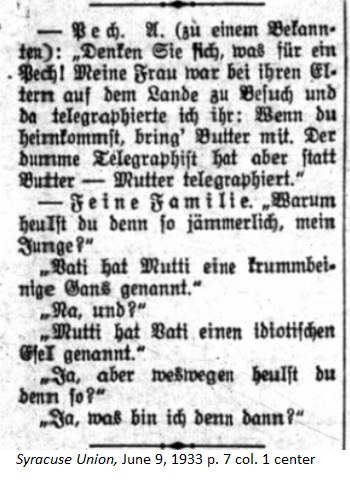
June 9, 1933 — Bad Luck A man to his friend: "Just imagine my bad luck! My wife was in the countryside visiting her parents and I telegraphed her. 'When you come home, bring butter." The dumb telegrapher misunderstood and telegraphed mother instead of butter." — A Fine Family. "Why are you crying so loudly, my boy?"
|
|
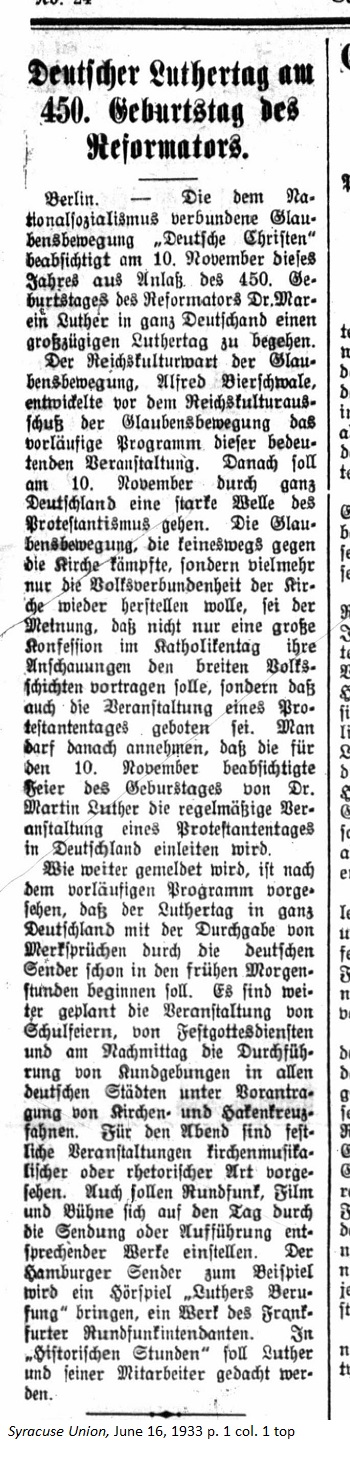
June 16, 1933 page 1 _____ Berlin. — The "Deutsche Christen" (German Christian) Faith Movement linked to National Socialism intends to hold a Luther Day throughout Germany on November 10th of this year in celebration of the 450th birthday of Dr. Martin Luther. The Reich's Culture Monitor, Alfred Bierschwale, developed the program for the Reich's Culture Committee of the Faith Movement to commemorate this significant event. Thus on November 10th a strong wave of Protestantism should occur throughout Germany. The Faith Movement, which in no way fights against the church but rather represents the people's solidarity with the church, is of the opinion that not only a Catholic Day for the profession of faith should be present as a demonstration of cultural identity but that a Protestant Day should be called into being. One may assume from this that the November 10th celebration of Dr. Martin Luther's birthday will introduce the establishment of a Protestant Day in Germany. According to the provisional program on Luther Day announcements will be transmitted by German Radio throughout Germany starting early in the morning. Other events are planned for school festivals, celebratory church services, and at noontime a rally in all German cities under church and swastika banners. In the evening festive musical or rhetorical events will occur. Radio stations, cinemas and theaters will provide appropriate works all day either by broadcast or live performance. For example, the Hamburg Radio Station will broadcast an audioplay titled "Luthers Berufung" (Luther's Vocation,) a work by the Frankfurt Radio Directory. In "Historischen Stunden" (Historic Hours) Luther and his associates are commemorated. |
|
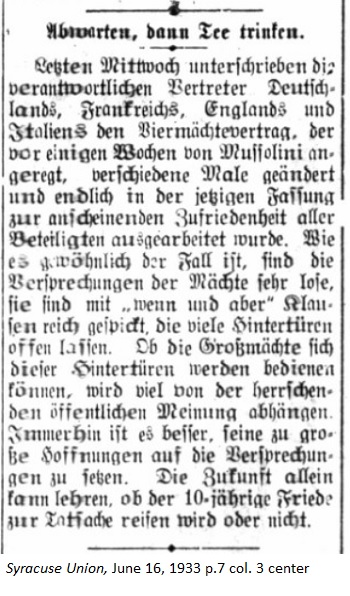
June 16, 1933 page 7 _____ Last Wednesday the designated representatives of Germany, France, England, and Italy signed the Four Power Pact, which the week before was initiated by Mussolini, changed many times, and finally worked into the current version to the apparent satisfaction of all parties. As is usually the case, the promises of world powers are loosely defined, they are rife with "if and or but" clauses which leave the back door open. Whether the greatly powers plan to use these back doors will great depend on prevailing public opinion. It's always better to place grand hopes on these promises. The future alone can teach whether the 10-year peace pact will or will not mature into fact. |
|
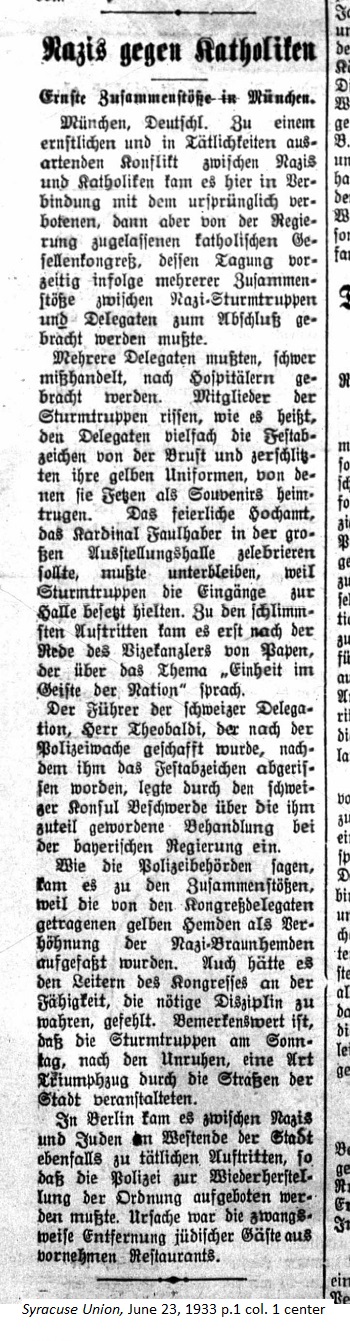
June 23, 1933 page 1 _____ Serious Clashes in Munich Munich, Germany. A serious conflict between Nazis and Catholics, which got completely out of hand. Originally the government had forbidden a meeting of the Catholic Journeymen Congress but then decided to allow it. The meeting was closed prematurely due to many clashes between Nazi Stormtroopers and conference delegates. Many delegates were severely maltreated and had to be brought to the hospital. Stormtrooper members ripped the conference badges off the chests of the delegates and tore their yellow uniforms off of them and took them home as souvenirs. The celebratory High Mass, which Cardinal Faulhaber was to perform in the exhibition hall, had to be stopped because Stormtroopers occupied the entry to the hall. The worst fighting came just after Vice-Chancellor von Papen's speech on the theme "Unity in the Spirit of the Nation." The leader of the Swiss delegation Mr. Theobaldi, who was taken off to the police precinct house after his badge was torn off of him, registered a complaint with the Swiss Consulate over the treatment he received at the hands of the Bavarian government. As the police authorities reported it, conflicts arose because the yellow shirts worn by the Congress delegates were perceived as mockery of the Nazi brown shirts. Also the Congress leaders were incapable of preserving the necessary discipline. It's remarkable that on Sunday after the unrest the Stormtroopers held a kind of victory parade through the streets of the city. In Berlin there was trouble between Nazis and Jews at the westend of the city. The police were called upon to restore order. The cause was the forcible removal of Jewish guests from upscale restaurants. |
|
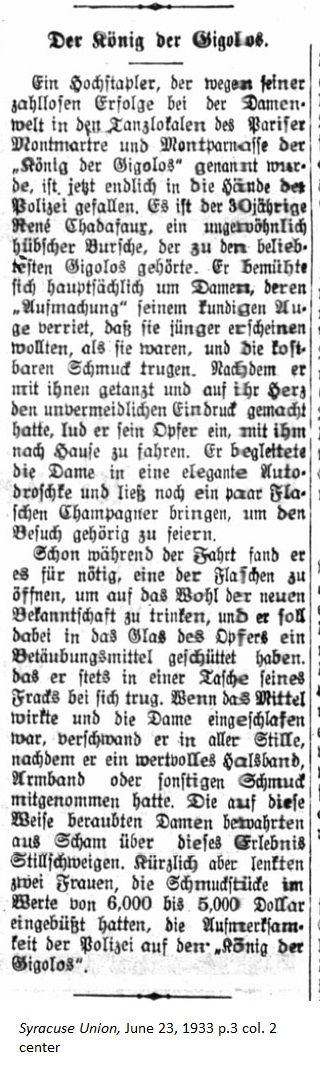
June 23, 1933 page 2 _____ A con man, who due to his countless successes with the ladies at the local dance hall of Paris' Montmartre and Montparnasse districts was called the "King of the Gigolos," is finally in the hands of the police. He is the 30-year-old René Chadafaux, an unusually good looking fellow who is the most popular in gigolo circles. His skilled eye seeks out the trappings of women who appear younger than they actually are and who wear expensive jewelry. After he dances with them and makes an inevitable impression on their hearts, he invites his victim to go to his house. He accompanies the ladies into an elegant taxi and gets a couple bottles of champagne to properly celebrate the visit. During the cab ride he finds it necessary to open one of the bottles to toast their new acqaintanceship and he allegedly drops a knockout potion, which he keeps in his dresscoat pocket, into the victim's glass. When the drug does its work and the woman is asleep he slips into the night with a valuable necklace, bracelet or other bauble. The women who are robbed in this fashion remain quiet out of shame, however recently two women, who had lost jewelry valued between 5000 and 6000 dollars, got together and alerted the police to the "King of the Gigolos." |

|
June 23, 1933 page 5 _____ Interesting Comments on Hitler and the Jews in Germany _____ Mr. and Mrs. John Müller of 165 Cook Ave., who departed on the "Bremen" on July 9, 1932, returned home last week after an almost one-year stay in the old homeland. They spent most of their time in the Palatinate, where Mr. Müller still has two blood relatives, Mrs. Anna Kleemann and Miss Anna Kleemann. Mr. Müller has some interesting things to report about current conditions in German and paid particular attention to the Hitler Movement to find out if the reports in American newspapers concerning the violence and murder of Jewish people by Hitler's people are based on facts. Mr. Müller neither saw nor heard anything in the slightest which could confirm these slanderous reports. He told us that in Germany absolute peace and order prevail. Everything is as clean and peaceful as before the War. Hitler was absolutely against Jewish persecution and would punish anyone who mistreats the Jews. Christians and Jews coexisted on friendly terms and were unable to understand how such lies could be printed by the American Press. All of Germany is enthusiastically for Hitler, whom it sees as the savior of Germany. Hitler has done more in four days than Bismarck would have been able to do in his lifetime. Now there is one, united German Reich which others tried in vain to achieve for centuries. The 31 parties have melted down into four and today there's practically nothing seen or heard of Communism. All political assemblies run in an orderly manner, such as the May 1st Festival, which in past years became a bloodbath. This year for the first time beautiful peace prevailed and had more of a family festival atmosphere. This was also the case during Hitler's visit to Pirmasens in the Palatinate near the Lorraine border, where last autumn before the vote Hitler gave a speech. 40,000 people attended, who cheered Hitler as their liberator and there were no disruptions. Mr. and Mrs. Müller themselves attended that assembly and had the opportunity to meet Hitler at the hotel. Pirmasens is one of the industrial cities with around 45,000 residents. In September 1793 the Duke of Braunschweig won the victory for Prussia over the French. Georg Dietrich, Mrs. Müller's brother lives in this city, where a large shoe industry operates. He is a leading shoe manufacturer with whom they had a pleasant visit. Concerning the Jewish question Mr. Müller said the following: "Since I read in the American newspapers, which I often bought in the larger German cities, about the dreadful treatment and conditions of the Jews, I kept my eyes and ears open but couldn't find anything. I stayed in many of the first-class hotels, where I found Jews among the guests who were treated the same as other guests. Then I thought about our own great American hotels, especially our famous and grand summer hotels in Lake Placid, Saranac, Saratoga, Newport, as well as Atlantic City, where Jews and people with Jewish names are not allowed. "I believed I would witness dreadful things in Frankfurt a.M. One tenth of all Jews in Germany live in Frankfurt — more than 50,000. It's the city of the Rothchilds, the Speyers, and the Oppenheims. I still found Jews in leading positions among businessmen, bankers, newspaper people, and industrialists. The relationship between Jews and the non-Jewish element seemed excellent. Their stores were doing good business and they were full of customers among whom, as far as I could see, there were no Jews. They even sold brown shirts. Occasionally I met German friends, who were on friendly terms with Hitler people and when I asked about the Jews in Germany I received the usual response that they were in possession of political and economic power disproportionate to their number. The Jews were great friends of the Republic as it was created after the War. For the first time they were liberated from all restrictions. This is what gave them their political influence; like us in America, Jews are excellent politicians — and the German Jew is in this way no different than the American Jews. — In Worms there is a small synagogue, which has been used daily for 8 to 9 centuries, and the Jews have never been bothered there. "Having stayed in Germany for more than 10 months, seen much, and traveled around, I can say that the politics regarding the Jewish question centers on this — should one or two percent of the population rule? The monarch fell because Germany was overpowered in the field, and the Republic fell because it was outsmarted by a minority. The German nobility, while seeing Hitler as a small, Austrian painter and paperhanger, uneducated and unable to speak proper German, still saw in him a dynamic force, a man with an intellect, who reflected the communal spirit of Germany and who could return Germany to its rightful place among the leading nations of the world. And this is the reason why the nobility, from the Hohenzollern down to the lowliest land owner, at least 75 percent of the nation, stand behind Hitler today." Hitler may be the man of the hour, establishing order in every nook and cranny. All official positions have been made honorary; young people aged 18 to 25 will be groomed for the workplace and especially in service to the country. They'll be provided with free meals by their bosses and receive a salary from the government. It's Hitler who's doing all this. Within four years all people will be employed and have an honest income. Everyone looks to Hitler as a savior. Order and optimism prevail as it does in our land. As for the rest, let us refer to a statement of Karl A. Kitchen* concerning the situation in Germany, which we publish in another section and which agrees totally with what Mr. Müller said. Mr. and Mrs. Müller spent four months in the country where Mr. Müller gladly participated in agricultural work. His face is tanned and he was so sad to leave the place of his childhood again that departture was downright difficult. It also offered the opportunity to meet with Mr. Philip Klinck (also from the Palatinate,) who was also known to be traveling in Germany and who will return here shortly. * See Next Article |
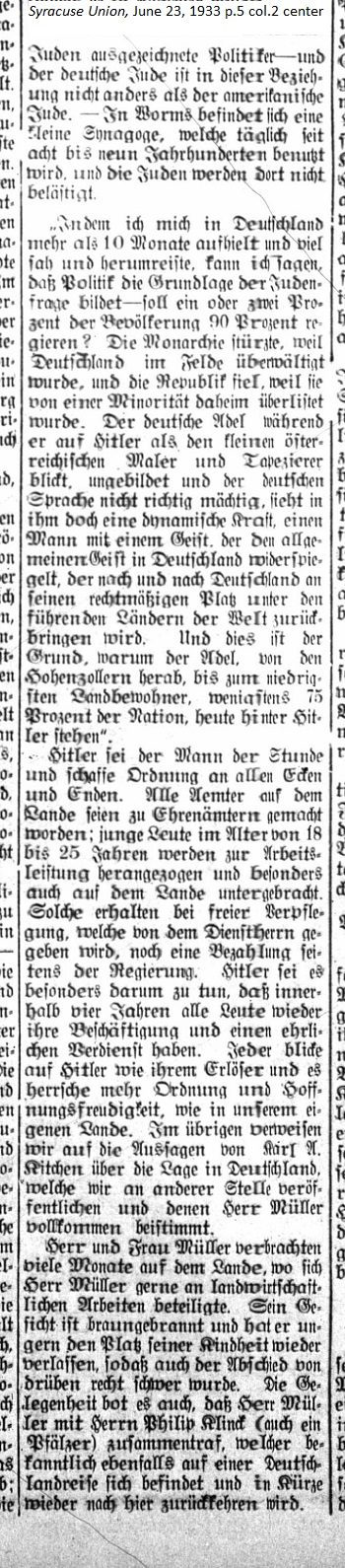
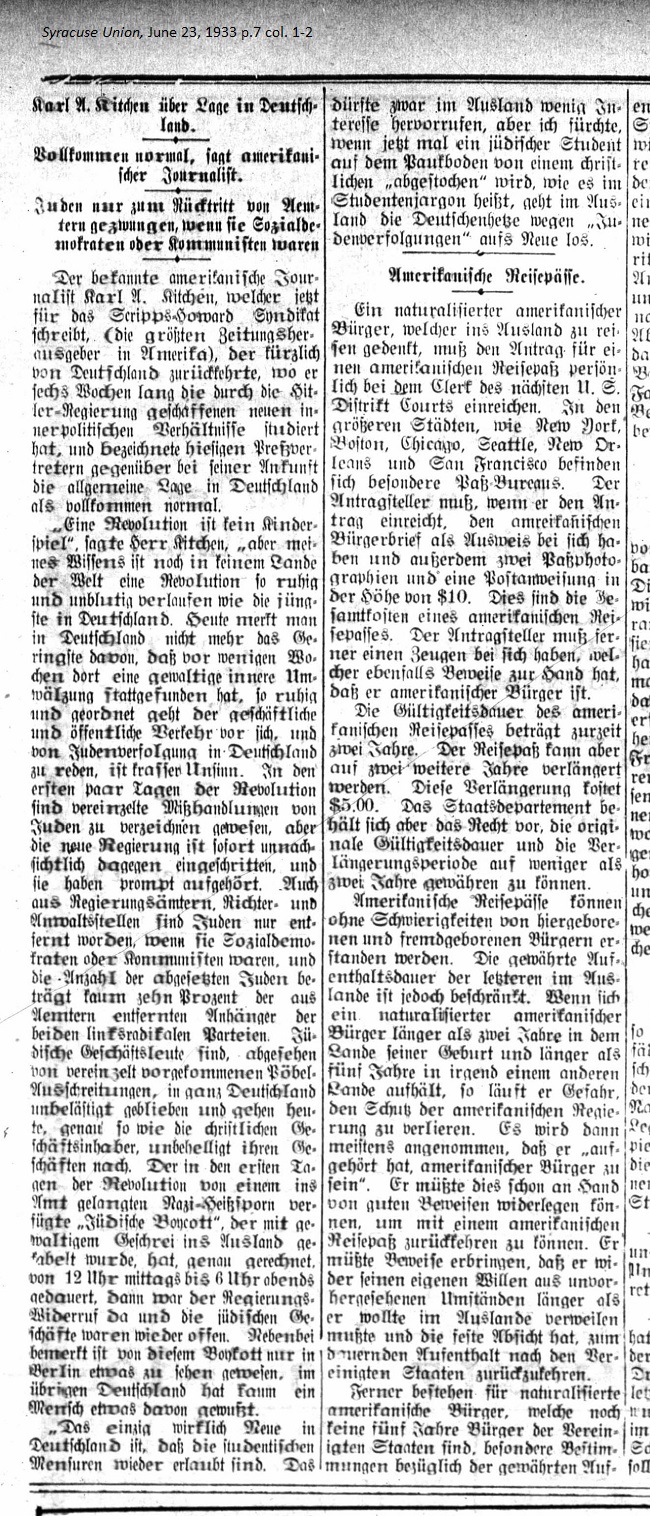
|
June 23, 1933 page 7 _____ Completely Normal, the American Journalist states _____ Jews only forced to retire from Official Office if They were Social Democrats or Communists The well-known American journalist, Karl A. Kitchen, who currently works for the Scripps-Howard Syndicate (the largest newspaper puibisher in America,) recently returned from Germany where for six weeks he studied internal political conditions created by the Hitler government. Contrary to other press representatives stationed there, he indicated that the overall situation in Germany is completely normal. "A revolution is no children's game," Mr. Kitchen stated, "but to my knowledge in no other nation in the world has a revolution been conducted so peacefully as recently in Germany. In Germany today one sees nothing in the slightest over the last few weeks indicating forced upheaval. Business and public concourse goes peacefully and orderly and any talk about Jewish persecution is blatant nonsense. In the first few days of the revolution there were signs of individual incidents of maltreatment, but the new government immediately took steps to counter them and the incidents ceased. And Jews were only fired from government positions, judgeships and attorney posts if they were Social Democrats or Communists, and the number of dismissed Jews scarcely amounted to 10 percent of posts vacated by members of those two political parties. Jewish business people, except for individual outbreaks of rioting, have remained unharmed throughout Germany and go about unmolested to their businesses just as Christian business owners. The 'Jewish Boycott' called for during the first days of the revolution by some Nazi hotheads who got into office, the reports of which were cabled abroad with a powerful cry had, by my reckoning,lasted from 12 noon to 6 PM then was countermanded by the government and Jewish businesses were able to reopen. Furthermore only in Berlin was there anything to see of this boycott. In the rest of Germany no one scarcely knew about it. "The only real news in Germany is that academic fencing matches are allowed to take place again. That might elicit very litle interest abroad but I feared that if sometime a Jewish student was 'poked,' as student jargon puts it, while duelling with a Christian, then abroad there would be an outbreak of German witch hunting due to 'Jewish persecution.'" American Passports _____ A naturalized American citizen, who's considering travel abroad, must apply personally for an American passport with the Clerk of the nearest U.S. District Court. In large cities such as New York, Boston, Chicago, Seattle, New Orleans and San Francisco you'll find designated passport offices. The applicant must have his American citizenship papers with him plus two passport photos and a money order for $10, the total cost for an American passport. Furthermore the applicant must bring a witness with him who has proof that he is an American citizen. An American passport is valid for two years, however it can be renewed for another two years. The State Department maintains the right to shorten the original two-year time period for which the passport is valid. American passports can be acquired without difficulty by any native-born or foreign-born citizen, although the length of stay abroad for the latter may be shortened. If a naturalized American citizen wishes to stay in the land of his birth longer than two years or in any other country for more than five years, he runs the risk of losing the protection of the American government. Most times it will be assumed that he's given up his American citizenship. He must keep these papers on hand as proof of citizenship if he then wishes to return to America with an American passport. He must bring proof that he was unwillingly detained longer due to unforeseen circumstances and had to remain abroad. He must demonstrate firmly his resolve to resume extended stay back in the United States. Furthermore there are special conditions with regard to length of stay abroad for naturalized American citizens who have been citizens for less than five years. They may travel abroad as often as they wish, however within the first five years of their citizenship if they accept employment abroad or permanently settle there, it will be assumed they acquired American citizenship under false pretenses and that they did not intend at the time they acquired citizenship to make America their permanent residence. Under such circumstances citizenship papers can be revoked, in the event that the guilty party cannot produce valid counterevidence. |
|
June 30, 1933 page 2 _____ The President of the Senate of the Danzig Free State, Dr. Ziehm, recently gave a speech on the radio to the German people in which he commemorated Danzig's glorious past and then elaborated on the current condition of the city, which has maintained its German spirit despite the difficulty of the times. Against the repeated and often expressed opinion of the German people from the German nation, which make up to 96 percent of the population, the Versailles Treaty declared us a "Free State." All the protests by Danzig residents agsinst this act of violence remained useless. To compensate for the abominable sacrifice placed upon Danzig, they promised the newly-formed Free State great economic growth. But already in the development stage it appeared that the path, down which Danzig had gone, was stony and full of hardship. Today one observes that of all the promises, which by a decree made Danzig a "Free State," not one has been fulfilled. The economic growth failed to materialize. The economic condition of the Danzig Free State is more difficult than it has ever been in its long history. If development continues in its current state, the time is not far off when Danzig's harbor commerce will play an insignificant role when compared to Gdingen's. In continual battles, Dr. Ziehm concluded, Danzig has had to defend its German population and its civic autonomy against foreign encroachment and breach of treaty and yet Danzig's German population remains united in this fight. To its rejoicing Danzig can affirm that the more heavy its loses, the stronger and more fervent are the sympathies and participation which Danzig experiences from its brothers in the Reich. Danzig is firmly resolved to preserve its German identity no matter the cost. |
|
June 30, 1933 page 3 _____ Many French beggars will breathe a sigh of relief when they learn that in a tiny village in Drome Department 86 year-old Louis Paulian has died. This man, who lived in retirement for many years, knew more about the art and trickery of begging than any other person alive. He made it his mission to unmask swindlers who preyed upon the good nature of his fellow man. Disguised as a beggar, he studied the organizations of this craft and mercilessly worked against their deceptive business operations.In Belleville he discovered a beggar high school managed by a former actor. Students received instruction on disguising oneself as a cripple; how to cough, whine and moan in order to melt the hardest heart and open up the most tightly clenched hand. For a long time Paulian was the most feared man in the entire beggars' world in France. |
|
June 30, 1933 page 4 _____ The decree issued by the Polish District School inspectors to teach subjects such as history and geography in the Polish language in schools which teach in German is a worthy component of the Polish master plan to thoroughly annihilate German school systems and a breach in the treaty section on protecting minorities. The next result of the decree will be a replacement of part of the teaching staff. Is that Polish "protection of minorities?" And even in purely religious realms, in Poland the gendarms rule, as proven in the trial of two German members of the minority; teacher Kopp and deacon candidate Reinberger were sentence to fourteen days detention for "overstepping one's occupational duties." What had they done? Instructed German children not yet able to read the Bible or a cathechism in German about the evanglical religion and children's church services. Certainly the accused had to be set free because even the Polish Court could not determine if such instruction transgressed beyond the limits of their professional duties. However, the course of the trial and the manner in which the police took their statements convincingly exposed the entire hardship which the German minority suffer in Poland while exercising their constitutional rights. What a contrast to Germany, where the Polish minority schools in Germany are completely free to have native Polish teachers give instruction without limitations. Germany recognizes the rights of its populations; Poland brutally violates them. |
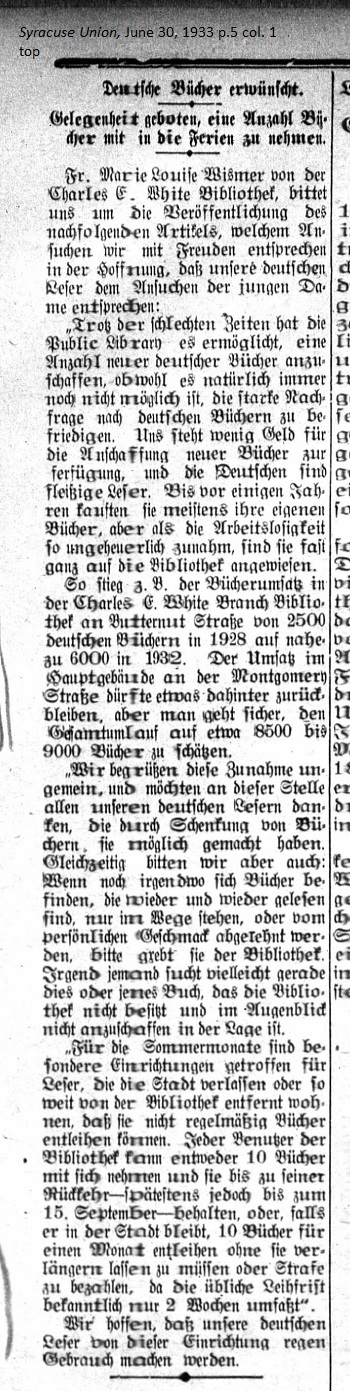
|
June 30, 1933 page 5 _____ Opportunity offered: a Number of Books available to take on Vacation _____ Miss Marie Louise Wismer of the Charles E. White Library asks us to publish the following article, a request to which we concede with pleasure in the hopes that our German readers will also grant her request: "Despite these difficult times the Public Library has been able to acquire a number of new German books, although it's still not possible to fully satisfy the strong demand. There's little money for purchasing newer books for circulation and Germans are avid readers. For the past few years most of they have been buying their own books, but as unemployment figures reach an incredible number, they're relying almost completely on the library. "Thus for example, book circulations have risen at the Charles E. White Branch Library from 2500 German books in 1928 to nearly 6000 in 1932. At the Main Library on Montgomery St. circulation may have lagged slightly behind but it's certain that total circulation is estimated between 8500 and 9000 books. "We welcome this tremendous increase and we want to thank our German readers who have donated books. At the same time we ask if you find any books which have been read over and over again, which are just taking up room, or which are not to your personal taste, please give them to the Library. Perhaps people are looking for this or that book which the Library is not in a position to purchase. For the summer months special accomodations have been made for readers who are leaving the city or live so far from the Library that they can't regularly borrow books. Any library user can either take 10 books with them and keep them until their return to the city; or in case they're staying in the city they can borrow ten books for a month without having to renew them or pay a fine since the usual loan period is only 2 weeks." We hope that our German readers will make active use of this accomodation. |