October - December 1934
|
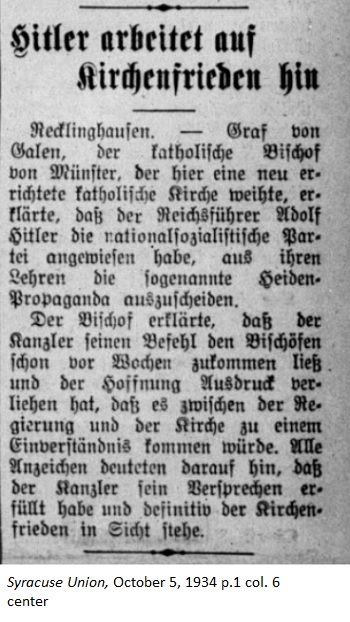
October 5, 1934 page 1 _____ Recklinghausen. — Count von Galen, the Catholic Bishop of Munster who was here dedicating a newly constructed Catholic Church, stated that Reichsführer Adolf Hitler may have instructed the National Socialist Party to eliminate the so-called pagan propaganda from its teachings. The Bishop said that the Chancellor sent his order to the bishops weeks ago and expressed the hope that an understanding could be reached between the government and the Church. All signs indicate that the Chancellor had fulfilled his promise and definitely aimed at peaceful co-existence with the Church. |
|
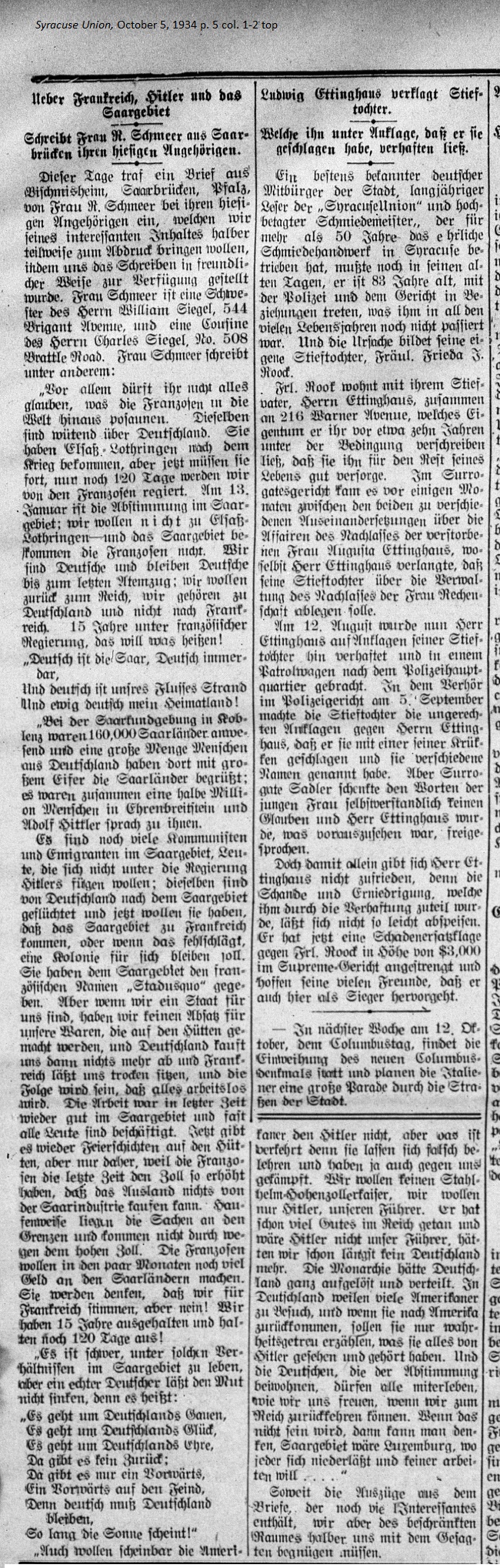
October 5, 1934 page 5 _____ Mrs. R. Schmeer of Saarbrücken writes to her relatives here _____ In the last few days a letter arrived for her relatives here from Bischmisheim, Saarbrücken, Palatinate, written by Mrs. R. Schmeer, which we found very interesting and wanted to publish a portion of it. It was graciously placed at our disposal. Mrs. Schmeer is the sister of Mr. William Siegel of 544 Brigant Avenue and a cousin of Mr. Charles Siegel of 4508 Brattle Road. Among other things, Mrs. Schmeer wrote: "Above all else don't believe everything which the French toot their own horn about worldwide. They're furious with Germany. They got Alsace-Lorraine back after the war but now they contend we will still be governed by the French for another 120 days. The referendum vote is scheduled for January 13th in the Saar Region. We don't want to go be like Alsace-Lorraine — and the French will not get the Saar Region. We are German and shall remain German to our dying breath. We want to go back to the Reich, we belong to Germany and not to France. 15 years under French rule, now that's saying something! "German is the Saar, German forever more,
"At the Saar rally in Coblenz there were 160,000 Saarlanders present and a great crowd of people from Germany fervently greeted the Saarlanders. There were half a million people in Ehrenbreiten and Adolf Hitler spoke to them. "There are still many Communists and immigrants in the Saar Region, people who do not want to submit to Hitler's government. They fled from Germany to the Saar Region and now want the Saar Region to come to France, or if that fails they want it to remain a colony. They've given the Saar Region the French name 'Status Quo.' But if we form our own state, we'll have no market for our industry goods. Germany won't buy from us anymore and France will leave us out to dry. As a result, we'll all be unemployed. In the last year employment was good in the Saar Region and almost everyone was busy. Now we have shift cancellations again in the factories because the French raised the tariffs so much lately that foreign countries can't afford to buy from us. Stockpiles collect at the borders and yield nothing due to the tariffs. In the next couple months the French still want to make a lot of money from the Saarlanders. You will think that we'll vote for France, but no! We've held out for 15 years and we'll hold out for the last 120 days! "It's hard to live under such conditions in the Saar Region, but a true German does not lose courage, like they say: "It's about Germany's districts,
"Apparently the Americans don't want Hitler, but that's preposterous since they've been misinformed and because they fought against us. We don't want a steel-helmeted Hohenzollern Kaiser; we just want Hitler, our leader. He's done much good in the Reich and if Hitler weren't our leader, it wouldn't be long before we'd have no Germany. The monarch completely dissolved and scattered. Many Americans visit Germany and when they return to America they should just tell the truth about what they've seen and heard about Hitler. And the Germans, who are present during the election, might witness how we would rejoice if we could return to the Reich. If that can't happen, then one might think the Saar Region is like Luxembourg, where everyone settled down and didn't want to work..." The letter contains many more interesting details but due to limited space, we'll have to be satisfied on what was presented above. Ludwig Ettinghaus Sues His Stepdaughter _____ Who Had Him Arrested for Hitting Her _____ One of the best-known German citizens of the city, a longtime reader of the Syracuse Union and a master blacksmith of advanced years, who practiced his honorable blacksmith trade in Syracuse for 50 years, now has to contend with the police and the court at the age of 83 years in an affair which never happened before in his lifetime. The case centers around his stepdaughter, Miss Frieda J. Rook. Miss Rook lives with her stepfather, Mr. Ettinghaus, at 216 Warner Ave. Ten years ago he signed the property over to her based on the condition that she would care for him for the rest of his life. A few months ago the pair confronted each other in Surrogate Court over the estate of the deceased Mrs. Augusta Ettinghaus. Mr. Ettinghaus demanded his stepdaughter to give an account of the administration of his late wife's estate. Now on August 12th Mr. Ettinghaus' stepdaughter had him arrested and taken in a patrol wagon to Police Headquarters. In the hearing at the Police Court on September 5th the stepdaughter made unjustified accusations against Mr. Ettinhaus that he hit her with his crutches and called her various names. However Surrogate Sadler understandably placed no credence in the young woman's words, and as expected, Mr. Ettinhaus was set free. But that alone did not satisfy Mr. Ettinghaus for the shame and disgrace dealt him by the arrest. This wasn't easy to excuse. He's now suing for damages in the amount of $3,000 from Miss Rook and expressed the hope that his many friends will also see him come out here as the victor. — Next week on October 12th, Columbus Day, the dedication of the new Columbus monument will take place and the Italians are plannning a huge parade through the streets of the city. |

|
October 12, 1934 page 3 _____ A hundred years ago the first German emigrants pushed their way into Dobrudscha [now located in southeastern Rumania and northeastern Bulgaria.] They didn't come directly from Germany but rather after a wide detour through Russia. Attracted by Catherine the Great's colonization policy, they left their homeland and endured many disappointments during their travels to the point where they kept on searching for a new country. They came almost by accident to Dobrudscha, where they established their settlements and now almost a hundred years later still preserve their cultural identity while leading a harsh farmers' existence filled with privation. As Sophie Ehrhardt described in the periodical Volk und Rasse (People and Race), one can distinguish three great immigration periods of the Dobrudscha-Germans:
These three migrations occurred correspondingly in northern Dobruska, then in the central region, and lastly in the southern portion of the country. A valuable early description of Dobrudscha came from Helmuth von Moltke in the year 1841. According to his data the country scarcely had 20,000 residents. "As far as the eye can see, one saw neither trees nor shrubs, — for hours you rode over uniform wasteland before you discovered a wretched village without trees or gardens in a waterless valley — water was pulled up out of ground wells using hemp rope — wolf-like dogs streaked wildly across the field." War and pestulence devastated the countryside shortly before this description; even today the central and southern portions of Dobrudscha are barren steppeland; the northern section however is mountainous, thickly forested and fruitful. In any event the German settlers had a rough time clearing the land before they could look forward to the fruits of their labor. With the exception of a few pastors, teachers, doctors, engineers and merchants, most to the 10,000 to 20,000 Germans in Dobrudscha are small farmer living together in German villages or portions of villages. Rumanians, Bulgarians, Turks, Tatars, Gypsies, Russians and other ethnic groups share those neighborhoods, but from far off one can recognize the German villages by their straight-lined village streets. They borrowed the style of house construction from the Russians in the steppelands of southern Russia. Many of the Germans in Dobrudscha no longer know from which regions in Germany their ancestors came, and they identify their origins as Kashubian from the lowlands of northern German and Swabian from southern Germany. They take a lively interest in the events of their old homeland and enthusiastically read the newspapers sent to them. Their cultural and intellectual conditioning is purely agrarian. They are physically strong and healthy German farmers who have families filled with many children to the point that the German population in the last seven years has grown from 8000 to around 12,000. One of the first immigrants to settle in Dobrudscha, whom they call "Father Kühn," once said,"If a German roams for too long, he never finds lasting peace." If from now on the Germans in Dobrudscha remain settled on their own piece of land, they will maintain close ties with their motherland. "The sense of loyalty among all expatriot Germans is particularly strong in the face of conflict and opposition in foreign surroundings. People who grow up among foreign populations, whose mother tongue is not their own, whose culture is dissimilar to theirs, must endure many hardships. Thus they learn early to distinguish their own unique character from that of other cultural groups and to maintain that uniqueness. The father opposes the union. "Why, Father?" The father says, "A man must seriously consider marrying. A man marries for the rest of his life. I should know. I've been married five times." |
|
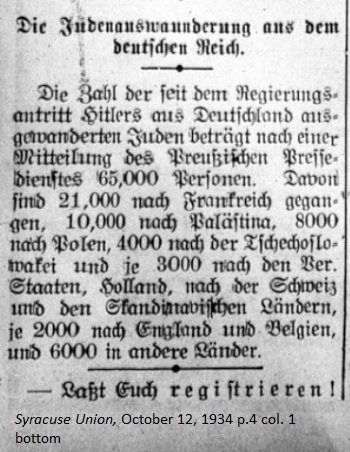
October 12, 1934 page 4 _____ The number of Jewish emigrants leaving Germany since Hitler's rise in the government amounts to 65,000 people according to a report of the Prussian Press Service. Of these 21,000 have gone to France, 10,000 to Palastine, 8000 to Poland, 4000 to Czechoslovakia, around 3,000 to the United States, Holland, Switzerland and the Scandanavian countries, around 2,000 to England and Belgium, and 6,000 to other countries. |
|
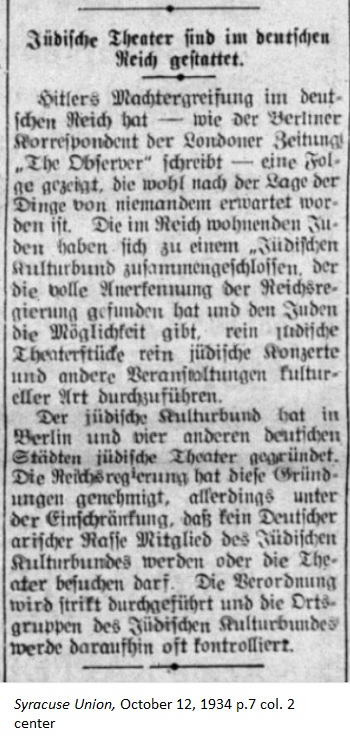
October 12, 1934 page 7 _____ Hitler's seizure of power in the German Reich — so the Berlin correspondent of the London newspaper The Observer writes — produced an outcome which, given the nature of things, no one could have expected. Jews living in the Reich have merged into a "Jewish Cultural Alliance" which has found full approval from the Reich government and which gives Jews the possibility to perform purely Jewish theatrical works, purely Jewish concerts, and other cultural events. The Jewish Cultural Alliance has established Jewish theaters in Berlin and four other German cities. The Reich government has sanctioned these establishments under the condition that no German of the aryan race become a member of the Jewish Cultural Alliance or attend its theaters. The regulation will be strictly enforced and the chapters of the Jewish Cultural Alliance will often be monitored. |
|
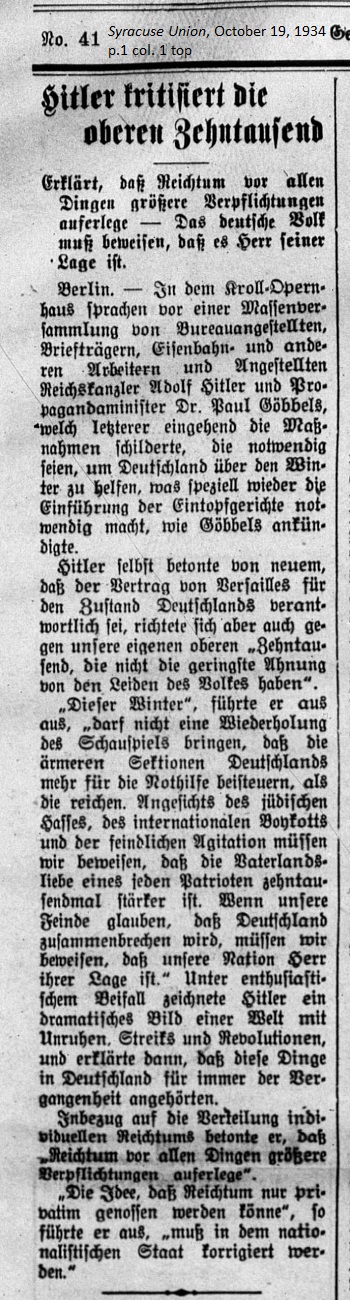
October 19, 1934 page 1 ______ States That Above All Else the Weathy Have Greater Obligations Berlin. — In the Kroll Opera House Reich Chancellor Adolf Hitler and Propaganda Minster Dr. Paul Goebbels spoke before a mass assembly of office clerks, letter carriers, railroad and other laborers and employees. Dr. Goebbels described in detail the measures needed to help Germany get through the upcoming winter with special emphasis on the reintroduction of the one-pot meal.* Hitler himself reemphasized that the Versailles Treaty was responsible for Germany's current conditions, however he also directed a comment against our own upper "Ten Thousand, who haven't the slightest clue about the suffering of the people." "This winter," he continued, "shall not bring about a repeat of the drama that the poorer sections of Germany are taxed more for the emergency relief than the rich. In the face of Jewish hatred, international boycotts and foreign agitation we must prove that each patriot's love of fatherland is ten thousand times stronger. If our enemies believe that Germany will fall apart, we must prove that our nation is the master of the affairs of its state." Amid enthusiastic applause Hitler painted a dramatic picture of a world with discord, strikes, and revolutions, then he stated that these things belonged forever in Germany's past. Regarding the distribution of individual wealth, he emphasized that "Above all else the wealthy have greater obligations" "The idea that wealth could only be enjoyed privately," he continued, "must be corrected in the National Socialist State." _____ [*Translator's Note: There's an interesting article on the one-pot meal and it's emphasis on uniting the German people during the Hitler era titled The Forgotten Nazi History of "One Pot Meals"] |
|
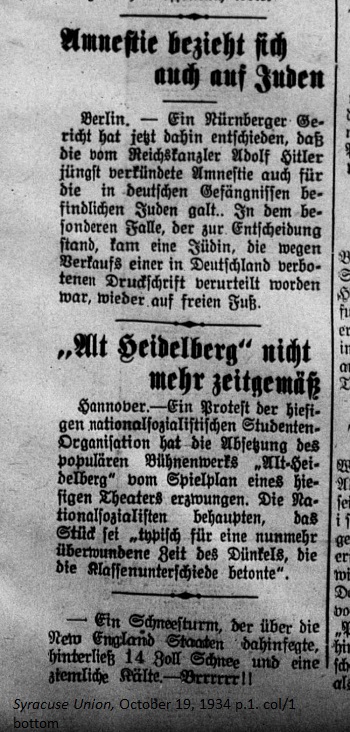
October 19, 1934 page 1 bottom _____ Berlin. — A Nuremberg Court has decided that the amnesty for German prisoners, which was recently announced by Reich Chancellor Adolf Hitler, applies to Jews as well. In a particular case under deliberation, a Jewish woman, who was sentenced in Germany for selling a banned brochure, was set free. "Old Heidelberg" No Longer Relevant Hannover. — A protest by a local National Socialist student organization has forced the removal of the popular theatrical piece "Alt-Heidelberg" from its schedule at a local theater. The National Socialists maintain the work is "typical for a no longer relevant time of darkness, which stressed social class differences." |

|
October 19, 1934 page 1 _____ John Labatt Would Gladly Pay Promised Ransom if the Government Wouldn't Hinder Him — Despite All His Riches His Life is filled with Sorrow and Anxiety Around midnight on August 17th John Labatt entered the lobby of a hotel in Toronto. He stands on the brink of physical and mental collapse. He was held for three days by three kidnappers in a hut. He had to hear how they planned his death if the demand for ransom was not successful. They set him free after a portion of the ransom was paid and he had promised to pay the remainder of $150,000. In the event that he did not keep his word, they threatened him with the kidnapping and murder of his children. Since that time Labatt can't shake his fear and anxiety. He's had to separate from his family, which currently resides in a unknown and fortified area so they're safe from the kidnappers. Labatt doesn't take a step without being accompanied by one or more detectives. Labatt is prepared to pay the rest of the ransom. In fact a mediator has the money in his pocket and just waits for the moment to turn it over to the kidnappers. However the police make the payout impossible. They're watching his every step. Fear and anxiety weigh so heavily on Labatt's life and health that since his kidnapping in the summer he seems to have aged many years older. Labatt's wife is heartbroken and friends of the family say that the constant fear can't be endured for much longer. The constant surveillance and the security measures are costing Labatt a gigantic sum of money to the point that the ransom itself will amount to little in comparison. Since his release Labatt has received seven threatening letters. The writing resembles the writing on the first ransom note. In Detroit a man named David Misener, a Canadian by birth, has been arrested on suspicion. His extradition is in the works. The suspect denies any guilt and supposedly has an alibi. Moscow Press Against Roosevelt's Policies _____ Moscow. — Charges that the America Labor Federation and the Government of the United States "are attempting to build a dam against the threatening avalanche of the labor movement" were found in the Soviet Newspaper for Industrialization, an organ of the Commissariat for Heavy Industry. The newspaper describes William Green as a traitor to the labor movement because he promised President Roosevelt he would make every effort to support him in ending strikes. The assertion, referring back to the dockworker and textile strikes, show that the "iron codex of class struggle is stronger than the paper codex." The article also adds that the labor movermentwould not be hampered by a "brokered arbitration court." Duty and Conflict the Only Watchwords _____ Rome. — For the 250 thousand young people between the ages of 18 and 21, who have assembled in the large cities of Italy for mobilization, this motto has become the guiding star: "Fascism promises you neither honor, nor status, nor fortune — only duty and conflict." |
|
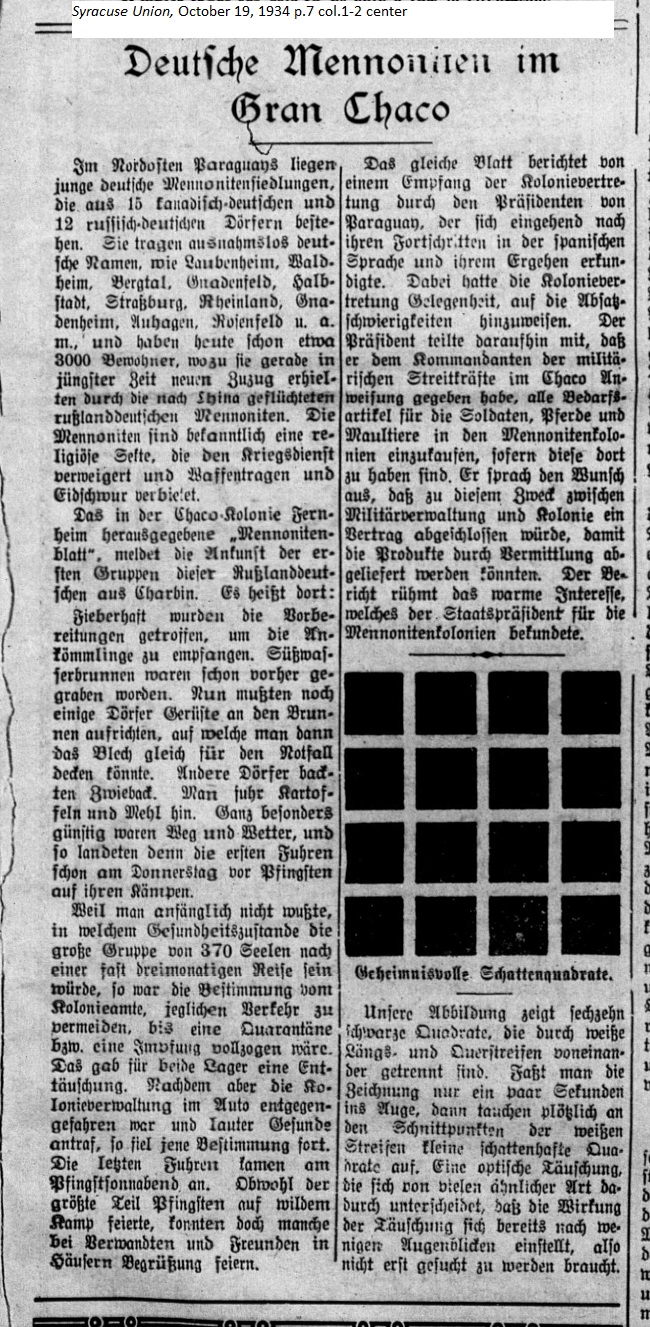
October 19, 1934 page 7 _____ In northeastern Paraguay lies the young German Mennonite settlement, which consists of 15 Canadian-German and 12 Russian-German villages. Without exception they bear German names such as Laubenheim, Waldheim, Bergtal, Gnadenfeld, Halbstadt, Strassburg, Rheinland, Gnadenheim, Auhagen, Rosenfeld, et.al. and today have 3000 residents, to which in recent days new influxes of Russian-German Mennonites fleeing by way of China have been added. The Mennonites are known as a religious sect, which refuses military service and forbids the carrying of weapons or oath taking. The Mennonite News published in the Chaco Colony of Fernheim reports the arrival of the first group of Russian-Germans from Chabin as follows: Feverish were the preparations to receive the new arrivals. Sweet water wells were excavated beforehand. Now a few villagers must construct framework for the wells, which will be covered with sheet metal for emergency usage. Another villager baked zwieback. Others brought in potatoes and flour. The road and the weather were especially favorable and the first imports landed arrived at the camps on the Thursday before Pentecost. Because no one knew at first what the health situation would be for this large group of 370 souls after an almost three month journey, the colony officials decided to avoid any contact until a quarantine period or vaccination regimen was completed. Both camps experienced disappointment because of this. However once the colonial authorities drove through in an automobile and witnessed nothing but good health, the decision was rescinded. The last arrivals came on Pentacost Saturday evening. Although the larger portion of people celebrated Pentecost in the wildernis of the camps, some celebrated with relatives and friends in their homes. The same newspaper reports about the reception of the colonial delegation by the President of Paraguay, who inquired extensively in the Spanish language about their progress and experiences. The colonial delegation had the opportunity of talking about their marketing difficulties. In regard to this the President said that he had given instructions to the commandant of military strikeforces on Chaco to purchase all articles needed for the soldiers, horses and mule in the Mennonite colony, provided the goods could be found there. He expressed the wish that to this end a contract should be drawn up between the military authorities and the colony so that the products could be delivered via middlemen. The report praised the warm interest which the National President showed the Mennonite colony. Mysterious Shadow Squares _____ Our image shows sixteen black squares divided horizontally and vertically by white lines. If one just looks at the image for a couple seconds then shifts suddenly to the intersections of the white lines, little shadowy squares appear. This is an optical illusion which distinguishes itself from many others in that after a few moments the illusion adjusts itself without needing to do anything. | >
|
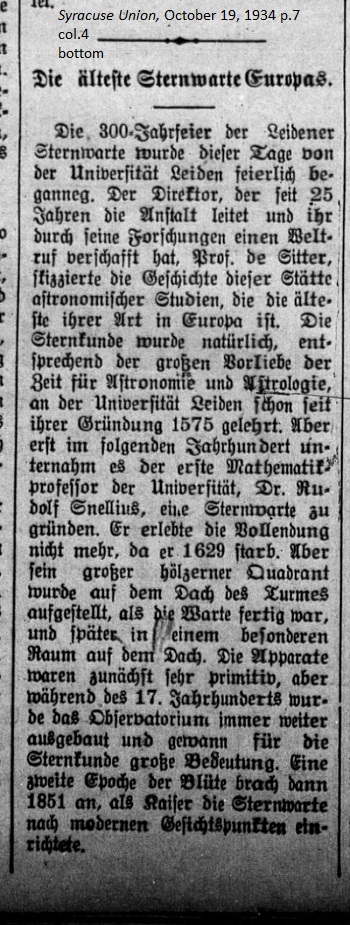
October 19, 1934 page 7 _____ The University of Leiden began the celebration of the three hundredth anniversary of the Leiden Astronomical Observatory a few days ago. The Director, who has managed the facility for the past 25 years and who has bestowed on it a worldwide reputation because of his research, is Prof. de Sitter. He has outlined the history of this observatory's studies in astronomy, which are the oldest of their kind in Europe. Due to the great preference for astronomy and astrology, astronomy has been taught at the University of Leiden since its founding in 1575. However it wasn't until the following century that the first mathematics professor at the University, Dr. Rudolf Snellius, established an observatory. He didn't experience its completion because he died in 1629. His large, wooden quadrant was erected in the attic of the turret when the observatory was completed and later in a specific space on the roof. The instruments were initially very primitive but during the 17th century the observatory was constantly enlarged, increasing the significance of astronomy. There was a second era of growth in 1851 when the Kaiser adapted the observatory according to modern standards. |
|
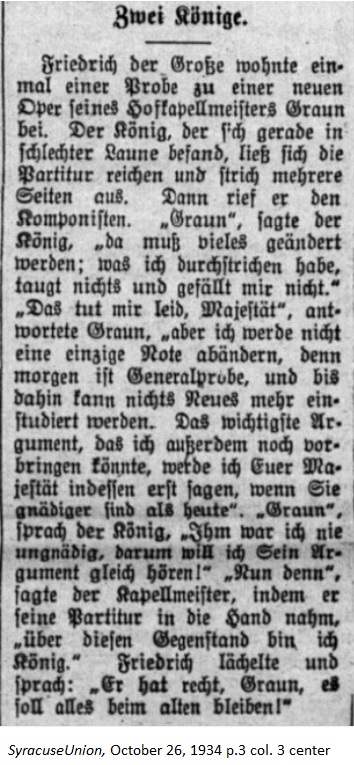
October 26, 1934 page 3 _____ Frederick the Great once attended a rehearsal of a new work by his court musical director named Graun. The King, who was in a bad mood, reached for the musical score and crossed out several pages. Then he yelled at the composer. "Graun," the King said, "much has to be changed; what I crossed out is worthless and it doesn't please me." "I'm sorry, Majesty," Graun replied. "but I will not alter a single note. The final rehearsal is tomorrow and until then nothing new can be studied. Besides which the most important argument I can raise I will explain tomorrow when you're in a more gracious state than today." "Graun," the King said, "I was never ungracious towards him*, so I will hear his argument now." "Very well," the conductor said while taking his score in his hands, "Over this subject I am king." Frederick smiled and said, "He is right, Graun, and it shall always remain that way!" _____ *[Translator's Note: To emphasize the social distance between German royalty and their lesser subjects, the subjects were addressed in the third person - he or him, she or her for you; his or her for your. See the AI Overview article for more details of Historical forms of address in German.] |
|
October 26, 1934 page 4
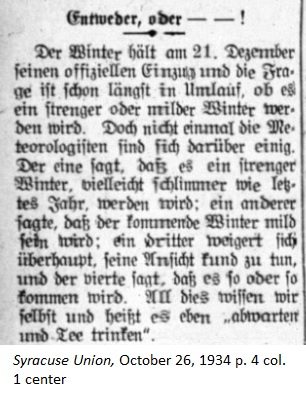
_____ Winter officially starts December 21st and the question has been circulating for a long time about whether it will be a harsh winter or a mild one. Not once have meteorologist been in agreement. One says, it will be a harsh winder, perhaps worse than last year's; another says the coming winter will be mild; a third basically refuses to give his opinion, and a fourth says it could be this way or that. We know this much ourselves — "Have a cup of tea, wait, and see." |
|
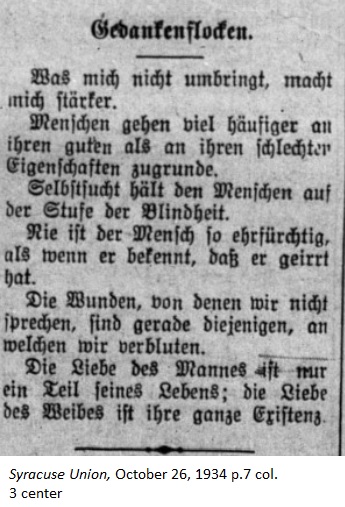
October 26, 1934 page 7 _____ What doesn't kill me, makes me stronger. Men die more often due to their good qualities than their bad qualities. Egotism holds people on the brink of blindness. Never is a man more dignified than when he acknowledges he made a mistake. The wounds about which we do not speak are the ones on which we bleed. A man's love is only a portion of his life; a woman's love is her entire existence. |

|
November 9, 1934 page 1 _____ Uses Sharp Words Towards the President of the American University It's known that Haufstängl endowed $1000 to enable a student from Germany to stay at Harvard University for one year for study purposes. Harvard rejected the endowment for the following reason: "Harvard is not prepared to accept a gift from a man who is so closely associated with the leadership of a political party, which has inflicted severe damage on the German university system." In his letter Haufstängl demanded greater clarification of the "astonishing viewpoints" which Harvard endorsed and he called Conant and his advisors "Trendsetters of the elements which conduct hidden battles against civilization." "The decision of the Harvard Corporation knowingly or unknowingly supports elements of human society, which under the mantle of liberalism, socialism and similar ideologies conduct hidden battles against civilization," Haufstängl writes. "You, Dr. Conant and your advisors, seem to care very little for the fact that you practically play the role of trendsetters for forces whose victory two years ago may have buried all the universities of Germany and who, if they are left alone in the United States, will certainly negate the 'grounding principle' of academic freedom, which you supposedly find to dear. "Your accusations against my government have raised serious concerns for me. With regard to your allegations, I must deny them. They are unbelievable and unjust and must be the result of biased information. In fairness to my government it only seems appropriate to demand that you bring forth concrete evidence for your peculiar ideas." Haufstängl reemphasized that the endowment had nothing to do with politics. He had written the letter to Dr. Conant as he had received "encouraging news" that persons, who had demonstrated against him in Harvard, had been convicted.* "This verdict against Communist terror in America stands in strange contrast to Harvard's decision to reject my stipend." _____ *[Translator's Note. See The Harvard Crimson article for details on the Harvard Demonstration of April 22, 1934. Japanese Press Criticizes America _____ Tokyo, Japan, — In a lead article two Japanese newspapers claimed the United States was responsible when the negotiations in London concerning naval fleet armaments arrived at a dead end or should have been broken off. The Tokyo newspaper Nischi Nischi and the Osaka Mainischi stated in its lead articles under the dataline "America is of the opinion that London negotiations have already come to a standstill. Without exaggeration, we must declare that the difficulties could be ascribed to an all too willing attitude on America's part." The lead article continued that the United States as well as England have forgotten that naval agreements of the past were just the result of frowns. Baton Rouge, La. — During an attempted escape of prisoners here one prisoner was killed and four others were wounded. All five prisoners were listed under the category unreformable. |
|
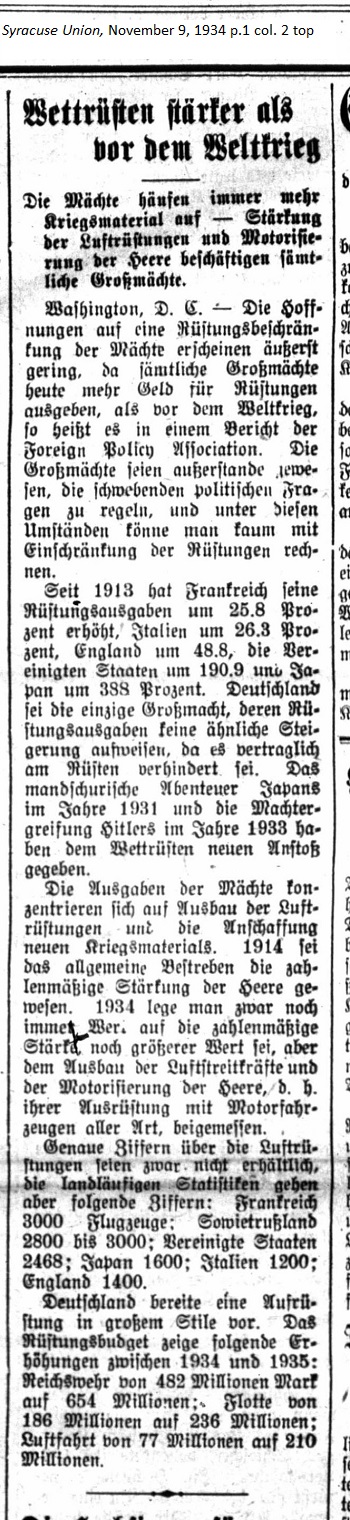
November 9, 1934 Page 1 _____ The World Powers Stockpile Ever More Wartime Materiel — The Great Powers Busy Strengthening Supplies of Air Armaments and the Motorization of Armies Since 1913 France has increased its armaments budget by 25.8 percent; Italy by 26.3 percent; England by 48.8 percent; the United States by 190.9 percent; and Japan by 388 percent. Germany is the only Great Power whose armements budget has witnessed no similar increase since it was hindered from weaponizing by the Treaty. The expenditures by the Great Powers concentrate on the building of air armaments and the creation of new war materiel. 1914 was the year of greatest efforts to increase the size of armies. In 1934 one places even more effort and even greater expenditure towards numeric increases in troops attributed to the building of air combat forces and the motorization of armies, i.e. equipping their armaments with motorized transport. Exact figures on air weaponry are not obtainable but generally accepted statistics go as follows: France, 3000 aircraft; Soviet Union, 2800 to 3000; United States, 2468; Japan, 1600; Italy 1200; England, 1400. Germany went about rearmament on a grand scale. The armaments budget showed the following increases between 1934 and 1935: Army from 482 million Marks to 654 million; Navy from 186 million to 236 million; aviation from 77 million to 210 million. |
|
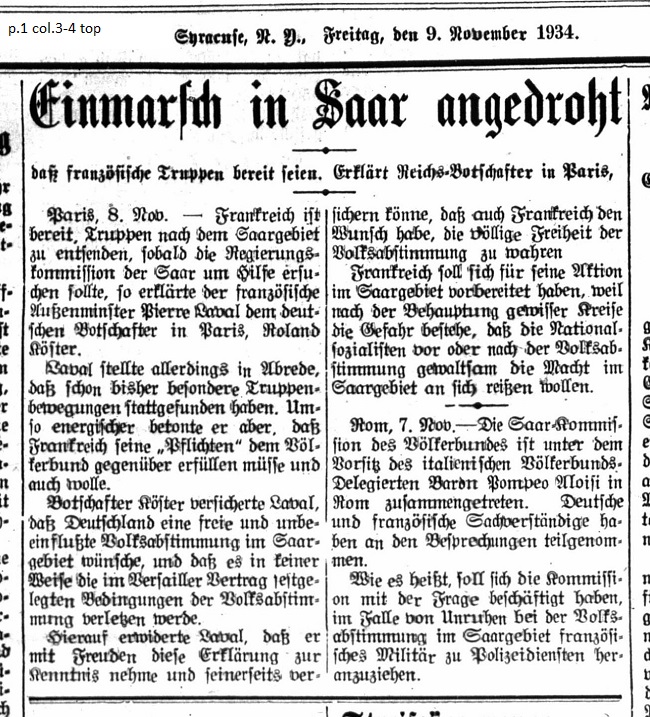
November 9, 1934 page 1 _____ French Troops Stand Ready, Declares Reich Ambassador in Paris _____ Paris, November 8th. — France is ready to send troops into the Saar Region as soon as the Government Commission of the Saar asks for help, stated French Foreign Minister Pierre Laval to the German Ambassador in Paris, Roland Köster. However Laval denied that special troop movements have already taken place. He just as energetically emphasized that France must and will fulfilled its "duty" to the League of Nations. Ambassador Köster assured Laval that Germany wants a free and uninfluenced election in the Saar Region and that in no way will the conditions established by the Versailles Treaty be violated. To that Laval responded that he joyfully accepts this declaration and on his part he can assure that even France wishes to preserve the full freedom of the election. France supposedly has prepared for certain action in the Saar Region because according to the allegation in certain cirlces, danger might exist that the National Socialists either before or after the election want to seize power in the Saar Region. Rome, November 7th. — The Saar Commission of the League of Nations has assembed in Rome under the chairmanship of the Italian League Delegate Baron Pompeo Aloisi. German and French experts have participated in the session. It's said that the Commission has been dealing with the issue in case of unrest with the election in the Saar Region by adding French military forces to the police services. |
|
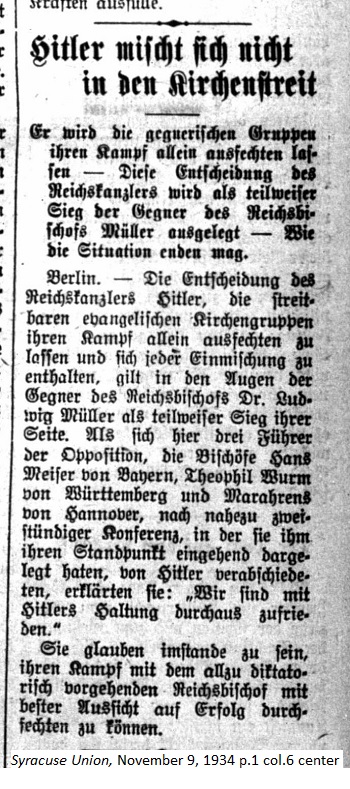
November 9, 1934 page 1 ____ He'll Let the Adversaries Fight Their Battle Alone — The Reich Chancellor's Decision Construed as a Partial Victory for the Opponents of Reich Bishop Müller — How the Situation May End They believe they are in a position to fight their own battle with the all too dictatorial Reich Bishop with the best possible prospect for success. |
|
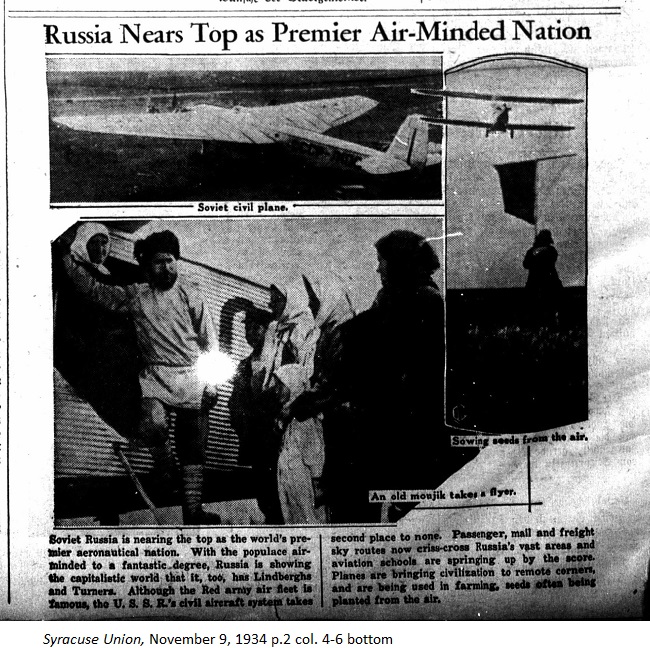
November 9, 1934 page 2 Soviet Russia is nearing the top as the world's premier aeronautical nation. With the populce air-minded to a fantastic degree, Russia is showing the capitalistic world that it, too, has Lindberghs and Turners. Although the Red army air fleet is famous, the U.S.S,R, civil aircraft system takes second place to none. Passenger mail and freight sky routes now criss-cross Russia's vast areas and aviation schools are springing up by the score. Planes are bringing civilization to remote corners, and are being used in farming, seed often being planted from the air. |
|
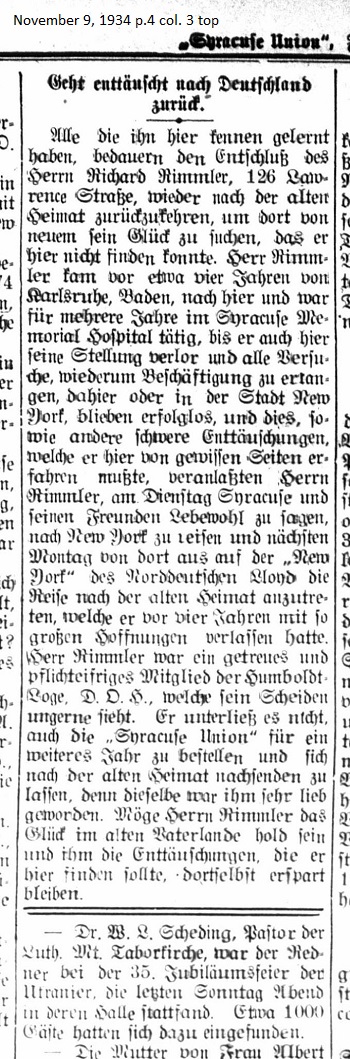
November 9, 1934 page 4 _____ — Dr. W.L. Scheding, Pastor of the Lutheran Mt. Tabor Church, was the speaker at the 35th anniversary of the Ukrainians last Sunday evening in the church hall. Around 1000 guests were in attendance. [Translator's Note: I'm not absolutely sure it's "Ukranier" and not "Utranier", however since the time slot is right for Ukrainian immigration to Syracuse, according to the Ukrainian National Home History, and Dr. Scheding was well acquainted with people of Eastern Europe and Russia, it seems a good guess.] |

|
November 9, 1934 page 7 _____ An entire series of scientific disciplines are busy with the determination of the original homeland of the IndoGermanic people. First there were efforts to compare their language, then study of their prehistory in order to derive a solution to this important question, and then, before all else, to intervene in the dispute concerning their race, ethnology, and historical archtypes. At first those comparing the language believed that northwestern India, the Iranian plateau or the Iranian steppelands may have been the original home of the IndoGermanic people. Later they also sought it in Europe in the regions of the lower Volga, southern Russia, north of the Black Sea, the countries in the Danube basin, the vicinity of Pripyat Marshes, Posen and the adjoining Congress Kingdom of Poland and Lesser Poland, Thüringia, and the northern regions of central Germany, the western Baltic Sea basin with Mecklenburg, Schleswig-Holstein, Jutland, the Danish Islands, and southern Scandanavia. Of extraordinary importance now, as Prof. Specht explains in the newspaper of the scientific world, Geistige Arbeit (Intellectural Work,) is that linguistics indicate there is a familial relationship to the IndoGermanic people when brought together with the expansion of the Neolithic culture of Middle Europe. Next one must consider the non-IndoGermanic groups such as the so-called Lake Dwelling Culture in the northern Alpine Region and the Linear Pottery Culture in central Germany since these are spatially very limited, coming from a totally different migration direction from the IndoGermanic people. For the IndoGermanic people the Megalithic Tomb Culture in the western Baltic Sea basin with the remaining sections of the adjoining coastlines of Mecklenburg, Schleswig-Holstein and Jutland stood in close assocation with the "Nordic cultures" of central Germany as a second essential component to the Saxon-Thuringian Corded Ware Culture. The migration is distinctive for the representatives of both groups in that it's always linked to the establishing of empires on foreign soil. The bearers of the Megalithic Tomb Culture migrated south as far as Hungary and towards the east and southeast to the Black Sea. And so Greece was settled by later Greeks; Asia Minor by Thracian-Phrygian tribes, which include the Armenians; South Russia by the Aryans; the Kuban region by the Hittites; East Prussia and the eastern adjoining regions by the Baltic and Slavic groups. Perhaps the Corded Ware people migrated in the same direction. Still later the Celts conquered southern Germany and the Romans took Italy, then advanced over the already IndoGermanic portions east of the Baltic Germans, Slavs, Aryans, and Hittites. By means of this expansion and the partial overlapping of the two indoGermanic populations we find an explanation for the familial kinship between the IndoGermanic languages. The migratory direction is established with Central Germany and the western Baltic Sea basin as the original homeland of the IndoGermanic people. The later Germans migrated from the homeland of the Megalithic Tomb people after blending with the migrating Corded Ware Culture, and from there expanding over today's Germany in the first century. "One must also associate two regions in Germany as the original homeland of Indogermans, the western Baltic Sea basin along with the Megalithic Tomb culture, which is simultaneously the original homeland of the Germanic people, and Thuringia-Central Germany with the culture of the Corded Ware people." — Eloquent. In the course of the exam the school inspector asked questions concerning the five senses and their function. "The ear is the organ for _____? "Hearing!" the tiny group responded. "And what are the eyes for?" "Seeing!" "And the nose?" "Smelling!" "And the tongue?" There was no response. Utter silence spread throughout the classroom. "Now," the school inspector said encouragingly, "think about it. What does one do with his tongue; what's the tongue there for?" One crafty little boy spoke up and stated with pride, "To stick out!" |
|
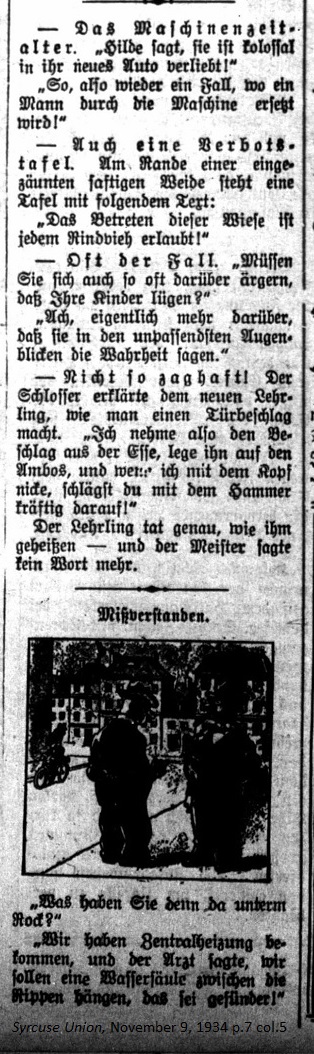
November 9, 1934 page 7 — The Machine Age. "Hilda says she's fallen madly in love with her new automobile!"
— Just Another Prohibited Sign At the border of a lush meadow there's a sign with the following text: All cows are permitted to enter this meadow!" — Often the Case. "Must you get angry so often because your children lie?"
— Not So Timidly! The locksmith showed his new apprentice how to make a mounting bracket for hanging a door. "Take the mount out of the forge, place it on the anvil, and when I nod my head, hit it with a hammer as hard as you can!"
A Misunderstanding "What do you have there under your shirt?"
|
|
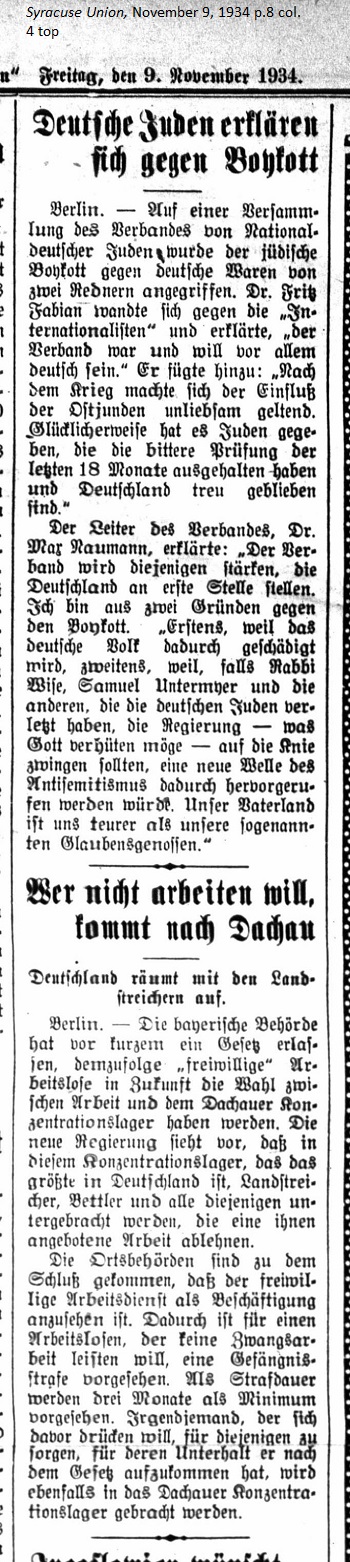
November 9, 1934 page 8 _____ Berlin. — At a meeting of the Association of National German-Jews the Jewish boycott against German goods was challenged by two speakers. Dr. Fritz Fabian opposed the "Internationalists" and declared "The Association was and will continue to be German." He added, "After the war the influence of the East European Jews was unwelcome. Luckily there were Jews who sustained the bitter trials of the last 18 months and remained loyal to Germany." The leader of the Association, Dr. Max Naumann, declared, "The Association will strengthen those who place Germany first. There are two reasons why I am against the boycott. Firstly, it will harm the German people ; secondly, as is the case with Rabbi Wise, Samuel Untermyer and the others, who have hurt the German Jews, because if the government — may God protect it — should fall to its knees, it might call up a new wave of antisemitism. Our fatherland is as dear to us as our so-called comrades in faith." Whoever Will Not Work Will Go To Dachau _____ Germany Clears Out the Vagrants. The district authorities have come to the conclusion that voluntary work service be considered employment. By this means someone unemployed, who does procure compulsory work, will be given a minimum prison sentence of at least three months. After the law is enacted, anyone unwilling to comply and pay for his upkeep will be sent to the Dachau Concentration Camp. |
|
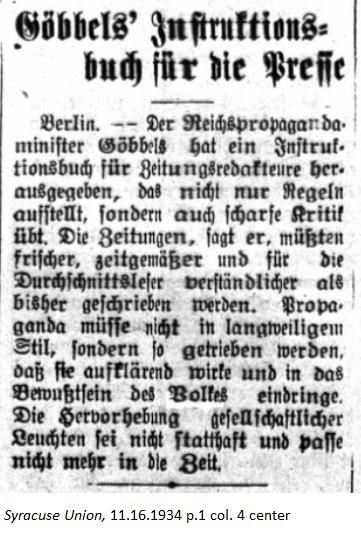
November 16, 1934 page 1 _____ Berlin. — Reich Propaganda Minister Göbbels has published an instruction book for newspaper editors, which not only estblishes rules but also exercises shapr critique. The newspapers, he says, must be written in a newer and more modern manner than before and be more understandable for the average reader. Propaganda must not be presented in a lifeless style but in an explanatory way so it sinks into the consciousness of the population. The emphasis on societal enlightenment is not permitted. |
|
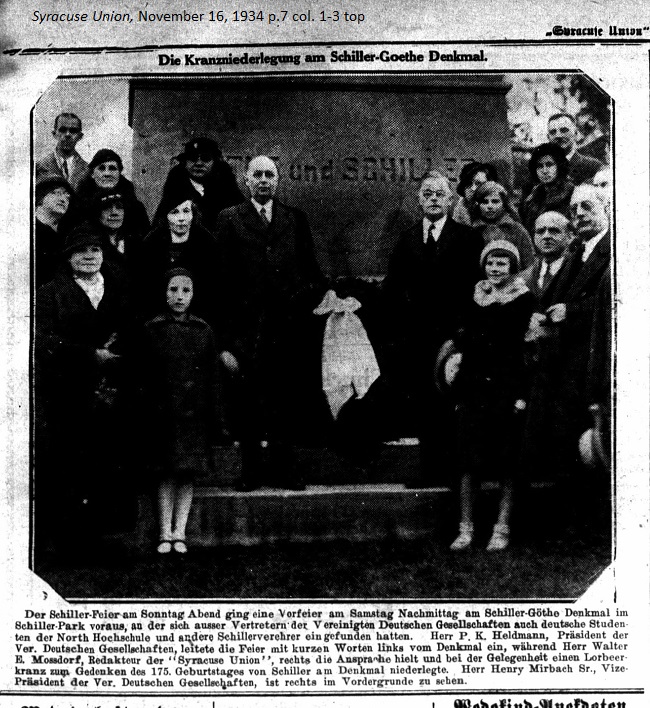
November 16, 1934 page 7 The Schiller celebration on Sunday was preceded by a preliminary ceremony at the Schiller-Goethe monument at Schiller Park on Saturday afternoon, which the representatives of the United German Associations attended along with the students of North High School and other Schiller devotees. Mr. P.K. Heldmann, President of the United German Associations conducted the ceremony. He's shown left of the words on the monument. Mr. Walter E. Mossdorf, editor of the Syracuse Union standing right of the words, gave a speech. A laurel wreath was laid at the monument to commemorate the 175th birthday of Schiller. Mr. Henry Mirbach Sr., Vice-President of the United German Assocations, is seen to the right in the foreground. |

|
November 16, 1934 page 7 _____ Wedekind's tragic humor, which always came through in his works, is a strong indicator of his personality and was strangely paired with his celebratory worth, his deep seriousness and his biting wit. He himself considered it the curse of his life in that he had to be a jokester while feeling called upon as a herald of a new gospel of salvation. The brief period of recognition and the rising fame granted him preceded long years of hardship and struggle, during which he came to terms with his brand of grim humor. He also attempted to earn his daily bread as a journalist. He himself had once said that things had gone for him in reverse order like the well-known Schmock in the "The Journalists". "Everything was deleted by Schmock right up to the brilliant, but in my case the brilliant was also cut out. As soon as I had put a single thought down on paper, he [the editor] showed it was tasteless, or too bold; in short, too intolerable. This fact kept me from making money to an extraordinary extent until I was put on a list. Back then Nietzsche had become world famous. Once I chanced upon just this one central notion, I wrote in an introduction the words, "Nietzsche is known to have said" or something similar. By this technique I never again was impeded by an obstacle." Wedekind's relationship to Max Halbe was a strange mixture of heartfelt friendship and bitter hostility. Many stories were told about it. Supposedly Wedekind once came into a restaurant in which all the tables were occupied. Halbe sat at one of them. Wedekind once again had sworn mortal emnity towards him. Despite this, he went over to Halbe's table and asked it he could sit there. "I prefer to eat alone," Halbe snarled. Wedekind looked over at the calf's head on which the other was feasting and said, "But Dr. Halbe, there are already two of you here." Once when Wedekind lay in bed with a broken leg, the good-natured Halbe paid him a visit and the two reconciled. After several weeks they met on the street. While Halbe greeted him warmly, Wedekind looked steadfastly at the sky. "But we're still reconciled," Halbe remarked in a tone of extreme amazement. But then he saw a look of deep resentment in Wedekind's eyes. "That was just in the event of death," Frank said and went off with quick steps, leaving a baffled Halbe standing alone on the street. It was in the cabaret called the Eleven Executioners; the money had run out. One patron, who had came in, noticed the reason for the depressed mood, reached into his pocket and said, "Gentlemen, I still owe each of you ten Marks." However Wedekind remained deadly earnest and said, "Excuse me, but they have already pumped twenty Marks out of me." |
|
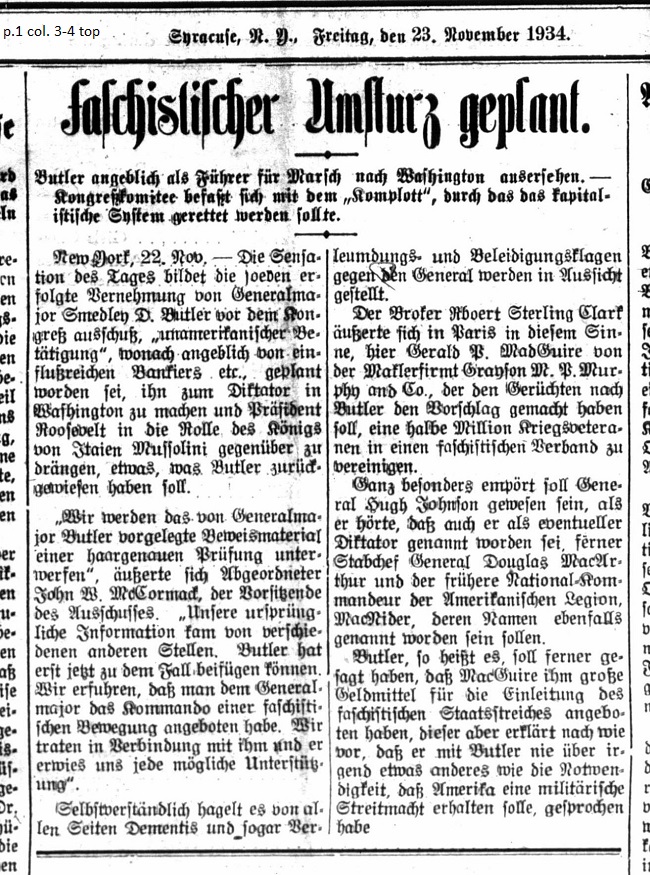
November 23, 1934 page 1 _____ Butler Supposedly Chosen as Leader for March on Washington — Congressional Committee Deals With the Conspiracy whereby the Capitalist System Will Be Rescued _____ New York, Nov. 22. — The hot news of the day concerns the interrogation of Major General Smedley D. Butler before the Congress on "unamerican activities" allegedly planned by influential bankers, etc. and the decision to make Butler dictator in Washington and to cast President Roosevelt in the role of king to be deposed as Mussolini had done in Italy. Butler allegedly rejected these plans.* "We will subject the proof submitted by Major General Butler to meticulous scrutiny," Representative John W. McCormack, chairman of the committee, stated. "Our original information came from various other sources. Butler is the first to provide additional information on this case. We learned that the Major General was offered the command of a fascist plot. We met with him and he showed us all possible support." Naturally denials are raining down from everywhere and charges of slander and insult are being placed against the General. In regard to this broker, Robert Sterling Clark in Paris related the rumor that it was Gerald P. MacGuire of the brokerage firm of Grayson M.P.Murphy and Co., who proposed to Butler he assemble a half million war veterans into a fascist army. Supposedly General Hugh Johnson was especially shocked to hear that he also might eventually be appointed dictator, as were Staff Chief General Douglas MacArthur and the former national commander of the American Legion, MacRider. It's said Butler also indicated that MacGuire offered him a large source of funding to lead the fascist coup d'etat, however MacGuire indicated he never spoke of anything with Butler other than the necessity of America acquiring a military strikeforce. _____ * See the Wikipedia article at https://en.wikipedia.org/wiki/Business_Plot for details. |
|
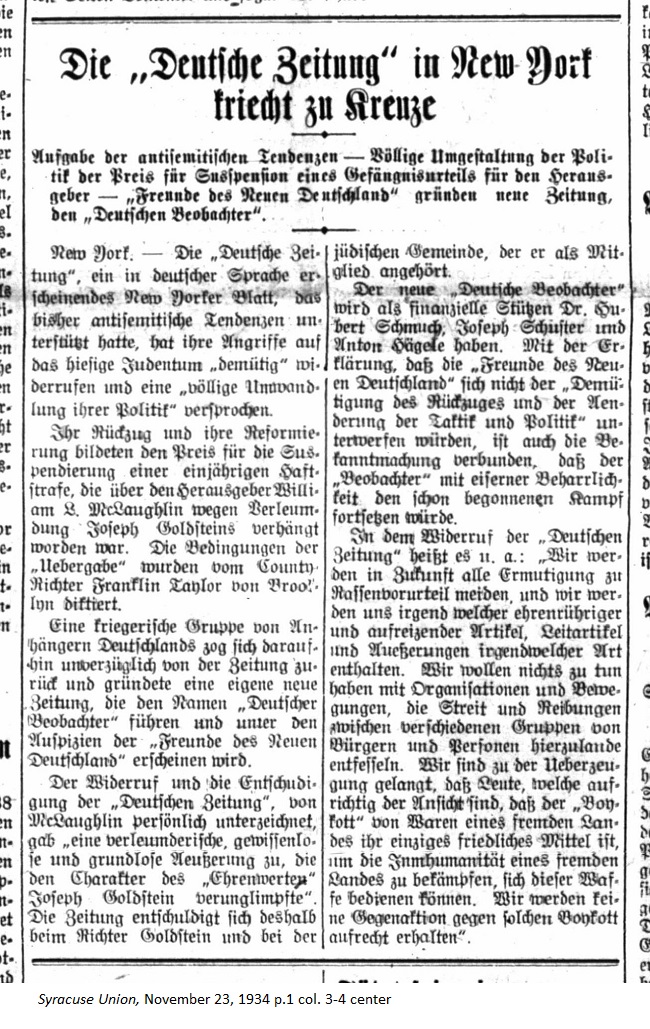
November 23, 1934 page 1 _____ A Charge of Antisemitic Bias — Total Reorganization of Policy the Price for Suspension of a Jail Sentence for the Publisher — "Friends of New Germany" Create a New Newspaper, the Deutsche Beobachter (German Observer.) _____ New York, — The Deutsche Zeitung, one of the German language newspapers published in New York which endorsed antisemitic biases, has "humbly" withdrawn its attacks on the local Jewish population and promised a "complete reorganization of its policies." Its retreat and reorganization are the price for the suspension of a one-year jail sentence levied against the publisher, William L. McLaughlin for the slandering of Joseph Goldstein. The conditions for the "surrender" were mandated by County Judge Franklin Taylor of Brooklyn. A militant group of supporters of Germany immediately withdrew from the newspaper and established it own newspaper carrying the name Deutscher Beobachter which will be published under the auspices of the "Friends of New Germany." The withdrawal and the apology by the Deutsche Zeitung, personally signed by McLaughlin, admitted to "a slanderous, unconscionable and unfounded statement, which disparaged the character of "honorable" Joseph Goldstein. The newspaper apologized to Goldstein and the Jewish community to which he belongs, in accordance with the Judge's instructions. The new Deutsche Beobachter will have financial support from Dr. Hubert Schmuch, Joseph Schuster, and Anton Hägele. With a statement that the Friends of New Germany" would not submit to the "humiliation of retraction and the change in tactics and policies," there is also an annoucement that the Beobachter would continue the fight with iron determination. In its retraction the Deutsche Zeitung stated, among other things, "In the future we will avoid all encouragement towards racial bias and we will desist from carrying any defamatory and provocative articles, lead articles and statements of a similar nature. We will have nothing to do with organizations and movements which unleash dispute and friction between various groups of citizens and people. We have reached the conclusion that people, who are sincere in their conviction that the boycott of wares from foreign nations is their own peaceful means of battling against inhumanity, and this may serve as a weapon. We will take no counteractions against such a boycott. |
|
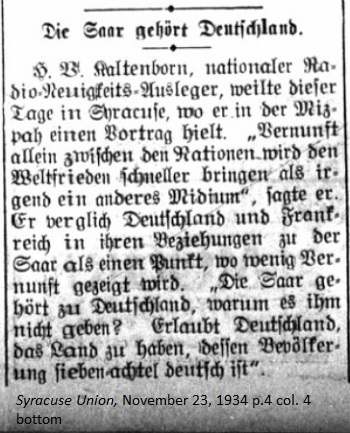
November 23, 1934 page 4 _____ H.V. Kaltenborn, national news commentator, spent the other day in Syracuse, where he delivered a lecture at the Mizpah Tower. "Common sense alone between nations will bring about world peace faster than any other medium," he said. He compared Germany and France in their relationship to the Saar as a point where little rational thought has been shown. "The Saar belongs to Germany, why should it give it up? Allow Germany to have the land whose people are seventy-eight percent German." |

|
November 23, 1934 page 7 _____ Allegedly German Air Weapons Leave France No Longer Able to Sleep Peacefully Paris. — Great fear and concern keeps the new French Minister-President, Pierre Etienne Flandin, from sleeping peacefully at night. Turmoil during the Armistice commemorative has led to new political unrest in France. With it comes bad thoughts and constant fear of Germany. Hitler's powerful air fleet has become the bogeyman in France. "Germany is ready," Air Minister Victor Denain has repeatedly proclaimed. When Denain took on his ministerial post last February for the first time, he told Parliament that France's Air Force was obsolete, and during the annual grand aerial manoevers he attempted to demonstrate that the French cities would be defenseless and could be annihilated by a strong foreign air force. Naturally the goal was to establish a higher demand for air fleets. And now the Ministry for Aviation along with the War and Marine Ministries are again seeking new authorization. Air Minister Denain will again tell Parliament of Germany's powerful armaments. Unsubstantiated sources suggest he will argue that Germany is in a position to manufacture 900 aircraft each month. The French High Command has information, according to which Germany's factories have been constructed to manufacture aircraft and that each factory can produce 30 aircraft per day. Naturally the French Chamber will believe it. One of the most urgent problems is the constantly growing unemployment figures. The new Cabinet will try to curtail the employment of foreign workforce. Furthermore, it's expected that it will reduce international trade restrictions in order to stimulate prosperity through foreign trade. However under the current circumstances all too much is not expected of the premier Cabinet in France. The probability of disunity among the political parties throws a crippling cloud over everything. Thus it's understandable if Minister-President Pierre Etienne Flandin daily asks the political parties to forget all the dispute and contention. But his voice remains unheard like the call from the desert and France will eventually be forced to dissolve Parliament or limit its authority, as it is already happening in so many countries. This is clear to the attentive observer without further explanation. Mackensen Emphasizes the German Love of Peace _____ The New Armored Cruiser "Admiral Scheer" Put Into Service Berlin. — General Field Marshal von Mackensen, one of the still living, famous German military leaders, released through his Adjutant that Germany has repeatedly shown its desire to preserve world peace. Placing the "Admiral Scheer" into service yielded widespread notice. It is the newest German heavily armed battle cruiser and it was named after the commander of the German fleet in Jutland. Reich Chancellor Hitler sent a message to the Commander of the battle cruiser in which he discussed the Battle of Jutland against a superior fleet. Better Legal Protection for "Poor Devils" _____ Berlin. In a recent speech before the Academy for Jurisprudence, Prussian Premier Hermann Göring gave the following significant declaration: "We will amend the judicial methods by which capitalist exploiters remain sucessful in court against every 'poor devil' because they have the money." His address before judges and lawyers lasted an hour. |

|
November 30, 1934 page 2 _____ For several centuries the church fortresses in the German settlement region of Transylvania have been a powerful sign of the cultural resilience and protective self-assertion of the German community in a remote section of southeastern Europe repeatedly assailed by the mighty Turkish armies. Documents indicate the first assault happened in 1291. In 1436 the Hermannstadt deacon informed the Pope that before the charging Turks the Saxons took refuge behind the wall of the reinforced church courtyard. From that time onwards the construction of fortifications around the church gained ever increasing importance. Even after Andrew III turned against these fortifications, they were vehemently encouraged by kings. When King Sigismund traveled through Burzenland (Southeastern Transylvania)in 1427, he paid great attention to the improvements and reinforcements in the fortresses. The important role of these German settlements as defensive barriers against the peril of merciless Turks was significant on more than one occasion. This was how the residents of Keisd retained their freedom from the burdens of war and the duties of maintaining and supporting armies by the construction of the church fortress, which was completed in 1496. A large number of little forts scattered throughout Transylvania were considered a requirement for the defense of small areas since experience had shown that small groups of villagers did not have armed fortresses like people did in the cities. The illustrated work titled Die deutsche Kunst in Siebenburgen (German Art in Transsylvania) by Victor Roth, published by Deutscher Kunstverlag in Berlin, explains that these forts protected an entire settlement from annihilation by the enemy. Space behind the walls were limited to all the residents of the village and a portion of neighboring villagers along with space necessary for storing grain and cattle plus weapons for defense against the enemy. During times of siege, storage space also served as living quarters, which were often built in stories one atop the other. An example still viewable today is the impressive church fortress of Tartlau. With the increase of Turkish invasions primarily in the 15th century and deep into the 16th century the fortress churches were improved until they proved insufficient against new age weaponry. Gradually people transition away from these no longer defendable places. These powerful walls surrounding the churches with their towers, defensive walkways, shooting slits and machicolations convey a powerful image of the battle besieged settlement existence of these Germans, who fulfilled their difficult cultural task with plows and swords. The interface of peaceful piety with extreme defensive capabilities can scarcely come through more clearly than in the church fortresses, which at least in part are still constructs of beautiful architectural cohesiveness. Their stones can relate the changing nature of the wartime experience, of the peaceful events of the villagers, of death and hunger, love and marriage, despair and grace. The history of the church fortress of Tartlau, which probably would have been built shortly after the great Mongolian invasion in the 13th century, is especially rich in stormy episodes. Its walls, which powerfully rise up almost four meters, have seen many foes. Even in 1552 the military governor of the Moldau attempted in vain to storm the walls; in 1658 they withstood the Turkish siege; and in 1704 they repelled the attack of the Transylvanian Magyars. Up to the present day, the church fortresses assume a leading place in the townscape as signs of the fierce tenacity of the German cultural pioneer. |

|
November 30, 1934 page 5 _____ Former German Drum Major Passes Away _____ An old and familiar character, named Jacob Schaudt of 123 W. Fayette St., departed this life last Saturday. For many years he was a drum major for the former Gaylord Musical Band and was seen at many parades in his drum major attire, marching to a military tempo, and masterfully swinging his baton. The ostentacious uniform was his prized possession and it was well maintained right up until his death. He even wore it last year at the German Day Parade, on which occasion the picture shown below was taken. Caption under picture reads "Jacob Schaudt." The deceased was born in Germany and took an active part in the Franco-Prussian War of 1870-71. Soon afterwards he emigrated to America. In 1876 he became an American citizen. He made a name for himself as a musician and was the drum major and official serenader of various bands, which performed for President Cleveland, President Theodore Roosevelt, and John L. Sullivan. Mr. Schaudt was highly respected in German circles and he was a many-year loyal member of the Arion. He was a great friend of music and song, and he sang along joyously with the Arion Singing Society. As an occupation he was a practicing shoemaker and he had many customers, whose shoes required special attention. He was known as a master of his craft far and wide. He is survived by his true life partner, Mrs. Harrriet Schaudt; one son, Carl Schaudt; and two daughters, Mrs. Frank McAfreld and Mrs. Alice Hotaling. He also has a sister, Marie Schaudt, who lives in Germany. At his funeral, which was held on Tuesday, November 27th, the following members of the Arion served as honorary and active coffin bearers: Carl Altmann, Nic Weber, Karl Wolthausen, Engelbert Fliri, Otto Rothenburg, Henry Mirbach Sr.; Franz Alletzhauser, Max Schultze, Emi Nixen, Fred Nitsch, C. Gottstein, and Karl Holzer. The burial followed at Hillcrest Memorial Park Cemetery, presided over by Rev. Wm. F. Bauer of Evangelical Friedenskirche. |
|
November 30, 1934 page 8 |
|
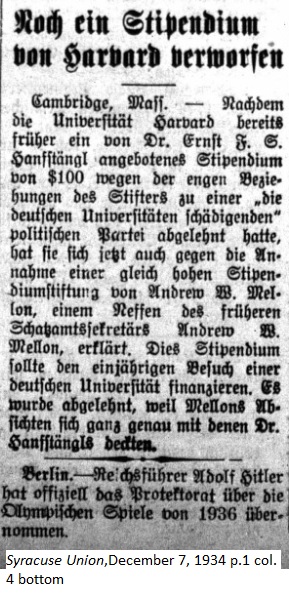
December 7, 1934 page 1 _____ Cambridge, Mass. — After Harvard University already rejected a stipend of $100 offered by Dr. Ernst F.S. Hanfstängl due to the donor's association with a political party "causing damage to the German universities," it has once again refused to accept a similarly high stipend from donor Andrew W. Mellon, a nephew of former Treasury Secretary Andrew W. Mellon. This stipend was supposedly to finance the year-long visit of someone from a German university. It was refused because Mellon's opinion's coincided completely with those of Dr. Hanfstängl. |
|
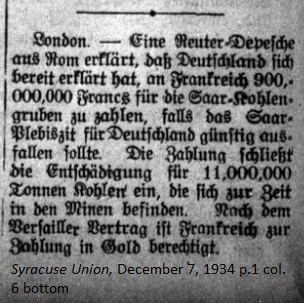
December 7, 1934 page 1 London. — A Reuter's dispatch from Rome has stated that Germany has declared itself ready to pay France 900,000,000 Francs for the Saar Region coal mines in the event that the Saar referendum turns out in favor of Germany. The sum includes compensation for 11,000,000 tons of coal currently located in the mines. According to the Versailles Treaty, France is entitled to payment in gold. |
|
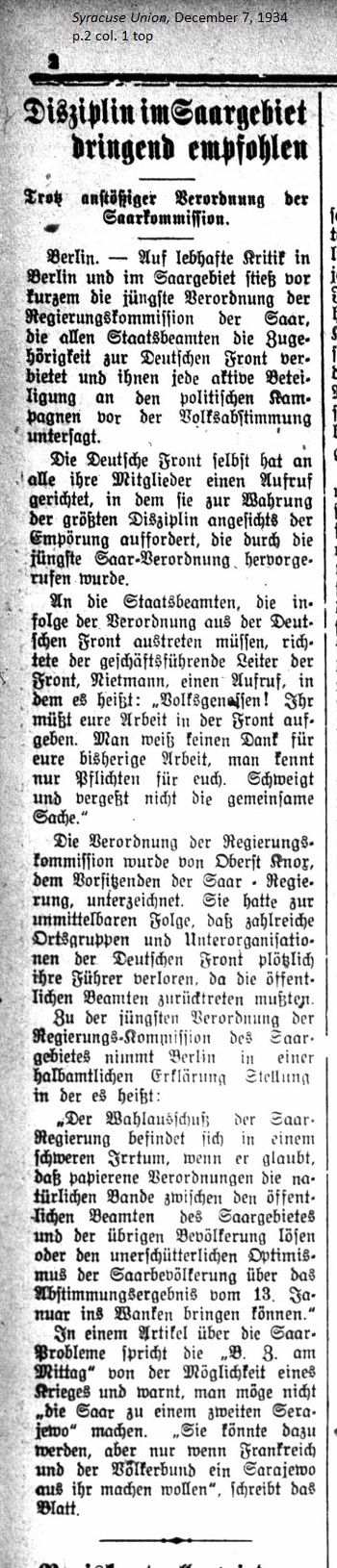
December 7, 1934 page 2 _____ Despite Improper Regulation of the Saar Commission _____ Berlin. — There's brisk criticism in Berlin and the Saar Region concerning the recent regulation of the Governmental Commission of the Saar, which forbids all state officials from membership in the German Front and bans active participation in political campaigns before the referendum. ' The German Front itself has issued an appeal to all its members, recommending they exercise great discipline regarding their outrage stemming from the recent ruling. To the state officials, who must resign from the German Front due to the regulation, the business manager of the Front, Nietmann, issued this summons: "Fellow Germans! You must cease your work in the Front. Expect no thanks for your past work; just recognize your duty. Keep quiet and do not forget the common cause." The regulation by the Governing Commission was signed by Colonel Knox, Chairman of the Saar government. It had an immediate consequence since numerous district groups and subordinate organizations to the German Front lost their leaders since public officials had to resign. Berlin issued a semi-official declaration to the recent regulation by the Governimg Commission in the Saar Region, which stated: "The Election Committee of the Saar government is seriously mistaken if it believes that a paper regulation can dissolve the natural bond between public officials of the Saar Region and the rest of the population nor can it rock the unswerving optimism of the Saar population concerning the referendum results on January 13th. In an article on the Saar Problem the Berliner Zeitung am Mittag spoke of the possibility of war and warned they may now tur "the Saar into a second Serajevo." "It could become this if France and the League of Nations want to make it another Sarajevo," the newspaper wrote. |

|
December 7, 1934 page 2 _____ You have to go up many stairs to the highest point of the National Youth Leadership Building in Berlin on Kronprinzenufer — then you enter one of two beautiful, brightly lit, book-filled rooms where Karl Hobrecker's library of unique and knowledge-packed collection of old children's books, diligently assembled over 25 years, has found its home. Anyone may come here and page through these wonderful books. And Karl Hobrecker presides here as the old custodian over his collection, presented as a gift to German youth. Untiringly he shows and explains his treasures, especially the significant and interesting examples housed in glass cabinets. Hobrecker is always ready to fetch anyone's request for a specific area of study out of the almost 12,000 volumes comprising rarities in youth literature. In old, forgotten, children's books one can see in words and pictures how images of the devil transformed in youth literature over five hundred years and how old German fairytale and saga characters underwent change over the course of time such as Reinecke Fuchs (Reynard the Fox) or Brentano's edition of the impressively described Gockelhahn (Rooster.) Struwwelpeter (Shock-Headed Peter) is represented in 300 different editions along with old and newer editions of Robinson the Younger, who is an unforgettable, well-trusted, and much-loved children's book character. Didactic ABC books from the Middle Ages and illustrated books are displayed here along with old calendars, coloring books, activity books, puppeteering books, books on manners, and literature for teenage girls, all spanning from earlier to later times. The "Wunderbücher" (Wonder Book Series) is very charming with its recto and verso pages artfully displaying illustrations and its characters which move when you pull the drawstrings. Karl Hobreker tells how Tom Seidmann-Freud came up with the idea of these old Wonder Books, proposed the development of these modern picture books so they turned, moved, and changed. He also reports on how other picture book artists such as [Elsa] Eisgruber and [Sibylle von] Olfers were inspired upon seeing these creations. Plus one sees how valuable a children's book museum is for the development of youth literature with regard to illustration and text. This is significant not just for those with creative interest but also for parents and educators, who seek to influence youth through the selection of learning topics, and older children, who are selecting their own topics. Everyone here has a unique opportunity to acquire a firmer and clearer grasp of the historical interdependence. However even those with no practical relationship to children's books as a creator, a selector, or a youthful consumer will not regret a visit to this collection since one will seldom see so many delightful, charming or grotesque pieces of decorative art as what is assembled here. The visitor can study very appealing and entertaining objects representing the intellectual disposition of past cultural epochs. Karl Hobreker wants to utilize his vast knowlege and lifelong experience as a collector to write a comprehensive and scientifically grounded history of youth literature. Initially the work will appear in individual, thematic groupings of monographs, then upon conclusion one united volume will give a overview of the development of German youth literature from the beginning up to today. In general it was no longer difficult or expensive to procure these old, forgotten books once one knew the locations of antiquarians and owners of old children's books, Hobreker admitted. Scarcely anyone except him had any interest in them, and these treasures were mostly lying about unnoticed. Wouldn't it be nice if someone made these magical and delicate children's picture books available in new editions? In closing, the original goal of these books was to be enjoyed and admired while subtly imparting edification on art appreciation. |

|
December 7, 1934 page 3 _____ Alleged Five Million Strong Army a Pretense for Escalation in Armaments Paris. — With the obvious intention of obtaining higher allocations for the French military budget, the French Parliament warns that in the coming year Germany will have an army of 5,500,000 men at its disposal. Leon Archimbaud, the Reporting Secretary on the Budget, asked for 5,689,215,000 Francs ($376,200,000) for armaments in 1935. "France's enemies are intensively preparing for war as if it will break out in the near future," he declared. Even Marshall Franchet D'Esprey supports Archimbaud. "I am dissatisfied with the progress of the French Army," he stated. "The situation appears to be at least as dangerous as it was in 1914. The Germans are preparing themselves, while our preparations are inadequate. For this reason the Germans are just as dangerous as they were in 1914." At the same time as this parliamentary debate the former War Minister, Colonel Jan Fabry, issued an article in which he discusses the possibility of a surprise German assault on France and maintains the attack would take the following course:
The current strength of the German Army is, according to his ridiculous assessment:
The German Army in 1935:
In addition to this Germany supposedly has 4,900,000 trained reservists, who would be mobilized within a few days. |

|
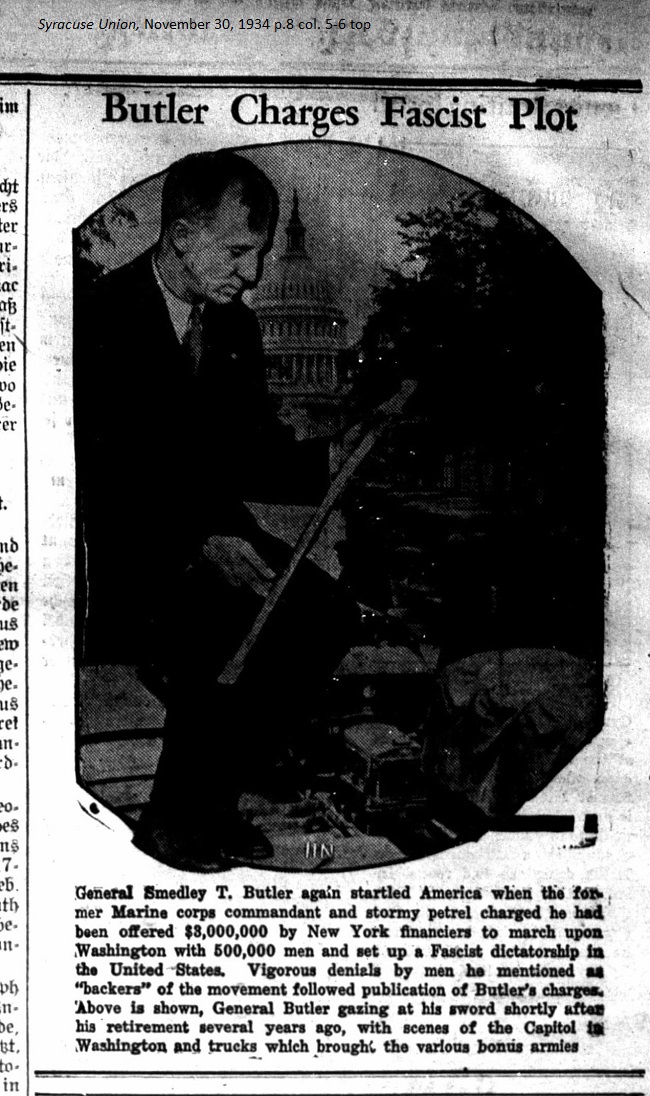
December 14, 1934 _____ "Butler Incident Not Yet Settled" — Democracy Finished if President Roosevelt Fails Detroit. — Rev. Father Charles E. Coughlin stated in his weekly press conference that someone had asked hin to give an address in favor of a dictatorship and that he refused to do it. He added that certain allegations made by General Smedley D. Butler were based on truth. Above all else it was true that Butler was requested to hold a certain speech. The speech was proposed to him (Father Coughlin) six months before it was supposed to be given, and as soon as it occurred he recognized it immediately. Father Coughlin did not want to say who wanted him to make the speech. When asked if it was true that he was offered $18,000 to make the speech he declined to answer. He said he didn't know if General Butler was offered money for the speech. He merely indicated, "The matter is not yet settled." When he was asked about J.P. Morgan, whose name he frequently mentioned in his radio addresses, Father Coughlin replied, "Mr. Morgan is a kind and honorable man. When I mention him in my radio addresses it only happens when he typifies the system. With regard to the Post-Depression Reconstruction he said, "The time has come when the patient can no longer be cured with a shot in the arm. If Roosevelt fails, then our democracy is over." After the holidays he wants to go to Washington to confer over further currency reforms. In mid January he will announce his plans concerning the introduction of a powerful lobby. "In the year 1936 we will be so strong that they will pay attention to our requests," he stated. Enemies of the Peace _____ Senate Promises Disclosure of the Conspiracy of the Weapons Manufacturers Washington, D.C. — The primary conspirator against world peace was announced by the Munitions Commission of the Senate. It should be placed on the pillory. Senator Arthur Vandenberg of Michigan, a member of the Munitions Commission, stated "It will be a rigorous task. Profiteering along with preparations for war must come to an end." According to Senator Vandenberg the United States must first put its house in order. Then it must instigate real internatonal measures to control weapons manufacturing and the weapons trade. The investigations will last all winter. In the interim the large ship builders and armor-plating manufacturers have not been investigated. When all the facts are firmly established the Commission will work out its recommendations. "Naturally the matter has far-reaching and international ramifications," Senator Venderberg stated. "Everywhere people are beginning to see through their game. People are aware of the danger which comes with uncontrolled weapons trading. I am convinced that more can be done for peace and good neighbor politics among nations through the regulation of this problem than all the conferences can achieve." Swedish and Dutch Troops for the Saar Region _____ The Swedish and Dutch governments have accepted the invitation of the League of Nations to act as police for the Saar region. Both countries will participate in occupation of the Saar region for the duration until the referendum. Their forces will supplement the police along with English and Italian troops. |
|
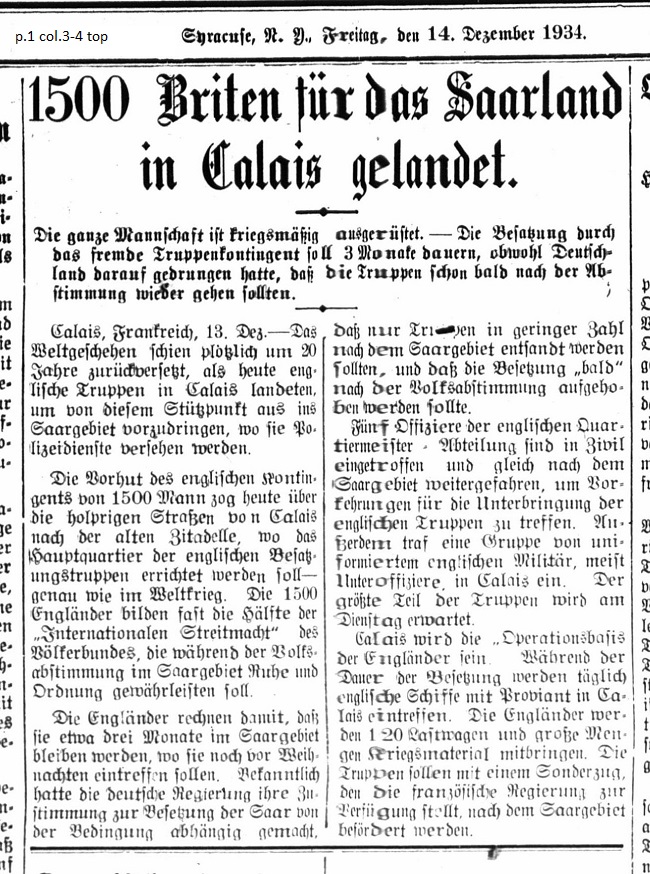
December 14, 1934 page 1 _____ The Entire Army Equipped for Battle — The Occupation by Foreign Troops Should Last Three Months, Although Germany Urged That Troops Should Leave Soon After the Referendum _____ Calais, France. December 13th. — World history appeared to have gone back 20 years suddenly as English troops landed in Calais in order to press into the Saar Region from this outpost, where they will provide police services. The advanced guard of the English contingent of 1500 men moved over the bumpy streets of Calais towards the old citadel, where the headquarters of the English occupation troops will be located — just as it was during the World War. The 1500 Englishmen make up almost half of the "International Strike Force" of the League of Nations, which will keep peace and order in the Saar Region during the Referendum. The English figure that they will remain in the Saar Region for around three months. They will enter the region just before Christmas. It's known that the German government made its agreement to the occupation dependent upon the condition that smaller numbers of troops be dispatched into the region and that the occupation must be lifted "soon" after the Referendum [which would be held January 13, 1935.] Five officers of the English Quartermaster Unit have arrived in civilian clothes and dispatched to the Saar Region to prepare for the housing of the English troops. Additionally a group of uniformed English military men have arrived in Calais. Most of these men are underofficers. The greater portion of troops are expected on Tuesday. Calais will be the "Operation Base" for the English. During the occupation English ships with provisions will arrive daily. The English will bring 120 trucks and a large amount of war materielle. The troops will be transported via a chartered train provided by the French into the Saar Region. |

|
December 14, 1934 page 1 _____ His Departure Seen as a Severe Blow for the Reputation of German Music and The famous orchestra conductor and composer Erich Kleiber has also requested release from his contract with the Opera House and the Philharmonic. Brückner was a volunteer during the War and was severely wounded in 1918. He is the owner of an Iron Cross. Before the partitioning of Upper Silesia he distinguished himself in the battles against the Poles. He organized the National Socialist Party in Silesia in 1925. German-American Becomes Consul Los Angeles, Calif. — Within local German-American circles people have been pleased to hear that Mr. Paul Tobeler, well known in the local business world, has been appointed Consul of Guatemala. 3,358,865 Marks for Emergency Relief Germany's "Day of National Solidarity", which was introduced by Reich Propaganda Minister Dr. Goebbels in order to request contributions for the Winter Relief Fund, has taken in 3,358,865 Marks (Approximately $1, 344,000.) League Meeting in January Geneva, December 13th. — The League of Nations has decided to meet on January 11th. This decision is undoubtedly due to the Saar Referendum, which will take place on January 13th. The League deems it desireable so it can immediately draft the necessary resolutions. |
|
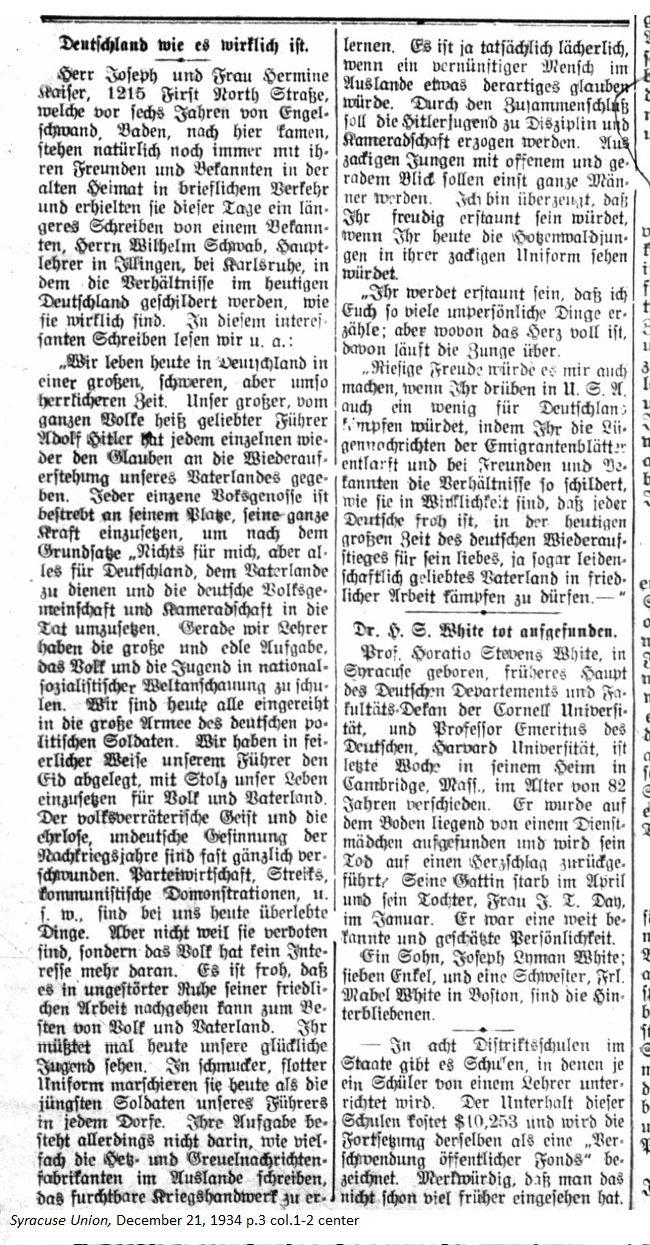
December 21, 1934 page 3 _____ Mr. Joseph and Mrs. Hermine Kaiser of 1215 First North St, who came back here 6 months ago from Engelschwand, Baden, have naturally corresponded with their friends and acquaintances in the old homeland. They received a long letter the other day from one contact, Mr. Wilhelm Schwab, senior instructor in Illingen near Karlsruhe. In it he described the current situation in Germany as it really is today. In this interesting letter we read among other things: "Today we live in Germany in a grand, difficult yet magnificent time. Our great leader Adolf Hitler, who is loved by the entire population, has given back to every individual faith in the resurgence of our fatherland. Every fellow German is endeavoring to find his place and is applying all his strength to live up to the prnciple 'Not for myself, but everything for Germany. To serve the fatherland and the German community, to establish comradery in action.' We teachers have the massive and noble task of instructing the adults and the young people in the National Socialist world view. Today we are all lined up in the great army of German political soldiers. In a celebratory manner we have given our oath to our leader, to proudly dedicate our lives for our people and our fatherland. The spirit of national betrayal and the dishonorable, non-German attitude of the postwar years have almost completely disappeared. Today we have survived political party economics, strikes, Communist demonstrations, etc. But this is not because they're forbidden but because the people no longer have an interest in them. It's joyful that one can pursue peaceful work in undisturbed peace for the good of the people and the fatherland. Just look at our happy young people today. They march about in neat, stylish uniforms as young soldiers for our Führer in every village. Its not their task to learn dreadful wartime trades as many rabble-rousing and horror story producing foreign reporters write. It's actually ridiculous that a rational human being living abroad would believe such a thing. Through integration the Hiltler Youth will learn discipline and comradery. With open and honest attention immature boys shall become mature men. I am convinced that you would be pleasantly surprised if you were to see the Hotzenwald boys of today in their jaunty uniforms. "You would be surprised that I'm telling you so many unpersonal things; but when the heart is full, the tongue runs over with it. "It would also make me tremendously happy if yoyu would also do a little campaigning for us over there in the United States. You could expose the false reports of the emigrant newspapers and describe the situation to your friends and acquaintances as they really are. Every German is happy to perform peaceful tasks in today's great era of German resurgence. Dr. H.S. White Found Dead Professor Horatio Stevens White was born in Syracuse, was former Head of the German Department and Faculty Dean at Cornell University, and Professor Emeritus of German at Harvard University. He departed this life last week in his home in Cambridge, Mass at the age of 82 years. He was found lying dead on the floor due to a heart attack by a servant girl. His wife died in April and his daughter, Mrs. J.T. Day, died in January. He was a widely known and cherished personality. He leaves behind one son, Joseph Lyman White; seven grandchildren; and a sister, Miss Mabel White in Boston. There are students in eight district schools in the State, in which each student is taught by one teacher. Costs for these schools are $10,253 and the continuation of these schools has been designated as a "waste of public funding." It's remarkable that no one caught this sooner. |
|
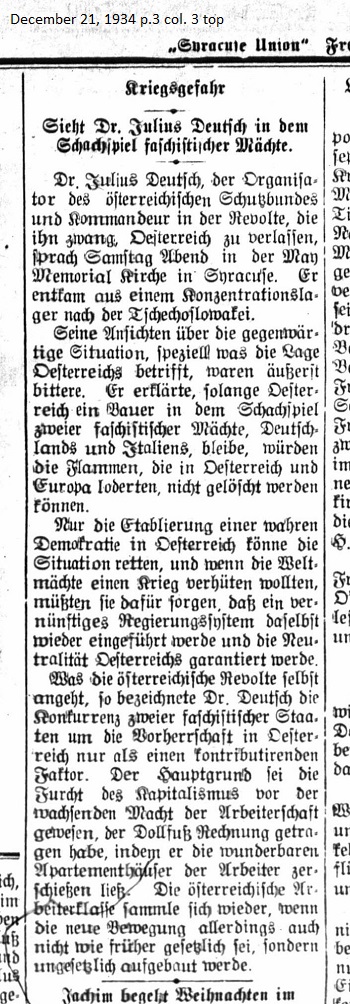
December 21, 1934 page 3 _____ Dr. Julius Deutsch Sees It in the Chess Match of the Fascist Powers _____ Dr. Julius Deutsch, organizer of the Austrian Defense Association and Commander in the revolt, which forced him to leave Austria, spoke Saturday evening in the May Memorial Church in Syracuse. He escaped from a concentration camp and went to Czechoslovakia. His opinions concerning the current situation, and especially the circumstances in Austria, were extremely bitter. He explained that as long as Austria was a pawn in the chess game of the fascist powers of Germany and Italy, the flames which ignited in Austria and Europe cannot be extinguished. Only the establishment of a true democracy in Austria can save the situation, and if the world powers want to prevent a war they should see to it that a rational government system is reintroduced and Austria's neutrality be guaranteed. Concerning the Austrian Revolt itself, Dr. Deutsch indicated that the competition between the two fascist nations for the domination of Austria was only a contributing factor. The major reason was capitalist fear for the growing power of the workforce, which led to Dollfuss allowing the shelling of the wonderful apartment houses of workers. The Austrian working class reassembled even though the new movement was not a legal entity as it was before. |
|
December 21, 1934 page 7 _____ It seems as though almost all of the ancient and pre-Christian concepts continued to exist and became incorporated into the Christmas tradition. Central to this ancient Germanic mid-winter feast we encounter the mysterious word Yule. Jacob Grimm already suspected that it dealt with a description for the sun wheel. In later times, especially through the research of Hermann Wirts, this was proven. Yuletide was a holy time of the year, permeated with mysterious forces from around November until January, in which the Germans of distant days long ago celebrated their highest feast and paid homage to the victory of a growing sun defeating darkness by worshipping the light, quite similar to what happened in the Mithras Cult, which so sharply worked its way into the Christian celebration of Christmas. The Yule Season, like Christmas, was the designation for the entire festive season; and like Christmas Day, Yuletide was the first and main feast day, followed by another 13 to 21 days of feasting. During this time all work requiring rotational motion was forbidden, especially spinning. Wheels were left motionless until the divine sun wheel gained renewed power. In German folk customs this ban on spinning was linked to the Germanic deities, Frau Holle (Lady of the Light) or Frau Perchta (The Terrifying Witch.) Since we do not have written chronicles of the ancient times, we must rely upon the sparse references of foreign historians. The most important source is a note from the Byzantine historian, Procopius from the 6th century, who described Yuletide as follows: "During their long winter nights the northerners send messengers on the 35th day to the summits of their highest mountain peaks to seek out the returning sun, and when they see it they loudly proclaim that after five days the new light will penetrate into the valleys. Then there's exuberant rejoicing and they celebrate with a huge feast, the feast of the joyous tidings." More than 200 years after Christianity was accepted in Iceland, the most important Icelandic historian, Snorre Sturlason, wrote around the year 1300 that pagan Norsemen celebrated three great sacrificial feast days a year, one at the beginning of winter, one in the middle of winter "for germination", and the third at the beginning of summer. These feast days were supposedly established by Odin. The law enacted by the Gulathing (Old Norse Assembly) established the midwinter fertility festival, offering the farmers a banquet in celebration of Christmas to honor Christ and the Virgin Mary and to hope for a good and fruitful year. Faith in the beneficial power of the sun was closely linked to this hope for renewed fertility. Snorre also wrote about the Norwegian King Haxon the Good (934-960,) who attempted to convert his subjects with little success by ruling "that people should begin celebrating Yuletide around the same time as the Christians celebrated, and as long as Yuletide lasted, each farmer should have a measure of beer without having to atone for it." Earlier the feast was held on Hökku Night, a midwinter night sometime around January 12th. The feasting took place over three nights. Then the Germanic Yuletide feast and the Christian Christmas celebration were united. Now people drank in loving memory of the old gods, a practice which usually was followed with a sacrifice, and in honor of Christ, the Virgin, and the saints. The spirit of Yuletide was thoroughly infused into the Christian feast and lent it a mystical blessing. In the Norse Sagas, Yuletide was the haunted season in which demons rampaged through the dark of night, the savages hunted, the armies of lost souls swarmed around human dwellings, and the powers of darkness surrounded the powers of light amid the howling winter storm. The Germans weren't counting the days, they were counting the nights and that is why there are a number of holy nights, and the German language calls Christmas "Weihnachten," meaning nights of devotion. People attempted to appease the spirits and the gods through sacrifices. The month before "Weihnachten" was a time for slaughtering livestock, mainly swine, because the arrival of snowfall in the forests meant food would not longer be available, thus sacrifices had to be made due to lack of adequate supplies of fodder. Rich, fresh meat gave cause for feasting. A residual effect of this is the preference for pork at nordic Christmas meals, and the continued existence of yule boars and other animals in the form of festive baked goods. It's been suggested that the Germanic slaughter and sacrifice feast extended from October and November well into December due to the continual expansion of farms cultivating meadows, which increased hay harvesting and enabled the feeding of animals in stalls. There was no longer a need for immediate slaughter when pasturing season was over. Thus Yuletide feasting united with the slaughter feast in December, which in turn made it easier to meld it with the Christian Christmas celebration. An Important Interview Berlin. — The Diplomatisch-Politische Korrespondenz (German Diplomatic-Political Press Service), which serves as the mouthpiece for the German Government's official postings, published an interview with Foreign Minister Konstantin von Neurath, who spoke about the prevailing sentiments of fear and mistrust throughout Europe. He remarked that the German goverment has been observing the situation. Commenting on the ministerial statement, the Korrespondenz and others ascertained that strange rumors were circulating, according to which the Reich was about to take the initiative and return to the League of Nations. "Unconditional equality for Germany," — the official organ stressed, — "is the prerequisite for any possibility of a solution concerning issues of armaments. All other deliberations are of secondary importance. As things lie, Germany itself cannot initiate action; the initiative must come from the other side!" The crucial import of the article is that one must cultivate a discussion of the topic in a moderate tone as if Gemany has not yet left the League of Nations. Chef's Specialty
|
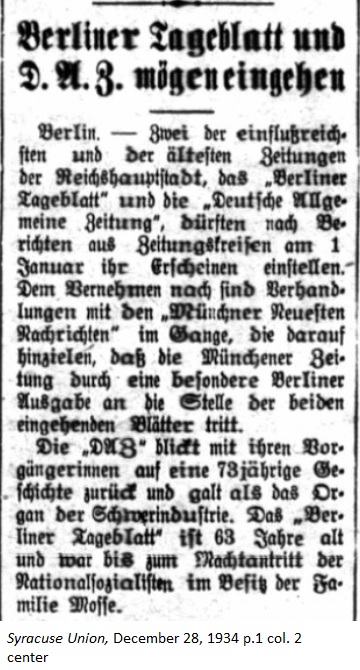
|
December 28, 1934 page 1 _____ Berlin. — Two of the most influential newspapers in the Reich's Capital City, the Berliner Tageblatt (Berlin Daily News) and the Deutsche Allgemeine Zeitung (German Universal News) may cease publication on January 1st, according to reports from newspaper sources. By all accounts negotiations are underway with the Münchner Neuesten Nachrichten (Munich Latest Reports) to have it issue a special Berlin edition in place of the two closing papers. The "DAZ" and its predecessors look back on its 73 year history as an organ of heavy industry. The Berliner Tageblatt is 63 years old and was in possession of the Mosse Family until the rise in power of the National Socialists. |
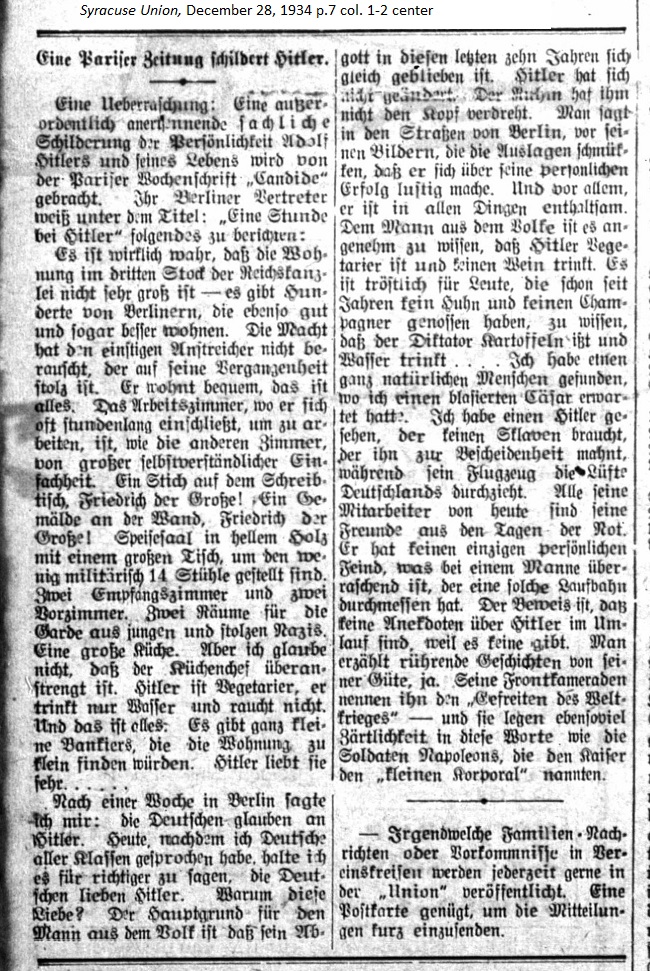
|
December 28, 1934 page 7 _____ A Surprise — An extraordinarily appreciative and factual description of Adolf Hitler's life and personality as published by the Parisian weekly newspaper, Candide. It's Berlin counterpart comes under the title, "An Hour with Hitler," which reads as follows: It's actually true that the residence on the fourth floor of the Reich Chancellery is not very large — there are hundreds of Berliners who live as well or much better. Power has not intoxicated the onetime house painter, who is proud of his past. He lives comfortably, and that's all. The workroom in which he often encloses himself for hours is, like the other rooms, genuinely simple. An engraving on the writing table, Frederick the Great! A picture on the wall, Frederick the Great! A dining room of light-colored wood with a large table around which are placed 14 somewhat-military chairs. Two reception rooms and two anterooms. Two rooms for the young and proud Nazi guards. One large kitchen. However I don't believe that the kitchen chef is overworked. Hitler is a vegetarian. He only drinks water and he does not smoke. And that's everything. There are no minor bankers, who would find the residence too small. Hitler likes it a lot ... After a week in Berlin I said to myself, the Germans believe in Hitler. Today, after speaking to Germans of all classes, I am certain it's correct to say, the Germans love Hitler. Why such love? The main reason according to the man on the street is that his idol has remained the same for the last ten years. Hitler has not changed. Fame has not turned his head. Someone says while in front of one of his pictures, which decorate the streets of Berlin, that he makes fun over his own personal success. And above all else, he is moderate in all things. The man on the street is pleased to know that Hitler is a vegetarian and he doesn't drink wine. This is comforting to people who have not enjoyed chicken or champagne in years. They know the dictator eats potatoes and drinks water... I have found an actual human being where I expected a pompous Caesar. I have seen Hitler, who needs no slaves, who advises modesty to others as his airplane soars through the air of Germany. All his coworkers of today are his friends from days of need. He doesn't have a single, personal enemy, surprising for a man who has travelled such a life course. The proof comes in there being no anecdotes circulating about Hitler, simply because there aren't any. People tell touching stories about his kindness, really. His frontline comrades call him the "Lance Corporal of the World." And they place great tenderness in these words just as Napoleon's soldiers, who called the emperor the "Little Corporal." — Any family news or societal events are gladly published in the Union. A postcard suffices for submitting a brief announcement. |

|
December 28, 1934 page 7 _____ The reverence for the spiritual heroes of the past occasionally takes on forms which cause the sober observer to smile. One of the most comical and enthusiastic homages is the clinging to harmless objects which once were in the possession of the great individual and now are acquired and preserved as relics of a specific kind. So it is with a pair of red velvet slippers belonging to Goethe, which have come into the possession of many owners and were displayed with reverence and wonder. These slippers are of a special sort. The name "Suleika" is embroidered in black on gold and a west-eastern patriarchal mood hovers around the lovely, comfortable footwear, which carry the names of the wonderfully celebrated lovers in West-Eastern Divan. In Karlsbad in 1795 a female gift-giver* was quite taken with State Minister von Goethe and she sent him a gift so "the Privy Counsellor would not soon forget her." Through the years she met him again and often gave him gifts, among which were the slippers. Goethe's slippers! Such esteem for such an everyday object, for in the end a slipper is in no way a rarity. The brilliant philologist Rudolf Hildebrand once mentioned wanting to establish an entirely new, scholarly branch of science concerning a "button belonging to Goethe," but on further reflection he ironically commented, it would be better to go with Schiller because someone had preserved an entire vest with a full set of buttons. What jubilation prevailed at the time when the Leipzig Schiller Society acquired this relic! It prompted young Theodore Fontane to climb up on Pegasus and compose a hymn concerning "Shakespeare's Socks." "Loudly praised, highly prized,
Behold, we have them now,
So let us honor his footwear
Behold, his wonderous hosiery,
_____ *[Translator's Note: The slipper donor might have been Marianne von Willimer.] |