Articles on Goethe in the 1920-35 Issues of the Syracuse Union
|
September 2, 1920, page 8
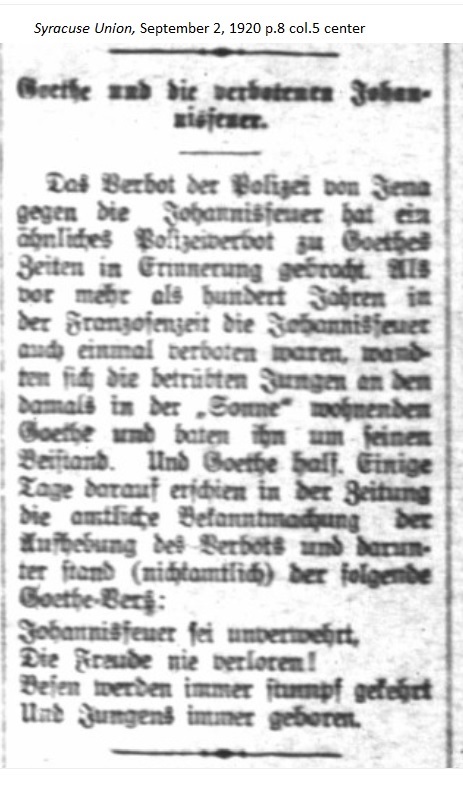
The ban against the St. John's Eve Bonfire by the Jena Police Department brings to mind a similar ban instituted during Goethe's time. More than a hundred years ago during the time of the French occupation, the bonfire was also banned. A group of disappointed youths went to Goethe, highly favored by the regime at the time, and asked for his assistance. And Goethe helped. A few days later an official decree appeared in the newspaper announcing the lifting of the ban. Underneath the announcement (and not official) stood the following verse by Goethe: May St. John's Bonfire no longer be banned,
[Translator's Note: A fuller explanation of the St. John's Bonfire of Jena can be found at a June 25, 1904 edition of the Vossische Zeitung. |
|
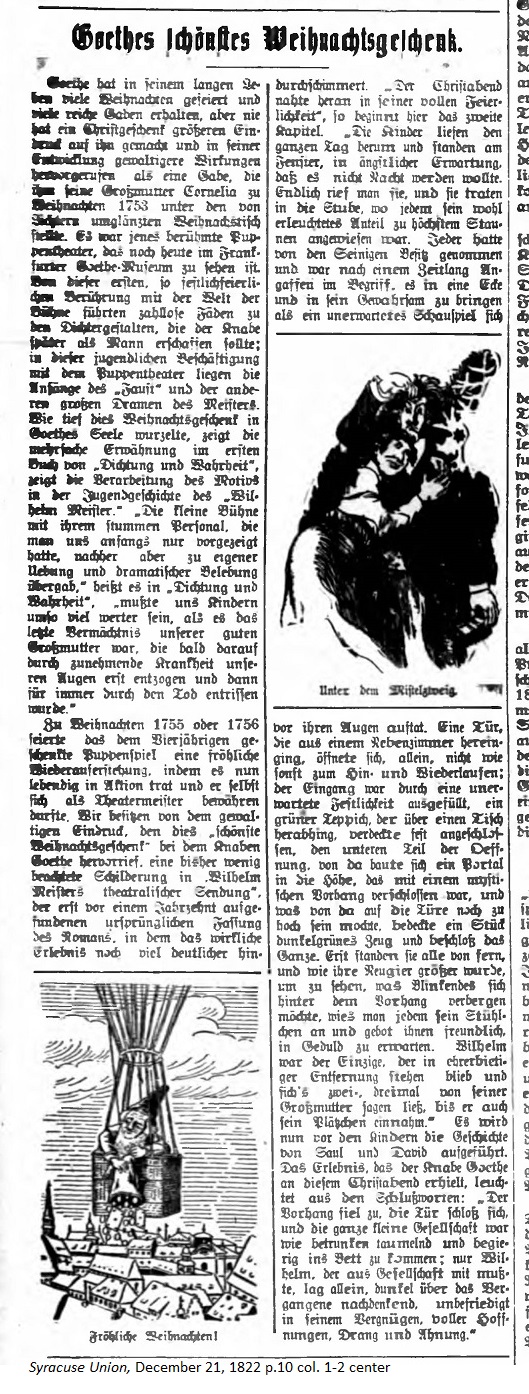
December 21, 1922 page 10 Goethe celebrated many Christmases in his long life and he received many grand gifts, but no Christmas present made a greater impression on him or more influenced his artistic development than the present his grandmother placed under the table decorated by firs for him during Christmas 1753. This was the famous puppet theater which can be seen to this day at the Goethe Museum in Frankfurt. From this first festive introduction to the world of the theater countless threads were tied to the poetic existence the boy would develop as he became a man. Behind his involvement with the puppet theater lay the beginnings of "Faust" and other great masterworks. How deeply this Christmas gift took root in Goethe's soul is shown in the first book of Dichtung und Wahrheit*. The story is reworked in the boy's narrative of "Wilhelm Meister." Book One states "At first we were shown the miniature stage with its silent characters, but then the figures came to life in dramatic performance. This became even more precious to us children because it was the last legacy of our grandmother, who soon after withdrew from us because of her illness and then was taken from us forever by death." On the Christmas Day of 1755 or 1756 the puppet theater given to the four-year-old enjoyed a happy comeback, this time with live action and Goethe himself installed as theater director. We receive a clearer image of the profound impression this "most beautiful Christmas gift," as the boy Goethe called it, in an until now little known description in "Wilhelm Meister's Theatrical Calling," originally composed as a novel ten years earlier. "Christmas Eve approached with all its festivities," Chapter Two begins. "The children ran about all day then would stand at the window in anxious anticipation of what the night would bring. Finally they were called and they entered the parlor where each excitedly received instruction on what he or she was to do. Each took his or her appointed place and after a while was called to attention as an unexpected theatrical performance took place before their very eyes. A door which led to another room opened, which was not to be used for entry and exit but rather as an access to a scene of unexpected solemnity. A green carpet hung over a table. It was tightly closed but there was an opening in the lower section on top of which was a portal covered with a mysterious curtain. The upper portion of the door was covered with a dark green cloth so you couldn't see anything above. Everyone stood up and in curiosity tried to peer inside to see what might be twinkling inside behind the curtain but they were all nicely told to go back to their seats and wait patiently. Wilhelm was the only one who at a respectful distance remained standing until his grandmother, twice, then three times told him to sit. Then he too took his seat." The story of Saul and David was performed for the children. The impression made on the boy Goethe that Christmas Eve was emphasized with these final words: "The curtain came down, the door closed, and the entire company stumbled as though drunken off to their beds. Only Wilhelm, who had to leave with the others, laid alone in the dark comtemplating what had passed, discontent with his own satisfaction and full of hope, urgency and apprehension." _______ [*Translator's note: See Dichtung und Wahrheit, Book 1, page 13 and Book 2, page 54. Wilhelm Meister's Theatical Calling is not available online in English. The German text can be found at https://www.projekt-gutenberg.org/goethe/meisthea/chap001.html] |
|
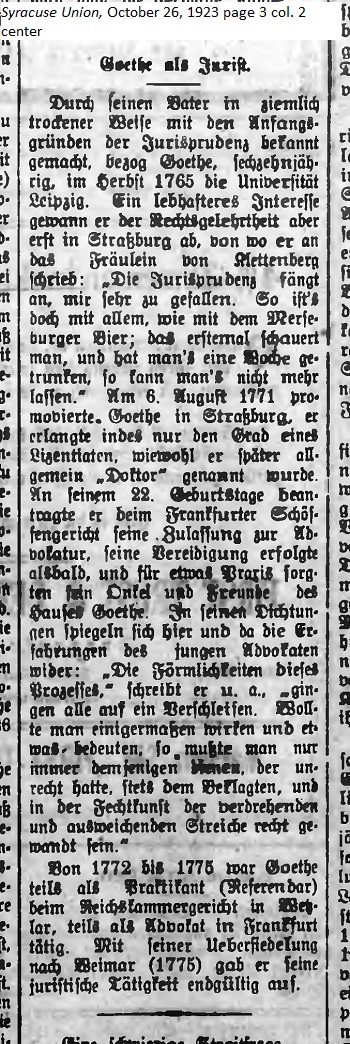
October 26, 1923 page 3 _____ It is known that Goethe began to study jurisprudence in 1765 at the University of Leipzig initially at the insistence of his father. However he gained his own enthusiastic interest in the study of law in Strassburg, as he wrote to Miss von Klettenberg: "Jurisprudence is beginning to appeal to me. It's like that with everything such as with Merseburger beer — at first it causes you to shudder but after a week drinking it you can never be without it." On August 6, 1771 Goethe earned his doctorate in Strassburg but with this he only gained his license to practice law, although later he was generally called "Doctor." On his 22nd birthday he applied to the Frankfurt Court of Assessors to practice law. His swearing in happened soon afterwards and he practiced law with his uncle and friends in Goethe's house. The experiences of the young advocate were reflected in his writings: "The formalities of this process all began with smoothing things over. If one wishes to have some influence and have meaning, one must always serve those who are in the wrong; always be the advocate for the defendant. In the swordplay of twist and evade, things will turn out right." From 1772 to 1775 Goethe worked partly as a law clerk at the Imperial High Court in Wetzlar and partly as an advocate in Frankfurt. With his relocation to Weimar (1775) he permanently gave up his law practice. |
|
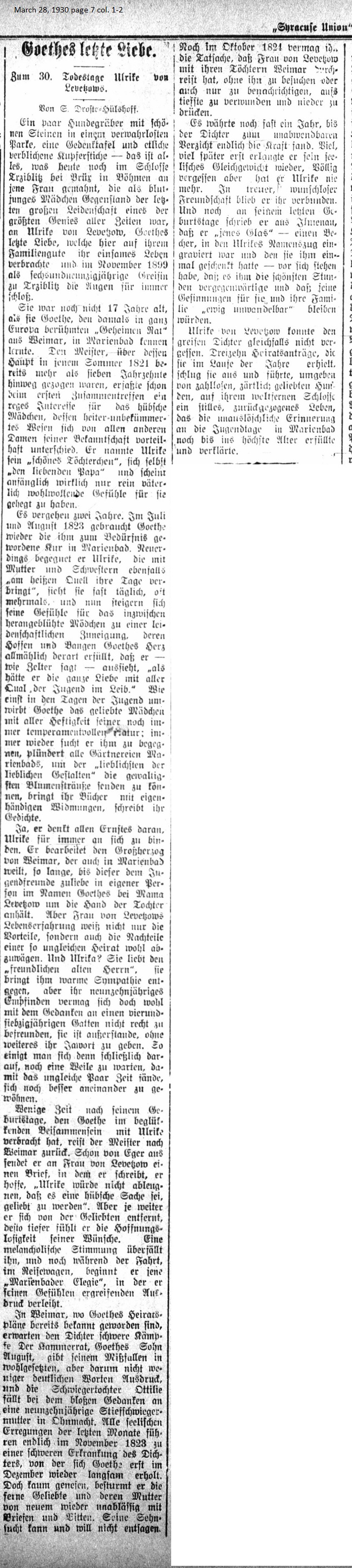
March 28, 1930 page 7 ______ On the 30th Anniversary of the Death of Ulrike von Levetzow ______ by S. Droste-Hülshoff A pair of dog's graves with beautiful headstones in a neglected park, a commemorative plaque, and several faded copperplate engravings — they're the only reminders of the woman who lived in Castle Trziblitz near Brüx in Bohemia. As a very young girl Ulrike von Levetzow was the last love of one of the greatest geniuses of all times, Johann Wolfgang von Goethe. She spent a solitary life at her family's estate in Trziblitz, and there in November 1899 at the age of ninety-six years she closed her eyes for the last time. She wasn't quite 17 years old when in Marienbad she met Goethe, the famous "Privy Councillor" from Weimar. Already more than 7 decades old in the Summer of 1821, their first meeting awakened in him an animated interest in the beautiful girl, whose happy and easy-going nature favorably distinguished her from all other female acquaintances. He called Ulrike his "pretty little sister" and she called him "beloved Papa." In the beginning he really seemed to have only fatherly feelings for her. Two years passed. In July and August of 1823 Goethe was again in need of taking the cure in Marienbad. He met Ulrike, who with her mother and sisters "was spending her days by the hot spring." He saw her nearly every day, sometimes more often, and this intensified his feelings to passionate devotion for the blossoming maiden who had matured in the interim. Goethe's heart filled with such hope and yearning that — as Zelter put it — it seemed "that he experienced love with all the anguish of youth." And like he was again in his youth Goethe courted the beloved girl with the intensity consistent with his temperamental nature. He always sought to meet her by plundering every florist shop in Marienbad so he can send magnificent bouquets to the "loveliest of all lovely creatures." He buys her books with hand-written dedications and writes her poetry. Yes, he actually thinks about binding himself forever with Ulrike. He convinces a friend of his youth, the Grand Duke of Weimar who's also in Marienbad, to ask Mama Levetzow for her daughter's hand on Goethe's behalf. However Mrs. von Levetzow's life experience recognizes not only the advantages but also the disadvantages of such a dissimilar pairing. And Ulrike? She loves the "kindly old gentleman." She has sympathy for him, but her nineteen-year-old sensibilities cannot reconcile with the thought of marrying a seventy-four year old man. Without further consideration, she is unable to say yes. So eventually it is decided to wait a while to see if the unlikely couple can find time to become better acquainted with each other. A short time after his birthday, which Goethe was fortunate enough to spend with Ulrike, the maestro returns to Weimar. Arriving in Eger he sends Mrs. von Levetzow a letter in which he expresses hope that "Ulrike would not deny that it is a beautiful thing to be loved." However the farther he gets from his beloved, the deeper he feels the hopelessness of his desire. A melancholy mood overtakes him and while still on the journey he begins the "Marienbader Elegie" (Marienbad Elegy) in which he gives poignant expression to his feelings. In Weimar, where Goethe's wedding plans are well known, the poet expects an uphill battle. The Court Councillor, Goethe's son August, expresses his well-chosen yet wordy displeasure and his daughter-in-law faints at the thought of having a nineteen year old mother-in-law. All the emotional agitation of the past months lead in November 1823 to severe illness for the poet and it's only in December that Goethe begins to slowly recover. Scarcely healed, he besieges his distant beloved and her mother with a storm of letters and requests. His desire can and will not cease. In October of 1824 he learns that Mrs. von Levetzow and her daughter travelled through Weimar without visitng him or even telling him. He's deeply wounded and depressed. It was almost a year before the poet finally found the strength to accept the inevitable conclusion. Later, much later he regained his intellectural equilibrium however he never completely forgot Ulrike. He stayed tied to her in true and contented friendship. And yet on his last birthday he wrote from Ilmenau that he received a goblet from Ulrike with her name engraved on it as a gift. He spent beautiful hours before it thinking that his feelings for her and her family would remain "forever unchanged." Similarly, Ulrike von Levetzow could not forget the aged poet. She received thirteen marriage proposals over the course of the years, but she refused them and led a secluded life in her remote castle surrounded by countless, dearly beloved dogs. The indelible memory of her days of youth in Marienbad sustained her into her old age. |
|
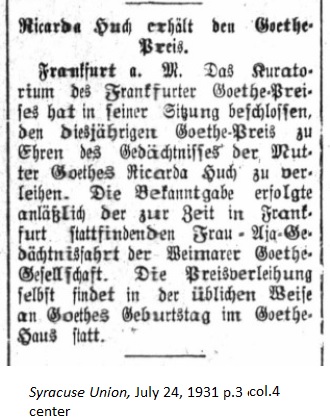
July 24, 1931 page 3 Frankfurt a. M. The Advisory Board for the Frankfurt Goethe Prize has closed its session. This year's Goethe Prize, given in memory of Goethe's mother, has been awarded to Ricarda Huch. The announcement took place following the celebration of the "Frau Aja" memorial journey of the Weimar Goethe Society. The prize itself is given in the usual manner on Goethe's birthday [August 28, 1749] at the Goethe House in Frankfurt. |
|
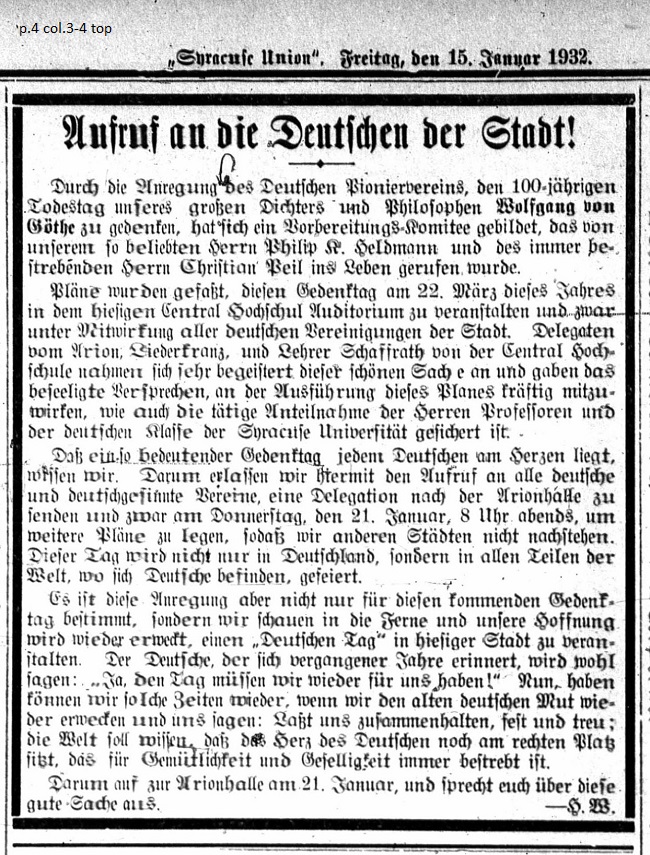
January 15, 1932 page 4 _____ At the suggestion of the German Pioneer Society a planning committee has been formed to commemorate the 100 year death date of our great poet and philosopher Wolfgang von Goethe. Our beloved Mr. Philip K. Heldmann and the ever-striving Mr. Christian Peil initiated the call for a committee. Plans have been made to hold this commemorative celebration on March 22nd of this year in the Central High School Auditorium. All the German organizations in the city will be participating. Delegates from Arion, Liederkranz, and Teacher Schaffrath of the Central High School have taken up this beautiful task with great enthusiasm and have given their solemn promises to vigorously work on an execution of the plan. Active participation by the professors and German classes of Syracuse University has been assured. We know that such a significant day of remembrance lies at in the heart of every German. For this reason we hereby issue a call to all German and German-minded societies to send a delegation to Arion Hall on Thursday, January 21st at 8 PM to set forth further plans so we do not lag behind any other cities. This day will not just be celebrated in Germany but in all parts of the world where you find Germans. The suggestion is not limited to the upcoming commemoration day but awakens a hope for the future that we might reinstitute a German Day celebration in our city. Germans who remember years gone by will certainly exclaim, "Yes, we must once again have a German Day celebration!" We can regain those good old days if we reawaken the old German courage and say, Let's get together, strong and true; the world should know that the heart of the German people is in its right place, forever striving for congeniality and sociability. Come to Arion Hall on January 21st and let's discuss this fine idea.
|
|
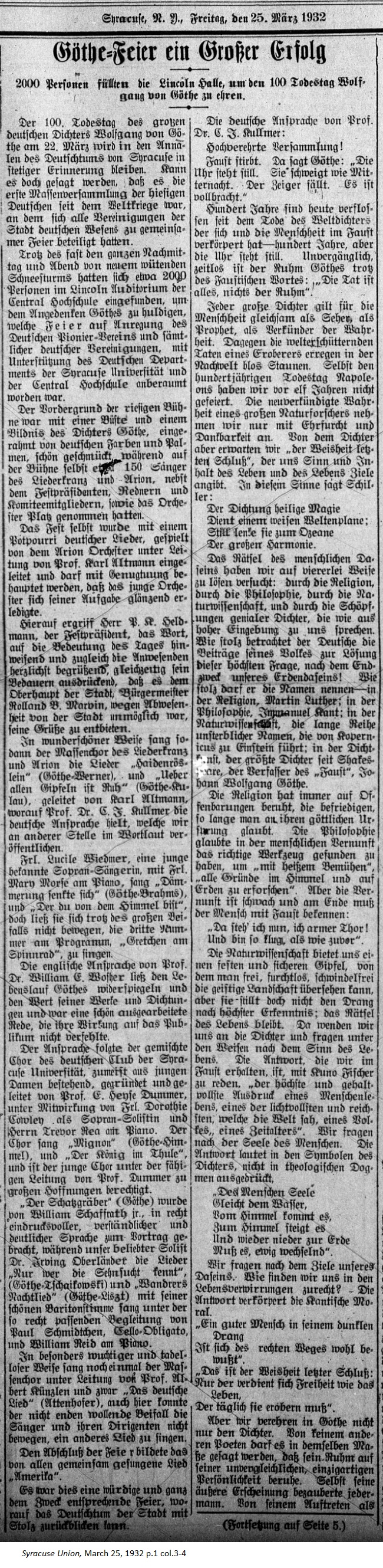
March 25, 1932 page 1 _____ 2000 People filled Lincoln Hall to Commemorate the 100th Death Date of Wolfgang von Goethe _____ Despite the recent snowstorm, which practically lasted all afternoon and evening, around 2000 people gathered in the Lincoln Auditorium of the Central High School to pay tribute to Goethe's memory. It was a celebration suggested by the German Pioneer Association and the all the city's German organizations, supported by the German Department of Syracuse University, and held at the Central High School. The foreground of the giant stage was beautifully decorated with a bust and portrait of the poet Goethe framed in German paints and palms. On the stage itself were 150 singers from the Liederkranz and Arion singing societies along with the festival president, speakers, and committee members plus the orchestra. The festivities included a potpourri of German songs, accompanied by the Arion Orchestra under the direction of Prof. Karl Altmann. Let it happily be noted that the young orchestra executed its assignment brilliantly. Afterwards Festival President P.K. Heldmann delivered a few words on the meaning of the day and heartily greeted all those present while also expressing his regrets that the mayor of the city, Rolland B. Marvin, was absent from the city and unable to offer his greetings. Then the group choir of the Liederkranz and Arion beautifully performed the songs "Haidenröslein (Goethe-Werner) and "Ueber allen Gipfeln ist Ruh" (Goethe-Kulau) conducted by Karl Altmann. Thereafter Prof. C.J. Kullmer gave a German language speech, the text of which we publish in a separate section. Miss Lucile Wiedmer, a young, well-known soprano, with Miss Mary Morse at the piano, sang "Dämmerung senkte sich" (Goethe-Brahms), and "Der du von dem Himmel bist". Despite the thundering applause she did not move until she performed the last song, "Gretchen an Spinnrad." The English language speech by Prof. Dr. William E. Wosher focused on Goethe's life and the value of his prose and poetry. It was a beautifully prepared address which did not fail to impress the audience. After the speech the mixed choir of the German Club of Syracuse University performed. The choir was comprised mostly by young women. It was established and conducted by Prof. W. Heyse Dummer with the participation of Miss Dorothie Cowley as soprano soloist and Mr. Trevor Rea at the piano. The choir sang from the opera "Mignon" (from the poem by Goethe, music by Himmel) and "Der König im Thule." Under the capable baton of Prof. Dummer the young choir exhibits great promise. "Der Schatzgräber" (Goethe) was recited by William Schaffrath Jr. in the German language in an expressive and clear manner then our beloved soloist, Dr. Irving Oberländer, sang the songs "Nur wer die Sehnsucht kennt" (Goethe-Tchaikowsky) and "Wanderers Nachtlied" (Goethe-Liszt) in his fine baritone voice accompanied by Paul Schmidtchen on the cello-obligato and William Reid at the piano. In an especially stunning and flawless rendition the group choir sang again under the direction of Prof. Albert Künzlen "Das deutsche Lied" (Attenhofer). Once again the unending applause prompted the singers and their conductor to sing another song. The conclusion of the celebration led to the song "America" sung by all. It was a a worthy and appropriate celebration upon which the German community of this city can look back with pride. The German address by Prof. Dr. C.J. Kullmer: Honored Assembly! Faust dies. Then Goethe says: "Time stands still. It's as silent as midnight. The clock stops. It is completed." A hundred years have flown by since the death of the world-poet, who epitomized himself and humanity in Faust — a hundred years, but time stands still. Goethe's fame is everlasting, timeless despite the Faustian words, "The deed is everything; fame is nothing." Every great poet works for humanity in a manner similar to the seer, the prophet, the herald of truth. Earth-shattering deeds of the conquerer merely elicit amazement in the next world. We didn't even celebrate the hundredth year anniversary death date of Napoleon eleven years ago. We accept the newly pronounced truth of a great researcher of nature with respect and gratitude. However from the poet we await "the ultimate conclusion of wisdom," which delivers us the sense and substance of life and its goal. In this vein Schiller speaks: The sacred magic of poetry
We have attempted to solve the mystery of human existence in many different ways: through religion, through philosophy, through the natural sciences, and through the creations of ingenious poets, who seem to speak to us from a higher level of intuition. How proudly the German considers his people's contribution towards the solution of this lofty problem, right to the end of their existence on earth! How proudly he names names — in religion, Martin Luther; in philosophy, Immanuel Kant; in natural science, a long list of iimmortal names from Copernicus to Einstein; in poetry, the greatest poet since Shakespeare, the author of "Faust", Johann Wolfgang Goethe. Religion has always relied on revelations, which satisfy so long as one believes in a divine origin. Philosophy believed it had found human reason to be the correct tool "to investigate all the reasons on heaven and earth" "with heated endeavor." However reason is weak and in the end man must recognize with Faust: "And here I stand with all my lore,
The natural sciences offer us a firm and secure perch from which one can survey the landscape freely, fearlessly and without feeling dizzy. However it still doesn't quiet the urge for higher learning. Life remains a mystery. So we turn to the poet and ask, how to make sense of life. The answer, which we find in "Faust" according to Kuno Fischer: Faust "is the highest and most substantial expression of a human life, he is the most enlightened and richest the world, a people, an era has ever seen." We ask about the human soul. The answer resounds in the symbols of the poet, not theological dogma. The soul of man
[From Gesang der Geister über den Wassern by Goethe.] We ask about the purpose of existence. How do we discover ourselves amid life's confusion? The answer epitomizes the Kantian moral "A good man in his dark urges
"Here is wisdom's final conclusion
However we don't just honor the poet in Goethe. So much more can be said of him than any other poet. His fame rests on his unique personality. Even his outward appearance charmed everyone. (Continued below on page 5) |

|
March 25, 1932 page 5 From his first entry as a youth at the Weimar Court to his last days when he was characterized by his olympic dignity and his sublime composure, he was considered a godlike entity transformed on earth. From no other poet were the journals, the speeches and letters so elaborately cited as a source of truth. If we turn to one timeless poetic creation, our attention is drawn to the fact that each work, including his immortal main opus, is one of overpowering experience. "I have always employed the ongoing harvest of experience in my existence," he once said. The harvest of the Sesenheimer era produced his first significant poetry. In the Sorrows of Young Werther, his first purely aesthetic work, he overcame the intoxicant of youth, the Storm and Stress Movement. From there he entered the path of his true destiny. The cultural world of western Europe had strayed into the pseudoclassical erroneous path and couldn't extract itself. A melding of the classical form with modern content originated out of the fire of the revolutionary period. But how peacefully, how solemnly he let the fateful days of the revolution pass over him. The fruit of these earthshaking events were perfectly illustrated in the classical idyll, "Hermann und Dorothea." In these days of reassessment of all values, where everything fluctuated, we should take a look at Goethe's attitude. When we contemplate the timeless significance of Goethe in his era we must not forget the influence of Schiller's friendship and the lasting mutual impact upon both of these unique geniuses. We must be astonished by the phenomenal extent of his creative intellect. His interests extended into all fields of study and investigation. However the subject above all others, whose range closely paralleled the national character of the German people, never left him in peace. It is the theme of the fall and reformation of humanity epitomized in the conjuror of the folk saga, Doctor Faustus. In the compendium of German literature there is no work which expresses so deeply the uniqueness of the German people. The conjuror, who through a pact with the devil acquires the pleasures of life, became a symbol for humanity, whose fate is decided through the investigation of life. In this questioning lies the grandiose character of Faust. Saying that the German exists among "the ranks of the poets and thinkers" is an honorable designation, however this honor was first bestowed upon him by the magnificent thinkers and poets of the 18th century. Of all the great ones who consistently enriched our intellectual treasury and who lent brilliance and prestige to the term German, the name Goethe stands in first place. For that reason on the hundredth anniversary of his death we bring the laurel wreath to commemorate his immortal ballads and pay tribute to his superior intellect. Indeed, what we say here is all too inadequate. Throughout the world one hears on this day of honor what was spoken by a choir: Traces of my days on this earth
|
|
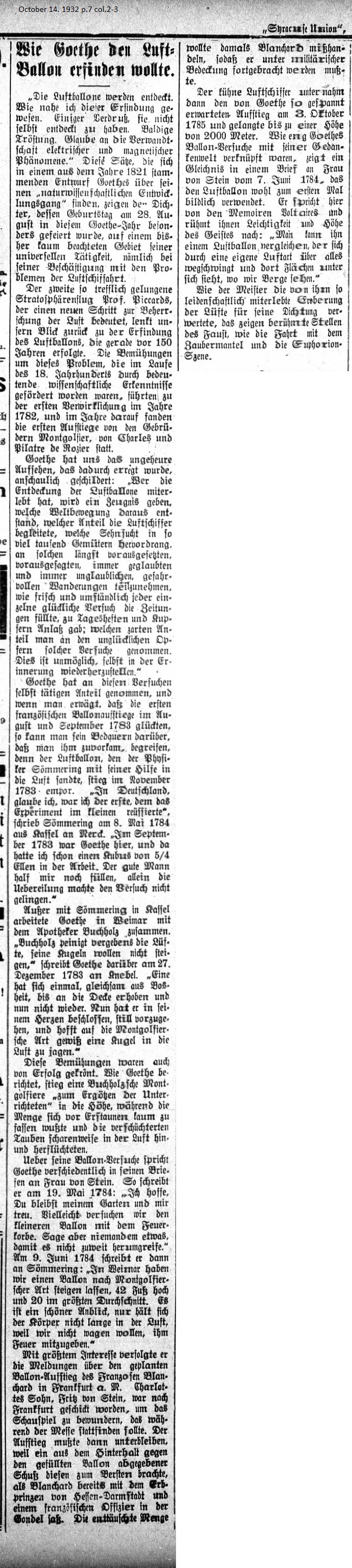
October 14, 1932 page 7 _____ "The hot air balloon was invented. How close I was to this invention. What chagrin, you didn't discover it yourself. Imminent consolation. Believe in the affinity of electrical and magnetic phenomena." These sentences, found in an 1821 outline by Goethe on his "path of progrssion through the natural sciences" shows the poet's universal activity . In this commemorative year of the 100th anniversary of Goethe's death, we have particular reason to celebrate his birthday on August 28th and his interest in a rarely noticed field of study, namely his work with the problems of airship travel. The second spectacularly successful flight into the stratosphere by Prof. Piccard [1932], who brought us a step closer to the mastery of the heavens, leads us back to the invention of the hot air balloon, which occurred 150 years ago. The struggles surrounding this problem, which during the course of the 18th century would have required significant scientific knowledge, led to the first actualization in 1782. A year later the first ascents were made by the Montgolfier Brothers, and Charles and Pilatre de Rozier. Goethe vividly described for us a huge sensation, which would thoroughly excite: "Whoever experiences the discovery of the hot air balloon will bear witness on how the earth moved, how it affects the airship, what yearning it will elicit in so many thousands of souls? How many things were assumed, predicted, believed though unbelievable; how many perilous journeys were taken? How fresh and laborious was each happy attempt that filled the newspapers? How many daily journals and copperplates? What sweet portion of mankind became unfortunate offerings? It's impossible to remember them all." Goethe himself had taken an active role, and when one considers that the first French ascents in a balloon successfully occurred in August and September 1783, one can imagine his regret that someone came before him, since the hot air balloon that the physicist Sömmering launched into the air with his help ascended in November 1783. "In Germany, I believe, I was the first who had limited success," Sömmering wrote on May 8, 1784 from Kassel on the Merck. "In September 1783 Goethe was here and I already had 5/4 cubits in the work. The good man helped fill the rest, however being overly hasty made the attempt unsuccessful." Besides working with Sömmering in Kassel, in Weimar Goethe collaborated with the apothcary Buchholz. "To no avail, Buchholz anguishes over air travel; his balloons don't want to ascend," Goethe wrote to Knebel on December 27, 1783. "Out of spite, one of them ascended up to the roof but went no farther. In his heart now he has decided to proceed quietly and take hope in Montgolfier's method of launching a balloon into the air." These efforts were crowned with success. As Goethe reported, a Buchholzian version of Montgolfier's balloon ascended to the heights "to the delight of the informed" while the masses, in astonishment, scarcely knew how to comprehend what was happening, and the scared flocks of pigeons flitted back and forth through the air. Goethe spoke about his balloon research on various occasions in this letters to Frau von Stein. On May 19, 1784 he wrote: "I hope you stay true to my garden and me. Perhaps we could try out the smaller balloons with the fire baskets. But don't tell anyone anything, so word doesn't travel too far." On June 9, 1784 he wrote to Sömmering: "In Weimar we have launched a balloon in the Montgolfier style, 42 feet high and 20 at the widest point. It's a beautiful sight, only it doesn't stay in the air too long because we haven't dared to give it some fire." With great interest he followed the announcement of the planned balloon launch by the Frenchman, Blanchard in Frankfurt a. M. Charlotte's son, Fritz von Stein was sent to Frankfurt to witness the drama while the Trade Fair was taking place. The launch had to cease because a sniper bullet caused the balloon to burst while Blandchard sat in the gondola with the Hereditary Prince of Hessen-Darmstadt and a French officer. The disappointed crowd wanted to assail Blanchard, so he had to be placed under military protection. The brave balloonist finally made the ascent so anticipated by Goethe on October 3, 1785 and reached an altitude of 2000 meters. How closely Goethe's balloon research was connected to his world of thought is shown in a letter to Frau von Stein on June 7, 1784 when he uses it in metaphor for the first time. He speaks here of Voltaire's memoires and credits him with levity and high intellect: "One can compare him to a hot air balloon, which swings out of the way of everything due to its own airlike nature. He sees flat surfaces below him where we see mountains." The maestro's utilization of his passionate interest in the conquest of air flight comes through in famous passages in Faust, such as the journey with the magic cloak and the euphoria scenes. |

|
July 7, 1933 page 2 _____ Among the costliest possessions of the library at the American Yale University is the Goethe Collection, which was assembled by the late William A. Speck. Last year during the centennial commemoration of Goethe's death, Yale University published its edition of the seventh and final volume of facsimiles reproductions from the collection, thus bringing the project, started in 1915, to a close. However a scholarly and complete catalog of the collection is still lacking. A preliminary installment is planned in the form of a smaller catalog containing the most important subjects in detailed description. A clear indicator of the precious nature of this collection is presented in this magnificent work titled Goetheana; a centenary portfolio of forty-three facsimiles & reproductions of unique or rare items from the William A. Speck collection. Five hundred copies were published. In the true-to-nature reproduction of the individual specimens, in which the Berlin establishment of Albert Frisch participated, the greatest possible precision was achieved. In the manuscripts and letters one sees each fold, each tear, the tiniest blemish contained in the original. One can see variations in ink and paper. The significance of the imaged letters, manuscripts, title pages, etchings, drawings, sheet music, silhouettes, medals, etc. will be presented in the introduction by the curator of the Speck Collection, Prof. Carl Schreiber. Much is revealed especially on the influence which Goethe had on the English-speaking world. Eight pieces relate directly to Faust. Thus Schreiber himself characterizes the content. "Goethe's own appearance is featured vividly through likenesses in individual portraits, silhouettes, busts, medals and drawings from the Italian Journey right up to his death. Goethe's manuscripts span more than half a century. May they serve as beacons, casting their rays forward and backward to illuminate the broad spectrum of the Goethe world. The series begins with a letter in which the intense excitement of Werther's era still vibrates. It closes with a poem, which expresses Goethe's unwavering hope for the approach towards a world literature as he and Carlyle dreamt of it and which would encompass the people of the world in a common bond. Between the poles of youthful Titanism and the heroic calm of old age we get an insight into Goethe's life as a husband, a friendly host, a theater director, etc. Goethe the poet appears in multiple personnae." Many documents display the influence of the Olympian on England, such as Carlyle's letter to Eckermann, the remarks of Henry Crabb Robinson in a letter to Knebel, the copy of Faust with an inscription by Byron, and three unique Werther pieces. The American roots for the justification of the collection include a self portrait by Longfellow reading from Goethe's works, the first draft of the poem "To Goethe" by Bayard Taylor, et. al. Concerning the universality of Goethe's creations we have, among other things, Schopenhauer's letter to Eastlake on Goethe's studies as a patron of the natural sciences, and in closing, a drawing of the Ilmenau mine, to which Goethe dedicated so much work and effort. |
|
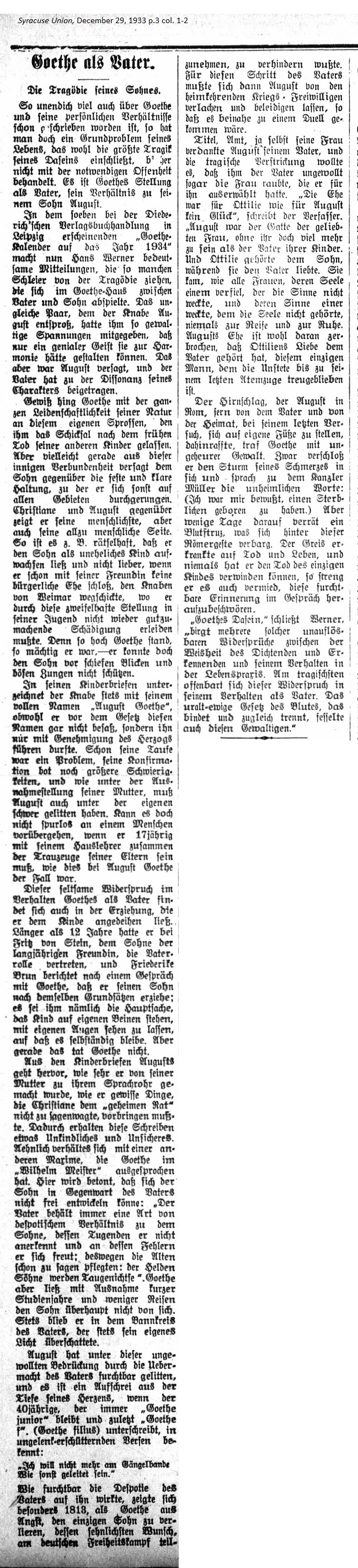
December 29, 1933 page 3 _____ The Tragedy of His Son In the newly released book by Diederich Publishing of Leipzig titled Goethe-Kalender auf das Jahr 1934 (Goethe Almanac for the Year 1934) Hans Werner discloses some significant information, which pulls back many veils concerning the tragedy which played out in the Goethe house between father and son. The dissimilar couple, from whom the boy August was spawned, created so much tension in his life that only a genial spirit could have shaped harmony from it. However August was denied this, and the father contributed to the dissonance in his character. It's certain that due to the very passionate nature of his being Goethe abandonned this, his only remaining offspring, after experiencing the premature death of his other children. Or perhaps it was due to this internal bond that he denied the son the firm and clear acceptance which he had struggled to attain in all areas. He showed his all-too-human side to Christiana [August's mother] and August. It's puzzling that he let his son grow up as an illegitimate child and not rather, even if he hadn't just signed a civil marriage contract with Christiana, sent the boy off to Weimar where he had to suffer irreparable damage due to the dubious status of his birth. For as high as Goethe stood, as powerful as he was, he could not protect his son from sideway glances and evils tongues. In his childhood letters the boy signed with his full name, "August Goethe," even though before the law he had no claim to this name. He was only permitted to do this with the approval of the Duke. Early on, his baptism was a problem; his confirmation offered even greater difficulties; and due to his mother's special status, how August must have suffered. And it certainly leaves a mark on a human being when at age 17 he and his private tutor had to be witnesses to his parent's wedding, as was the case for August Goethe. Goethe's odd contradiction in behavior as a father also shows up in the upbringing of the child. For longer than 12 years he had played the role of father for Fritz von Stein, son of a longtime friend [Charlotte von Stein.] After a discussion with Goethe, Frederike Brun reported that he would raise his son according to the same principles, namely teach the child to stand on his own two feet, and let him see the world through his own eyes so he would remain independent. However Goethe didn't do that. From August's childhood letters we learn how much he turned his mother into his mouthpiece, how he would tell her certain things which Christiana dared not tell the "privy councilor." There's something unchildlike and uncertain permeating these letters. It's similar to a maxim which Goethe had said in Wilhelm Meister which indicates that the son cannot freely develop in the presence of the father. "The father always maintains a sort of despotic relationship to the son, whose virtues he does not recognize and in whose flaws he relishes; for this reason the elders used to say, 'the sons of heroes become good-for-nothings.'" But with the exception of a brief study session and a few trips he didn't let his son know anything about himself. Instead he remained in the orbit of the father who overshadows his son's own light. August suffered terribly under the unwanted oppression of his father's superiority and it is an outcry from the depth of his heart when the 40-year-old, who always remained "Goethe junior," and eventually signed himself "Goethe f. (Goethe filius,) professed in awkward, convulsive verse: "I will no longer be led about
How dreadfully the father's despotism affected him is shown especially in 1813 when Goethe hindered August from fulfilling his dearest wish of participating in the German Wars of Liberation for fear of losing his only son. Because of his father's action August had to endure the laughter and abuse of the volunteers when they returned home from war and this nearly led to a duel. August had his father to thank for his title, his office, and even his wife. It would be this tragic involvement which caused his father to unwillingly steal the wife that he had chosen for his son. "The marriage was not a happy one for Ottilie or for August," the author wrote. "August was the husband of a beloved wife without his being more to her than the father of her children. And Ottilie belonged to the son while she loved the father. As with all women whose souls fall for someone who is not interested while awaking the interest of someone to whom her soul does not belong, she never came to maturity or achieved peace. August's marriage is shattered due to Ottilie's love for his father, the only man to whom this erratic woman remained true until his final breath. The stroke which August suffered in Rome and carried him far from his father and his homeland, occurred during his last attempt to stand on his own two feet. It hit Goethe with a powerful force. He kept the storm of pain inside and spoke these uncanny words to Chancellor Müller: "I was aware that I had given birth to a mortal." A few days later there was talk of a hemorrhage, a sign which the Romans concealed. The old man became ill and teetered between life and death. He could never get over the death of his only child no matter how strenuously he tried to avoid conjuring up the terrible memories in conversation. "Goethe's existence," Werner concludes, "hides many such unsolvable contradictions between the wisdom of the poet savant and his behavior in life practice. This contradiction is most tragically apparent in his conduct as a father. The age-old law of the blood, which binds and at the same time divides, even shackled this powerful figure." |
|
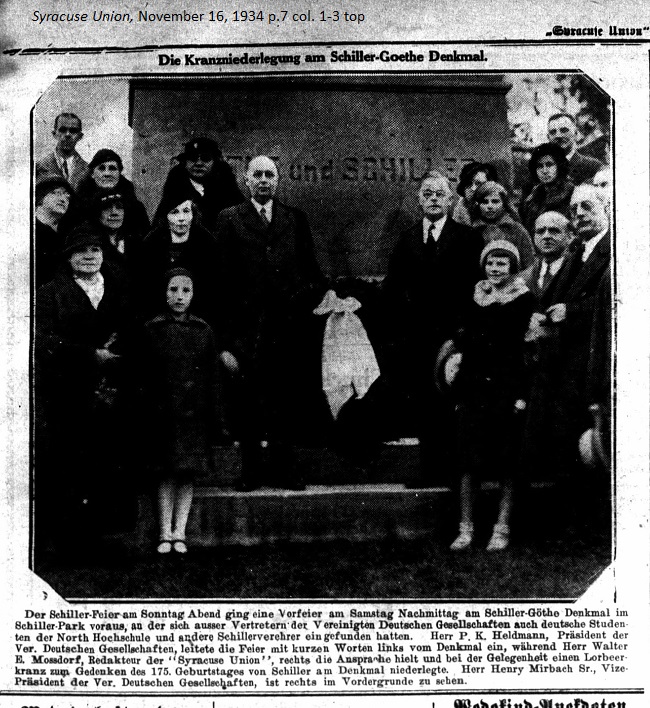
November 16, 1934 page 7 The Schiller celebration on Sunday was preceded by a preliminary ceremony at the Schiller-Goethe monument at Schiller Park on Saturday afternoon, which the representatives of the United German Associations attended along with the students of North High School and other Schiller devotees. Mr. P.K. Heldmann, President of the United German Associations conducted the ceremony. He's shown left of the words on the monument. Mr. Walter E. Mossdorf, editor of the Syracuse Union standing right of the words, gave a speech. A laurel wreath was laid at the monument to commemorate the 175th birthday of Schiller. Mr. Henry Mirbach Sr., Vice-President of the United German Assocations, is seen to the right in the foreground. |
|
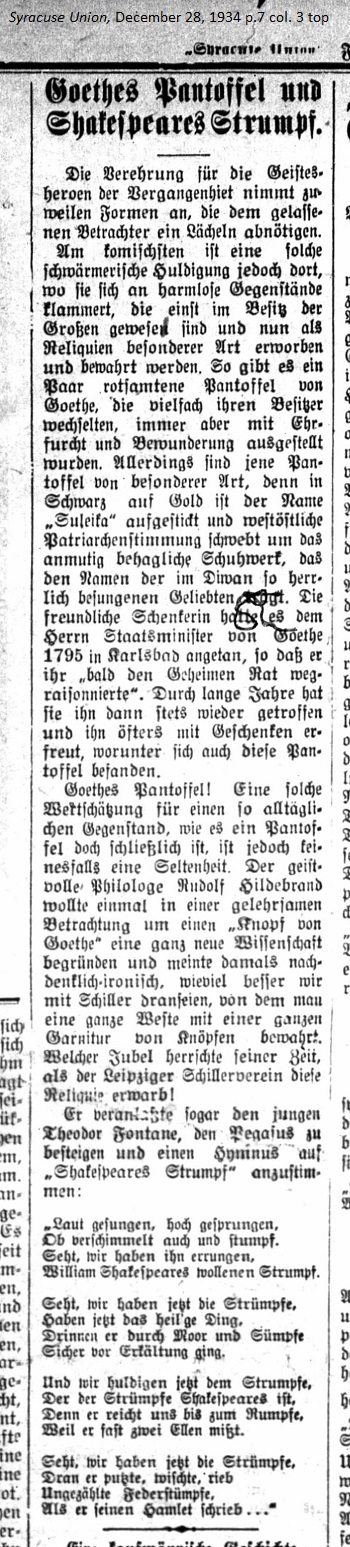
December 28, 1934 page 7 _____ The reverence for the spiritual heroes of the past occasionally takes on forms which cause the sober observer to smile. One of the most comical and enthusiastic homages is the clinging to harmless objects which once were in the possession of the great individual and now are acquired and preserved as relics of a specific kind. So it is with a pair of red velvet slippers belonging to Goethe, which have come into the possession of many owners and were displayed with reverence and wonder. These slippers are of a special sort. The name "Suleika" is embroidered in black on gold and a west-eastern patriarchal mood hovers around the lovely, comfortable footwear, which carry the names of the wonderfully celebrated lovers in West-Eastern Divan. In Karlsbad in 1795 a female gift-giver* was quite taken with State Minister von Goethe and she sent him a gift so "the Privy Counsellor would not soon forget her." Through the years she met him again and often gave him gifts, among which were the slippers. Goethe's slippers! Such esteem for such an everyday object, for in the end a slipper is in no way a rarity. The brilliant philologist Rudolf Hildebrand once mentioned wanting to establish an entirely new, scholarly branch of science concerning a "button belonging to Goethe," but on further reflection he ironically commented, it would be better to go with Schiller because someone had preserved an entire vest with a full set of buttons. What jubilation prevailed at the time when the Leipzig Schiller Society acquired this relic! It prompted young Theodore Fontane to climb up on Pegasus and compose a hymn concerning "Shakespeare's Socks." "Loudly praised, highly prized,
Behold, we have them now,
So let us honor his footwear
Behold, his wonderous hosiery,
_____ *[Translator's Note: The slipper donor might have been Marianne von Willimer.] |
|
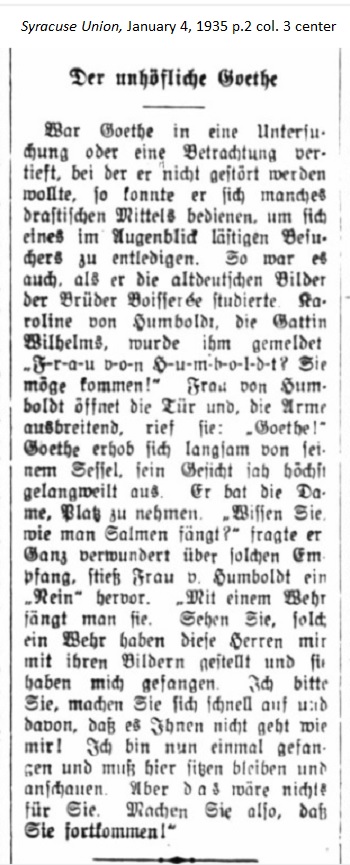
Janaury 4, 1935 page 3 _____ |

|
January 18, 1935 page 2 _____ A New Contribution on the Theme, Goethe and America. Than our aging continent, No crumblng castles And no hard basalt. You have no inner tension In such chaotic times, No useless memories Of futile dissension." This well-known set of poetic lines by Goethe sounds like a heavy sigh. Scarcely any other sentiment seems as descriptive of the intellectual heritage of Europe or the lukewarm regard for the allure of the new and unknown. This wasn't the sentimental enthusiasm for America of a writer like Seume, who had a begrudging scorn for Europe's veneer of civility. And still it's not just grounded in the concept of the land of limitless opportunity, which stimulated his hopes and opinion for the unburdened freshness of the new, self-generating American man as a beautiful counterpart to the close-knit environment of his world. Alexander von Humboldt had already strongly stimulated intellectual interest in America with the publishing of his travel experiences. From 1810 on Goethe also made the acquaintance of a series of Americans, including Colonel Burr, Bancroft, William Emerson and Burton Harrison of Virginia, whom he called "representatives of the New World transcending the thresholds of the houses in Weimar's Frauenplan neighborhood to deliver their greetings." From these men Goethe obtained a vivid picture of the powers which built their far-off states, culture, and economy and which offered them a far wider field of activities than the men in Europe, who were tightly pushed together in narrow confines. Even more important in the development of Goethe's image of America was the journey of Prince Bernhard in 1825. This son of Karl August was perhaps the first resident of Weimar to step foot on American soil, as Ernst Beutler in his contribution to the Dieterich Publishing House in Leipzig reported in the 1835 Goethe Calendar. The literary fruit of his visit to the New World was a travel journal of around 600 pages, the printing of which Goethe himself actively involved.* [* Translator's Note: An English translation of this book, Travels Through North America During the Years 1825 and 1826, is available through Project Gutenberg at https://www.gutenberg.org/cache/epub/41913/pg41913-images.html.] The deep impressions, which the Prince assembled concerning his interaction with the land and the people, did not fail to also affect Goethe. In Wilhelm Meister we find significant traces of intensive studies of America, which indicate personal knowledge of the New World among the European travelers as well as the influence of the rich experiences of the princely son of Weimar. Goethe's interest in the affairs of America further piqued as he obtained Cooper's Indian novels, which we all flew through with baited breath in our youth. In the Sources of the Susquehanna he couldn't just quit after a couple of readings, he had to make notes concerning the structure of the novel and its characters. Goethe excitedly read through the 1826 edition of Last of the Mohicans in three days. Then followed The Spy, The Pilot, and immediately after both parts of The Pioneers, and finally in 1828 The Red Rover. All books were read in English. Cooper's descriptive artistry filled him with the greatest admiration and he dictated to his secretary, "I admire the richness of the material and the wittiness of the handling. It's not easy to execute works with great awareness and such consistency as the Cooper novels." These Indian novels attracted the poet to acquaint himself with the events which inpired Cooper to tell his stories, and Goethe took Ramsay's history of the American Revolution to hand. "The way Cooper described American life made him want to have a great account of the history of America, and on February 28, 1827 he devised guidelines, to the extent they can be defined, and placed them as an assignment for the German literary world." |