January - June 1926

|
|
Syracuse Union Reaches The Large
German Speaking Population of Syracuse And Vicinity - Advertise | Syracuse Union
The Only German Newspaper Published in Syracuse. |
A Wise Merchant Will Advertise
In The Syracuse Union If He Wants To Get Or Keep German Trade |
| No 4 | Established 1856 | Syracuse, N.Y., Friday, January 22, 1926 | Eight Pages | Volume 74 |

|
January 22, 1926, page 1 col. 4 _____ Unjustly Accused of being an Enemy Foreign National Dr. Bowinkel, whose name has an excellent ring, came to the United States and California in 1892 and created a large practice. Soon he was a highly sought out surgeon. He obtained his first citizenship papers and was already prepared to become a citizen of this country when the late federal judge M.T. Dooling became severely ill but delayed getting tested. The war had waged already for more than a year. Dr. Bowinkel felt that as a member of the German Red Cross he had duties to fulfill so in conjunction with the United States government he was granted permission to travel to Germany. There on the Western Front Dr. Bowinkel performed great service as a field surgeon for a long period of time. Then he went to Spain and returned to the United States after the ceasefire. In the interim he was branded an "enemy foreign national" and all his property was confiscated. An administrator lived in his beautiful home in Alameda. All attempts to regain his property were useless. Federal Judge Rudkin commented while issuing his ruling that a man like Dr. Bowinkel, who as a physician brought relief to so many suffering people even though they were enemies of this country, should never have caused him to be branded an enemy foreign national especially since the United States abides by the [Geneva] Convention which is the reason permission was granted in the first place. |
|
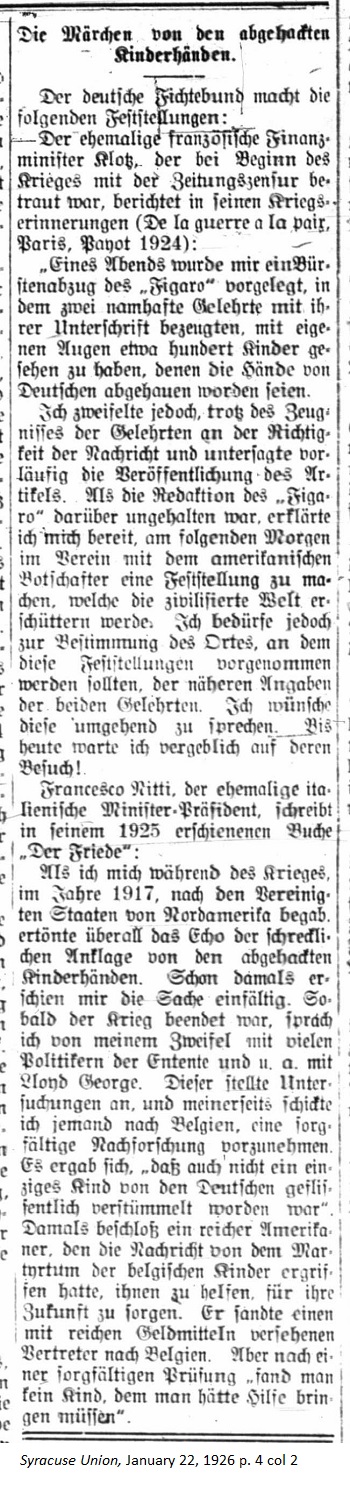
January 22, 1926 page 4 col. 2 _____ Former French Finance Minister Klotz, who at the beginning of the war was appointed a newspaper censor, reported in his war memoire, De la guerre a la paix, Paris, Payot 1924: One evening a proof from the Figaro was submitted to me in which two leading scholars issued sworn and signed statements that they had seen with their own eyes around two hundred children whoses hands had been hacked off by Germans. Despite the testimony of the scholars I doubted the veracity of the account so I disallowed the publication of the article. Since the editoral staff of the Figaro wasn't happy about this I declared that I was ready to make a statement the next morning in conjunction with the American ambassador which would shock the civilized world. I asked for the location of the two scholars who issued the statements. I wanted to speak with them immediately. To this day I'm still waiting for their visit! Francesco Nitti, former Italian Ministerial President, writes in his book titled The Peace published in 1925: "During the war in 1917 as I was going to the United States of North America the horrible accusation of hacked off children's hands echoed everywhere. The story seemed imbecilic to me. As soon as the war ended I spoke of my doubts with many politicians of the Entente and Lloyd George. This prompted investigations and I sent someone to Belgium to conduct careful research. The result — "not one single child was intentionally mutilated by the Germans." At that time a wealthy American was enraged by reports of martyred Belgium children and he decided to help them. He sent a representative with substantial funding to Belgium but after careful investigation "he found no child to whom one should bring help." |
|
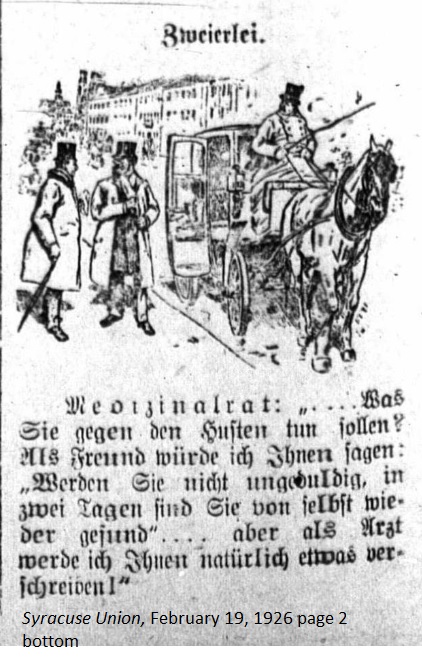
February 19,1926 page 2 Medical Advice: "...What should you do about that cough? As a friend I would tell you, 'If you are patient, in two days you'll be just fine'...but as a doctor I would tell you 'I'll prescribe you something.'" |

|
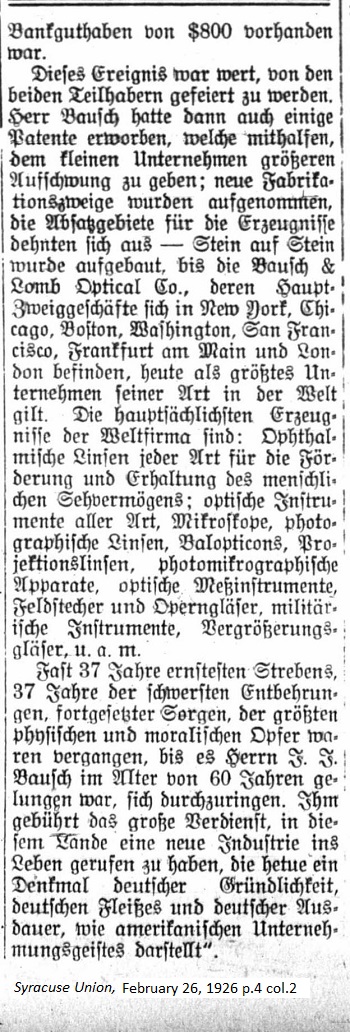
February 26, 1926 page 4 _____ In 1849 Bausch came to America, which relied completely on Europe for its eyeglasses and optical instruments because at that time the process for manufacturing lens was unknown in this country. The American optics industry was limited to the manufacture of horn mountings and frames for lenses. It was the young immigrant's hope to earn a living by grinding lenses. Other work had to be sought. In Buffalo tried to find work as a woodturner but he had an accident and lost two fingers at a sawmill. He had not forgotten the love for his profession and due to the accident he was no longer able to work as a woodturner, so he decided to return to the optical business in Rochester. J.J. Bausch had inexhaustible confidence that he would succeed in landing on his feet. His friend Henry Lomb, who had scaped together a living as a carpenter, lent him his savings of $60 for half interest in Bausch's business. With this gigantic sum Bausch started grinding lenses with a highly primitive machine he made himself. His partner Lomb, who came from Hessen-Kassel, made his living by all different kinds of work. However the optical business did not gain momentum. People did not believe in it. Bausch had to trade his wares for food. Lomb managed to get by alone but young Bausch had to take care of his wife, whom he had married in 1849. The instruments he needed for his business he got from his brother in Germany on credit. The Civil War broke out and Henry Lomb became a volunteer in the army. Every month then "Captain" Lomb sent a portion of his meagre wages to his business partner. These couple of gold dollars gined ever greater buying power and thus became a key factor in the continuation of the small business' operations. As the great industrialist himself once explained, "And then that little bit of luck arrived, or as some would say, that once in a lifetime moment for which he had waited finally came because he hadn't lost his courage." One afternoon during a business trip Mr. Bausch saw a piece of vulcanized rubber on the pavement. Picking it up and examining it he came upon the idea that this material would be good in the manufacture of eyeglass frames and other optical applications when previously only horn had been used. After some experimentation he succeeded in fabricating better and less expensive eyeglass frames. The work grew slowly until it eventually became a viable business. A watch factory sent in orders for the manufacture of watch housings using this material. Eyeglass stands also became popular. When Henry Lomb returned from the war Friend Bausch could show him that not only were all debts settled but also there was a bank account with $800 in it. This circumstance was worthy of celebration for both partners. Mr. Bausch had also acquired a few patents which helped the little enterprise gain greater momentum. New branches of manufacture began. The market area expanded. Stone was built upon stone until the Bausch & Lomb Optical Co. had branch headquarters in New York, Chicago, Boston, Washington, San Francisco, Frankfurt am Main, and London. Today it is the largest enterprise of its kind in the world. It's main product lines include ophthalmic lenses for every branch of research and the preservation of human sight; optical instruments of all varieties, microscopes, photographic lenses, photomicrographic apparatuses, optical measurement instruments, binoculars, opera glasses, military instruments, magnifying glasses, and other applications. Nearly 37 years of serious endeavor, 37 years of hardship, continuous trouble, great physical and moral sacrifice occurred until Mr. J.J. Bausch at the age of 60 succeeded. He performed a great service by bringing a new industry to this country. Today it stands as a memorial to German thoroughness, German diligence, and German endurance as it represents the spirit of American enterprise. |
|
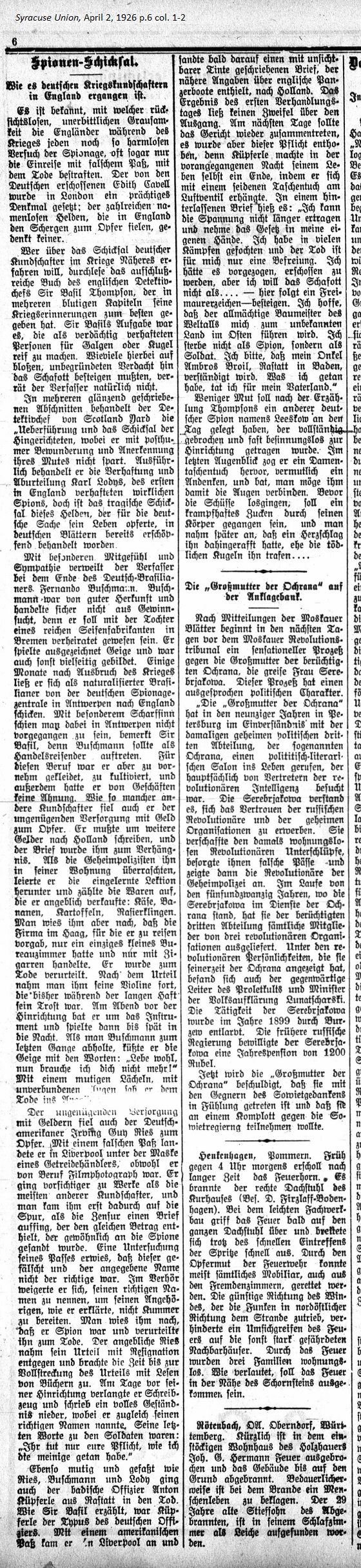
April 2, 1926 page 6 _____ How German Spies Fared in England during the War It's well known how ruthless and relentless the English were during the war against even the most harmless attempt at espionage. Even entering the country with a false pass could be punished with death. In London a magnificent memorial was erected for Edith Cavell, who was shot by the Germans. Numerous, nameless heroes who became the victims of English henchmen received no monuments. Anyone who wishes to know more about the fate of German spies should read the insightful book of English Chief Detective Sir Basil Thompson[sic], who superbly set down his wartime memories in many bloody chapters. It was Sir Basil's assignment to arrest suspicious people and bring them to the gallows or the firing squad. Naturally the author did not reveal the baselessness for many of the suspicions which brought someone to the scaffold. In the many well written passages the Chief Detective of Scotland Yard covered the "conviction and fate of those executed, whereby he does not spare the posthumous admiration and acknowledgement of their courage. He deals in detail with the arrest and sentencing of Karl Lodys, the first genuine spy in England. It was the tragic fate of this hero to offer up his life for the German cause and his story was already exhaustively covered in the German newspapers. The author exuded particular compassion and sympathy for the demise of German-Brazilian Fernando Buschmann. Buschmann was from a good family and he did not act for financial gain. He was about to marry the daughter of a rich soap manufacturer in Bremen. He was an excellent violinist and broadly educated in several areas. A few months after the outbreak of the war the German Espionage Service in Antwerp had him became a naturalized Braziian citizen. They then sent him to England. They didn't seem to operate too intelligently in Antwerp, Sir Basil commented, because Buschmann was supposed to enter England as a travelling salesman. For this occupation Buschmann was too well dressed and too cultured, besides which he had no knowledge of business practices. Like so many other spies he had not been sufficiently funded. He had to write to Holland to get more money and the letter sealed his fate. When the secret police surprised him in his residence he assumed his rehearsed persona and recited a list of the things he had for sale: cheese, bananas, potatoes, razorblades. But he was told that the firm in Haag he represented only had a small office and only dealt in cigars. He was sentenced to death. After the sentence was delivered someone brought him his violin which comforted him through his long imprisonment. On the evening before his execution he asked for his instrument and played it late into the night. As he was led on his final journey he kissed his violin and uttered these words: "Farewell, for I no longer need you!" With a courageous smile and unblindfolded eyes he looked death squarely in the face. The insufficiently funded German-American Guy Ries was also a victim. He landed in Liverpool with a false passport pretending to be a grain dealer even though he was actually a film photographer. Like other spies he worked carefully. People first discovered him when the censors checked his letter, which had the same content as what other spies usually sent. An inspection of his passport proved that it was falsified and the name on it was incorrect. During a hearing he refused to give his proper name so as not to trouble his relatives. He was labelled a spy and condemned to death. Ries accepted the verdict with resignation and spent the time until his execution reading books. The day before his death he asked for writing materials and he wrote out a full confession including his proper name. His last words to the soldiers were: "You are merely doing your duty as I have done mine." Just as courageous and composed as Ries, Buschmann and Lody, Baden officer Anton Küpferle from Rastatt went to his death. As Sir Basil reported, Küpferle was the typical German officer. He came to Liverpool on an American passport and soon after sent a letter written in invisible ink to Holland containing information on English armored ships. The results from the first hearing left no doubt of the outcome. The court was supposed to reconvene the next day but proceedings were tabled since Küpferle took his own life the following night by hanging himself with a silk handkerchief tied to an air valve. In a letter he left behind he wrote: "I can no longer bear the strain and I'm taking the law into my own hands. I have fought in many battles and for me death is liberation. I would have preferred to be shot but I don't want to climb the scaffold ..." — here follows a Freemason symbol. "I hope that the almighty architect of the universe will guide me to the unknown land in the East. I die not as a spy but as a soldier. I pray that my uncle, Ambros Broil of Rastatt in Baden, will understand. What I have done I did for my fatherland." According to Thompson's narrative, another German spy named Leeskow showed less courage on the day of his execution. He was completely crushed and was practically unconscious as he was carried to the gallows. At the last second he pulled out a woman's handkerchief, supposedly a keepsake, and asked that he be blindfolded. Before the bullets were fired, a spasm went through his entire body. People assumed he had a heart attack before the lethal bullets could reach him. The "Grandmother of the Ochrana" in the Prisoner's Box _____ According to reports in the Moscow newspapers over the next few days the Moscow Revolutionary Tribunal will conduct a sensational trial against the grandmother of the notorious Ochrana, elderly Mrs. Serebrjakowa. The trail has a downright political character. In the 1890s the "Grandmother of the Ochrana" with consent of the third division of the secret police in St. Petersburg, the so-called Ochrana, created a political and literary salon which was frequented by representatives of Revolutionary Intelligence. Serebrjakowa knew how to gain the trust of the Russian revolutionaries and the secret organizations. She provided shelter to homeless revolutionaries of that time. She got them false passports and then turned them over to the secret police. Over the course of twenty-five years, when Serebrjakowa worked for the Ochrana, she had delivered all the members of three revolutionary organizations over to the notorious third division. Among the revolutionaries she turned over was the current leader of the proletariat and minister of public enlightenment Lunatscharski. In 1899 Serebrjakowa's activities were unmasked by Burzew [Vladimir Burtsev.] The previous Russian government granted Serebrjakowa a yearly pension of 1200 Rubles. Now the "Grandmother of the Ochrana" will be tried for being on contact with opponents of Soviet thinking and for plotting against the Soviet government. Henkenhagen, Pomerania. At 4 in the morning the fire alarm rang for a long time. The right side of the casino roof belonging to D. Firzlaff-Bodenhagen was on fire. Since this was a half timberframe structure the fire quickly spread to the entire roof despite rapid response. Through self-sacrifice the fire department was able to save most of the furniture including the furnishings in the guest rooms. The wind pushed the flames in a northeasterly direction thus endangering neighboring houses. Three families became homeless. It's suspected that the fire started near the chimney. Rötenbach, Oberndorf, Württemberg. Recently the one-story residence of woodcutter Joh. G. Hermanm caught fire. The house burnt to the ground. Regrettably one human life was claimed by the flames. The 29 year old stepson of the owner was found dead in his bedroom. |
|
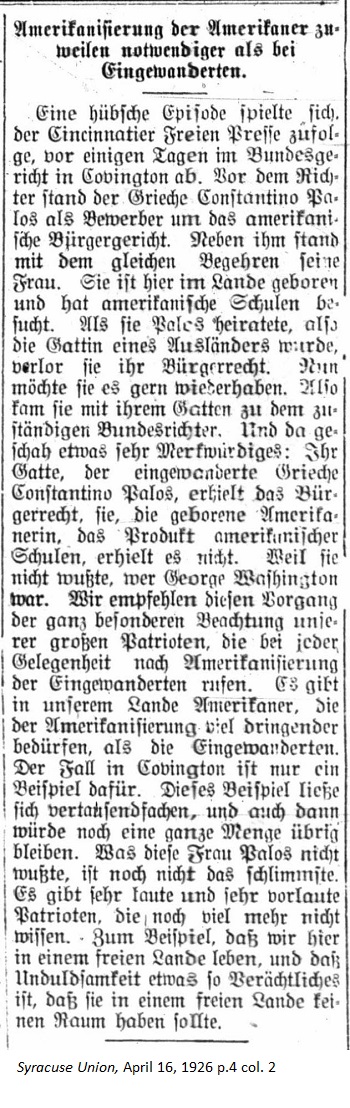
April 16, 1926 page 4 _____ According to the Cincinnatier Freie Presse [Cincinnati Free Press] a beautiful episode played out in the Federal Court in Covington. Greek immigrant Constantino Palos stood before the judge as an applicant for American citizenship. Next to him stood his similarly petitioning wife. She was born in this country and attended American schools. When she married Palos as the wife of a foreigner she lost her American citizenship. Now she was happy to regain it so she accompanied her husband to the federal judge. Then something noteworthy happened. The Greek immigrant Constantino Palos received his citizenship while she, the native-born American product of the American school system did not. She did not know who George Washington was. We ask our grand patriots, who call for the americanization of immigrants at every opportunity, to pay special attention to this episode. In our country there are Americans who might require americanization much more than immigrants. The case in Covington is only one example. This example could be reported thousands of times and yet many more thousands would remain unreported. What Mrs. Palos didn't know isn't the worst example. There are many loud and insolent patriots who know far less. For example, that we live in a free country and that intolerance is so contemptible that it should not exist in our country. |

|
April 23, 1926 page 4 _____ Lutheran Immigration Authorities will bring 4,000 Europeans to Canada over the Course of the Year _____ The Canada Colonization Association, which settles new immigrants from Europe on farmland in the West, reports that since the new year 40,000 acres of land have been sold. Purchases in one of the past few weeks alone totaled 10,310 acres. All parcels were purchased under the so-called Crop Payment Contract. The total cost amounted to 1,750,000 Dollars. The parcels were called "improved" farmland with buildings, machinery and livestock. In the month of March 19,830 acres of land were sold to 774 families who had already moved onto the farms. From January 1st to March 31st a total of 39,599 acres were sold to 161 families. 13,479 acres of land are located in Manitoba and have been sold to 71 families. 8930 acres sold to 33 families are in the Province of Saskatchewan. In the Province of Alberta 57 families purchased 17,160 acres. The German Mennonites from Russia represent the majority of purchasers. Among the remaining purchasers are Danes, Russians, Hungarians, Austrians, Scottish, and French Canadians. Some of the new settlers were able to make lesser or or larger down payments. Many had no money with which to make down payments. In the last week in March 10,310 acres were sold for a total sum of $425,000. The land transactions were conducted with the Canada Colonization Association in conjunction with the "Mennonite Settlement Board." The Association, working with the Lutheran Immigration Committee, has settled 3360 acres. The total sum for these land deals total close to 100,000 dollars. Land parcels are located as follows: 320 acres near Virden, Manitoba; 1280 acres near Wordsworth, Saskatchewan; 800 acres near Chater and 960 near Maryfield, Saskatchewan. Settlers for these farms came from Germany, Hungary, and Russia. |
|
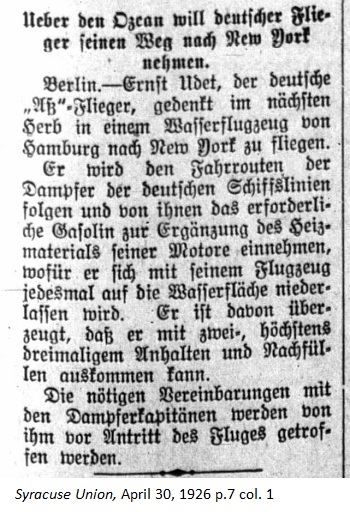
April 30, 1926 page 7 He will follow the route of the German steamship line. He will land on the water's surface and obtain the necessary fuel to keep his engine running from the steamship. He is convinced that he can complete the journey by refueling twice, or at most three times. The necessary agreement with the steamship's captain will be made before the commencement of the flight. |
|
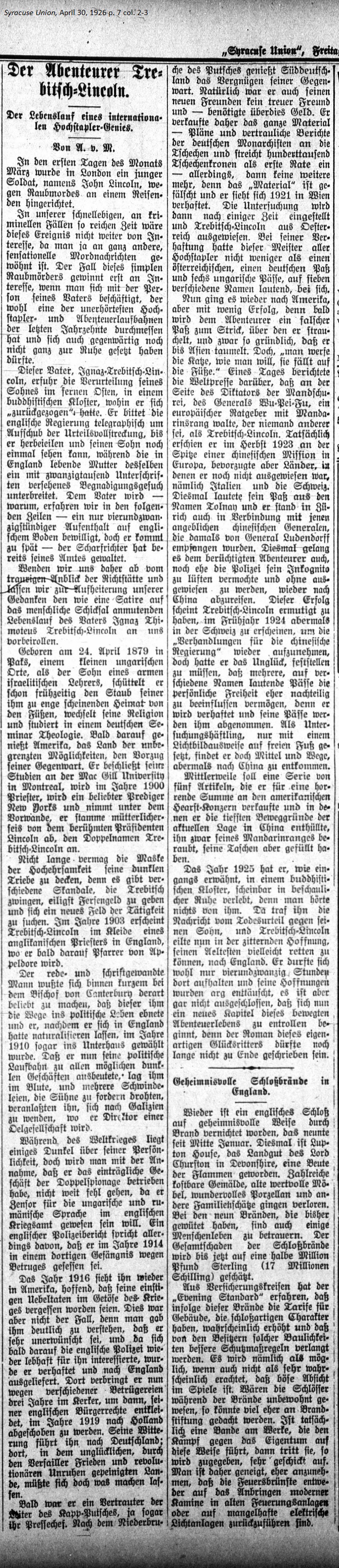
April 30, 1926 page 7 _____ The Life of a Genius International Confidence Man By A. v. M. In our fast-paced, criminally rich times this is no longer an event of interest since we are so accustomed to other sensational reports of murder. What becomes a matter of interest in this case is research into the murderer's father, the most outrageous confidence man and adventure seeker of the last decades who even today has not been entirely laid to rest. This father, Ignaz-Trebitsch-Lincoln, found out about his son's verdict while in the Far East in a Buddhist monastery to which he had "retired." He telegraphed the English government and requested it postpone the sentence until he could hurry back and see his son one more time. The son's mother, living in England, had submitted a plea for clemency with twenty thousand signatures. The father was granted a mere twenty-four hour permission to step on English soil. — We will learn why in a few paragraphs. — The father arrived too late. The executioner had already performed his job. Let us turn away from the sad sight of this execution and allow our spirits to be raised by examining the life of Ignaz Thimoteus Trebitsch-Lincoln as it scrolls before us in satire. Born on April 24, 1879 in Paks, a small region of Hungary, Trebitsch-Lincoln was the son of a poor Israelite teacher. At a young age he scraped off the dust of the tiny confines of his homeland, changed his religion and studied in a German theological seminary. Soon after America, the land of limitless opportunity, was graced with his presence. He finished his studies at McGill University in Montreal, became a priest in 1900 and a beloved preacher in New York. Under the pretense that on his mother's side he was related to the famous President Abraham Lincoln, he assumed the double surname Trebitsch-Lincoln. Not long thereafter the mask of grand respectability which covered his dark ambitions fell and there were many scandals which forced Trebitsch to turn tail and seek a new field for activity. In 1903 Trebitsch-Lincoln appeared in the garb of an Anglican priest in England. He became the pastor of Appeldore. The well-spoken and literate man swiftly became a favorite of the Archbishop of Centerbury, who paved the way to a political career for Trebitsch as soon as he was naturalized. In 1910 he was elected to the House of Commons. His political career lent itself to all manner of shady business. It led to many cases of swindle. The demand for atonement prompted him to move to Galicia where he became the director of an oil company. During the World War a dark cloud obscures him from view. The assumption that he operated as a professional double agent may not be far from the truth. He wanted to become a Hungarian and Russian translator in the English War Office. An English police report indicated that in 1914 he was imprisoned for fraud. The year 1916 sees him again in America, hopeful that his former bad deeds would be forgotten amid the bluster of the war. However this was not the case. He was given to understand that he was not welcome since the English police had a lively interest in him again. He was taken into custody and sent back to England. There he spend three years in jail for various cases of fraud. He was stripped of his English citizenship and in 1919 deported to Holland. He travelled to Germany. With the unfortunate circumstances caused by the Versailles Treaty and the revolutionary unrest he found lots to do. Soon he was a confidant to the leader of the Kapp Revolt. Trebitsch became his Press Chief. After the dissolution of the revolt Trebitsch went to suthern Germany. Naturally he was not a true friend to his new friends, he just needed money. He sold plans and confidential reports of the German monarchists to the Czechs and collected an initial payment of one hundred thousand Czech Krone — however after this there were no more payments because the reports were falsified. In 1921 he was arrested in Vienna. After a while the investigation was concluded and Trebitsch-Lincoln was deported from Austria. While under arrest this maestro of confidence men had amassed no fewer than one Austrian and one German passport plus six Hungarian passports under various names. He went back to America but had no success. Soon one of the adventurer's false passports became his downfall and he finagled his way to Asia. But as the saying goes, "No matter how you toss the cat it always lands on its feet." One day the world press reported that along the side of the Manchurian dictator, General Wu Pei Fu was a European advisor who ruled with Mandarin authority. That advisor was none other than Trebitsch-Lincoln. In the Fall of 1923 he was at the head of a Chinese mission to Europe preferring countries from which he had not been expelled, namely Italy and Switzerland. This time his passport was under the name of Tolnay. In Zurich he stood with the other Chinese generals at a reception held by General Ludendorff. The notorious adventurer managed to remain incognito, thus escaping police attention and deportation. Returning to China this success seemed to embolden Trebitsch-Lincoln. In the Spring of 1924 he went to Switzerland in order to renegotiate certain issues for the Chinese government. He had the misfortune of learning that having multiple passports under different names can be disadvantageous to one's personal freedom. He was arrested and his passports were confiscated. Being detained during further investigation and with only one photo identication he still managed to find the ways and means to escape back to China. By then he had sold a series of five articles for an enormous sum to the American Hearst corporation in which he revealed the reasons for the situation in China. He was divested of his Mandarin rank but his pockets were filled with money. As previously mentioned, in 1925 he entered a Buddhist monastery supposedly to live a more tranquil existence. Nothing was heard about him. Then he discovered the death sentence pronounced on his son. Trebitsch-Lincoln hurried off on the shaky hope that he could save his eldest child in England. He could only remain there for twenty-four hours and his hopes were thoroughly dashed. However it is not out of the question that a new chapter will begin for this adventure seeker. It may be a long time before the final story for this soldier of fortune will be written. Mysterious Mansion Fires in England _____ From insurance circles the Evening Star has learned that as a result of these fires the tariff on buildings possessing a palatial character will most likely increase and owners will be required to provide better security measures. It's possible and even probably that evil intentions are in play here. If the mansions were uninhabited at the time many would think that this was arson. If its a band at work which is waging war on properties of this kind, it must be admitted that it is quite skilled. One is inclined to think that the blazes are caused either by installation of modern chimneys to old furnaces or the lack of electrical light fixtures. |
|
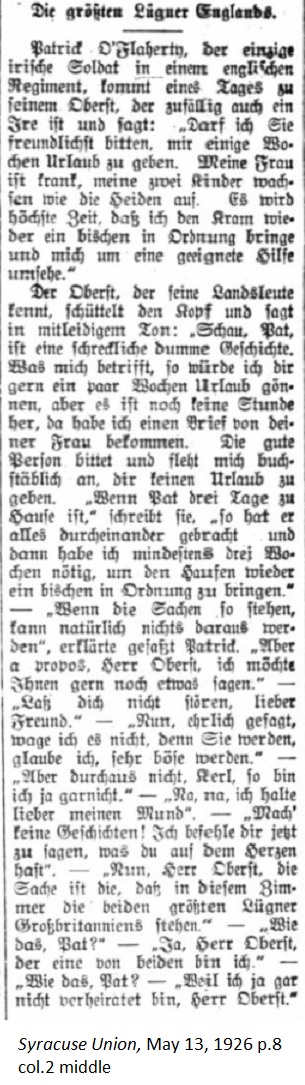
May 13, 1926 page 8 _____ The Colonel, who knows his countrymen well, shakes his head and says in a sympathetic tone, "Look, Pat. That's a dreadfully stupid story. If it were up to me I'd gladly grant you a couple weeks leave, but not an hour ago I received a letter from your wife. The good woman literally begged me not to give you leave. "If Pat is home in three days," she writes, "he'll ruin everthing. I need at least three weeks to get the house back in order." —"As things stand, I suppose nothing good can come if it," Patrick firmly declared. "But with regard to all this, Colonel, I'd like to tell you something." —"Don't worry about it, my friend." —"Good of you to say but I believe you're going to get angry." —"Not at all, buddy." —"Still I think I'd better shut my mouth." —"Oh,stop. I order you to tell me what's on your mind." —"Alright, Colonel. The truth is that in this room stand the two greatest liars in Great Britain." —"How is that, Pat?" —"Colonel, I'm one of the two because I'm not married." |

|
May 28, 1926 page 8 _____ Please excuse me for allowing myself to turn to you and your dear readers with my concerns and ask for help for my wife and 2 children waiting in Canada since under the current circumstances I cannot help them. My lack of money due to the inflation prompted me 2 years ago to accept my brother-in-law's offer to work for him in Canada. In payment for my work he promised me one third of the harvest from 4 out of 4 parcels of land. I sold my furniture to pay for my passage. Once I arrived he refused to keep his promise because all newly arrived Germans were employed for 25 Dollars per month. Considering the large expenditure for 4 tickets I could not afford to go along with this. My brother-in-law violently attacked me and injured my left foot. I was under a doctor's care for 3 months and was unable to perform heavy labor. He was only fined 10 Dollars and my civil suit was denied by the Provincial Police and the District Court. I was deemed a dependent of my brother-in-law. Even though right was on my side, at first my brother-in-law insisted I be deported. The government later told me they did not wish to get involved in our dispute because the original deal had been conducted privately. Here one notices the subsequent influence of the District Court which my brother-in-law, who is pro-English, used in cultivating the government's protection to my detriment. Without knowledge of the language and an injured foot I couldn't find work, so I couldn't feed my family. Dispair drove me last month to abandon my family and return to Germany for help but circumstances here are so dire that I can find neither work nor help. In my great need and cluelessness and in my concern for my loved ones, whom I certainly must help, I turn in reliance to you with the request, placed as an ad in your newspaper, that your readers show charity to my wife. I cannot believe that as Germans you have no heartfelt sympathy for the dire fate of my wife, who languishes hopelessly with her children in a foreign land. Confirmation of my information can be obtained from Mr. Paul Juettner in Prelate, Sask., Canada. Will you please send donations to my wife, Mrs. Katharina Dauscher in Nelson, B.C. Canada. If contrary to expections nothing comes of this, could you perhaps send me the address of a well-to-do and noble-minded person who might give financial support for my family's deportation. I ask you as earnestly as I can, not to deny me your precious support. Don't be heartless. Ask your brother Germans for alms and don't take away my last hope for help. Put yourself in the position of my wife and have mercy on her and my innocent children. In advance let me send you my heartfelt thanks. I remain yours in true German greeting. Respectfully,
|
|
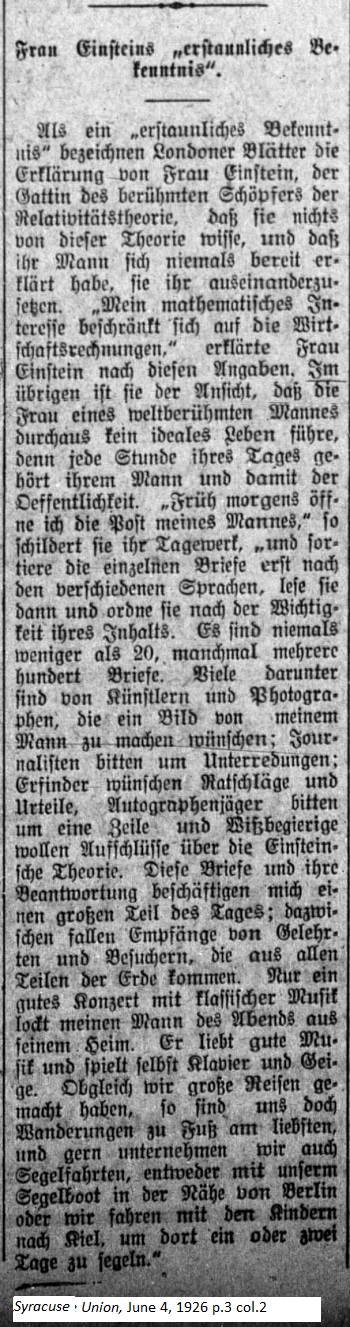
June 4, 1926 page 3 _____ |
|
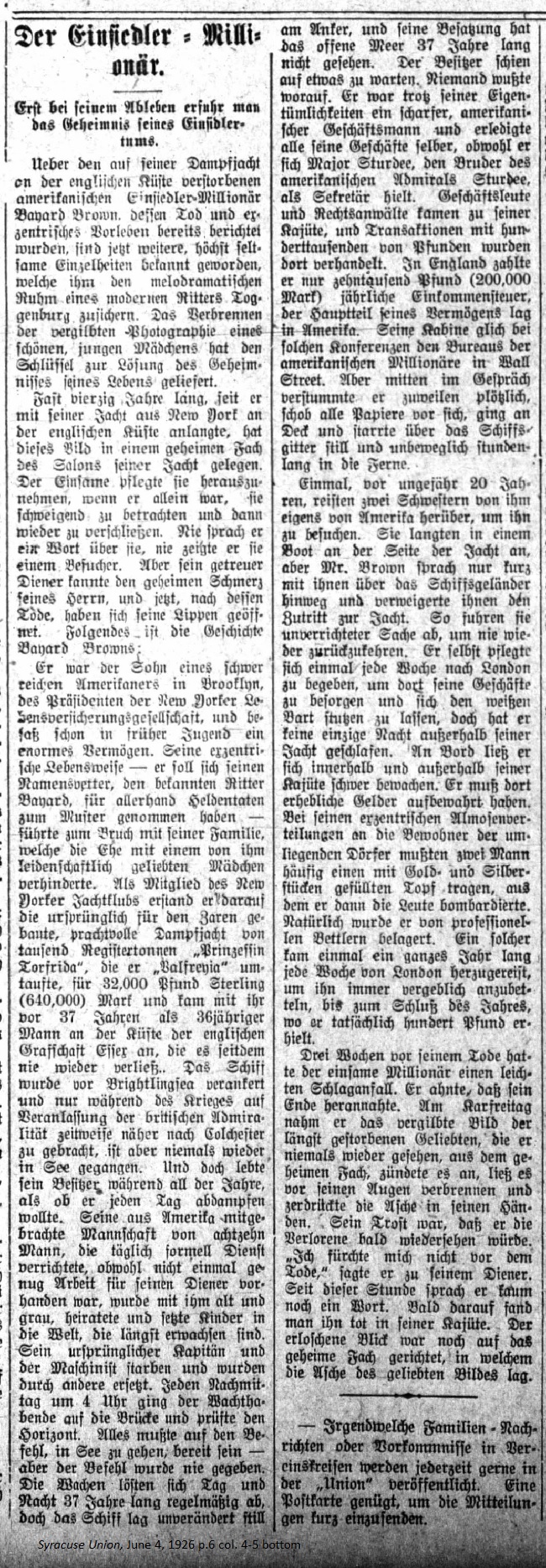
June 4, 1926 page 6 _____ Only after His Death did People discover the Secret Reason for his Seclusion Nearly forty years ago he sailed his yacht from New York and reached the English coast. Since that time the photograph has been in a secret compartment in his parlor. The hermit only took the picture out when he was alone. He examined it quietly then put it away. He never said a word about it to anyone and he never showed it to a visitor. However his loyal servant knew his master's secret pain and now with his death the servant is unsealing his lips. The following is the history of Baynard Brown. He was the son of a very rich American in Brooklyn who was president of the New York Life Insurance Company. He possessed an enormous income at an early age. He had supposedly taken his namesake, the well-known heroic Knight Bayard, as his role model. His eccentric lifestyle led to a break with his family, which had hindered his marriage to a girl he passionately loved. As a member of the New York Yacht Club he purchased a magnificent steamer yacht originally built for the Czar and called the Princess Torfrida. It was registered at one thousand tons. Bayard christened her "Valfreyia." He paid 32,000 Pounds sterling (640,000 Marks) for her. Thirty-seven years ago as a 36 year-old man he arrived on the Englsh coast at the County of Essex, which he never left. The ship was anchored near Brightlingsea and only moved at the request of the British admiralty during the World War to Colchester. He never went back out to sea again and yet he lived each day for the rest of his life as though he might decide to sail off any day. The crew of 18 men he brought with him from America performed their formal tasks even though there really wasn't enough work for each to perform. They grew old and gray with him, married, brought children into the world who grew to adulthood. The original captain and machinist died and were replaced. Every afternoon a 4 PM the watch commander went to the bridge and searched the horizon. Everything had to be prepared for the order to go out to sea, but the order never came. For 37 years the watch was relieved regularly as the ship remained still at anchor and the crew did not see the open sea for 37 years. The owner seemed to be waiting for something but no one knew what it was. Despute his peculiarities he was a sharp American businessman and conducted all his own deals even though he employed Major Sturdee, brother of American Admiral Sturdee, as his secretary. Businessmen and attorneys came to his cabin, where transactions for hundreds of thousands of pounds were made. In England he paid only ten thousand pounds (200,000 Marks) in yearly income tax. The major portion of his income stayed in America. During such transactions his cabin resembled the office of an American millionaire on Wall St. However suddenly amid business conversations he would go silent, shove all papers away from himself, go on deck, stare off into the distance, and remain still for hours. One time, about 20 years ago, two of his sisters came over to visit him. They landed a boat at the side of the yacht but Mr. Brown only spoke briefly with them over the ship's railing and refused to let them come onto the yacht. They conducted various pieces of business so they would never have to return. Brown himself went to London once a week to take care of business matters and to have his white beard trimmed but he never spent a single night off of his yacht. Onboard he was seldom seen in or out of his cabin. He must have kept significant sums of money in there. In an eccentric manner of distributing alms to the residents of the local villages he had two men carry a huge pot filled with gold and silver pieces onto the deck. Brown then bombarded the people with the coins.Naturally he was besieged by professional beggars. One such beggar came by every week for a year from London to beg, but to no avail. However at the end of the year he received one hundred pounds. Three weeks before his death the solitary millionaire had a minor stroke. He realized that his end approached. On Good Friday he took the yellowed picture of his long deceased beloved, whom he had never seen again, out of the compartment, lit it and watched it burn before his eyes. He crushed the ashes in his hands. He took solace in the fact that he would see her soon. "I am not afraid of death," he said to his servant. After this hour he scarcely spoke a word. Soon after he was found dead in his cabin. His blank gaze was directed towards the secret compartment in which the ashes of the beloved photo laid. Family announcements or organizational events will gladly be published anytime in the Union. A postcard will suffice to submit the information |
|
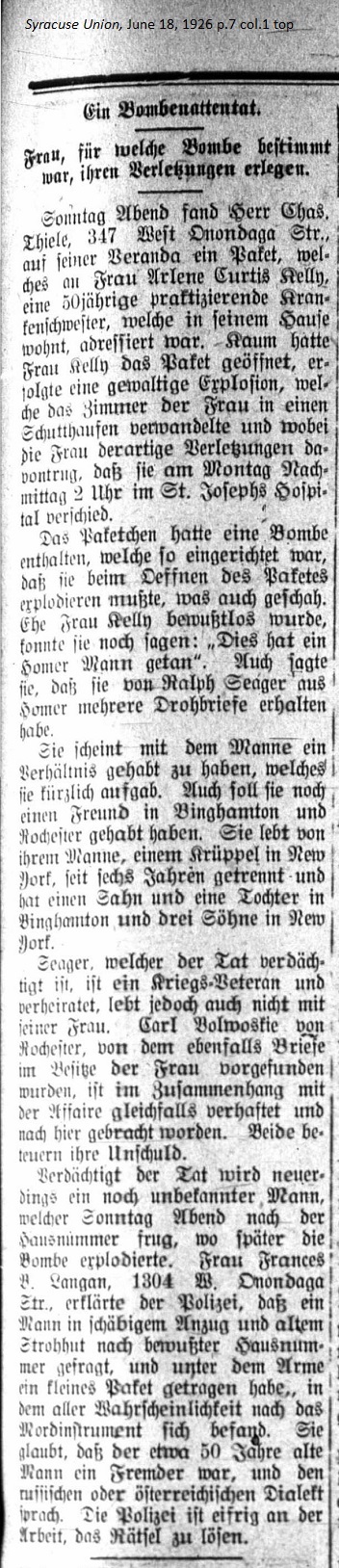
June 18, 1926 page 7 col. 1 ______ Woman, for whom the bomb was meant, died from her injuries _____ The package contained a bomb which was designed to explode when it was opened. Before Mrs. Kelly lost consciousness she said: "A man from Homer has done this." She also said that she had received many threatening letters from Ralph Seager of Homer (New York.) She appears to have had a relationship with the man, which she recently ended. She still had a male friend in Binghamton and one in Rochester. For six years she lived apart from her husband, a cripple in New York. She has one son and a daughter in Binghamton and three sons in New York. Seager, who is suspected of the deed, is a war veteran and married. He too does not live with his wife. Carl Bolwoskie of Rochester, from whom letters were found in Mrs. Kelly's possession, was arrested in connection with the affair. Both men assert they are innocent. A yet unknown man is also under suspicion. Sunday evening he had asked about the house number where the bomb later exploded. Mrs. Frances B. Langan of 1304 W. Onondaga St. told the police that a man in a shabby suit and an old straw hat asked about a certain house number and carried a small package under his arm which in all probability was the murder weapon. She believes that the approximately 50 year-old man was a foreigner who spoke with either a Russian or Austrian accent. The police are working hard to solve the mystery. |
|
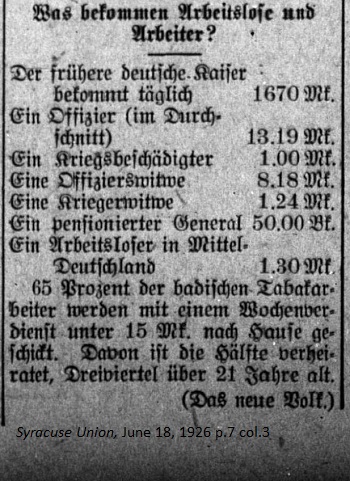
June 18, 1926 page 7 col.3 _____ An Officer (average): 13.19 Marks A Disabled War Veteran: 1.00 Mark An Officer's Widow: 8.18 Marks A Soldier's Widow: 1.24 Marks A Pensioned General: 50.00 Marks An Unemployed Worker in Central Germany: 1.30 Marks 65 Percent of Baden Tobacco Workers will be sent home with a weekly wage of under 15 Marks. Half of these workers are married and three-quarters of them are over 21 years of age. (Das neue Volk.) |
|
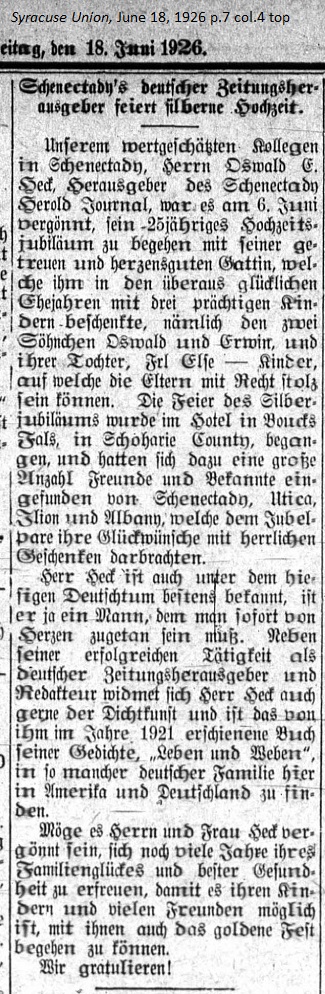
June 18, 1926 page 7 col.4 _____ Mr. Heck is also well-known to the local German community. He is a man to whom one's heart immediately goes out. Along with his successful activity as German newspaper publisher and editor Mr. Heck also writes poetry. In 1921 he published a book of his poetry titled Leben und Weben [Life and Movement,] which can be found among many German families in America and Germany. May Mr. and Mrs. Heck enjoy many more years of family happiness and best health so it's possible for their children and friends to be with them to celebrate their golden anniversary. We congratulate them! |
|
June 18, 1926 page 7 col. 5 _____ |
|
June 18, 1926 page 8 _____ |

|
June 25, 1926 page 3 _____ There are Two Islands which are cut off from the Rest of the World by Anton Zischka Two hundred miles southwest of Malina [Manila] on the edge of the stormy, hot China Sea, nesting place of dreadful typhoons, lies Culion, the island of lepers. It's part of a chain composed of rocky sunburnt islands which jut like a purple mirages out of the peacock blue coastal waters. It's always surrounded by a muggy, tropical veil of fog. A dozen frail, French nuns, an American pathologist, and couple doctors from the Philippines care for 5000 lepers, outcasts who are cut off from the rest of the world. Only one government boat per month from Manila dares to come with medicine and letters, tons of outdated newspapers and seldom, very seldom one guest: either Father Villalonga, and old Jesuit proest from Madrid; a missionary; or a very brave scientist of Harvard University coming from Calcutta, Saigon, or Tokyo. Sometimes native boats with maroon lateen sails arrive. recently the American bilt a radio station which communicates with Manila. Around 7 AM the American doctor leaves the green bungalow which has a view of the entire bay. Around 7 PM he returns home and works in his laboratory until midnight...He has a sife living in a house in New York City on fifth Avenue... His name is Dr. H. Windsor Wade...He will never return to America since his life is dedicated to the five thousand who would be helpless without him. Practically his direct opposite geographically is Dr. Hjalmar Sjägerkrantz. He lives far to the north, in the arctic winter at the northmost tip of Norway in voluntary seclusion. He has only three hundred sick people in the home on Repvaaga. His female assistants are mostly Swedish...He has no radio station and the government steamer comes only three or four times a year with medical supplies and food for the lepers. Perhaps there's another station situated somewhere in the four oceans, some secluded place where those suffering from this dreaded disease are cared for. Nobody knows...Few in the "civilized world" know things like that there are islands of lepers. They lie too far off from "great" events. To them heroism is too powerful to speak about. However in China and Japan, on the hot battlefields of Marocco and Syria, in Mesopotamia — if not anywhere in the world at large — heroes and heroic deeds are plentiful. There's always someone during a battle or a catastrophe who will distinguish himself. Yet how many know about Culion or Repvaaga? Both islands are islands for lepers, for sick people imprisoned with leprosy, people being consumed by their wounds. However there are other realms of the unclean whose skin is smooth and clear, on islands without borders... The Opal Released from a Curse |
Go to Webpage 12
Return to Index
Translation by Susan Kriegbaum-Hanks