July - December 1928
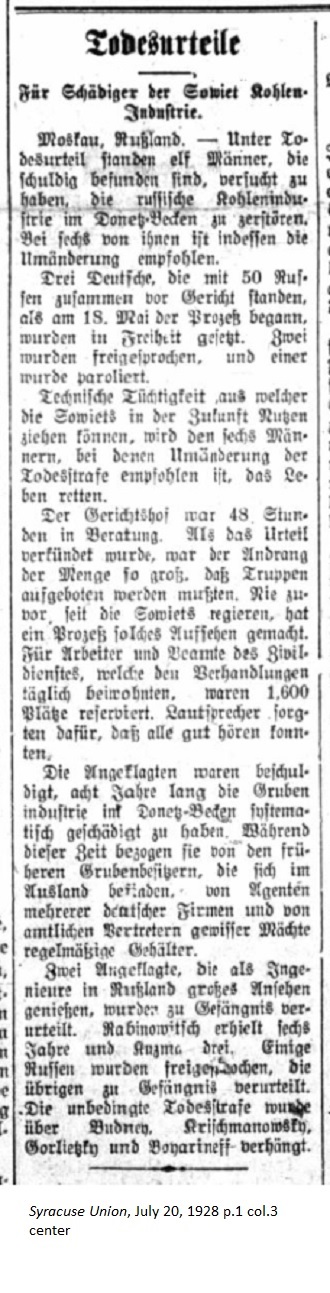
| July 20, 1928 page 1 _____ For Damages to the Soviet Coal Industry Three Germans, who stood before the court with 50 Russians as the trial began on May 18th, were set free. Two were found not guilty and one was paroled. The six men recommended for lesser sentences had technical ability which the Soviets might find useful in the future. The court deliberated for 48 hours. When the decision was announced the storming of the crowd was so intense that troops had to be deployed. Never before, since the Soviets have governed, has a trial been such a sensation. For laborers and civil servants who daily attended the proceedings 1600 places were reserved. Loud speakers were provided so all could hear things clearly. The accused were charged with systematically damaging the mining industry for eight years. During that time they regularly obtained payments from former mine owners living outside Russia, agents from many German firms and official representatives. Two of the accused, who had great reputations as engineers in Russia, were sentenced to imprisonment. Rabinowitsch received six years and Kuzma received three. A few Russians, who had been sentenced to imprisonment, were set free. Unconditional death sentences were leveled against Budny, Krischmanowsky, Gorlietzky and Boyarineff. |
|
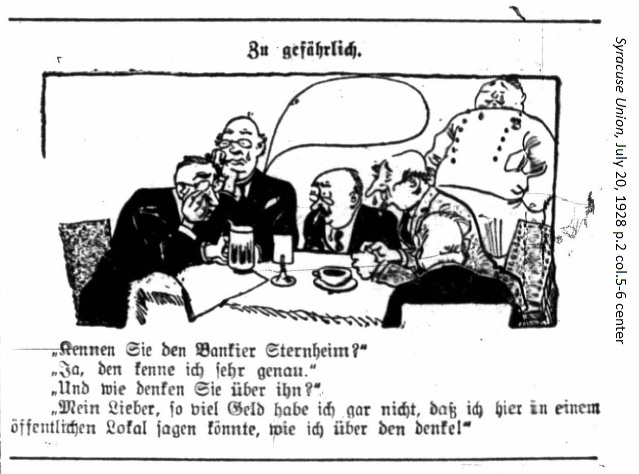
July 20, 1928 page 2 "Do you know Banker Sternheim?"
|
|
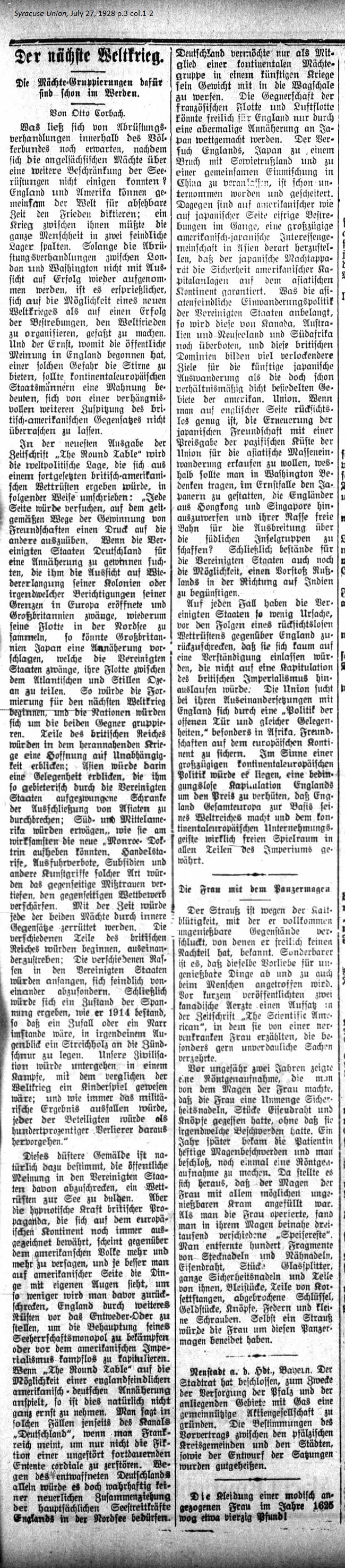
July 27, 1928 p.3 _____ The Grouping of Forces for It is already in the Works. _____ by Otto Corbach What else can we expect from the disarmament negotiations within the League of Nations since Anglo-American forces cannot agree on further limiting of sea armaments? For the foreseeable future England and America together could dictate the peace. A war between the two of them would certainly divide all of humanity into two hostile camps. Until disarmament negotiations between London and Washington recommence with a successful outcome in mind it's more profitable to consider the possibility of world war than successful efforts towards bringing about world peace. And the sincerity with which public opinion in England was initiated to confront such danger should warn continental European statesmen not to be overwhelmed by the disasterous intensification of British and American antagonism. In the latest issue of the periodical The Round Table [Volume 19, 1929 - Issue 75, pp. 447-464, Naval Disarmament] global politics, as it would evolve with the continuation of the British-American arms race, was described as follows: "Each side would attempt to exert pressure on the other in a timely matter by establishing friendships. If the United States attempted to establish ties with Germany by offering the prospect of recovering its colonies or correction of its borders and thus attempt to force Great Britain to regroup its flotilla in the North Sea, then Great Britain might suggest partnership with Japan , thus forcing the United States to divide its naval forces between the Atlantic and Pacific Oceans. Thus shapes the beginning for the next world war as nations group around the two opponents. Portions of the British Empire might see a hope for independence as the war nears. Asia might see the opportunity to break free of the restrictions and exclusions placed on it by the United States. South and Central America might contemplate how to suspend the new 'Monroe Doctrine.' Trade tariffs, export bans, subsidies, and other gimmicks would deepen mistrust mong opponents and sharpen rivalries. With time both powers would experience internal rupture. Various portions of the British Empire might begin to separate from each other. The various races in the United States might become hostile and segregate themselves from others. Eventually tensions would result as they did in 1914 so that an accident or some fool was in a position to light the match and ignite the fuse. Our civilization would die in a battle in which the First World War seems like child's play in comparison, and as always military intervention would follow and all participants would lose everything." Naturally this grim scenario is certain to discourage public opinion in the United States from sanctioning a naval arms race. However the hypnotic power of British propaganda, which still prevails on the European continent, seems to break down more and more among the American people. The better one looks with his own eyes at issues on the American side, the less one will shudder as he imagines England posing the Either-Or question by further weaponization in order to combat the assertion of a monopoly on naval dominence or to capitulate without a fight before American imperialism. When The Round Table hints at the possibiity of an American-German relationship which is hostile to England, naturally it's not to be taken quite seriously. In such cases one says on that side of the channel "Germany" when he means France so as not to destroy the fiction of an uninterrupted, lasting, and cordial Entente. Solely due to Germany's deweaponization there really would be no need for concentration of England's naval forces in the North Sea. Germany might only throw its weight onto the scale as a member of a continental power conglomerate. The antagonism of the French flotilla and air force admittedly could prompt an arms race with an informal alliance with Japan. England's attempt to have Japan break ties with Soviet Russia and commence a communal intervention in China has already been undertaken and aborted. In contrast in America and Japan there have been eager attempts to establish communal interests in Asia in which the Japanese power structure has the guarantee of American capital behind it on the Asian continent. As concerns the xenophobic immigration policy towards Asians by the United States, it will be surpassed by Canada, Australia, New Zealand and South Africa as these British dominions form much more appealing objectives for future Japanese immigration as the relatively densely settled regions of the American Union. When one on the English side is reckless enough to desire buying into a renewal of Japanese friendships by surrendering the Union's Pacific coast for Asiatic mass migration then why should people in Washington hesitate to grant the Japanese in cases of emergency the right to throw the English out of Hongkong and Singapore and give the Japanese free reign to spread out over the southern island groups? Eventually wouldn't it present the United States with the possibility of facilitating an incursion by Russia in the direction of India? In any case does the United States have so few reasons to shy away from the consequences of a reckless arms race against England that it would embark on an agreement which would not lead to the capitulation of British imperialism? In its dispute with England the Union attempts to assure an "open door policy with equal opportunities" especially in Africa and friendship on the European continent. Would it make sense for a liberal continental European policy to demand an unconditional capitulation by England to avert England's making the whole of Europe the basis for its global empire and granting free reign to the continental European spirit of enterprise in all parts of the Empire? The Woman with the Armored Stomach _____ The ostrich is known for its cold-bloodedness when it comes to eating totally inedible objects which have no nutritional value. It's even stranger that this preference for inedible things is also found in humans. Two Canadian physicians recently published an article in the magazine Scientific American in which they tell of a neuropathic woman who gladly consumes indigestible items. About two years ago an x-ray of a woman's stomach showed that she had consumed a vast number of safety pins, pieces of iron wire, and buttons without having digestive issues. A year later the patient had grievous stomach distress and people decided to take another x-ray, which showed that the woman's stomach was jam packed with all manner of inedible articles. When they operated on the woman they found nearly three thousand various "leftovers." They removed a hundred fragments of pins and sewing needles, iron wire, glass splinters, whole safety pins and parts of them, bits of lead, parts of corset stays, broken keys, coins, buttons, feathers and small bolts and screws. Even an ostrich would have envied the woman for her armored stomach. Neustadt an der Haardt, Bavaria. The city council has decided to establish a not-for-profit company to provide the Palatinate and surrounding region with gas. The conditions of the pre-agreement between the Palatinate communities and the cities along with the draft for the charter were approved. The clothing of a fashionably dressed woman in 1625 weighed around forty pounds! |
|
August 3, 1928 page 1 _____ Was a resounding success and demonstrates the Power and
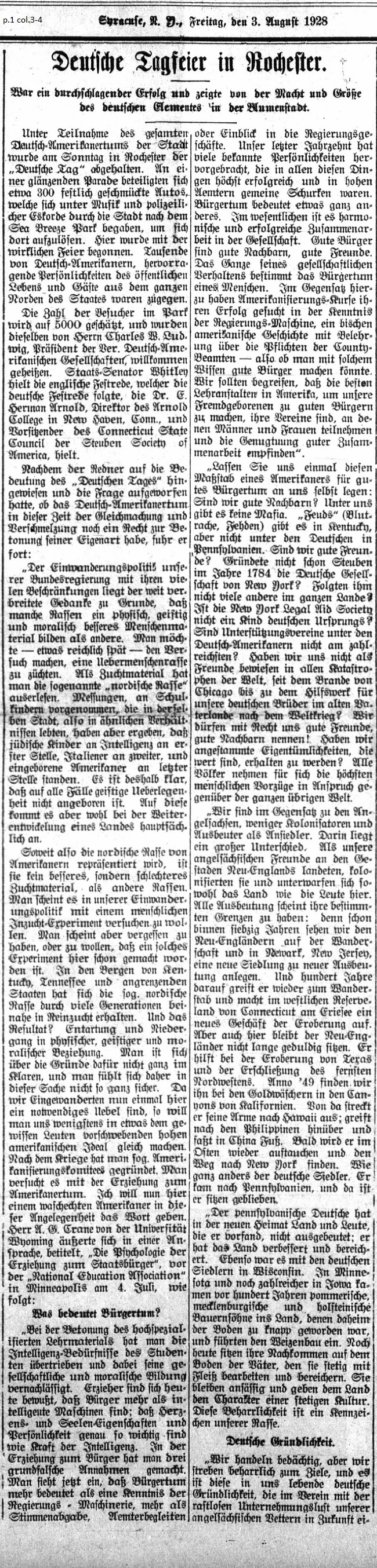
_____ The entire German-American community of Rochester participated in the German Day celebration held last Sunday. Around 300 festively decorated autos took part in a magnificent parade, which had a police escort and a musical accompaniment. The parade went through the city and out to Sea Breeze Park where the the participants dispersed. Here the real party began. Thousands of German-Americans, eminent personalities in public life and guests from the entire northern portion of the state attended. The visitors in the park numbered around 5000 and they were welcomed by Mr. Charles W. Ludwig, President of the United German-American Association. State Senator Whitley held an English language festival address followed by a German address given by Dr. E. Herman Arnold, Director of Arnold College in New Haven Conn. and chairman of the Connecticut State Council of the Steuben Society of America. After the speech on the meaning of German Day was delivered, a question was taken concerning whether the German-American community in this age of equalization and merger still has a right to emphasize its individual character, the speaker replied: "The immigration policy of our federal government with its many limitations has its basis in the widely prevalent belief that many races create a better physical, intellectural and moral humanity than any other option. One might — quite belately — make the attempt to cultivate a super human race. The so-called "nordic races" have been chosen as the breeding material. However measurements taken of school children living in the same city and having similar environments have revealed that Jewish children were in first place for intelligence, Italian children were second and native born American children came in last. Thus it is clear that in all cases intellectual superiority is not inborn but rather comes with the ongoing development of a country. As concerns the nordic races represented by Americans, they were poorer rather than better breeding material. It seems people want to use our immigration politics in their human breeding experiment and this experiment is already being performed. In the mountains of Kentucky, Tennessee, and the adjoining states they already have so-called nordic races which for several generations have remained practically unmixed. And the result? Degeneration and decline in physical, intellectual, and moral attributes. People aren't quite clear about the reasons for this and they're not really sure of anything in this matter. Since we immigrants already here are a necessary evil, at least among a certain group of higher minded individuals we are considered the same as the American ideal. After the war people established the so-called Americanization committees. Through education they tried to americanize immigrants. Here I will use the words of a true blue American. Mr. A.G. Crane of the University of Wyoming gave a speech titled "The Psychology of Education for Citizenship" before the National Education Association in Minneapolis on July 4th as follows: "'The stress on highly specialized teaching material has exaggerated the intelligence needs of students and thus disregarded their social and moral education. Today teachers are aware that citizens are more than just intelligent machines; that emotional and spiritual characteristics and personality are just as important as the power of intellect. In educating towards citizenship one has made three utterly wrong assumptions. Let's look at the first assumption, that citizenship means more than a knowledge of the governant machinery, more than voting, supervising officials or gaining insight into governmental business. In our past ten years many well-known personalities have come forward who were highly successful in all these qualities and were real scoundrels in high office. Citizenship means something quite different. Essentially it is harmonious and successful collaboration in society. Good citizens are good neighbors, good friends. The sum total of one's social behavior determines the citizenship of a man. Contrary to this, americanization courses sought its results in a knowledge of the governing machine along with a little American history with teachings on the duties of county officials — as though one with such knowledge could make a good citizen. We should comprehend that the best educational institutions in America to turn our foreign-born population into good Americans are the associations in which their men and women participate and the satisfaction they feel through good collaboration.' "Let us now apply this American measurement for good citizenship to ourselves: Are we good neighbors? There is no Mafia among us. There are feuds in Kentucky however none among the Germans in Pennsylvania. Are we good friends? Didn't Steuben establish the German Association of New York in 1784? Following this weren't there many other associations established throughout the country? Isn't the New York Legal Aid Society a child of German origin? Aren't relief organizations the most numerous among German-Americans? Haven't we proven ourselves friends in all catastrophes around the world, from the Chicago fire to the relief organization for our German brothers in the old fatherland after the World War? We may correctly call ourselves good friends, good neighbors! Don't we have inborn qualities which are worthy of being preserved? All races lay claim to the highest human virtues vis-a-vis the rest of the world. "In contrast to the English speakers we are more settlers than colonizers and exploiters. Therein lies a great difference. When our anglo-saxon friend landed on the shores of New England, he colonized and subdued the land and the people. All exploitation seemed to have its designated boundries: already within seventy years we see the New Englanders on the move and creating a new settlement in Newark, New Jersey for renewed exploitation. Another hundred years saw migration to the western reserve land from Connecticut to Lake Erie and a new round of conquest. But even here the New Englander didn't remain idle for long. He helped with the conquest of Texas and the development of the far northwest. In 1849 we find him at the gold rush in the canyons of California. From there he stretched his arms towards Hawaii, then reaching over towards the Philippeans and setting a foot in China. Soon he will emerge again in the East and find his way to New York. Quite different from the German settler. He came to Pennsylvania and he's still there. "The Pennsylvania German did not exploit the land and people of his new homeland; he improved and enriched the land. It was the same with the German settlers in Wisconsin. In Minnesota and even more numerous in Iowa, farmers' sons from Pomerania, Mecklenburg, and Holstein came here a hundred years ago because land became too scarce in the old homeland to cultivate wheat. To this day their descendents live on the land of their fathers which they diligently work and enrich by their labor. They remained there and gave the land the character of a stable culture. This tenacity is a hallmark of our race." "We move cautiously but strive tenaciously towards a goal and it is this innate German thoroughness which in conjunction with the restless love of enterprise of our English-speaking cousins will produce an efficient American race in the future. "The negro of the South was the object of anglo-saxon exploitation and this brought about the great racial conflict in our country which since the conclusion of the Civil War has not been eradicated from the world. We of German heritage have never exploited people in such a manner and our former countries have never caused such grief. Thus in the future we will continue to foster collaboration in charitable and educational objectives in our organizations and empower our countrymen of both genders through the blessing of continuing education, which proceeds from nurturing sociability in our associations. We apply serious effort and diligence, thoroughness and tenacity in teaching our people good citizenship so that our men and women experience 'the joy and satisfaction of cooperation.' We want to practice unbegrudging neighborliness not just among ourselves where one association helps another in all educational and social endeavors but also lend support to people of other heritages in their worthy endeavors. Then events like this "German Day" will have a place in the framework of true americanization." The Steuben Union of Rochester had made the preparations with the help of the singers and the regional associations. A massive choir sang, speeches were given, and a large folks festival was attended by young and old and lasted late into the evening. Let's not forget everyone singing the Star Spangled Banner and "Deutschland, Deutschland über Alles," which flowed from thousands of throats and echoed throughout the wooded grove. |
|
August 3, 1928 page 5
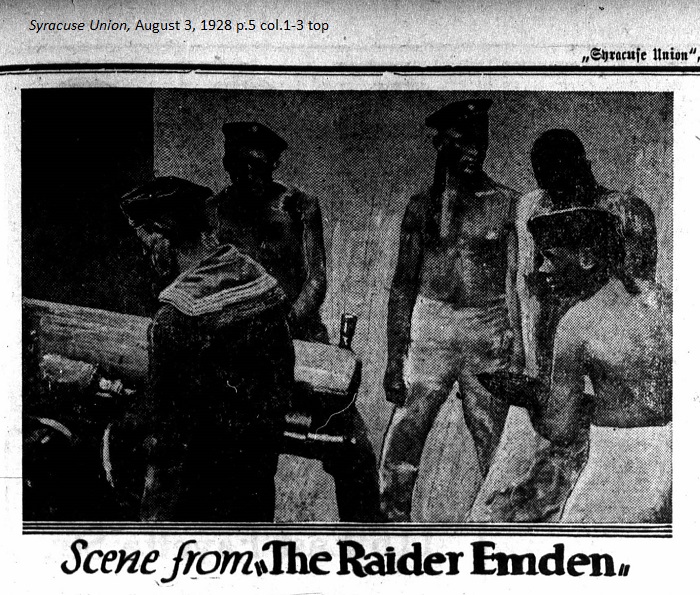
The most monumental of all Sea Films will be shown at the Empire Theater _____ Heroism and nobility, coupled with humanity, are the primary themes as one watches how the German cruiser conducted raids in contrast to the English ships. The commander of the Emden, Lieutenant von Müller, behaves chivalrously towards passengers and crews of the ships being raided. His noble-mindedness is a high point in the annuals of naval history. The English, recognizing the courtesy being offered during the brief span of time presented for a life or death decision, respond with similar courtesy. After the Emden was shot by an English cruiser and unable to fight, the large Australian cruiser "Sidney" captured the surviving officers and crew. The commander of the Sidney, Captain J.T. Glossop stated that the English government had ordered the Emden's officers to lay down their swords. In Australia grand celebrations took place as von Müller was brought in. He refused to participate. Because he gave his word of honor he was allowed freedom of movement in the country. These are the facts given in the German film "The Raider Emden," which recently came to America. For eight weeks the cruiser made the Chinese waters and the Indian Ocean a fearful place for ship's traffic. The heroics of the Emden stands in first place among the annuls of naval warfare. "The Raider Emden" gives both friend and foe the same right to decide. Critics and the public recognize the film as the greatest naval warfare film to even come out of England or Europe. Whenever the Emden captured an enemy transport vessel, the crew and supplies were placed on a "prisonship" which followed nearby the Emden. Only then was the raided ship sunk. During a battle the prisonship, with its captured crew and passengers on deck, did not take part in the action so no prisoners were ever in danger. One day the Emden raided a British troop transporter which was on its way from Calcutta to France. The soldiers were placed on the prisonship. On board that ship was a racehorse, which was shot so it would not suffer the pain of drowning. This and similar deeds of humanity amazed the English crews and soldiers and when the Emden was captured the commander, in the English spirit of sportmanship, reciprocated. "The Raider Emden" is the first German war film, which was shown in England. The history of the film cannot be unknown to any German. It deals with the adentures of the German cruiser from the time of its departure from the harbor of Tsingtau to its sinking by the Australian cruiser "Sidney." The interim shows the grand, glorious time of the Emden. It's described as the terror of the sea, responsible for the sinking of 24 enemy ships with a total worth of $10,000,000 before it reached the inevitable fate of daring German seafarers. It must be established that the Englishman, wielding his national conceit over the tiny horizon, will probably view the German the same way he always has. However, by its composition the film is quite liberal so as not to offend British male honor. For this reason the British public not only approved of the film but also paid tribute to the German, so perhaps some of this prejudice disappeared. Scenes like the operation of cannon by a German sailor whose arm was ripped off by a bullet, the bandaging of English wounds by Germans, etc. elicited a salvo of applause from the English public. "The Raider Emden" is a reproduction of one of the greatest naval episodes ever known. It unbiasedly portrays friend and foe alike. It is also "a profound indictment against war and destruction" according to the English Press. The film is a production of the Emelka Co. of Munich. The Empire Theater will show this suspenseful film beginning tomorrow, Saturday, August 4th. Locomotive Explosion with Disasterous Consequences _____ Ten cars derailed and a massive disruption in traffic ensued as a result of the accident since this was the main line of the Central Railroad, which was out of service for a substantial period of time. The boiler of the locomotive was thrown 50 feet away, telephone and telegraph wires near the tracks were torn up for more than a hundred feet. The sound of the explosion could be heard three miles away. The bodies of both victims of the catastrophe were horribly ravaged. Memorial for unknown Soldiers at the Battle of Oriskany _____ Mr. M. Henry McCarthy, head of the burial firm John McCarthy & Sons, died suddenly of a heart attack on Friday morning in his office. He was 56 years old. |
|
August 24, 1928 page 3 _____ A Momento, by Professor Ed. Leonhardt It was in the year 1840 as war-thirsty Minister Thiers stood at the helm of a chauvinistic government of France and made every effort to cause a European war in order to regain Rhineland territory lost in the last peace treaty. Holy rage burned within the Germans and in all German lands the flames intensified: Protect the threatened homeland! The Rhinelander Nikolaus Becker composed a bold and spirited Rhenish song: "You shall not have it, the free, German Rhine ..." And right around this time a young, unknown Swabian named Max Schneckenburger created "Die Wacht am Rhein" in the Swiss mountains. Becker's song spread throughout Germany. The much more powerful and beautiful lyrics by Schneckenburger remained almost totally unnoticed. Then came the day when each and every German felt what this poet had been singing about. When French Swiss arrogance became a pretense for fences; as France once again threatened Germany's power, unity, and might; as the entire nation rose up as one man, that's when Schneckenburger's "Wacht am Rhein" awoke in one magnificent and ravishing voice and the nearly forgotten song resounded like clashing swords and billowing waves through the entire German countryside as the song for marches, battles and victories; as the song of love and jubilation, loyalty and confidence. It became the theme song of the German people. The composer of this song was a simple merchant, who was born as the son of a prosperous farmer and businessman in Thalheim. He was a capable and diligent mervchant and later a partner in the iron foundry of Schnell & Schneckenburger. The political climate of the time worked upon his sensitive disposition: since the July Revolution it had fermented among everyone. He had no sympathy for the cosmopolitan ideals of certain dreamers for freedom. As the Rhine clamor grew ever louder among the French, Schneckenburger took his lyre to hand and composed a song for his patriotic friends, which soon fueled the glowing embers in every German heart and accompanied the army of a united fatherland from one victory to another. He sent the poem to the organist and singing teacher Mendel in Bern, who arranged it for men's choir. It was performed a few times — and then forgotten. Only now and then was it placed on a program for a singing festival. Schneckenburger died in May 1849. He was laid to rest at the cemetery in Burgdorf. His friends placed an iron cross on his gravesite. In 1853 the song came into the hands of musician Karl Wilhelm, who at the time was a music teacher in Krefeld. The poem enthralled him and he composed it for men's choir. It was favorably received all over for its folksy, powerful and gripping score. Soon after the "Wacht am Rhein" echoed among the German singing societies. In 1854 the song was sung by 100 singers in Krefeld for the silver wedding anniversary of the late Kaiser Wilhelm I. At a garden party in Elberfeld the prince heard it for the first time and it affected him so deeply that he bestowed upon the composer the title of "Royal Music Director" in 1860. Ten years later the German army marched to the tune of "Lieb Vaterland, magst ruhig sein" [Beloved fatherland, may you live in peace] as it crossed over the French border. And again resounded the "Wacht am Rhein", and again it spurred the army to bravery and to highest achievement. The "Wacht am Rhein" helped win battles and it accompanied victory celebrations. "It was at Weissenburg," so a Prussian captain related, "while storming up Geisberg. We climbed up the barricades with thorn hedges. The trailblazers couldn't finish quickly enough. What could we do? We had to move forward. The officers went over and the crews followed. We encountered a hailstorm of bullets up there. The company faltered for a moment and I was hit by two bullets in the thigh. I figured we were done for. Then the lads sang the song which I had heard day after day during the entire march, the "Watch on the Rhine." The everything went forward. Our ranks were heavily diminshed by the enemy's murderous fire, but the hill was stormed and victory was ours. Since then that song has been a sanctuary, a prayer for me. Since then the "Wacht am Rhein" has become a "sancutary" for the entire German people. We want to preserve it as long as "one drop of blood still burns and a fist draws a sword and an arm extends the rifle." The song will live on eternally among us, it is at home in the most remote corner of our large homeland, and it echoes in the distance, far beyond the seas, whereever the German tongue speaks. Propelled by the music of Karl Wilhelm, it flies into every country. Karl Wilhelm was born in Schmalkaldin as the son of a village musician. As a capable pianist and musician he took over the direction of the "Liedertafel" [singing society] along with a men's choir, a singers' association, and a mixed choir in Krefeld. The society existed quietly and secludedly but acted zealously and exhibited a multitude of talents. He worked relentlessly for the propagation and broadcasting of good German music. He enriched the treasury of German songs with every composition. However it was the "Wacht am Rhein" which made him "immortal." Since the glorious war years he received a wealth of honors and recognitions. The Kaiser sent him the Medal of Arts and Sciences. The Kaiser's wife sent him a gold medal. Bismarck wrote him a letter which closed with the words: "You have served to give the folk tune its greatest elevation. It expresses the nation's communal spirit at home and abroad ..." Alone and introverted, Wilhelm spent his last years in a small village in Thuringia, where he died in 1873. However we will in German loyalty and respect preserve the memory of this master and all others who found their final resting places in the Swiss countryside. In these grave and difficult days we will send our fervent greetings to these two silent icons: Max Schneckenburger and Karl Wilhelm! In their memory we wish to relight the torch of holy rage, German loyalty, German courage, German unity, German pride, German action, German victory, and German gratitude so we may sing with full voices and raised heads: "Beloved fatherland, may you live in peace." The End of the Kimono _____ |

|
August 24, 1928 page 5 _____ Among those who last week made a four-day stop in Canada with one day in Montreal was Mr. Alex C. Oberländer of the Syracuse Union. He came there by automobile, having driven through the states of Vermont, New Hampshire, and Maine and visiting the towns and province of Quebec and arriving in the city of Quebec on the last day. During the entire trip of 1603 miles he never heard a word of German. Whereever he went in the city and province of Quebec and enquired about Germans, people responded in broken English with a French accent: "There are a few Germans here but we don't know their addresses." When he visited the magnificent city of Montreal via auto, he saw a welcome sign: "Hofbräu, Krausmann's Restaurant. Naturally he had to stop there. He and his traveling companions found that it was an authentic beer garden and restaurant reminiscent of the ones in New York City a long time ago. It was arranged and furnished in true German beer garden fashion. The place was filled with the best residents of Montreal who drank real imported beer and feasted on foods prepared in a German manner, however not one of the guests could speak German. A waiter with a healthy facial tone approached the Syracuse visitors and said something in French. Mr. Oberländer responded in German. The waiter's expression immediately brightened and continued the conversation in German. He was a genuine German and it pleased the Syracuse visitors who were hearing German for the first time in four days in the province of Quebec. Soon after Mr. Krausmann himself appeared to greet the German guests. Both he and his guests had a fine time. A good German meal was soon served and imported Kuhnbach, Pilsner, Würzburg and Munich beers were drunk. The meal, which could scarcely be served in Syracuse for $1.50, and the drink, which once would have cost $3.50, were presented here at only 75¢ for the meal and 30¢ per ½ liter of imported beer. No more hospitable and friendly host could be found than Mr. Krausman. He reminded the Syracuse visitors of Mr. Charlie Siegel and Carl Risch by the way in which they treated their customers to real German recipes. Mr. Oberländer recommends Krausmann's genuine German beer garden and restaurant to the Germans of Syracuse and Central New York who wish to visit Montreal and are unacquainted with this large French city. The same can be said of 44-46 St. James St., half a block north of the public square where the famous Notre Dame Church is located. The view of this church alone is worth the trip to Montreal. Montreal, beyond Malone and Trout River, is 266 miles from Syracuse by auto — this is the shortest way and every inch of the road from the Canadian border to Montreal is in excellent condition. The highway goes through the well-known Indian village of Caugnawaga, follows the shore of the St. Lawrence River, the Lachine Rapids and Lake St. Louis. It crosses the river to Montreal at St. Lambert. The toll over the 1 ½ mile long Victoria Bridge costs only 25¢ per auto and 5¢ per person. A German in Montreal will not feel at home except at Krausmann's Beer Garden — we know this from experience. On the return trip from Montreal one can use the well-paved roads of the north shore of the St. Lawrence River to Prescott and from there cross on the ferryboat to Ogdensburg. This route to Syracuse is about 281 miles. |
|
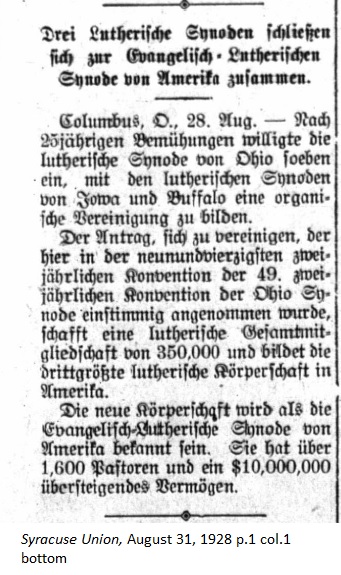
August 31, 1928 page 1 _____ Columbus, O., August 28th — After 25 years of negotiations the Lutheran Synod of Ohio has agreed to form an organizational association with the Lutheran Synods of Iowa and Buffalo. The proposal to merge, which was unanimously accepted at the 49th biannual convention of the Ohio Synod, now has a total Lutheran membership of 350,000 members and constitutes the third largest Lutheran entity in America. The new corporation will be known as the Evangelical-Lutheran Synod of America. It has 1,600 pastors and assets of over $10,000,000. |
|
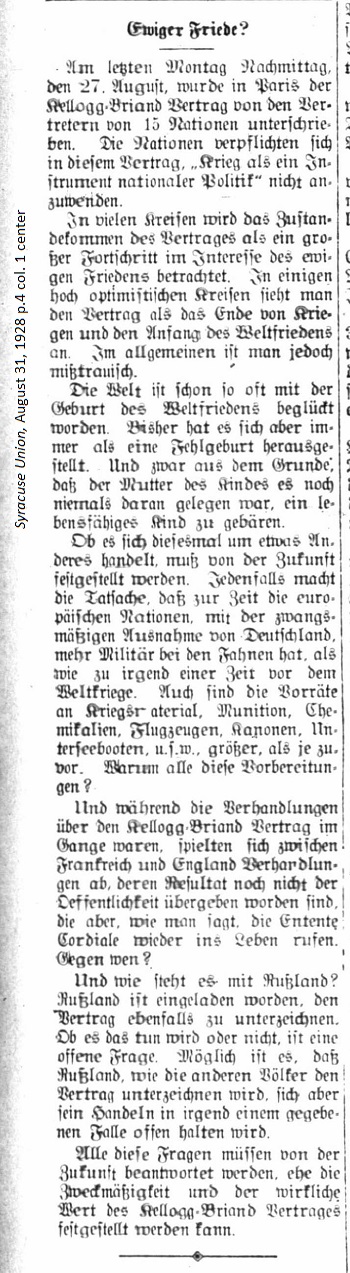
August 31, 1928 page 4 _____ Last Monday afternoon, August 27th, the Kellogg-Briand Pact was signed in Paris by the representatives of 15 nations. In this pact the nations pledged not to employ "war as an instrument of national politics." In many circles the creation of the pact was viewed as a great advancement in the interest of eternal peace. In some highly optimistic circles people see the pact as the end of war and the beginning of world peace. In general most people are suspicious. The world has often been delighted with the prospective birth of world peace. However until now the prospect has turned to miscarriage. Usually the reason given was that the expectant mother never had a suitable place in which to bear a viable child. Whether or not things will be different this time will be determined in the future. In any case there's the fact that to date the European nations, with the compulsory exception of Germany, have more military presence than in any other time before the World War. Additionally the inventory of munitions, chemicals, aircraft, cannons, submarines, etc. is greater than at any previous time. Why all these preparations? While negotiations on the Kellogg-Briand Pact were in the works there were talks between France and England, the results of which have not yet been made public. And yet, as they say, has the Entente Cordiale been called back to life. Against whom? And how do things stand with Russia? Russia has been invited to sign the pact. Whether it will or will not is an open question. It's possible that Russia, like the other groups which will sign the pact, will keep their options open in certain situations. All these questions must be answered in the future before the usefulness and true value of the Kellogg-Briand Pact can be determined. |

|
August 31, 1928 page 4 _____ Deals a Staggering Blow to the Anti-Saloon League The League, Mr. Busch said, anticipated the victory of Governor Smith and attempted to mislead voters. After 8 years of miserable Prohibition failures in which it paralysed the country, corrupted and demoralized youth, led to bootlegging and moonshining, and cuased an increase in crime and other evils, the League now seems to have been gripped by a mortal fear that the former brewing industry will fulfill its citizen's duty and clean up this disgusting situation which the Anti-Saloon League has brought to this country. "Mr. Cherrington seems panicked at the thought of the good sense of the American people will emerge and a healthy, moderate law will be enacted in place of this Prohibition blunder. To hinder the true solution to the problem and maintain the status quo, Mr. Cherrington drags the deconstructed brewing industry before the political spotlight and spewed his condemnation. "For nearly 40 years Cherrington has identified himself with the League. The records of his own department show that he has used a budget of more than 17 million dollars for Prohibition propaganda and politicking and that the League has taken in more than 70 million dollars in order to make bootlegging and moonshining one of the largest, most secure and profitable business enterprises in the country. Only in hindsight is the League's accounting slightly hazy: it shows that 50 percent of its income went to salaries, office expenses and personnel. Somewhere a solution to the Prohibition problem, which would have put the country on a path of real sobriety, was negated by the sinecures of the League and forced its allies to perform honest work for their livelihoods." "The A.S.L. [Anti-Saloon League] boasts about itself in its official literature," Mr. Busch continued, "that it fathered the Prohibition law and that it controls the department for the enforcement of Prohibition. In the recently published biography of Wayne B. Wheeler, an esteemed colleague of Dr. Cherrington, it was often stated that 'Wheeler controlled six Congresses, dictated to two presidents of the United States, directed the passing of laws in most states of the Union, elected candidates for important state and federal offices, was the guiding influence in the Democratic and Republican parties, distributed more patronage than any other twelve men and supervised a federal bureau from outside without official authorization. It's an unfortunate fact that this declaration is 100 percent true. The department, which the League reportedly controlled, was the Prohibition Office.'" Finally the League incriminates itself by means of its responsibility for the scandals created during Prohibition's enforcement, for the murders and immoral acts it committed, for the wide-reaching corruption, bootlegging, smuggeling and general collapse of compliance with the law. A Strange Joke Gallipolis, Ohio. — The 17-year-old farm boy Earl George left a note at the shore of nearby Raccoon Creek. The note indicated his body would be found in the water. Police officers quickly organized a search party with an undertaker, the coroner, relatives of the young man and one hundred neighbors to look for the boy. Two boys found George hiding behind some shrubs, amused by the excitement of the search for his corpse. He admitted that the suicide note was a hoax. |

|
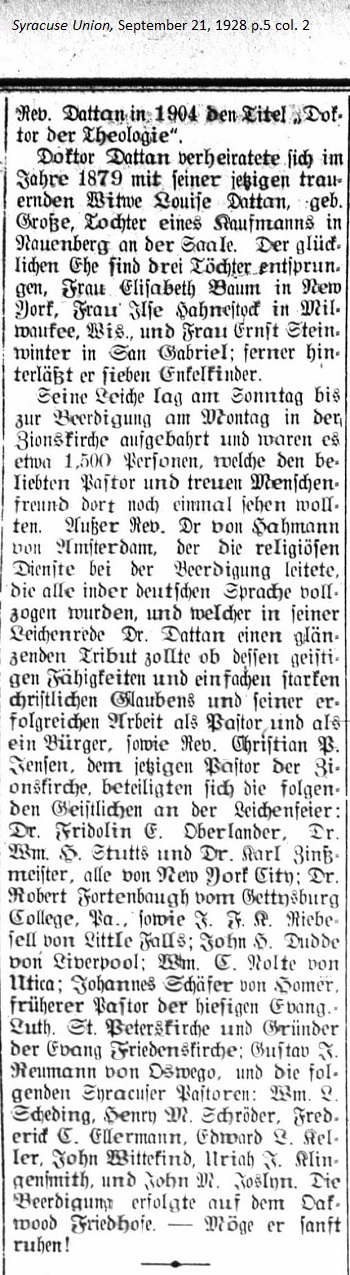
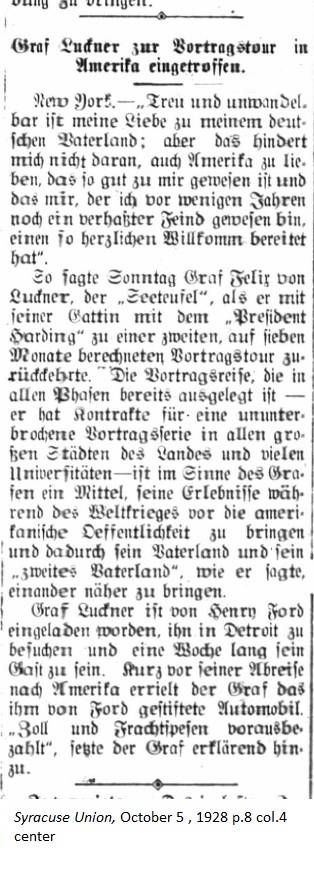
September 21, 1928 page 5 _____ Pastor Dattan is no more! _____ Died of a Stroke last Friday Morning _____ With sincere regret we report the sad news that last Friday morning the city of Syracuse and its surrounding area lost a good citizen. The beloved pastor-emeritus of the Evangelical-Lutheran Zion Church, Rev. Dr. Hermann Gustav Dattan, has passed away. On Thursday, September 13th he suffered a stroke in his home at 1303 First North St. Without regaining consciousness he gave up the ghost the next morning at 10 AM. His wife and daughter, Mrs. Baum, along with Rev. Wm. L. Scheding of Mt. Tabor Church, who had arrived as a friend, waited by his side as the end neared. He reached the age of 75 years, 7 months and 20 days. Caption under picture reads: Rev. Dr. Hermann G. Dattan The deceased was born on January 25, 1853 in a village of the Grand Duchy of Sachsen-Weimar, Rudersdorf, where his father was a pastor. Until he was 12 he attended the village school then until Easter of 1867 received confirmation instruction at the side of his father. He was then able to complete the 9-year academic high school course in Weimar in five years and take his college entrance exams at Eastertime, 1872. He attended the universities of Jena and Halle for 3 years and took his first theological exams in the summer of 1875 and then became an assistant minister at the court church in Weimar. He filled this position for nearly 2 years until he passed his second,or State exam in 1877 and was assigned pastor in Neu-Kewitz with its filial congregations in Rödiger, Neuengöner and Porstendorf. He remained in the service of his hometown rural church in which he carried out many other parish appointments until 1890, when with the invitation and recommendation of the Evangelical Diaphora Conference, whose chairman at the time was General Superintendent Dr. Trautwetter-Rudolstadt, came to America to take over the position of minister to the Evangelical-Lutheran Grace Church in Buffalo. On November 8, 1890 he landed on the North German Lloyd Steamer Saale in Hoboken. On November 16th he preached for the first time to his new congregation, which he served as spiritual caregiver until the end of April 1893. With the resignation of Rev. Alexander Oberlander as spiritual caregiver, who served the Evangelical-Lutheran Zion Church for 23 years, Rev. Dattan received a unanimously decided call for the vacant post in February 1893, which he took over on April 30th of the same year and was installed in a ceremony on June 4th, which was presided over by Pastors George Merschroth of the Evangelical-Lutheran St. Paul's Church of Syracuse and Reinhold Kessler of the Evangelical-Lutheran St. Paul's Church of Oswego. Despite being younger than Dr. Dattan, both these installed pastors have already passed away; Dr. Dattan presided over both their funerals. After about 33 of true ministerial service to the Ev.-Luth. Zion Church, in January 1926 Dr. Dattan requested he be released from his duties as pastor due to declining health. It was with great regret that the church appointed him Pastor Emeritus, gave him a pension and the absolute right to conduct German church services whenever he felt himself physicially able to do so. Dr. Dattan did this for about a year until he eventually was forced to give it up — the spirit was willing but the flesh was weak! In 1904 Syracuse University bestowed upon Rev. Dattan the title of "Doctor of Theology." Dr. Dattan married in 1879 his currently grieving widow Louise Dattan, neé Gross, daughter of a merchant in Naunberg on the Saale. The happy marriage produced three daughters, Mrs. Elisabeth Baum in New York, Mrs. Ilse Hahnestock in Milwaukee, Wis., and Mrs. Ernst Steinwinter in San Gabriel. He also leaves behind seven grandchildren. His body was laid out on Sunday until the funeral on Monday in Zion Church and viewed by around 1,500 people who wished one last look at their beloved pastor and true friend to mankind. Rev. Dr. von Hahmann of Amsterdam conducted the religious rites during the funeral fully in the German language and bestowed a glowing tribute in his funeral speech on the Dattan's spiritual acumen; his simple, strong christian faith; and his effective work as a pastor and a citizen. Rev. Christian P. Jensen, the current pastor of the Zion Church, enlisted the following clerics for the funeral service: Dr. Fridolin E. Oberlander, Dr. Wm. H. Stutts and Dr. Karl Zinssmeister, all of New York City; Dr. Robert Fortenbaugh of Gettyburg College, Pa. Also in attendence were J.F.R. Riebesell of Little Falls; John H. Dudde of Liverpoole; Wm. C. Nolte of Utica; Johannes Schäfer of Homer, former pastor of the Evang.-Luth. St. Peter's Church and founder of the Evang. Church of Peace; Gustav J. Reumann of Oswego and the following Syracuse pastors: Wm. L. Scheding, Henry M. Schröder, Frederick C. Ellermann, Edward L. Keller, John Wittekind, Uriah J. Klingensmith, and John Joslyn. The burial took place at the Oakwood Cemetery. — May he rest in peace! |
|
October 5, 1928 page 8 _____ This is what Count Felix von Luckner, the "Seeteufel" (Sea Devil,) said Sunday as he returned with his wife on the "President Harding" for a second, seven-month lecture tour. The tour is already laid out in detail. He has contracts for an uninterrupted lecture series in all the largest cities in the country and many universities. The Count believes this is a medium in which to bring his World War experiences to the American public and thus to bring his fatherland and his "second fatherland," as he calls it, closer together. Count Luckner has been invited by Henry Ford to visit him in Detroit and stay for a week as his guest. Shortly before his departure for America the Count received an automobile donated by Ford. "Tariff and freight costs paid for in advance," the Count added. |

|
October 12, 1928 page 4 _____ Syracuse Union was represented. _____ Last Thursday Mr. Alex E. Oberlander of the Syracuse Union received a telegraphed invitation from Mr. Hoover, the Republican presidential candidate, to visit him in Washington. With a delegation of publishers and editors of foreign language newspapers in 14 different languages, Mr. Oberlander attended a luncheon at the Mayflower Hotel and afterwards he was in the audience for a welcome delivered by Mr. Hoover. The Italian language newspaper people knew best how to fawn over Mr. Hoover, in all probability to emphasize their power of influence. During his stay in Washington Mr. Oberlander also visited Chairman Work of the Republican National Committee. Mr. Hoover thanked the visitors for their interest. "You have rendered a great service to the country by helping to americanize immigrants. The task of the foreign language press is particularly important here if the political problems of the land are to be discussed extensively. Through the foreign language press the new immigrant learns to understand political ideas which would not ordinarily interest him. In national debate problems find their resolutions and public interest is awakened, thus giving all sides the opportunity to glean information concerning important issues. You must understand that I make absolutely no distinction between old and new immigrants. The degree of quickness with which the new immigrant adjusts to our national system is not determined by the race from which he descends, but by the degree of independence the individual develops under the new circumstances." "I can say that I have learned much from the newspapers of your representative races and nations. I had the good fortune to stay in most of the countries of Europe during and after the war and one can learn to appreciate to a greater extent the fine qualities of nations and their people than one can during the monotony of peacetime. I became acquainted with the countries of Europe and I learned to appreciate them." "There is no difference among the races in this national campaign: it is nothing other than a discussion between Americans and so it must be viewed as such. We do not want international disputes in America: we've already had too much of that over the past years." |
|
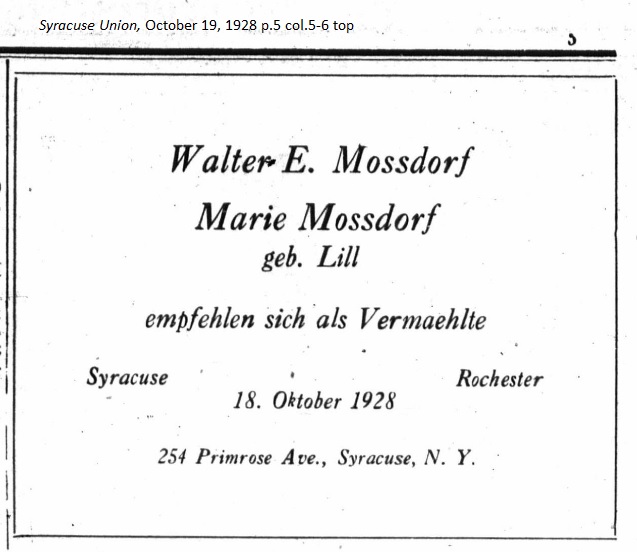
October 19, 1928 page 5 Marie Mossdorf
present themselves as a married couple Syracuse Rochester October 18, 1928 254 Primrose Ave., Syracuse, N.Y. |
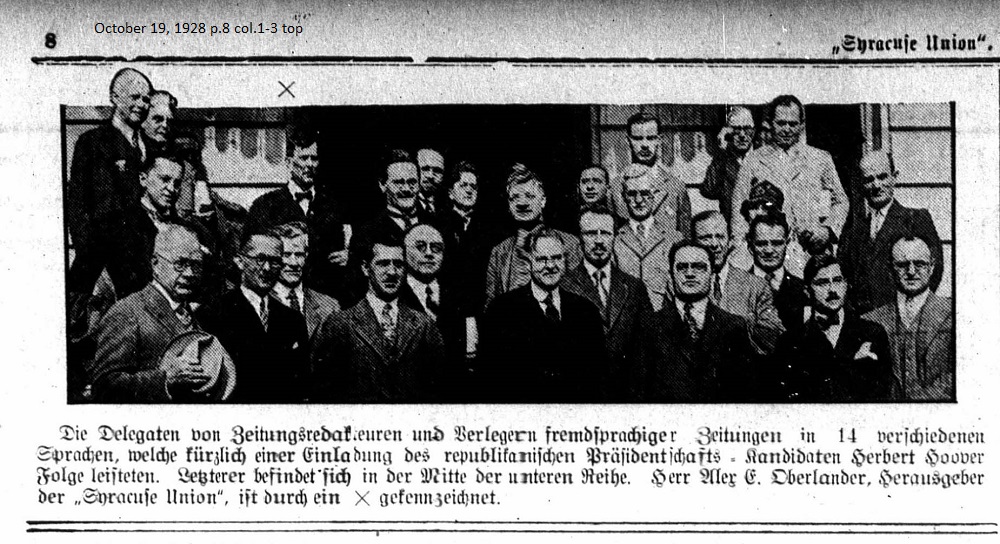
October 19, 1928 page 8 The delegation of editors and publishers of foreign language newspapers in 14 different languages, who recently received invitations to visit Republican presidential candidate Herbert Hoover, who is in the middle of the lowest row. Mr. Alex E. Oberlander, publisher of the Syracuse Union, is identified below the X. |
|
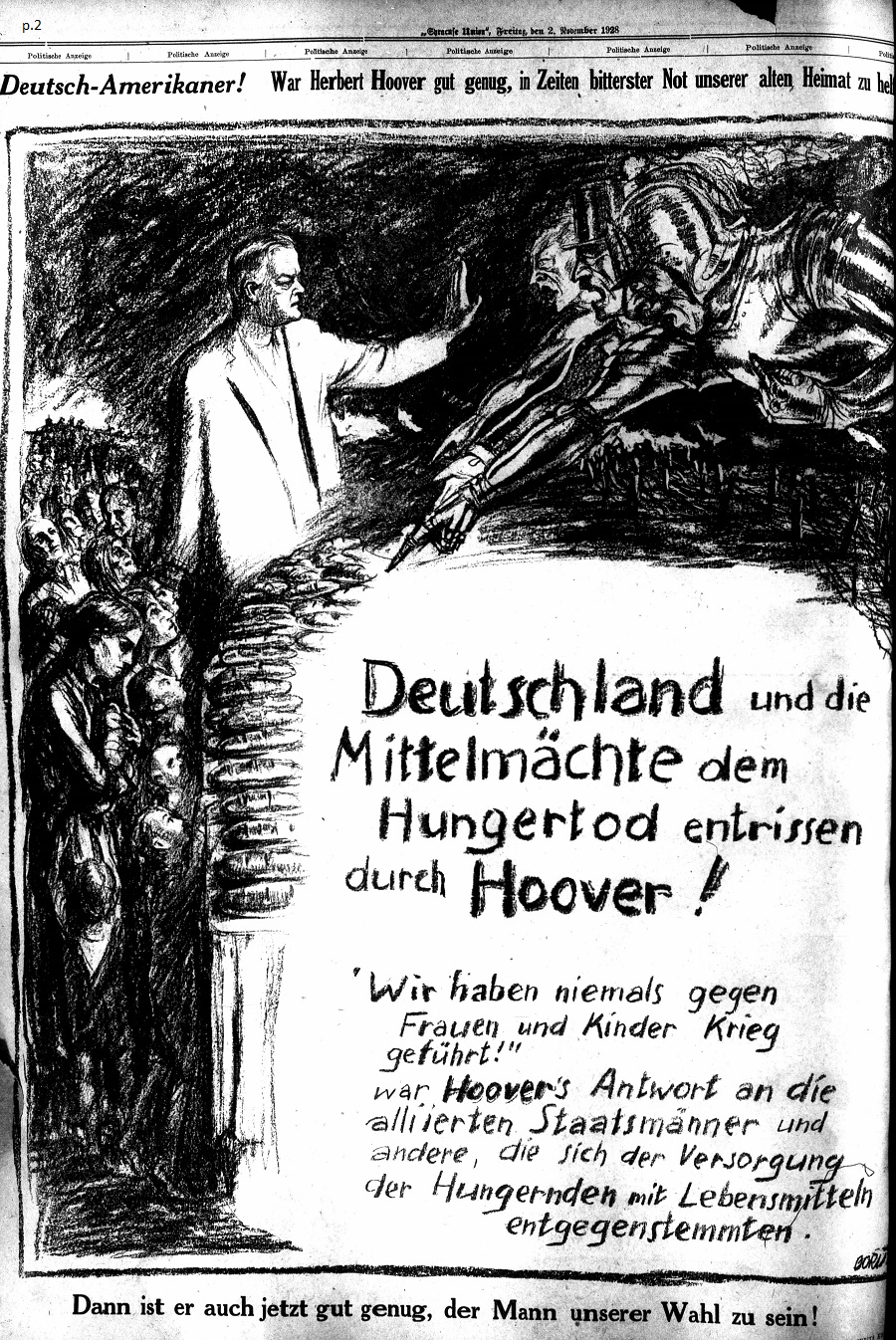
November 2, 1928 page 2 German Americans, Herbert Hoover was good enough to help our old homeland in the time of most bitter need. Germany and the Central Powers were saved from Death by Starvation by Herbert Hoover! "We have never waged war against women and children!" was Hoover's response to the allied statesmen and others who opposed providing food to the hungry So he's good enough now to be the man we elect! |

|
November 2, 1928 page 7
_____ Until a few Centuries ago People in the Alpine Countries believed in Them _____ by Georg Eschenbach When a cold wind whips the rain against the windowpane all week long during the summer, folklore called it "Petrus," or St. Peter. It was blamed for sunless, damp days and some people thought that it was no kindly, white-bearded keeper of the heaven's keys, who chased the wind and rain from our disappointed faces but rather a legendary monster, who played evil tricks on us. This treacherous entity seems very powerful and at its worst practices its dreadful deed in the Alps, where to this day some people believe in, hate, and fear the weather witches. Even a few decades ago most Alpine residents were firmly convinced of their existence and their power. The weather witches suddenly and surprisingly unleash their force on unsuspecting Alpine folk. The sun can shine hotly in a cloudless sky, then a white curtain of fog will creep up in the west and blanket the mountains. Gray clouds follow and gather in the valley. The dark army of the weather witches storms through and smashes against the steep rock face. Crouched in fear, the lifeforms in the narrow valley are plunged into sinister darkness. Suddenly hail pelts down, beating the shingles on the roofs, tearing fruit from the trees, pounding harvest-ready grain into the ground, churning up the potato fields. Streams and rivers swell up past their banks, flood the valley and fields in gray, icy water which deposits rubble in its wake. Eventually the sun shines again and highlights the battlefield created by the weather witches. Many "home remedies" were tried by the country folk to control the dreadful work of the weather witches. Even today some people consider it especially effective to gather certain herbs in the spring, which are sanctified on the feast of the Assumption, and cast into the hearth flames by housewives as a storm approaches. The smoke rises through the chimney, goes up the noses of the weather witches, and chases them away. An ancient custom, which supposedly offered the best remedy against the unholy rabble, is the clanging of a weather bell because the witches fear nothing more than the metallic voice of a dedicated protector. For this reason most churches in high-lying Alpine villages, which suffer most greatly in stormy weather, only used their bells for this purpose. When bad weather threated, the first weather bell sounded from the valley or mountain chapel and the sister bells followed suit in the neighboring villages. The shock caused by the clanging bells pushed through the weather witches' blustery appendages and prompted them to avoice the bell-protected valley. The mighty sound swept away the witches like an old broom and destoyed their power like the warning bark of a dog chases away unwanted visitors. There's an old saying in the Lower Inn Valley (Unterinntal): "When the Schwaz Broom sweeps, and the Brixen Bull bellows; when the Salve Hound barks, then the weather has no power." The "Broom," "Bull," and "Hound" refer to the weather bells in Schwaz, Brixen, and Upper Salve. Another effective remedy to the weather witches was supposedly the weather cannon. People hoped that the ear piercing bang would terrify the weather witches as the sound resounded a hundred fold through the narrow valley. Even clear-headed individuals swore to the cloud-dispersing properties of the cannon and the practice was continued in the Alps right up to the beginning of our century. In many regions of Styria weather towers and weather huts can be seen which house rusted, bell-mouthed barrels of weather cannons. Even Frederick the Great wanted to investigate the effectiveness of gun powders against approaching storms. In his "Trostgründen" [Consoling Reasons] Laicharding reported, sometimes in his meetings with Joseph II in Neiss the king had the assembled military body of 36,000 men shoot their rifles and cannons at the same time when approaching clouds indicated strong storms were on the way, "regardless of the dreadful banging." Laicharding continued, "The clouds did not move off, and the expected rain came in its fullest measure." In contrast the Alpine herdsmen were completely convinced of the effectiveness of weather cannons. During every storm an ear-shattering volley of guns, mortars and cannons played in concert. Some more zealous weather cannon shooters loaded their barrels with solid balls and shot holes in the sky and clouds. In Lower Inn Valley on such an occasion a careless shooter's finger was torn off and folklore has it that once his ringed finger dropped out of the clouds the wounded weather witch unleashed her pained rage with hail and thunder in the neighboring valley. In other regions people loaded guns with breadcrumbs, believing they could shoot a witch down with them. If the residents of a village were able to defend themselves by uniting their efforts in a witch raid, the monsters had to attack a neighboring community. Naturally the neighbors were not in favor of this, so things sometimes led to bloody conflict because the threatened neighbors would try to prevent their countrymen from using their weaponry. Some communities, which were located downwind of a storm's path, begged the authorities to forbid the more favorably located village from chasing away the weather witches. A slightly less treacherous but mischievious entity is the wind witch. It scatters freshly cut grass clippings and destroys hay piles. Even until recently it was usual for mowers to throw their knifes as soon as the wind blows because they believed it chased the wind witch away. The last remnants of these superstitions are slowly disappearing. The insights into the soul of the people, which we find so interesting, should be acknowledged but we should not regret their passing. "Mystery Ships" revealed. _____ In the Daily Telegraph Counter Admiral Gordon Campbell tells about the "Mystery Ships" which were under his command during the War and were used to bait enemy submarines. In outward appearance these ships were innocent trade steamers, but in reality they were secretly equipped with artillery guns to shoot U-Boats. To enhance the illusion as soon as a sub was sighted, the boats in which the crew took their places, were lowered. Naturally it was only a portion of the crew but the people in the U-Boat didn't know that. When the enemy boarded, the crew still left onboard quickly opened fire on the invaders. The group which had the assignment of leaving the ship was called the "panic party" because they were supposedly leaving the ship in apparent panic and confusion as demonstrated by their screaming. The officer, who commanded this group, swapped caps with the Captain on the bridge. He was the last to leave the ship, accompanied by a stuffed parrot in a cage. (Seamen always had a beloved pet with them.) As the boats were casting off, a boilerman with a ruddy complexion would come out of the boiler room shouting and hand ringing. The boats would come back to get him. There were about thirty men in the boats dressed in clothing to represent a full crew. The ship looked abandonned when in fact the crew stood by the cannons, the chief machinist and his men were at the kettles, and the machinery, the Captain and the Quartmaster were on the bridge which was hidden from sight by a wooden screen and a man stood ready to raise a white flag. The radio operators were in the "Panic Group" and the crew, which stayed onboard, was deployed. |
|
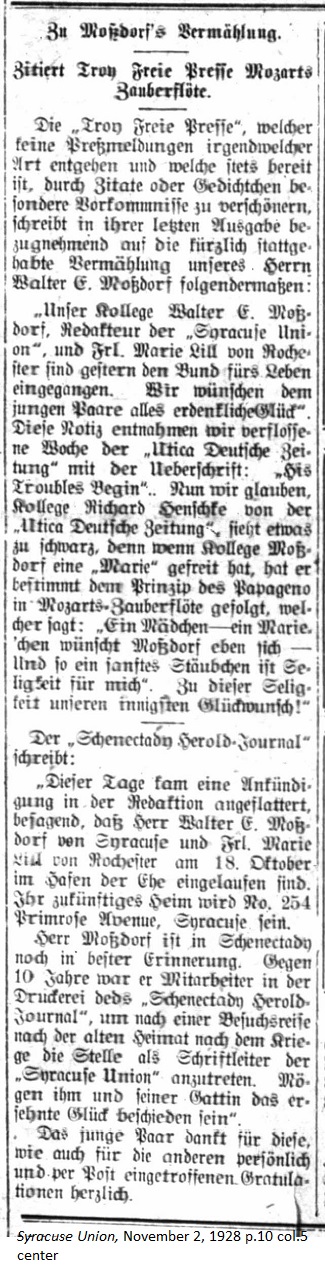
November 2, 1928 page 10 _____ The Troy Freie Presse cites Mozart's Magic Flute ______ The Troy Freie Presse, which never avoids an opportunity to report news of any kind and is always prepared to embellish any event through paraphrase or poetry, wrote in its last issue about the recent marriage of our Mr. Walter E. Mossdorf as follows: "Our colleague Walter E. Mossdorf, editor of the Syracuse Union, and Miss Marie Lill of Rochester entered into the bond for life yesterday. We wish the young couple every imaginable happiness. We took this notice from last week's Utica Deutsche Zeitung which began with the heading 'His Troubles Begin.' Now we believe that our colleague Richard Henschke of the Utica Deutsche Zeitung sees things a little too darkly, and if Colleague Mossdorf has courted a "Marie" he has certainly followed Papageno's wish in Mozart's Magic Flute, which says: "A girl, a sweet Marie, our Mossdorf has hoped for; such a little dove would be bliss for me." Such bliss is our most heartfelt wish!" "This day an announcement floated into the editorial office that Mr. Walter E. Mossdorf of Syracuse and Miss Marie Lill of Rochester sailed into the harbor of wedlock on October 18th. Their future home will be No. 254 Primrose Avenue, Syracuse. Mr. Mossdorf is well-known here in Schenectady. Around ten years ago he was an employee in the printing office of the Schenectady Herold-Journal and after a visit to the old homeland after the war took a position as lead writer for the Syracuse Union. May he and his wife be blessed with happiness."
|
|
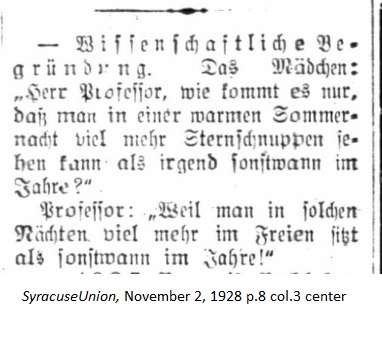
November 2, 1928 page 8 — Scientific Explanation.
|
|
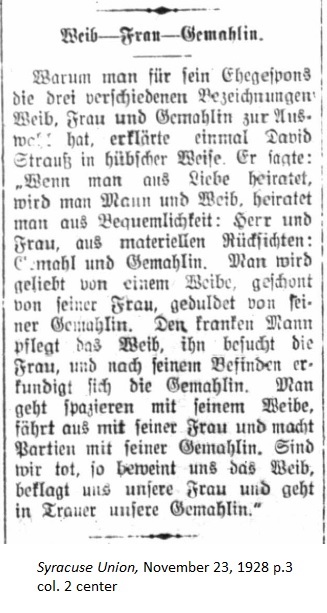
November 23, 1928 page 3 ______ Why do we have three different terms for the females we marry? David Strauss once explained it in a beautful way. He said: "When a man marries out of love, the couple become man and wife. When a man marries for convenience, they are Mr. and Mrs. If they marry for material reasons, they are spouses. A man is loved by his wife, looked after by his Mrs., and tolerated by his spouse. A wife cares for her sick husband; his Mrs. visits him in the hospital; a spouse seeks information about his condition. A man takes a stroll with his wife; drives off with his Mrs.; and plays games with his spouse. When a man dies, his wife cries for him; a Mrs. complains about him; and a spouse observes the mourning period." |
|
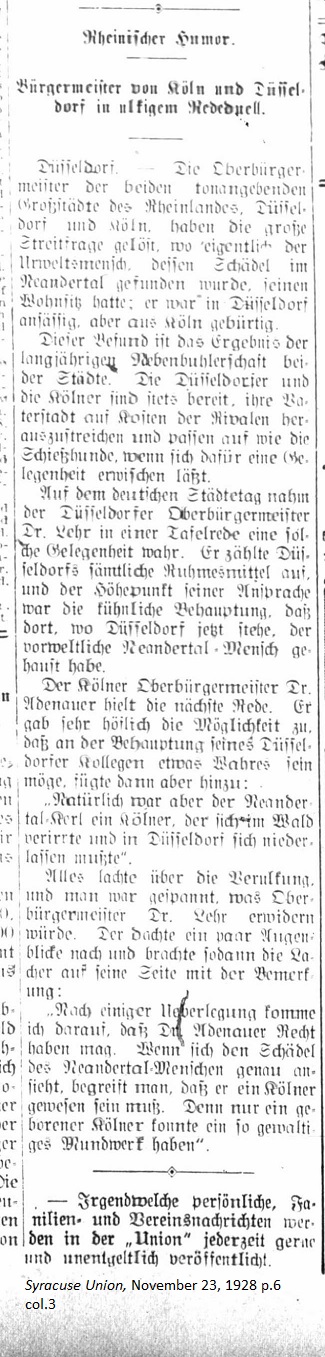
November 23, 1928 page 6 _____ The Mayors of Cologne and Düsseldorf in an Amusing Duel of Words _____ Düsseldorf. The senior mayors of the two prominent large cities, Düsseldorf and Cologne, have resolved the grand debate over where the primitive man, whose skull was found in Neanderthal, lived — he settled in Düsseldorf but was born in Cologne. This resolution is the result of a longstanding rivalry between the two cities and the residents of Düsseldorf and Cologne are ready to boost their cities at the cost of their rival. They stay alert like watchdogs anxious to seize any opportunity. At the German Association of Cities meeting the Düsseldorf senior mayor Dr. Lehr did just that in his speech. He spoke of Düsseldorf's claim to fame and the high point of the speech was the bold assertion that where Düsseldorf now stands used to be Neanderthal, where the primitive man once lived. Cologne senior mayor Dr. Adenaier gave the next speech. He very courteously posited the possibility that his Düsseldorf colleague's assertion may be correct, but then he added: "However, naturally this Neanderthal fellow was from Cologne. He must have lost his way in the woods and settled in Düsseldorf." Everyone laughed at this pun and anxiously awaited Dr. Lehr's response. He thought about it for a few minutes then laughter broke out as he remarked: "After some deliberation I've come to the conclusion that Dr. Adenauer must be right. When you take a good look at the Neanderthal man's skull, you see that he must be from Cologne. Only someone born in Cologne could have such a big mouth." — Any personal, family, and association news will gladly be published in the Union anytime and without charge. |
|
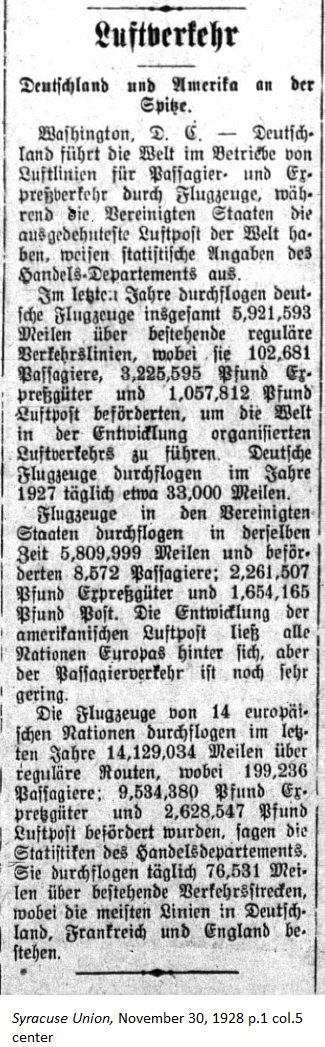
November 30, 1928 page 1 _____ Germany and America in the lead. Washington, D.C. — Germany leads the world in the operation of airliners for passenger and express freight service while the United States has extensive worldwide airmail service according to statisitical data of the Commercial Trade Department. In the past year German aircraft flew a total of 5,921,593 miles over regularly established travel routes, moving 102,681 passengers, 3,225,595 pounds of freight, and 1,057,812 pounds of airmail around the world. German aircraft flew around 33,000 miles daily in 1927. Aircraft in the United States flew in the same period 5,809,999 miles and moved 8,572 passengers, 2,261,507 pounds of freight and 1,654,165 pounds of mail. The development of American airmail service surpasses all nations in Europe however passenger transport is meager. The aircraft of 14 European nations last year flew 14,129,034 miles over regular routes, moving 199,236 passengers, 9,534,380 pounds of freight, and 2.628,547 pounds of airmail, according to the Commercial Trade Department. Daily 14 European nation's aircraft flew 76,531 miles over regularly established traffic routes, established mostly in Germany, France and England. |
|
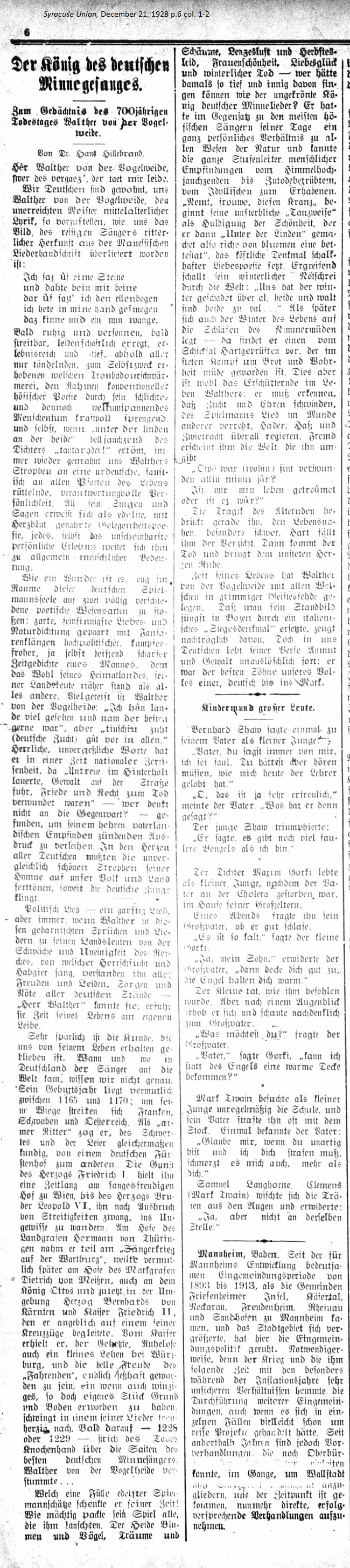
December 21, 1928 page 6 ______ A Commemoration of the 700 Year Death Date of Walther von der Vogelweide _____ by Dr. Hans Hillebrand We Germans are used to thinking of Walther von der Vogelweide as the foremost master of Middle Age lyric poetry as presented to us through the Codex Manesse, the giant songbook of knightly origin. I sat upon a stone
[*Translator's Note: The poem is translated here] Sometimes peaceful and pensive, other times aggressive and passionate; filled with a depth of experience, averse to all things trivial; its self-imposed purpose - to extol the troubador's infatuation with the framework of conventional courtly poetry powerfully springing from a modest but globally aware humanity. And even when the poet vigorously calls out "tandaradei!" in "Under the linden, deep in the meadow" Walther's stanzas remind us of the ancient German view into all aspects in the life of a conscious individual. All his songs and sagas display the noblest sentiments, occasional poetry transforming the most modest personal experience into a universally pertinent human truth. What a wonder it is that deep within this German minstel's soul was enough room for two totally different poetic forms: tender and extremely sensitive love and nature poetry paired with the fanfare of highly political, ready to do battle, and even sharply biting commentary on the times in one man, who was bound more closely to the well-being of his homeland than any other poet. Walther von der Vogelweide was well travelled. "I have seen many lands and taken the best there was," however, "German culture exceeded them all." He spoke wonderful, unforgettable words in a time of national turmoil: "Disloyalty lurks in ambush, violence reigns on the streets, peace and justice pummeled to death" — Who doesn't think of the present times? — found to bestow stirring expression to one's noble feelings towards the fatherland. In the heart of all Germans there is certainly no more unique and beautiful stanza than this hymn intoned for our people and country and whereever the German tongue is spoken. Political song — a nasty song, but as always when Walther sings in this sharply worded form to his countrymen he sings of the weaknesses and disunity of the empire created by the lust for power and greed. He understands it all — joy and sorrow; worries and needs in all German social groups. People knew that "Mister Walther" was closely acquainted with them and their lives. Very little information remains concerning his life. We don't know where and when the singer came into the world in Germany. His birth year was probably between 1165 and 1170. The Franks, the Swabians and the Austrians contest the location of his birth. As a "poor knight" he yielded the sword and the lyre with equal skill for one German prince after another. The patronage of Duke Friedrich I allowed him an extended stay at the song-loving court in Vienna until a dispute broke out with the Duke's brother, Leopold VI, forcing Walther to leave for parts unknown. In the court of Landgrave Hermann von Thuringia he took part in the "Sängerkrieg auf der Wartburg" (Minstrel Contest at Wartburg,) then stayed for a while at the court of Margrave Dietrich von Meissen, on to King Otto's court, and finally in the regions of Duke Bernhard von Kärnten and Kaiser Friedrich II, whom he supposely accompanied on the Crusade. Haunted and restless, he obtained a small fiefdom near Würzburg from the Kaiser. The bright joy of the "traveller" eventually became a wish to settle down on his own piece of land and this appeared in his songs. Soon thereafter, 1228 or 1229, the bony hand of death silenced the strings of the best German minstel, Walther von der Vogelweide. What a plenum of noble musical mastery he gave to his time! How powerfully he thrilled all with his playing. Meadows, flowers and birds, dreams and fantasies, the love of spring and the sorrow of fall, womanly beauty, happiness in love and winter death — who else could have sung so profoundly and intimately as the uncrowned king of German minnesong? Unlike most court singers of his day he had a completely personal relationship to the essence of nature and understood the entire range of human emotions from exultation to grief, from the pastoral to the sublime. "Take, dear lady, this garland," is the beginning of his immortal "Tanzweise" (Dance Melody,) which pays homage to beauty. In "Unter den Linden a bed is made of flowers and this establishes a delicious memorial to devilish love poetry. "Notschrei durch die Welt" (Outcry throughout the World) states "Winter has caused damage everywhere; meadow and forest are all gray."* [Translator's Note: this poem can be found Here about a third of the way down the webpage.] Later in the "Winter des Lebens" (Winter of Life) speaking of the (Slumber of the Tireless) he discovers an individual harshly tested by fate who has become tired due to the battle for bread and truth. Here is the distressing element in Walther's life: he must acknowledge that culture and honor disappear; that the musician's song is brutalized in the mouth of others; that discord, hatred, and strife rule over all. The world around him seems foreign. "Where have all the years gone?
The tragedy of aging depressed him, especially difficult was the pace of life. Resignation was hard for him. Then came death and uncertain peace. During his lifetime Walther von der Vogelweide had a ferocious intellectural feud with the French-speaking Swiss. That his statue was recently replaced by an Italian victory monument testifies to this. However for us Germans the elegance and power of his verse lives on indelibly. He was the beloved son of our people, German to the core. Out of the Mouth of Babes _____ As a small boy Bernard Shaw once said to his father: Father, you always tell me I'm lazy. However you should have heard today how my teacher praised me." "Oh, that's good to hear," his father responded. "What did he say?" The young Shaw triumphed. "He said there are many rascals lazier than me." As a young boy the poet Maxim Gorki lived in the house of his grandparents after his father died of cholera. One day his grandfather asked him if he had slept well. "It was so cold," young Gorki said. "Yes, my son," the grandfather replied. "Cover yourself up well, and the angels will keep you warm." The boy did as he was told, however after a moment he got up and went to his grandfather. "What do you want," his grandfather asked. "Father," Gorki said, "instead of angels can I have a warm blanket?" As a young boy Mark Twain attended school irregularly, and his father punsihed him often with a cane. One time the father told him:
Samuel Langhorne Clemens (Mark Twain) wiped the tears out of his eyes and replied:
[Translation of the remaining 2 sentences not possible.] |