January - June 1929
|
January 4, 1929 page 1 _____
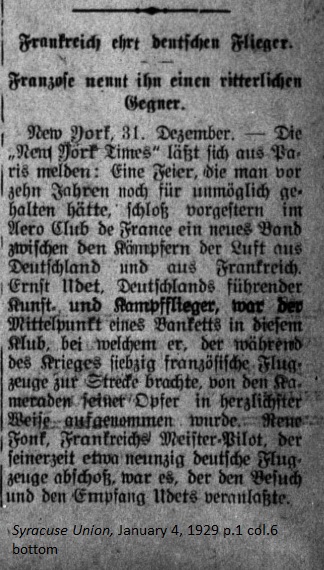
The French call him a Chivalrous Opponent New York, Decembr 31st. — The New York Times published a report from Paris: It was an event people would have thought was impossible ten years go. A banquet of World War I German and French fighter pilots took place the day before yesterday at the Aero Club de France. Ernst Udet, Germany's leading aerobatic and fighter pilot, was the center of attention at the banquet. During the War he brought down seventy French aircraft but now he was heartily welcomed by comrades of his victims. Rene Funk, France's master pilot who in his day shot down ninety German planes, organized the visit and reception for Udet. |
|
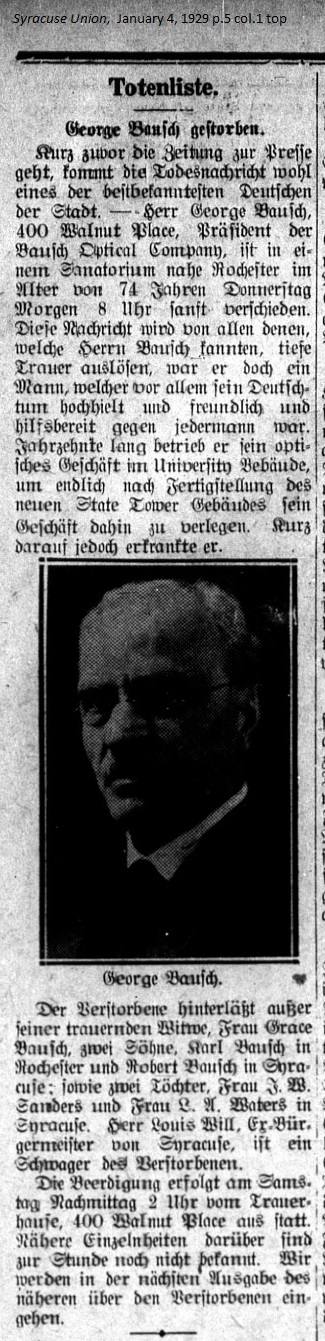
January 4, 1929 page 1 _____ George Bausch dead Shortly before this issue went to the press we received a death notice for one of the best known Germans in the city. — Mr. George Bausch, 400 Walnut Place, President of the Bausch Optical Company, departed this life in a sanatorium near Rochester at the age of 74 years on Thursday morning at 8 AM. All who knew Mr. Bausch will be deeply saddened by this news. He was a man held in high regard by the German community known for his friendly demeanor and willingness to help others. For decades he operated his optical business in the University Building and moved the operation to the new State Tower Building once it was completed. Shortly thereafter he became ill. Caption under picture reads: George Bausch The deceased leaves behind his grieving widow, Mrs. Grace Bausch; two sons, Karl Bausch of Rochester and Robert Bausch of Syracuse; also two daughters, Mrs. J.W. Sanders and Mrs. A.L. Waters of Syracuse. Mr. Louis Will, former mayor of Syracuse, is a brother-in-law of the deceased. The burail will occur Saturday at 2 PM from the house of mourning, 400 Walnut Place. Further details are not known at this time. We will give more information concerning the deceased in the next issue. |

|
January 11, 1929 page 5 _____ Two Pioneers die at the same Time _____ Mr. George Bausch and Mr. Louis Leiter _____ Last Thursday we found out at the last minute that Mr. George Bausch died and mentioned it in our last issue. Days later came news from Miami, Florida that another pioneer businessman had departed this mortal plain at almost the same time. This was Mr. Louis Leiter, who had resided in Florida for some time. Mr. Bausch died on Thursday morning at 7:50 AM in Brigham Hall Sanatorium in Canandaigua, here he had stayed since September. He reached the age of 74 years and was the first optician in Syracuse. In 1880 he established the Bausch Optical Company. His father and grandfather were opticians in Germany and he learned the optical trade under his father during his youth. At the age of 15 he came from Germany to Rochester, where he worked for 10 years at the Bausch & Lomb Optical Company. His boss was his uncle, J.J. Bausch, who died a year ago [sic]. [Reported in the February 26, 1926 issue of the Syracuse Union] The current business belonging to Mr. Bausch was established in the old Bastable Arcade, located in the same place where the new State Tower Building stands. The business was always in the same general area. Mr. Bausch was a Republican and showed great interest in the affairs of his party and the country, but he was never a candidate for political office. He was also a good German, who held the German language and the German newspaper in high regard. In him the German community has lost a good and zealous advocate. He was a member of the Syracuse Turnverein, the Liederkranz, the Chamber of Commerce and the Citizen's Club. He was married twice and leaves behind his widow, Mr. Grace Root-Bausch; two sons, Robert E. Bausch, who worked jointly with this father in the business and in all likelihood will carry on the concern, and Carl L.Bausch in Rochester; also two daughters, Mrs. Louis A. Waters and Mrs. James B. Sanders. The burial occurred on Saturaday from the house in mourning at 400 Walnut Place to Woodlawn Cemetery. There were a large number of people in attendance. Mr. Louis Leiter reached the age of 86 years. He was born in Germany June 20, 1844 and came with his parents as a 9-year-old boy to America. At a young age he exhibited a great love for music. His first job was as an errand boy in a clock and watch business. He owned a jewelry business in the Wieting, Kirk, and Pike Building, the current location of the Witherill Store. Later he worked in the piano trade with his brother Hermann and as a partner built up a large business. After the death of his brother the business was incorporated. Mr. Leiter was owner of the current home of the Syracuse Lighting Company, where he lived for many years. He was an honorary member of several German singing societies and philanthropic organizations plus a 32nd degree Freemason. A lung infections was the cause of his death. The body was brought to Syracuse and buried at the Woodlawn Cemetery on Thursday. He leaves behind three sons, Harry N. Leiter of the business firm; Dr. Horace L. Leiter and Milton M. Leiter, attorney. He also leaves a brother, Henry, in Rochester and a sister, Mrs. Bessie Mass in Battle Creek, Michigan. May these two pioneers, who enjoyed great esteem, rest in peace. |
|
January 18, 1929 _____ |
|
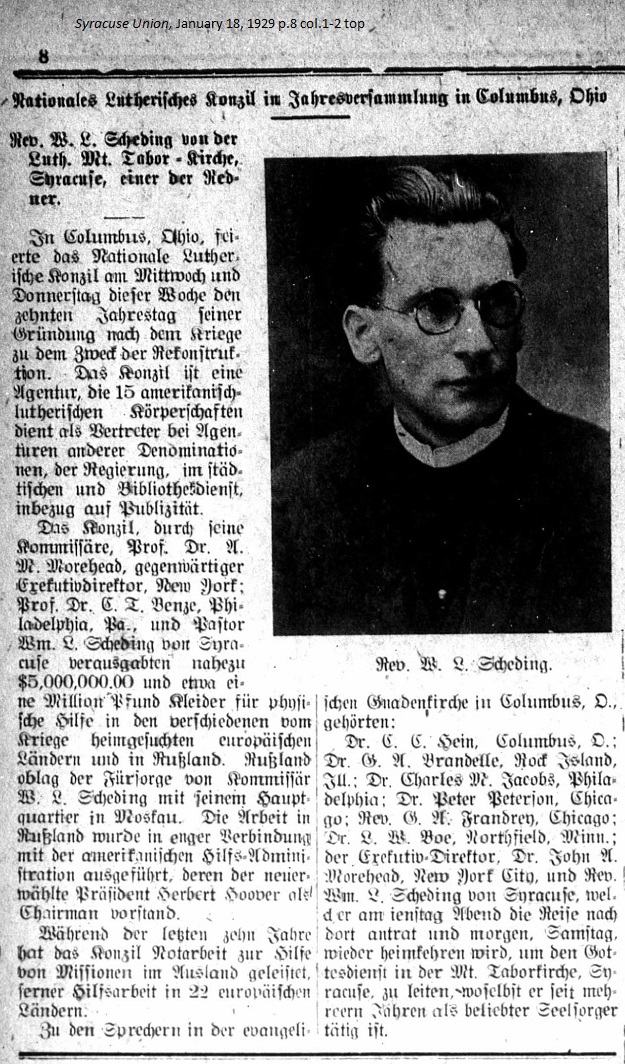
January 18, 1929 page 8 _____ Rev. W.L. Scheding of the Lutheran Mt. Tabor Church of Syracuse One of the Speakers _____ On Wednesday and Thursday in Columbus, Ohio the National Lutheran Council celebrated the tenth anniversary of its founding. It was created after the War in an effort at reconstruction. The Council is an agent for 15 American-Lutheran entities and acts as representative for them with other denominations, the government, civic and library service, and in matters of publicity. The Council's commissioners are Prof. Dr. A.M. Morehead, currently Executive Director, New York; Prof. Dr. C.T. Benze, Philadelphia, Pa.; and Pastor Wm. L. Scheding of Syracuse. They have spent nearly $5,000,000 and collected about one million pounds of clothing to help the post-war devastated European countries and Russia. Commissioner W.L. Scheding is responsible for Russia with its main headquarters in Moscow. The work in Russia is performed in close association wth the American Relief Administration with newly elected President Herbert Hoover as Chairman. During the past ten years the Council has performed important work helping missions abroad in 22 European countries. Among the people who spoke in the Evangelical Grace Church in Columbus, Ohio were: Dr. C.C. Hein, Columbus, Ohio; Dr. G.A. Brandelle, Rock Island, Ill.; Dr. Charles M. Jacobs, Philadelphia; Dr. Peter Peterson, Chicago; Rev. G.A. Frandrey, Chicago; Dr. L.W. Boe, Northfield, Minn.; the Executive Director, Dr. John A. Morehead, New York City; and Rev. Wm. L. Scheding of Syracuse, who made the trip Tuesday evening and returned home Saturday morning in order to perform church service at the Mt. Tabor Church, Syracuse, where he has been a beloved spiritual caregiver for several years. Caption under picture reads: Rev. W.L. Scheding |
|
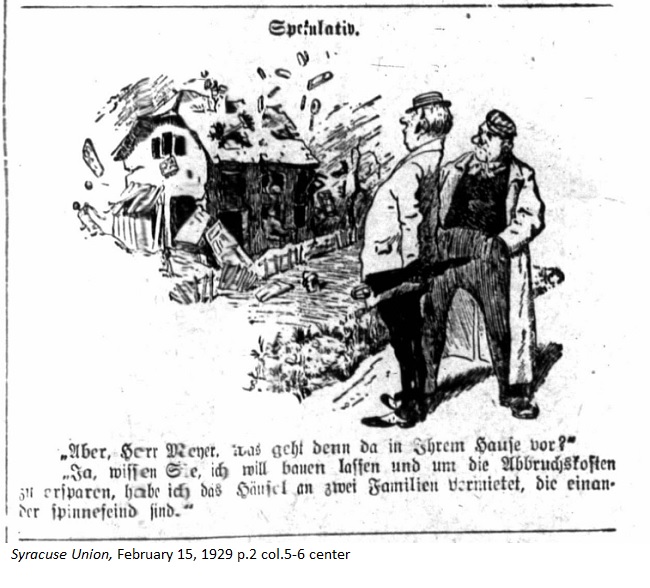
February 15, 1929 page 2 "Mr. Meyer, what's happening to your house?" "I wanted to get it rebuilt, so to save the demolition costs I've rented it to two families who hate each other's guts." |
|
March 1, 1929 page 1 _____ Bronxville, N.Y. — Dr. Newell Dwight Hillis, former preacher at the Plymouth Church in Brooklyn, has died this day after a lengthy illness. He was 71 years old. During the War Hillis travelled the entire country and held rabble-rousing speeches in which he attacked the German people. He spread untruthful, horrible stories causing hatred against the German community. |
|
March 1, 1929 page 4 _____ In the chambers of the U.S. Senate in Washington they remember this German immigrant refugee as a young spitfire, a freedom dreamer, and a revolutionary. He worked his way up to a Senate seat and later to Cabinet membership as a trustworthy advisor to President Hayes. He was not only active in Washington but in many other American cities where German organizations and associations have established Carl Schurz Memorial celebrations held on March 2nd. His memory is thoughtfully and reverently honored by the German-American element as its foremost representative bringing honor to his people. This great son of Mother Germania is also commmorated in Germany on March 2nd. There the "Vereinigung Carl Schurz" (Carl Schurz Association) has taken the initiative for preparation of an imposing memorial celebration. However the most impressive commemoration may take place in the German Reichstag which even President von Hindenburg will attend. At the invitation of the Vereinigung Carl Schurz in association with the Carl Schurz Memorial Foundation Prof. Dr. Albert Faust, Germanist of Cornell University, will deliver the official American address on the theme "Carl Schurz' Work in the United States and his Influence on the Idea of Democratic Unity." For the 100th birthday celebration, March 2, 1929, of the important leader of the March 1848 Revolution and later German-American stateman a book titled Carl Schurz, ein deutscher Kämpfer (Carl Schurz, a German Warrior) by Dr. Otto Dannehl has been published and bound and is available through Walter der Gruyter & Co., Berlin for 10 Reichsmarks. |
|
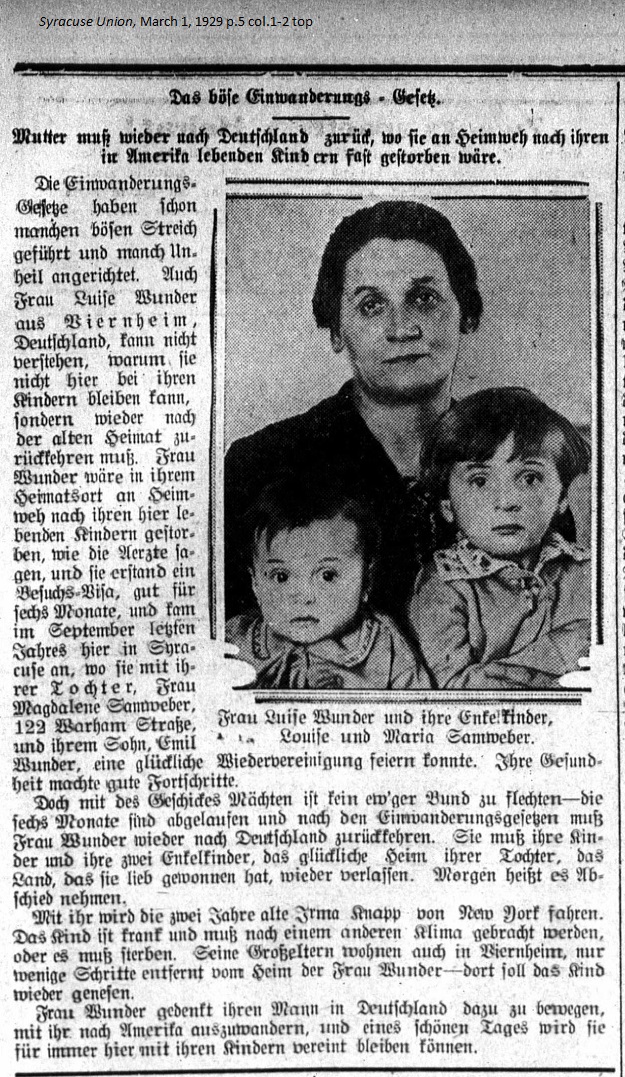
March 1, 1929 page 5 _____ Mother must return to Germany, where she's practically could have died of Homesickness for her Children living in America. And yet no eternal bond is recognized by the powers that be — the six months have passed and according to the immigration laws Mrs. Wunder must return to Germany. Once again she must leave her children and her two grandchildren, her daughter's happy home, and the country that has won her heart. Tomorrow is departure day. The two-year-old Irma Knapp of New York will travel with her. The child is sick and must be taken to a different climate otherwise she will die. Her grandparents also live in Viernheim, just a few steps away from Mrs. Wunder's home — The child will recouperate there. Mrs. Wunder is trying to convince her husband in Germany to immigrate with her to America. One fine day she will be be able to stay forever with her children. Caption under picture reads: Mrs. Luise Wunder and her grandchildren, Louise and Maria Samweber. |
|
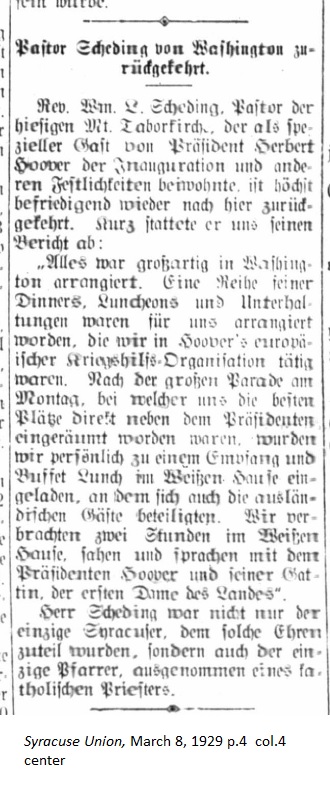
March 8, 1929 page 4 _____ "Everything was beautifully organized in Washington. A series of fine dinners, luncheons and entertainments were arranged for us since we were active in Hoover's European War Relief Organization. After a large parade on Monday where we were seated in the best places near the President, we were personally invited to the White House for a reception and buffet lunch which was also attended by foreign guests. We spent two hours at the White House, saw and spoke with President Hoover and his wife, the First Lady of the Land." Mr. Scheding was not the only person from Syracuse who was so honored but he was the only minister except for one catholic priest. |
|
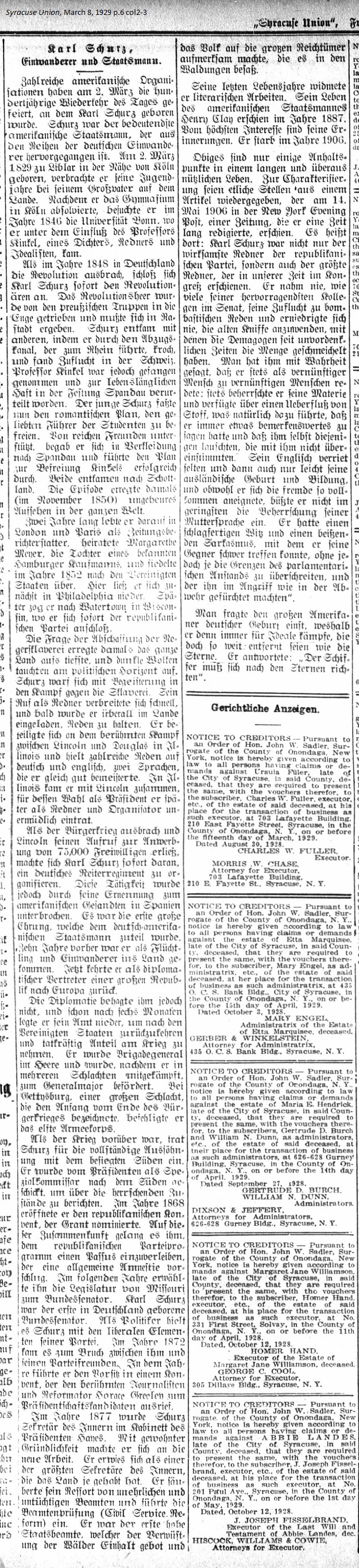
March 8, 1929 page 6 Immigrant and Statesman _____ When the Revolution broke out in Germany in 1848 Karl Schurz immediately decided to become a revolutionary. Prussian troops trapped the revolutionary army and forced it to surrender in Ranstadt. Schurz escaped with some others down a gully which led to the Rhine and he found refuge in Switzerland. Professor Kinkel was taken prisoner and sentenced to lifelong imprisonment in the fortress at Spandau. Young Schurz fashioned the romantic plan to liberate the beloved leader of the students. Supported by rich friends he went to Spandau in disguise and successfully carried out the plan to free Kinkel. Both escaped to Scotland. In November 1850 the episiode created a huge sensation around the world. He lived for two years in London and Paris as a newspaper reporter; married Margarethe Meyer, the daughter of a well-known Hamburg merchant; and came to the United States in 1825. He settled in Philadelphia. Later he moved to Watertown in Wisconsin, where he immediately joined the Republican Party. The question concerning the abolition of slavery submerged the country into the abyss and dark clouds arose on the political horizon. Schurz threw himself with zeal into the fight against slavery. His reputation as an orator spread rapidly and soon he was invited to speaking engagements all over the country. He took part in the famous battle between Lincoln and Douglas in Illinois and held several speeches in German and English, two languages he had mastered. In Illinois he joined Lincoln for whom he later campaigned for president using his skills as a speaker and organizer. When the Civil War broke out and Lincoln issued the call for 75,000 volunteers Karl Schurz immediately organized a cavalry regiment. This activity was interrupted by his appointment as American envoy to Spain. This was the first great honor which this German-American statesman would receive. Ten years earlier he had arrived in this country as a refugee and immigrant. Now he returned to Europe as a diplomatic representative of a grand republic. Diplomacy didn't suit him so he resigned this posting after six months in order to return to the United States and take part in the Civil War. He became an Army brigadier general and after taking part in many battles he was promoted to major general. At Gettysburg, the great battle which signaled the beginning of the end of the Civil War, he commanded the Eleventh Army Corps. When the war was over Schurz advocated for full reconciliation with the defeated south. He was sent by the president as a special commissioner to the south in order to report on prevailing conditions. In 1868 he opened the Republican Convention, which nominated Grant. At this gathering he succeeded in annexing a passage to the Republican program proposing a general amnesty. The following year the Missouri Legislature selected him to be its State Senator. Karl Schurz was the first person born in Germany to go to the Senate. As a politician Schurz aligned with the liberal element of his party and in 1872 that element broke away. In this year he became chairman of the new element's convention, which proclaimed the famous journalist and reformer Horance Greeley as its presidential candidate. In 1877 Schurz became Secretary of the Interior in President Hayes' cabinet. With his usual thoroughness he got to work and proved himself one of the best Secretaries of the Interior that the country ever had. He rid his department of dishonorable and incapable officers and introduced Civil Service Reform. He was the first high-ranking state official to stop the devastation of our forests' contents and make the public aware of the great treasures the forests possessed. His later years were dedicated to literary pursuits. His biography of the American statesman Henry clay was published in 1887. Of greatest interest are his memoires. He died in 1906. The above are mere indicators of a long and useful life. Passages from the May 14, 1906 New York Evening Post, a newspaper he edited for some time, published the following: "Karl Schurz was not only a powerful orator of the Republican Party, he was also the greatest orator to appear in Congress during our time. He did not take flight into bombastic rhetoric like so many of our eminent colleagues in the Senate nor debase himself by resorting to old tricks with which demagogues have flattered the masses for time immemorial. People have rightly said that he was a reasonable man talking to reasonable people. He mastered his subject and left out superfluous material which naturally led to it. He always had something noteworthy to say and he listened to those who did not agree with him. His English rarely revealed, and only slightly, his foreign birth and education and although he had a perfect understanding of the foreign idiom he never forfeited the mastery of his mother tongue. He had a quick wit and could exercise biting sarcasm against his opponent without crossing the boundries of parliamentary decorum and this made him formidible in both attack and defense." Someone once asked the great American of German birth why he would always fight for the Ideal, which can be as far out as the stars. He responded, "The sailor must navigate by the stars." |

|
March 29, 1929 page 6 _____ It had rained for two days without stop. And there would be no change in the weather for the foreseeable future. Despite this I had to travel to the neighboring town. I was talking about this at the restaurant table with a group of friends, saying I wasn't looking forward to it. Mr. Kahle, who lives in the neighboring town and sits with the group when business brings him here, heard my comment. "Tell me, could you take a letter there with you and put it in the mail box for me?" "Gladly," I replied. "I'll write it right now." After a short time he handed me an envelope. I saw the address and said, "You wrote a letter to yourself?" "Yes. Tomorrow it's presumably going to rains just as torrentially. I've been having an argument with the letter carrier and it pleases me no end that the bugger will have to deliver it to me in this lousy weather!" |
|
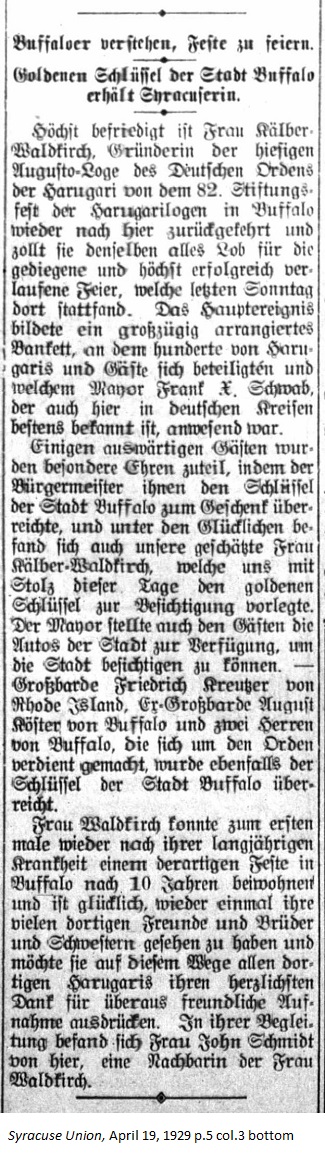
April 19, 1929 page 5 ______ A Syracuse Woman receives the Gold Key to the City of Buffalo ______ Mrs. Kälber-Waldkirch, founder of the local Augusto Lodge of the German Order of the Harugari, is well pleased upon her return from the 82nd celebration of the founding of the Harugari Lodge in Buffalo and she sang the praises for the highly successful celebration, which occurred last Sunday. The main event was a magnificent banquet, in which hundreds of Harugari members and guests took part and which Mayor Frank X. Schwab, well known in German circles here, attended. A few guests were especialy honored when the Mayor bestowed upon them the keys to the city. Among those so honored was our esteemed Mrs. Kälber-Waldkirch, who today proudly gave the key to us for safe keeping. The Mayor also placed cars at the guests' disposal so they could see the city. — Grand Bard Friedrich Kreutzer of Rhode Island, Ex-Grand Bard August Koster of Buffalo, and two gentlemen from Buffalo, who were of service to the Order, were also given keys to the city. This was the first time in 10 years that Mrs. Waldkirch was able to attend such a celebration due to prolonged illness. She was happy to once again see her many friends in Buffalo and her brothers and sisters and she wishes to express her heartfelt gratitude for the friendly reception she found there. She was accompanied to Buffalo by Mrs. John Schmidt of Syracuse, who is her neighbor. |
|
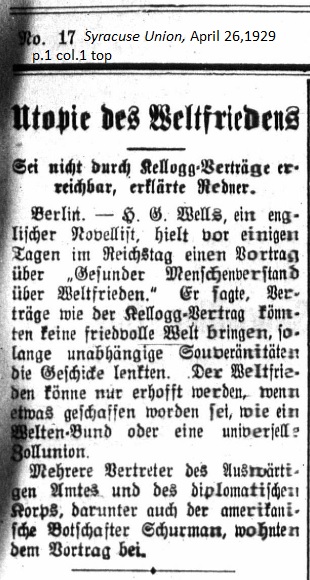
April 26, 1929 page 1 _____ May not be achievable through the Kellogg Pact, Orator declares. Many representatives of the Foreign Office and the Diplomatic Corps, among them Ambassador Schurman, were present for the lecture. |
|
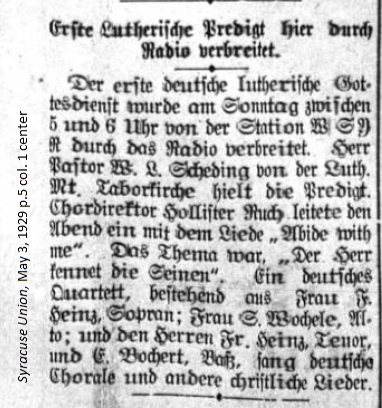
May 3, 1929 page 5 _____ The first German Lutheran church service was broadcasted on Sunday between 5 and 6 o'clock on Station WSYR. Pastor W.L.Scheding of the Lutheran Mt. Tabor Church gave the sermon. Choir director Hollister Ruch opened the evening with the hymn "Abide with me." The theme was "The Lord knows His People." A German quartet, comprised of Mrs. F. Heinz, soprano; Mrs. S. Wochele, alto; Mr. Fr. Heinz, tenor; and Mr. E. Bochert, bass sang the German chorale and other Christian songs. |
|
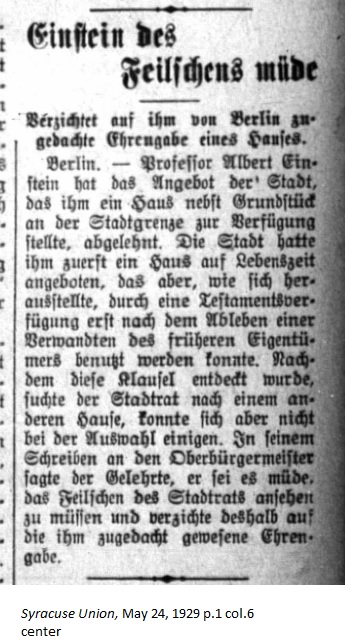
May 24, 1929 page 1 _____ Declines the Honorary Gift of a Berlin House given to Him. |
|
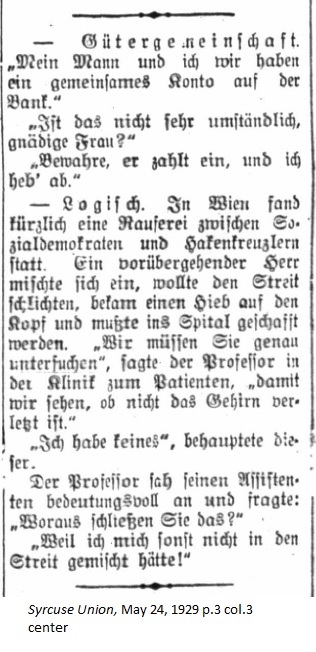
May 24, 1929 page 3 — Community Property.
— Logic.
|
|
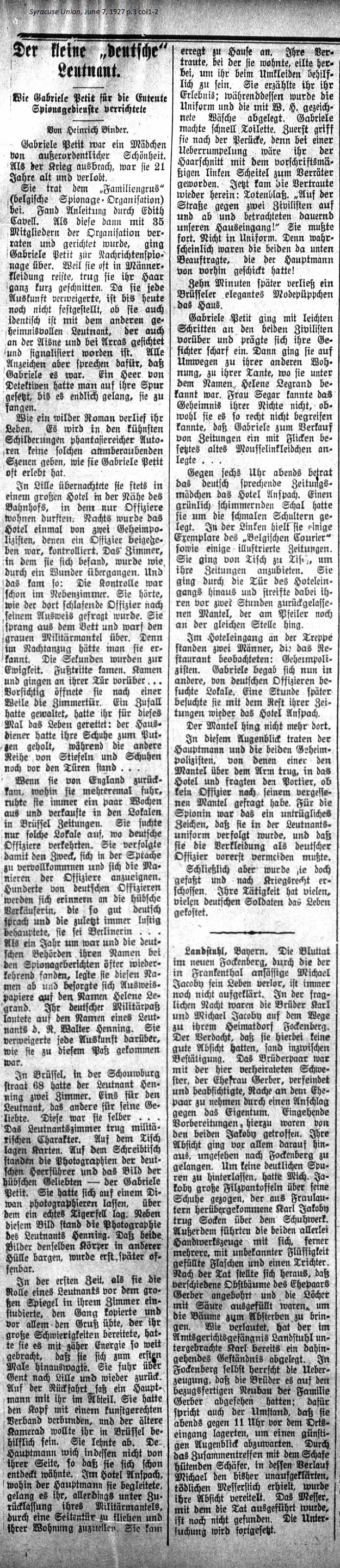
June 7, 1929 page 3 _____ How Gabriele Petit worked for the Entente Spy Service _____ by Heinrich Binder Gabriele Petit was a girl of extrordinary beauty, When the war broke out she was 21 years old and engaged. She joined the "Familiengrus," the Belgian Spy Organization and found guidance from Edith Cavell. When Cavell and 35 other members of the organization were betrayed and executed, Gabriele Petit transferred to the Intelligence Service. Because she often wore men's clothing she kept her hair quite short. Whether she withheld information has not been firmly established up to now, nor has it been ascertained whether she was the same secret lieutenant spotted and signaled on the Aisne and near Arras. However all signs point to it being her. An army of detectives was put on her trail until she was eventually captured. Her life read like an adventure novel. The most clever descriptions by fantasy authors couldn't have created breathtaking scenes as wild as the life Gabriele Petit lived. In Lille, she stayed overnight in a hotel near the train station in which only officers were supposed to live. One night the hotel was investigated by two secret policemen accompanied by an officer. It was a wonder the room in which she was staying was passed over. The police were at the room next to hers. She heard how a sleeping officer was asked for his identification. She sprang out of bed and threw on her gray military coat because in night clothes she would have been recognized. Seconds became an eternity. Footsteps approached. They came and went past her door... A while latter she carefully opened the door. Good fortune prevailed and saved her life. The houseboy had taken her shoes to clean them while rows of boots and shoes stood before all the other doors. When she returned from England, where she had gone several times, she always rested for a couple of weeks and sold newspapers in the taverns of Brussels. She only went to the taverns frequented by German officers. She went with the purpose of perfecting her German and learning the mannerisms of the officers. Hundreds of German officers recalled the pretty vendor, who spoke such good German and who had ultimately maintained that she was from Berlin. A year later the German authorities found her name repeatedly in their espionage reports, so she changed her name and procured identity papers in the name of Helene LeGrand. Her German military passport carried the name Reserve Lieutenant Walter Henning. She refused to give any information on how she had procured this pass. In Brussels on 68 Schouwburg St., Lieutenant Henning had two rooms, one for the lieutenant and the other for his beloved. They were one and the same. The lieutenant's room had a military character. There were maps on the table. On the desk stood photographs of German army leaders and a portrait of his beautiful beloved, Gabriele Petit. She had a photograph of herself on a couch covered with a tiger pelt. Next to the picture was one of Lieutenant Henning. It was only discovered later that both pictures were of the same person in different wrapper. The first time she assumed the role of a lieutenant she practiced in front of a mirror. She copied his walk and rehearsed his salute. All this hard work prepared her until she was able to perform the role with such energy that she dared to venture out for the first time. She went through Gent to Lille and back again. On the return trip a captain sat with her in the same compartment. She had bound her head in a authentic-looking bandage and the senior comrade wanted to assist her in Brussels. She declined. The captain still wouldn't move from her side so she thought she had been discovered. At the Hotel Anspach, where the captain escorted her, she abandonned her military coat, managed to flee through a side door and rushed back excitedly to her home. Her fiancé, with whom she lived, hurried over to help her undress. She told him of her adventure. The uniform and the monogrammed underwear were discarded. Gabriele quickly dressed. Then she grabbed the wig, since during a surprise attack her own haircut with its part on the left side would have marked her a traitor. Her fiancé came back in, deathly pale. "There are two civilians going back and forth down the street watching our front door!" She had to leave immediately, but not in uniform. Perhaps those two were sent by the captain! Ten minutes later an elegant, fashionably dressed, Brussels lady left the house. With light steps she passed the two civilians and committed their faces to memory. Then she went her way to her other residence, to her aunt where she was known by the name Helene Legrand. Mrs. Segar did not know her niece's secret although she could not understand why Gabriele donned a patched, old muslin dress when she sold newspapers... Around six in the evening a German-speaking newspaper salesgirl entered the Hotel Anspach. She had place a shimmering green shawl around her small shoulders. In her left hand she held a few copies of the Belgischen Courier along with a few illustrated newspapers. She went from table to table offering her newspapers. She went through the door of the hotel entrance and swooped past the coat she had abandonned two hours earlier, which was still hanging in the same place on a peg. Two men stood on the stairs at the hotel entrance watching the restaurant. They were secret police. Gabriele now took herself to another restaurant frequented by German officers. An hour later she went back to the Hotel Anspach with the remainder of her newspapers. The coat was no longer hanging there. At that moment the captain and the two secret policemen entered the hotel. One of them had the coat over his arm. They asked the porter if an officer had asked about his forgotten coat. This was an unbearable indicator to the spy that she was being pursued in a lieutenant's uniform and that she must give up her disguise as a German officer. Eventually she was captured and under the laws of wartime shot. Her activity cost many German soldiers their lives. |
|
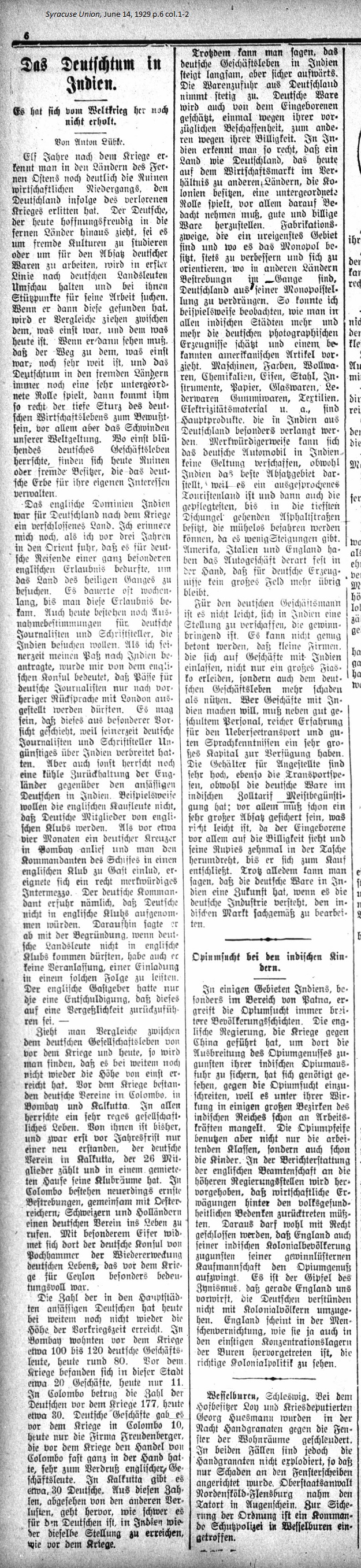
June 14, 1929 page 6 _____ It has not yet recovered from the War _____ By Anton Lübke After the war the English dominion of India was a closed country to Germany. I still remember when I came to the Orient three years ago that German travellers needed a special English permit to visit the land of the holy Ganges. It often took a week before the permit arived. Even today there are special exemption clauses for German journalists and writers who wish to visit India. When I applied for my pass to India the English Consulate told me that the pass for German journalists could only be obtained after consultation with London. It might be that this greater degree of caution occurred because at the time German journalists and writers had an unfavorable influence on India. The English also exhibited a cool reluctance to allow Germans to settle in India. By way of example, English merchants did not want German members in their English clubs. Around four months ago when a German cruiser sailed into Bombay and someone invited the commander of the ship to be his guest at an English club, there was a truly remarkable interlude. The German commander learned that Germans were not accepted in English clubs. He declined the invitation and gave as the reason, if German countryman could not attend English clubs then he had no desire to receive an invitation. The Englishman who made the invitation only offered the excuse that he had forgotten Germans won't accepted as members. If one compares social life before the war and today, he will find that it has not regained the vitality it once had. Before the war there were German societies in Columbo, Bombay and Calcutta. In all three cities a lively social life prevailed. Within the past year only one society has risen anew, the German Society of Calcutta with 26 members holding its club functions in a rented house. Recently in Columbo the first steps have been taken to form a German society with Austrian, Swiss and Dutch members. With particular eagerness the German Consul of Pochhammer has been working to reawaken the German social life, which was especially active in Ceylon. Even the number of resident Germans in the main cities is significantly less than it was before the war. Before the war there were around 100 to 120 German businessmen in Bombay. Today there are about 80. There were 20 businesses in this city before the war. Now there are 11. In Columbo before the war there were 177 German residents; today around 30. There were 10 businesses before the war; today there's only the Freudenberger Firm, which before the war almost completely dominated trade in Columbo, much to the chagrin of English businessmen. In Calcutta there are around 30 Germans. Aside from the other damages, this number attests to how difficult it has become for the German community to achieve the status it held in India before the war. Despite all this it can be asserted that German social life in India is rising slowly and moving forward. The export of merchandise from Germany is steadily increasing. German wares are also appreciated by the native Indian population not just for their excellent quality but also their affordability. In India they rightly recognize that a country like Germany in today's economic marketplace plays a subordinate role to countries which possess colonies. Plus it must take precautions to make sure that it is producing good and inexpensive wares. Manufacturing branches which are the place of origin and possess a monopoly always try to improve themselves and orient their operations when efforts are in the works to keep Germany from coming into competition with their monopoly. For example, I was able to observe how people in all Indian cities appreciate German photographic products but still prefer the popular American article. Machinery, dyes, cotton goods, chemicals, iron, steel, instruments, paper, glassware, leather goods, rubber goods, textiles, electrical materials, etc. are the main products which people in India particularly want from Germany. Remarkably the German automobile has no customer base in India even though India represents the best market because it is an eminent tourist destination and because German autos are the most practical for deep jungle to asphalt street travel and easy to drive in mostly level terrain. America. Italy and England have the automobile market firmly in hand, leaving little market for German cars. It's not easy for the German businessman to create an economic niche in India. It cannot be sufficiently emphasized that small firms who try to do business in India not only suffer huge fiaskos but also they do more harm than good to German business life. Along with well-qualified personnel anyone who wants to do business in India must have a wealth of experience in overseas transport and good knowledge of the language plus a lot of capital at his disposal. Wages for staff are very high as are tranportation expenses although German wares enjoy favorable tariff and customs charges in India. And above all else there needs to be an assured market, which is not easy since the native individual is looking for inexpensive prices and his Rupies slosh around in his pocket ten times before he decides to make a purchase. Despite everything one can say that German wares have a future in India if German industry understands it must adapt to the Indian market. Opium Addiction among Indian Children _____ In a few sections of India, especially the region of Patna, opium addiction is seizing an ever wider portion of the population. The English government was fighting a war with China in order to assure the spread of opium usage to benefit its Indian opium exports. However it then felt necessary to interfere because under opium's influence a workforce shortage had developed in some large sections of the Indian empire. But it wasn't just the working class using the opium pipe. It had spread to the children. In a report from the English Civil Service to higher government positions it was emphasized that economic considerations must take a back seat to public health concerns. It may be justifiably concluded that England should regulate opium usage to benefit its Indian colonial population and the profit-seeking merchants. It is the height of cynicism that England has just criticized that the Germans don't know how to deal with colonial populations. England seems to think human extinction is a proper form of colonial politics as was once the case in the concentration camps of the Boers. |