July - December 1929
|
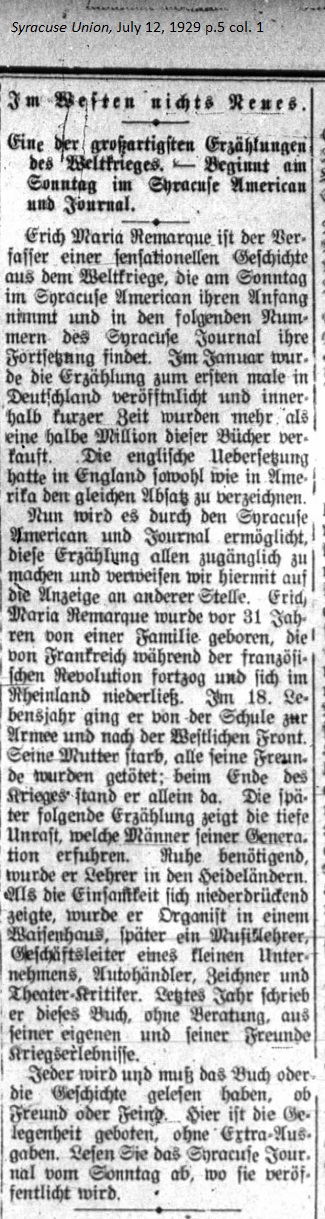
July 12, 1929 page 5 _____ One of the Greatest Tales of the First World War —
_____ Erich Maria Remarque is the author of one of the seneational stories to come out of the World War, which will have its premier on Sunday in the Syracuse American and have it's following installment printed in the following issue of the Syracuse Journal. The story was published in Germany for the first time in January and in that short time more than half a million copies of this book have been sold. The English translation has had similar sales in England and America. Now the Syracuse American and Journal will make it possible for everyone to access this tale and we will furnish an advertisement on a separate page. Erich Maria Remarque was born 31 years ago to a family which moved from France during the French Revolution and settled in the Rhineland. At the age of 18 he left school, went into the army and was assigned to the western front. His mother died; all his friends were killed; by the end of the war he stood all alone. The story he later wrote demonstrates the deep unrest that men of his generation experienced. Needing peace and quiet, he became a teacher in the moor lands. When the isolation became oppressive he became an organist in an orphanage. Later he became a music teacher, the manager of a small enterprise, an auto dealer, a draftsman and a theater critic. He wrote this book last year without guidance, based on his own and his friends' war experiences. Everyone will have to read this book, be he friend or foe. Here the opportunity is offered without additional cost. Read the Sunday issue of the Syracuse Journal, where it will be published. |
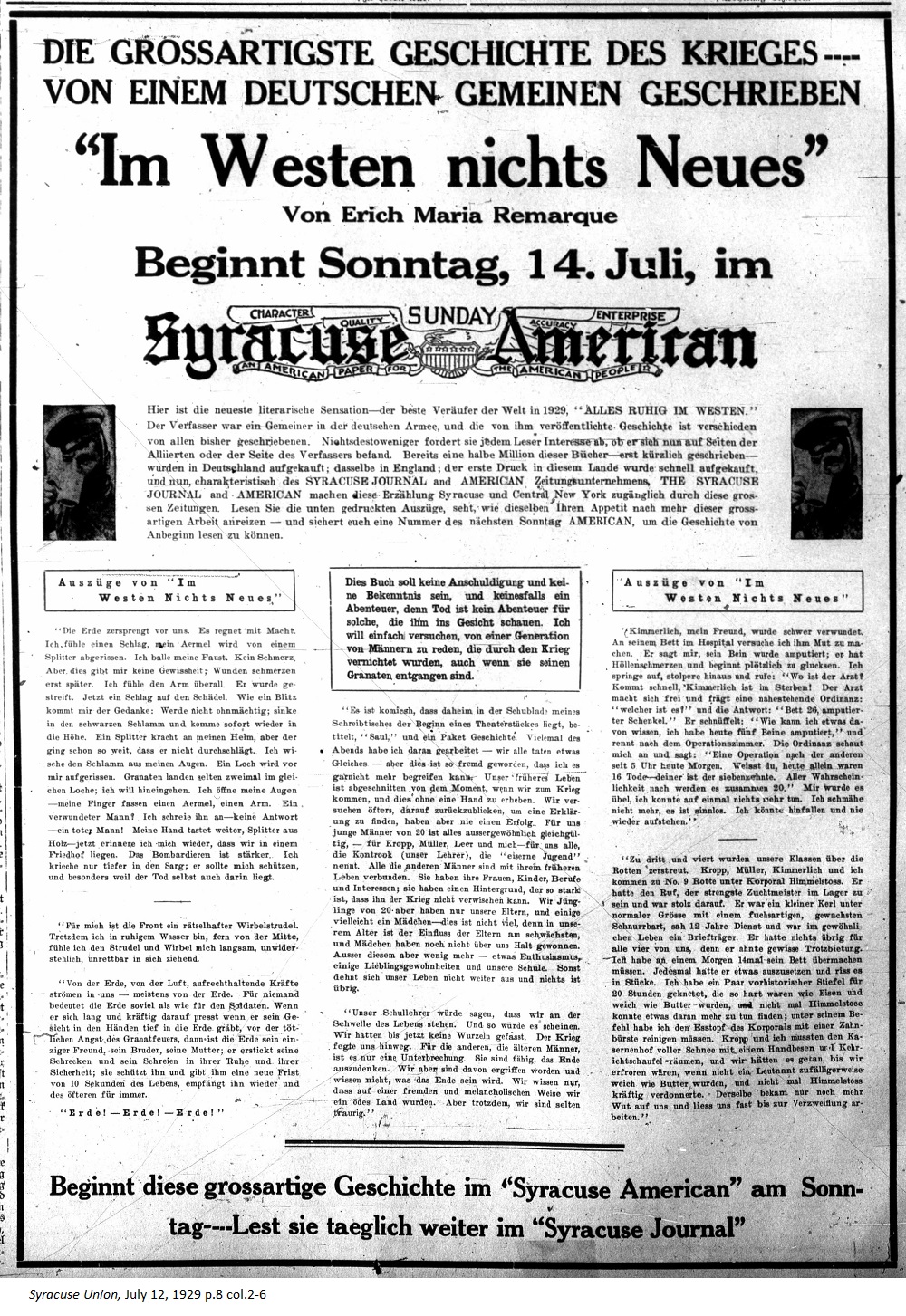 July 12, 1929 page 8 Written by a German Enlisted Man All Quiet on the Western Front
begins Sunday, July 14th in the Syracuse American Here is the latest literary sensation — the World's Best Seller of 1929, All Quiet on the Western Front. The author was an enlisted man in the German Army and the story he has published is different from any other story written thus far. No matter whose side you're on, this story will capture the reader's interest. Just written recently, already half a million copies of this book have been sold in Germany. The same holds true for England; the first printing rapidly sold out. And now, characteristic of the Syracuse Journal and American , it makes this story accessible to Syracuse and Central New York. Read the excerpts printed below and see if they don't whet your appetite for more of this great work — and secure yourself a copy of next Sunday's American so you can read the story from the beginning. [Framed center text in bold print]
[Excerpts not translated. The book is available online at Google Docs] Start this great story Sunday in the Syracuse American---then continue it daily in the Syracuse Journal |
|
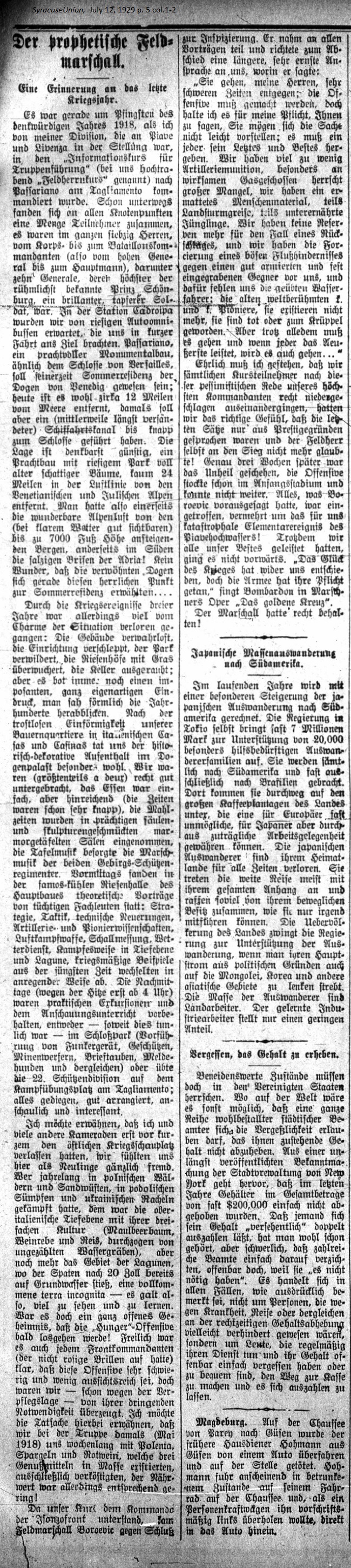
July 12, 1929 page 5 _____ A Memoire of the Last Year of the War. It was just around Pentacost of the memorable year 1918 when I was ordered by my division on the Piava and Livenza rivers to go to Passariano on the Tagliamento River to take the "Information Course for Troop Unit Command" (called the "Field Command Course" by us high flying fellows!) At all the junction points there were already large numbers of participants, in total seventy brigade and battalion commanders (from lofty generals to captains.) There were ten generals, of which the most widely known was Prince Schönburg, a brilliant and valiant soldier. In the Cadroipa Station a giant omnibus awaited to take us the short distance to our destination. Passariano with its magnificent monumental structure, similar to the palace at Versailles, was in its day the summer residence of the Doge of Venice. Today it's about 12 miles from the sea but back then there was a shipping canal which went right up to the palace (silted up since that time.) The location is extremely favorable, a magnificant building in a giant park full of old shade trees, scarcely 24 miles as the crow flies from the Venetian and Julian Alps. On one hand you have the wonderful alpine air from the mountains climbing up to an altitude of 7000 feet (visible when the weather is clear;) on the other hand to the south you have the salty breezes of the Adriatic! No wonder the resident doges chose this magnificent spot for their summer homes... The location's charm disappeared with three years of wartime activity. The building deteriorated; the furnishings disappeared; the park grew wild; grass overgrew on the large courtyard; the cellar was plundered; however it still had an imposing, unique impact whereby one could look back through the centuries. After the bleak uniformity of the farmers' quarters in Italian houses and cabins the historically decorative Doge's palace did us a world of good. We were well accommodated (mostly 2 to a room.) The food was simple but ample (the times were very lean.) Meals were taken in magnificently columned and sculpture decorated halls on marble tables. The table music consisted of the march music of the two mountain guard regiments. Theoretical lectures by capable professionals were held in the morning in the wonderfully cool large hall: strategy, tactics, technical innovations, artillery and scouting science, aviation weaponry, sound measurements, weather forecasting, battle methods in lowlands and lagoons, battle plans from ancient times, all interspersed in interesting ways. In the afternoon (after 4 PM due to the heat) there were practice excursions and object lessons either — to whatever practical extent was possible — on the palace grounds (demonstrations on radio equipment, artillery, trench mortars, carrier pigeons, messenger dogs, etc.) or the 22nd Artillery Division practiced on the battle exercise field in Tagliamento; all practical and well organized, lively and interesting. I would like to mention that I and four other comrades had left the eastern battle zone recently and felt uncomfortably like novices here. Anyone who has fought for years in Polish forests and sand deserts, Podolian marshes and Ukrainian plains has much to learn about the Italian lowlands with their threefold culture (mulberry trees, grapevines and rice fields crossed by countless irrigation ditches.) And then there was the region of lagoons where ground water still rose when the shovel dug 20 inches deep. It was a genuine terra incognita. — There was so much to see and learn. Was it a completely open secret that the "Hunger" Offensive would soon begin? Admittedly it was clear to every frontline commander (who wasn't wearing rose-colored glasses) that this offensive would be very difficult and with little promise, yet we were convinced of its urgent necessity — due to the food shortage. I hereby mention the fact that when we were with the troops in May 1918 we existed on polenta, asparagus and red wine, three luxury foods available in mass quantities but with little nutritional value. Since our course of study was under the control of the command of the Isonzo Front, Field Marshal Boroevic attended at its conclusion to provide inspiration. He took part in all lectures and in closing he delivered a very serious address in which he said: "Gentlemen, you will encounter very difficult times. The offensive must take place and I consider it my duty to tell you that you may not take this matter lightly. Each must give his all and his best effort. We have far too little artillery munitions, especially a grand lack of operational gas bombs. Our manpower is exhausted; part old men reservists, part undernourished youngsters. We have no more reserves in case of setbacks. We're running against a strong current, against a well-armed and firmly entrenched opponent. And we don't have our trained point guards. The old, world famous scouts no longer exist. They're either dead or crippled. But despite all this we must advance and if everyone does his utmost, it will also go..." Honestly I must admit that we course participants dispersed with a feeling of downright depression after this pessimistic speech by our highest commander. If only the last sentence were spoken out of prestige reasons. The field marshal himself believed that victory was not possible. Just three weeks later the disaster occurred. The offensive faltered in the beginning stages and could go no further. Everything which Boroevic had said happened, augmented by the catastrophic elemental flooding of the Piave River! We all did our best but we couldn't go forward. "The fortunes of war had decided against us even though the Army had performed its duty," Bombardon sings in Marschner's opera "The Golden Cross." The Field Marshal had been proven right! Japanese Mass Migration to South America _____ In the current year there has been a sharp incease in Japanese migration to South America. The Tokyo government itself has raised almost 7 million Marks to support needy migrating families. They will be transported to South America, almost exclusively to Brazil. There they will find work on large, rural coffee plantations. For Europeans such work might be impossible but for Japanese it could be a thoroughly beneficial work opportunity. They make the long trek with all their relatives with them and whatever they can carry of their movable possessions. Overpopulation has forced the Japanese government to support the emigrants while also striving to direct the mainstream for political reasons to Mongolia, Korea and other Asian regions. The larger portion of emigrants are rural laborers. Educated industrial workers make up only a small portion. Forget Raising Wages _____ Enviable circumstances must prevail in the United States. Where else in the world would it be possible for an entire range of municipal employees to forgo having their wages increased. From a recently published notice by the government of the City of New York, last year wages totalling almost $200,000 were simply not raised. We've heard of someone accidentally allowing his wages to be doubled but it's rare when countless employees simply forgo raises because they "don't need them." It was specifically noted that this wasn't a case whereby personnel whose raises might have been withheld due to sickness, vacation or similar circumstances but by people who regularly perform their jobs and have apparently forgotten or are too comfortable to make their way to the cashier's office for the pay out. Magdeburg. On the highway from Parey to Güsen former servant Hohmann of Güsen was run over by a car and killed on the spot. Hohmann apparently was riding his bicycle in a drunken state on the highway when a passenger car wanted to pass him on the left, as proscribed by law. Hohmann veered directly into the car. |
|
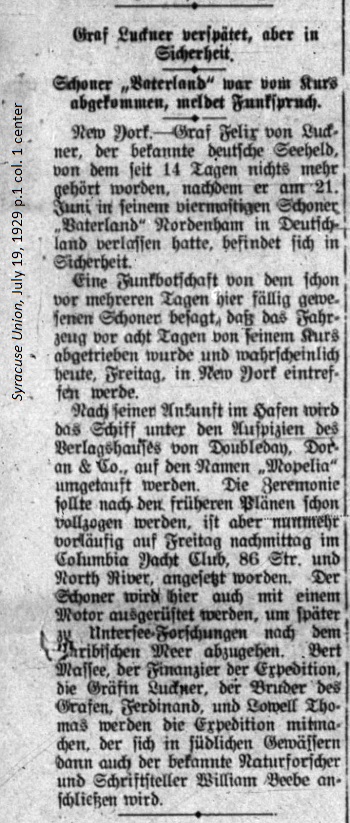
July 19, 1929 page 1 _____ The Schooner "Vaterland" deviated off course, according to a Radio Message _____ New York. — Count Felix von Luckner, the well-known German sea hero, had not been heard from for 14 days when he left Nordenheim Germany in his four-masted Schooner, Vaterland, on June 21st. He has been located and is safe. A radio message sent from the missing schooner reported that the craft was pushed off course eight days ago and may arrive in New York today, Friday. After its arrival in New York Harbor the ship will be christened with the name "Mopelia" under the auspices of the publishing house Doubleday, Doran & Co. According to previous plans the ceremony was supposed to have already taken place but is now rescheduled for Friday afternoon at the Columbia Yacht club, 86th St. and North River Dr. Here the schooner will also be equipped with a motor to prepare it for future underwater research in the Caribbean Sea. Bert Massee, the financier for the expedition, Countess Luckner, the Count's brother Ferdinand, and Lowell Thomas will make the expedition, which once it is in southern waters, will be joined by well-known nature explorer and writer William Beebe.
|

|
July 26, 1929 page 3 ____ The Sad Story of a German in a French Prison ___ by Karl Wilke Anyone who as a soldier on the Front gained notoriety for heroic deeds and distinguished service, and who thanks to favorable circumstances could provide the homeland with food, was considered a valued personage during the war. But for anyone who landed in prison, the curtain closed behind him. He lost public interest; he lost the attention of his fellow man. If relatives asked about his absence, they were consoled with "Be happy that your husband, son, or brother has escaped the dangers of war." Like the prisoners living behind barbed wire, a hundred thousand of them having to endure life in Siberian camps under the capriciousness of French commandants, the relatives remained in the dark. Only upon the belated return home of a loved one did next of kin learn the specifics of the silent sorrow and deaths behind the French Front. The dead remained mute, and the survivors spoke reluctantly about the years past. But now one from their midst has taken up his pen and tells with unadorned casualness delivered straight from the heart about nearly two years in prison, 1918 to 1920. He calls the book Prisoner Halm, an impersonal account because he wishes to be but one of many characters. His personal destiny recedes behind the haunting experiences of the many and thus raises the story to a noble level for the "unknown" prisoner. The work is worthy to be shelved with the best wartime literature. It has been published by Koehler & Amelang Publishing of Leipzig. It would go too far to discuss here particular episodes from this griping book. As is so often the case, life as it is represented here is greater than even a writer can invent. A powerfully artistic climax builds with shocking events in the first weeks as hunger and idleness play out in Camp Candor and press in on the inmates within a short period of time. From this follows months of horrible waiting until 1920, bitterly called "better times," in which all hope is lost as the powerless German people receive a roster of prisoners from Clemenceau's own hand. The heart fills with yearning and fear for the women and children and for months after the peace agreement the prisoners must denotate unexploded shells and perform other dangerous tasks at the Front, work which delivered many to their grave rather than their homeland. One must have lived behind barbed wire, must have suffered deprivation, hunger and thirst to the point of collapse, withstood damp and cold, dirt, sickness and the loss of civil rights, felt the helplessness of being subjugated by irrational, malicious commandants in order to be able to write this book. One has to believe that these descriptions of dire existence must leave behind a devastating impression. You experience wonder at how uplifting this book is: silent heroism which culminates in holding one's chin up, safeguarding oneself and others from the indignities and refraining from apathy, which together with undernourishment and sickness demand daily death offerings. This totally unpolitical book issues a tremendous indictment against the French government, which at that time withheld the legal and moral rights of German prisoners after the armistice and the peace agreement. These prisoners were innocent victims of a lost war. There is a similarity with the present time since in that same spirit the German worker and the German economy will be enslaved for generations. Taken from a purely human perspective this portrayal of prisons of war is just as terrifying and problematic as the description of wartime experience. One stands awestruck before the greatness of the human soul. In such situations it not only preserves itself from physical and spiritual death but also finds the strength to rescue weaker characters from collapse. In this sense the commemoration for the German prisoner of war becomes even more significant in our difficult times. Despondence need not arise. Rather men, leaders need not loose the belief in the future. Copyright 1929 by Köhler & Amerlang, G.m.b.H. (Ltd.), Leipzig, Täubchenweg 19. Price: Board covered - 4.50 Marks; Fabric cover - 6 Marks. |
|
July 26, 1929 page 4 _____ Currently at the Temple Theater there will be a display of actual German war photos from the beginning of the war to the end. No German should miss to view these pictures, which shows the reality of war — at and behind the fireing line. The German advance through Poland; the march through Belgium; the victory and grand defeat of the Russians; the Battles of Ypres and Chateau-Thierry; England's entry into the war; Italy's participation; the Austrians in the Alps; the sinking of submarines; America's participation; German women at the Front; in breadlines; at work; the search for food; the Kaiser; Hindenburg; the Crown Prince, etc. Everything is here to see — the real war, as it was waged in Germany. The exhibit will be on display today and Friday. Come take a look. |
|
July 26, 1929 page 6 _____ There are robust German Colonies located there. By Walter Hambach During the time before the war German people of the Empire lived only as a minority in foreign countries and maintained close relations with their people back in Germany. In contrast, after the war Germans living in the Soviet Socialist Republic have been regarded as stepchildren in German popular opinion. It perhaps may be known that Germans also live on the Volga but the destiny of these people is of interest only insofar as one takes the opportunity to snidely criticize the Soviet system. At this time there are around 1½ million Germans living in the Soviet Union. Soviet Germans are geographically distributed as follows: The most vigorous and populated settlements are in South Russia in the region around Odessa, in Kherson, in the district of Yekaterinburg, in the Don River area, and in Crimea. There are hundreds of German colonial villages. In the Volga Republic the city government is completely German. Even the troops receive orders in German. Farther to the east we find Germans on the Transsilberian Railroad Line in the Omsk and Pawlodar regions. In Novosibirsk a German newspaper is published and the local radio station broadcasts programs in the German language. German settlements don't stop as we approach closer to the land of the rising sun. On Lake Baikal there are German villages and in Itkutsk there's a large German evangelical church. In the Amur River region German settlements are emerging at this time and German colonial villages have already extended to the Pacific Ocean. After more than a 150 years these Germans have lost contact with the German Empire, however to this day their German characteristics have been preserved. In Kazakstan one can hear real Bavarian dialect. On the Sea of Azov they speak the Low German of the Danzig region. In 242 villages of Crimea you can hear Swabian and Bohemian dialects. In the Ukraine there are hundreds of German elementary schools, in Helenendorf in Transcaucasia there's a higher vocational school. Teaching seminaries, middleclass and farmers schools exist in several areas. In the German Volga Republic they're planing to build a German university. In the coming summer a German radio station will be built in the capital city of Pokrowsk in the Volga Republic. Almost four hundred credit and consumer cooperatives are also in that region. In Transcaucasia there's a wine producers cooperative serving as a model for other establishments. German villagers are called together via loud speakers and electric light have been installed. This cooperative, whose members operate only 6% of the vinyards of the area, deliver 55% of the wine produced in the region. This fact speaks volumes for the pioneer work done by the Germans in the Soviet Union. What is now the main problem concerning this extremely viable splinter group of German people? Above all else it is the lack of cultural unity with the old homeland. Granted they allowed the German colonists to use German as an official language in government matters, schooling and newspaper publishing, but today Russian is prominently intermixed with German in these institutions. Although political and cultural freedom exist at a basic level, cultural unification of Germans in the Empire with Germans of the Soviet Union is extremely difficult. The Russians do not allow books published in Germany to cross the border. The press is censored and over there Germany is described as an abhorrent bourgeois state whose technological advancements are wonderful but whose attitude towards the communistic economic system is one of sworn emnity. At one time the German community was called to Russia to act as teachers and role models because the country lacked fresh, intellectual stimulation. However that intellectual capital has long been depleted and consequently the justification for the Soviet Germans remaining there has been compromised. The son only speaks German because his father and grandfather still do. German character is only maintained because the settlements are thoroughly isolated. The brain power originating from the villages was completely absorbed by the Russian community. Even if russification politics of the tsarist regime declined during the revolution, it has amplified in the past twenty years and a wall of isolation from the outside world has been piled ever higher to the point where today it's practically impossible to climb over it. It requires great skill. The Soviet German community is struggling, like all expatiated German groups. Seldom does it have full autonomy like that of the Volga Republic, rather it's sanctioned in the form of so-called German districts. This group lacks more than any other German minority: cultural bonding with the Motherland. In the end it's continuation depends on this. This community will only resolve its mission in the Eurasian arena when it becomes a role model for the other ethnic groups between which it has settled, when it takes the intiative towards advancement. This initiative can only be regained or maintianed when it reenters into an intellectual and cultural relationship with the motherland and as her herald sets out as a pioneer of western culture in the east. An Italian's Decision concerning South Tyrol _____ Le petit Niçois, a much-read newspaper on the Riviera, published not long ago an article of the former Italian lawmaker Francesco Ciccotti, who issued policy on minority questions in the League of Nationsnd who outlined the situation for the German minority in South Tyrol as follows: "We Italians, who know the real situation concerning oppressed national minorities, have the duty to be fair to the Germans and to recognize which perils lie for the future of our fatherland and Europe's peace in the case of Tyrol. Everyone knows that the Treaty of Versailles merged South Tyrol with Italy and that from Trient to the border it is undeniably populated by Germans. This is an "annexation", which was determined from a strategic and political point of view. The facist dictator is determined to "Italianize" Tyrol via methods whose brutality touches on the purely grotesque. It may be called a misjudgment of the German intellect and one might assume that one day it could refrain from agreeing to the oppression of its people. Lightning strikes a Radio Antenna _____ Not long ago in Austria a storm descended on the region of Spielfeld over Mureck and Radkersburg. Over the area of Misselsdorf a powerful bolt of lightning hit an antenna, circled down the electrical wire, then travelled into the home of senior teacher Rudolf Schiefer, who was just sitting down to lunch. The lightning blew out the entire window frame and the change in air pressure shattered the panes of glass. Dishes, pendulum clock, pictures and furnishings on the table were smashed to pieces. Teacher Schieffer was thrown to the floor. He suffered nervous shock and significant injuries to his face and hands while his wife and mother were merely dazed. Then the lightning went through the window into a house about one hundred and fifty paces away belonging to farm owner Alois Neuhold, who was also thrown to the floor ahead of great devastation. The lightning eventually made it to Neuhold's barn, where it killed six steers. Community physician Dr. Leschanz administered first aid to the injured. The strange behavior of the lightning caused general confusion throughout the region. Wolfach, Baden. Soon there will be a Black Forest Hometime Festival with an exhibit of period costumes and other objects from the region's past. There will also be paintings by Professor Liebich and Professor Hasemann on display. The festival and the beautiful, colorful folk costumes promise to be a powerful draw for the region. |

|
August 2, 1929 by H. Mirbach Sr., Syracuse, N.Y. _____ Mr. Henry Mirbach of this city, who on July 13th set off on the "Hamburg" for a visit back to the old homeland and Cologne on the Rhine, sends us the following report which arrived yesterday. It was written onboard the steamship: "Now we are travelling at full speed. Today the sun is shining magnificently after yesterday's rain. A few people are sea sick, but not too many. All others are enjoying life. A former resident of Syracuse now living in Oswego, Mr. M.A. Geiger, is travelling with us. In the evening he's the liveliest of fellows, one might say he really lightens thing up. There are very nice travelling companions throughout the tourist class. The food and entertainment are great. We have a few native-born Americans among us but even they seem comfortable with German speakers. Just as I was sitting here and writing, an English-speaking American came over and told me that he wouldn't have expected to feel so at ease among Germans. As of now we Germans are the best people in the world for him. His dainty little wife feels the same way. A hard-working farmer from out west is sailing with us. His wife is a spirited and lively former school teacher. They talked about New York. They had spent a week there before departure, just like me. They didn't like it there, it was too lively. They rarely ventured out in the streets. It was just the opposite for me. I thought everything there was wonderful. The place pulsates with life and the street traffic wasn't that bad. It's grand the way the taxis and busses snake around each other and how self-assured and calm pedestrians cross the streets. I only found one thing unpleasant, that was the pervasive stink of fat, smoke, and sour sweat. We rode down 7th Avenue into the furrier district. Man, you should have seen the furs! One would have thought there weren't that many animals in the world. Here the air was permeated with camphor — From there we went to Broadway! By now evening descended, flowing with life, brightened by light, swarming with people — and yet how small these people were in comparison to the skyscrapers. Days before we were at Coney Island. Thousands upon thousands bustled about on the beach and in the water. As evening broke Coney Island was lit up by countless electic lights. In front of the sideshow booths promoters shouted out relentlessly. A circus held a parade with its team of horses and elephants. A really good band supplied music on horseback. Everything was pleasant and cheerful. When one is amid such liveliness once must feel as though he hasn't a care in the world. At this moment I haven't any either. My thoughts are on Syracuse and my beloved relatives and many friends. Greetings to you all! |
|
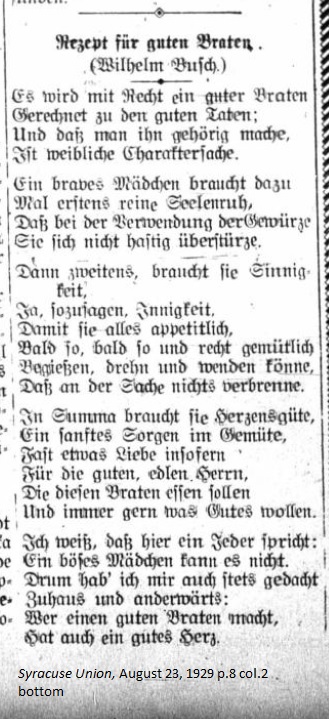
August 23, 1929 page 8 (Wilhelm Busch) _____
Planning is a crucial matter
First, young cooks must learn to release
Next they need inventiveness
In closing, a good cook needs a kind heart,
I'm speaking about what I know now
|

|
August 23, 1929 page 3 _____ by Henry Mirbach Sr. _____ I have been in the homeland now for ten days. After a beautiful voyage the "Hamburg" landed in Cuxhaven. The trip on the ship was wonderful. I had previously travelled on a sailing ship from Antwerp to Galveston, Texas during my younger days. I also sailed second class from Antwerp to New York and third class from Hamburg to New York, but the best voyage was this one in tourist class. It's indescribable what the passengers were offered by way of entertainment. There were concerts, dances, masquerades, beer festivals, etc. There were only a few cases of seasickness. The journey was like being in a railroad car, only one had more freedom of movement. The hospitality and service were excellent. There was also a passenger in first class, the German ambassador von Prittwitz. Unfortunately he did not find it worth the trouble to present himself to his fellow travelers in the tourist class, who were mostly German or German-American. It seems that men like him always foster the belief that it's not good to come too closely in contact to common folk. It was only recently that much has been done since the war to contribute to relief efforts of the German people. For myself I ask little but for the interests of the German community in America I wuld have been happy to see if during the ten-day voyage he might have spared an hour for us — and this opinion was shared by all. In the short time I've been in the fatherland I have found that Germany is different. It has two faces — Many noisy amusements and events, a great deal of bustle practically everywhere. However all these factual observations are superficial. Behind and underneath there is much misery and bitter poverty. Wages for workers are meager. Things are slightly better for clerical personnel. There are many unemployed who must be supported by the State or by charitable organizations. The prices for food and other necessary articles are shockingly high in comparison to wages. For example, a pair of shoes of no better quality than American-made footwear costs between 18 and 24 Marks.* Better stated, a worker making between 40 and 50 Marks a week (he wouldn't have more than that after deduction of taxes and other mandatory contributions) would have to spend half his weekly wages for shoes. An American worker, who earns $25 per week, would only have to spend one-fifth to one-sixth of his wages. It's that way with almost everything but once in a while some things are cheaper. I have the impression that everything is as inexpensive as it can be given the cost of the raw materials (except for luxury items, the most of which are sold to foreigners.) In general, reparation costs place an incredible burden on the people and are partially responsible for the damnable hedonism or in other cases the inconsolable dispair or absolute indifference. Some people think there's no sense in saving any money. Better to live it up and die happy. These people have been perverted by the Frenchies. Serious thinkers view the future with fear and trembling. They're terrified. How will it end? That is the question. And so, as already described, things will remain until the entire population unites in its aspirations — only when partisanship and discord among the political parties ceases and people place the fatherland above party politics and class divisions. Germany cannot be helped with bombastic words or bombs and grenades. Only internal peace and unity can cure Germany from the creeping consumption which it currently suffers. But enough of that. My travel report has degenerated into political hot air. It'll be different next time. I'll talk more about the trip itself. There's still so much beauty in the old homeland. Until then, solong and farewell, my fellow Syracuse residents! Henry Mirbach, Sr. *Translator's Note: In 1929 the exchange rate was 4.2 Marks to the Dollar, or between $4.50 and $5.50. Here in New York State an August 15, 1929 ad in the Brockport Republic shoes were advertised for $2.98 to $5.89. |
|
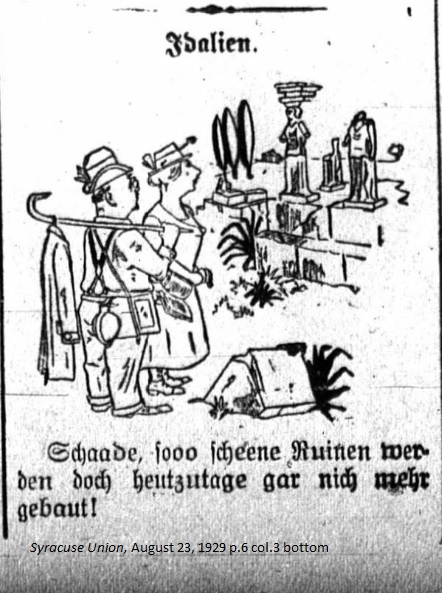
August 23, 1929 page 6 Such as shame that beautiful ruins like these can't be built today! |
|
September 6, 1929 page 4 _____ On the latest flight von Lakehurst to Friedrichshafen, one of the American passengers aboard the Graf Zeppelin could not refrain from breaking the ban on smoking during the trip. He secretly smoked a cigar in the restroom. This was true American contempt for the regulations. As the man himself stated, rules are there to be broken. He voiced an opinion one finds so often here in America, which is a plague upon this country. Police sanctions, state laws, even constitutional paragraphs are breached with a light heart and without much thought. Is it any wonder that our workhouses and prisons are overfilled, that the number of deaths and other serious crimes are far greater in the United States than anywhere else? Our young people must learn self control, respect for the law and one's community. |

|
September 6, 1929 page 4 _____ by Henry Mirbach Sr., Syracuse _____ In Cologne everything is hectic and well beyond the traffic of Syracuse. Being on the streets is dangerous with so many luxury autos, trucks, motorcycles and bicycles dashing about. I never imagined that would be the case. Pleasures of every kind, many more than we have in Syracuse. — Movie theaters, cabarets, variety shows, dance halls, nightclubs, etc. Here in public one doesn't see the distress. Behind the curtains it's a totally different story. There's a great deal of foreign traffic here. In the large hotels one hears nearly every language. Display windows are full of the finest of merchandise. The prices are just as high as those in America. Only in a few cases can you find something cheaper here. I can hardly comprehend how people can exist. Lots of them only eat vegetables. Life is so desperate that it's horrible to witness how they are forced to live on meager unemployment benefits or paltry earnings. People considered well-off previously whom I've visited are ashamed that they're in no position to offer me a cup of coffee or a bite to eat. After a long search in hostels, etc. I finally found an old school friend of mine in a soup kitchen. He just scrapes together an existence by begging. The suit he was wearing when I saw him last before the war he's still wearing today. It's threadbare but outwardly clean in every detail so we were able to take him with us to a restaurant. We fed him well, provided him with an abundant amount of good underwear, and gave him travel money. I'm not ashamed to say I cried out in the open street when he said to me as he departed, "Thanks, many thanks, Heinrich. For the first time in weeks I don't have to sleep in a brick kiln or under an open sky." Unfortunately a man is not rich enough to render enough help. The charitable organizations and State-run social services programs do a great deal here but Germany is a poor country. One shouldn't be fooled by the outer appearance created by all the amusements and events. Just now the schools are on vacation and one sees entire train loads of school children and youth organizations at the railway stations and throughout the city. People in uniforms are all over, swastika guys, empire banner carriers, former soldiers of the Front, warriors, organizers, wayfarers, Boy Scouts, etc. There seem to be fewer association carnival than there were before the war. Last Sunday was the Constitution celebration. That was somewhat pleasurable. Processions, fireworks, torchligh parades, and other grand doings. I suppose that even amid such great need it's just how the fun-loving Rhinelanders deal with it, otherwise to me the German people would seem utterly delirious and living in a fantasy world. However one thing is certain. Germany is working with all its might and energy to rebuild. Everything that's already been done in Cologne attests to and gives me confidence in a fine future for our beloved fatherland. I am of the opinion that no other people in the world could redirect themselves after a lost war as well as is the case with Germany. Tomorrow I leave my beloved Cologne and travel to Berlin. From there I go to Gotha, Frankfurt and Strassburg, my old garrison. Travel is great, but one must exercise reason and have the necessary dollars. Henry Mirbach, Sr. (In all likelihood Mr. Mirbach will return home at the end of October because he couldn't get a place in tourist class before October 17th. As much as the old homeland pleases him, for it's where his body and soul originated, he's looking forward to returning home to Syracuse,and he sends all his friends his heartfelt greetings. And his many friends in Syracuse will be happy to have their Henry back in their midst. Remark added by the editor.) |
 |
September 20, 1929 page 2 _____ A Fifty-Year-Old Pilot's Recollections _____ by Richard Korte The prize money was quickly gone, because in 1909 one had to hurry if he wanted to win it from enterprising and generous patrons. The Wright Brothers great invention of the three-axis control system, which was essential for directional and altitudinal control because it assured aircraft equilibrium, was scarcely known in Europe since all kinds of aircraft permeated the continent. Grade is responsible for the revival of interest in the great German aeronautical works of Otto Lilienthal, the first glider pilot. This brave German man famously died on August 10, 1895 as the result of severe injuries sustained in a flying accident the day before. He had just been preparing to switch over from glider to motorized flight. His death so shocked the Wright Brothers, American motorcycle dealers at the time, that they decided that no matter the cost they would fulfill the goal of this German. In America they were still being jeered as the "lying (rather than flying) brothers" when one German and one French captain listened to their devoted followers, then for the good of their fatherlands, attempted to discover the Wright Brother's secrets. The Frenchman was Captain Ferber, who died in a plane crash in 1910. He was an industrious, brave and decent man who considered it the highest praise to be called the "herald of the German Lilienthal in France." However initially out of prejudice the French War Ministry refused to purchase the Wright Brothers' aircraft. The German was Captain Hildebrandt of the Airship Battalion. He had already brought the first eyewitness reports from America in 1907, which were published with extensive construction details in a German newspaper. It was the first exact description of the Wright Brothers' flights to surface in any newspaper because the brothers had always been tight-lipped with information to the American press. It was published in the November 18, 1907 issue of the Berliner Lokal Anzeiger and it had a huge impact on German aircraft engineering, and Hans Grade was among the first to promote further research. On November 2, 1908 he made a test flight to Magdeburg. On January 11, 1909 he suceeded in flying to an altitude of 400 feet and soon after to 1000 feet. It was raised that he was able to make his way through strong winds. Grade made a longer flight in November of the same year in Bremen. There reporters saw him stay in the air for 54 mintures. By now it was clear to the spectators why Grade was called the grasshopper. Early flying was basically a matter of springing into the air. Orville Wright, who in the same year was prompted to make his famous trip to Germany by the Berliner Lokal Anzeiger, set the world record for sustained flight at 95 minutes and the altitude record at 500 feet. Wilbur Wright had been flying to Paris, the Riviera and Rome, plus giving instruction to aviators. The French aviation inventor Blériot, following a similar path to the Wright Brothers, succeeded in crossing the English Channel on July 28, 1909, thus winning the 50,000 Mark prize put up by the Daily Mail. On July 19th his competitor Latham reached to within 2000 feet of the English coast and landed in the English Channel. He was rescued and attempted to cross the Channel again on July 27th. He again made the acquaintanceship of the Channel but managed to escape death. Grade's deeds in Germany enthralled German flight engineers and fortified their self-confidence to achieve greater things. They have not failed. Museum for German Immigration to Brazil _____ Under the direction of well-known Brazilian-German, Minister Dr. Konder, an organization was recently established to create a museum of German immigration in Blumenau. The museum will be incorporated as a registered organization or foundation with the rights of a legal entity as established by the laws of Brazil and as often occurred and continues to occur with schools, churches, hospitals, etc. The organization will own the museum and its foundation funding, provide governance through an advisory board of trustees, naturally with Dr. Konder standing as its head and other board members from various associations having legal identities from various cities; for example the Organization of German-Brazilian Firms, the Germania Club, the School Association, etc. The advisory board appoints a regional committee in Blumenau which provides the maintenance of the museum and whose chairman functions as its prefect (director) of the Municipality of Blumenau (for as long as he is a German-Brazilian.) Immigration shall be the focus and a memorial for the centennial celebration shall be erected. Within the museum a Hall of Industry shall be created dating back to the 16th century, at which time upper and lower German merchant houses were built. The contributions of the Barons von Eschwege and the Varnhagen elders will be represented, who smelted the first iron and lead ores. The Hall of Trade and Banking will be handled with equal attention. The contributions from colonial times of the German community with regard to Brazil's prosperity should not be underemphasized. The proud banking palaces, the handsome buildings of leading firms on the main streets of the city, the large German hotels will be portrayed in pictures in the Hall. Also the operations of the German-Brazilian merchants in the colony, which were less pleasing to the eye yet highly important for the benefit of the country, will find well-earned appreciation here. Off from the Grand Hall for Brazilian-German Organizations there's a passageway to rooms for intellectual activities. It is known that a prosperous organizational life blossomed in the Brazilian-German community spanning from purely social to religious activities. Singing and music societies, sports clubs and gymnastics associations, relief and charitable organizations, hospital, school and church groups, merchant and marketing associations were created by the German population in countless numbers. This museum will contribute to the German community's promotion within the growing political system. This will have ever greater significance for Germany's commerce and it may be hoped that the German Empire will support this new, expatriated German enterprise. |
|
September 20, 1929 page 5 _____ Erich Maria Remarque is being considered by the Nobel Prize Committee for his famous wartime book All Quiet on the Western Front. In former officers' circles this recognition is viewed with disapproval since in their opinion it scornfully portrays and ridicules Germany's heroic fighting in the world war. (The book can be found all over Germany and it has received tremendous approval. Those who took part in the war in the west declare that the author described the war as the common soldier experienced it. — The story was put in print recently by the Syracuse Journal-American .— Remark added by the editor.) |
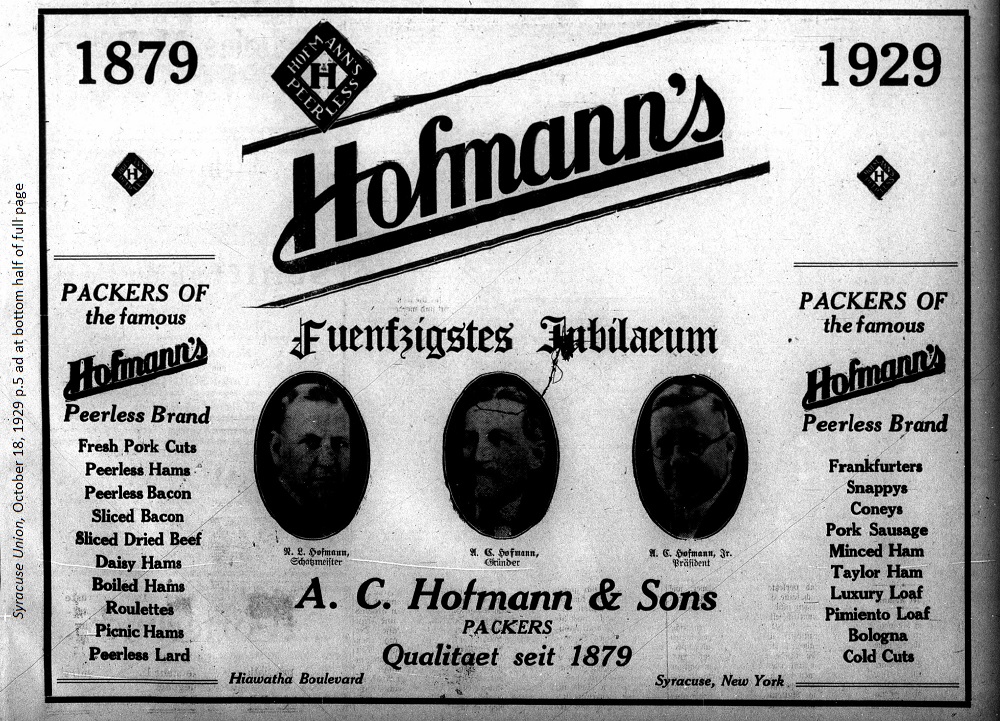
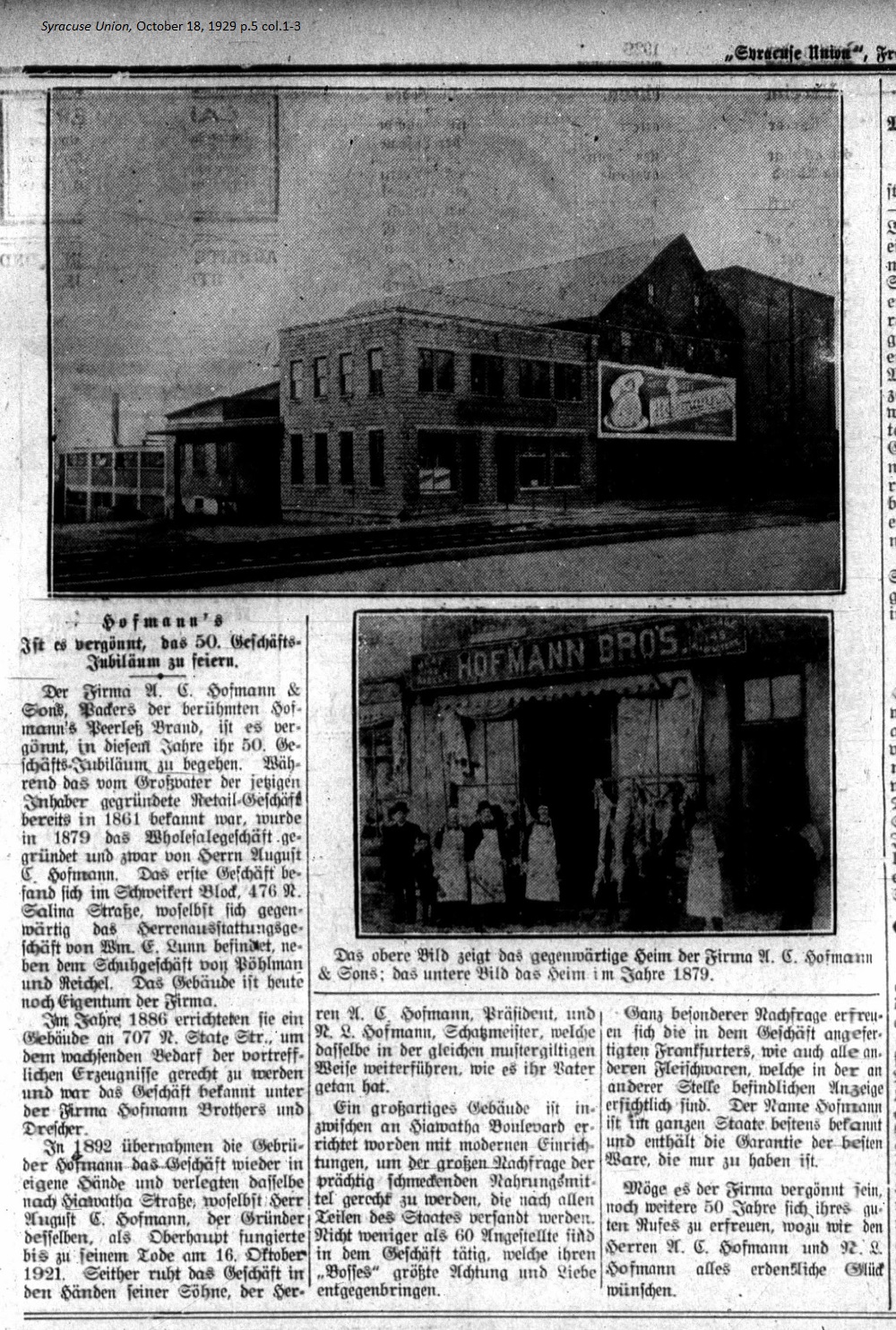 _____ October 18, 1929 page 5 Hofmann's Celebrating it's 50th Year Anniversary _____ The firm A.C. Hofmann & Sons, packers of the Hofmann's Peerless Brand, is celebrating the 50th anniversary of the company's founding. While the retail business was established by the grandfather in 1861, the wholesale business was founded in 1879 by Mr. August C. Hofmann. The first business was on the Schweifert Block at 476 Salina St., currently the location of the menswear business of Wm. E. Lunn and next to the shoe business of Pohlman and Reichel. The building is still the property of the firm. In 1886 they erected a building at 707 N. State St. in anticipation of the growing demand for their fine products. The business became known as the Firm of Hofman Brothers and Drescher. In 1892 the Hofman Brothers took over sole ownership of the business and moved it to Hiawatha St. where Mr. August C. Hofmann, the business founder, functioned as the company's head until his death on October 16, 1921. Since then the sons have run the business with Mr. A. C. Hofmann as president and Mr. N.L. Hofmann as treasurer. They have carried on the business in the same exemplary fashion as their father. Meanwhile a magnificent building has been constructed on Hiawatha Boulevard with modern equipment to meet the demand for their superb and tasty foods, which are shipped all over the State. No fewer than 60 employees work in the business, who have great respect and love for their "bosses." The company's line of frankfurters are in particularly high demand, and like all their other meat products, are featured in the ad located below. The name Hofmann is well known throughout the State and offers a guarantee of being of the highest quality. May the firm enjoy its fine reputation for another 50 years. We wish Mr. A.C. Hofmann and Mr. N.L. Hofmann all the best. ___ Translator's Note: Hofmann's is still in business in Syracuse. It's my favorite brand of hot dogs! |
|

|
October 18, 1929 page 6 _____ About Old German Beers and Taverns _____ by Dr. H. Henningsen-Hamburg It's only been about a hundred years that houses have been identified on a street with numbers. In earlier times one identified a house by its owner's name or the house itself had a unique name. Just as all romantic notions have been expunged by the technology and pace of the new age, so too has the new objectivity asserted itself in the designation of buildings and threatened what few named properties remain with extinction. Today there are only two building types with specific names: apothecaries and taverns. However, just as one has feared, they too are fading from the everyday world. There's an ever greater uniformity in name creations today. Thus it is not without a certain allure that the traditional names of German taverns be retained because they too are a part of German romanticism and German culture. Who doesn't know the old "Stachel" (spike or stinger) in Würzburg, where even today there's a lot of hearty boozing. Or "Das goldene Herz" (The Golden Heart) in Halle with its recently added coffin lid [roof?] In Bad Kösen there's the well known "Der mutige Ritter" (The Brave Knight.) Earlier people often chose such names which could be visually represented and then had them mounted on beautiful and artistic wrought-iron work. In this way simple citizens would immediately recognize the name of the tavern even in cases where they could not read. For this purpose names like "Zum grünen Kranze" (The Green Wreath,) "Zur Tanne" (The Fir Tree,) "Goldene Rose" (Golden Rose,) "Zum schwarzen Elefanten" (The Black Elephant) were chosen. In Hamburg there's still a "Himmelsleiter" (Jacob's Ladder.) Earlier in Hamburg there were names such as "Zum blauen Hahn" (The Blue Rooster,) "Schimmel" (The White Horse,) "Zum alten Börse" (The Old Stock Market,) "Zum Sandwirt-Hofer" (The Sandlot,) "König von Preussen" (The King of Prussia,) "Zum ländlicher Verkehr" (Rural Traffic.) The name "Zum grossen Fass" (The Large Cask) has admittedly died out but now we have in world-famous St. Pauli one known under the name Sankt Liederlich [which could be translated as the Slovenly Saint,] a frontier cask quaff which goes down no better and no worse than the earlier "Gesundbrunnen" (Fountain of Health.) Fallen into oblivion is the tavern in Wandsbek with the beautiful name "Zur alten Hopfenkarre" (The Old Hops Cart.) Even today we still have names like "Im Sack" (In the Bag.) "Zum Ofenloch" (The Oven Door) or another Black Forest tavern "Sieh dich für" (Watch Out!) or a Hamburg tavern quaintly called "Zum Dummerjan (The Dunderhead.) In Nuremburg we have a "Goldene Laus" (Golden Louse,) in Dessau the "Goldenen Beutel" (Golden Purse.) Schubert often frequented "Zum guten Hirten" (The Good Shepherd) while Beethoven cherished the "Unmöglichkeit" (The Impossible) in Carlsbad. Well known are name such as "Bratwurstglöckle" (Bratwurst Bell) and "Brusttuch" (Kerchief). Lesser known but fine names include "Zum nackenden Bauch" (The Bared Belly,) "Hund mit der Jungfrau" (Dog with the Maiden,) the "Weiberschule" (School for Wives) in Augsburg and the "Bär auf der Orgel" (Bear on the Organ) in Breslau. It's not just the taverns which have special names, it's also the beers that they serve. The recipes for the beers brewed in the monasteries during the 15th century were compiled in so-called "Bierbüchern" (Beer Books.) Of those 3 books are still known, one by Johann Brettschneider, who was a student of Philipp Melanchthon; another by Heinrich Knaust, who was born in Hamburg; and lastly a book called the Curieuse Antiquarius, (Curious Antiquarian,) expanded edition which was published in 1712 by Berckenmeyer in Hamburg. Here we find an entire series of names: Braunschweigische Mumme (Braunschweig Gumption;) Goslarische Gose (Goslar Gose;) Kyritzer Mord-und-Todschlag (Death by Murder;) Delitzscher Kuhschwanz (Delitz Cow's Tail;) Eislebischer Krabbel an die Wand (Eisleben Toddler on the Wall;) Bautannberger[sic] biet den Kerl (Bautzen Citizen offers the Rascal[?];) Breslauer Scheps (Breslau Castrated Ram;) Halberstädter Breyhan (Halberstadt Wheat Beer;) Wernigeroder Lumpenbier (Wernigerode Rascals' Beer;) etc. Knaust's beer book calls Stade's beer "Kater," (Cat) "because it sneaks up like a cat on a man, who has had too much to drink, and scratches his head." Hanoverians call their beer Broyhana derived from the brewer's name, Kurt Broyhan. |
|
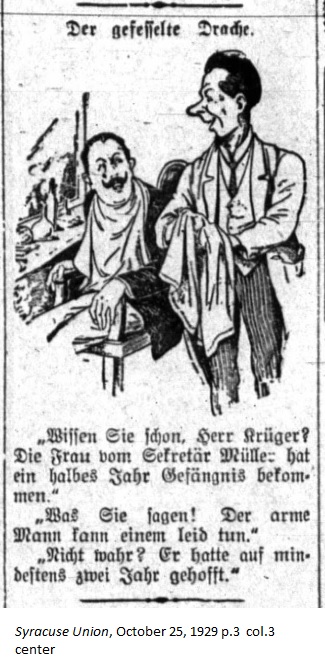
October 25, 1929 page 3 "Did you know about this, Mr. Krüger? The wife of Secretary Müller has received a sentence for half a year in prison." "What are you saying! The poor man must be beside himself." "Indeed! He had hoped for at least a two year sentence." |
|
November 11, 1929 page 1 _____ Next Berlin Municipal Parliament will not legislate with an Effective Majority _____ The provincial and municipal elections, which were held last Monday in Germany, were accompanied by bloody unrest from the start. In Breslau two socialists were beaten to death by a group of Communists while countless encounters took place between the Communists and the Nationalists. Thousands of people were arrested. Berlin. — The local political picture has become uncertain due to community election results since moderate factions, which until now worked together with the Socialists to govern the Empire's capital city. Their influence has been weakened and the next Municipal Parliament will rarely be able to govern with an effective majority. The Socialists along with the Communists have acquired 120 of the 225 legistlative seats and if both parties were to unite they would be in a position to take control of the rudder. However the chasm between the two is as unbridgeable and scarcely shallower than that between the Socialist and the far right. Given all these factors they're already talking about a new election in Berlin if one makes no pretense in thinking that the situation could be improved. The Communists pull ahead with 57 parliamentary members, an increase of 14 seats, and now become the second most powerful party in the Municipal government. For the first time Hitler's National Socialists make an appearance with 13 representatives. Expressed in terms of votes, the success of these two radical parties is still impressive. This year the Communists are in a position to gather up 570,000 votes for their candidates, that's 200,000 more than in the last election in 1925. And Hitler's people, who hadn't yet made the scene in 1925, can round up about 133,000 votes. The gain in the number of radicals comes primarily at the cost of the German Nationalists, some of whose members moved to the Right Wing, and the Socialists, some of whose members moved to the Left. The German Nationalists lost 6 legislative seats and the Socialists lost 9. The Democratic Party of Senior Mayor Böss also lost seats, decreasing from 14 members to 7. The German People's Party, the Central Party and the Economic Party retained their status with the first and last each gaining one seat. |
|
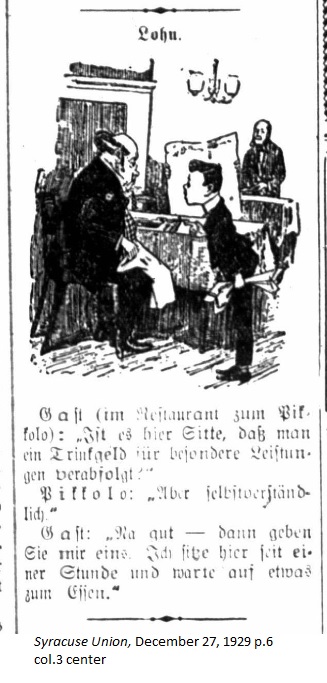
December 27, 1929 Guest (in a restaurant to the boy waiter): "Is it the custom here to leave a tip for exemplary performance?" Boy Waiter: "But of course." Guest: "Well good — then give me one. I've been sitting here for an hour waiting for something to eat!" |