July - December 1930
|
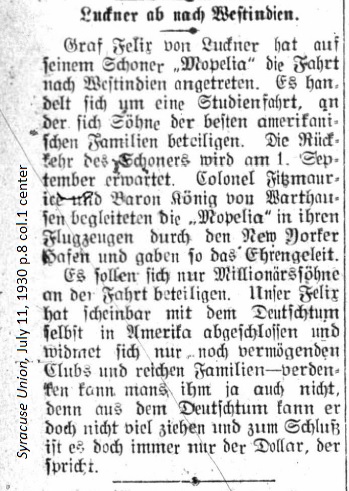
July 11, 1930 page 8 _____ Only the sons of millionaires are supposedly participating in the voyage. Our Felix is apparently done with the German community in America amd now only mixes with the wealthy clubs and privileged families — one can't blame him for this since he can't really get much from the Germans. In the end it's always the Dollar that speaks. |
|
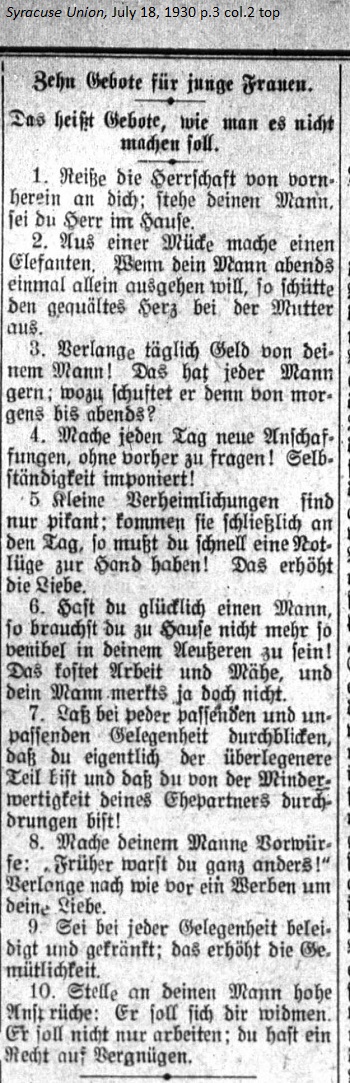
July 18, 1930 page 3 _____ These are Rules Which should not be made _____
|
|
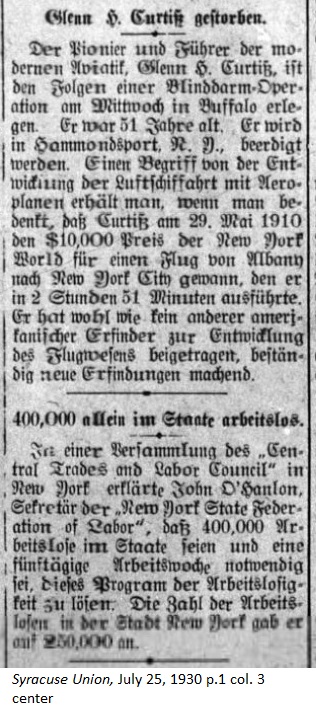
July 25, 1930 page 1 _____ 400,000 Unemployed in the State _____ At a meeting of the Central Trades and Labor Council held in New York John O'Hanlon, secretary of the New York State Federation of Labor, declared that 400,000 people are unemployed in the state and a five-day work week may be needed to solve the unemployment problem. He stated the number of unemployed in New York City was 250,000. |
|
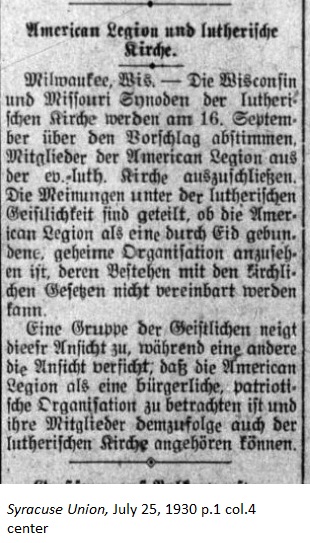
July 25, 1930 page 1 ______ One group of clerics is inclined to accept this interpretation while another group believes that the American Legion should be deemed a citizenly and patriotic organization whose members may belong to the Lutheran Church. |
|
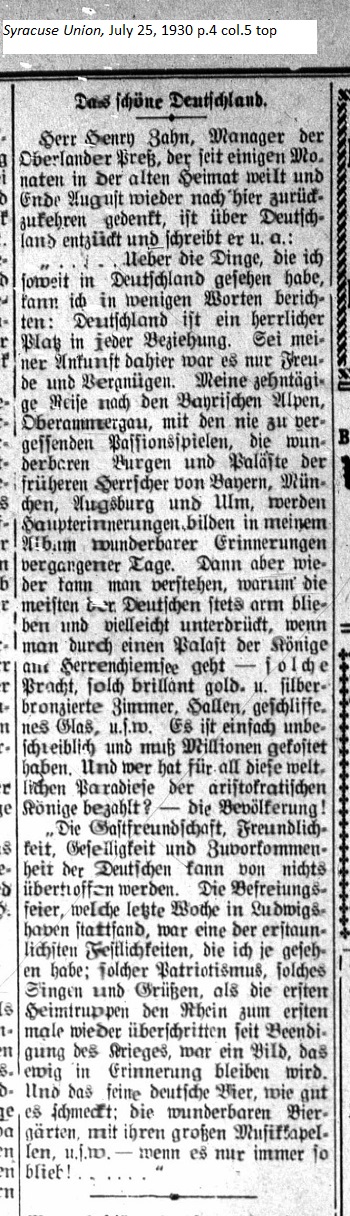
July 25, 1930 page 4 _____ Mr. Henry Zahn, Manager of Oberlander Press, has spent a few months in the old homeland. He intends to return here at the end of August. He's enchanted by German and writes among other things: "...Concerning things I have seen so far in Germany, I can report in a few words. Germany is a magnificent place in every respect. Since my arrival here everything has been joyful and pleasant. My ten-day trip to the Bavarian Alps and Oberammergau with its unforgettable passion play, the wonderful castles and palaces of the earlier rulers of Bavaria, Munich, Augsburg and Ulm, will form everlasting memories in my mental album of past times. However one can understand why most Germans still remain poor and oppressed as one goes through the palaces of kings at Herrenchiemsee — such grandeur, so much brilliant gold and silver embossed rooms, halls and polished glass, etc. It's simply indescribable and must have cost millions. And who paid for all this worldly paradise of the kings? — The people! "The hospitality, amicability, sociability and courtesy of the German people are surpassed by no one else. The liberation celebration held last week in Ludwigshaven was one of the most astonishing festivities I've ever seen. Such patriotism, such singing and greetings as the first home troops entered the Rhine region since the end of the war; it was an image that will forever live in memory. And the fine German beer, how good it tastes. The wonderful beergardens with their grand musical ensembles, etc. If only it could remain that way forever!..." |
|
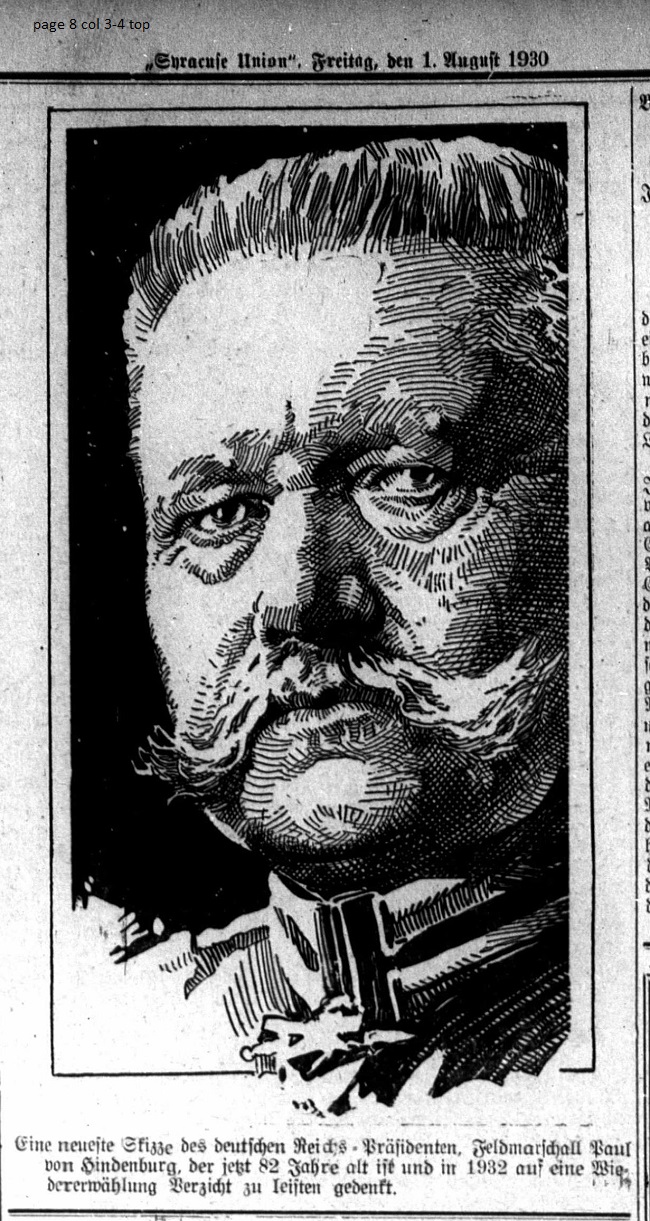
August 1, 1930 page 8 Caption under illustration reads: The most recent sketch of German President, Field Marshal Paul von Hindenburg, who is now 82 years old and contemplating not seeking reelection in 1932. |
|
|
August 1, 1930 page 8 _____ His Stops in Speyer, Ludwigshafen and Mainz bring Rounds of Praise. A small clash between a number of parading empire-banner wavers [Social Democrats] and a group of steel-helmets [World War One Veterans] in Mainz couldn't disturb the well-planned festival program or lessen the enthusiasm of the people for the noble Reichs President. The President thanked the people of Mainz for their forbearance during the foreign occupation of their revered old city and for their proven love and loyalty to the Fatherland. In Speyer on Saturday a truly cordial and warm reception was held for the President at a location where all famous people were toasted since the founding of the Republic. Early in the morning as the train carrying the Reichs President left the station until early afternoon when the head of the country continued on his journey to Ludwigshafen, Worms and Mainz, crowds of people filled the streets to cheer the President on. Whereever he looked there was enthusiastic jubilation. At an official greeting ceremony held in the Town Hall, in the company of the Minister-Presidents of Bavaria and Baden, the President delivered an address in which he expressed his gratitude to the people of the Palatinate for standing true and firm by the Reich despite "all foreign enticements and treacherous machinations" during the bitterest of times. The crowd of people, who assembled in front of the Town Hall, cheered continually until the President appeared on the balcony and waved to them. Spontaneous and enthusiastic singing of the German National Anthem echoed from thousands of throats. All who saw the President were impressed by his strict military bearing and the melodiousness of his voice. The President traveled in the company of his son, Colonel Oskar von Hindenburg; his political secretary, Dr. Meissner; and Minister of Foreign Affairs, Dr. Julius Curtius. From Speyer the travel party went by automobile through the Palatinate to Ludwighafen in order to board a Rhine River steamer to Worms and Mainz. The entire trip took five days and it was a truly triumphant procession. All Rhine boats were colorfully decorated with flags and pennants. In the city just recently vacated by the French a festive mood prevailed and an enthusiastic reception by the population greeted the Reichs President. After the official greeting by the city fathers, the President enjoyed a dinner with intimate friends, then went to the castle in which Napoleon once lived and which served as the residence of the Commandant of the French Occupation Army, General Guillaumat. This latest trip by the President clearly proves his popularity. The entire population was astir. In the rural districts the residents lined the streets and thunderous cheering erupted at the sight of the President's automobile. With the exception of a few freight wagons parked on the side of the road and a forgotten signpost in French, all traces of the occupation were expunged from this region. President Hindenburg attended Sunday church service at the Mainz Cathedral and then attended a wonderful liberation celebration at the city auditorium. Foreign Affairs Minster Julius Curtius, Premier Erkelenz of Hessen and Mayor Kalb delivered addresses, after which President Hindenburg gave a brief speech with perfectly straight posture. In the afternoon Hindenburg went by auto to Wiesbaden, where he attended preplanned festivities.He then went to nearby Eltville. — United States Steel Co. earned $32,126,717.00 last quarter. |

|
August 8, 1930 page 3 _____ The well-known director Max Reinhardt loves pageantry, not just on the set but also in his home (if you can call his palace, named Leopoldskron, just a house.) All celebrations there are illuminated exclusively with wax candles. Recently a rich American was invited. As the servant admitted him and lit his way up the stairs with a candle, the man from Dollarland remarked dolefully, "Oho, electrical blackout?" |
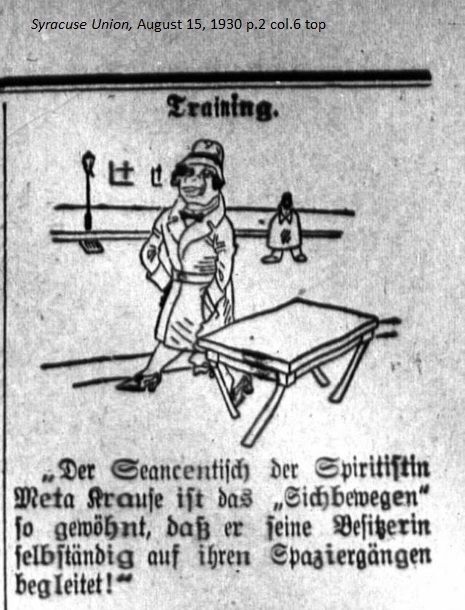
| August 15, 1930 page 2 Spiritualist Medium Krause's seance table is so used to moving on its own that it accompanies her on her afternoon strolls. |
|
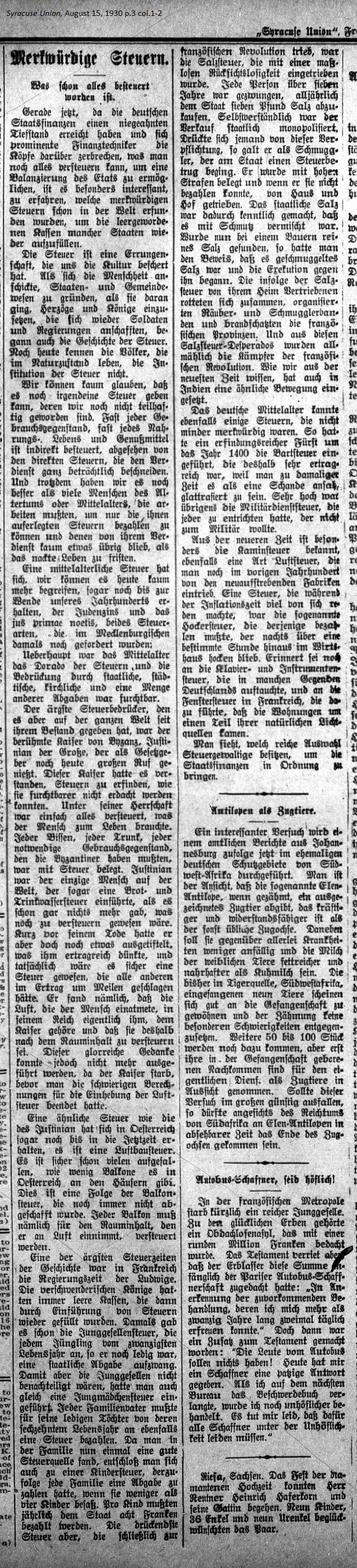
August 15, 1930 page 3 _____ Just about Everything has been taxed. Just now, as German federal finances have reached an unexpected low and prominent financial analysts are wracking their brains on what else they can tax to balance the budget, it's especially interesting to learn which unusual taxes already exist in the world to fill some nations' emptied coffers. Taxes are a bequest bestowed upon us by culture. As humanity set out to establish nations and community life; as it began to install dukes and kings, who in turn acquired soldiers and created governments, so began the history of taxation. Yet even today there are populations living in undeveloped areas, who do not know about the institution of taxes. We can scarcely believe that there's a tax yet to be bestowed upon us. Just about everything in daily use, every nutritional and food item, every drink and tobacco product is indirectly taxed, not to mention the direct taxes, which significantly curtail our income. And despite this we still have it better than many people of ancient times or the Middle Ages, who had to work just to pay the taxes imposed upon them with little left to scrape out a meager life. We can scarcely believe anymore some of the taxes of Middle Ages, which actually existed until just before the turn of our century — there was Jewish tariff plus a "jus prima noctis" [Right of the first night,] two forms of taxation which were imposed upon the Mecklenburg population. The Middle Ages were the times of ultimate taxation and oppression by federal, civil, religious and all other manner of groups was dreadful. The harshest tax oppressor there ever was since his ascent to the throne was the emperor of Byzantium, Justinian the Great, who still today is famous as the law-giver. This emperor knew how to invent taxes more abominable than ever seen previously. Under his rule absolutely everything, one needed to maintain existence, was taxed. Every bite of food, every drink, every necessity of life a resident of Byzantium required, was taxed. Justinian was the only person in the world to introduce a bread and water tax since there was nothing else left to assess. Shortly before his death he came up with something else he deemed profitable, and it certainly would have been exceeded all other profits by a mile. He believed that the air people breathed in his empire belonged to him so he had the right to tax it according to volume. However this glorious idea could not be carried out since the emperor died before the difficult calucations for raising the air tax could be completed. Another draconian period for taxation occurred in France at the time of the Bourbon dynasty. Spendthrift kings always had empty coffers, so they introduced a new tax each time to fill them. Once there was a bachelor's tax imposed on young men from age twenty onwards until such time as he married. However, young men were not the only participants. A similar tax was imposed on unmarried young women, which the family father had to pay for his daughter once she turned sixteen. Since families supplied a good source for taxation, it was decided to implement a childrens tax, which every family had to pay if they had fewer than four children. Eight Francs had to be paid to the state annually per child. However the most oppressive tax, which eventually led to the French Revolution was the salt tax, which was collected with utter ruthlessness. Each person over the age of seven was forced to buy seven pounds of salt each year from the State. Naturally the sale of salt was a State-owned monopoly. Anyone who shrank from fulfilling his duty was deemed a smuggler who committed tax fraud against the State. He received large fines and if he couldn't pay, he was driven from house and home. As a result it was intimated that state salt was mixed with dirt and you could only get pure salt from a farmer. This in turn provided proof that the salt was smuggled and death sentence proceedings were commenced against the individual. As a result of the salt tax people were driven from their homes, came together with others to form gangs of robbers and smugglers, and plundered the French provinces. And out of these salt tax desperados arose the French Revolutionaries. As we learn from recent times, in India they are launching a similar movement. The German Middle Ages knew a few taxes which were no less remarkable. An inventive prince around the year 1400 introduced a tax on beards, which were predominant because at the time people considered it a disgrace to be clean shaven. Incidentally there was a very steep military service tax for anyone who didn't want to serve in the military. In more recent times there was a chimney tax, a form of air tax which was still in existence during the last century and exacted against newly emerging industries. A tax much discussed in the time of inflation was the so-called barstool tax, which people had to pay if they stayed over a certain hour in a tavern. And let's remember the piano and instrument tax, which popped up in certain regions of Germany and the tax in France, which was directed against residences which got a portion of their natural lighting from windows. One sees the wide range of tax options available to bring stability to State finances. _____ Antelopes as Draught Animals _____ An interesting experiment, based on an official report from Johannesburg, will be conducted in the German reserve in southwest Africa. People are of the opinion that a so-called eland, when tamed, makes an excellent draught animal, which is more powerful and more resilient than the common ox. Furthermore it is less susceptible to many illnesses and the milk of the female eland has greater fat content and is more nutritious than cow's milk. Nine elands captured in Tigerquelle, Southwest Africa seemed to adapt well to captivity and there were no particular difficulties with domestication. An additional 50 to 100 will come later as elands born in capitivity will be trained to work as draught animals. Should this experiment prove successful in the foreseeable future the use of oxen as draught animals may come to an end. Autobus Conductors, be courteous! _____ Recently in the French metropolis a rich bacheolor died. Among the happy inheritors was the homeless shelter, which received a million Francs. However the will disclosed that the testator originally bequeathed this sum to the Parisian Autobus Conductors Association: "In recognition of the courteous treatment which I enjoyed twice a day for more than twenty years." However then an ancillary clause was added to the will: "The Autobus people shall get nothing! Today a conductor gave me a snotty answer. When I went to the company's nearby office and demanded the complaint book I was treated even more discourteously. It pains me that all conductors must suffer because of such rudeness." Riesa, Saxony. Pensioner Heinrich Haferkorn and his wife celebrated their diamond wedding anniversary. Nine children, 36 grandchildren and 9 great-grand children congratulated the couple. |

|
August 22, 1930 page 4 Vienna, July 12. Vienna, the birthplace of psychoanalysis, has become the preeminent center for psychology, the science of the soul. And above all else it has developed the methodology for the subject's teaching. As the residence of the world-famous Austrian scholar and doctor, Prof. Sigmund Freud, Vienna has become a destination for mental and nervous illnesses of all kinds; additionally foreign physicians come here since a teaching institute and outpatient clinic for psychoanalysis was established. The psychoanalysis which Freud and his students practice is the strictly orthodox teaching of the master himself: time and patience are necessary because it takes years for neurosis sufferer's personality to be significantly altered so he can become a productive and happy individual. Psychoanalysis also works to prevent the development of illnesses already present in childhood or adolescence and establishes a pedagogy based on psychoanalytical experience. A daughter of Professor Freud's, Anna Freud, has contributed excellent work in the field of childhood psychoanalysis and teaching methodology. Children who are burdened or living in harmful environments can become better with psychoanalytical treatment. In Vienna one can learn all the scientific and practical innovations by attending courses and receiving in-depth training. Many young men trained here can utilize their knowledge abroad and become centers of this significant doctrine. Out-patient clinics operated abroad by trained psychoanalysts can work in hospitals in departments for mental illnesses with departments for educational training. A wealth of scientific work has already been contributed to the field. Four psychoanalytical periodicals are published in Vienna: the Internationale Zeitschrift für Psychoanalyse; the Imago as a periodical for application of psychoanalysis in the natural and psychological sciences; the Zeitschrift für psychoanalytiche Pädagogik; and Die psychoanalytische Bewegung. The latter two smaller and less expensive journals are suited to broadcasting the important psychoanalytical issues to a wider audience. The periodical Imago tracks advancements in other science fields through the psychology of the unconscious mind and publishes articles on art and literature, ethnological and cultural history, plus modern reflections on sociological, juridical, mythological, and religious psychology. Ethnopsychology and above all else the psychology of creativity find their forum here. Vienna has become the intellectual center of psychoanalysis thanks to Freud. Motivations of all kinds — the training and healing of nervous conditions — are offered here. The University gives opportunity to broaden the study of psychology and facilitates adult and child psychiatric clinics in supplementing medical training. Modern community welfare institutes, polytechnical institutes, career counseling centers, and a host of other institutions are at the disposal of doctors and students coming to Vienna in ever greater number in order to study the science of the soul, psychology under the guidance of the grand master of the discipline. It is noteworthy that the increasing number of students are coming from the United States and the countries of South America. |

|
September 5, 1930 page 4 _____ Due to the generosity of Mr. Adam Bolles we recently came into ownership of four bound volumes of the Syracuse Union from 1865, 1866, 1867, and 1868. The Union was first published in September 1852 under the name Onondaga Demokrat. A few years later the name was changed to Wöchentlicher Syracuse Demokrat. to distinguish it from the Central Demokrat, which made its first appearance on July 1, 1858. The Union kept the name Wöchentlicher Syracuse Demokrat until January 1, 1866, when the name was changed to Syracuse Union. It's regrettable that the volumes could not be found for the years prior to 1865. Scanning the 1865-67 volumes we found interesting articles such as the first district-wide gymnastics festival for Western New York and the founding celebration for the Syracuse Liederkranz (Singing Society). We clearly see from this that our beloved Syracuse Liederkranz is in reality 77 years old rather than 75, for which a celebration was recently held. The announcement for the 12th anniversary of the founding was signed by Charles Dissel, secretary of the Liederkranz at the time. It was published in various issues of the newspaper. On October 11, 1865 a detailed article on the 12th anniversary was published. The question which arises in reading this old news is: Were Carl Dissel, former secretaty of the Syracuse Liederkranz, John L. Röhner, publisher of the newspaper, and their coworkers of 1865 wrong in calling this the 12th anniversary, or are those currently alive in error about the founding of the society 75 to 77 years ago? Herewith we bring a few articles from the Union of 65, 64, and 63 years ago, 65 Years Ago From the Wöchentlicher Syracuse Demokrat (Syracuse Union) from August 26, 1865: "The first district-wide gymnastics festival of New York State was held on Sunday, Monday, and Tuesday in Rochester..... "Among the prize winners were: 1 Prize, Gymnast Hoefler of Syracuse; 11th Prize, Gymnast Christ, Syracuse; 12th Prize, Gymnast Wedel; and 16th Prize, Gymnast Schwanz, Syracuse. From September 16, 1865: the Liederkranz will celebrate the 12th Anniversary of its founding with a concert and ball In Shakespeare Hall on October 16 of this year. Friends of song and gaiety are cordially invited. Chas. Dissel, Secretary. "School Census. — The Clerk of the School Board extracted from the Census for our city the following statistics concerning school-age children.
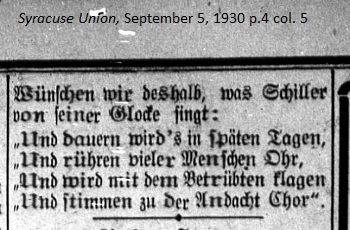
Reduction of 42 in the 6th Ward. Total increase, 981. It is indicated that the German Ward (Ward 2) showed the largest increase in the number of students." 64 Years Ago. (Syracuse Union, September 1, 1866) "Concert and Ball. — As already announcement, the Liederkranz Singing Society is celebrating the 13th anniversary of its founding on Sunday and Monday. The first day (Sunday) will include a previously rehearsed concert...On the second day of the festival (Monday) a delightful dance will take place. Both attractions will be held in the roomy hall in Ackernmann's Block." 63 Years Ago. (Syracuse Union, September 7, 1867) "...We wish to announce that the Liederkranz has begun the celebration of the 14th anniversary of its founding and we would like to express our well-wishes that the society may enjoy many more celebrations to come. Thus we wish what Schiller said in his poem, 'Song of the Bell':
|
|
September 5, 1930 page 4 _____ |
|
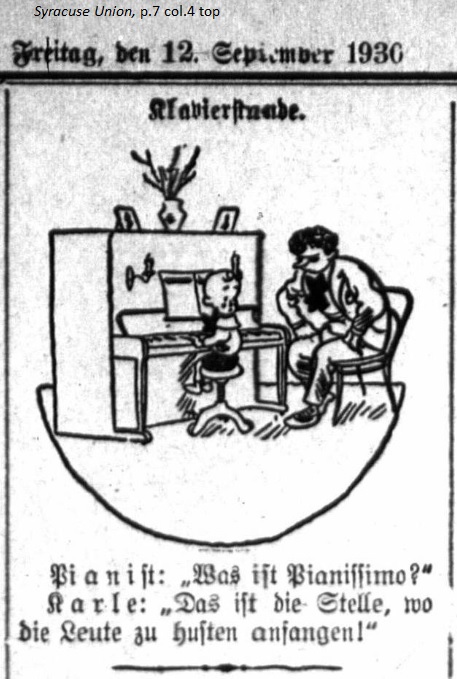
September 12, 1930 page 7 Piano Teacher: "What is pianissimo?" Student: "It's the part where people start to cough!" |
|
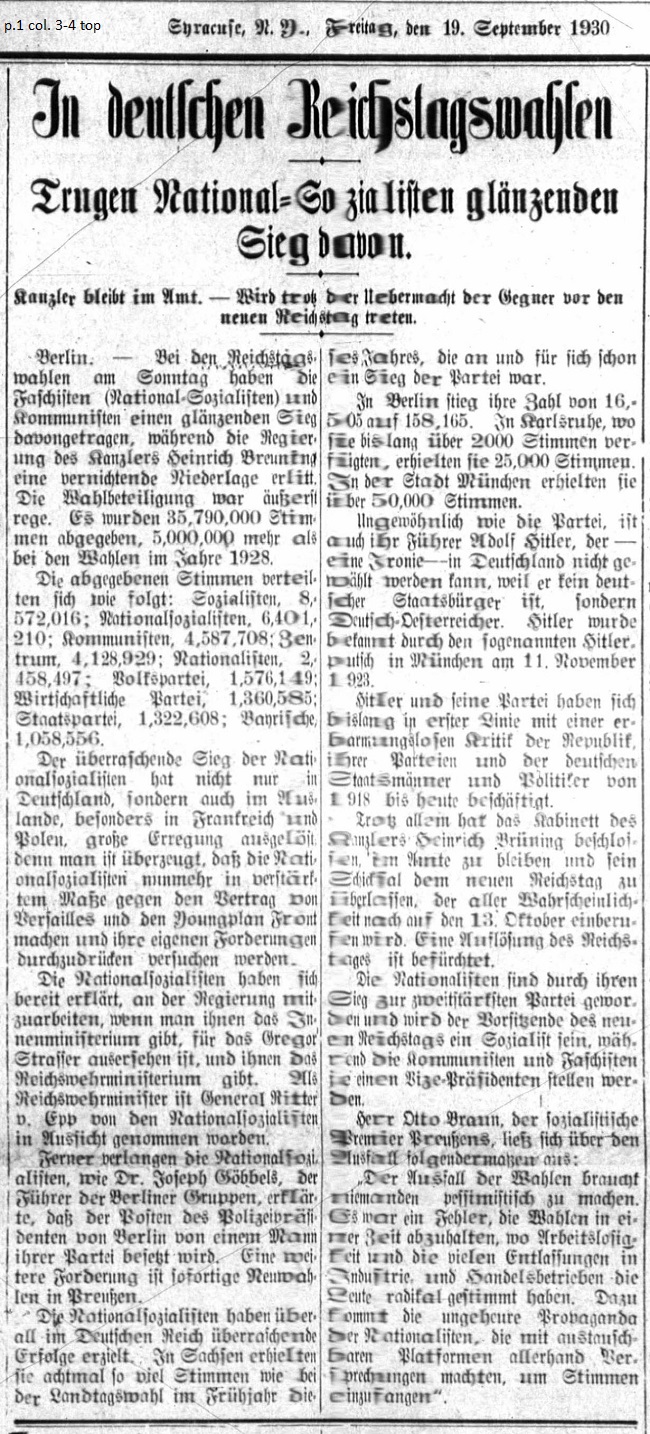
September 19, 1930 page 1 _____ The National Socialists win a Significant Victory _____ The Chancellor remains in office. — Despite the superior power of the opponents he will open the new parliamentary session. _____ Berlin. — At the Reichstag elections held on Sunday the Fascists (National Socialists) and the Communists won significant victories while Chancellor Heinrich Bruening's party suffered a sound defeat. Voter turnout was extremely heavy with 35,790,000 ballots cast; 5,000,000 more than the election in 1928. The votes were distributed as follows: Socialists, 8,572,016; National Socialists, 6,401,210; Communists, 4,587,708; Center Party, 4,128,929; Nationalists, 2,458,497; Peoples Party, 1,576,149; Economic Party (of the Middle Class), 1,360,585; State Party, 1,322,608; Bavarian Party, 1,058,556. The surprising victory of the National Socialists created great excitement not just in Germany but abroad, especially in France and Poland because people are convinced that the National Socialists, in increasing numbers are against the Versaille Treaty and the Young Plan and will attempt to push through their own demands. The National Socialists have already declared they are ready to work with the government if it will give them the positions of Minister of the Interior, slated for Gregor Strasser and the title of Minister of Defense. General Ritter v. Epp of the National Socialist Party has been selected for that post. As announced by Dr.Joseph Göbbels, leader of the Berlin group, the National Socialists also want the post of President of the Berlin Police Force for a member of its party. A further demand is for a new election in Prussia. Overall the National Socialists have achieved surprising success in the German Empire. In Saxony they received eight-times as many votes as they did in the spring regional election, which in and of itself was a victory for the Party. In Berlin their numbers rose from 46,505 to 158,165. In Karlsruhe, where they previous received 2,000 votes, they now had 25,000 votes. In the city of Munich they received over 50,000 votes. As unusual as the Party is its leader, Adolf Hitler, who in an ironic twist cannot vote in Germany because he's not a German citizen. He's an Austrian German. He became known through the so-called Hitler Putsch in Munich on November 11, 1923. From 1918 to the present Hitler and his Party have been merciless critics of the Republic, their parties, and the German statesmen and politicians. Despite all this, Chancellor Heinrich Brüning's cabinet has decided to remain in office and leave its fate to the new Reichstag, which in all likelihood will be called into session on October 13th. It's feared the Reichstag will be dissolved. Due to their victory the Nationalists has become the second most powerful party. A Socialist will become chairman of the new Reichstag while the Communists and Fascists will each have a Vice-President. Mr. Otto Braun, the Socialist Premier of Prussia, had the following to say about his loss: "Loosing the election need not make people pessimistic. It was a mistake to hold the election in such a time when unemployment and the many layoffs in industry and merchandising have radically affected so many people. Add to that the monstrous propaganda of the Nationalists, who made so many promises in interchangable platforms to gain votes." |
|
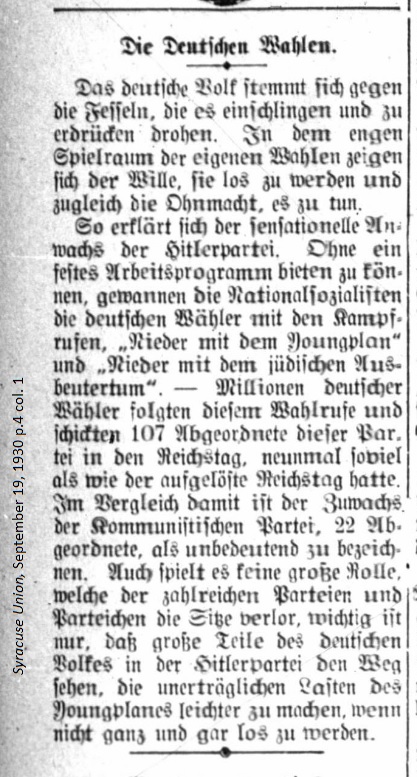
September 19, 1930 page 4 _____ The German people strain against the chains that bind and threaten to crush them. In the tight confines of the individual elections they demonstrate their will to be liberated while at the same time demonstrate their inability to do it themselves. So declares the senesationally growing ranks of the Hitler Party. Without being able to offer a firm employment program, the National Socialists issued the battle cry to voters, "Down with the Young Plan" and "Down with Jewish exploitation." — Millions of German voters followed this election slogan and sent 107 delegates to the Reichstag, nine times as many as the prior Reichstag had. In comparison to this increase, the Communist Party had 22 delegates, an insignificant showing. It isn't important how many parties and factions lost seats; what's important is that a large portion of the German people see the Hitler Party as the path to making the unbearable burden of the Young Plan lighter if not entirely or almost entirely nullify it. |

|
September 19, 1930 page 7 _____ Like the German Language, Others also have their Foreign Words _____ by Karl Hillebrandt About our German language it has been asserted that it has more foreign words than any other language and yet it has been unable to impart portions of its own vocabulary to other nations. This is not so. There is an entire range of concepts which originated in Germany and which are designated so well by one German word that it became necessary to incorporate the German word to represent the concept. In English and French, our closest cultural-linguistic neighbors, we find examples at every turn. They do not limit themselves to the fields of science and literature but also apply to objects of daily usage and concepts of everyday life. These too are closely and insoluably linked to German words. In the field of minerology we have gneiss, quarz, and feldspat, known throughout the world by their German names in the same or slightly altered forms. In France and England Quarz is spelled "quartz." Feldspat in England is "feldspar." Kobalt and Zink are in both neighboring languages "cobalt" and "zinc." In both cases the unaccustomed K is replaced by the third letter of the alphabet. The word Nickel would belong to this category too were it not already a Swedish word. The patrons of literature in both nations are also acquainted with German concepts. In the English critique of a French book on Bougainville, the discoverer and world traveler from the 18th century, the terms "the wanderlist" and "the stubengelehrte" were frequently used. In another article from the same newspaper issue we find "the Weltschmerz" without explanation of the German concept, thus providing proof that the word was familiar to the educated Englishman. Benedetto Croce, the important Italish philosopher, spoke without reserve about "la culture e sittengeschichte" [culture and the history of morals] and was certain his countrymen would understand. In France "la weltanschauung" plays a significant role in literary journals and Germany's modern usage of the term "Neue Sachlichkeit" [New Objectivity] found no sensible translation. To our neighbors on the other side of the Rhine it is a foreign word, the usage of which they can not deny. In addition to the word "Hinterland," which is a concept dealing with political geography, in French and English we have: "l'oberland bernois," the Bernese Oberland as a geographic designation which is untranslatable. "Kaiser und Reich" exists in both languages. Vaterland is anglicized to the form fatherland, a designation for Germany which has derisive overtones. In England as well as France we have the foreign words "Alpenstock," "Rucksack," and "Edelweiss." "Kindergarten" in both languages means the same thing as in German; the "Kursaal" [spa entertainment hall] is only found on the other side of the English Channel. In French "Bier" becomes "bière; a glass of beer is a "bock," however in England "bock-beer" means the same thing as it does here — a strong, brewed spring drink made of hops and malt. "Kirchwasser" and "Kümmel," both hard liquors, do not change names when they cross the border. You can order them there and here and be certain your request will be granted. The word "Schnaps" in England is spelled "schnapps," and refers to genever. Kohlrabi, spelled "kohl-rabi" is the same beloved vegetable as here. The dance we call "Schottischen" [Scottish] is as popular in its homeland as it is here in Germany. In France "bourgmestre" still exists and corresponds to our Bürgermeister. The French change "Schlitten" [sleigh] to "schlitte;" Schlag [blow or beat] to "schlague." Reichswehr [Armed Forces] and "Rentenmark" [temporary German monetary unit of 1923] as well as "Schupo" [uniformed policeman] can have good or bad connotations. The "Salamanderreiben" [Rubbing the salamander - a German student drinking ritual] of our students is literally translated in French as "frotter le salamandre." From England the German words "kriegsspiel" [war game] and "poltergeist" are worthy of mention since they stand out in English texts and dictionaries. |
|
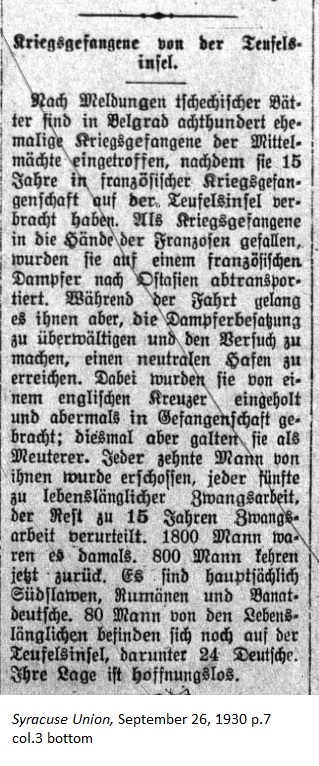
September 26, 1930 page 7 ______ According to reports from Czech newspapers eight hundred former prisoners of war from the Central Powers arrived in Belgrade after they had spent 15 years in French prisons on Devil's Island. As prisoners of war in the hands of the French they were transported on a French steamer to East Asia. However during the journey they succeeded in overpowering the steamer crew and reaching a neutral port. From there they were recaptured by an English cruiser and taken into custody, this time charged as mutineers. Each tenth man was shot, each fifth man was sentenced to hard labor for life. The rest, 1800 men, were sentenced to 15 years hard labor. 800 men have currently been returned. They are mainly southern Slavs, Rumanians, and Banat-Germans. 80 of the men who were sentenced to life are still on Devil's Island. 24 among them are German. Their situation was hopeless. |

|
September 26, 1930 page 8 _____ (Sent In) From the document King Gustav of Sweden handed over to Nobel Prize recipient Thomas Mann it was learned that the writer received the honor for his Buddenbrooks. The great number of readers of the book can only too well understand the appreciation of northern Europe. Although the Germany of 1930 is very different from the Germany of 1900, the Lubeck of today bears little resemblance of the city of the 19th century and the quiet parlors and dark staircases are quickly disappearing, a new readership has developed, drawn in from the first perusal of the story. As a young writer during his stay in Italy, Mann began the work on this expansive work, which took two and a half years to complete. At first the publisher, Fischer Verlag, was reluctant to publish it unabridged but then relented after an anxious letter from the author. The novel appeared in 1900. It was a book which found its readership slowly. It's size stood in the way of rapid success. Only after the critics recognized it as a masterwork and the publisher brought out an inexpensive "Peoples Edition" for around three Marks did the book become a rare "best seller" in Germany. It's peculiar: this "story of the decline of a family" seems — and appears to — concern each individual reader; and that it comes in the form of a book and it's headed for success. Those who read the book for the first time in 1929 found their way into it without difficulty and and were captivated by it. One feels indebted to the Nobel Prize recipient. In 1912, while forced to stay in Davos due to his wife's illness, Mann began the first draft of his second great novel, The Magic Mountain. In a brief autobiography published recently in Neuen Rundschau Mann related how the work grew on him and turned into a powerful 1200 page tome. He spent seven years completing it. All in all, the book took twelve years. It was published in 1924. Meanwhile, the war for Europe had come and gone: otherwise perhaps the book in its present form would never have been written. The shared sorrow of the European people prepared the groundwork and the German of the post-war era identified with Hans Kastorp just as he had with the Buddenbrook brothers, Tonio Kröger and Gustav v. Aschenbach. Somewhere around 1913 Thomas Mann was considered a candidate for the Nobel Prize for the first time. The enthusiasm was astonishing when he finally received it last year. At a celebration at the University of Bonn, which the author attended, the professors expressed serious concerns that the old floorboards wouldn't hold up to such a surge of people. Next to the two great novels there are numerous novellas by Mann, among them the delightful "Unordnung und frühes Leid" [Disorder and Early Sorrow,] whose young heroine, Mann admitted, is his youngest daughter. It's thus easy to guess that the two older children are modelled after his daughter Erika and son Klaus. These two young people completed a merry world tour around three years ago and then reported about it in a book, which they titled Rundherum [Around and About.] This is also available at the library. It should be of particular interest to young immigrants, who will recognize many of the same first impressions of America. Marie Louise Wismer |
|
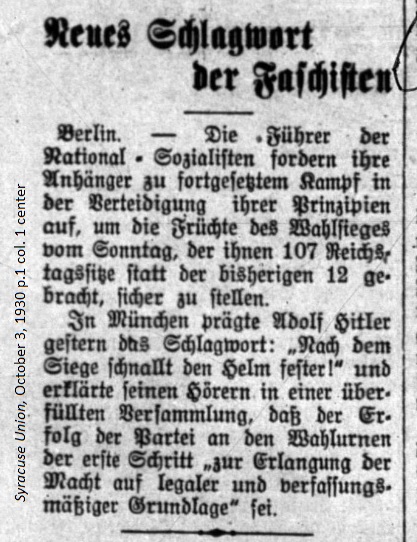
October 3, 1930 page 1 _____ Yesterday in Munich Adolf Hitler coined a slogan: "With the victory the helm is more secure!" He explained to his audience in the overpacked assembly hall that the success of the Party at the ballot box is the first step "in obtaining the power to a legal and constitutional foundation." |
|
October 3, 1930 page 4 _____ The offer is hard to believe: "Mother offers her boy for sale; Price $50,000 cash." The ad appeared today in the Syracuse Journal next to a picture of the mother and her 6 year old boy. One feels tranported back hundreds of years when such things were still possible, however under today's customs and laws to have such a thing happen, and have it advertised in a newspaper column, seems scarcely likely. The protests which have already occurred demonstrate that the general public is not pleased with an ad of this nature. We would have little more to do with the matter were it not for the fact that the mother is a German, who in all probability has frittered away her years in romantic notions. She says that by selling her son she wants to give him the opportunity to grow up and live as a "gentleman." Yet this mother's intentions seem to be quite different. She wants to be free again, rid of her husband and child. With the money she hopes to get with the sale of her child it will be possible to return to the old homeland to lead a carefree life! It's not the wellbeing of her child which fills her heart but her own wellbeing and happiness. This woman is 31 years old, met an American soldier in Germany during the war years, and came here 9 years ago in order to marry the man a year later. Her husband and the father of her son wants nothing more to do with the matter. "If she wants to sell her child, it's her business," he said. "But on the day she sells him, she'll leave my home." To this the wife and mother responded "I don't care. I've had enough unpleasantness." This response readily demonstrates the woman's motive. She doesn't care about her husband and she cares even less for the child she gave birth to. She's ready to sell him for filthy lucre and doesn't want to see him again. And this from a German wife and mother! — Unbelievable! |
|
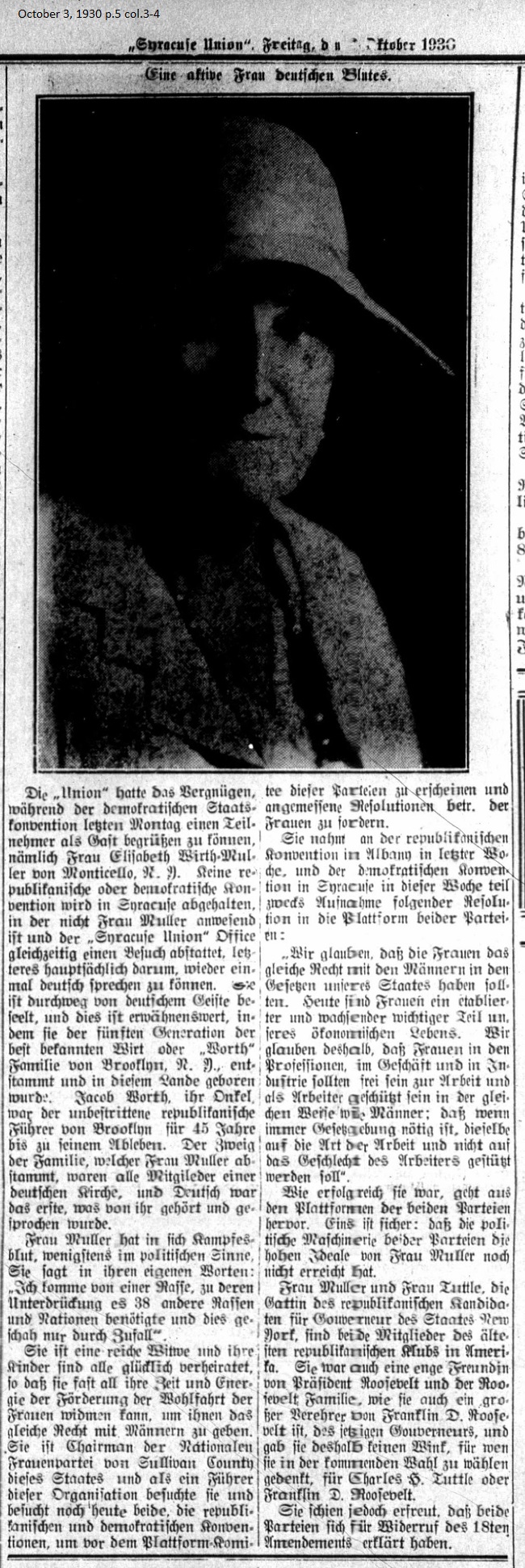
October 3, 1930 page 5 Mrs. Muller's vein contain fighting blood, at least in the political sense. In her own words she says: "I come from a race which wanted to oppress 38 other races and nations, and this only happened by accident." She is a rich widow and her children are all happily married, so she expends practically all her time and energy towards the advancement of women so they receive the same rights as men. She is chairwoman of the National Women's Party of Sullivan County in this State and as leader of this organization she has attended and still attends both the Republican and Democratic conventions in order to appear before the Platform Committees of these Parties and urge reasonable resolutions to accommodate women. She attended the Republican Convention in Albany last week and the Democratic Convention in Syracuse this week to suggest the following resolution to the platforms of both Parties: "We believe that women should have the same rights as men in the laws of our State. Today women are an established and increasingly important portion of our economic life. Therefore we believe that women in the professions, in business and in industry should be free to work and protected as workers in the same way as men; that whenever legislation is needed, protections should be granted according to the kind of work and not to the gender of the worker." How successful she was shows in the results of both Party Platforms. One thing is certain: the political machinery of both Parties still have not reached the high ideals presented to them by Mrs. Muller. Mrs. Muller and Mrs. Tuttle, the wife of the Republican candidate for Governor of the State of New York, are both members of the oldest Republican clubs in America. She was also a close friend of President Roosevelt and the Roosevelt family, and a great admirer of Franklin D. Roosevelt, our current Governor. For this reason she gave no indication for whom she intends to vote in the upcoming election, Charles H. Tuttle or Franklin D. Roosevelt. She just seems happy that both Parties have called for the repeal of the 18th Amendment. |
|
October 10, 1930 page 1 _____ Yells a Prague Mob at Rallies against German Cinema. Nationalist students and other hooligans grouped in hostile demonstrations before the German sound film theater and demanded the film be substituted by Czech or American films. The police alleged the rioting was caused by the Fascist and Chauvanistic Press. Around 500 young roughnecks stormed the Jewish Roxy Theater, drove the theater goers out to the streets, and smashed the furnishings to pieces. Another angry crowd assembled outside the German Embassy and shouted, "Down with the Germans and the Jews!" Police intervened and dispersed the demonstrators. Another crowd of people went to the German theater and broke all the windows in the Temple of the Muses. Hitler's People under a Church Bann _____ |

|
October 10, 1930 page 1 _____ Would Block Any Putsch Attempts In a discussion of Hitler's Program with a newspaperman, Mr. Grassmann said as follows: "Despite the remarks in Leipzig that the National Socialist only want to use legal measures to achieve power, if Hitler or his adherents should attempt a coup, you will see that the organized labor union of Germany is ready to defend its democratic Republic to the utmost, just as it did in 1920 when the Kapp Putsch was toppled by the united efforts of the unionized workforce." Mr. Grassmann expressed his convictions quietly but with decisiveness. As leader of the largest German unionized workforce with more than 5,000,000 members or 70 percent of all organized labor in Germany, he is in a position to precisely express the attitudes of unionized labor. "At the Reichstag election the Social Democrats received 8,500,000 votes," he added. "That is scarcely less than that of the previous election, however these millions of voters are for the most part organized laborers belonging to our union. One can surmise from this that they would go through thick and thin for the Republic. The Communists and the National Socialists deprived us of a few voters with their promises, however under dire circumstances one can't rely on these people. "Democracy is not just an ideal for us. It is a vital issue. Dictatorships in Italy, Lithuania, Poland, and Spain have all turned sharply against organized labor. Thus I am of the firm conviction that our members will do everything to preserve the Republic." On the question of how organized labor would deal with a coalition between the National Socialists and Brüning's government, Grassmann replied: "That would be unbearable for the union. Hitler and his followers don't have the slightest idea about real life when they discuss tearing up the Treaty of Versailles. We of organized labor know what that would mean." Mr. Grassmann said a cloaked dictatorship is just as intolerable, but he openly admitted that it would be extremely difficult to get the Middle-Class Parties to side with the Social Democrats. "We have social issues such as government insurance, sickness benefits, unemployment support, curbing inflation and wage disparagement over which the representatives of finance and labor find it very difficult to agree. However, despite this, I am not pssimistic about the future of the Republic," he added. |
|
October 10, 1930 page 7 _____
This advice was given by a hundred year old man, Banker John Stewart. The old man meant eating too much is just as harmful as drinking too much. Two meals a day are quite sufficient. Above all else, ask yourself what should be served at these two "simple" meals. |

|
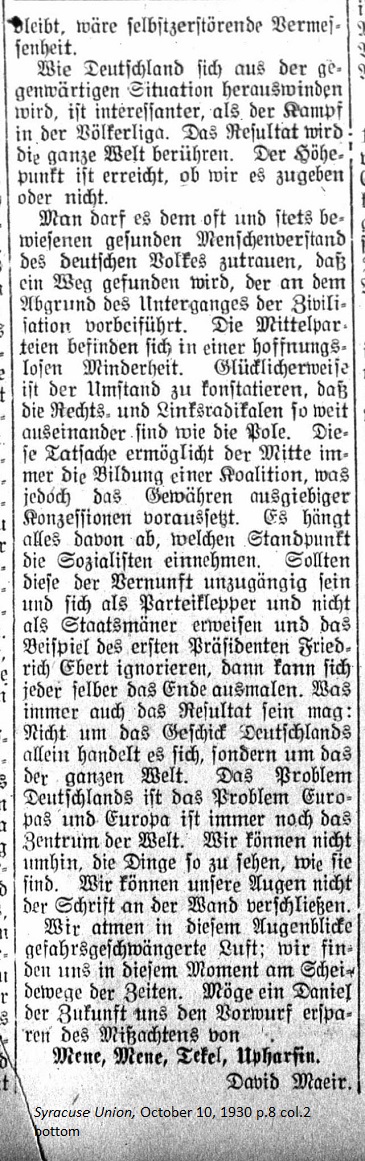
October 10, 1930 page 8 _____ As Balsazar's feast had reached it drunken highpoint, a hand wrote a warning on the wall. The inebriated king's dull eyes could not read the writing and on the next morning he was dead. Another festival of Balsazar was in the works during the ten years or longer in the halls of the power brokers of Europe. These parties celebrated the collapse of an opponent. To bring this about it took an outrageous, four-year battle among twenty-eight nations with the appointment of every available man and all the amassable funding and even then it would not have succeeded were it not for the famine and treachery they used. As the opponent splayed exhausted on the ground, they robbed him of what somber rest he still had left, divided his garments and natural resources, branded his forehead with a sizzling iron of lies, and forced him to bear a burden which twenty-eight years of united effort could not resolve. With a pistol pressed to his bloody breast, he was forced to agree to it without a choice in the matter. Translating this into everyday language, the results of the German elections of September 14th must be understood as the will of a people provoked to the extreme, totally broken under an insane burden, deprived of even the slightest of hope. The election results are no more and no less than the expression of despair. The people, who asserted themselves on September 14th, did so after twelve years on the road to Calvary. It's a journey which began with the introduction of the 14 Points, led to one disappointment after another and one lie after another until it became unbearable, with no light at the end of the tunnel or the slightest glimmer of hope. The outburst has happened and every rational individual must wonder why this didn't happen much, much sooner. Anyone who takes the time to analyse the election will discern that the German people have always proven themselves good natured and patient, the leadership of Ebert and Stresemann had a loyal following though all hardship and personal setback brought on by compliance politics. Economic collapse and spiritual despondency are the initial cause of the election results. The worldwide depression may have intensified the German condition and the French mindset, described by Voltaire as "half tiger, half monkey," accelerated the total breakdown. So much for the causes. And now the results. The first repercussion was unfortunate. The Brüning Cabinet called the election in order the find out how the people felt about additional taxes. The middle class parties were either crushed or weakened while the radicals on both sides, the Communists and the Fascists, emerged with their waving banners. The result is striking: both parties are against compliance and further entry into agreements. Brüning and his cabinet, which looks like a malformation of nature, must go before the Reichstag. And the Reichstag should say Yes when the people's emphatic No has not yet faded away. This time it can't even use the red file [voter roster?] The Reichstag called upon the people and the people spoke loud and clear. For this reason it would not be possible to balance the budget and and make the reparation payments. The Reichstag would be forced to call a moritorium on the Young Plan and make new plans for repayment of the reparation debt. It's an issue which must be resolved eventually. Screaming in anger or offensive insults of the usual variety will change nothing. On this point the whole world is in agreement, with the possible exception of Poincaré, who has learned nothing after twelve years. As yet the world has stood by disinterested and looked at these outrageous proceedings in hope that the good-natured German people would back down without grumbling, which has happened until now to the satisfaction of everyone. It was the most wretched period in world history and it took a tremendous shove to jolt the world out of its stupor and force it to recognize the cold, hard facts. Sitting quietly and hoping that something favorable will occur is madness. Expecting that Germany will continue to be the breakwall against the red tide would be self-defeating arrogance. How Germany will squirm its way out of the current situation is of greater interest than the battle waging in the League of Nations. The result will affect the entire world. The climax will be reached whether or not the world wants to accept it. One may depend upon the frequently proven sound reasoning of the German people, that they will find a way to skirt past the chasm leading to the downfall of civilization. The middleclass parties fnd themselves a hopeless minority. Luckily the right and left radicals stand at polar extremes. This might enable the establishment of a coaliton government, which will require the granting of extensive concessons. It depends upon which viewpoint the Socialists choose. If they are not open to reason and prove themselves party hacks rather than statesmen and they ignore the example of first President Friedrch Ebert, then each of us can paint the picture of the finale for ourselves. Whatever the result may be, Germnay is not in this alone; the whole world did its part. Germany's problem is Europe's problem and Europe is still the center of the world. We cannot let things go on as they are now. We can't close our eyes to the writing on the wall. At this moment we breathe in danger-filled air; we find ourselves at the crossroads of time. May there be a Daniel in the future to spare us from the accusation of neglect, the reproach of numbered, numbered, weighed, divided. David Maeir. |
|
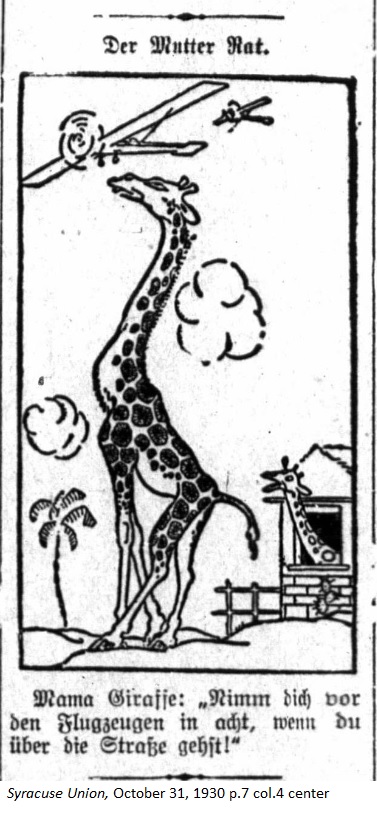
October 31, 1931 page 7 Mama Giraffe: Look out for airplanes whenever you cross the street! |
|
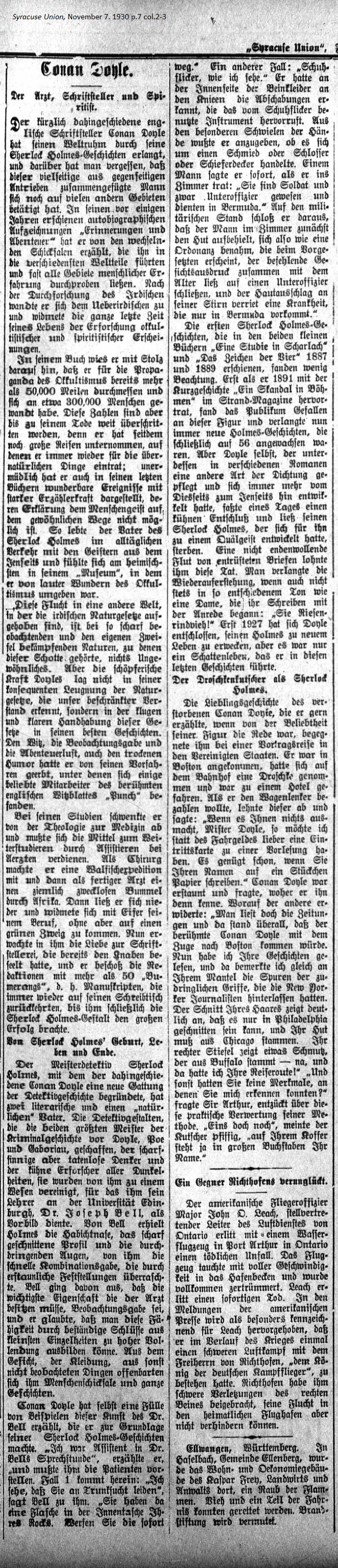
November 7, 1930 page 7 _____ The Physician, Writer and Spiritualist. In his book he boasts that in studying occultism he had covered more than 50,000 miles and spoken with around 300,000 people. These numbers were greatly exceeded by the time of his death since he had undertaken more extended trips in which he studied supernatural phenomena. In his last books he discussed ceaselessly and with powerful narrative ability the wonderous events which can not be rationally explained by the human mind. Thus the father of Sherlock Holmes lived in daily commerce with the spirit world and felt most at home ins his "museum," in which he was surrounded by the wonders of occultism. The flight into another world in which earth's natural laws are suspended, is not an unusual thing for this Scotsman known for his sharp skill of observation and his natually skeptical nature. However Doyle's creative power did not lie in his consistent denial of natural laws, which our limited powers of reason recognize but rather in the prudent and clear manipulation of these laws in his best stories. He inherited the wit, the power of observation, the love of adventure, and even his dry humor from his forefathers, among whom were numbered a few beloved contributors to the famous English satirical magazine Punch. In his studies he deviated from theology to medicine and to gain the financial means for further study he worked as an assistant to physicians. As a surgeon he joined a whaling expedition then as a fully fledged physician he made a seemingly aimless journey through Africa. Then he settled down and zealously pursued his profession however this did not prove profitable. Now he developed a love of writing, which had first blossomed when he was a boy. He decided to edit the more than 50 manuscripts he had on this desk until he finally had great success with his Sherlock Holmes character. The master detective Sherlock Holmes, with whom Conan Doyle established a new genre of detective story, had two literary and one "natural" father. The detectives created by the two great masters of criminal stories before Doyle, Poe and Gaboriau, were sharp-witted but passive thinkers. The bold explorer of the dark world united the essence of these characters with one of his teachers at the University of Edinburgh, Dr. Joseph Bell. From Bell Holms inherited the hawk nose, the angular profile, and the penetrating eyes. From Doyle he received the quick power of deduction which resulted in astonishing findings. Bell insisted that the most important quality that a physician had to have was the power of observation. He believed one could train this ability to a higher level by making reasonalbe conclusions based on small details. The face, the clothing, other observed details revealed a man's life and his entire history. Conan Doyle himself discussed plenty of examples of Dr. Bell's skill, which he used as the foundation of his Sherlock Holmes stories. "I was an assistant in Dr. Bell's clinical consultations," he stated, "and I had to introduce the patients to him. To Case 1 Bell said, 'I see you suffer from alcoholism. You have a flask in the inner pocket of your coat. Throw that away immediately.' In another case he stated, 'A cobbler, I see.' He had noticed the abrasion between the knees of the man's trousers caused by a cobbler's tool. From the callouses on the hands he could have known that the man was either a blacksmith, a metal worker, or a slater. To one man he immediately stated as he walked into the room, 'You were a soldier, certainly a corporal, and you served in Bermuda.' From the military bearing, the fact that he kept his hat on when he entered the room and behaved like an orderly going before superior officers, the commanding countenance together with his age, it led one to conclude that he was a corporal. The rash on his forehead indicated an illness only found in Bermuda." The first two Sherlock Holmes stories, each published in small book form, were A Study in Scarlet (1887) and The Sign of Four (1889). They received little public attention. The short story "A Scandal in Bohemia" was published in Strand Magazine in 1891. The public liked the main character and wanted more Holmes stories, which eventually grew to 56 in number. Meanwhile Doyle became more interested in different forms of writing and always felt pulled this way and that until one day he made a bold decision and let his Sherlock Holmes character, which had become a real nuisance for him, die. This move yielded him a deluge of angry letters. People wanted a resurrection, if not in the quite so decisive a tone as one woman wrote. She began her salutory address with "You big, stupid fool!" In 1927 Doyle decided to bring his Holmes back to life, but in these last stories it was only a life in the shadows. A favorite story of the late Conan Doyle, which he gladly related whenever conversation about the popularity of his fictional character arose, happened when he was on a lecture tour in the Unted States. He had arrived in Boston and taken a taxi at the train station to get him to his hotel. When he tried to pay the driver the man declined the fare and said, "If it's no trouble, Mister Doyle, I'd rather have an admission ticket to the lecture rather than the fare. It would suffice if you'd write your name on a piece of paper." Conan Doyle was astonished and asked how he knew him. "It's been all over the newspapers that the famous Conan Doyle would come by train to Boston. Now I have read your stories and I noticed right away that there are traces of where New York journalists grabbed your coat. The cut of your hair clearly shows that it was done in Philadelphia and your hat must have come from Chicago. Your right boot shows signs of mud from Buffalo — and I had your travel route!" "And yet you had no clear marker on how you could recognize me?" Sir Arthur asked, delighted by the pracical applicaton of his methods. "Oh, and one more thing," the driver said with a smirk. "Your name is embossed on your luggage in large letters." Translator's Note: See The Arthur Conan Doyle Encyclopedia for how it records this story. An Opponent of Richthofen has an Accident _____ The American flight officer, Major John D. Leach, acting head of the Ontario Air Service, suffered a fatal accident in a seaplane in Port Arthur, Ontario. The plane dove at full speed into the harbor basin and was completely smashed. Leach died immediately. Announcements in the American Press emphasized the distinction that in the course of the war Leach once engaged in a heated air battle with Baron von Richthofen, "the king of German combat plots." Richthofen caused him a serious injury of the right leg, however this did not hinder Leach from returning to his home airfield. Ellwagen, Württemberg. In the Ellenberg neighborhood of Haselbach the residence and farm buidlings of Kaspar Frey, farmer and attorney, were the victims of flames. Cattle and a portion of the movable property were saved. Arson is suspected. |
|
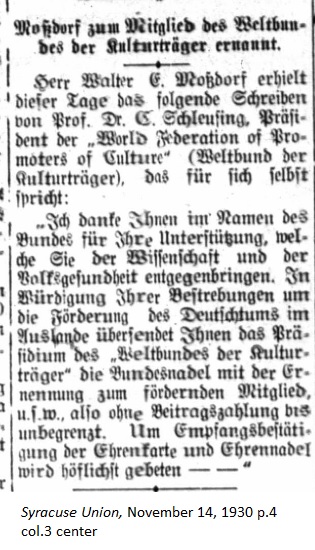
November 14, 1930 page 4 _____ "I thank you in the name of the Federation for your contribution to scholarship and public wellbeing. In appreciation for your efforts in promoting German life abroad, the steering committee of the World Federation of Promoters of Culture is sending you a Federation pin with ,appointment to membership with unlimited exemption from dues. We kindly request receipt of the honorary card and pin ..." |
|
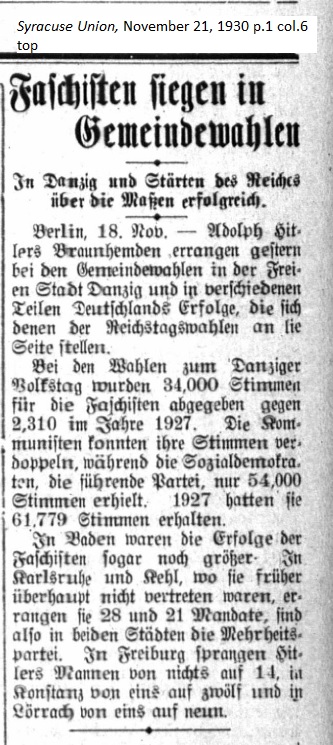
November 21, 1930 page 1 _____ Successful beyond Measure in Danzig and Municipalities of the Empire _____ 34,000 votes were cast for the Fascists in the election to the Danzig Volkstag, as opposed to 2,310 in 1927. The Communists were able to double their votes while the Social Democrats, the ruling party, received only 54,000. In 1927 they had received 61,779 votes. In Baden the Fascist victory was even larger. In Karlsruhe and Kehl, where earlier they were basically unrepresented, the Fascists gained 28 and 21 representatives respectively, a majority in both cities. In Freiburg Hitler's men went from no representatives to 14; in Konstanz an increase from one to twelve and in Lörrach from one to nine. |
|
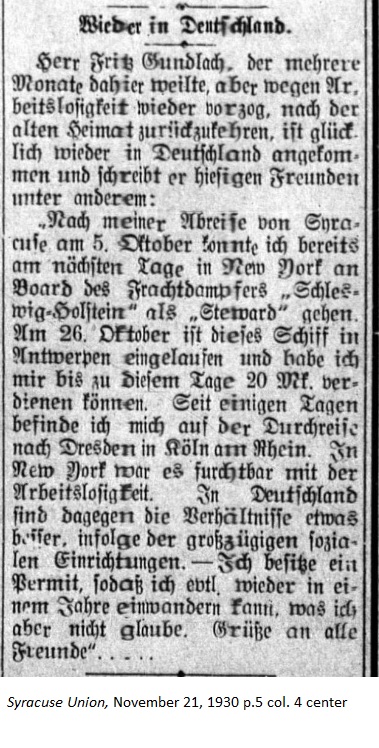
November 21, 1930 page 5 _____ Mr. Fritz Gundlach, who spent many months here but had to leave due to unemployment, has returned safely to the old homeland in Germany and has written to his friends here: "After my departure from Syracuse on October 5th, the next day in New York I was able to board the steam freighter "Schleswig-Holstein" as a steward. The ship arrived in Antwerp on October 26th and I had earned 20 Marks. A few days later I was on a cross-country journey through Dresden to Cologne on the Rhine. In New York the unemployment rate was dreadful. In Germany circumstances are somewhat better as the result of more numerous social agencies. — I have a permit so in a year I can emigrate again, but I don't think I will. Greetings to all my friends..." |
|
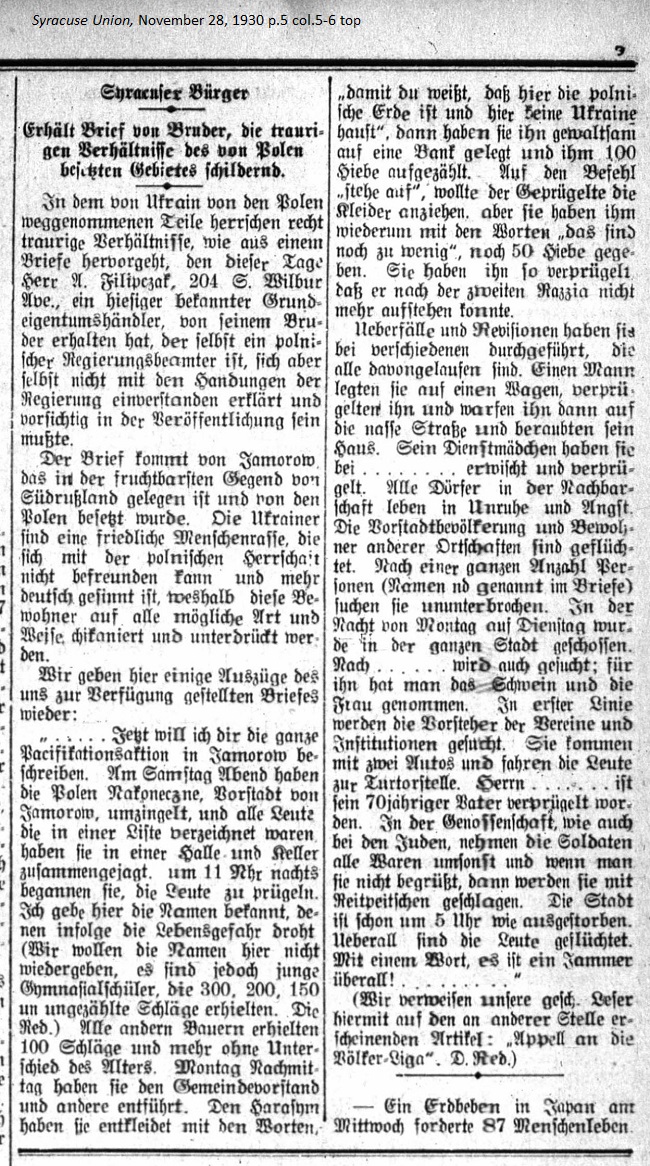
November 28, 1920 page 5 ____ Receives Letter from Brother, who describes the Sad Situation in the Polish Occupied Regions _____ The letter comes from Jammorow, which lies in the most fertile region of southern Russia and is now under Poland's control. The Ukrainians are a peaceful race, which is not on friendly terms with Polish domination. They have more in common with the Germans, which is why these residents have been tricked and oppressed by every possible ways and means. We reprint here a few paragraphs from this letter which was given to us: "....Now I will describe to you the entire pacification action in Jamorow. On Saturday evening the Poles surrounded Nakoneczne, a suburb of Jamorow, rounded up all the people who were on a list, put them into a hall and basement, and around 11 that night they started to beat them. I give the names here of those who were in mortal peril. [We will not reprint the names, but there were high school students who received 300, 200, 150, and countless blows. — The Editor.] All other farmers received 100 blows or more without regard to age. Monday afternoon they carried off the parish council and others. They took Harasym's clothing and said, "So you'll know that this is Polish territory and no Ukrainians live here." Then they shoved him onto a bench and dealt him 100 blows. When he was ordered to "stand up" the beaten man wanted his clothes back, but they responded with "That's not enough" and they hit him 50 more times. They beat him so hard that he couldn't stand up after the second beating. "Various individuals have carried out raids and audits to run people off. They put one man into a wagon, beat him, threw him into the wet street, and burgled his house. They nabbed his maid at ... and beat her. All the residents of the neighborhood lived in upheaval and fear. The people of the suburbs and the residents of other areas have fled. They're continually looking for an entire group of people [Those names are listed in the letter.] There was shooting throughout the city on the night between Monday and Tuesday. They were also looking for ...; they took his pigs and his wife. The first to go were the chairmen of associations and institutions. They came in two cars and drove the people to the city gates. Mister ... 's 70 year old father was beaten. The soldiers took all the property of the associations and the Jews. If someone didn't greet them they would be hit with a riding crop. The city is dead by 5 in the afternoon. People are fleeing. In a word, it's miserable all over! ..." [We refer our beloved readers to another section for the article "Appeal to the League of Nations" — The Editor] |
|
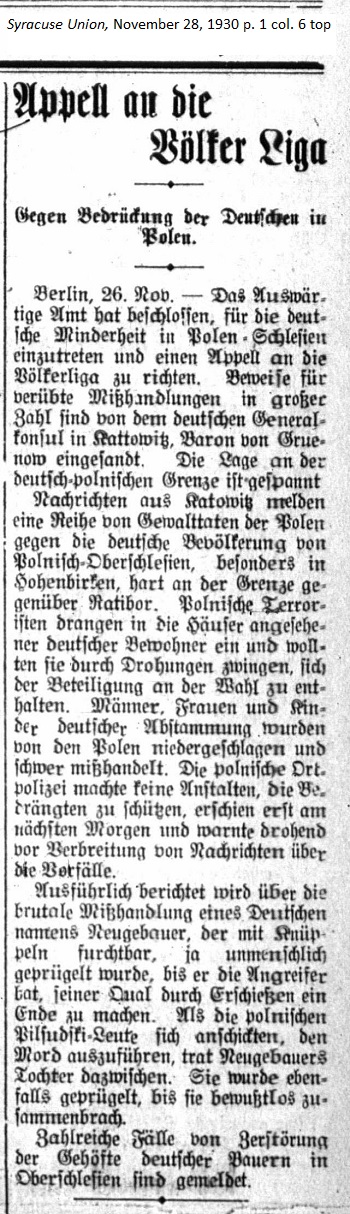
November 28, 1930 page 1 _____ Regarding the Oppression of Germans in Poland _____ Berlin, November 26th, — The Foreign Affairs Office has decided to advocate for the German minority living in Polish Silesia and direct an appeal to the League of Nations. Proof of many incidents of maltreatment have been submitted by the German Consulate General in Katowitz, Baron von Gruenow. The situation at the German-Polish border is tense. Reports from Katowitz list a series of violent acts perpetrated by the Poles against the German population of Polish Upper Silesia, especially in Hohenbirken, right at the border across from Ratibor. Polish terrorists stormed the houses of respectable German residents and issuing threats, tried to force residents to refrain from taking part in the upcoming election. Men, women and children of German heritage were struck down and severely mistreated. The Polish regional police made no attempt to protect the oppressed, only arriving the morning after the event and warning people against disseminating information about the incidents. Extensive information was reported about the brutal mistreatment of a German named Neugebauer, who was terribly, indeed inhumanely, beaten with clubs until he begged his attackers to end his suffering with a bullet. As Pilsudski's Polish forces prepared to commit the murder, Neugebauer's daughter came between them. She was beaten until she fell unconscious. Numerous incidents of the destruction of homesteads belonging to German farmers have been reported in Upper Silesia. |
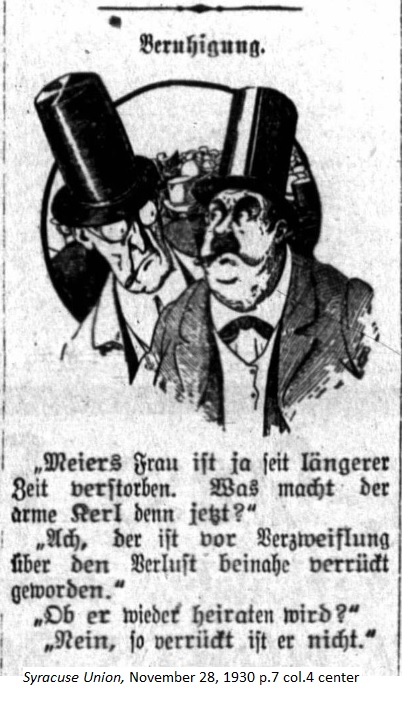
|
November 28, 1930 page 7 "Meier's wife has been dead for a long time. What is the poor man doing now?" "Oh, in despair over her death he's practically gone crazy." "As to whether or not he should marry again?" "No, he's not that crazy." |
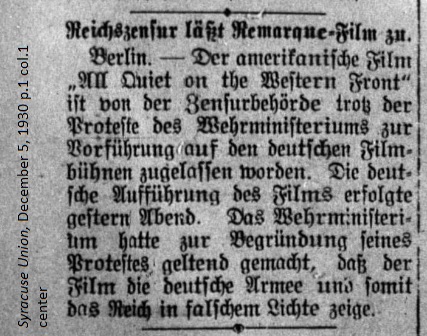
|
December 5, 1930 age 1 |
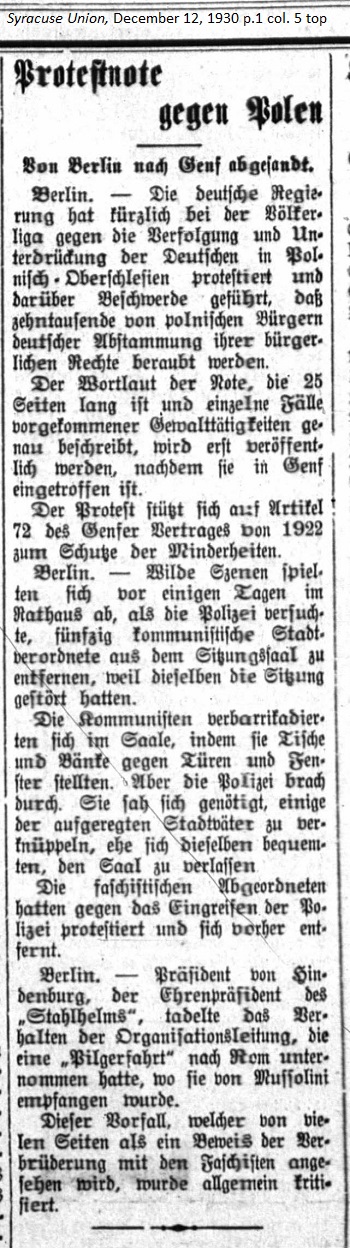
|
December 12, 1930 page 1 _____ Sent from Berlin to Geneva Berlin. —Recently at the League of Nations the German Government protested against the persecution and oppression of Germans in Polish Upper Silesia and issued a grievance stating that ten thousand Polish citizens of German heritage were robbed of their civil rights. The wording of the note, which is 25 pages long and describes individual cases of violent acts, was first made public after it was delivered in Geneva. The protest is based on Article 72 of the Geneva Convention of 1922 regarding the protection of minority populations. Berlin. Wild scenes played out in the City Hall a few days ago as police attempted to remove fifty Communist City Council members from the meeting room because they had disrupted the meeting. The Communists barricaded themselves in the room by placing tables and benches against doors and windows. However the police broke through. They found it necessary to club a few of the agitated city fathers before they calmed down and left the room. The Fascist officials had protested against the police intervention and left earlier. Berlin. President von Hindenburg, honorary president of the "Steel Helmets" [Paramilitary organization of World War I frontline soldiers in the Weimar Republic,] criticized the behavior of the organization's leadership, which undertook a "pilgrimmage" to Rome, where they were received by Mussolini. This occurrence, which on many sides was viewed as proof of fraternization with the Fascists, was generally criticized. |
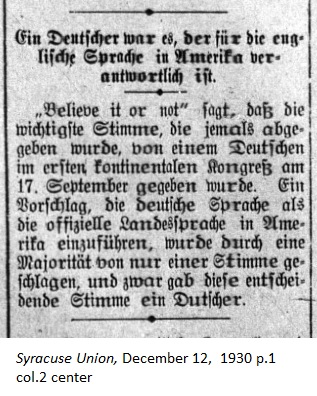
|
December 12, 1930 page 1 _____ "Believe it or Not" states that the most important vote ever cast was by a German at the First Continental Congress of September 17th [1774.] A proposal, which was forwarded to make German the official language in America, was rejected with just one vote shy of a majority. That vote came from a German. |
|
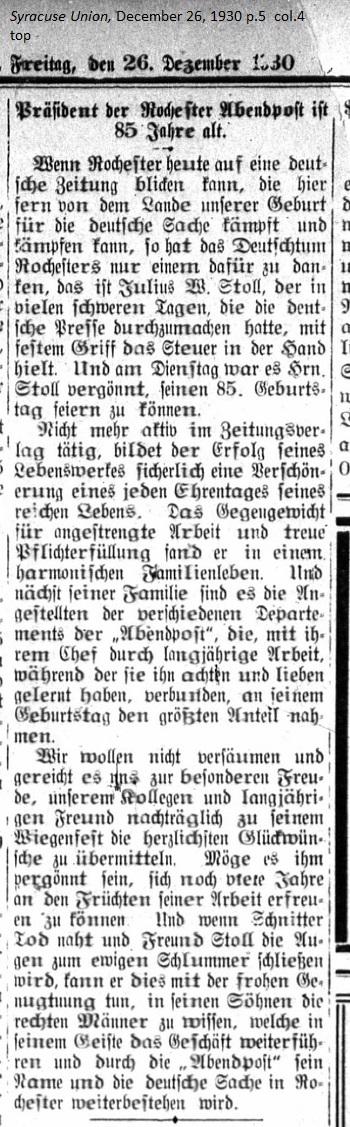
December 26, 1930 _____ No longer actively taking part in the newspaper's publication, the result of his life's work certainly provides a fine backdrop to the great day in his rich life. The counterbalance to strenuous work and the true fulfillment of duty he found in a harmonious family life. Along with his family there are employees from various departments of the Abendpost, who learned to love and respect their boss during long years of working together and who took part in his birthday celebration. We do not want to neglect and take great pleasure in extending our colleague and friend of many years our heartfelt best wishes for his birthday. May he be granted many more years of enjoyment for the fruits of his labor. And when the Grim Reaper nears and Friend Stoll closes his eyes for the last time, he can do so in full satisfaction, knowing that his sons are the right men to carry on the business in his spirit and through the Abendpost his name and the German cause in Rochester will live on. |