January - June 1931
|
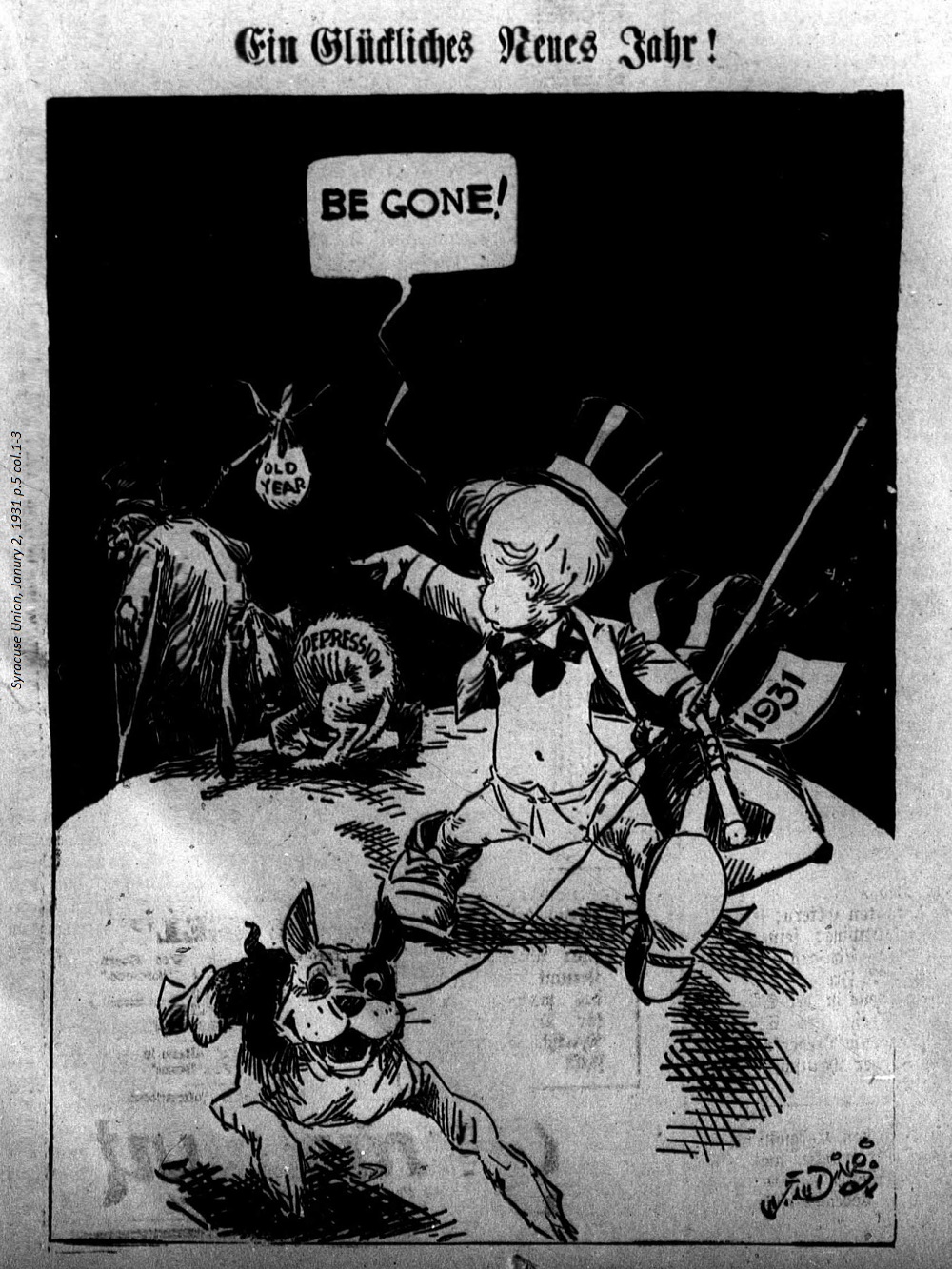
January 2, 1931 page 5 |
|
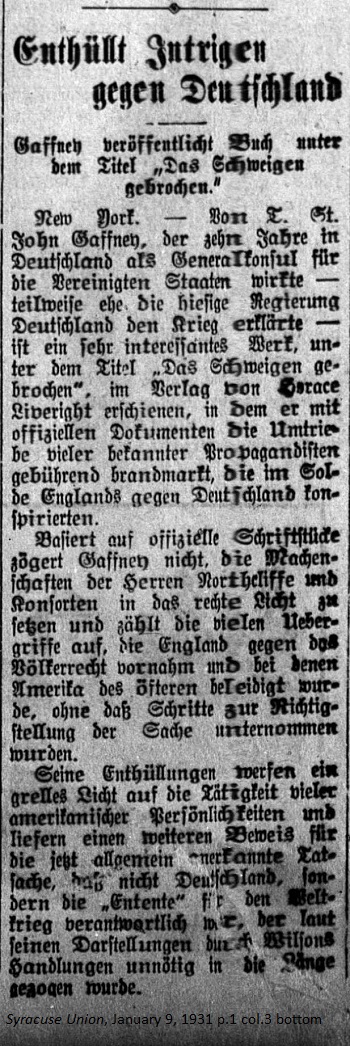
January 9, 1931 page 1 _____ Gaffney publishes Book under the Title Breaking the Silence. Based on these documents Gaffney does not hesitate to place the machinations of Mr. Northcliffe and his consorts in a proper light. He lists the numerous incursions which England perpetrated against International Law, which often offended America, yet no steps were ever taken to rectify the matter. His revelations cast a harsh light upon the activities of many American personalities and deliver further proof contesting the generally acknowledged fact that it wasn't Germany but the "Entente" which was responsible for the World War. According to his interpretation, in the long run Wilson's involvement would have been unnecessary. |
|
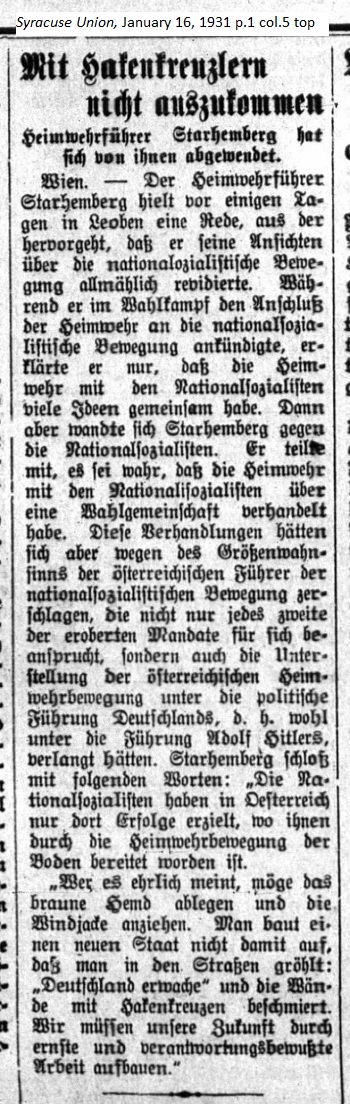
January 16, 1931 page 1 Home Guard Leader Starhemberg has turned away from them. "Whoever sincerely thinks about it may get rid of the brown shirt and put on the windbreaker jacket. You can't build a nation when people are crying out in the street 'Germany, awake' and smearing walls with swastikas. We must create our future through earnest and responsible labor." |
|
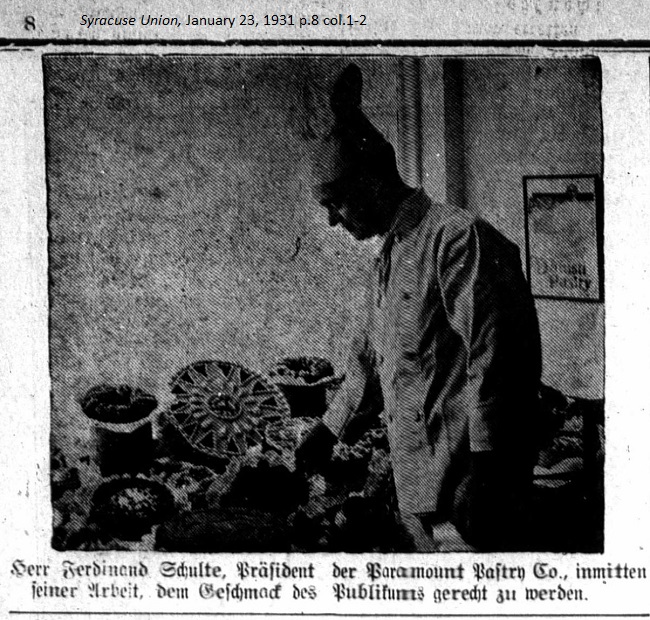
January 23, 1931 page 8 Caption under picture reads:Mr. Ferdinand Schulte, President of the Paramount Pastry Co., by whose work the taste requirements of the public are satisfied. |
|
|
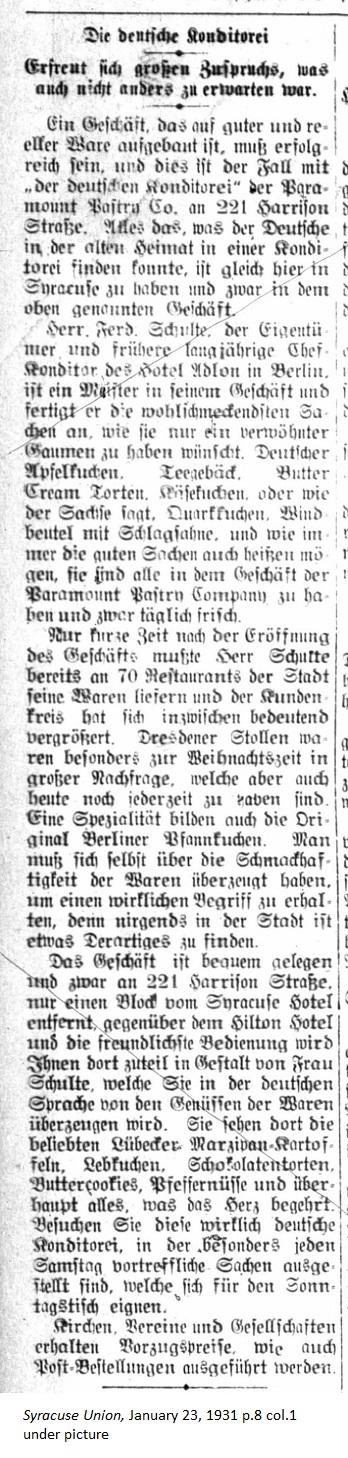
January 23, 1931 page 8 _____ Enjoys Great Popularity, as was expected. _____ A business built on fine and geniune ingredients just has to be successful, and this is the case with the "Deutsche Konditorei" of the Paramount Pastry Co. at 221 Harrison St. Everything the German could possibly find in a bakery in the old homeland can be found here in Syracuse at the above named business. Mr. Ferd. Schulte is the business owner. Previously he was the head pastry chef at the Hotel Adlon in Berlin. He is a master at his craft and he produces the best tasting baked goods suitable for the pampered palate. German apple tarts, tea cakes, buttercream torts, cheesecakes, cream puffs [literally wind bags with whipped cream] or whatever you may call them, they're all freshly baked and available daily at the Paramount Pastry Company. Shortly after the business opened Mr. Schulte was already delivering his wares to 70 restaurants. Since then the customer base has increased significantly. Dresden fruitcake is especially in demand at Christmas time but it can be had anytime. The original Berliner jelly donut is a specialty of the house. You have to try the baked goods for yourself in order to understand that they're nothing like anything else in the city. The business is conveniently located at 221 Harrison St., only a block from the Syracuse Hotel and across the street from the Hilton Hotel. You'll receive truly friendly service from Mrs. Schulte, who will convince you in the German language about how best to enjoy the baked goods. You'll find the popular Lubeck marzipan potatoes, gingerbread, chocolate tortes, butter cookies, spice cookies, and everything your heart desires. Visit a real German bakery, which displays wonderful wares each Saturday just right for your Sunday table. Churches, organizations, and businesses receive discount prices. Mail orders are also accepted. |

|
January 30, 1931 page 1 ______ Many People injured, a few dead, in Clashes between Fascists and Communists Hamburg Police were needed to take custody of 80 individuals. The fight began when 200 Communists attempted to break up a gathering of Fascists and revolvers were fired. The Fascists barricaded themselves and called the police for help. A veritable battle broke out and three people were severely wounded. The clash was one of the fiercest in the so-called "secret civil war," as the government calls it, currently happening in Germany. Stendal, Germany. Jan. 28th. — Fifteen people, including one passing pedestrian who just got too close, suffered serious injuries when the police used bludgeons to stop a rally by the Communists and disperse the crowd. The Communists had arrived in the city during the night in 4 automobiles. First the Communists shattered the equipment in a restaurant, which National Socialists were known to frequent. Then they began to menace a Protestant pastor, whom they followed into the church and taunted. On a train on its way to Berlin a heated battle broke out between National Socialists and federal railway employees during which shovels were used as weapons. Berlin, Jan. 28th. — Jewish clashes over the weekend between Communists, National Socialists, and supporters of the Reichs Banner [Social Democrats] left one person dead, 30 to 40 people injured and dozens in custody in various portions of the empire. In Hahnheim near Mainz the mayor was injured when he attempted to establish peace among National Socialists and Reichs Banner people. He was severely beaten by the Hitler people. In the melee a police officer was also attacked. Two National Socialists were significantly injured and sent to the hospital. Another 40 were taken into custody. In Kassel 90 Communists pushed their way into a National socialist meeting and the usual brawling with chair legs, beer mugs, etc. ensued. ??? Hitler followers were sent to the hospital and 90 people were arrested. In Stralsund National Socialists assaulted a Communist. In Wriezen (Brandenburg) a Communist was stabbed by Hitler people. In Radeberg near Dresden a National Socialist meeting was disrupted by Social Democrats and Communists. Six people were injured and many were arrested. In Penig near Chemnitz, after an assembly of Hitler people 5 people were sent to the hospital. The Mayflower destroyed by Fire _____ Philadelphia. The "Mayflower," a yacht once owned by the President, lies today at the bottom of the Delaware River. On Saturday it caught fire and slowly sank as the Fire Department tried to put the flames out with water and bring the fire under control. Young Wife slain with Ax _____ Terre Haute, Ind. Jan. 29. — 23 year old Lawrence Johnson is in custody for killing his wife, 15 year old expectant mother Mildred , with an ax. They were living in his wife's family. The murder happened in the house and Lawrence spoke with the family until the police arrested him. He did not want children. [Translator's Note: Parts of the text were missing so I consulted the January 28, 1931 issue of the Evansville Courier and Press to fill in the blanks.] |
|
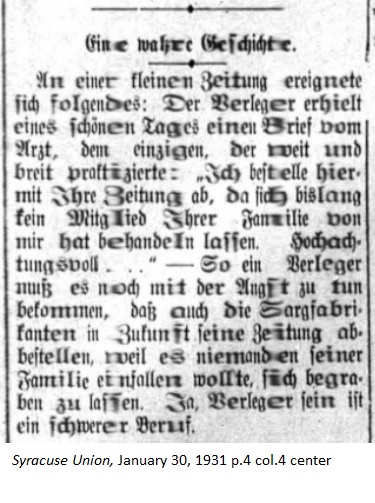
January 30, 1931 page 4 _____ At a small newspaper the following occurred: One fine day the publisher received a letter from a physician who practiced far and wide. "I hereby cancel my subscription to your newspaper since for some time I have not treated any member of your family. Respectfully, ..." — So, does that mean the publisher might have to worry about the coffin maker cancelling his subscription in the future because no member of his family wants to be buried? Really, being a publisher is a difficult occupation. |
|
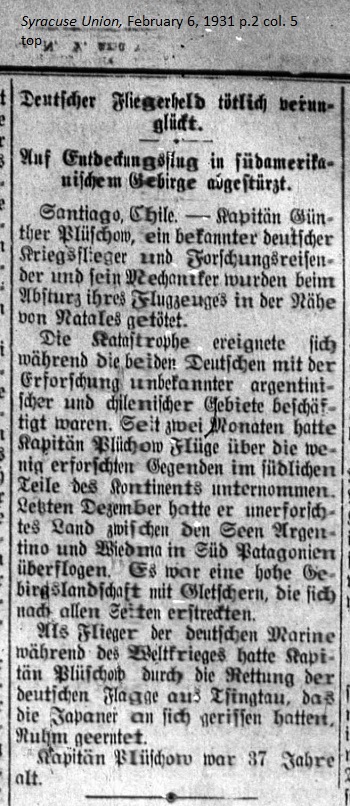
February 6, 1931 page 2 _____ Crashes while making Exploratory Flight of a Mountain Chain in South America Santiago, Chile. — Captain Günther Plüchow [sic], a well-known combat pilot and explorer, and his mechanic were killed in a crash of their aircraft near Natales. The catastrophe occurred while both Germans were busy exploring an unknown section of Argentina and Chile. Captain Plüchow had been flying over the unexplored region of the southern continent for two months. Last December he flew over unknown territory between the Argentine Sea and Viedma Lake in southern Patagonia. It was a high-altitude mountainous region with glaciers stretching out on all sides.
|
|
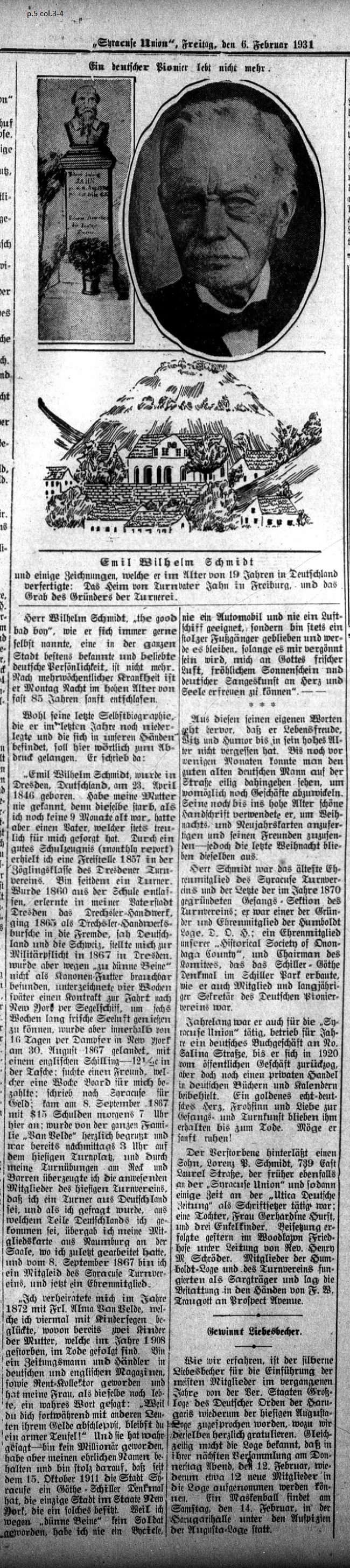
February 6, 1931 page 5 Mr. Wilhelm Schmidt, "the good bad boy" as he liked to call himself, was one of the best known and beloved German personalities. After an illness lasting many weeks he died Monday night at the advanced age of almost 85 years. The autobiography which he wrote last year and which we have in our hands we're going to print here word for word: "Emil Wilhelm Schmidt was born in Dresden, Germany on April 23, 1846. I never knew my mother because she died before I was 9 months old. However I had a father who faithfully cared for me. Due to a good monthly school in 1857 I obtained student status at the Dresden Gymnastics Society. I've been a gymnast ever since. I graduated from the school in 1860 and apprenticed in the lathe operator trade, became a journeyman in the trade abroad, saw Germany and Switzerland, signed up for compulsory military service in Dresden in 1867, but due to "weak legs" was not found useful as cannon fodder. Four weeks later I signed a contract for travel to New York on a sailing vessel, which would have allowed me to enjoy six weeks of fresh air. However in a matter of 16 days I landed in New York on August 30, 1867 with an English Schilling — 12 ½ cents in my pocket. I sought out a friend, who paid a weeks board for me; wrote to Syracuse for money; arrived on September 8, 1867 at 7 in the morning in debt for $15; was greeted cordially by the "Van Velde" family and already by 3 in the afternoon was at the gymnasium and due to my gymnastics exercises on the high and parallel bars I convinced those gym members present that I was a gymnast from Germany. When I was asked in what part of Germany I was from I handed over my membership card from Naumburg on the Saale, which was the last place I had worked. As of September 8, 1867 I was a member of the Syracuse Gymnastics Association, and currently I am an honorary member. "In 1872 I married Miss Alma Van Velde, who blessed me with four children, two of whom followed their mother in death in 1908. I've been newspaper man and a dealer in German and English-language magazines as well as a rent collector. When my wife was still alive I told her these true words, 'Because you've always shared your money with other people, you'll always be poor!' She sincerely responded, I'm not a millionaire, but I've maintained an honorable name and I am proud that since October 15, 1911 the city of Syracuse has a Goethe-Schiller Monument, the only city in New York State to own one. Because I hadn't become a soldier due to "weak legs," I'll never have a bicycle, or an automobile, or an airplane. Instead I'll remain a proud pedestrian for as long as God grants me fresh air, happy sunshine, a German song in my heart, and a soul with which to enjoy them all." His own words show that even at an advanced age he had not forgotten his love of life, his lively wit and his sense of humor. Until a few months ago people saw a good, old German man still going about his business on the street. Even in old age he still had beautiful penmanship, which he used to send Christmas amd New Years cards to his friends — this was the case right up to last Christmas. Mr. Schmidt was the oldest honorary member of the Syracuse Gymnastics Association and the last member of the Association's singing section established in 1870. He was a founder and honorary member of the Humboldt Lodge, German Order of the Harugari; an honorary member of the Historical Society of Onondaga County, and chairman of the Committee for the Goethe-Schiller Monument built in Schiller Park. He was also a member and many-year secretary of the German Pioneer Society. For years he was also involved with the Syracuse Union. He then operated a German bookstore on No. Salina St. until he retired from public business dealings in 1920. However he still maintained a private trade in German books and calendars. Right up to his death he had a pure gold, truly German heart, a cheerful nature, and a love of song and gymnastics. May he rest in peace! The departed leaves behind a son, Lorenz P. Schmidt, who previously was employed as a type setter at the Syracuse Union and later for some time at the Utica Deutsche Zeitung. He also had a daughter, Mrs. Gerhardine Hurst, and three grandchildren. A funeral was held yesterday at Woodlawn Cemetery conducted by Rev. Henry M. Schröder. Members of the Humboldt Lodge and the Gymnastics Association acted as pallbearers. Funeral arrangements were managed by F.W. Traugott on Prospect Ave. Loving Cup Winner We have learned that the silver loving cup for the installation of new members last year by the United States Grand Lodge of the German Order of the Harugari has again been awarded to the Augusta Lodge. We offer our heartfelt congratulations. At the same time the Lodge announced that at its next meeting on Thursday night, February 12th around 12 new members will be installed into the Lodge. There will be a masked ball on Saturday, February 14th in the Harugari Hall under the auspices of the Augusta Lodge. |

|
February 13, 1931 page 4 _____ Interesting Lectures Tomorrow, Saturday, at the Onondaga Hotel _____ Tomorrow, Saturday there will again be a meeting of the Foreign Relations Council in the ballroom of the Onondaga Hotel along with dinner. The theme will be Fascism, or perhaps Hitlerdom in Germany. The unexpected, and almost unprecedented result of the Hitler Movement in the recent German elections is an event of international import. It may be seen as one of the greatest disturbances to international progress in 1930 due to the strategic importance of the German relationship to the major nations of Europe and the United States. Perhaps it is not the only factor which can directly influence the delicate balance of political and economic conditions such as the attitude and the behavior of the German population. The overall economic depression and the obligation for making regular reparation payments have brought about a truly serious situation in Germany. Adolph Hitler, who seems to have taken Mr. Mussolini as his model, was the focal point for the discontent, if not the exasperation currently rampant in Germany. He and his followers received 6,400,000 votes in the September elections and 107 out of 575 seats in the Reichstag while previous they only had 12 seats. It is due to the wide-reaching possibilities of the Fascist Movement in Germany that two speakers have been chosen to speak about this issue at tomorrow's meeting. The first speaker is Dr. Erich Hoffman, who just recently came to America to perform research at Amherst Agricultural College. Earlier he was president of a German Student Association for students in Germany, Austria, and Czechoslovakia. In this capacity he came in contact with leading politicians and civil servants of these nations. He is well qualified to discuss the chosen topic. The second speaker is Mrs. Marie B. Macdonald, also of German heritage. She is currently editor of the Steuben News. She recently returned from Germany where she studied the political situation. Earlier today she spoke in the Gymnastics Hall. She is well known as an orator. The dinner tomorrow afternoon begins promptly at 12:30 so the discussion can begin at 1:30. The ticket price is $1.50. Those who do not wish to take part in the dinner are invited to listen to the lectures for an entry fee of 50 cents to cover the costs for the speakers. In all likelihood the lectures will be of particular interest for our German readers. |
|
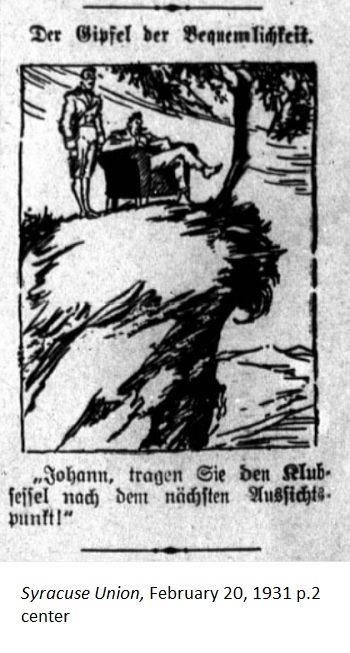
February 20, 1931 page 2 |
|
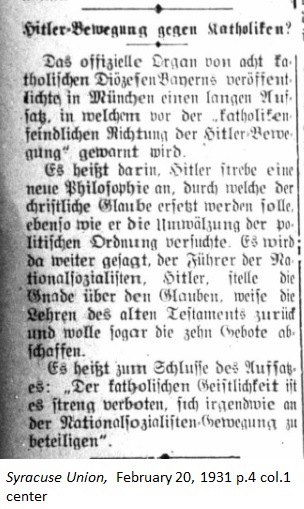
February 20, 1931 page 4 _____ The official organ of 8 Catholic Dioceses in Bavaria published a lengthy article in Munich, in which a warning was issued concerning the "Anti-Catholic direction of the Hitler Movement." It states that "Hitler strives towards a new philosophy through which the Christian faith should be replaced just as he attempted to radically change the political order. The leader of the National Socialists further stated mercy should be valued more than faith, the teachings of the Old Testament should be rejected, and the Ten Commandments should be abolished. In the end the article it is stated, "Catholic spirituality will be strictly forbidden from having any part in the National Socialist Movement." |
|
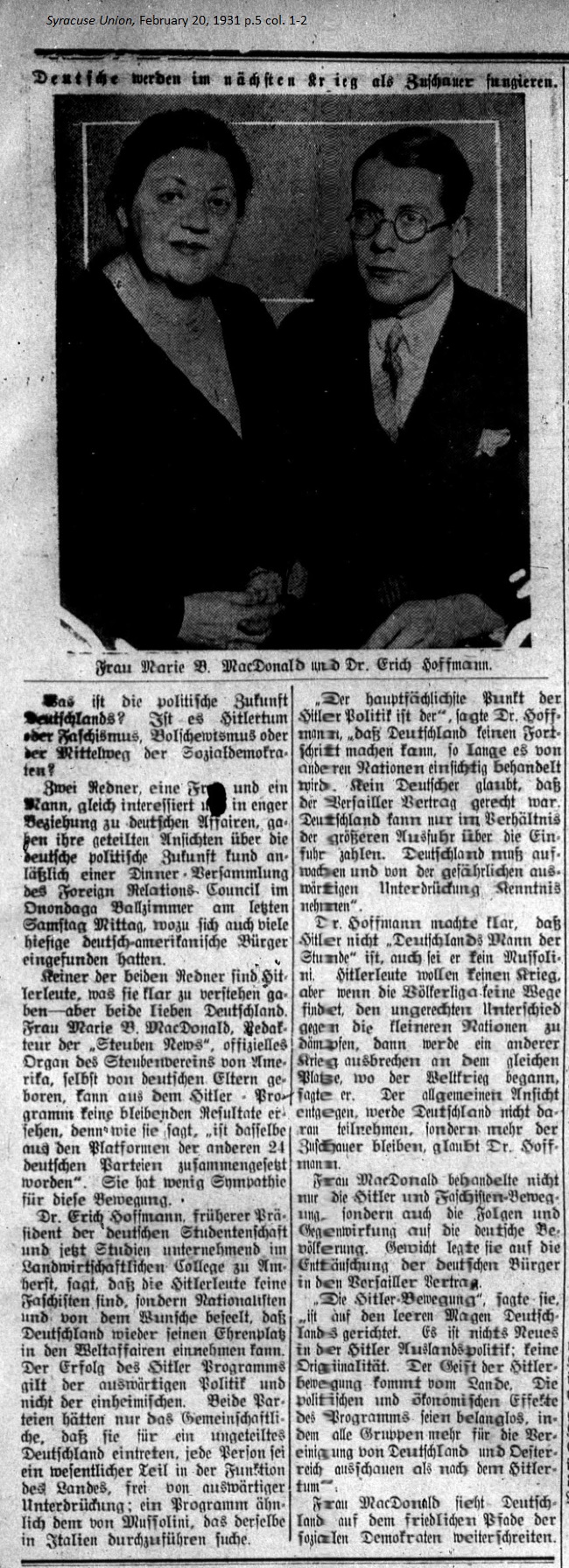
February 20, 1931 page 5 _____ Caption under picture reads: Mrs. Mary B. McDonald and Dr. Erich Hoffmann What is Germany's political future? Is it Hitlerdom or Fascism, Bolshevism or the middle road of the Social Democrats? Two speakers, one woman and one man, both presented items of interest in specific fields of German affairs. Each gave us his or her opinion of Germany's political future at a dinner meeting of the Foreign Relations Council at the Onondaga Ballroom last Saturday afternoon, which was well attended by local German-American citizens. Neither speaker is a Hitler proponent, which each clearly declared — however both love Germany. Mrs. Mary B. MacDonald, editor of the Steuben News, the official organ of the Steuben Society of America, is the child of German parents. She feels that no permanent results can come from the Hitler Program as she states, "it's pieced together from the platforms of the other 24 German Parties." She has little sympathy for the movement. Dr. Erich Hoffmann, former president of the German Student Association currently undertaking studies at the Agricultural College of Amherst, states that Hitler's people are not Fascists but Nationalists inspired by the desire to see Germany once again take its rightful place in world affairs. Hitler's Program is the result of foreign political trends and not domestic affairs. The only thing the two party systems have in common is their desire for a united Germany where each individual is an essential partner in the functioning of the nation, free of foreign oppression: one Program similar to that of Mussolini, which is being carried out in Italy. "The main point of Hitler's politics is," Dr. Hoffmann states, "that Germany cannot progress as long as it is comprehensively controlled by other nations. No German believes that the Versailles Treaty was fair. Germany can only pay based on the proportion of exports over imports. Germany must wake up and become aware of the dangerous oppression wielded by foreign nations. Mrs. MacDonald dealt with not only Hitler and the Faschist Movement but also the actions and reactions of the German people. She placed emphasis on the disillusionment of the German citizen with the Versailles Treaty. "The Hitler Movement," she said, "is directed towards the empty stomachs of Germany. There's nothing new in Hitler's foreign politics; no originality. The spirit of the Hitler Movement comes from the country. The political and economic effect of the Program may be inconsequential in that all groups seem more focused on the unification of Germany and Austria than on Hitlerdom." Mrs. MacDonald sees Germany moving along the peaceful path of the Social Democrats. |
|
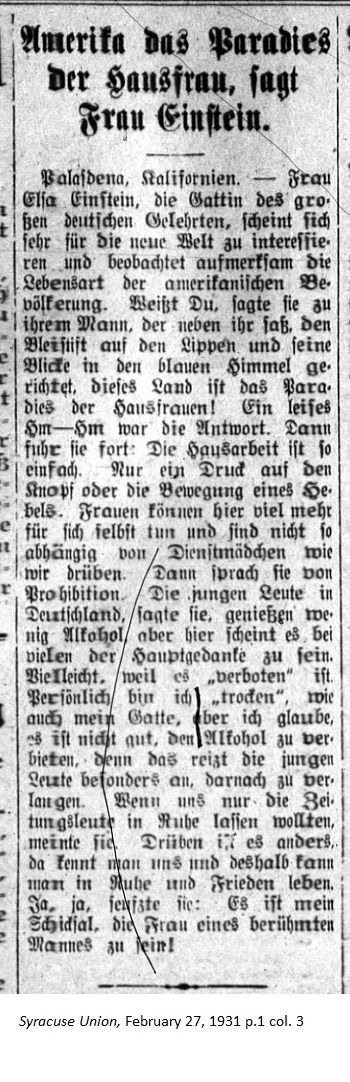
February 27, 1931 page 1 _____ Pasadena, California. — Mrs. Elsa Einstein, the wife of the great German scholar, has quite an interest in the New World and pays close attention to the lifestyles of the American public. Do you know, she said to her husband who was sitting next to her with a pencil to his lips and his gaze directed towards the sky, this country is a paradise for housewives! A soft Hm—Hm was his response. Then she continued: Housework is so easy. The push of a button or the movement of a lever. Women can do far more for themselves and are no longer dependent on servant girls like we were over there. Then they speak of Prohibition. Young people in Germany drink little alcohol but here it seems to be a major issue for many. Perhaps because it's "forbidden." Personally, I'm "dry" like my husband but I believe it's not good to prohibit alcohol. That especially provokes young people into wanting it. If the newspaper people would only leave us in peace, she intimated. It's different over there because they know us so they leave us to our peace and quiet. Yes, yes, she sighed. It's my fate, being the wife of a famous man! |
|
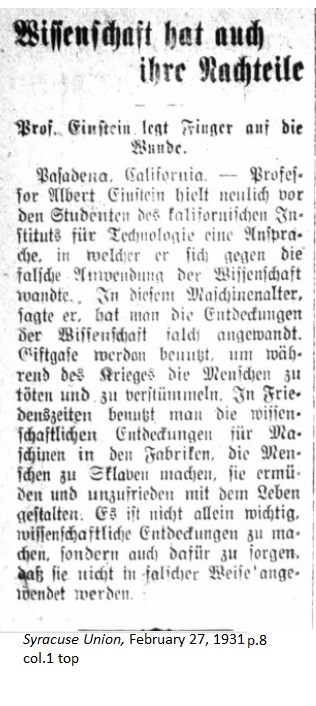
February 27. 1931 page 8 _____ Prof. Einstein sticks His Finger into the Wound Pasadena, California. — Professor Albert Einstein recently gave a speech before the students of the California Institute for Technology in which he tackled the incorrect applications of science. In this machine age, he said, people have improperly applied the discoveries of science. Poisonous gas was used in order to kill and maim people during the war. In peacetime men use scientific discoveries to produce machines for manufacturing, which turn people into slaves. They become weary and discontent with life. It is not only important to make scientific discoveries but also to look after them so they are not applied in incorrect ways. |
|
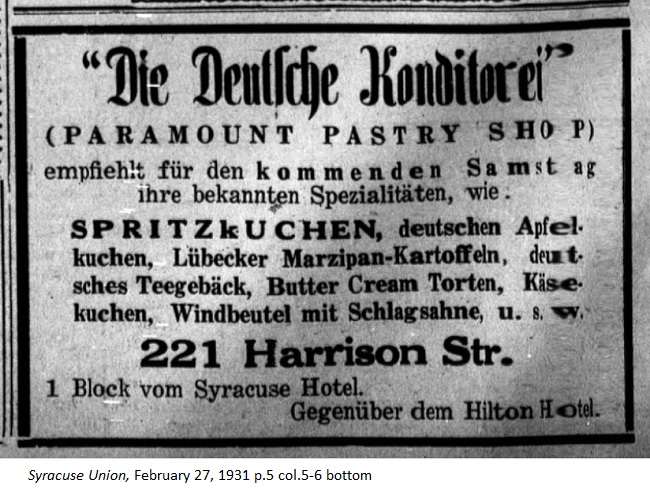
February 27, 1931 page 5 (Paramount Pastry Shop) Recommends these well-known specialties
French Crullers, German Apple Tart, Lübeck Marzipan Potatoes, German Teacakes, Butter Cream Tort, Cheese Cake, Cream Puffs with whipped cream, etc. |
|
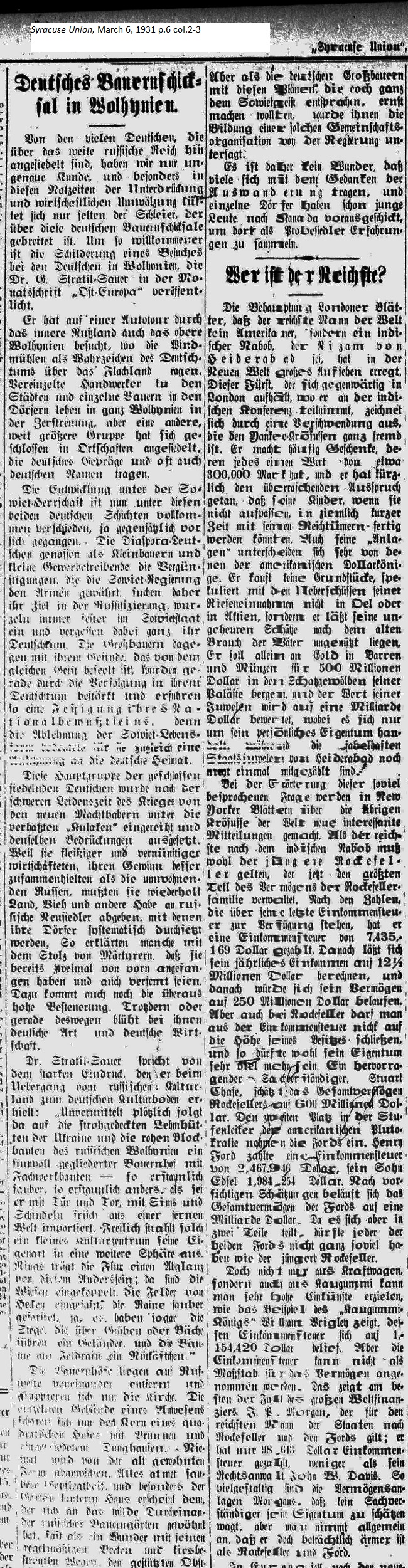
March 6, 1931 page 6 _____ Of the many Germans who settled over the wide expanse of the Russian Empire, we now have an unsubstantiated report. Especially in these dire times of oppression and economic upheaval, the veil over the fate of German farmers in Eastern Europe seldom lifts. Thus the visitor account by Dr. G. Strail-Sauer in the monthly periodical Ost Europe about the Germans of Volhynia is truly welcome. He took an auto tour through the interior of Russia and visited upper Volhynia, where the windmills loom as markers of the German population on the flatlands. Stray craftsmen in the cities and individual farmers in the villages live scattered throughout Volhynia, however other, much larger groups, which bear German characteristics and often German names, settled in closed enclaves. The development of both of these German castes are completely different, indeed going in opposite directions. As small farmers and tradesmen, the diaspora Germans enjoy the benefits which the Soviet government grants to the poor. They become ever more ensconced in the roots of Russification within the Soviet State and completely forget their German heritage. The groups of large farmers, on the other hand, are filled with the same spirit and they are strengthened by their oppression and cling firmly to their sense of national identity. Rejection of the Soviet lifestyle means adherence to the German homeland way of life. After the difficult and sad war years this main group of closed-settlement Germans were ranked by the new Russian power brokers along with the Kulaks [wealthy peasant farmers at odds with Collectivism] and they were placed under the same oppressive policies. Because they were more diligent and knowledgeable farmers their yields were greater than those of the surrounding Russians and they were repeatedly forced to cede land, cattle and other goods to new Russian settlers, who systematically settled in German villages. Many declared with the pride of matrydom that they have already started over twice and ostracized. Then there is the dreadful, high taxes. Despite or perhaps because of this they prosper in their agrarian, German way of life. Dr. Stratil-Sauer speaks of the strong impression made on him in transitioning from the cultivation of Russian land and that of more arable German soil. Suddenly and unexpectedly straw covered, mud huts in the Ukraine and crude blockhouses in Russian Volhynia were followed by compartmentalized timber-framed farm houses — amazingly clean, amazingly different, with doors and gates, sills and shingles freshly imported from a far-away world. Indeed a small culture center radiated with a character from a distant land. All around the landscape one catches a glance of a different state of being. Meadows are interconnected, fields are edged with hedges, groves well-pruned. There are even catwalks with railings over ditches and brooks; trees with nesting boxes. The farms are located at shouting-distance from each other and are grouped around a church. Individual buildings of an estate circle a square courtyard with a well and a dung heap. There is no deviation from this old pattern. Everything exemplifies cleanliness and order especially the gardens behind the houses, as opposed to the wild confusion of the typical Russian farm garden. It's a wonder, this uniformity of garden plots and gravel-paved paths; the carefully staked fruit trees. Old household furnishings were lost in the turmoil of war during which the German Volhynians were forced to the Russian interior or even farther off to Siberia, so new furnishing had to be procured. Despite this they held fast to the old ways, to their faith, and their customs, albeit that the German teachers had to give instruction according to the Communist educational program and church services could only be held on a few Sunday afternoons. Some of the younger farmers wanted to give up the old traditions as difficulties increased so they considered merging into a collective farm. However once the German owners of the large farms seriously studied these plans, which corresponded with the Soviet mindset, the government rejected the idea of such a communal endeavor. Thus it's no wonder that many are thinking of emigrating and individual villagers have sent off their young people to Canada to collect information on becoming prospective settlers. Who is the Richest? _____ New York newspapers came up with many new and interesting questions while discussing the other Croesuses of the world. The richest after the Indian nabob must be Rockefeller Jr., who currently controls the largest portion of the Rockefeller family fortune. According to the numbers provided by the last income tax statement he made available, he has paid an income tax of 7,435,169 Dollars. That left him an annual income of 12½ Million Dollars with total assets of 250 Million Dollars. However even with Rockefeller one cannot conclude from income tax the total worth of his property. One respected expert in the field, Stuart Chafe, estimated the total worth of Rockefeller's assets at 600 Million Dollars. In second place is American plutocrat Henry Ford, who paid $2,467,946 in income tax; his son; Edsel paid $1,984,254. Careful estimation brings the worth of total assets to One Billion Dollars. Since the Fords' worth is divided in two parts, neither of the two Fords has as much as Rockefeller Jr. One can make a huge income not just in automobiles but also in rubber, as with the Rubber King, William Wrigley, whose income tax amounts to 1,154,420 Dollars. However the income tax cannot act as the measure of total assets. This is shown most effectively the case with world financier J.P. Morgan, who ranks as the next richest man after Rockefeller and the Fords. He only paid 98,613 Dollars, less than his attorney John W. Davis. Morgan's assets are so varied that no expert dares to estimate the total value of his property, however one assumes that he is still considerably poorer than Rockefeller or Ford. According to the latest reckoning of the American newspapers, the richest man in Europe is the mystery Greek tycoon, Sir Basil Zaharoff, who earned a huge fortune in armaments and who lives in seclusion. A few other Indian monarchs are counted among the 25 richest men in the world including Gaekwar of Baroda. Prominence in the American plutocracy has dissipated. The Astors and the Vanderbilts, who once stood at the top, are now only in the second rankings in wealth. |
|
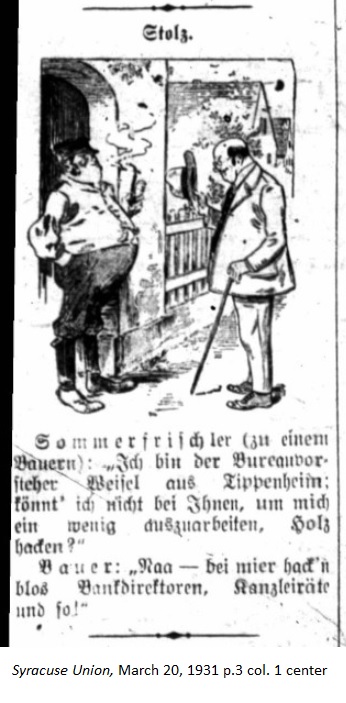
March 20, 1931 page 3 Summer Vacationer (to a farmer): "I am Bureau Chief Weisel from Tippenheim. Could I perhaps do some work for you like chopping wood?" Farmer: "Nope. I only let Bank Directors and Chancellery Advisors chop my wood." |
|
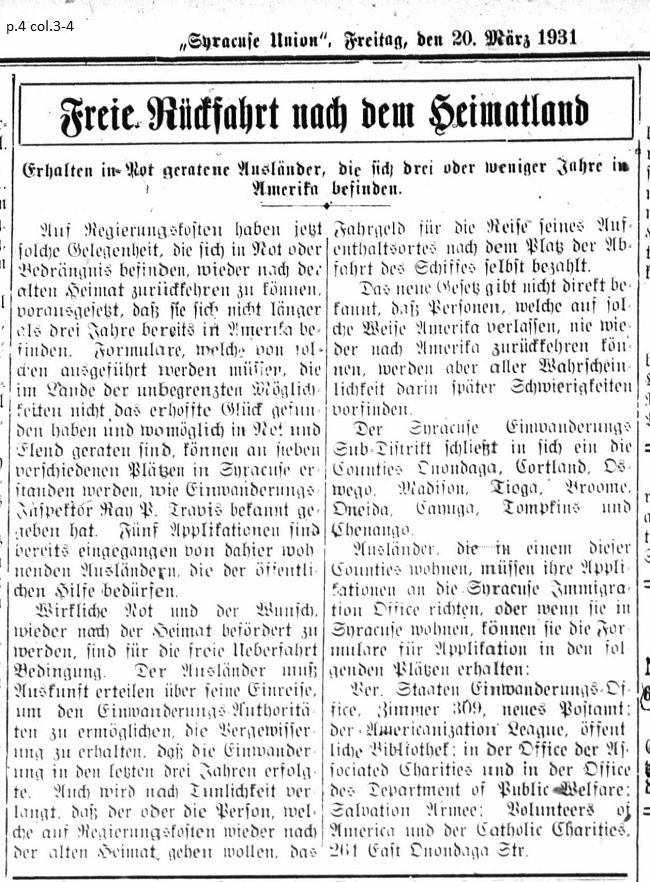
March 20, 1931 page 4 Available for Immigrants in Need, Who have been in America for Three or Fewer Years _____ True need and the desire to return to the homeland are the conditions for receiving free passage. The immigrant must give details about his trip into the country in order to give the Immigration Authorities the reassurance that the immigration was undertaken in the last three years. Expediency from the applicant is also required in order the receive passage at the government's expense. The new regulation does not give direct information that the people leaving America might not be able to return to America, however in all likelihood there will be difficulty trying to return later. The Syracuse Sub-District for Immigration serves Onondaga, Cortland, Oswego, Madison, Tioga, Broome, Oneida, Cayuga, Tompkins and Chenango counties. Immigrants who live in these counties must direct their applications to the Syracuse Immigration office. Those living in Syracuse may get their application forms from the following locations: The United States Immigration Office, Room 309, New Post Office; The Americanization League, Public Library; the Office of Associated Charities and the Office of the Department of Public Welfare; the Salvation Army; Volunteers of America and the Catholic Charities, 261 East Onondaga St. |

|
April 24, 1931 page 14 _____ Will create Gainful Employment for 860,000 People — The Newspaper Stahlhelm suspended after Attacks on the Government Berlin. — A committee under the chairmanship of former Minister Dr. Heinrich Braun has been formed to propose immediate relief for the unemployed, which once enacted will provide employment for 860,000 people. The committee has drafted legislation which sets the work week at 40 hours for the major industries. It's estimated that this measure will create 580,000 places for employment. It's also planned to prohibit one man from having two jobs, thereby freeing up another 280,000 jobs. In another proposal, married women who work for the government should be convinced to give up their positions and make do with what their husbands earn. Those who voluntarily give up their positions will receive a severence payment. A minority of committee members said that these women should simply be laid off. Berlin. — The Berlin Police Headquarters has suspended the organ of the Stahlhelms [World War I frontline soldiers paramilitary organization], Der Stahlhelm for three months because the newspaper published an article which strongly supported the people's desire for the dissolution of the Prussian Parliament. According to the Police the article is tantamount to hateful critique of the Republican form of government. Der Stahlhelm will no longer have an opportunity to become involved with this popular issue since the list containing the names of pro-dissolution voters was already closed on the 15th of this month. Furthermore, there was great outcry among the right-wing groups concerning whether this police sanction was valid and not purely arbitrary. It's well-known that Reichs President von Hindenburg is honorary president of this organization of former Front Line soldiers. _____ Libel leads to Divorce Berlin. — At the center of divorce proceedings which Director G. has leveled against his wife there is one word: "Villain!" The couple, who in a few weeks would be married for 25 years, lived happily together until a year ago. A year ago the 50-year-old director met a young dancer, with whom he went out a few times. When his wife found out about it, she sent a postcard to her husband's business containing one fateful word: "Villain!" This postcard caused quite a sensation in Director G.'s office. People believed in every possible irregularity in how the Director conducted business until to everyone's astonishment they learned that Mrs. G. was the sender of the card. Director G. immediately began divorce proceedings. The court also considered the request to dissolve the marriage justifiable. Failure for the marriage was attrbuted to the wife alone. She had overreacted to an alleged transgression and committed an unforgiveable, libellous offense, which would seem to make further marital union impossible. The Cruiser Emden sails to China _____ The German Cruise Emden, the first German warship to visit China since the World War, entered Shanghai Harbor on Tuesday.
|

|
May 1, 1931 page 1 _____ Contract to Russian Millions made Public — The Soviets rescinds Orders in Vienna due to the Ban on Egg Imports Under an inch-high heading spanning six columns the newspaper printed a statement allegedly made by Thuringian Minister-President Wilhelm Frick at a Fascist assembly. "At a National Socialist Convention," Frick told the Beobachter afterwards, "there's been serious deliberation over whether the time has come for the respectful yet decisive suggestion that the Reichs President resign." Frick went on to say that the old war hero no longer has the trust of the majority of German people. It is the first time that the National Socialists have openly attacked the Reichs President. Their anger naturally goes back to the fact that President von Hindenburg has had the government enact extraordinary provisions, which he deemed necessary. Berlin. — A group of industrialists has published the text for a 300,000,00 Mark contract for machinery and other goods, which the Soviet Goverment will place in Germany between April 15th and August 31st. They will be authorized by the Upper Soviet Economic Advisory Board and co-signed by tbe Soviet Trade Delegation, which will handle the arrangements here. The contracts are beyond the usual framework for business transactions between Germany and Russia and are subject to individual stipulations by the Soviet Economic Advisory Board and the German firms. Payment arrangements are set at 20 percent at time of order while the remainer must be paid withn 13 to 28 months ********* at a rate of 2 percent above the Reichs Bank rate, compounded quarterly. Vienna. — The Soviet Government has rescinded its industry contracts worth 500,000 Dollars as the result of a ban by the Austrian Agricultural Ministry on the import of Russian eggs. |

|
May 15, 1931 page 1 _____ Cleans up the Nazi Party and sacks Defiant Captain — A Political Manifest The fact is, at least temporarily, Hitler is averse to all rash untertakings, loudly denounces and banishes all those in the Party who would try to gain power through anything other than legal means. When Catptain Stennes attempted to incite the "Stormtroopers" under his command to direct action, Hitler expelled him from the Party. During this occasion Hitler issued the following manifest: "In 1923 I said that we must march, and then we marched. Today I say, that any further attempt in this direction is insanity. I have sworn that the Party will stand by the law. "Captain Stennes has been expelled from the National Socialist Party by me. I will ruthlessly clean the Party of all elements which do not unconditionally obey my orders. Under no circumstances will I abide intentional disobedience or disregard for the law within our Party. "Together with six other individuals I established this Party eleven years ago. However I can proudly say that only fate allowed me to create a Party out of nothing, one in which millions of Germans place their hope while millions of others are filled with fear and dread. "The Party members came from all classes, so rank and title mean nothing in our movement. Personally, for me it was a particularly difficult fight. Hundreds of thousands take issue with the fact that a man of the people like me established a movement to save the nation. Back then none of the intellectuals, who turn socialist phrases today, had the courage to stand by my side. Today, you never know what the socialist heart has discovered. After my stormtroopers and I brought the movement to prominence, the salon socialists and salon Bolsheviks made an appearance. But I hate these liars and hypocrites, who are not true socialists. "Before success arrived, each of us gambled his life. Everyone had to defend himself in court, and I was sentenced to no fewer than five years and three months in solitary confinement and spent 14 months behind prison walls. "In 1924 I was released from prison and reestablished the party for a second time out of nothingness. In the National Socialist Movement I see the only future for our people. "The best support of the movement comes from the masses. With growing disappointment I have observed that intellectuals, even officers, have no understanding that authority must be obtained honorably; to attempt to gain it any other way is to destroy it. "Captain Stennes joined the Party in 1927 and was made a leader of the Storm Division. The soldier of the Storm Division is a political warrior. Our artillery is propaganda, and it is the task of the Storm Division to defend our propaganda." |
|
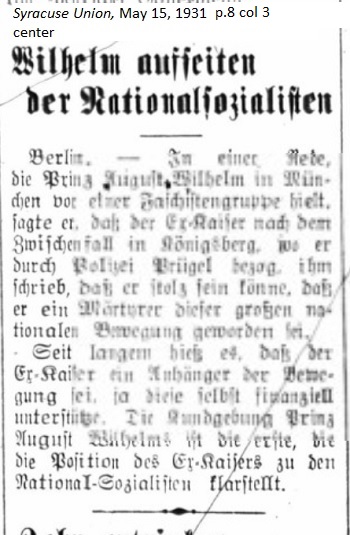
May 15, 1931 page 8 _____ Berlin. — In a speech which Prince August Wilhelm held in Munich before a group of Fascists, he said that after an incident in Königsberg where the former Kaiser was beaten by police, he wrote that he would be proud to be a martyr for this great national movement. This means that for a long time the former Kaiser may have been a member of the movement. In fact he may support them financially. Prince August Wilhelm's announcement is the first to clarify the position of the former Kaiser with regard to the National Socialists. |

|
May 22, 1931 page 3 _____ Since the war women have shown that they can achieve greatness in a field of study previously reserved almost exclusively for men, namely the field of exploration, which places great demands on courage and stamina. There are German women among the female pioneers of science, as published in a survey written by Hans Rohde for C.S. Mittler & Son Publishing of Berlin titled Die deutsche Auslands- und Meeresforschung seit dem Weltkriege (German Foreign Land and Marine Research since the World War). The significant role which Geology Professor Dyhrenfurth's wife played during the great Himalayan Expedition of 1930 is currently being filmed. She was the soul of the entire enterprise. The oldest German female explorer was Dr. Emilie Snethlage, who in 1929 at the age of 61 succumbed to a heart attack during her last great journey through the southern states of Brazil. Her death was a dear loss to German science. For over a quarter of a century she had taken many trips through this seldom explored area and had assembled a wealth of material for the study of the people living in that region. Gulla Pfeffer conducted ethnographic exploration among the wild mountain folk of Cameroon and Nigeria between 1927 and 1929. She pentrated regions which previously had never been entered by a European and proved through her collections and records that a woman in Interior Africa can accomplish tasks which men have passed over. She published practical and humanistic overviews on the meaning of home and family in the native cultures. The importance of female participation in such enterprises has been demonstrated by Mrs. von Eickstedt, who accompanied her husband, anthropologist Baron von Eickstedt, on the German Expedition to India from 1926 to 1929. She was well acquainted with the wild mountain and pygmy populations of Ceylon, the Andaman Islands, and Lower India and was on better terms with them as would have been possible for men as she took measurements of the female populations. She contributed much to the understanding of the difficult race problems in this region. The secondary school teacher Aenne Schmücker studied the landscape of West Greenland, its people, its geological and geographic conditions from July to November 1929. In this year she will begin a new trip to this polar region. As a physician Dr. Margarete Zuelzer achieved marvelous things in Dutch India.She investigated the cause of Weil's disease and fabricated an antiserum in Sumatra whose timely application made it possible to heal Europeans from the deadly course of the disease. On her many travels through Sumatra and Java she also learned about the land and people and was able to make important ethnological studies. Women have also paricipated in other German scientific expeditions. Three ladies were on the German-Russian Syphilis Expedition to Transbaikal and various female illustrators went on the great African Expedition of Leo Frobenius. They participated on the archaeological digs. Women have taken part in many fields on German Expeditions. |

|
June 5, 1931 page 1 Commotion in Germany over the Geneva Negotiations _____ The calls "Out with Curtius" and "Leave the League of Nations" grow ever louder — Many demand that German Foreign Politics should take a Stronger Stance Like a wave sweeping over the German landscape there's the demand that "something must happen in order to save the German people from sinking in their misery." One cannot gauge just what has to occur in the political life of the people. Everywhere there's the cry "Get out of the League of Nations." That's already been shouted since the middle of the week, and even more strongly by the right-wing parties. The few voices which advised "calm down" are dying away amid the prevailing wrath about the recent proceedings in Geneva. "What did you expect from Geneva?" the more prudent ask. The people's response is still pending. This applies especially to the strongly contested plan by France and its allies for a German and Austrian Customs Union. The right-wing parties shout out the demand: "Let's give up the useless attempts in our foreign politics to come to an understanding with France! It has brought forth no fruit." Recently in Geneva the German Foreign Office tried to submit a protest against a mural. This set the ball rolling in the Empire. Whether a stronger political stance would have led to success is dubious, however it appears that wide circles in Germany demanded stronger approach. Furthermore particularly bitter sentiments erupted since the ailing agriculture economies of the Baltic provinces were granted too much financial assistance by the Empire. It was claimed that the only ones who benefited were the country squires living east of the Elbe and the amount added up to more than the yearly compensatory payment. With regard to the compensation itself, perhaps the government should see itself forced the undertake something tangible so the resentment does not increase. It seems certain that the meeting to be held in June between Chancellor Brüning and Foreign Minister Curtius in Chequers, England with British Prime Minister MacDonald and British Foreign Minister Henderson will deal with the compensation questions and set the course for resolving the issues. German Female Aviator is seriously injured. _____ Passau, Bavaria. — The German aviator Christel Marie Schulter, who boarded an airplane going from Berlin to Vienna as part of a planned flight around the world, was seriously injured during an emergency landing near here. She suffered breaks in both legs. Her pilot, Gustav Sackmann was severely injured. Both were taken to the hospital. The airplane was shattered to pieces. The interim destinations for the planned flight around the world were as follows: Budapest, Sofia, and Istambul to Tokyo, Japan and from there perhaps to New York. |