July - December 1931

|
July 3, 1931 page 3 _____ The Hessian town of Lich experienced a unique spectacle as storks migrated last spring. For days a flock of 30 storks gathered each night on a church roof and settled at the ridge at carefully measured distances from one another so that there was a space of two meters between each long-legged bird. The distances apart remained so consistent that even weeks later lime residue was left behind on the roof marking each bird's habitat. On a regular basis they also conducted a kind of parade. Karl Rudolf Fischer attempts to establish why the storks elect such militaristic posturing in the Frankfurt weekly periodical Die Umschau. The 30 storks were apparently visiting a locally settled mating pair and it was very likely that this couple was frightened or spooked during the migration so it stayed in this location for a prolonged period of time. Perhaps the migrating birds came from southern Sweden, Denmark or Schleswig-Holstein and chose Lich with its meadows as their hotel because of the region's absolute safety, as proven by the presence of the resident stork pair. The parade-like grouping can be attributed either to security or technical advantage. Positioning for the sake of safety can be seen in other species which live in groups such as wild cattle, which put defenseless calves in the center of the group when a predator approachs, then surround the young and lower their horns as a protective barrier. In contrast, however the principle of usefulness would indicate that large migratory birds would fly in V-formation. Films have shown that flight formation is not uniform across the board for all birds at any given time. There's a specific span between the lead bird and his followers based on wing movement so that the followers can adapt to air currents, which make flight easier. The parade of the Lich storks is indeed a security precaution. The gap that they so caefully create relates to the minimum distance which is necessary to immediately take flight. The storks perform the parade to assure the ability to take flight if there is danger as well as the capacity to maintain balance in the event of sudden or strong wind gusts and the readiness to do battle with incompatible members of their own species. |
|
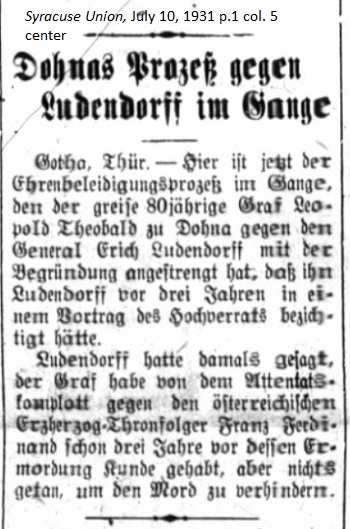
July 10, 1931 page 1 At the time Ludendorff said that the Count might have had prior intelligence concerning the assassination plot against Austrian Archduke Franz Ferdinand but had done nothing to prevent the murder. |
|
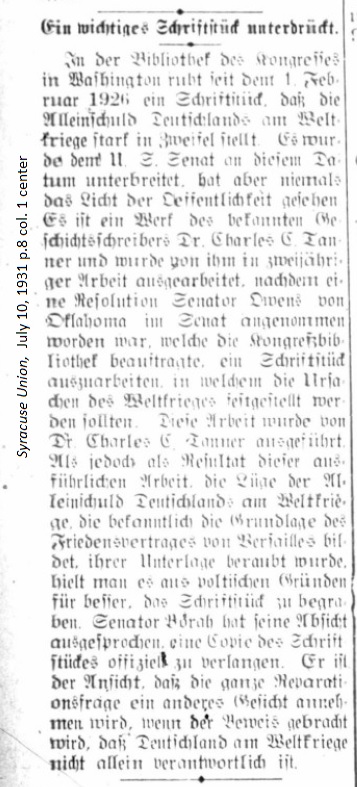
July 10, 1931 page 8 _____ At the Library of Congress in Washington there has been a document since February 1, 1926 which places in doubt the assertion that Germany alone was to blame for the World War. The document was distributed through the U.S. Senate on this date however it was never made public. It is a work of the well-known historian Dr. Charles C. Tanner. He worked on it for two years after a resolution by Senator Owens of Oklahoma was passed to charge the Library of Congress with the task of creating a document establishing the original causes of the World War. This work was executed by Dr. Charles C. Tanner. As a result of this work the lie concerning Germany's sole guilt for the World War was robbed of its underpinnings. This lie was the basis for the Versailles Treaty. For political reasons it was deemed better to bury the document. Senator Borah expressed his intention of officially demanding a copy of the document. He is of the opinion that the entire reparation issue will take on a different character once proof is brought to light that Germany is not solely responsible for the World War. [Translator's Note: According to an article on Senator Latham Owen the study was never published.] |
|
July 24, 1931 page 1
|
|
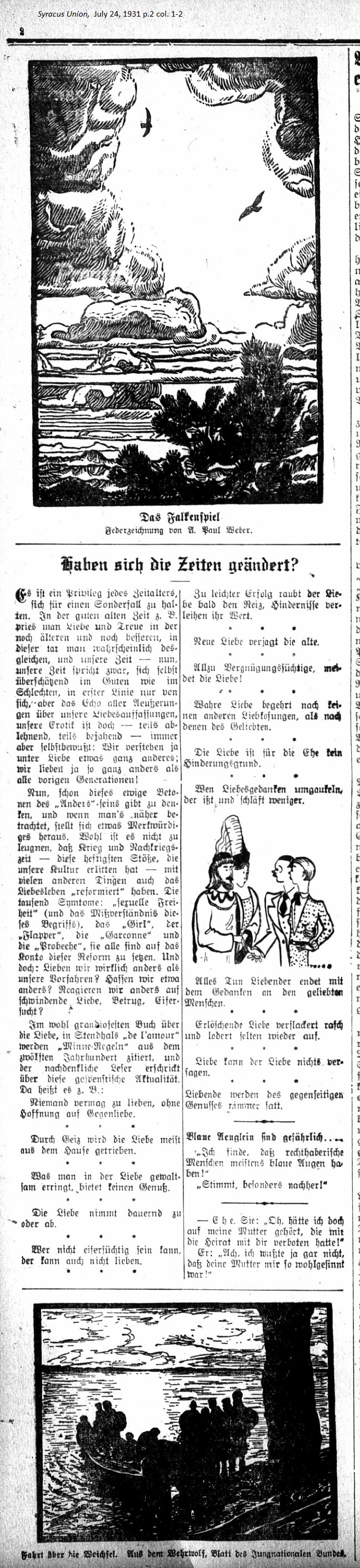
July 24, 1931 page 2 It is the privilege of each era to consider itself a special case. In the good old days, for example, people said love and loyalty lasted longer and got better with age. Now, in our day we might overemphasize both the good and the bad but the echo of all opinions concerning our concepts of love and our eroticism — partly negative and partly positive — are always most assuredly: By love we mean something quite different; we love so differently from all previous generations! Today this eternal emphasis on the "differences" leads one to think more about them and consider them more closely and it reveals something very remarkable. Indeed, there's no denying that the war and post-war years — the heaviest blows which our culture has ever suffered — have transformed among other things our lovelife. A thousand symptoms: "sexual freedom" (and the misunderstanding about this concept,) the "Girl," the "Flapper," the "Garçonne" (Tomboy,) and the "Trial Marriage." All these are on the list of transformations. And yet, do we really love differently than our ancestors? Do we hate differently? Do we react differently to waning love, betrayal, jealousy? The most grandiose book on love from the 12th century, the Minne Regel (The Rules of Love), which was cited in Stendhals De L'Amour, shocks the thoughtful reader with its weird pertinence today. Here are some examples: No one seeks to love without the hope of love in return. Avarice most often drives love out of a house. Love gained by force brings no enjoyment. Sometimes love lasts, sometimes it doesn't. Anyone who's jealous cannot love. An easy victory soon robs love of its charm; hinderances lend value. New love chases away old love. Love shuns away from the excessive pursuit of pleasure. True love does not desire the caresses of anyone other than the beloved. Love is no obstacle to marriage. Anyone entertaining thoughts of love eats little and sleeps less. All the lover's deeds end with thoughts of the beloved. Dying love flickers out quickly and seldom rekindles. Love can deny love nothing. The lover will never tire of the beloved's pleasure. "That sounds right!" She: "Oh if only I had listened to my mother. She forbad me to marry you!" He: "Really? I never knew that your mother knew me that well." |
|
July 24, 1931 page 3 Frankfurt a. M. The Advisory Board for the Frankfurt Goethe Prize has closed its session. This year's Goethe Prize, given in memory of Goethe's mother, has been awarded to Ricarda Huch. The announcement took place following the celebration of the "Frau Aja" memorial journey of the Weimar Goethe Society. The prize itself is given in the usual manner on Goethe's birthday [August 28, 1749] at the Goethe House in Frankfurt. |

|
July 24, 1931 page 4 Syracuse Union
______ Registered at the Post Office of Syracuse, N.Y. as second class mail. _____ The Oberlander Press,
_____ Subscription prices for the Syracuse Union as follows:
|
|
July 24, 1931 page 8 The Dornier DO-X, world's largest 'plane, which hopped the South Atlantic to Brazil on her way to visit the United States, had four continents on her schedule when she left German port last fall. Aviators say her performance and bad weather during the past months has been a stirring example of aircraft reliability. Revolution, fire and bad weather dogged the DO-X and if it had not been for her own sturdiness and the faith of her makers, her travels might have ended long ago. Her staunch behavior is attributed by them in no small part to the twelve American motors — Curtiss Conquerors — running on gasoline and lubricated by Mobil Oil supplied by the Vacuum Oil Company. The DO-X flight to Brazil was projected last November, after a triumphant tour of Europe, during which the Prince of Wales took over the controls and piloted the DO-X on one occasion. On her way down the French coast, the immense seaplane descended on the ocean and taxied for fifty miles along the surface as a test of her seaworthiness — a stunt few seaplane pilots would care to attempt with their 'planes. At Lisbon the DO-X met trouble. One of the big wings caught fire. By the time the blaze had been put out, the framework of the wing had been sadly damaged. It was repaired and January 31st the ship flew to Las Palmas in the Canary Islands. She was in command of Captain Friedrich Christiansen, and Admiral Gago Coutinho of the Portuguese Navy, veteran of a South Altantic flight in 1922, was abroad, (both pictured above.) In the Canaries the DO-X was subject again to numerous delays, and it was not until May 1st that she reached Rio de Oro, a Spanish colony on the African coast. Three days later, May 4th, she flew to Bolama, Portuguese Guinea, and landed plumb in the middle of a revolution. Nearly a month later the DO-X finally got out over the ocean, making her first hop to Porto Praia in the Cape Verde Islands off the African coast, May 30th. June 5th she took off from there. Thirteen hours and eighteen minutes later the roar of her twelve motors disturbed the monotony of existence for the convicts in the Brazilian penal colony on the little Island of Fernando Noronha, 1500 miles across the Atlantic from Porto Praia. The big ship landed there and next morning hopped to Natal on the nearby coast. From Natal, the DO-X took flight for Rio de Janiero on June 18th, landing at Maceio and Bahia en route and reached Rio on the 19th. After visits here and there in South America, she is scheduled to start North for the United States. |
|
August 7, 1931 page 2 _____ The first wave of this horror began to rage in the year 1331 after the arrival of a horrible, stinking, contaminated fog. However it took a long time for it to spread from the three trade routes of India, Persia and Russia. We have the first more precise reports out of the 40th year of the 14th century where ghoulish scenes were observed in Sicily, such as the piling up of corpses, fleeing by the terrified and the spread of contagion. A classical description of the first pest outbreak was made by Giovanni Boccaccio in the introduction to his book of stories in which the amusing and opulent fairy tale contrasts with the glaring background of pest-ridden Florence. "Since the redeeming incarnation of God's Son," so the poet begins, "1348 years had flown by when in the magnificent city of Florence, which surpassed all other Italian cities in beauty, the death-delivering Pest broke out. Either by the working of heavenly bodies or for the improvement of our poor lifestyles, this lesson to mortals began a few years ago, robbing countries of countless members of humanity and spreading unstoppably to the West."* Boccaccio stressed that no medical advice and no medicinal powers proved restorative: "Very few recovered, and almost all died rapidly within three days. The perniciousness of this plague became even greater as the deadly germ passed from the sick to the healthy like tinder on dry or greasy objects and this is not just with being near to or speaking with the sick but by touching their clothing and other possessions." The writer also speaks about the lust for life, which seized people in the face of death, about their luxurious and dissolute lives, and the apathy, the laughter and the frolicking which take the place of pain and sorrow." In Germany the Thüringische Chronik reports: "Whoever was taken by the pestilence-ridden poison slept for three days and nights and when he woke he began to wrestle with death until the soul went out of him." Most chroniclers specifically mentioned that even animals succumbed to the contagion. The most dreadful result of the dangerous situation was that the sick were abandoned by their closest relatives. "There was no love, no trust, no more faith. A brother abandoned his brother; husbands abandoned their wives and wives their husbands; parents abandoned their children and children their parents. People didn't just die alone from the plague but also from privation and a lack of life's necessities." It was often mentioned that only the dogs remained true to their masters in their greatest time of need. The contagion imprinted a dark shadow on the entire culture of an era. It seemed the end of the world was near and the terrible agitation of the masses led to spiritual disease and the outbreak of devil worshipping and Jewish persecution, to dance mania and flagellation. The most terrifying expression in the time of the Black Death was the Dance of the Dead, which emphasized the equality of all mortals before the power of death. The utter cluelessness of the medical profession intensified this fear and reinforced the belief in arcane magic. Even the Pest Ordinances, first enacted in Florence and Venice, could not hinder the advance of massive death tolls. It's been calculated that from the first outbreaks of contagion in the decade before 1340 until 1350 half of the European population had been carried off. 20,000 cities and towns were completely depopulated and wild animals lived in the houses filled with corpses. The number of European pest victims in the 14th century was grossly underestimated at 25 percent. One statistic, which Pope Clemens VI had commissioned, had calculated the death toll at over 42 million people by 1350. In a single year in Germany 1 ¼ million people succumbed to the plague. According to this, Germany was not as greatly infected. The north was hardest hit. In Pomerania and Holstein ⅔ of all residents died; in Schlewig ⅘ died. From Lübeck, the Venice of the North, for every 1000 residents only 10 survived. The total number of deaths was calculated at 90,000. In Vienna the daily number of victims was 500 to 700 and yet life triumphs from this unimaginable figure. Gallow humor prevailed when in the last great outbreak of plague in Germany during the 17th century the Vienese bagpiper Max [Marx] Augustin lived. After singing a song he drunkenly threw himself into the death cart and was tossed into the pit dug for pest victims. The lyrics to the song were,"Ach du lieber Augustin, 's Geld ist hin, d' Freud ist hin! Ach du lieber Augustin, alles ist hin!" (Oh, beloved Augustin, the money's all gone, happiness is long gone. Oh, my dear Augustin, everything is gone!) ______ *The Decameron : Day the First, twelfth paragraph: To leave the country and return to the city, what more can be said save that such and so great was the cruelty of heaven (and in part, peradventure, that of men) that, between March and the following July, what with the virulence of that pestiferous sickness and the number of sick folk ill tended or forsaken in their need, through the fearfulness of those who were whole, it is believed for certain that upward of an hundred thousand human beings perished within the walls of the city of Florence, which, peradventure, before the advent of that death-dealing calamity, had not been accounted to hold so many? Alas, how many great palaces, how many goodly houses, how many noble mansions, once full of families, of lords and of ladies, abode empty even to the meanest servant! How many memorable families, how many ample heritages, how many famous fortunes were seen to remain without lawful heir! How many valiant men, how many fair ladies, how many sprightly youths, whom, not others only, but Galen, Hippocrates or Æsculapius themselves would have judged most hale, breakfasted in the morning with their kinsfolk, comrades and friends and that same night supped with their ancestors in the other world! |
|
August 7, 1931 page 4 _____ The increase of 145% for German is particularly significant based on the fact that during and after the World War study of the German language was basically abandoned, leading the Board of Education to suspend the study of German. In the two and a half years between the beginning of 1918 to almost the end of 1920 there was no German language instruction in the public schools of New York City. |
|
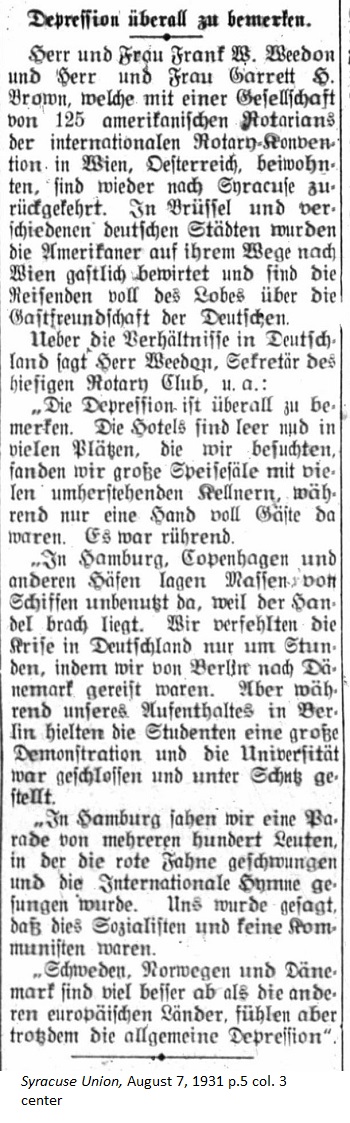
August 7, 1931 page 5 _____ Concerning economic conditions in Germany Mr. Weedon, Secretary of the local Rotary Club and other organizations, said: "The Depression can be seen everywhere. Hotels are empty and in many places we visited we found in large dining rooms many waiters stood idle because only a handful of guests were there. It was a moving experience. "In Hamburg, Copenhagen and other ports a high volume of ships stood idle because trade had shut down. We missed the crisis in Germany by only a few hours because we traveled from Berlin to Denmark. However during our stay in Berlin students held massive demonstrations and the universities were closed and placed under guard. "In Hamburg we saw a parade of many hundreds of people in which the Red Flag waved and the International Hymn was sung. We were told that these people were Socialists and not Communists. "Sweden, Norway and Denmark fared much better than the other European counties but still you could feel the Depression all over." |
|
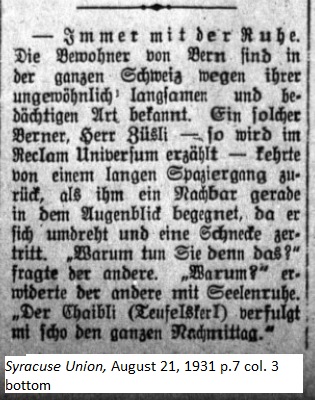
August 21, 1931 page 7 — Take it easy. The residents of Bern are well-known throughout Switzerland for their unusually slow and deliberate nature. One such Bern resident, Mr. Züsli, so we are told in Reclams Universum, returns from a long walk when just at the moment he turns around and steps on a snail he meets a neighbor. "Why did you do that?" the neighbor asks him. "Why?" Züsli responds calmly. "That little devil has been following me all afternoon." |
|
August 28, 1931 page 4 _____ |
|
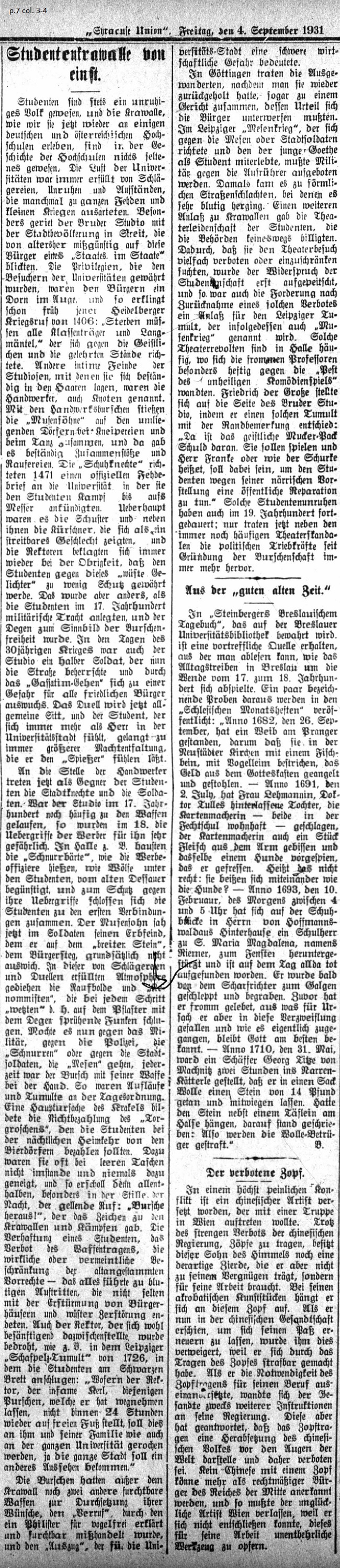
September 4, 1931 page 7 _____ Then in the place of the tradesmen the students had the town constables and the soldiers to deal with. Whereas in the 17th century the student groups had to run from weapons, in the 18th century it was the solicitors who posed the greatest danger. In Halle, for example, the "mustache wearers," as the solicitors were called, dwelled like wolves among the students. This was a practice promoted by the residents of Dessau. To protect themselves against the wolves' encroachment the students came together for the first time and formed associations. A son of the Muses now saw the soldier as his arch enemy, whom he could not avoid out on the streets. In this atmosphere of brawling and dueling, ruffians and braggarts swaggered down the streets while whetting their daggers till they gave off sparks. If they encountered the military, the police, the mustache wearers, or the city soldiers, the student always had his weapon at hand. Crowds of people and turmoil were the order of the day. A major cause of brawling concerned the non-payment of the Gate Tax, which students were supposed to pay on the way home from the beer halls in the villages. Often their pockets were empty or they weren't willing to pay. So especially in the still of the night the cry would go out, "Fellow students, come out!" which indicated that rioting or fighting was happening. Arresting students, forbidding weapons, actual or intended restriction of old and traditional liberties — all led to bloody encounters, which often ended with the storming of the citizens' houses and wanton destruction. Even the school rector, who placed himself between combatants to mollify the situation, was threatened. For example, in the Leipzig "Sheepskin Tumult" of 1726 during which the students were posted on the blackboard," "The Rector, damn the wretch, he had these students taken away — within 24 hours they will be free again; and they will take revenge on him, his family and the entire university. Indeed, the entire city will take on a difference look." Besides rioting the students had two other dreadful weapons to implement their desires. Discrediting, whereby a philistine was set free and then horribly maltreated; and moving out, which for the university city created severe economic distress. In Göttingen, as soon as the students who left the city werebrought back, they immediately went to court. The resultant verdict subdued the citizenry. In the Leipzig "City Soldier War" the verdict went against the soldiers. As a student young Goethe lived through this as the military had to be called in to quell the insurgents. [See Goethe's Autobiography, page 288 for details.] At that time street fights broke out regularly and much blood flowed. Another reason to riot was the student's passion for the theater, which the authorities would not condone. With their visits to the theater forbidden or limited, dissension stirred up among the student body. The demand to rescind the prohibition resulted in turmoil in Leipzig known as the "Muses War." Such theater revolts occurred frequently in Halle, where the pious professors were particularly against the "plague of unwholesome comedies." Frederick the Great sided with the student brotherhood and concluded with a passing remark, "It's the clergy mucker pack's fault. Let them be performed and let Mr. Franke, or whoever the scoundrel is called, be present to offer public reparation to the students for his foolish performance." Such student unrest persisted into the 19th century; and now along with the frequent theatrical scandals we have the political scandals acting as driving forces to excite the student leagues even more to violence. From the "Good Old Days." _____ In Steinberger's Breslau Journal, preserved in the Breslau University Library, there is an excellent resource, from which one can see how everyday life existed in Breslau during the end of the 17th and beginning of the 18th centuries. A pair of siginificant samples were published in the Schlesischen Monatsheften: "Anno 1682, September 26th, a woman stood at the pillory because she took money from the offering box of the Neustadt Church using a whalebone covered with bird lime. — Anno 1691, July 2nd, Mrs. Lehmannin, daughter of the late Doctor Tulles, beat the female card maker. Both resided at the fencing school. The card maker also bit off a piece of the woman's arm and fed it to a dog. That just not right: Biting each other like dogs. — Anno 1693 February 10th, between 4 and 5 in the morning on the footbridge at Mr. von Hoffmannswaldaus rear building; a schoolmaster named Riemer fell out of a window and was found dead that day. He was taken by the executioner to the gallows to be buried. He lived piously and what led him to this dubious end only God knows. — Anno 1710, May 31st, Shepherd Georg Titze of Machnitz was placed in jail for two hours for putting a 14 pound stone in a sack of wool and then had it weighed. The stone was hung around his neck with this sign: "This is how a wool scammer is punished." The Forbidden Braid _____ A Chinese artist was put in a highly distressing situation when he performed with a troop in Vienna. Despite the Chinese Government's strict ban on wearing braids, this son of heaven was still adorned with one. He did not sport the braid out of choice but because he needed it for his work. During acrobatic performances he hung by the braid. When he now appeared before the Chinese Embassy to get his travel permit renewed, he was denied because wearing the braid was punishable by Chinese Law. When he explained the necessity of the braid in his work the Embassy referred back to his government for further instructions. The response was that wearing a braid was a disparagement of the Chinese people in the eyes of the world and was forbidden for this reason. No Chinese people with braids would be considered proper citizens of the Middle Kingdom. Therefore the unforrunate artist had to leave Vienna because he could not bear to sacrifice this essential tool of his trade. |
|
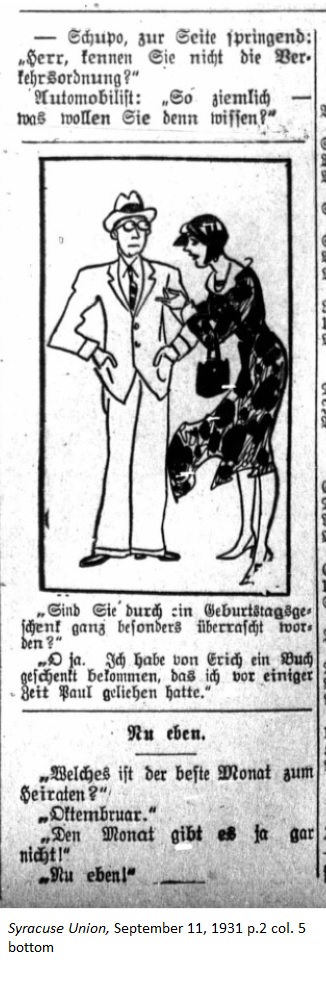
September 11, 1931 page 2 — Traffic Cop, who just jumped out of the way of a car: "Hey Mister, don't you know the traffic laws?" Motorist: "Pretty well. What would you like to know?" _____ Text under illustration reads: "Were you particularly surprised by any of your birthday presents?" "Oh, yes. Erich gave me a book that I had lent to Paul some time ago." _____ Plain and Simple "Which month is best for getting married? "Octembruary." "There's no such month." "Exactly!" |
|
September 18, 1931 page 7 _____ About the Germans in Paraguay _____ by E. von Ungern-Sternberg Fifty years ago Paraguay became the land of high hopes and for many German immigrants the land of fulfilled dreams. The oldest German colony of San Bernardino is only one hour away by train from Asuncion and lies on a beautiful lagune with deep blue water. Wealthy Asuncion residents have their summer villas there but San Bernardino does not exhibit the activities of a growing colony. There are no adventure-seeking individuals who hoped to find the new El Dorado in far-off South America; no land hinted at in Indian stories. The Guarani people no longer use poison dart pipes and no longer wear ornamental paint. Rather, they're well informed in questions of how to earn a living, seeming more like the immigrant Europeans, looking back on the customs of their forefathers when they enjoy far too much burnt sugarcane schnaps. Even the wild animals of the jungles, which incidentally are rare, seldom slink about this civilized, affluent colony in which everything happening within the shadow of the church tower is considered important and in which the extraordinary arouses suspicion, just as it does in a small German town. And people are well-steeped in the lives and activities of their fellow colonists. There are a few "jakares," American crocodiles, which spoil any chance for swimming. Electric eels in the streams may come onshore and daze horses and people with their electric discharges. Sometimes wild cats or pumas stray into the high lapacho trees, however they are not dangerous for people. At worst they might maul errant cattle. However the Paraguay of the unpenetrable jungles, in which the Indians still put poison on their arrows, and into which there is no pathway, still exist nearby. In 1886 Dr. Förster, Nietzsche's brother-in-law, established the colony of New Germania in an area about the size of a German principality. Within a few years the sister of the German philosopher created a gracious courtyard there. Her small, corn stover covered cottage at the entrance to the colony was the only stone building and it could have been compared to a palazzo with its European amenities. On the veranda, surrounded by tall banana bushes and pineapple beds, the family of Baron Maltzahn and other eminent colonists and guest often gathered. The Baron had created a small paradise on his estate, which was located nearby. When you leave the capital city of Asuncion and make the trip to New Germania, after a night's travel aboard the electricity-powered steamer you land at dawn in the Brazilian Province of Matto Grosse in the magic garden of tropical Barancarita on the Yeghui. The sun rises suddenly in the eastern sky and bathes everything in gold and purple. Hummingbirds buzz about in blossoming bushes. Flocks of parrots, loris, and arrhas [?] flutter about the palm trees; butterflies and insects seek out flowers and the air is filled with a thousand fragrances. Peons, barefoot with spurs strapped to their feet, ponchos tossed over their shoulders and hats pulled down over their faces, light a fire on the shore, boil a kettle of water and pour the water over the Paraguay tea in a bombilla. No South American can get a. I hear the long without it. The mate (herbal drink rich in caffeine) has a bitter taste but it's spicy and refreshing. They smoke a sweet, strong tobacco pressed into a roll... [Translator's note: The remainder of this text takes the reader away from Paraguay and to a hunting trip in Sicily. It would seem either a lot of text was passed over or this is a completely different story.] The mule, rather than being tethered, remained standing as if by command. He braceed his feet against the slanted earth. I heard the jumbled movement of human feet, subdued calls, then my pursuer ran up behind me. It seemed like this was my final moment. The men I saw in the morning dove to the right and left of the mule. I calmly raised my gun and noticed as it was still emitting a plume of smoke, how I had put a bullet hole in a lightly colored rabbit as it passed by me. I saw not so much excitement in eyes no longer staring down danger but gratitude because the day of hunting had gone sucessfully. I heard the man's words in Sicilian: "Do you want to take it with us? The pelt alone is worth ten Lire." Given another chance at life, freed from misguided fear and feeling cocky, in a loud voice I offered to double the sum for the poor little animal. The old watchman came closer when he heard my words. He considered me a thoroughly excellent foreigner, who for a ride would pay him no less handsomely. When is a Person Drunk? _____ In Sweden the unauthorized use of alcohol is punishable by law. In order to establish the amount of alcohol consumed and its influence on motor vehicle accidents, the Swedish government appointed Prof. Widmark and other government physicians to perform blood tests. In a report on the results, as communicated by H. Lutz of the Frankfurt journal Die Umschau, Widmark initially pointed to the individual sensitivity of alcohol. Blood alcohol content by individuals consuming similar amounts of alcohol depended upon body weight and time span of the consumption. Then individual blood level values could be determined from the amount consumed. According to the findings from the blood probe, the scholar suggested that an alcohol level of under one part per thousand should be set as the legal limit for a not guilty verdict. In cases with a blood alcohol level between 1 and 1.6 per thousand, one must consult the findings of the investigating physician. Blood alcohol levels over 1.6 per thousand justify a guilty verdict due to intoxication. A Wunderkind _____ |
|
September 25, 1931 page 1 _____ Insurgents, who in the early morning occupied six cities in the Styria, In the early morning hours divisions of the Home Guard surprised the government authorities and took possession of six cities in the Province of Styria. By the evening government troops reoccupied the cities and between 2000 and 3000 insurgents were imprisoned. Pfriemer, a 50-year-old attorney and war veteran, was the leader of the coup. Around 2 A.M. the Home Guard began its activities under his leadership. By 5 A.M. they occupied the cities of Judenburg, Schladming, Kirchdorf, Kapfenburg, and Selzthal. It's believed that Pfriemer commanded one of 500 units, into which the Home Guard is organized. He prematurely acted in order to accelerate a larger coup. Government troops found only weak resistance. Three people were reported dead. There was no confrontation with insurgents except in Kapfenberg [sic] where the Socialist Headquarters was stormed. Dr. Pfriemer has supposedly fled to Italy but the government disputes this. Pfriemer and Count Lamberg would be arrested for high treason. |

|
September 25, 1931 page 7 _____ Even before the inception of wedding advertisements, there was a proper marriage newspaper, which was called to life by Theophilus Fridrich Lorenz in Munich in 1799. Full particulars on this unique weekly periodical, the full title of which was Allgemeine Heiratsschule für beiderlei Geschlechter (Universal Marriage School for Both Genders,) were disclosed by Margit Zuman in Zeitungsverlag. The newspaper was issued every Tuesday and initially consisted of eight octavo sheets. As the number of subscribers grew the newspaper was enlarged to carry not just wedding advertisements but all kinds of entertaining items, which those, who were not contemplating marriage, would like to read. The publisher emphasized that the Heiratszeitung generated a sense of family, provided those, who were eager to marry, with help in planning an appropriate union, and steering people clear of the "ever pervasive corruption of morals." Mr. Friedrich Lorenz advocated primarily for "Love Marriages" however he considered a small or large dowry contributed by women desireable. He considered the marriage broker, who was only engaged for a fee, a capable consultant and he furnished advertisements of marriage experts, who were charged an extra 12 Kreuzer [approximately 60 pfennig or 33 cents in today's US currency.] The first marriage candidate, who sought his happiness in this newspaper, was "a Protestant cleric of noble reputation and habits with a steady income of 600 Guldens." His courageous offer soon attracted the first female to the plan, a "20 year old noble lady with a fair face." The pair entered into the bond for life. With this the ground was broken. The marriage advertisements were very substantial and consisted of two octavo sheets containing 31 lines of text. As an example, one such ad related a message which today might seem downright strange: "I bravely stand before you as a candidate for marriage. I'm about six and a half feet tall, measure an average of 17 inches [?], with a girth of not quite a Bavarian Elle (24 inches.)"* *[According to measurements supplied by a Wikipedia article, a Schuh measured somewhere between 11 and 12 inches; an Elle 23 - 24 inches.] "At age 27 I am a muscular man who's completely healthy. Of honest but poor parents who raised me, I have a pair of 1000 Florin coins left to me by a cousin in the clergy. I learned so much in academia that I could, if talent is rewarded, provide food and clothing for a wife and 30 children. As of now I am without employment, however I assist my father, a deputy. A female with 10,000 Florins could give my talent a boost, perhaps raising me up to a chief court clerk's position, because wide-ranging duties of the court require having one's own equipment. Without money at best I can be a deputy like my father, who at the beginning of my academic career said to me, 'Son, if you learn something you can become a lawyer. If you learn nothing, you can become a privy councillor.' — Since I feel mature enough for the cheerful and gentle nature of a female, I will await with all possible patience until a beauty finds herself ready to gaze upon me and take pleasure in my attributes. If she possesses the qualities I need a wife to possess, a gentle and cheerful nature which sees past her own displeasure and helps wipe the sweat from the brow of an overwhelmed working man, she will have the spunk to tell me about her qualities and quantities in an open manner and thus become a twofold treasure to me because she knows how to set aside any bias." _____ |
|
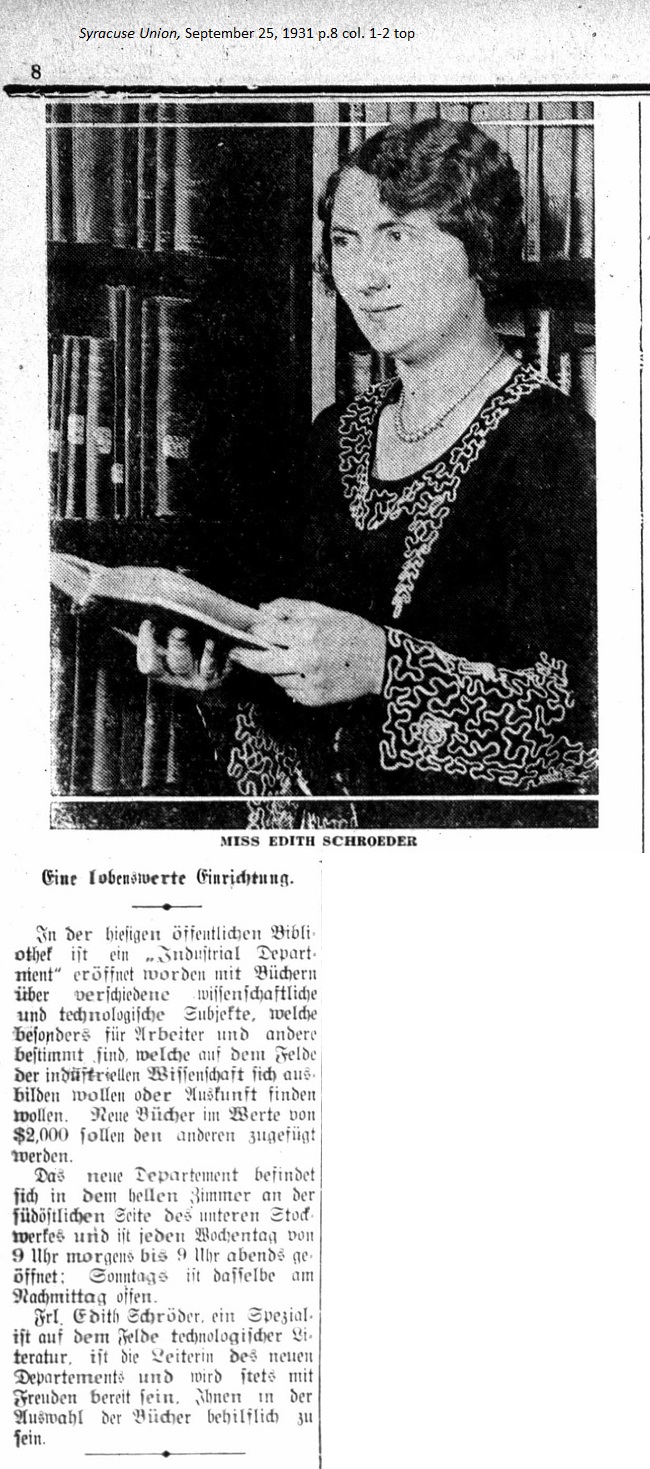
September 25, 1931 page 8 _____ At the Syracuse Public Library an "Industrial Department" has been opened which carries books on a variety of scientific and technological subjects. It's especially designed for workers and others who wish to educate themselves in the field of industrial science or to find out specific pieces of information. The new department is located in the well-illuminated room on the south-facing side of the downstairs level and is open weekdays from 9 in the morning to 9 at night. On Sundays the department is open in the afternoon. Miss Edith Schröder, a specialist in the field of technological literature, is the manager of the new department. She would be pleased to help you with your choice of books. |

|
October 2, 1931 page 1 _____ Right Wing Organizations want to show a United Front to battle the Reds — Hitler's Speech at the Thuringian District Session of the National Socialists. In the speech which closed the session, the district leader emphasized that in the coming winter the Steel Helmets would be assigned very unusual and difficult tasks. A united front of all right-wing parties was necessary to bring the Bolshevik flood tide, in recent times particularly popular in the Lowlands, to a standstill. The speaker reported that a few days ago he found out about a planned insurrection by the Communists whereby countless small terror groups would be sent to the Lowlands. The district leader declared, amid resounding applause, that any attempted Communist coup would find the Steel Helmets well prepared to provide defensive actions in unison with the Storm Trooper Division of the National Socialist Party of Brandenburg. In the event the Government again needs the help of the national movement, assistance will not be provided without meeting certain conditions. The district leader closed his speech with the solemn promise that the Steel Helmets will fight for the preservation of the German fatherland. In Thuringia 35,000 National Socialists marched to their seventh District Meeting. 10,000 men of the Storm Trooper Division took part in a celebratory, religious camp service. Hitler, Dr. Frick, August Wilhelm of Prussia, Naval Lieutenant von Killinger, and other leaders made an appearance. Scathing remarks were made about Curtius, and Hitler discussed the proceedings in Geneva. Concerning the political situation Hitler said as follows: "As Leader I have to preserve the unity of the Movement and will do everything essential towards that task. I feel I am the representative, the responsible director, and the standard bearer of the last hopes of millions of Germans. Happen what may, I stand here and here I will remain. No one will force me from my place. I would feel a miserable wretch if I did not have the courage even to take on the responsibility in the vital fight for power in Parliament. It wasn't our politics which burdened us with our current misery. However it is our people who bear the hardship, and for this I am ever ready to take on the pain of our people through assuming the responsibility. If one grows weak, another individual must take his place. Willingly I do not flinch a step from the position which I occupy." |
|
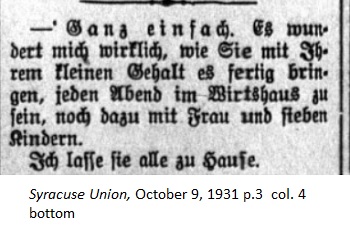
October 9, 1931 page 3 — Quite Easily. I really amazes me how you can afford on your small salary to be at the tavern every night when you have a wife and seven kids. I leave them all at home. |
|
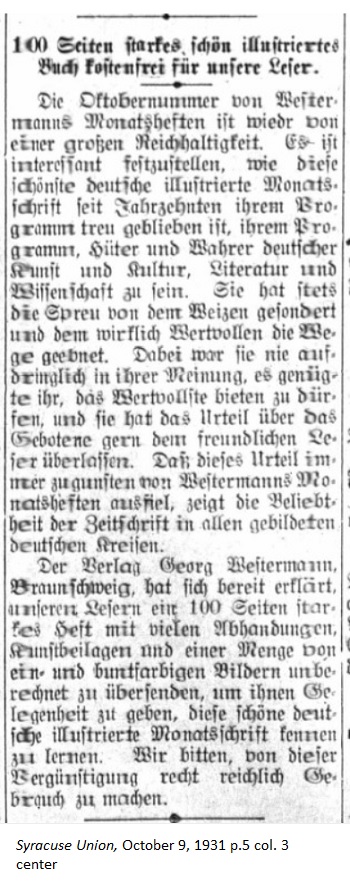
October 9, 1931 page 5 _____ Georg Westermann Publishing Co. of Braunschweig has already stated it has sent our readers a 100 page periodical with many essays, art supplements, and a large quantity of black-and-white and color illustrations at no charge in order to give them an opportunity to acquaint themselves with this beautifully illustrated German monthly publication. We ask you to make good use of this free gift. |
|
October 16, 1931 page 7 |

|
October 30, 1931 page 1 _____ One Hundred Thousand of His Brown Shirts March Passed Him — Parade Lasts Seven Hours — Prussian Prince with the Leader of the Nazis — Schism of the Social Democrats. In a fiery speech Hitler assailed Chancellor Brüning's government, predicting that it would soon collapse. "We have the people behind us," he called out. "We need no emergency decree. For our cause we need neither the Police nor the Parliament." "In reference to the Communists he stated, "We'll soon be finished with this dreadful enemy." Joseph Goebbels, Hitler's lieutenant in Berlin, said that within six weeks Brüning will suffer a shipwreck. During a heated encounter between Hitler's men and their opponents eleven were severely injured and one was dead. An automobile loaded with 27 Nazis veered off course near Wurzen and one of the men inside the car was killed. All others suffered injuries. Berlin. — The new foundation and organization of the Social Democrats, who left the "Socialist Workers Party, is completed. In the Reich's capital city a country-wide conference was held in which there were 88 representatives from the Reich, with 25 of the 32 precincts of the Social Democrat Party being represented. The following Party Chairmen, each of whose members has the same voting rights, were elected: Delegates Seydewitz, Dr. Rosenfeld, and Ströbel. For the Party Committee Delegates Portue, Dr. Eckstein-Breslau, Zweiling-Plauen, and Mrs. Dueby were elected. The Independent Workers Party of England and the former Reichstag Delegate Ledebour sent letters of greeting to be read at the Founders Day Conference. Ledebour suggested the possibility that he and his friends might join the new Party. After the speech in which Seydewitz discussed the new tasks for the Party, Dr. Eckstein-Breslau read aloud the Party's new constitution. There was unanimous acceptance for an action program, which contained a clear-cut disassociation from the SPD (Social Democratic Party) and the KPD (Communist Party of Germany). |
|
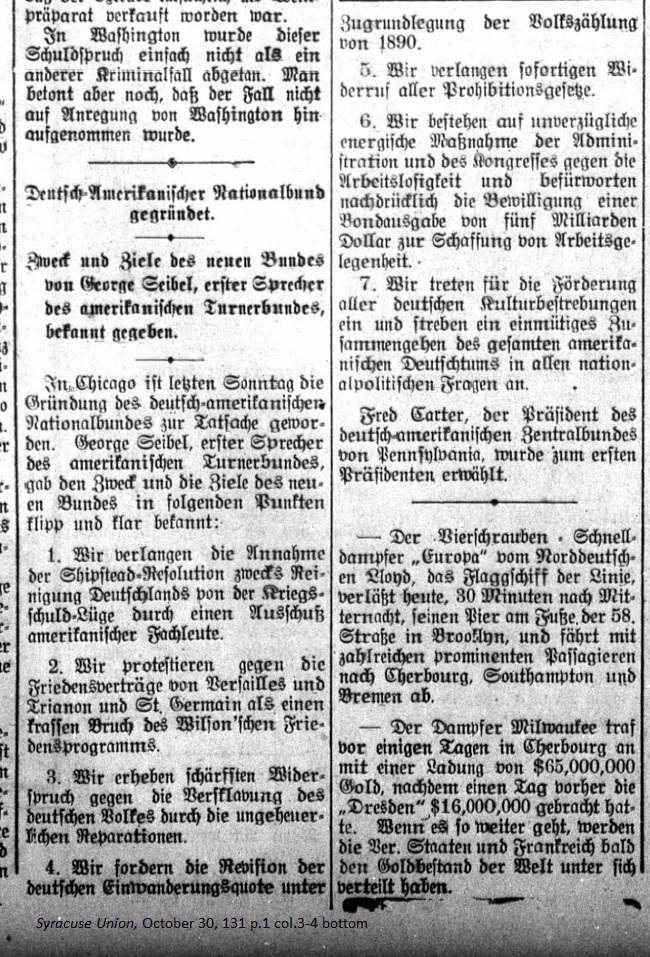
October 30, 1931 page 1 _____ Goals and Objectives of the New Bund (Association) by George Seibel, _____ Last Sunday in Chicago the establishment of the German-American National Association came to fruition. George Seibel, first speaker from the American Gymnastics Society, made clear the goals and objectives of the new Bund through the following points:
Fred Carter, President of the German-American Central Association of Pennsylvania, was elected the first president. — The four-propeller, fast steamer "Europa" from North German Lloyd, flagship of the line, left its pier, located at the foot of 58th St. in Brooklyn, at 30 minutes after noon. It's carrying many prominent passengers to Cherbourg, Southhampton, and Bremen. — The steamer Milwaukee left Cherbourg a few days ago with a cargo of $65,000,000 in gold. The day before the "Dresden" brought $16,000,000. If thing keep going like this, the United States and France will soon divide the world's gold holdings between them. |
|
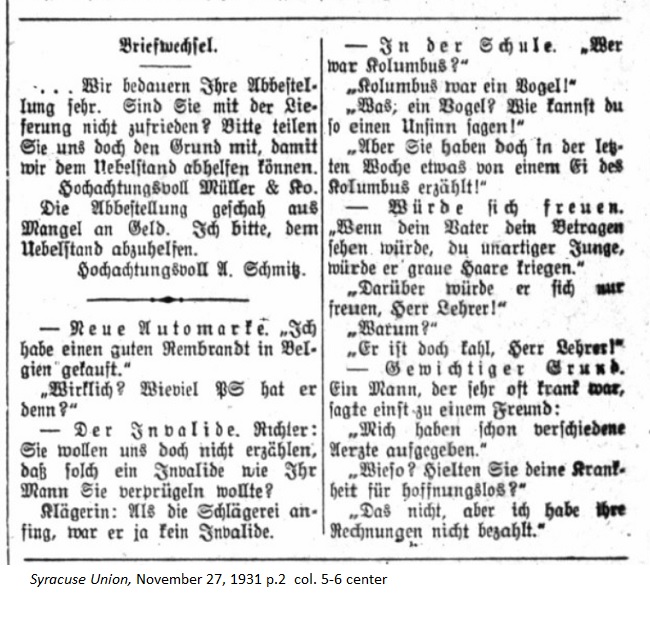
November 27, 1931 page 2 _____ ...We sincerely regret your cancellation. Are you displeased with the delivery? Please tell us the reason so we can resolve the problem.
The cancellation resulted from lack of money. I request your assistance in resolving the problem.
— A New Automake. "I just bought a real Rembrandt in Belgium."
— The Invalid.
— At School. "Who was Columbus?"
— He'd be happy.
— A Really Good Reason.
|
|
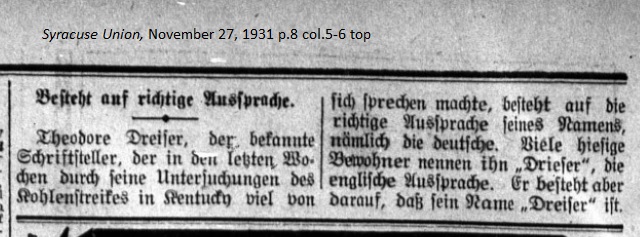
November 27, 1931 page 8 _____ Theodore Dreiser, the well-known author who talked a lot about himself during his research into the last few weeks of the Kentucky coal strike, insisted on the correct pronunciation of his name, that is, the German pronunciation. Many of the local residents call him "Drieser," the English pronunciation but he kept insisting it's "Dreiser." |
|
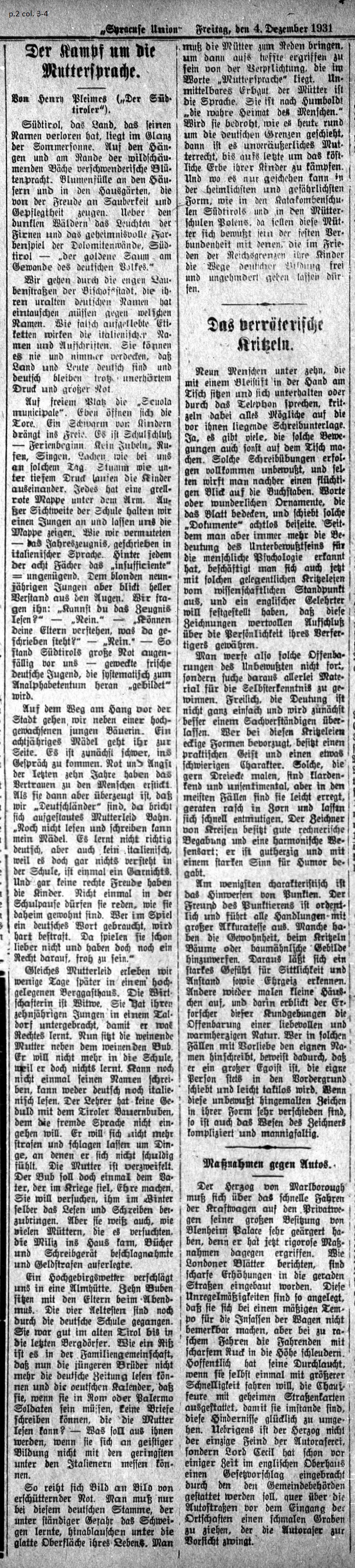
December 4, 1931 page 2 _____ by Henry Pleimes (Der Südtiroler = The South Tyrolean) We go through the narrow, tree-lined streets. Their ancient German names were exchanged for newer Italian ones. How wrong are the street signs newly affixed with Italian names and lettering. But they could never hide the fact that the land and the people are German and remain German despite incredible oppression and great hardship. In an open space the "Scuola Municipale." A swarm of children rush out into the open. It's the end of school — Vacation begins. No rejoicing, shouting, singing, laughing as it was in our day. As though under a heavy burden, the children run silently among each other. Each child has a bright red portfolio under his arm. Beyond sight-range of the school we stop a boy, who lets us see what's in the folio. As we suspected — the yearly report card written in the Italian language. After each of the eight subjects, the notation "insufficiente." However the blond, nine-year-old boy's eyes display intellect. We ask him, "Can you read what's written on the report card?" — "No." — "Can your parents understand what's written?" — "No." — Thus we clearly see the problem before us — vibrant, fresh German youth systematically educated to become illiterate. On the way over the slope ahead of the town we approach a tall, young farmwoman. An eight-year-old girl walks by her side. It's nearly impossible to converse with them. Hardship and fear over the past ten years have smothered their trust in humanity. But once she's convinced we're "German Countrymen" a pent-up motherly tale of woe gushes out. "My girl can't read or write. Nothing's properly taught in German or in Italian. Nothing in school is understood, not a thing. And the children have no joy. They may not speak during recess as they do at home. Anyone using a German word while at play is severely punished. They'd rather not play and still have the right to be happy." We experience similar tales a few days later in a high-lying mountain guest house. The innkeeper is a widow. She brought her ten-year-old son to the village in the valley so he would learn properly. Now the crying mother sits next to the crying boy. He does not want to go to school anymore because he's not learning anything. He still can't write his name and he cannot read German or Italian. The teacher has no patience for Tyrolean peasant boys, who will not stop speaking a foreign language. He no longer wants to be punished or beaten for things about which he does not feel guilty. The mother is desperate. The boy should respect the father who died in the War. She will try to teach him to read and write this winter. But she also knows how many mothers tried this and and how the militia came into the house, confiscated the books and writing implements, and levied fines. The weather in the high mountains forces us into an alpine hut. Ten boys sit with their parents in the evening. The four eldest had gone through the German school. Things were good in old Tyrolea down to the last mountain village. Like a rift in the family, the younger brothers can no longer read the German newspaper and the German calendar and if they have to become soldiers in Rome or Palermo they can not write letters that their mother can read. — What will become of them when they cannot measure up to the Italians in intellectual training? Thus one image after another forms a picture of shocking hardship. One need only peek under the smooth surfaces of their lives to see how these people of German ancestry are in constant danger and thus learned to keep quiet. One must induce the mothers to speak to be gripped by the obligation lying beneath the term "Mother Tongue." Language is motherhood's unmediated legacy to her children. According to Humboldt language is "the true home of humanity." If it's threatened, as it is today around the German borders, then it is an inalienable mother's right to fight to her utmost for her children's precious inheritance. And that it can happen in the most clandestine and dangerous form in the catacomb schools of South Tyrolea and in the schools of Poland, then these mothers should be aware of the firm bond with those who, within the peaceful borders of the empire, are free and unhindered to give their children a German education. Telltale Doodling. Nine out of ten people, who sit at a table with a pencil in their hands and have a conversation or talk on the phone, doodle all kinds of things on a pad in front of them. There are many who even make the designs on the table itself. This doodling is totally unconscious and seldom looks like a letter of the alphabet, a word or a wonderful design covering the paper, which is then carelessly cast aside. However today people are paying closer attention to the significance of the unconscious mind in human psychology and studying it from a scientific standpoint. One English expert wants to establish that these designs give valuable information on the personality of its producer. Such revelations of the unconscious are not immediately apparent but rather only after searching all available aspects of self awareness. Indeed, interpretation is not easy and best left to an expert. Whoever prefers making angular forms with these doodles possesses a practical intellect and somewhat difficult personality. Those who make triangles are clear thinkers and unsentimental but in most cases are readily excitable, anger quickly and become easily discouraged. The drawer of circles possesses good analytical skills and a harmonious nature. He has a good heart and a sharp sense of humor. The least likely characteristic is a design made of dots. A friend of dots is orderly and conducts all activities with great accuracy. Some by habit draw trees or tree-like images. This indicates a strong preference for morality, decency, and ambition. Others draw little houses. In these images the researcher sees a loving and warm hearted nature. Those with a preference for writing their own names indicate a great egoist who puts himself first and tends to be tactless. When these unconsciously drawn doodles vary greatly in form it indicates a nature which is complex and diverse. Sanctions on Autos _____ The Duke of Marlborough must have been very irritated about automobiles driving fast on the private roads to his estate of Blenheim Palace. He took stringent measures against it. As reported in the London newspapers, sharp elevations were built into the even pavement. The irregularities are arranged so car passengers driving at a moderate speeds will not notice the bumps, but at high speeds drivers will be jerked up into the air. Hopefully His Grace will furnish his chauffeurs a secret street map indicating the location of the bumps so they can go around them in the event they want to travel at higher speeds. Incidentally, the Duke is not the only foe of auto racing. Some time ago Lord Cecil proposed a law in the Upper House by which community authorities will be permitted to install small trenches across the streets leading into their towns, which in turn will force auto racers to use caution. |
|
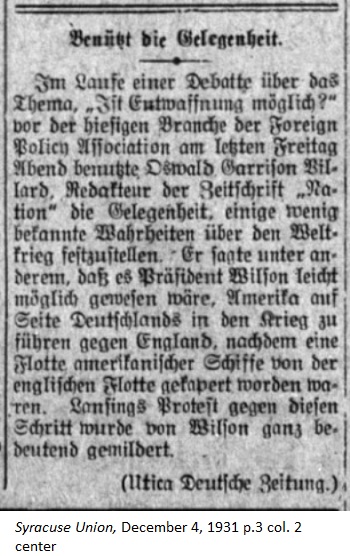
December 4, 1931 page 3 _____ Utica Deutsche Zeitung |
|
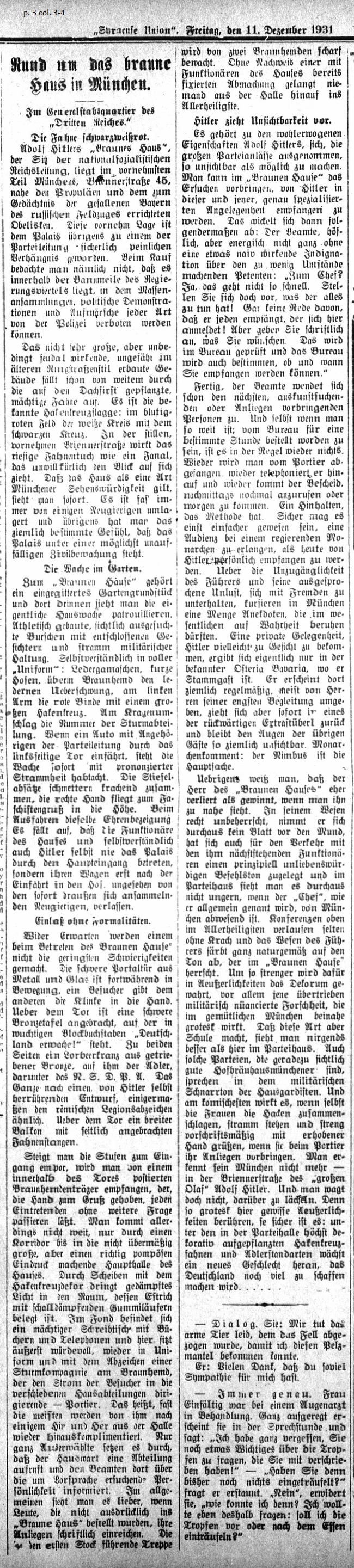
December 11, 1931 page 3 _____ In the General Staff Headquarters of the "Third Reich" The Black, White, and Red flag. Adolf Hitler's "Brown House," seat of the National Socialist Reich Administration, lies in the nicest section of Munich at 45 Briennerstrasse near the Propyläen and the obelisk constructed in memory of the fallen Bavarians in the Russian campaign. This upscale location, where a mansion became a Party Headquarters, was certainly disasterous. When it was purchased, nobody considered that it was within the no-protest zone of the government quarters — mass demonstrations and marches of any kind were forbidden by the police. This not very large but absolutely feudal-looking building built on a relatively old, circular street draws attention even from a distance because of the massive flag planted on the ridge of the roof. It's the familiar flag with the swastika on it: a blood red field, the white circle and the black cross. In quiet, aristocratic Brienner St. that gigantic cloth flag functions like a beacon, which involuntarily draws the eye. Since the house is considered a Munich attraction worth seeing, people see it first. It's almost always mobbed by the curious and one gets the distinct impression that the mansion possibly standsunder unobtrusive civilian guard. The garden belonging to the "Brown House" is enclosed by the fence within which one sees guards on patrol — athletically built, intentionally chosen young men with unflinching faces and straight military bearing and naturally in full uniform: leather boots and shorts with a leather over-the-shoulder belt and a brown shirt with a red band with swastika on the left sleeve. On the collar there's the number of the Storm Trooper Division. When a car with members of the Party leadership enter the left side of the gate, the guard immediately stands at attention. Boot heels click together, the right hand flies into the air with the Fascist greeting. Upon exiting the same gestures occur. It's evident that the house officials, and naturally Hitler himself, never enter the mansion through the main entrance but rather their cars drive into the courtyard so they are unseen by the crowd of curious onlookers outside. Contrary to what one expects, there is not the slightest difficulty when entering the Brown House. The heavy metal and glass portal is constantly in motion. One visitor after the other just takes the handle. Above the gateway there is a bronze plaque, which in stocky block printing reads "Germany, awake!" On both sides there is a laurel wreath of embossed bronze, on which there is an eagle and underneath which are the letters N.S.D.P.A. [National Socialist Democratic Party.] Designed by Hitler himself, it resembles the designation for the Roman Legions. Above the gate on a wide balcony hangs an edgewise-positioned flagpole. If one climbs the stairs to the entrance, one encounters a man in a brown shirt posted at the gate with his hand raised up in greeting. Each entrant is allowed to pass without being questioned. Not far down a corridor, one passes into the house's main hall, which seems ostentatious. Subdued light filters through panes of glass decorated with swastikas. The floor is covered with noise-dampening rubber runners. At the rear there's a heavy desk with books and telephones, and here sits an outwardly dignified man in a uniform marked with the sign of the Storm Trooper Division on his brown shirt. He's a doorman directing the tour of visitors through various sections of the house, or at least ushering most of them from the hall to the "Him and Her." Only a chosen few get to go through to a custodian and the officers who ask for the reason of the visit. Generally it's preferred that people, who were not specifically invited to the Brown House, to submit their requests in writing. The stairs leading to the second floor are scrupulously watched by two Brownshirts. Without proof of a previous arrangement by an official no one gains entry from the hallway to the inner sanctum. Among Hitler's deliberate characteristics is to be as invisible as possible, except at large Party events. In the Brown House one can request, at this or that special occasion, to be received by Hitler himself. In that event the following occurs: An official, courteously but not without a somewhat naive sense of indignation over the rarely made petition replies, "To see the Chief? That doesn't happen so fast. What is this regarding? No one said anything about his receiving anyone who calls! Write down what you want. The Bureau will look into it and decide whether and when you can be received." Finished, the official turns to the next person seeking information or reception. Even when someone has an appointment for a specific hour, things still aren't set. Once again he's received by the porter, another phone call, then the notification —call this afternoon or come back tomorrow. Stalling, with a method to it. Long ago it might have been easier to get an audience with a reigning monarch than it is today to meet Hitler in person. The Führer's inaccessibility and his expressed dislike of conversing with strangers has prompted various anecdotes in Munich which essentially point to the truth. A private opportunity to come face to face with Hitler only happens once in a while at a well-known Bavarian Osteria where he is a frequent guest. He's usually surrounded by his closest companions but then draws off to a small back room and thus remains invisible to the restaurant guests. A monarch comment: the cloud of invisibility is the main thing. Incidentally, some people know that the lord of the Brown House looses rather than gains something when you see him up close. Hotheaded by nature, he doesn't mince words. Even with his closest officers he takes an unlikeable, commanding tone, and at the Party House no one is unhappy when the "Chief," as he is generally called, is away from Munich. Conferences in the inner sanctum seldom occur without angry words and the Führer's personality naturally permeates the tone which prevails in the Brown House. For this reason formality, decorum, and above all else excessive military-style forcefulness must be strictly maintained. In easy-going Munich this seems rather grotesque. Nowhere better than at the Party House one sees how behavior is schooled. Even Party members, who are apparently good beer garden citizens of Munich, speak in the shrill military tone of the house guards. And it seems most comical when women click their heels together, stand at attention and strictly greet with a raised hand when they place their requests with a porter. That's when you don't recognize Munich anymore — Adolph Hitler on the Briennerstrasse of Grosse Olaf. [?] But no one dares laugh about it. The grotesqueness of this formaily makes one thing certain: under the Party Hall's decorative swastika flag and eagle standard a new race is growing, which will give Germany still more things to accomplish... — Dialog.
— Always Accurate.
|
|
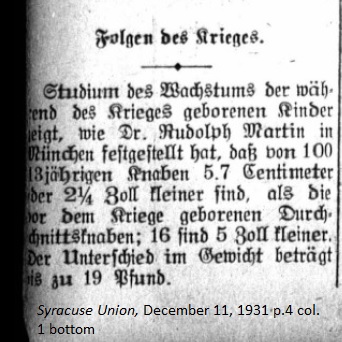
December 11, 1931 page 4 A study on the growth rate of children born during the War, according to Dr. Rudolph Martin in Munich, shows that 100 thirteen-year-old boys are 5.7 centimeters or 2 ½ inches shorter than the average boy born before the war. 16 are five inches shorter. The difference in weight amounts up to 19 pounds. |

|
December 25, 1931 page 1 Publication of His Open Letter to the Chancellor would have been a Violation of the Political Truce — Socialists decide to Support Brüning As was announced in Munich, Hitler answered an open letter in which he used 9,000 words to attack Brüning. He was going to publish the response in the National Socialist Press News. Berlin. The Albatross Aircraft Company has denied that Adolf Hitler order 25 airplanes from them for the National Socialist Party, however in wider circles it is believed that the Fascists intend to create an air flotilla. In a similar vein, Hitler has entered into an agreement to organize an aviation corps. It was admitted that a nationalistic sports club of former flight officers was being organized just as there would be a National Socialist automobile club. Hitler indicated that the Communist Flight Club owns 24 aircraft. Berlin. The Socialist Party recently decided in Krakow to support Chancellor Brüning until January in order to give him the opportunity to implement his promised price reductions. However he was warned that workers would not be happy with lower wages if prices didn't fall at the same time. Otherwise the Socialists will join the Communist and Nazi opposition and overthrow the government. With the Socialist's resolution there is hope that the proposition tended by the opposition for an immediate meeting of the Parliament will be rejected when the Elder Counsel meets this week. Heidelberg. During a Tea hosted by the 75-year-old former imperial diplomat, Mr. von Reichenau, conducted at Castle Rotenberg for 40 prominent individuals, a raid took place in search for correspondence from Hitler. There were numerous letters from Hitler and some from Hindenburg to Reichenau. No special writings by Hitler were found, contrary to the predicted purpose of the raid. Hamburg. The Hamburg "Dom," the annual market which takes place before Christmas and amuses the populace to its heart's content, recently experience a sad conclusion. During its last hours there was a demonstration by the Communists and a fight with the police. One of the Reds was killed and four other people were wounded when the police fired at the troublemakers. — An announcement from Tampa calls for the end of the strike of cigar workers. Five thousand people have returned to work. — The German Kaiser given his household staff food, clothing, and wood he cut himself for Christmas. Better than nothing. |
|
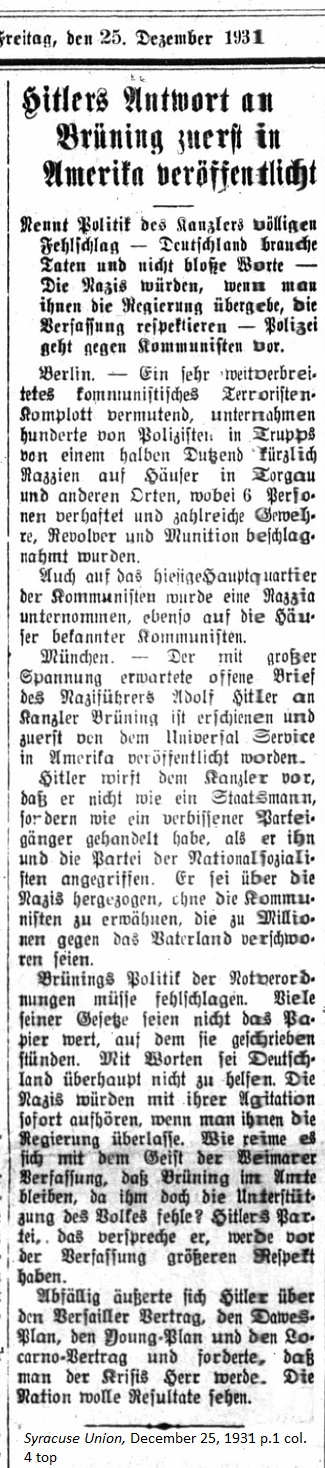
December 25, 1931 page 1 _____ Calls the Chancellor's Political Platform a Complete Failure — Germany needs Actions, not Words — If the Government was turned over to Them, the Nazis would respect the Constitution — Police take Action against the Communists Even the local Communist Headquarters was raided along with the houses of well-known Communists. Munich. The nervously anticipated public letter of Nazi leader Adolf Hitler to Chancellor Brüning has appeared and for the first time it was published by the Universal Service in America. [An English version of the letter is available at https://research.calvin.edu/german-propaganda-archive/hitleranbruening.htm] Hitler blames the Chancellor for not acting like a statesman but rather like an obstinate factionist. when he assailed him and the National Socialist Party. He had criticised the Nazis without mentioning the Communists, who by the millions have plotted against the fatherland. Brüning's emergency regulations must fail. Many of his laws are not worth the paper they're written on. Words won't help Germany. The Nazis would immediately cease agitation if the government was turned over to them. How would it agree with the spirit of the Weimar Constitution if Brüning remained in office since he no longer has the support of the people? Hitler's Party, he promises, will have great respect for the Constitution. Hitler speaks disparagingly about the Versailles Treaty, the Dawes Plan, the Young Plan and the Locarno Pact and he demands that the government resolve the crisis. The nation wants results. |
|
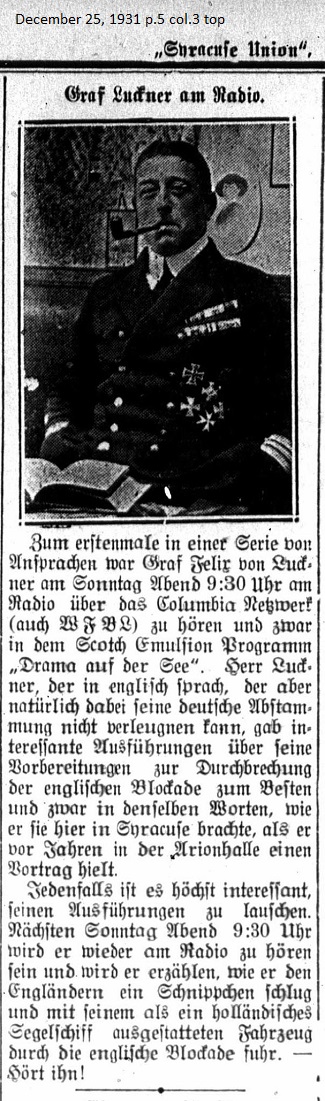
December 25, 1931 page 5 Be that as it may, his speech was highly interesting. Next Sunday evening at 9:30 he will again be on the radio to tell how he tricked the English by camoflaging his ship to look like a Dutch sailing ship in order to get through the blockade. — Hear him! |