January - March 1933

|
January 6, 1933 page 1 _____ Trier. — A while back a stranger appeared in the capital city of Luxembourg. He called himself Count Sapieha and he began negotiations with a estate broker to supposedly purchase a chateau for a Polish magnate living in London. Eventually the Count and a Luxembourg broker settled on a purchase agreement whereby Prince Boleslav Piat allegedly purchased an estate lying on the Upper Moselle River. The purchase agreement was sent to London and it was returned with the signature of the supposed Polish Prince. The intermediary, Count Sapieha, then traveled to Berlin, where he met with the Luxembourg estate owner in his residence on Lützowstrasse to negotiate the particulars. On this occasion the former estate owner discovered that the new owner's intermediary had engaged a new staff of servants and had paid himself out of the funds deposited in the bank by the contractual parties. The use of funds from the deposit prompted suspicion in the former owner of the chateau. He notified the criminal police, who arrested Count Sapieha and discovered that the Count was a well known con artist named Alex Woy, who was also being investigated by other authorities for marriage fraud. Apparently he had set up a scheme and later performed some sort of trick to procure the funds set aside for the new chateau staff. Upon inquiry by the Berlin Police it was discovered that there was no Prince Piat in Poland or London. Their investigation is not yet concluded. The case of the fraudulent purchase contract has created quite a sensation in Luxembourg. German Youth consider an Appeal from the Reichs Government _____ President and Chancellor issue Call for Help "Hundreds of thousands of young Germans suffer under the unemployment crisis and inactivity. Therefore on this Christmas Day the Reichs President and the government turn to the German people with the plan to provide German youth with rigorous vocational instruction along with spiritual and physical training, which should secure for them at the very least a warm meal daily to support their stamina." The government promises all associations, which have a planned approach to caring for our youth, financial support. In an attached table the message indicates that the government will set aside 9,000,000 Reichs Marks in an ongoing budget for this purpose and it is hoped that even the private sector might procure funding for youth work programs. It plans to instruct youths up to age 25 at least four hours daily with two hours dedicated to vocational training with the remaining time dedicated to physical and spiritual edification. — The French steamship "Atlantique" burned at high sea. Passengers were not on board and the German steamship "Uhr" rescued the 86 man crew. The ship cost $18,000,000. |
|
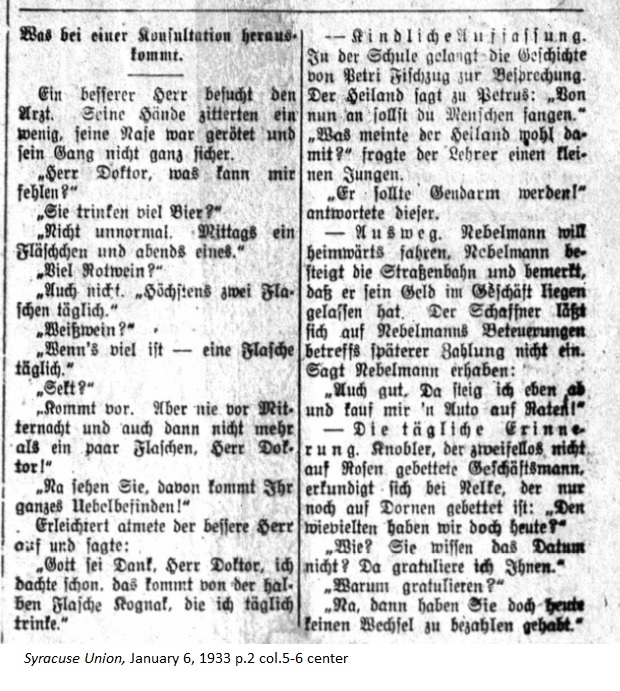
January 6, 1933 page 2 _____ A financially well-off man visits the Doctor. His hands shake a little, his nose is red and his gait is rather unsteady. "Herr Doctor, what's wrong with me?" "Do you drink a lot of beer?" "Nothing abnormal. A bottle in the afternoon and one in the evening." "Much red wine?" "Also not much. At most two bottles a day." "White Wine?" "At most, a bottle a day." "Champagne?" "On occasion, but never before midnight and no more than a couple bottles, Herr Doctor." "No wonder you find yourself so unwell!" The well-off man breathes easier and says, "Thank God, Herr Doctor. I thought it came from the half bottle of cognac I drink each day." _____ — A childlike concept. The story of the Apostle Peter is discussed in school one day. The Savior said to Peter, "From today onward you shall be a fisher of men." "What did the Savior mean by that?" the teacher asked one little boy. "He should become a policeman!" the boy responded. _____ A businessman wants to get home but as he reaches the streetcar he notices he left his money in his office. Despite the businessman's assurance that he'll pay later, the conductor refuses to let him on. The businessman says in a calm manner, "That's okay. I'll just get off and go buy an automobile on the installment plan!" |
|
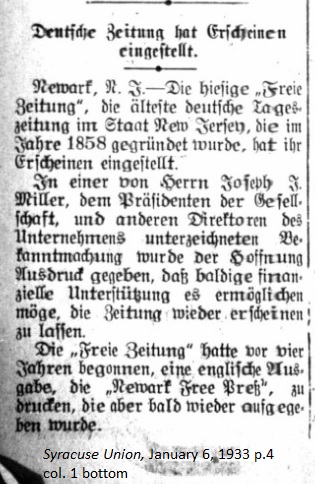
January 6, 1933 page 4 _____ Newark, N.J. — The city's Freie Zeitung, the oldest German daily newspaper in the State of New Jersey founded in 1858, has ceased publication. In an announcement signed by Mr. Joseph J. Miller, the president of the firm, and other directors of the enterprise, it was hoped that as soon as financial support is made available, the newspaper will resume publication. The Freie Zeitung began publishing an English edition four years ago titled the Newark Free Press, however it ceased publication soon after its start. |
|
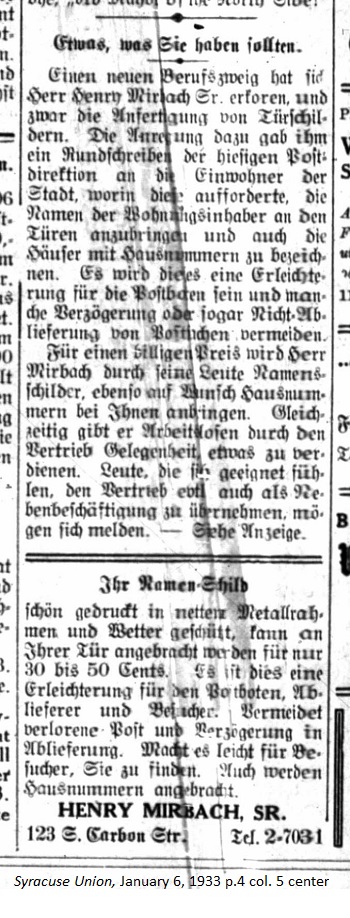
January 6, 1933 page 4 _____ Mr. Henry Mirbach Sr. has chosen a new line of business making doorplates. The inspiriation came from a circular from the local post office to the residents of the city requesting that names of the residents be listed on their house doors along with the house number. This would make things easier for the postmen and avoid delays or non-delivery of mail. For a modest price Mr. Mirbach will have his people create and install nameplates for you and add house numbers if desired. At the same time, through this enterprise he is giving unemployed people the opportunity to earn some money. People who feel inclined to eventually take over this sideline may apply. — See the Ad. Your Nameplate beautifully embossed in a metal framework and weather resistant, can be installed on your door for only 30 to 50 cents. It makes it easier for postmen, delivery people, and visitors. Avoid lost mail and delays in deliveries. Make it easier for visitors to find you. House Number can also be added. 123 S. Carbon St. Tel. 2-7031 |
|
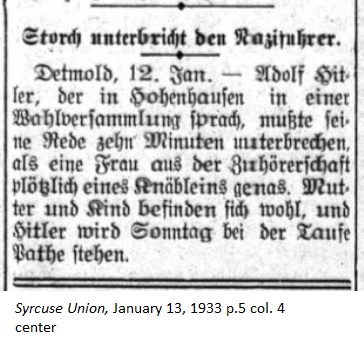
January 13, 1933 page 5 _____ Detmold, January 12. — Adolf Hitler, who spoke at an election rally in Hohenhaufen, had to discontinue his speech for ten minutes as a woman in the audience suddenly gave birth to a baby boy. Mother and child are well, and Hitler will stand as godfather on Sunday at the Baptism. |
|
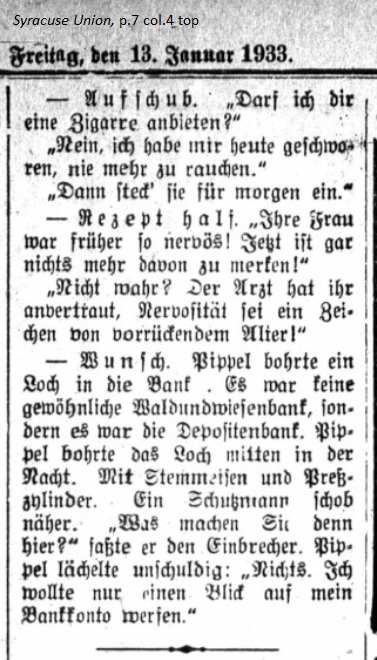
January 13, 1933 page 7 — Postponement. "May I offer you a cigar?" "No, today I swore never to smoke again." "Then keep it for tomorrow morning." _____ — A Prescription Helped. "Your wife was so nervous earlier. Now there's no sign of nervousness! "I know. The doctor told her that nervousness is a sign of advancing old age!" _____ — The Wish. A burglar bored a hole into the bank. It wasn't your usual "forest and meadow" local bank but a commercial bank and he was boring the hole in the middle of the night with a chisel and press cylinder. A policeman approached. "What are you doing here?" he asked the burglar. The burglar smiled innocently. "Nothing. I just wanted to take a look at my bank account." |
|
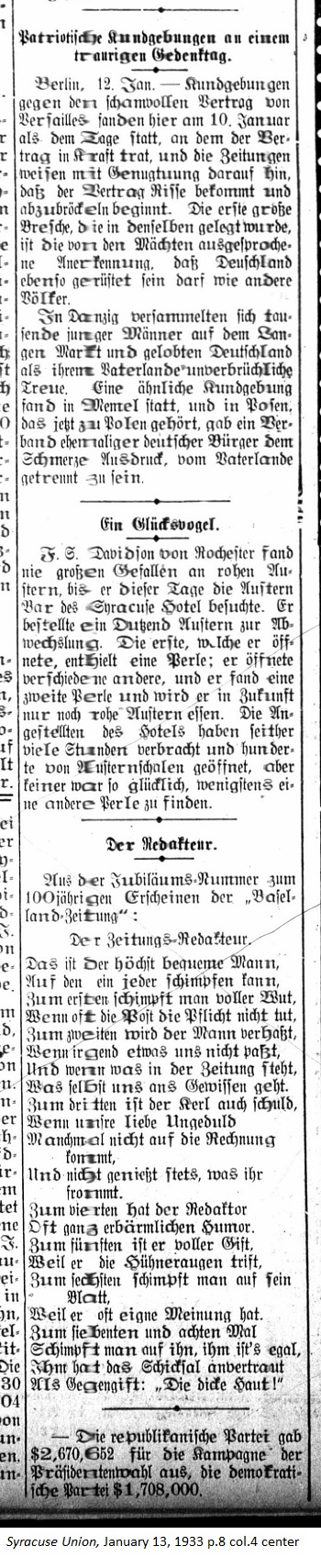
January 13, 1933 page 8 _____ Berlin, January 12. — A demonstration against the shameful Versailles Treaty took place here on January 10th, commemorating the day on which the treaty took effect. The newspapers indicated with satisfaction that the treaty was flawed and beginning to disinegrate. The first large breach came from the acknowledgement expressed by the world powers that Germany could be as well armed as the other nations. In Danzig thousands of young men assembled at the Langen Market and pledged their unswerving loyalty to Germany. A similar rally took place in Memel and in Posen, which currently belongs to Poland, a gathering of former German citizens expressed their pain at being separated from the fatherland. A Lucky Person _____ F.S. Davidson of Rochester was never very fond of raw oysters until the day he visited the Oyster Bar at the Syracuse Hotel. He ordered a dozen oysters just for a change. The first one he opened contained a pearl. He opened another one and found a second pearl. In the future he will only eat raw oysters. The employees of the hotel have spent many hours and opened hundreds of oyster shells but no one has been lucky enough to find another pearl. The Editor _____ From the Anniversary Issue of the 100 years of publication of the Baselland Zeitung: But people blame him for any event Which leads to anger, they rant and rail Whenever the paper doesn't come in the mail. Others simply hate the guy
A third group of impatient buggers
The editor is known for his perceptive wit
The sixth group makes fun of his journalism
|

|
January 20, 1933 page 3 _____ Which speaks of many interesting things _____ Among other things, Mr. Hildrebrandt writes: Lübeck, December 7, 1932
Dear Brother in Office, The detailed and interesting letter, which to took time to write while in the middle of an abundance of tasks, should have been answered a long time ago. But it's a remarkable thing, even a day in retirement is not long enough when there's still work to be done. And when I rummage through my memory I can only think of a retirement that's full of boredom. Now before anything else, sincere thanks for your letter. It's many pages made the old times live on again. It caused us sorrow that the bitterness can still be so clearly detected. Understandibly, it weighs down on you. One can well understand it. When one has made every possible effort and exerted oneself with all ones strength, then success should be gained with recognition and praise rather than misapprehension and disappointment. One can understand how one cannot defend himself against such bitterness... Two nights ago we were again placed in the dismal times of 1921 - 1923 in a lecture by Sister Gallison Reuter concerning her work and travels in the U.S.A. to benefit the Quaker Relief Program for the feeding of German children. She was also in Syracuse but didn't feel she was received with understanding and compassion. She was born in Lübeck, an old woman in her seventies but quite active and vital. But before I forget, many thanks for the photgraphs you enclosed with your letter. When one looks at the face one becomes aware of how old one is. I see you before me as you were as a student in Atchison, and now right before my eyes I see two young men in uniform who can make the claim that they are sons of yours. And there's a younger man and a young girl, who have already grow out of their childhood shoes. When I was in Atchison I was already well beyond my spring chicken days. Now even my 70th birthday is behind me and sometimes I can scarcely believe what has passed. With regard to seeing each other again on this earth, as you indicated at the end of your letter, how nice to think that in the not too distant future you might put on your travelling boots again and visit the old fatherland, as Pastor Dattan's wife has done. A journey by us to America is out of the question. Our physical strength would still allow us to do this but the wallet issues a dictatorial "No!" Trips to America are not consistent with having daily bread and we would be happy enough if we still had some of that. Taxes and calls for help in great need are ever increasing while income consistently goes down by several percentage points. Just recently we received a reverse Christmas gift costing us another of 5%. But one has no right to complain when one sees so many thousands of our people who are so much more worse off. Things in America are also not good. I can't imagine how in such a rich land so much need could exist. However here with us things are much sadder and more hopeless. The social institutions we have contributed a lot so that to a great extent total despair has not set in among the masses. However it is apparent that it is inadequate and so many cannot safeguard themselves from hunger. Our enemies (I will still regard them as such for as long as they use other means to continue the war) seem intent on driving Germany into the arms of Bolshevism. And if Bolshevism even once conquers Germany I do not believe that it will stop before the fortifications where France has doubled and tripled its eastern border. Even in France God will not allow the trees to extend into heaven*; however whether Germany would gain any advantage by it seems questionable to me. Perhaps the German people have to be driven deeper into distress before it can taste the blessing of hardship. Once again Germany seems to be isolated in the foreign politcal arena. Its internal politics are disjointed and disunified. The citizenry is divided with the radical parties on the left and right gaining ground, and eventually there will be battle between the National Socialists and the Communists. In Lübeck the Social Democrats have held the government since the revolution. The Mayor, Senate and citizenry were red. Since November, when the elections were held, there's been a turnaround; the right-wing parties have the majority, if only just. With regard to the German issues in particular, we have neither understanding nor interest. There's nothing to anticipate. Concerning American questions I stay apprised of the current issues through the Literary Digest. A female friend has sent to me this year's issues, which often arrive promptly at my house on the day of publication, although they're printed well in advance. I've determined that their reports on Germany seem to be taken their material mainly from left-wing newspapers. That's why anything one reads concerning politically motivated murderous deeds one gets the impression that the "Nazis" are usually the aggressors and are guilty of acts of violence while the reasons behind the situation are different, namely that the National Socialists (to which, by the way, I am not a member) are mostly the victims of the attack and suffer the most deaths. I've wanted to write to the Literary Digest, but there would be no point to it... As I write this letter, the Reichstag is holding its second session during which, among other things, it will deal with a representative of von Hindenburg. It's been going on for a few weeks offstage and we haven't heard anything. It's now between night and morning of the next day and I must bring my letter to a close. Meanwhile there was this scandalous scene in the stormy session of the Reichstag, which hopefully will not be repeated in the foreseeable future. The Reichstag of the pre-war era was more boring but far more dignified. There's no predicting if things will change or get better. The peace will not be disrupted until after Christmas, provided the session of the Reichstag scheduled for tomorrow really occurs. By then maybe the situation will clear up. Will the United States just once deal earnestly with that spoiled child, France? It's truly remarkable that the U.S. has remained quiet during France's refusal to pay its debts after previous siphoning off the huge piles of gold and locking them away in its treasury, and expending enormous sums for its military. And how much longer will the tragicomedy in Geneva continue to play out, even with Germany's cooperation when it is the injured party? However I will no longer sing this nasty political song and take my leave with friendly greetings from my house to yours. Yours,
_____ *From an article by Wolfgang Mieder titled "'The Trees don't grow to the Sky' : Transmission, Use and Meaning of a Proverb" published in Linguistische Treffen in Wroclaw, Vol. 21, 2022. The German proverb refers to things not lasting forever, or everything having its limits. |

|
January 20, 1933 page 5 _____ |
|
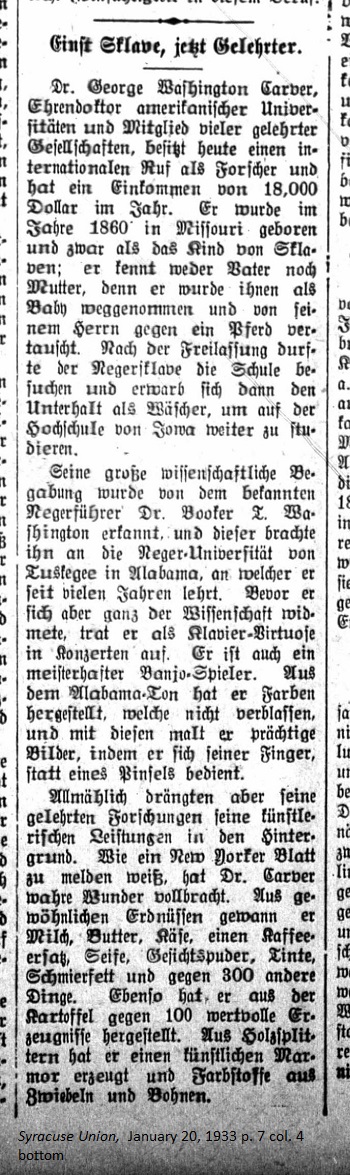
January 20, 1933 page 8 _____ Dr. George Washington Carver, honorary doctor of American universities and member of many scholarly societies, today possesses an international reputation as a researcher and has an income of 18,000 Dollars per year. He was born in Missouri in 1860 as the child of slaves. He did not know his father or mother because he was taken away as a baby and traded by his master for a horse. After the Emancipation the Negro slave could attend school and then he earned his living as a launderer so he could further his studies at the high school in Iowa. His great scientific aptitude was recognized by the famous Negro leader, Dr. Booker T. Washington, who brought him to the Negro University of Tuskegee in Alabama, at which he taught for many years. However before he completely devoted himself to science he performed as a piano virtuoso at concerts. He was also a masterful banjo player. From Alabama clay he produced pigments which did not fade and with which he painted beautiful pictures. He used his fingers rather than paintbrushes. Over time his scholarly research forced his artistic achievements into the background. As a New York newspaper reported, Dr. Carver had performed miracles. From the ordinary peanut he produced milk, butter, cheese, a coffee substitute, soap, face powder, dye, grease and 300 other items. From potatoes he produced 100 valuable products. From wood splinters he developed an artificial marble and from onions and beans he produced dyes. |
|
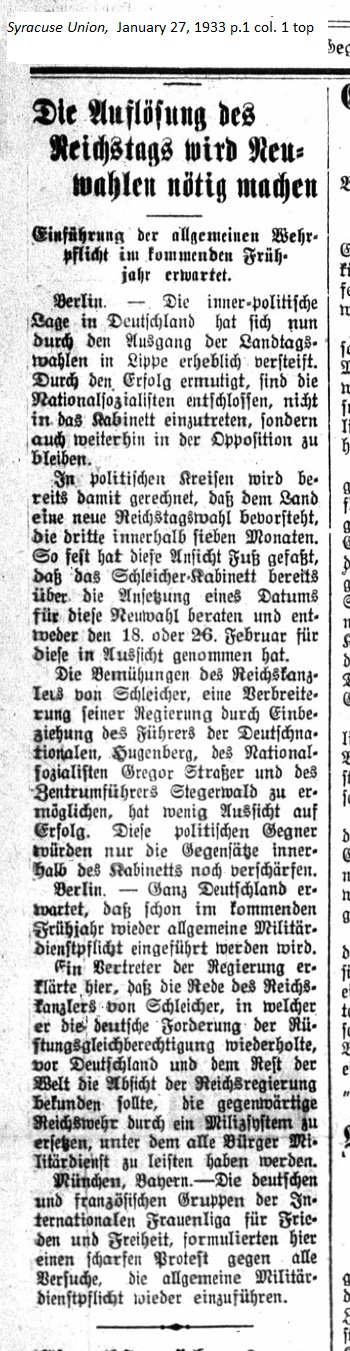
January 27, 1933 page 1 _____ Introduction of Compulsory Military Service expected in the upcoming New Year In political circles it's already being forecast that new Reichstag elections will be pending for the country, for the third time in seven months. This opinion is one such firm footing that the Schleicher Cabinet is already discussing a date for the new election on either February 18th or 26th. Efforts by Reichs Chancellor von Schleicher to secure an extention of his government through inclusion of the leaders of the German Nationals, Hugenberg; the National Socialists, Gregor Strasser; and the Central Party under Stegerwald, have little prospect of success. These political opponents would only sharpen the antagonism within the Cabinet. Berlin. — All of Germany expects that in the coming year universal military conscription will be implemented again. A representative for the government states that the speech by Reichs Chancellor von Schleicher, in which he repeated the German demand for armaments parity, shall indicate to Germany and the world the Reich goverment's intention to replace the current defense system with a military system under which all citizens will have to perform military service. Munich, Bavaria. — The German and French groups of the International Women's League for Peace and Freedom registered a strong protest against all attempts to reinstate compulsory military service. |
|
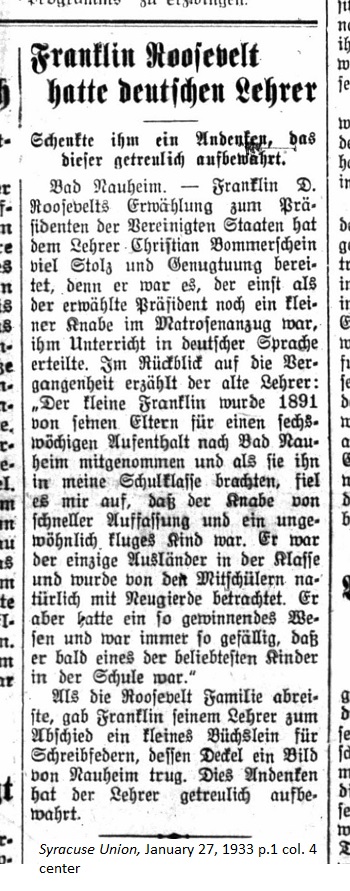
January 27, 1933 page 1 _____ Gave Him a Memento as a Keepsake Bad Nauheim. — Franklin D. Roosevelt's election to the presidency of the United States filled teacher Christian Bommerschein with pride and satisfaction, for it was he who gave him German language instruction when the president was a small boy in a sailor suit. Looking back to the past, the old teacher related: "In 1891 young Franklin was taken to Bad Nauheim for a six week stay by his parents. When they brought him to my classroom it occurred to me that the boy had quick skills of comprehension and he was unusually clever. He was the only foreigner in the class and naturally he was viewed with curiosity by his fellow students. But he had such winning ways and was always so pleasant that he soon became one of the favorite children in the school." When the Roosevelt family left, as a parting gift Franklin gave his teacher a small box for his quills, the top of which had a picture of Nauheim. The teacher faithfully preserved this as a keepsake. |
|
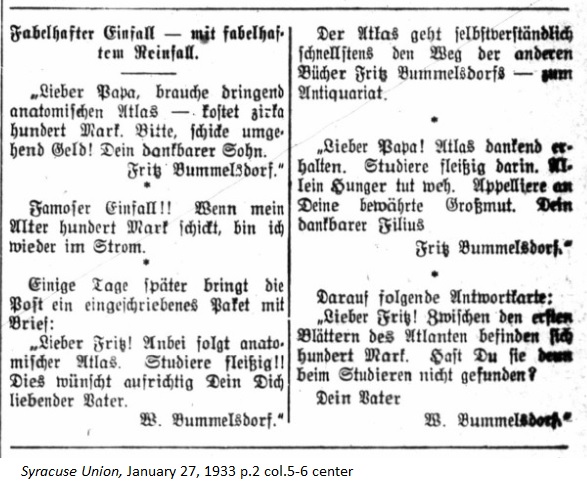
January 27, 1933 page 2 _____ "Dear Papa, I urgently need a anatomical atlas. It costs around 100 Marks. Please send money promptly! Your grateful son, Fritz Bummelsdorf." Excellent idea! If the old man sends one hundred Marks, I'll have electricity again. A few days later the mailman delivers a package with a letter:
The atlas naturally goes as quickly as possible the way of Fritz's other books, to the antiquarian book dealer. "Dear Papa! Atlas gratefully received. I'm studying it carefully, but hunger pains get in the way. I'm appealing to your generous nature. Your grateful son, Fritz Bummelsdorf." The following response came in the post: "Dear Fritz, Between the first few pages of the atlas I placed a hundred Mark note. Didn't you find it when you were studying? Your father, W. Bummelsdorf." |
|
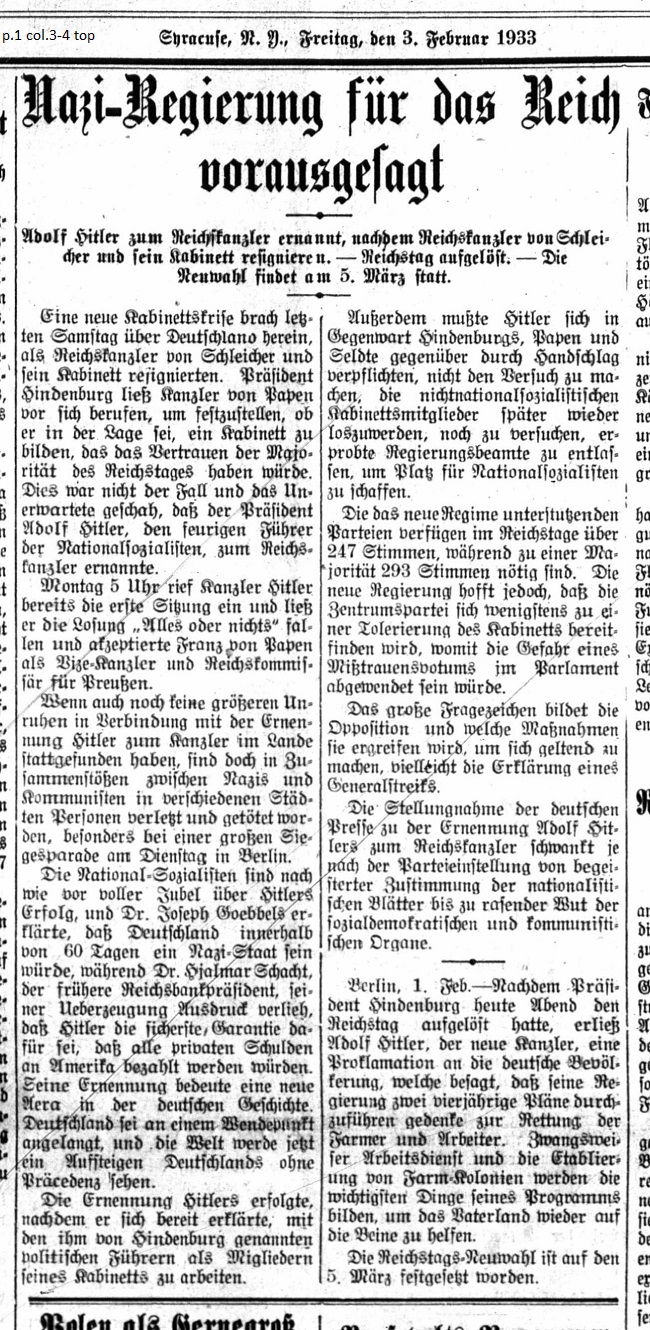
February 3, 1933 page 1 _____ Adolf Hitler to be appointed Reichs Chancellor after Reichs Chancellor von Schleicher and his Cabinet resign — Reichstag dissolved — New Elections take place March 5th _____ A new Cabinet crisis befell Germany last Saturday as Reichs Chancellor von Schleicher and his Cabinet resigned. President Hindenburg called on Chancellor von Papen to establish whether he was in a position to build a Cabinet in which the majority of Parliament would have confidence. This was not the case and the unexpected happened as the President appointed Adolf Hitler, the fiery leader of the National Socialists, to the post of Chancellor. Monday at 5 o'clock Chancellor Hitler already called for the first meeting and issued the slogan "All or nothing" and accepted Franz von Papen as Vice-Chancellor and Reichs Commissar for Prussia. While there were no large signs of unrest in the nation with the appointment of Hitler as Chancellor, there were clashed between Nazis and Communists in various cities where people were injured or killed, especially at the large victory parade Thursday in Berlin. The National Socialists are more then ever before jubilant with Hitler's victory, and Dr. Jospeh Goebbels stated that Germany would be a Nazi State within 60 days while Dr. Hjalmar Schacht, former Reichs President, expressed his conviction that Hitler would be the surest guarantee of all private debts being repaid to America. His appointment means a new era in German history. Germany is reaching a turning point, and the world will now witness an unprecedented ascension. Hitler's appointment followed his previous statement that he would work with political leaders appointed by von Hindenburg as Cabinet members. Additionally Hitler vowed with a handshake in the presence of Hindenburg, Papen and Seldte not to make any attempt to get rid of the non-National Socialist Cabinet members at a later date or to dismiss any time-tested government officials to create postings for National Socialists. The new regime of supporting Parties has over 247 votes in the Reichstag but it takes 293 votes to form the necessary majority. The new government therefore hopes that the Central Party will at least show tolerance for the Cabinet, thereby avoiding the danger of a "no confidence" vote in Parliament. The Opposition is the big question mark. What measures will it take to maintain its influence, perhaps call for a general strike? The positions taken by the German Press to Adolf Hitler's appointment fluctuate according to the political leanings from enthusiastic approval by the Nationalist newspapers to wild rage by the Social Democratic and Communist newspapers. Berlin. February 1st. — After President Hindenburg dissolved the Reichstag this evening, he permitted Adolf Hitler, the new Chancellor, to issue a proclamation to the German people, which stated that his government intends to carry out two four-year plans to save the farmer and the worker. Compulsory work service and the establishment of farming colonies will be important components of his program to help the fatherland get back on its feet. The new Reichstag election is scheduled for March 5th. |
|
February 3, 1933 page 4 634 No. Salina St. Syracuse, N.Y.
_____ The Oberlander Press
Subscriptions for the Syracuse Union are as follows:
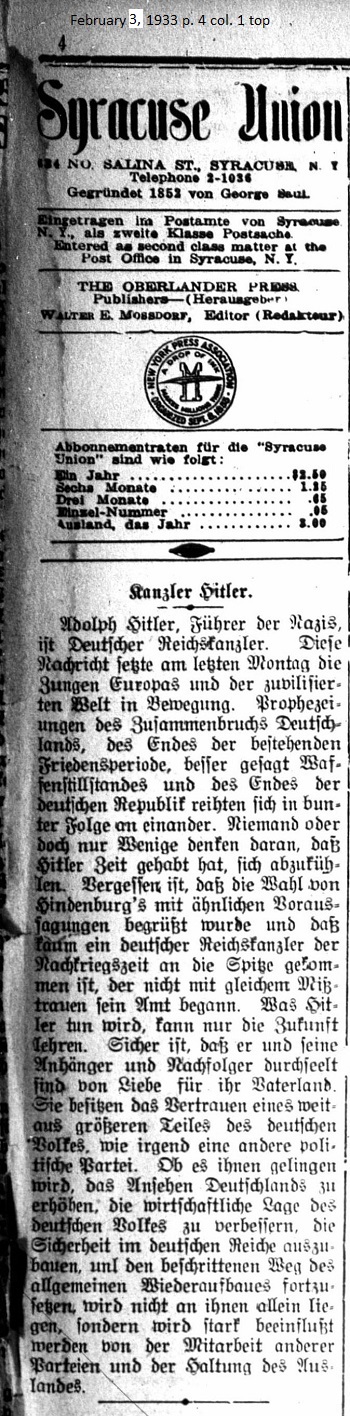
Chancellor Hitler _____ Adolph [sic] Hitler, leader of the Nazis, is German Chancellor. This report from last Monday set the tongues of Europe and the civilized world wagging. Prophecies of Germany's collapse, of the end of the current peace, or better said, the cessation of hostilities and the end of the German Republic are strung together in colorful series. No one, or perhaps only a few, think that Hitler has had time to cool down. We've forgotten that Hindenburg's election was greeted with similar predictions and that scarcely any German Reichs Chancellor has come to the fore without similar misgivings. Only the future can teach us what Hitler will do. It's certain that he and his followers thoroughly love their fatherland. They possess the trust of a significantly larger portion of the German people than any other political party. Whether they will succeed in raising Germany's reputation, improve the economic circumstances of the German people, expand security in the German Empire, and initiate steps towards reconstruction, will not lie with themselves alone but with strong influence from the coworkers in the other Parties and the attitudes held by foreign countries. |
|
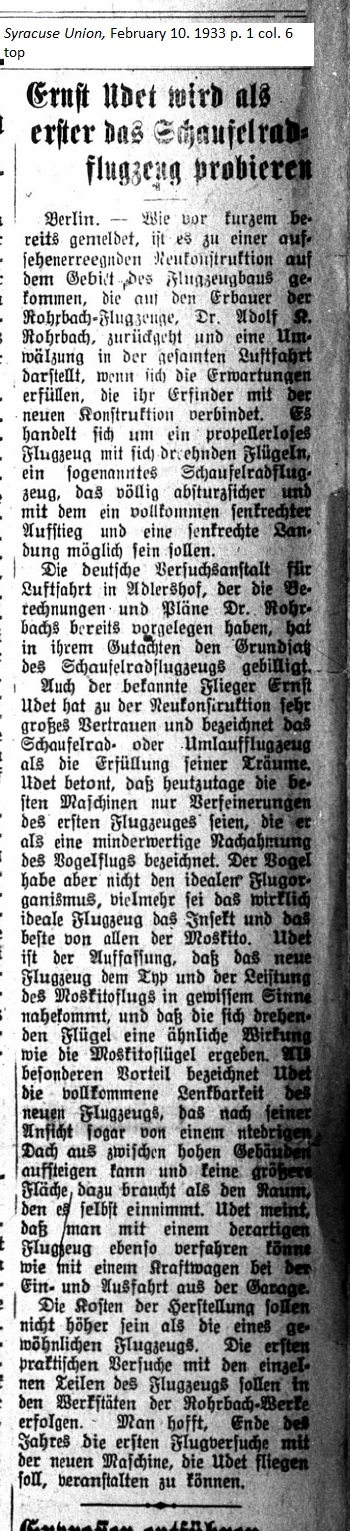
February 10, 1933 page 1 _____ Berlin. — As was recently reported, a spectacular innovation has come to the field of aircraft construction, which refers back to Dr. Adolf R. Rohrbach, designer of the Rohrbach Aircraft, and a radical change in all fields of aviation. If it fulfills its expectations, its inventor will be involved with the construction of an aircraft without propellers and equipped with rotating wings. Called a paddle wheel airplane, it cannot crash and it takes off and lands perpendicularly to the ground. The German Research Institute for Aviation in Adlershof, to which Dr. Rohrbach has already submitted his calculations and designs, has agreed to examine the fundamentals of paddle wheel aircraft. Even the famous aviator, Ernst Udet, has great confidence in the new design and indicates that paddle wheel or rotary aircraft is the fulfillment of his dreams. Udet said that to date the best machines are only refinements of the first aircraft, which he considers an inferior simulation of bird flight. Birds may not have the ideal flight organs. The truly ideal aircraft may mimic the insect, best of all the mosquito. Udet is of the opinion that new airplanes should, to a certain extent, approximate the design and method of mosquito flight and that paddle wheel wings would produce a similar effect. Udet noted the key advantage would be complete ease of handling and the ability to climb from a low roof between taller buildings and scarcely require more landing space than its own surface area. With such an aircraft one could travel as one travels in an automobile going in and out of a garage. The cost of production should not be any higher than for a traditional airplane. The first practical tests with the individual parts of the aircraft should take place in the workshops of the Rohrbach factory. It's hoped that by the end of the year the first test flights of the new machine, which Udet will conduct, can be scheduled. |
|
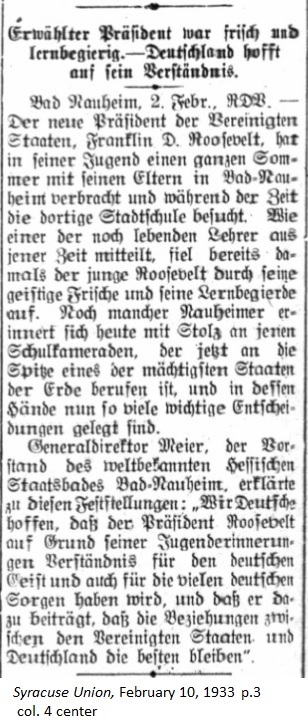
February 10, 1933 page 3 — Germany hopes for his Understanding _____ General Director Meier, the chairman of the world famous Hessian State Bath in Bad Nauheim said regarding this statement, "We Germans hope that, in light of his early childhood memories, President Roosevelt will have an appreciation for the German intellect and for our many German concerns and that he sees to it that the relationship between the United States and Germany remains on the best of terms. |
|
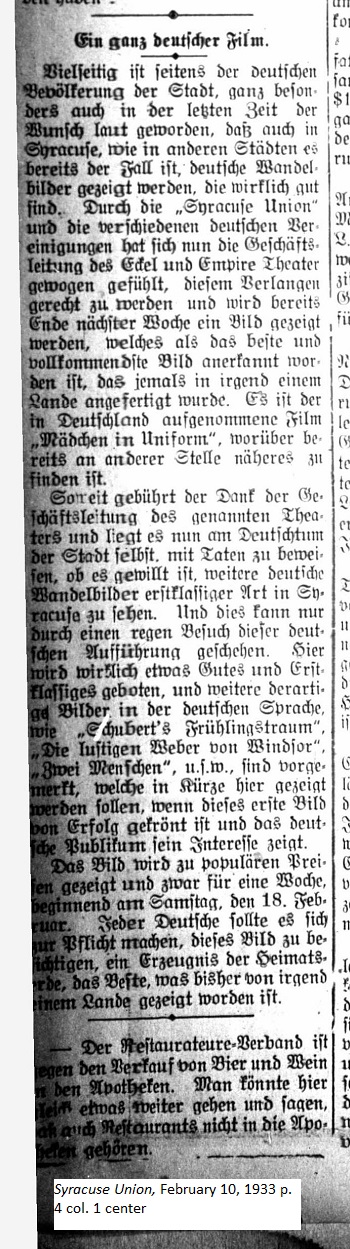
February 10, 1933 page 4 _____ From many sides on behalf of the German people of Syracuse and other cities, particularly in recent days, the desire has been expressed to view really good German movies. Through the efforts of the Syracuse Union and various German associations the management of the Eckel and Empire Theater feels compelled to do right by this desire and by the end of next week will show a film deemed the best and most perfect movie produced in any country. It is the German film "Mädchen in Uniform" (Girls in Uniform,) which is already being shown in other nearby places. We owe the management of the theater our thanks and now it is up to the German community of this city to prove whether it is willing to see other first class, German cinema in Syracuse. And this can only happen through regular attendance of these German productions. Something really good and first rate will be offered along with similar films in the German language including "Schuberts Frühlingstraum" (Schubert's Dream of Spring,) Die lustigen Weiber von Windsor (The Merry Wives of Windsor,) "Zwei Menschen" (Two Men,) etc., which will be shown in the near future if this first movie is crowned with success and demonstrates the German public's interest. The film us shown at a popoular price and only for one week beginning Saturday, February 18th. Every German should consider it a duty to see this film, a product of the homeland, the best shown thus far from any country. |

|
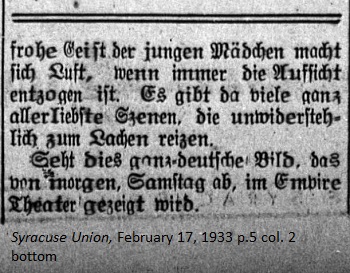
February 17, 1933 page 5 _____ "Mädchen in Uniform" will be shown Saturday morning for the first time here at the Empire Theater _____ Since this film is shown in the German language, it is mainly meant to be viewed by the German public and we hope that no German forgoes the opportunity to see this film while at the same time prompting the showing of other German films in Syracuse in the future. "Mädchen in Uniform" is an adaptation of the drama "Gestern und Heute" (Yesterday and Today) written by Christa Winsloe with performances in Berlin and throughout Germany. It deals with an academy for aristocratic girls in Potsdam, in which strict Prussian values are taught in a well-intended but misunderstood culture. A new student, Manuela, flees from the heartlessness of a world full of teachers with barrack yard ideals, who have turned her school into a disciplinary institute for soldier mothers without feelings and seeks solace in the arms of an understanding and clever teacher, Fräulein von Bernburg. Everything, which the lonely heart of a girl growing up without motherly love in an old aristocratic houshold experiences, spontaneously erupts into fantasy and passionate bonding with the noble teacher and friend. However, in the milieu of a girl's boarding school, teachers may not have feelings. Discipline and order form the leitmotif, and as Manuela, on a festive occasion slightly inebriated on punch, professes her love and respect for the beloved teacher with a toast, stringent punishment is meted on the "sinner" and there's talk of expulsion from the school — and even the object of her affection feels threatened since she is accused of having permitted Manuela's affections to take such a form. In the last moment the desparate girl is stopped from taking her own life, thus sparing a school a from a scandalous affair. The headmistress closes the film with a moral quandary — and nothing to say. A world of soldier-like boarding schools is built around the confused existence of this girl's feelings — It's a world of female cadets in which one face is softer and purer than the other. The film is worth seeing just for the variety of girlish heads, the magical juxtaposition of small blond heads, South German rounded skulls, endearing big city types and country innocents. The girls barracks are masterfully represented in shades of the Potsdam style for military training of noble and upper class soldiers. This film brought three women to rapid fame. First there's Director Leontine Sagan, who has produced an excellent film providing clever film editing and camera angles. The strength of her direction lies in the successful casting of her characters. Hertha Thiele, who portrays Manuela, is a slender, blond girl possessing a gripping power of expression and delicate sensibilities. Her teacher, a sensible woman with earnest, beautiful eyes and straightforward acting skill is the third discovery: Dorothea Wieck. With them is young Ellen Schwanneke as the clown of the boarding school, a mischief maker with a warm heart, no sense of urgency, and an endearing nature. Still more astonishing is the number of young, unknown girls who performed in a totally new film world and by their simple, genuine roles intensified its impact — undoubtedly due at first to the director but also due to the earnest efforts of the girls themselves. One unforgettable character is the headmistress of the school, portrayed by Emilia Unda. Her exit at the end of the film makes a deep impression and one has the feeling that her regime has come to an end. In closing one other thing should be mentioned. Although "Mädchen in Uniform" deals with a serious theme, there are many comedic moments when the irrepressible, happy spirits of the girls have fun whenever the supervisors aren't around. There are many endearing scenes which provoke irresistable laughter. See this entirely in the German language film, which will be shown from Saturday morning on at the Empire Theater. |
|
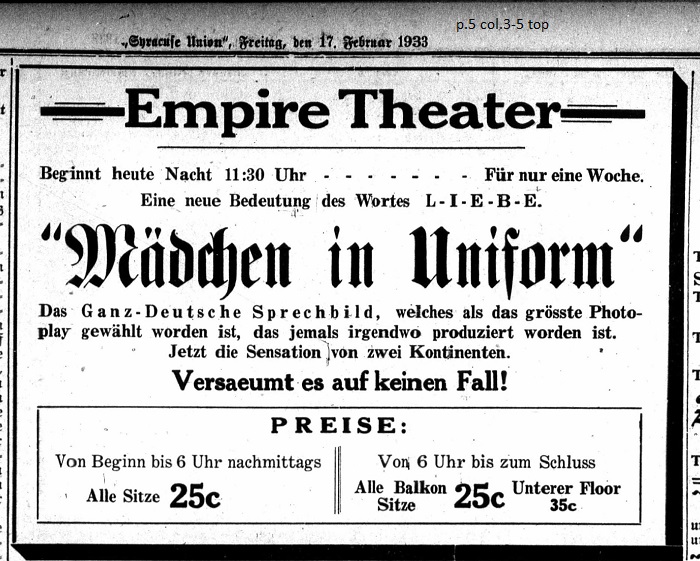
February 17, 1933 page 5 __________ Begins tonight at 11:30 - - - - - For one week A new meaning of the Word L-O-V-E "Mädchen in Uniform" The All-in-German Talking Film, which has been selected as the greatest Photoplay
Don't miss it for any reason! Prices: From beginning to 6 PM, all seats 25¢ From 6 PM to close, all balcony seats 25¢; Floor Level 35¢ |
|
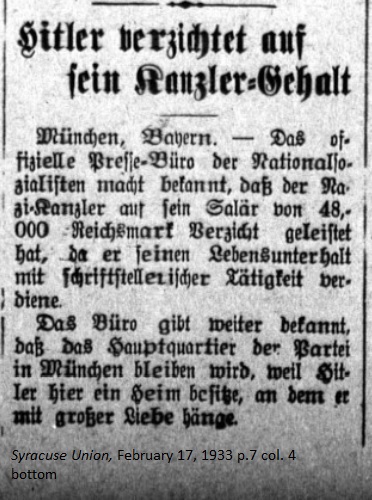
February 17, 1933 page 7 _____ Munich, Bavaria. — The official Press Bureau of the National Socialists is making it known that the Nazi Chancellor has declined his salary of 48,000 Marks since he earns his livelihood through his literary activities. The Bureau further announces that the Headquarters of the Party will remain in Munich because Hitler owns a home here, of which he is very fond. |
|
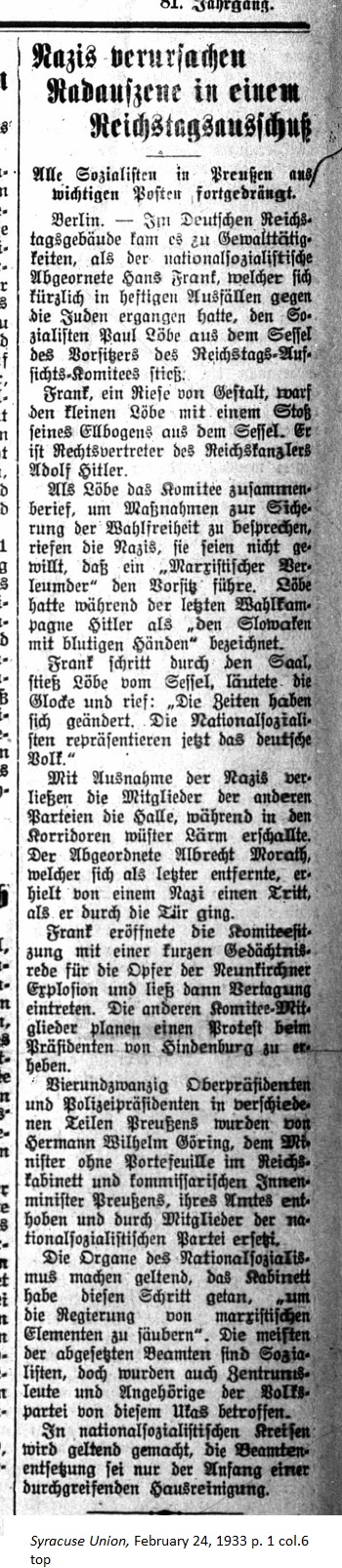
February 24, 1933 page 1 _____ All Socialists in Prussia ousted from Important Posts Berlin. — Things came to violence in the German Reichstag Building as the National Socialist delegate Hans Frank, who had recently enacted strong sanctions against the Jews, ejected Socialist Paul Löbe from the chairman's seat of the Reichstag's Supervisory Committee. Frank, a giant of a man, threw tiny Löbe off the chair with a shove of his elbow. He is the legal representative of Reichs Chancellor Adolf Hitler. As Löbe called the committee to session to discuss measures to secure electoral freedom, the Nazis shouted that they were unwilling to let a "Marxist scoundrel" lead the committee. During the last election campaign Löbe had called Hitler "the Slovak with bloody hands." Frank strode through the hall, shoved Löbe from the chair, rang the bell and shouted, "Times have changed. The National Socialists now represent the German people." With the exception of the Nazis, members left the hall while a shrill noise rang out in the corridors. Delegate Albrecht Morath, who departed last, received a kick from a Nazi as he went through the door. Frank opened the committee session with brief speech commemorating the victims of the Neunkirchen explosion, then let the session commence. The other committee members planned to lodge a protest with President von Hindenburg. Twenty-four senior presidents and police presidents from various parts of Prussia were ousted from office by Hermann Wilhelm Göring, Minister without Portolio in the Reich Cabinet and Provisional Interior Minister of Prussia. Members of the National Socialist Party replaced them. The newspaper of the Natioanl Socialists made it known that the Cabinet initiated these steps "to clean the goverment of the Marxist element." Most of the ousted delegates are Socialists but a few Central Party people and members of the Peoples Party are also affected by the edict. In National Socialist circles it's known the ousting of officials may be only the beginning of a thorough house cleaning. |
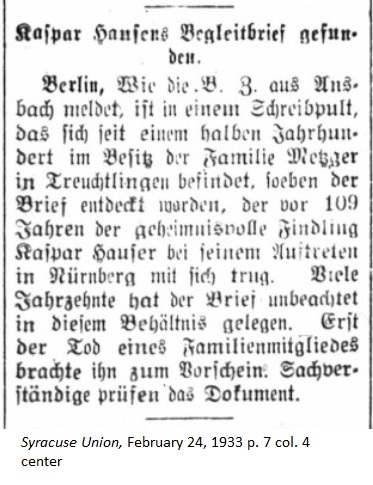
|
February 24, 1933 page 7 |
|
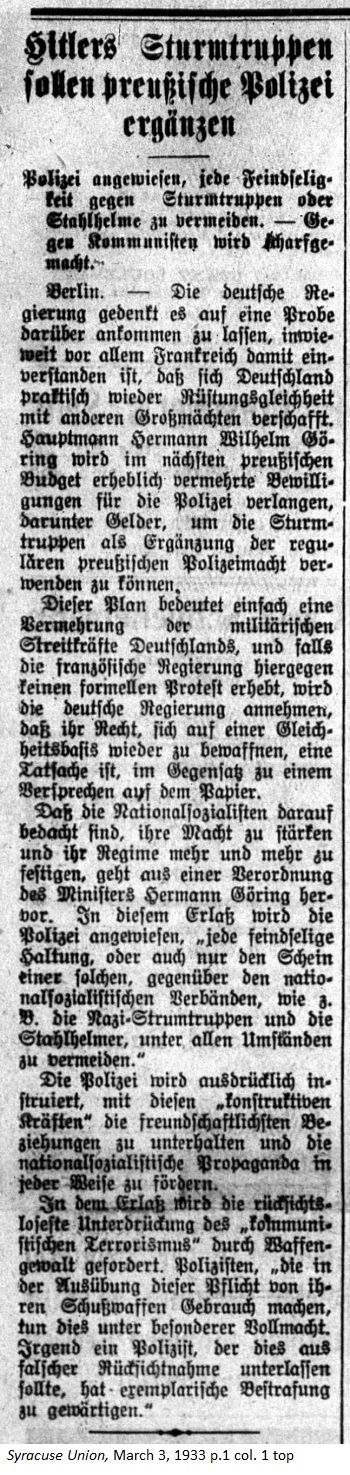
March 3, 1933 page 1 _____ Police instructed to avoid any Hostility against the Storm Troopers and Steel Helmets — Will be trained against Communists. This plan simply means an increase in Germany's military strikeforce and in the event that the French government does not register any formal protest, the German government will assume that it has in fact the right to rearm based on parity, in contrast to a pledge on paper. With an ordinance issued by Minister Herman Göring it follows that the National Socialists intend to strengthen their power and firmly establish their regime. By decree the police will be instructed "in all situations to avoid any hostile conduct, or even the appearance of such, towards the National Socialist groups such as the Nazi Storm Troopers and the Steel Helmets." With this "constructive reinforcement" the police were expressly instructed to maintain the most amicable relationships and to advance the National Socialist Propaganda at every turn. In this decree the most ruthless suppression of "Communist Terrorism" via armed force is authorized. Police "who in the execution of their duty make use of their firearms do so with full authority. Any policeman, who refrains from doing this under false pretense, can expect to be punished as an example to others. |
|
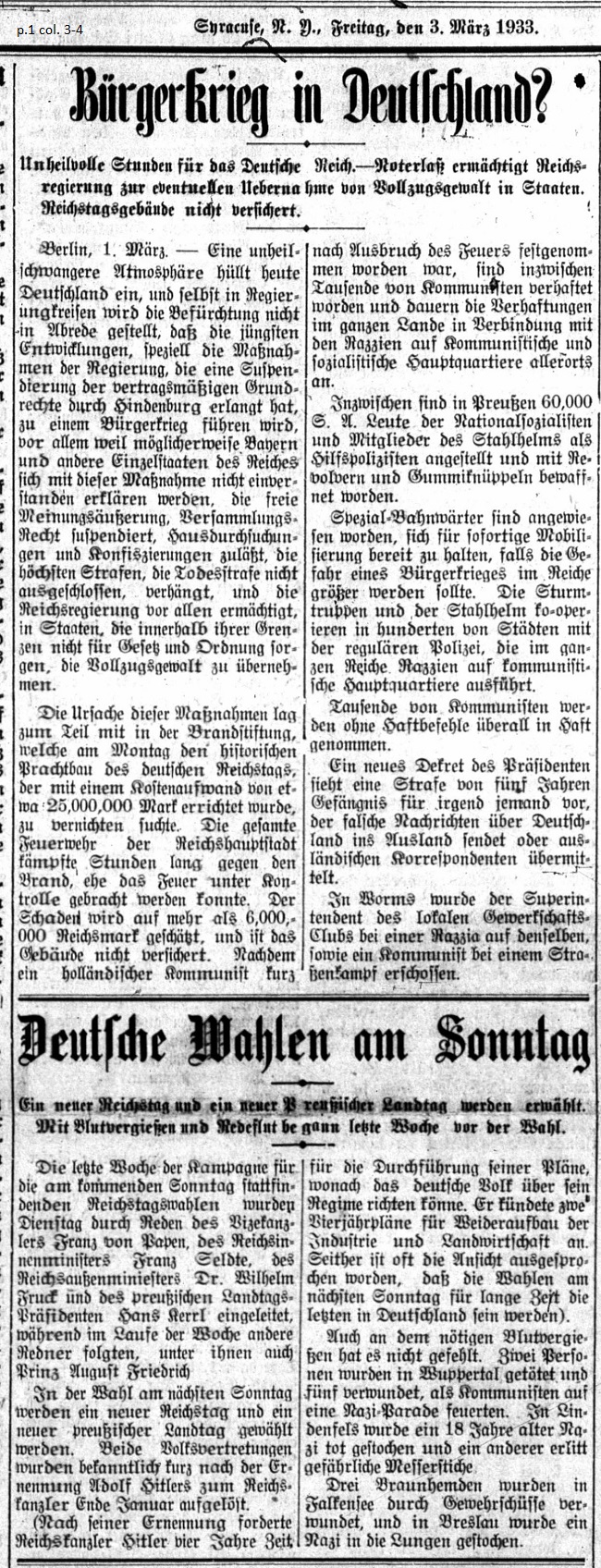
March 3, 1933 page 1 _____ Ominous Hourse for the German Reich — Emergency Ordinance Authorizes Reich Government to eventual Takeover by Executive Power in the States — Reichstag Building not insured. _____ The reason for these measures lies in part with the arson committed on Monday to the historic and magnificent building which houses the German Reichstag, which was constructed at a cost of 25,000,000 Marks. The entire Fire Department of the capital city battled the blaze for many hours before the fire could be contained. Damage is estimated at more than 6,000,000 Marks and the building is not insured. A Dutch Communist was arrested shortly after the outbreak of the fire. In the interval thousands of Communists were arrested and endured imprisonment throughout the nation in connection with raids on Communist and Socialist headquarters. In the meantime 60,000 National Socialist Storm Troopers and members of the Steel Helmets were appointed auxiliary policemen in Prussia and were armed with revolvers and rubber truncheons. Special railway attendants have been instructed to wait in reserve for immediate mobilization in the event that danger arises of a civil war in Germany. Storm Troopers and Steel Helmets are cooperating in hundreds of cities with the regular police, who have carried out raids on Communist headquarters throughout the nation. Thousands of Communists were taken into custody without arrest warrants. A new decree by the President calls for a punishment of five years in prison for anyone who sends false reports about Germany abroad or communicates with foreign correspondents. In Worms the Superintendent of the local trade union club was shot during a raid, as was one Communist during a street fight. _____ A New Reichstag and a New Prussian State Parliament will be elected — The Last Week before the Election began with Bloodshed and Rhetoric _____ Next Sunday's election will select a new Reichstag and a new Prussian State Parliament. Both parliaments were recently dissolved after the appointment of Adolf Hitler as Reich Chancellor at the end of January. (After his appointment Reich Chancellor Hitler requested four years to carry out his plans. Thereafter the German people can judge his regime. He announced two four-year plans for the rebuilding of industry and agriculture. Since that time the opinion has often been expressed that Sunday's election will be the last one in Germany.) And there has been no lack of the necessary bloodshed. Two people were killed in Wuppertal and five wounded as Communists fired into a Nazi parade. In Lindenfels an eighteen year old Nazi was fatally stabbed and another suffered serious knife wounds. Three brownshirts were wounded by rifle fire in Falkensee and in Breslau one Nazi was stabbed in the lungs. |
|
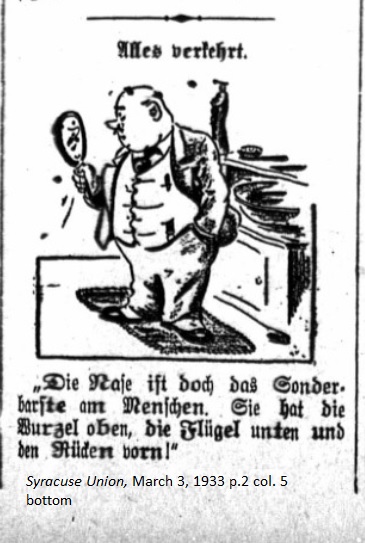
March 3, 1933 page 2 The nose really is the oddest human feature. The root is up above, the wings flare out underneath, and the backside is in the front. |
|
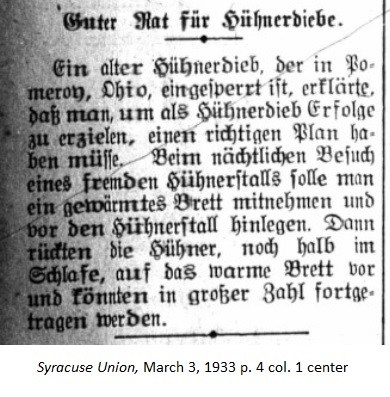
March 3, 1933 page 4 _____ An old chicken thief imprisoned in Pomeroy, Ohio stated that anyone aiming to become a successful chicken snatcher must have a proper plan. During a nightly visit at a unfamiliar chicken coup one should take a warmed wooden plank and place it in front of the coup. While still half asleep, the chickens move towards the warm plank and can be carried off in great numbers. |
|
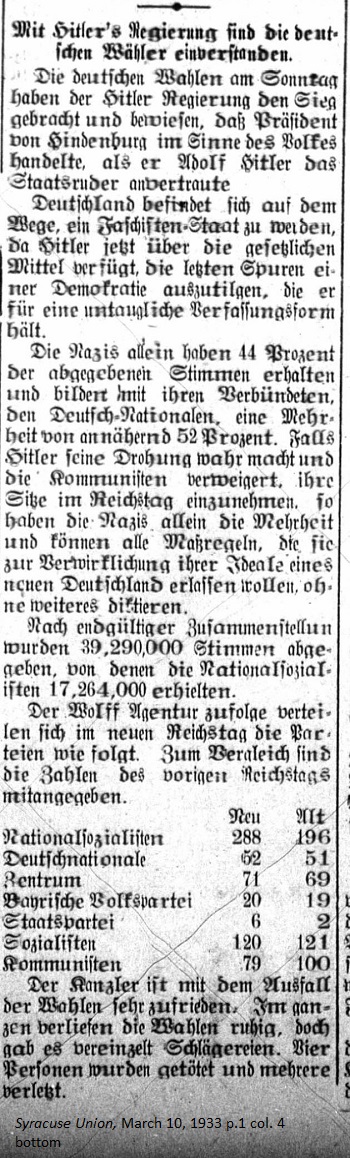
March 10, 1933 page 1 Germany finds itself on the path to becoming a Fascist state since Hitler currently uses legal means to obliterate the last traces of democracy, which he considers an ineffectual form of constitution. The Nazis alone received 44 percent of ballots cast and joining with their allies, the German Nationals, it achieved a majority nearing 52 percent. In the event Hitler stands by his threat and denies the Communists their seats in the Reichstag, then the Nazis alone will have a majority and will be able to dictate any measures they deem appropriate to realize their idea of a new Germany. After the final tally 39,290,000 votes were cast, of which the National Socialists received 17,264,000. The Wolff Agency distributed the parties in the new Reichstag as follows. In comparison the numbers for the prior Reichstag are given.
The Chancellor is very pleased with the results of the election. On the whole the elections ran peacefully but there were a few individual brawls. Four people were killed and many were injured. |
|
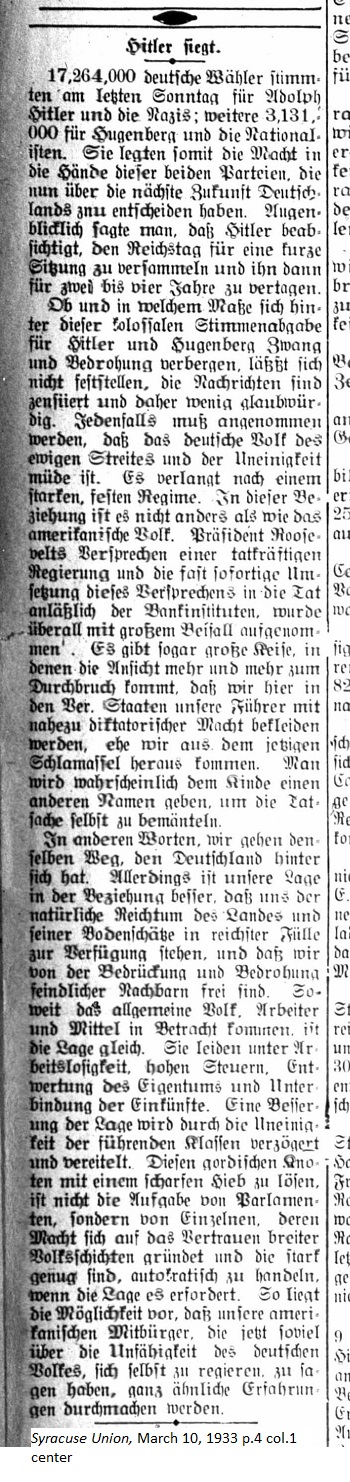
March 10, 1933 page 4 _____ 17,264,000 German voters voted last Sunday for Adolph [sic] Hitler and the Nazis; another 3,131,000 voted for Hugenberg and the Nationalists. Thus they placed the power in the hands of these two parties, which will decide the future of Germany. Immediately people say that Hitler intends to assemble the Reichstag for a brief session and then adjourn Parliament for two to four years. Whether and to what extent coercion and threats lie behind this colossal number of ballots cast for Hitler and Hugenberg can't be determined if the reports have been censored and thus unworthy of belief. It must be assumed that the German people are tired of continuous disputes and disunity. They want a strong, solid regime. In this regard they are no different than the American people. President Roosevelt's promise of an energetic government and the almost immediate action to fulfill this promise in the banking industry was met with approval by all. There are large circles in which opinions run more and more to the conclusion that we here in the United States will invest nearly dictatorial power in our leader before we get out of the current mess we're in. One would probably name the child differently in order to cover up the deed. In other words, we're going down the same path that Germany has already put behind itself. Certainly our circumstances are better. The natural richness of the country and its natural resources stand fully at our disposal and we are free of the suppression and threat of foreign enemies. As far as general populace, the workers and the financial means are concerned, the situation is the same. We suffer under unemployment, high taxes, devaluation of property and declining revenue. An amelioration of the situation will be delayed and thwarted by the disagreements among the ruling classes. Solving this Gordian Knot with the sharp blow of the sword is not the task of Parliament but rather of individuals, whose power is grounded in the trust of a broader social class which is strong enough to handle the aristocrats when the situation demands it. Therein lies the possibility that our American citizens, having so much to say about the German people's inability to govern itself, will be going through similar experiences. |
|
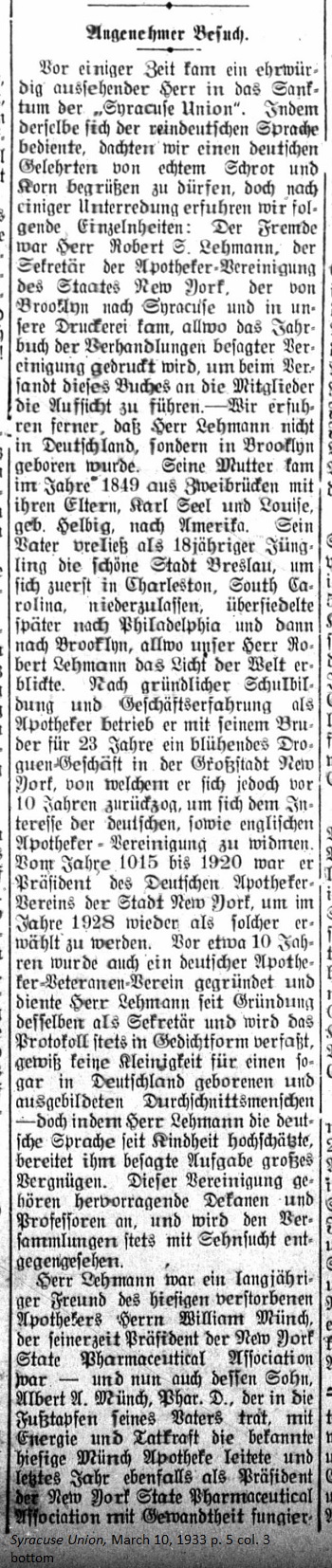
March 10, 1933 page 5 _____ A while ago a respectable looking gentleman came into the sanctum of the Syracuse Union. Since he possessed true skill in the use of the German language, we thought we might be greeting an educated man of true German stock. After a brief conversation we learned the following: The stranger was Mr. Robert S. Lehmann, the secretary of the Pharmacist Society of the State of New York, who came from Brooklyn to our print shop in Syracuse to have the Society's yearbook of proceedings printed. The book would be distributed to its members. We further learned that Mr. Lehmann was not from Germany but born in Brooklyn. His mother came from Zweibrücken to America in 1849 with her parents, Karl Seel and Louise, neé Helbig. As a young man of 18 years his father left the beautiful city of Breslau, settling first in Charleston, South Carolina. Later he moved to Philadelphia and then Brooklyn, where our Mr. Robert Lehmann first saw the light of the world. After receiving a thorough education with business experience as a pharmacist, he and his brother operated a thriving drugstore business for 23 years in New York City, from which he retired 10 years ago in order to dedicate himself to the interests of the German and English-speaking Pharmacy Society, From 1915 to 1920 he was president of the German Pharmacists Association of the State of New York and was reelected to the post again in 1928. Around 10 years ago a German Pharmacist Veterans Association was established and Mr. Lehmann has served as its secretary since its founding. He records the minutes of meetings, no small task even for an average man born and educated in Germany, but since Mr. Lehmann highly esteemed the German language since childhood, this task gave him great satisfaction. Illustrious faculty deans and professors belong to this society and meetings are always inspiring. Mr. Lehmann was a longtime friend of the local pharmacist, the late William Münch, who was in his day president of the New York State Pharmacuetical Association — and now his son, Pharm. D. Albert A. Münch, following in his father's footsteps, is actively managing the well known, local Münch Pharmacy. Last year he skillfully functioned as president of the New York State Pharmaceutical Association together with the owner of the pharmacy known under the name "Powers Drug Co., namely Philip R. Heldmann and several other local pharmacists. |
|
March 17, 1933 page 1 _____ Even at the beginning of the last century many South German Catholics emigrated to Transylvania. For the most part they have disappeared due to their joining German Protestant denominations. These Catholics had only two choices, either stay with the German community and join a Protestant sect or move to a Magyar community to retain their faith. In Munkac, Swabia a large number fell into Orthodoxism because they were too far from a German pastor. It's now impossible to win them back. In Bessarabia German settlements containing around 70,000 people are almost all Protestants now. A large portion of them were originally Catholics from Bavarian Swabia. The decline came during the last century because there were no German priest in the region. Things are especially bad in Yugoslavia where no fewer than 550,000 German Catholics for the most part live scattered among the Islamic, Orthodox, and Evangelical Christian sects. The Boniface Association wants to navigate through such peril. Its founding was proclaimed in a German announcement in Paderborn on Sunday, Decembe 11th. According to Prelate Schäfer the association "will commit itself to the religious needs of Germans scattered abroad during the diaspora. It will enable the spiritual work of German clerics in the threatened German foreign regions and establish Catholic schools." Dr. Scherer, representative of the Reich Association for German Catholics Living Abroad, expressed the intentions of the founders of the Boniface Association as follows: "We do not want Germans to lose their German identity because they are Catholic. But we also do not want Catholics, because they are German, to lose their faith." Nazi Victory encourages Annexation Movement _____ "Adolf Hitler, Our Chancellor" shout Enthusiastic Austrians Vienna. — The annexation movement between Germany and Austria recently received new fuel as the Hitlerites held mass assemblies throughout the country in celebration of the victory of the former Austrian citizen, Reichs Chancellor Adolf Hitler. Meanwhile the question has been raised whether the parliamentarian system of government has been completely eliminated. The officials, who have the right to call for a session in Parliament, have resigned after a stormy session over the handling of tbe railroad workers. The semi-official Reichspost writes that Parliament may have "abolished itself." Even President Miklas cannot call Parliament into session. Nazi leader Alfred Frauenfeld launched a sharp attack on the opposition parties, stating that they were avoiding a new election and he threatened that his movement would sieze power by force if a new election is not held. "Our Chancellor is not Engelbert Dollfuss; our Chancellor is Adolf Hitler," he shouted to the 20,000 assembled Nazis. "One people and one nation" was the motto at the assembly. Warsaw. — The Central Association of Polish Jews, 3,500,000 strong, called for a boycott on German goods in protest against Jewish persecution in Germany and appealed to Jews around the world to join them and do the same. Black, White and Red Flags flying from Many Townhalls _____ Hamburg a Dangerous Place due to Bloody Conflicts between Communists and Nazis — Three Americans complain about Mistreatment by the Stormtroopers Nathaniel Wolff of Rochester, N.Y. reports that the policemen hit him and then took him to a residence where he was held prisoner until a Nazi leader appeared and ordered his release. Previously a man forced him to sign a document exonerating the Nazis of any wrongdoing and obliging him to leave the German country as a Jew and never to return. He set off for Paris. Henry Sattler, New York and Edwin Dakin of Hannibal, Mo. reported that Nazis broke into their residences and accused them of anti-Nazi sentiments. A huge black, white and red flag, the old colors of the German Kaiser, is flying on the tower of the Berlin City Hall in the center of the city. The flag is visible from afar. The Swastika flag of the National Socialists and the earlier imperial black, white and red colors are flying in various cities on their town halls, including Emden, Mannheim and Freiburg. In Osnabruck the seven flags of the "Iron Front" and Soviet flags are raised at the headquarters of the Communists and Socialists and publically burned in the marketplace. Hamburg is currently a dangerous place in the nation since the Nazi coup has led to constant conflicts between police and Communists. The Hamburg Police announced that in street fights taking place in the worker's district of Altona, four people were killed and eleven others wounded, among them four policemen. The unrest began when "Brownshirts" hoisted their swastika onto the town hall and members of the Hitler Party and police exchanged gunfire. Nazi Press crusades against the Jews _____ Supposedly to blame for Capitalism and Communism Berlin. — The Nazi Press is exhibiting more antisemitic tirades than ever before. In official circles it's intimated that the government is not contemplating any antisemitic measures. One factor in the situation might be the German National members of the Cabinet, which allegedly condemns any form of antisemitism. The leaders of the Central Association of German Citizens of Jewish Faith are fearful of the suppression of their organization in Thuringia. The association was established in 1893. "Fidelity to German and Jewish things is inseparable," a representative of the organization stated. "Whenever we gave information to foreigners it happened in accordance with Germany's wish to raise its reputation in the eyes of the world and never in a derogatory manner." Here is an article from the Berlin newspaper Angriff typical for the campaign of the Nazi Press: "Our hatred of Jews is no passing fancy but the logical conclusion of our love for the German people. The Jews brought international Capitalism which brazenly placed the chains of slavery on Germany, and the Jews also brought us Marxism. The Germans waged a gigantic war against Marxism and especially Communism, the intellectual crime of the Jew Marx." |
|
March 17, 1933 page 4 _____ The Republican colors black, red, and gold as the emblem for the German nation have again been abolished and by decree of President von Hindenburg, Germany's national flag will return to the colors black, white, and red. Additionally, and simultaneously, the swastika banner will be hoisted on public buildings. Sunday was Germany's Memorial Day for those who had fallen during the World War and church bells rang throughout the land. Along with church celebrations numerous military events took place, which commemorated the days of the pre-war era. In Hitler's speech, which announced the reinstatement of the old Reich colors and the official recognition of the Swastika banner, the Reich Chancellor admonished his followers to observe "strict and blind obedience" and avoid all actions which could damage the government. "From now on we are responsible for the nation," the Chancellor stated. "The huge work of reonstruction of the German nation must move forward, organized from the government on down." "Our victory has been so overwhelming that we do not need to exercise petty acts of vengence. It is our task to work in the interest of the people and especially to reestablish the feeling of absolute security in business. "Only if our enemies commit violent acts, will you be instructed to ruthlessly overcome resistance." |
|
March 24, 1933 page 1 _____ Enthusiasm throughout the Nation — Hindenburg and Hitler's Appeal In the Potsdam Garrison Chapel broadcasted via Radio throughout the Land _____ Berlin. — Among announcements which have no precedence in German history, the opening of the first National Socialist controlled Reichstag took place, initiated by a stirring appeal by Hindenburg from the Garrison Chapel calling on the nation to cooperate because the last election gave a constitutional majority to the Cabinet and Chancellor Hitler. Hitler followed, alluding to the National Socialist surge as "reestablishment of Germany's national honor." The speech was received with overwhelming jubilation throughout the land, where it was broadcast via radio. Former Crown Prince Friedrich Wilhelm, members of the Cabinet, and the Reichstag officials were witnesses to the great historic event, which called back memories of the days of the Kaiser's empire especially since Hindenburg appeared in his Field Marshal's uniform and the Crown Prince in the unform of the Black Husars. He and wartime veterans from 1864, 1866,and 1870 were seated in places of honor in the Garrison Chapel. The Crown Prince sat in the old Kaiser's Loge. After Hitler finished, the crowd of people assembled in front of the Chapel sang "Deutschland, Deutschland über alles." A church service was also performed in the Potsdam Cathedral before the Reichstag opened, which Hitler, who is Catholic, did not attended. One of his Propaganda Chiefs gave this explanation: "The Catholic bishops recently denounced the Nazis and the Catholic Church has denied them Holy Communion. These measures were never rescinded, therefore we are in no position to attend Mass." Understandably all of Germany is parading about with black, white, and red flags and swastika banners. Hindenburg and Hitler received powerful ovations whenever they were seen by the crowd. |
|
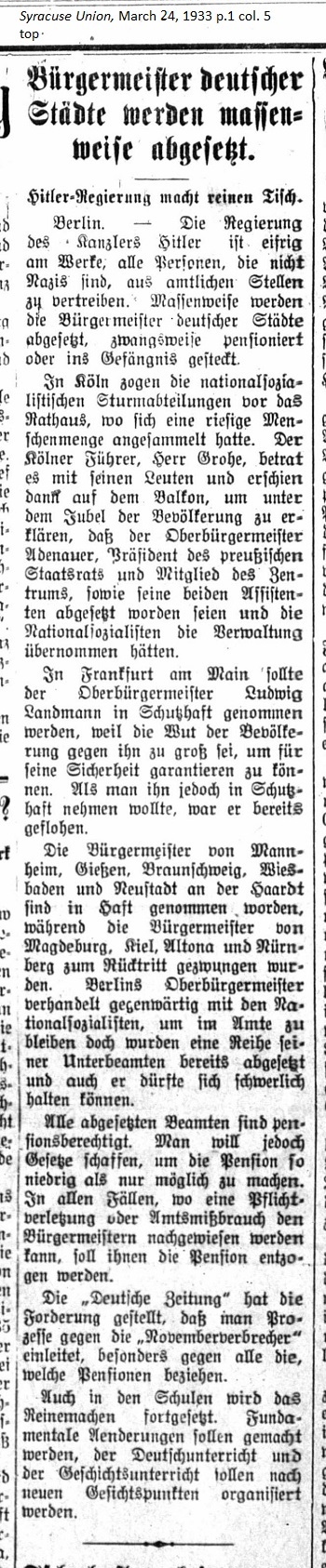
March 24, 1933 page 1 _____ Hitler Government Clears the Table In Cologne the National Socialist Division of Storm Troopers moved to the front of the City Hall where a huge crowd of people had assembled. The Cologne leader, Mr. Grohe, entered the building with his people and then appeared on the balcony in order to announce to the cheering crowd that Executive Mayor Adenauer, President of the Prussian State Council and member of the Central Party along with both of his assistants had been fired and that the Nationl Socialists had taken over the administration. In Frankfurt am Main Executive Mayor Ludwig Landmann was supposedly placed in protective custody because the rage of the people against him was so great that it was necessary to guarantee his safety. He had already fled before he could be taken into custody. The mayors of Mannheim, Giessen, Braunschweig, Wiesbaden, and Neustadt on the Haardt were taken to prison while the mayors of Magdeburg, Kiel, Altona, and Nuremburg were forced to retire. Berlin's Executive Mayor is currently dealing with the National Socialists to stay in office but many of his subordinates have already been fired and even he may find it difficult to retain his post. All the ousted officials are eligible for pensions. Laws will have to be made to make these pensions as small as possible. In all cases where dereliction of duty or abuse of office can be proven, their pensions will be taken away. The Deutsche Zeitung (German Newspaper) has demanded that trials be conducted against the "November Outlaws," especially against all those who draw pensions. Even in the schools measures to clean house have been initiated. Fundamental changes shall be made whereby German instruction and the teaching of history shall be organized in accordance with a new perspective. |
|
March 24, 1933 page 3 _____ |
|
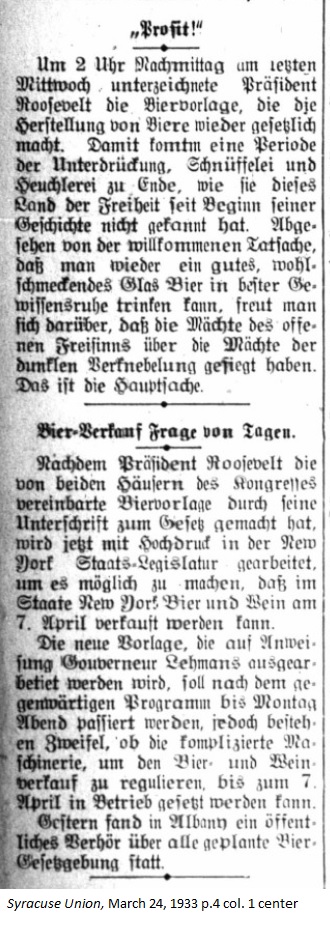
March 24, 1933 page 4 _____ At 2 PM last Wednesday President Roosevelt signed the Beer Bill, which makes the manufacture of beer legal again. Thus comes the era of oppression, snooping and hypocrisy, unknown in any other era in the history of this land of the free, to an end. Besides the fact that one can again have a good tasting glass of beer in good conscience, one can also rejoice that the powers of public liberalism have triumphed over the powers of dark obfuscation. This is the main issue. Beer Sale Question of the Day _____ Since President Roosevelt signed the bill submitted by both Houses of Congress, which made beer legal again, now the New York State Legislature will have to work at top speed to make it possible to sell beer and wine by April 7th. The new bill, which will be drawn up under Governor Lehmann's directive, is scheduled to be passed Monday evening, however there are doubts as to whether the complicated mchinery to regulate the sale of wine and beer can be set in operation by April 7th. In Albany yesterday a public hearing concerning all planned beer legislation took place. |
|
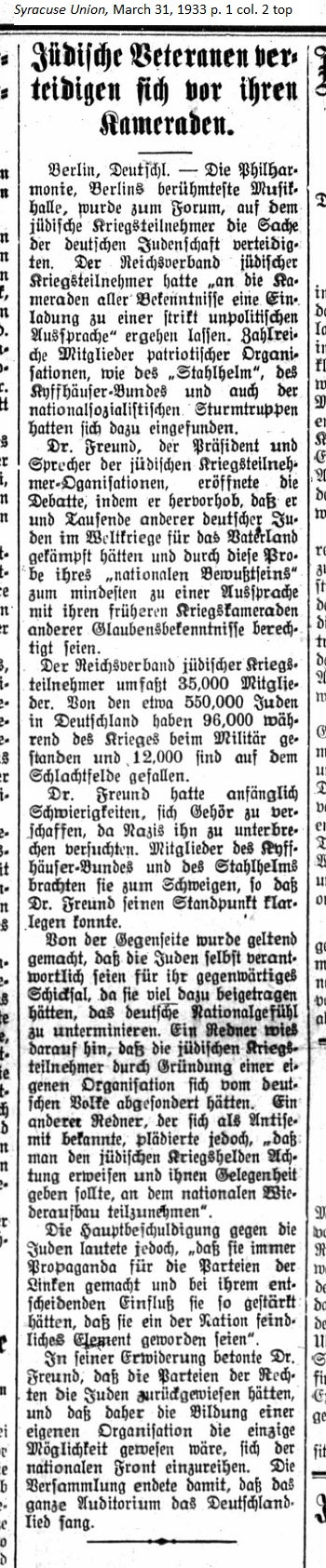
March 31, 1933 page 1 _____ Berlin, Germany. — The Philharmonia, Berlin's most famous music hall, became the forum for Jewish war participants to defend the issues of German Judaism. The Reich Association of Jewish War Participants submitted "an invitation to the comrades of all denominations for a strictly unpolitical discussion." Numerous members of patriotic organizations, such as the Steel Helmets , the Kyffhäuser Bund, and even the National Socialist Stormtroopers attended. Dr. Freund, President and speaker for the Jewish War Participants Organization, opened the debate in which he raised the issue that he and thousands of other German Jews would have fought in the World War for the fatherland and through this probe into their "national conscience" they are entitled to a discussion with their former war comrades of other faiths. The Reich Assocaition of Jewish War Participants is comprised of 35,000 members. Of the approximate 550,000 Jews in Germany 96,000 served in the military during the War and 12,000 died on the battlefield. Initially Dr. Freund had difficulty getting people's attention because the Nazis attempted to interrupt him. Members of the Kyffhäuser Bund and the Steel Helments quieted them down so that Dr. Freund could make his position clear. The opposing side stated that the Jews themselves might be responsible for their current predicament since they might have contributed much to undermine the German sense of national identity. One speaker indicated that Jewish war participants had separated themselves from the German people by establishing their own organization. Another speaker, known to be an antisemite, argued "that one should watch the Jewish war heroes and give them the opportunity to participate in the nation's rebuilding." The main accusation against the Jews was "that they always created propaganda for the left-wing parties and in using their influence had grown so strong that they had become the most hostile element in the nation." In his response Dr. Freund emphasized that the right-wing parties might have dismissed the Jews and that the building of their own organization might have been the only possible means of joining the ranks of the national front. The meeting ended as the entire auditorium sang the Germany song. |
|
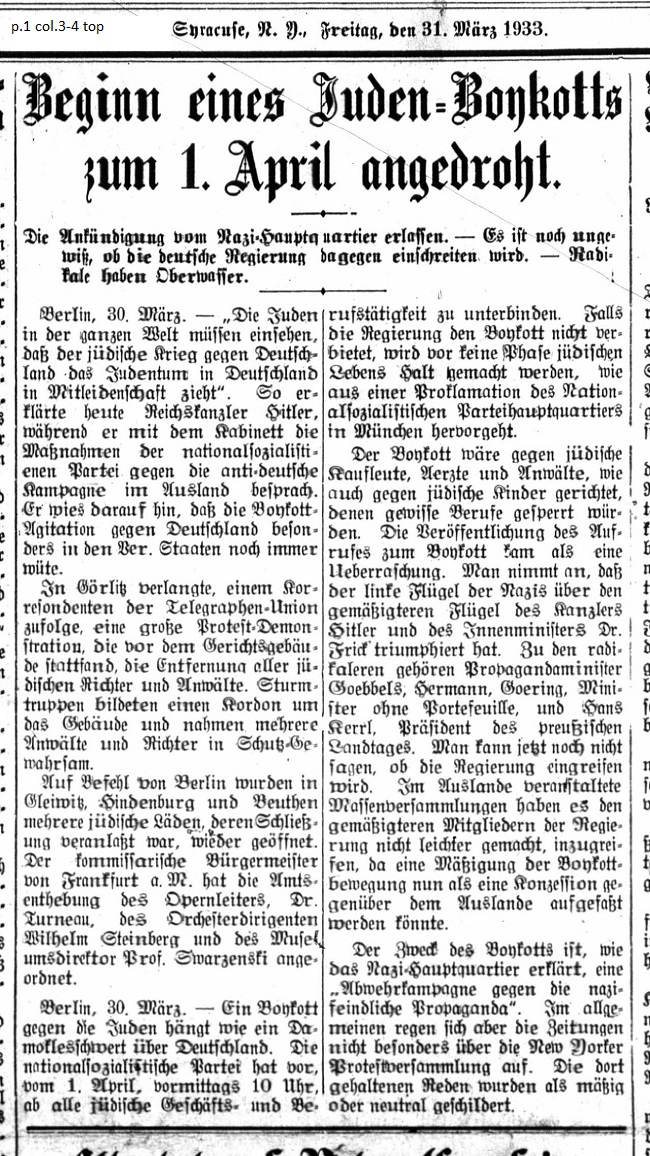
_____ The Announcement issued by Nazi Headquarters — It's uncertain if the German Government will intervene against it — Radicals have the Upper Hand _____ Berlin, March 30th. — "Jews throughout the world must realize that a Jewish war against Germany has a deterimental effect on the Jewish community in Germany." So declared Reich Chancellor Hitler today as he discussed with his cabinet the measures to be taken by the National Socialist Party against the anti-German campaign abroad. He indicated that boycott-agitation against Germany is always especially rampant in the United States. According to a correspondent of the Telegraph Union, in Görlitz a large protest demonstration was held in front of the courthouse which demanded the removal of all Jewish judges and lawyers. Storm Troopers formed a cordon around the building and took many lawyers and judges into protective custody. By orders from Berlin in Gleiwitz, Hindenburg and Beuthen many Jewish shops, which were closed, were reopened. The acting mayor of Frankfurt a. M. ordered the dismissal of the Opera Director, Dr. Turneau; the Orchestra Director, Wilhelm Steinburg; and the Museum Director, Prof. Swarzenski. Berlin, March 30th. — A boycott against the Jews hangs like a Sword of Damocles above Germany. The National Socialist Party intends to halt all Jewish businesses and workers on April 1st from 10 AM onward. In the event the government does not forbid the boycott, no halt will be made to any phase of Jewish life, according to the proclamation of the National Socialist Headquarters issued in Munich. The boycott would be directed against Jewish merchants, physicians and lawyers as well as against Jewish children, certain of whose jobs would be spared. The announcement calling for the boycott came as a surprise. One assumes that the left wing of the Nazis have triumphed over the moderate wings of Chancellor Hitler and Interior Minister Dr. Frick. Among the radical factions are Propaganda Minister Dr. Goebbels, Minister at Large Hermann Göring, and Hans Kerrl, President of the Prussian Parliament. One cannot say if the government will intervene. Mass gatherings organized abroad have not made things easiers for moderate members of the government since a tempering of the boycott can only be viewed as a concession to foreign pressure. The purpose of the boycott is, as explained by Nazi Headquarters, a "resistance campaign aimed at Nazi hostile propaganda." However in general the newspapers are not upset over the New York protest assembly. Speeches held there were described as moderate or neutral. |
|
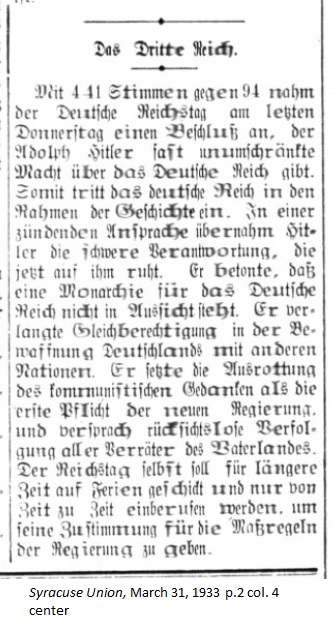
March 31, 1933 page 2 _____ With 441 votes to 94 last Thursday the German Reichstag made a decision which gives Adolph [sic] Hitler almost unconditional power over the German Reich. Thus the German Empire goes down in the annals of history. In a rousing address Hitler took over the difficult responsibility which had been rested upon him. He stressed that a monarchy is not in sight for Germany, He demanded equal rights in arming Germany with other nations. He placed the eradication of Communist ideology as the first duty of the new government and promised ruthless prosecution of all traitors to the fatherland. The Reichtag shall be sent off on holiday for a long period of time and only called back from time to time to give approval for the measures taken by the government. |
|
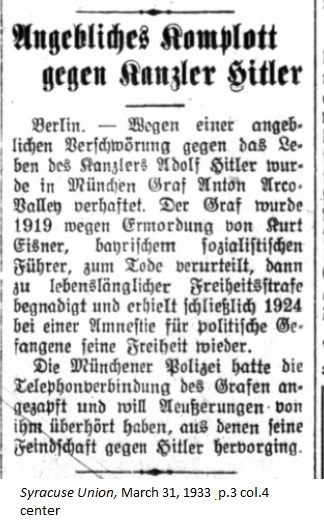
March 31, 1933 page 3 _____ Berlin. — Due to an alleged conspiracy against the life of Chancellor Adolf Hitler, Count Anton Arco-Valley was arrested in Munich. The Count was condemned to death for the 1919 murder of Kurt Eisner, Bavarian Socialist leader, then granted clemency and sentenced to life imprisonment. In 1924 he was finally set free under an amnesty for political prisoners. The Munich Police tapped the Count's telephone connection and overheard conversations by the Count regarding his hostility towards Hitler. |

|
March 31, 1933 page 4 _____ The coming months will prove whether the distortion of thr real facts in the so-called persecution of Jews in Germany has brought more harm than good to German Jews. Without examining the outrageous lies closer, which in this case are not just being spread here but around the entire world, it's right to ask the question of whether their broadcasting was or was not a tactical error. Hitler's Party has claimed that a large portion of the Jewish community is internationally and solidly connected. The world has now delivered proof that the claim is correct. This was grist for the Nazi mill and scarcely contributes anything to change their resolution of driving the Jewish people of Germany out of numerous top-ranking positions they currently occupy. This in no way involves antisemitic persecution in the religious sense. Nonetheless it does and remains undemocratic, intolerant, and in direct opposition to the American concept of equality and liberty for all. _____ Hitler Strikes Back _____ The reports on the alleged persecution of Jews in Germany multiply day by day. First the propaganda wave here, then the proof of falsehood there; then inciting economic boycott abroad, followed by the Nazi government's boycott declaration against the Jews in Germany. The last action may be explained in light of the Nazi state of mind, which sees in their political agenda the saving of Germany from slavish oppression when a skilled diplomatic chess move was not certain. In contrast, the prescribed sanctions for boycott of Jewish doctors, lawyers, and business houses, as well as the limitation of study options among Jewish children will certainly be used by numerous opponents of Germany abroad as new proof for the continuation of propaganda. The measures also don't correspond with fundamental principles of tolerance and freedom of action which have existed in German life for decades. Protest Assembly was quite tame _____ The protest assembly in New York against alleged Jewish persecution in Germany, announced with great screams and loud fanfare, proceeded quite tamely. The visit met expectations and the majority of the planned speakers showed up, but the proper momentum was not achieved. It got lost as official data established that the reports concerning Jewish persecution were strongly exaggerated. Thus one had to limit the accusations to actual facts, which indcate that the Jewish community in Germany will have to endure certain restrictions in the future. The majority of speakers at the protest assembly extolled high praise on the German people and emphasized that the protest was not directed against them. Al Smith spoke freely and openly that they did not know what it actually dealt with; it was a protest in general against any form of oppression in personal freedom. Governor Lehmann was held back by pressing government business and could not attend the assembly. Hitler's name was hissed every time a speaker mentioned it. |